TL;DR
- Engineered quartz is the easiest stone for a new fabrication shop to start with.
- It cuts the same from one slab to the next, has no grain to respect, and forgives a slightly wrong blade speed without shattering.
- Granite is a close second if you want natural stone from day one.
- Marble and quartzite punish mistakes with visible damage.
Why does stone choice matter so much for a new fabrication shop?
Your first six months are about learning the machine, not fighting the material. Every stone has its own hardness, grain behavior, porosity, and way of failing. Pick the wrong one and your margin walks out the door on broken slabs, burnt blades, and callbacks for chipped edges.
The Mohs hardness scale runs from 1 (talc) to 10 (diamond). Most countertop stones land between 3 and 7. That gap sounds small. It isn't. It changes blade wear, feed rate, and how much a new operator can get away with while still dialing in the CNC. [1]
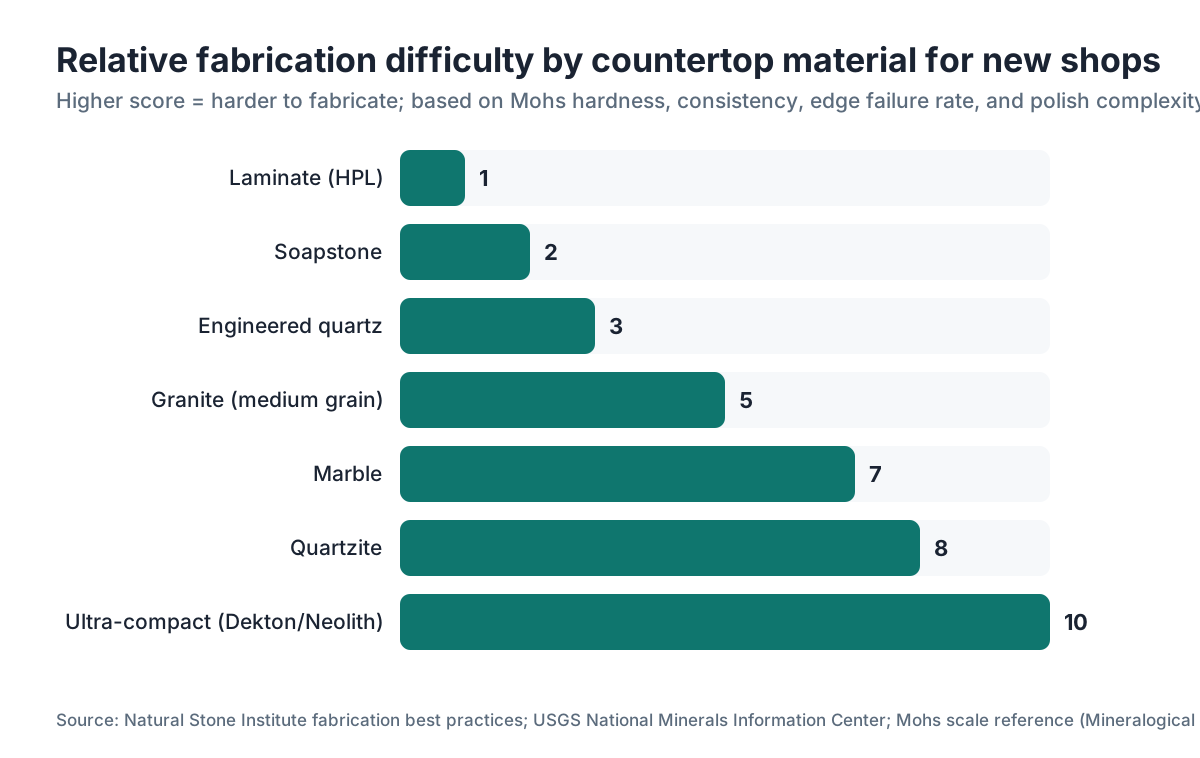
Four things decide how hard a stone is to fabricate: hardness, consistency (engineered versus natural), thickness variation across the slab, and how the edges behave when you profile them. A beginner shop needs all four to be as predictable as possible, because you're calibrating equipment and training people at the same time you're trying to turn a profit on real jobs.
What is the easiest stone to fabricate for a beginner shop?
Engineered quartz is the easiest countertop stone to fabricate in a new shop. Full stop.
Manufactured quartz (Silestone, Caesarstone, Cambria, MSI Q) is roughly 93 percent ground quartz bound in polymer resin. [2] That binder is the whole point. It gives the slab the same hardness and density from one end to the other, with none of the voids, fissures, or hard pockets you find in natural stone. The feed rate that works on one Caesarstone slab works on the next slab in the same series. When you're still learning, that repeatability is worth real money.
Quartz scores about 7 on Mohs, hard enough to last but still clean-cutting with a standard segmented diamond blade at the right RPM and water flow. [1] Edges profile the way you expect. Polished finishes come off the machine looking done, not ragged.
The catch: quartz is heavy, around 18 to 20 lbs per square foot at 3 cm, [3] and some lighter colors show machining marks if your polishing pad sequence is sloppy. Those are process problems you can solve. They're nothing like a chunk breaking out of a mitered marble edge on the last pass.
For a homeowner reading this: Cambria countertops show what premium engineered quartz looks like finished and installed.
How does granite compare to quartz for beginner fabricators?
Granite is the classic first natural stone for a new shop, and it's a fair choice if you want to sell real stone from the start. Hardness runs 6 to 7 on Mohs depending on the mineral mix. [1]
The headache is inconsistency, slab to slab and even inside one slab. Some granites carry veins of soft feldspar cutting through harder quartz zones, so your blade fights changing resistance the whole way across. A green operator may not catch the moment a feed rate that works on 80 percent of the slab is too hot for the rest.
Fissures are the other trap. Natural granite often has hairline fissures the factory fills with resin or epoxy. Pass the saw too close to one and the slab can crack during machining, or later during templating and transport. Old hands spot them and route around. Beginners run right through them.
Granite is forgiving on edges, though. It chips, but not dramatically. Ogee and eased profiles come off most CNC edge routers looking good without much hand finishing. And the work is there: granite is still one of the most requested materials in residential kitchens. [4]
Run your first six jobs on granite and you'll learn fast. Budget a broken slab or two as tuition. Our granite countertops guide covers the material in more detail.
Is marble too hard for a beginner shop to fabricate?
Marble is the material most beginner shops should leave alone until they have a year under their belt. That's an opinion, and I mean it as one.
Marble is calcium carbonate, so it's soft (Mohs 3 to 4) but prone to chipping along its veins. [1] The softness sounds like an advantage, and it is, right up until your saw hits a vein running across the cut and a piece pops off a detail edge. A client who spent $8,000 on Calacatta does not want a call about a chipped ogee.
Polishing marble to a mirror is its own skill. The pads and compounds differ from quartz, and the margin for error is thinner because marble shows a scratch or a haze the second the light hits it.
High material cost and high client expectations, arriving together, on a process you haven't locked in yet. That's the worst mix for a young shop. Get confident on quartz and granite first. Marble becomes a good, profitable next step once you have the reps. Just not first.
For cleaning guidance you can hand to clients, our how to clean stone countertops article covers marble alongside other materials.
What about quartzite, soapstone, and other natural stones?
Quartzite is sandstone metamorphosed under heat and pressure until it's mostly quartz. It's beautiful, it photographs like marble, and it's genuinely harder than granite, often 7 to 7.5 on Mohs. [1] That hardness eats blades faster, and the stone is brittle in a way that punishes an aggressive feed rate. Quartzite is not a beginner stone.
Soapstone sits at the other end, around Mohs 1 to 2. [5] You can scratch it with a fingernail. Easy to cut, yes, but edges dent, tools leave marks, and you need a light touch on the CNC. The market is small (specialty kitchens, science lab tops), too small to build a first year around. The how to clean soapstone countertops guide shows how differently this material behaves in service.
Travertine and limestone act like marble: soft, vein-heavy, high expectations. Skip them early.
Dolomite and ultra-compact surfaces (Dekton, Neolith) are their own category. Ultra-compact is extremely hard (Mohs 8 and up), needs diamond-only tooling, and demands precise water cooling. Experienced shops charge a premium for it and earn it. A new shop should not be cutting Dekton on a machine it's still calibrating.
How does laminate compare as a starting material for new shops?
Laminate (Formica, Wilsonart, and the rest) isn't stone, but it belongs in this conversation because some shops start on it exactly because it forgives everything. You cut it with a router, a band saw, or a circular saw with the right blade. No waterjet, no CNC grinding, no diamond tooling. [6]
The trouble with building a shop on laminate is thin margins and almost no skill transfer to stone. Cutting Formica teaches you nothing about running a wet saw or a CNC bridge saw. If the goal is a stone shop, start on stone.
Now, if you already run a laminate operation and you're adding stone as a new service, easing in makes sense. Start with quartz on the stone side. Keep laminate as your volume product while you learn. Our laminate countertops and formica countertops guides cover that side of the business.
Butcher block countertops and Corian countertops sit in the same bucket: non-stone materials you fabricate with woodworking or basic router tools. They can be profitable add-ons once your stone line is running. They just won't prepare you for stone.
What equipment does a beginner shop need to fabricate quartz and granite?
The workable minimum for quartz and granite is a bridge saw, a CNC router or edge polisher, lifting gear, and a sink cutout setup. None of it is cheap. A used CNC bridge saw in decent shape runs $30,000 to $80,000. A new one runs $80,000 to $250,000 or more depending on the maker and what it can do. [7]
Plenty of first shops skip the full 5-axis CNC and start with a manual bridge saw plus a CNC edge polisher. Lower startup cost, shorter learning curve on the machine side. You cut on the bridge saw, template by hand, and run edges on the polisher. Slower, but the ways it can go wrong are gentler.
Blade choice matters more than most beginners think. A segmented continuous rim diamond blade built for quartz won't last on quartzite. Manufacturers publish a material rating for every blade, and matching the blade to the stone is the single most cost-effective habit you can build in year one. Budget $150 to $400 per blade depending on diameter and quality. [8]
Water flow matters just as much. Both quartz and granite need steady water at the blade to prevent heat fractures and flush debris. Skimpy water is one of the top causes of chipping and dead blades for new operators.
What are the typical waste rates for different stones in a new shop?
Waste rate, the share of a slab that gets cut away or broken during fabrication, hits your margin directly. In an experienced shop, granite and quartz waste runs 15 to 30 percent of the slab, mostly from cut geometry and layout. [9] In a new shop, add another 5 to 15 percent on top for learning errors: mis-cuts, chipped edges, a sink cutout measured wrong.
Quartz loses less to catastrophe than marble. Mis-cut a quartz piece and you usually get a scrap and a recut, not a shattered slab. Granite cracks at fissures now and then but generally survives a recut pass.
Nesting, the art of laying out cuts to waste as little as possible, is where software starts paying for itself. Nesting a complex kitchen by hand on a 120 x 63 inch slab versus a tool-assisted layout can be the difference between one slab and two. SlabWise's nesting tool exists for exactly this: new shops over-order by one slab per job until they get disciplined, and that habit is expensive.
For homeowners, waste rate is why your fabricator quotes the job, not your bare measured square footage. Kitchen countertops pricing always folds in a waste factor.
What fabrication skills transfer from one stone to another?
This is one of the smartest questions to ask before you pick a starting material. Some skills carry over completely. Some don't.
Templating transfers almost fully. Quartz, granite, or marble, the discipline is the same: measure accurately, account for out-of-square walls, mark sink locations right. Get very good at this first and every stone you add later benefits day one. Countertop installation accuracy starts at the template.
CNC programming fundamentals carry across too, but feed rates and water settings need re-dialing for each stone. A quartz profile that takes 4 passes at a given speed may need 6 on quartzite.
Polishing pad sequences do not transfer cleanly. Quartz wants a specific resin-bond pad progression. Granite uses a different grit sequence. Marble needs lighter pressure and different compounds. Each material has its own finish-quality curve.
Safety transfers entirely. Silica dust protection is non-negotiable on every stone. OSHA's construction standard (29 CFR 1926.1153) and the general industry standard (29 CFR 1910.1053) both require engineering controls and respiratory protection when you cut stone. [10] The general industry standard requires the employer to "establish and implement a written exposure control plan" once workers may be exposed above the action level of 25 micrograms per cubic meter as an 8-hour TWA.
How should a beginner shop price jobs on easy-to-fabricate stones?
Pricing is where new shops make their most expensive mistake, and the mistake almost always runs one direction: too cheap.
For quartz, the national average installed price in 2024 ran roughly $60 to $150 per square foot depending on brand, edge profile, and region. [4] Fabrication labor alone (material aside) typically runs $15 to $35 per square foot in a mid-cost market, though that swings hard by region and overhead.
A real break-even for a new shop includes: blade wear (higher per job in year one because you're still dialing in technique), water treatment if local code requires it, template labor time (new shops underestimate this by 30 to 50 percent on their first dozen jobs), and callbacks. Budget callbacks at 5 to 8 percent of job revenue your first year. Seasoned shops run 1 to 2 percent.
Don't race to the bottom on quartz just because you're new. Clients shopping on price alone are not the clients you want early. What you're building is a portfolio of clean work, which means taking jobs with enough margin to do them right, even when that means re-cutting one piece.
For fabricators building a quoting workflow, software that tracks material cost, blade cost per linear foot, and labor time by edge type beats a spreadsheet by a mile. SlabWise was built to automate that exact math.
What should a new shop's first material inventory look like?
Start narrow. Three to five quartz SKUs in the colors your local market actually buys: a white, a gray, a beige, maybe one dramatic veined option. Don't buy a dozen slabs across six materials on a hunch that variety sells. Slabs parked in the yard are cash you can't spend.
Granite makes sense as a second stock material, especially medium-grain blacks and browns that work easily and sell steadily. Check what your local distributors keep in stock so you're not sitting three weeks on a reorder in the middle of a job.
Build a relationship with one or two slab distributors before you open, not after. Ask what moves in your market. They watch dozens of shops' ordering patterns and can tell you what actually sells versus what just looks good in a showroom.
Hold off on marble, quartzite, and ultra-compact surfaces until you've machined a sample piece and it went fine. Most distributors will sell you a remnant or a partial slab to practice on before you commit to full inventory.
Frequently asked questions
Can a beginner shop fabricate marble if they go slowly?
Going slowly helps but doesn't erase the risk. Marble's calcium carbonate structure chips along veins no matter the feed rate, and a mirror finish takes a pad sequence and compound selection that only comes with practice. Most fabricators recommend 6 to 12 months of quartz and granite work before taking marble jobs where a client has spent $6,000 or more on material alone.
What is the hardest stone to fabricate?
Ultra-compact surfaces like Dekton and Neolith are the hardest, with hardness above Mohs 8. They need diamond-only tooling, precise water cooling, and specific CNC parameters, and a mistake often means a shattered slab with no recovery. Quartzite (Mohs 7 to 7.5) is the hardest natural stone commonly used for counters and is also brutal for beginners. Neither belongs in a new shop's first year.
How long does it take to learn to fabricate quartz competently?
Most fabricators reach consistent quality on quartz edge profiles and sink cutouts within 3 to 6 months of regular production work. Templating accuracy comes faster, around 4 to 8 weeks. Polishing takes longest because a bad finish often hides until the piece sits in natural light. Expect about 6 months before you're confident on complex shapes and waterjet inlays.
Is engineered quartz more profitable than granite for a new shop?
Quartz tends to produce fewer callbacks and broken slabs in the first year, which protects margin even when per-job revenue looks similar to granite. Quartz material often costs more, but fabrication time is more predictable, so labor estimates land closer. Granite cuts a touch faster on simple jobs but adds risk from fissures and uneven density. Most new shops do best running both within the first year.
What tools do I absolutely need before my first quartz job?
A wet bridge saw with a quartz-rated diamond blade, a CNC edge polisher or a handheld angle grinder with polishing pads, a template system (digital or physical), suction cups and a slab dolly for handling, and silica dust controls (HEPA vacuum, water suppression, and respiratory PPE as required by OSHA 29 CFR 1910.1053). Don't cut any stone without silica controls in place. That's a legal requirement, not a preference.
Can I fabricate soapstone with woodworking tools?
Partly, yes. Soapstone is soft enough (Mohs 1 to 2) to cut with carbide-tipped woodworking blades and shape with routers. But silica dust rules still apply, because soapstone carries talc and other minerals that can be respiratory hazards. OSHA's silica standards reach any stone cutting operation. The small market for soapstone counters makes it a poor primary material for a new shop anyway.
What is the typical slab size for engineered quartz and how does it affect nesting?
Most engineered quartz comes in two standard sizes: about 120 x 55 inches (jumbo) and 120 x 63 inches (super jumbo), though sizes vary by maker. Bigger slabs cut seam count but demand tighter nesting so you don't waste expensive material. A typical kitchen uses 45 to 65 square feet of counter, so most kitchens fit on one to two slabs depending on layout and island size.
How much does a starter stone fabrication shop cost to set up?
A realistic floor for a small stone shop with a used bridge saw, used CNC edge polisher, template system, lifting gear, and silica controls is $80,000 to $150,000 in equipment alone, before rent, inventory, or staff. A new mid-range CNC bridge saw by itself runs $80,000 to $250,000. Many shops start with used equipment at $30,000 to $60,000 per major machine to hold down initial capital while they learn.
Does stone hardness affect blade cost significantly?
Yes, a lot. A diamond blade cutting soft granite may last 300 to 500 linear feet. The same blade on quartzite or Dekton may fail at 50 to 100 linear feet. Blade cost per job can double or triple moving from quartz to ultra-compact surfaces. For a new shop watching cash flow, that's real money. Blade makers like Diteq and Husqvarna publish material compatibility and expected life by stone type on their product pages.
Should a new shop offer edge profiles beyond eased and beveled edges?
Not in the first few months. Eased and slightly beveled edges are fast, forgiving, and what most residential clients actually want. Complex profiles like ogee, dupont, and waterfall take more CNC time and more polish passes, and errors show. Build confidence on simple profiles first. Once you can turn out a chip-free eased edge across 20 jobs, add one profile at a time.
What silica dust rules apply to stone fabrication shops?
OSHA's general industry silica standard (29 CFR 1910.1053) covers most countertop shops. It requires engineering controls (wet cutting, HEPA vacuums), a written exposure control plan, medical surveillance for workers exposed above the action level, and respiratory protection when controls alone fall short. The permissible exposure limit is 50 micrograms per cubic meter as an 8-hour TWA. Non-compliance can bring citations and fines.
Is prefab granite a good option for a very new shop with minimal equipment?
Prefabricated granite (pre-cut to standard sizes with pre-polished edges) removes most fabrication risk because the edges and sizing are done at the factory. The installer just cuts the sink opening and makes small field adjustments. Margins are lower since you aren't adding fabrication value, but it's a legitimate way into installation while you build equipment and skill. Many shops start here and add full fabrication once cash flow allows.
How do I know if a granite slab has fissures before I buy it?
Inspect every slab in person under raking light before you buy. Fissures often hide under overhead fluorescents but show up when a strong light hits the surface at a low angle. Run your finger across it: a true crack has a tactile edge, while a fissure is usually smooth and factory-filled. Your distributor's yard staff can usually point out which slabs are known to have significant fissures.
Sources
- NSF International, NSF/ANSI 51 Food Equipment Materials standard (quartz composition reference): Engineered quartz is approximately 93 percent ground quartz bound in polymer resin
- Natural Stone Institute (formerly Marble Institute of America), Dimension Stone Design Manual: 3 cm engineered quartz weighs approximately 18 to 20 pounds per square foot
- Angi (formerly HomeAdvisor), Countertop Installation Cost Guide 2024: National average installed quartz countertop price ranged from $60 to $150 per square foot in 2024; granite is one of the most requested residential kitchen materials
- U.S. Geological Survey, National Minerals Information Center, Talc and Pyrophyllite commodity summary: Soapstone is composed primarily of talc, which has a Mohs hardness of approximately 1
- Formica Corporation, Fabrication Guide for High Pressure Laminate: Laminate (HPL) can be cut with a router, band saw, or circular saw with appropriate blade; no diamond tooling required
- Fabricators & Manufacturers Association International (FMA): New CNC bridge saws for stone fabrication range from approximately $80,000 to $250,000 or more depending on manufacturer and capability
- Husqvarna Construction, Diamond Blade Selection Guide: Diamond blades for stone cutting range from approximately $150 to $400 depending on diameter and bond type; material compatibility and expected service life vary by stone type
- Natural Stone Institute, Countertop fabrication best practices: Granite and quartz slab waste in experienced fabrication shops typically runs 15 to 30 percent of slab area due to cut geometry and layout requirements
- U.S. Department of Labor, OSHA, Occupational Exposure to Respirable Crystalline Silica standard 29 CFR 1910.1053: OSHA requires employers to establish a written exposure control plan and provide engineering controls and respiratory protection for workers exposed to respirable crystalline silica; action level is 25 micrograms per cubic meter as an 8-hour TWA, PEL is 50 micrograms per cubic meter
- U.S. Department of Labor, OSHA, Occupational Exposure to Respirable Crystalline Silica in Construction 29 CFR 1926.1153: Construction industry silica standard requires engineering controls and respiratory protection when cutting stone above action level of 25 micrograms per cubic meter as 8-hour TWA
Last updated 2026-07-10