TL;DR
- Stone router bits run on three coolant systems: flood wet coolant (water or a water-soluble mix at 1 to 4 gallons per minute), mist (an air-water spray at a fraction of that volume), and dry cutting with air blast only.
- Flood cooling is the shop standard for granite and quartzite.
- Mist handles lighter cuts on softer stone.
- True dry cutting is rare and cuts bit life hard.
Why do stone router bits need coolant at all?
Diamond is the hardest material on earth. Heat is still its enemy, in a specific way. When a diamond-tipped router bit grinds through granite or quartzite, friction at the cutting zone can push local temperatures past 400°C (752°F) with no coolant [1]. At that point the bond matrix holding the diamond segments to the bit body softens, diamonds pull free before they've done their work, and the bit glazes instead of cutting. The tool feels busy. It's really just burnishing the stone.
Coolant does two jobs at once. It pulls heat out of the cutting zone, and it flushes the slurry of stone dust and diamond debris out of the cut path. That second job gets ignored. A clogged kerf traps heat and forces the diamonds to re-grind particles they already cut, which doubles wear. Good flow keeps the path clear so fresh diamond meets fresh stone on every pass.
Then there's safety. Dry cutting granite throws off respirable crystalline silica, which causes silicosis. OSHA's construction silica standard (29 CFR 1926.1153) requires engineering controls, and wet methods are listed as one of the accepted controls [2]. Water knocks down airborne dust at the source. That's why most professional shops run wet no matter what the bit maker recommends.
What types of coolant systems are available for stone router bits?
Three families exist, and they behave nothing alike in practice.
Flood wet coolant (through-spindle or external nozzle) This is the workhorse of the fabrication shop. Water or a water-soluble mix hits the cutting zone continuously, either through holes in the spindle (through-spindle) or from external nozzles aimed at the bit. Flow in professional CNC stone machines usually runs 1 to 4 gallons per minute (GPM) depending on the cut [3]. Profiling a thick granite edge at full depth needs more than a light chamfer pass. Through-spindle delivery puts fluid right at the tip without spraying around the bit, so it's more efficient but harder to retrofit on older machines.
Mist coolant (air-water atomization) A mist system atomizes water into fine droplets with compressed air, usually at 60 to 90 PSI, and blows that mist at the cutting zone. Water use drops sharply, often below 0.1 GPM equivalent, which matters if you recycle water or work under discharge limits. The catch is that mist doesn't clear slurry the way flood does. It handles softer stones like limestone or soapstone and lighter router passes, but most fabricators running production granite on CNC will tell you mist alone can't keep up on deep profile cuts.
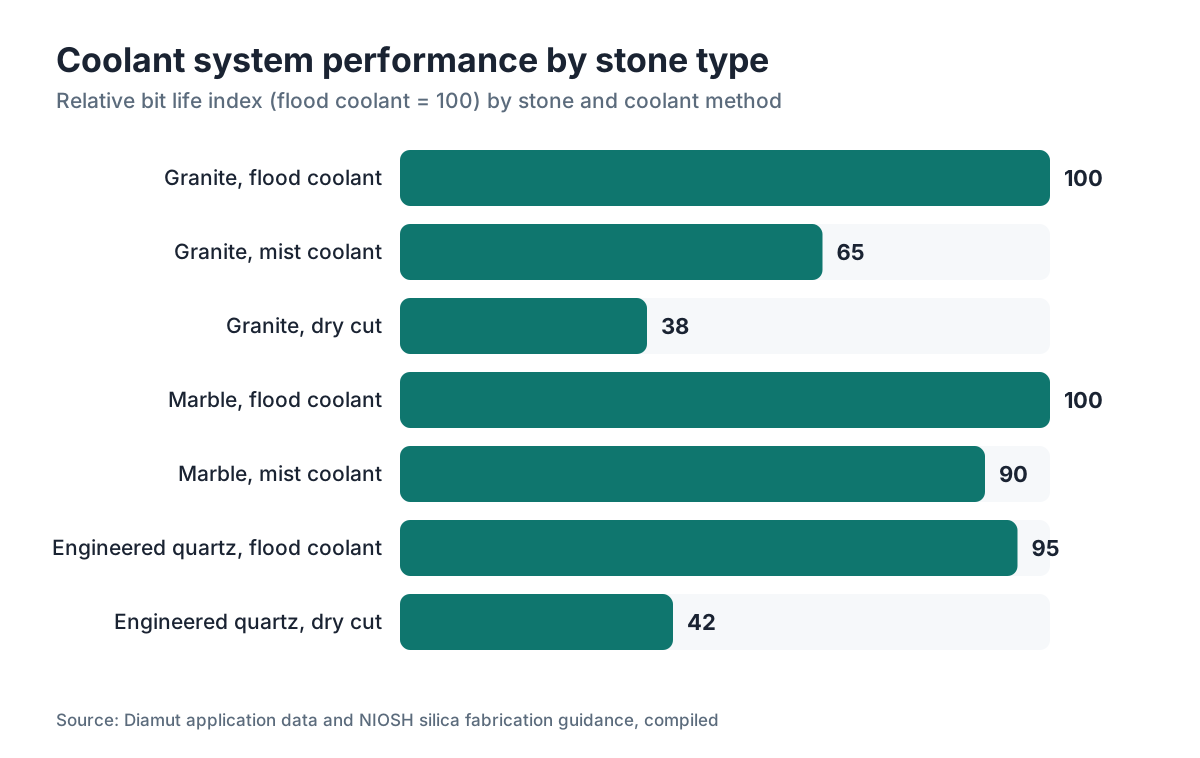
Dry cutting with air blast Some bits are sold as "dry cut" diamond router bits. They do run without water, using compressed air to clear debris. They work best on engineered stone and softer natural stone, and they need a vacuum dust extraction system to satisfy OSHA silica rules [2]. Bit life in true dry operation is much shorter. One tool maker's published comparison shows dry-cut diamond bits lasting roughly 30 to 50 percent as long as the same profile bit run with flood coolant on granite [4]. Most shops that try dry cutting go back after the first few bits wear out ahead of schedule.
What is flood coolant and how does it work on a CNC stone machine?
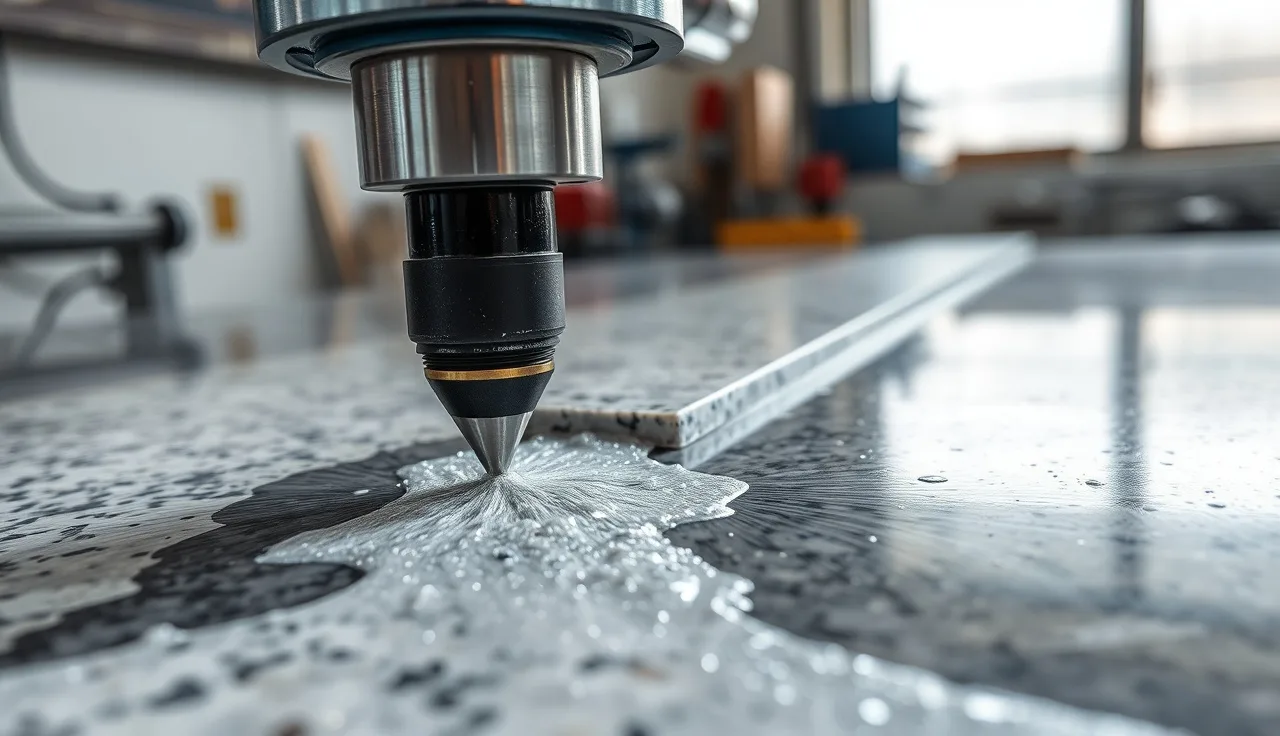
Flood coolant on a CNC bridge saw or CNC router is a closed-loop or semi-closed system. Water from a sump tank gets pumped through lines to the spindle or nozzle array, hits the cutting zone, picks up heat and slurry, then drains off the table into a settling basin or recirculating filter. The sump refills, and the cycle repeats.
Most professional CNC stone machines carry a coolant pump rated between 0.25 and 1.5 horsepower, good for 2 to 5 GPM at the pressures they need (typically 20 to 60 PSI at the nozzle). Flow rate matters more than pressure for router bits. You're not blasting material away. You're flooding the zone so heat has somewhere to go and debris has a path out.
Plain water is the most common coolant in stone shops. It's cheap, it's safe, and stone doesn't corrode the way metal does. Some shops add 2 to 5 percent of a water-soluble cutting fluid to improve lubricity and hold back bacteria in the sump, especially in warm climates where standing water turns foul fast. Water treatment is a real operational cost that never shows up in the bit price.
Water recycling systems keep spreading because municipal discharge of stone slurry is regulated in a lot of places. A basic settling tank with flocculant chemical drops most of the particulate out of suspension before the water returns to the sump. Bigger shops use filter press systems. EPA effluent guidelines for manufacturing wastewater (40 CFR Part 438) cover some of these discharge scenarios [5], and local wastewater authorities often pile stricter standards on top.
For anyone tracking job cost per square foot, water, additives, and wastewater handling add up but stay small next to bit cost. A rough shop estimate lands around $0.02 to $0.08 per square foot in water and disposal for typical granite profiling, though nobody has a clean industry-wide study on that number.
How does mist coolant work and when should you use it?
Mist systems use a venturi or pressurized reservoir to inject water into an airstream, breaking it into droplets in the 10 to 100 micron range. That mist exits a nozzle aimed at the bit, giving you evaporative cooling and some lubrication without the water volume a flood system demands.
The real draw is setup simplicity. A mist system bolts onto almost any router or hand tool because all it needs is a compressed air line and a small reservoir. For a shop doing occasional stone work rather than production runs, mist is a reasonable call on lighter cuts.
Mist struggles on deep profiling and continuous work. Evaporative cooling only helps if the mist actually reaches and wets the cutting zone, and a spinning bit that throws droplets outward disrupts that easily. Diamond router bits often run at 12,000 to 18,000 RPM, and at those speeds centrifugal force off the bit deflects mist away from the cutting edge. Some fabricators fight back with multiple nozzles set to approach from different angles.
For softer stones (limestone, travertine, and to some extent marble) mist coolant can do fine on profile passes. For quartzite and granite, especially in production, flood coolant is the reliable choice.
Can you run stone router bits completely dry?
You can. You probably shouldn't. Dry diamond router bits exist, they get sold, and they do cut stone without water. The engineering behind them usually means a more open segment design or a softer bond that self-dresses harder, trading bit life to make up for the missing coolant.
Heat is the ceiling. Granite and quartzite are hard and abrasive enough that even the best dry-cut design builds up heat that shortens bit life under sustained cutting. The 30 to 50 percent life reduction cited by at least one tool maker [4] is probably generous for hard granite. Some fabricators report worse.
The silica dust issue is non-negotiable. Table 1 of the construction silica standard lists wet methods as a required control for stone cutting, and under OSHA's rule, when Table 1 controls are used "fully and properly, the employer is not required to measure workers' exposure" [2]. Skip the water and you need a vacuum dust extraction system at the tool, which piles on cost and complexity that often beats the hassle of just running water.
Dry cutting has honest uses: quick field cuts on soft material, spots where water would ruin adjacent work, or very small jobs on engineered stone where the bit runs at light loads. Keeping dry-cut bits on the shelf isn't wrong. Treating them as a production answer for hard stone is.
What flow rate and water pressure do stone router bits need?
The numbers shift by operation. Here's a working framework.
For profile router bits on granite or quartzite, aim for 1.5 to 3 GPM at the cutting zone on production passes. Light finishing passes can get by with less. Through-spindle delivery is more efficient, so you might get adequate cooling at 1 GPM through the spindle versus 2.5 GPM from an external nozzle, because through-spindle puts the fluid exactly where it needs to be before the bit can throw it away.
Pressure at the nozzle matters less than flow. Most systems run 20 to 60 PSI. High pressure through a badly aimed nozzle just splashes water around the machine. Low pressure with good nozzle placement and enough flow works fine.
On CNC machines cutting sinks or inside curves, the coolant has to hold flow through the full rotation of the cut. Worth checking. Some external nozzle setups do great on straight passes but leave the bit half dry when the gantry turns a tight inside corner and the geometry changes.
Some machine makers publish minimum flow specs in their documentation. Intermac, Brembana, and Park Industries all publish technical specs for their CNC stone machines [3], though exact numbers vary by model. If you can't find the spec, 2 GPM at the nozzle for production granite profiling is a safe default most shop owners will back from experience.
Does the type of stone change what coolant system you need?
Yes, and it matters. Hardness, abrasiveness, and thermal behavior all drive how much cooling you need.
| Stone Type | Mohs Hardness | Abrasiveness | Recommended Coolant System |
|---|---|---|---|
| Limestone / Travertine | 3-4 | Low | Mist or light flood |
| Marble | 3-4 | Low-Medium | Mist or flood |
| Soapstone | 1-2 | Very Low | Mist or dry (light cuts) |
| Granite | 6-7 | High | Flood, 1.5-3 GPM |
| Quartzite | 7+ | Very High | Flood, 2-4 GPM |
| Engineered Quartz (Silestone, Cambria, etc.) | 7 approx. | High | Flood; dry-cut possible with extraction |
| Porcelain Tile/Slab | 7-8 | Very High | Flood recommended |
Granite and quartzite are the hard cases because they're both hard and abrasive. The quartz in granite (typically 20 to 40 percent quartz content by volume [6]) is what wears diamond segments fastest. More heat and more abrasion means more coolant.
Engineered quartz like Cambria countertops or Silestone runs almost entirely on quartz, so it's just as demanding on bits. It is more homogeneous than natural stone, though, which means fewer surprises mid-cut.
Softer natural stones (marble, travertine, soapstone) forgive a lot more. For occasional marble profiling, a mist system often handles it. Marble countertops and granite countertops sit at opposite ends of the coolant demand range even though both are common natural stone.
Porcelain slabs keep gaining ground in shops, and they punish bits even with good coolant because fired ceramic is harder and more abrasive than most natural stone. Don't underestimate porcelain's thirst for coolant.
How does coolant affect diamond router bit life?
This is where the economics get concrete. Diamond router bits for stone profiling aren't cheap. A quality ogee or full bullnose profile bit for granite runs $80 to $250 or more depending on diameter and segment quality. Production shops burn through several a month.
With adequate flood coolant, a good diamond profile bit on granite might finish 200 to 400 linear feet of edge before it needs replacing or re-tipping, depending on stone hardness, feed rate, depth of cut, and bit quality. Starve it of coolant and the same bit might quit at 80 to 150 linear feet. That gap is money. Run $150 bits at half the life and you've added $0.30 to $0.60 per linear foot in bit cost alone.
Heat failure looks different from normal wear. Normal wear is the segments getting shorter as diamonds surface and shed in the self-sharpening cycle. Heat failure shows up as segment delamination (the segment separates from the body), bond glazing (the matrix melts and seals over the diamonds without releasing them), or cracking in the body near the segment attachment. See any of those and inadequate coolant is the likely cause, even if water was flowing, because misdirected coolant doesn't stop heat.
For fabricators watching operational cost, countertop installation economics ride on shop efficiency, and bit life is one of the levers you actually control. Running more coolant than you think you need costs almost nothing per job. Running too little costs a bit every time one fails early.
What about through-spindle coolant versus external nozzles?
Through-spindle delivery is the engineering-preferred option. Coolant travels through the spindle housing, through the tool holder or collet, and out through holes in the bit body. It exits right at the cutting edge, where the heat and debris live. No guessing about nozzle aim.
The cost is complexity. Through-spindle systems need a spindle built for it, sealed rotating unions (called rotary unions or swivel couplings) to pass fluid from a stationary line into a spinning spindle, and bits with internal channels. Not every router bit supports it. Most diamond profile bits for countertop work use external coolant because the bit geometry (a hollow form profile, not a drill bit) makes internal channels impractical.
External nozzles are the overwhelmingly common answer in stone shops. A ring nozzle that surrounds the bit feeds coolant from several directions, which handles the problem of the bit throwing water away. Single-nozzle setups work but need careful aim and usually more total flow to make up for the inefficiency.
Shop owners retrofitting coolant often start with a simple single nozzle, then upgrade to ring or multi-nozzle setups once they see how much steadier the cooling gets on tight curves and inside corners.
SlabWise fabrication job cost tracking can tie coolant setup changes to bit consumption per job, so the payback on a ring nozzle upgrade shows up in the data instead of a hunch. Even without software, a simple log of bits used per linear foot of edge is enough to tell whether your coolant setup is doing its job.
How do you maintain a stone fabrication coolant system?
Neglected coolant systems fail quietly. The pump wears, flow drops, and you don't notice until bits start dying early or stone starts cracking at the cut edge.
The basics:
Sump cleaning. Stone slurry settles in the sump and eventually fills it, cutting effective volume and clogging strainers. Most shops clean sumps weekly or every two weeks in production. Let slurry build up and you also create anaerobic conditions where bacteria grow, which brings foul odor and can throw off water chemistry.
Strainer and filter checks. The pump intake strainer and any inline filters need regular eyes on them. A partly clogged strainer drops flow hard, and the pump can still sound fine while delivering half its rated flow.
Nozzle inspection. Stone slurry deposits mineral scale inside nozzle orifices, narrowing them over time. A nozzle that used to push 2 GPM might be down to 1.2 GPM after six months without cleaning. Check it by timing the output into a bucket.
Pump maintenance. Submersible coolant pumps are workhorses, but they wear. Impeller erosion from abrasive stone particles is a real failure mode. Some shops drop a magnet in the sump to catch ferrous particles; stone slurry also carries fine mineral particles the magnet won't touch, which is why settling and filtration still matter.
Bacterial control. If your coolant includes water-soluble fluid, follow the maker's concentration guidelines. Under-concentration breeds bacteria. Over-concentration wastes money and can irritate skin. Concentration test strips are cheap and worth using weekly.
Good coolant maintenance costs little. A machine shutdown from a burned-out pump, or a fractured bit that wrecks a slab, costs a lot.
What are the silica dust and safety regulations for stone cutting coolant?
OSHA's respirable crystalline silica standard for construction is 29 CFR 1926.1153, and the general industry standard is 29 CFR 1910.1053 [2][9]. Both set a permissible exposure limit (PEL) of 50 micrograms per cubic meter (µg/m³) of air as an 8-hour time-weighted average, with an action level of 25 µg/m³.
Table 1 of the construction standard lists specific tasks and required controls. For using a handheld power saw to cut fiber cement, masonry, tile, or stone, wet cutting or a vacuum dust extraction system on the saw is required. When Table 1 controls are used "fully and properly, the employer is not required to measure workers' exposure" [2]. That's a real compliance shortcut, and it's a big reason wet cutting is so widely adopted.
The National Institute for Occupational Safety and Health (NIOSH) has documented silicosis cases in stone countertop fabricators specifically, and NIOSH has published guidance flagging elevated silica exposure in engineered stone fabrication [7]. Engineered quartz products can run 90 to 95 percent crystalline silica by weight, which is why they get called out separately in safety guidance.
For shop owners the takeaway is direct: run your flood coolant properly and you meet the primary engineering control requirement under the silica standard. Dry cutting for any reason means you need a HEPA-filtered vacuum extraction system at the tool. Leaning on respirators alone, without engineering controls, is not compliant under the current standard when engineering controls are feasible [2].
California's Division of Occupational Safety and Health (Cal/OSHA) has its own silica rules that are at least as strict as federal OSHA and sometimes more detailed. Operate in California and you check both.
What do coolant systems cost and what should a shop budget for?
Cost swings a lot depending on whether you're equipping a CNC machine or a hand router, and whether you're starting fresh or upgrading.
Basic external nozzle setup for a hand router or small bridge saw: $50 to $300. This is a submersible pump in a bucket or small sump, flexible tubing, and a nozzle. It works. It's not pretty, but small shops and installers doing field cuts run exactly this.
Integrated coolant system on a mid-range CNC stone machine: usually baked into the machine price, but the pump, plumbing, and settling tank add $2,000 to $8,000 to the base cost when priced out separately [3]. Park Industries, for one, prices coolant options separately on some configurations.
Water recycling and filtration for a production shop: $5,000 to $30,000 depending on volume and sophistication. A basic two-chamber settling tank with flocculant injection sits at the low end. A filter press that produces dry cake for disposal and returns clean water to the sump sits at the high end.
Ongoing operational costs: water, coolant additives, and slurry disposal are the recurring items. Water cost is usually small (a production shop might use 500 to 2,000 gallons a day in a recirculating system, plus makeup water for evaporation and drag-out). Coolant additive at 2 to 5 percent concentration runs $20 to $80 per 5-gallon concentrate jug, and a mid-size shop might use one jug a month. Slurry disposal runs from free (if you have land to spread settled solids) to $200 to $500 a month for hauling, depending on your municipality.
The costliest mistake is under-investing in coolant and paying for it in early bit deaths and the occasional cracked slab. A $500 ring-nozzle upgrade on a CNC machine that stretches bit life by 30 percent pays for itself inside two months in most production shops.
Frequently asked questions
Can I use regular tap water as coolant for stone router bits?
Yes, and most shops do. Plain tap water is the standard coolant for diamond stone router bits. Hard water areas build mineral scale in nozzles and lines over time, worth managing with periodic cleaning or a small amount of water-soluble coolant fluid. The fluid also holds back bacteria in the sump. As a starting point, tap water works fine without additives.
What happens if I run a diamond router bit without coolant on granite?
The cutting zone overheats fast. Above roughly 400°C the bond matrix holding the diamond segments softens, diamonds pull free early, and the bit glazes over. You'll watch it stop cutting cleanly and start burning the stone edge. Beyond bit damage, dry cutting granite throws off respirable silica at levels that likely blow past OSHA's permissible exposure limit of 50 µg/m³, so you get a tool cost problem and a safety compliance problem at once.
How much water flow does a granite router bit need?
For production profiling of granite, 1.5 to 3 gallons per minute (GPM) at the cutting zone is a practical target. Through-spindle delivery can work at lower flow because the coolant reaches the edge directly. External nozzle systems need more total flow to make up for water the spinning bit throws clear. Light finishing passes work at lower flow; deep full-profile cuts need the high end of that range.
Are mist coolant systems good enough for stone routing?
For softer stones like marble, travertine, or limestone, mist works well on profile routing. For granite, quartzite, and engineered quartz, mist alone generally can't keep up on production-depth cuts. The water volume mist delivers is too low to flush slurry hard, and centrifugal force from the spinning bit deflects the fine droplets away from the cutting zone at typical router speeds. Most production granite shops use flood coolant.
Do dry-cut diamond router bits actually work on stone?
They cut, but bit life is much shorter, typically 30 to 50 percent of what flood-cooled bits get on granite. Dry cutting also throws off silica dust, so you need a HEPA vacuum extraction system at the tool to satisfy OSHA's silica standard (29 CFR 1926.1153). Dry bits have honest uses for occasional cuts on softer or engineered stone in the field, but they're not a practical production answer for hard natural stone.
How do I know if my coolant system is delivering enough flow to the router bit?
Easiest check: hold a bucket under the nozzle(s) with the pump running and time how long it takes to collect a known volume, then calculate GPM. Also watch the cutting zone while routing. You want a steady wet slurry flushing out, not steam or a dry powdery dust cloud. Bits glazing over or wearing faster than expected are the performance signal that flow is too low.
What coolant system do I need for engineered quartz (Cambria, Silestone, etc.)?
Treat engineered quartz like hard granite for coolant. Engineered quartz products run 90 to 95 percent crystalline quartz by weight, which makes them highly abrasive and hard on diamond bits. Flood coolant at 1.5 to 3 GPM is the right approach. NIOSH has flagged elevated silica exposure risk in engineered stone fabrication, so proper wet suppression isn't optional. Some shops run quartz dry with extraction, but bit life drops measurably.
How often should I clean and maintain my stone shop coolant sump?
In a production stone shop, cleaning the sump every 1 to 2 weeks is reasonable. Stone slurry settles and fills the sump bottom, cutting effective volume, clogging strainers, and creating anaerobic conditions where bacteria grow and cause odor. Check the pump intake strainer weekly. Measure nozzle output periodically to catch scale buildup before it drops flow. Soak nozzles in dilute acid or descaler to clear scale.
What are the OSHA rules for silica dust when cutting stone countertops?
OSHA's silica standard (29 CFR 1926.1153 for construction, 29 CFR 1910.1053 for general industry) sets a permissible exposure limit of 50 µg/m³ as an 8-hour average. Table 1 of the construction standard lets employers skip air monitoring entirely when specified controls, including wet cutting, are used fully and properly. Dry or poorly controlled cutting may require respiratory protection and air monitoring at any exposure above the 25 µg/m³ action level.
Can I retrofit a coolant system onto an older CNC stone router?
Yes. External nozzle setups are the standard retrofit because they don't require spindle modifications. A submersible pump in a sump tank, flexible tubing, and a ring nozzle around the bit is the practical solution. Ring nozzles that encircle the bit give more uniform coverage than single-nozzle setups, especially on curved cuts. Budget $200 to $800 for a solid retrofit depending on nozzle type and pump size.
Does coolant type affect the finish quality on polished stone edges?
Water alone has no meaningful effect on finish quality on natural stone. If you use a water-soluble additive, stay in the 2 to 5 percent range the maker recommends. Very high concentrations of some additives can leave residue on polished surfaces, but that's uncommon in normal shop use. The bigger quality factor is flow consistency. Inconsistent flow causes thermal cycling at the bit, which can leave chatter marks on the finished edge.
Is wastewater from stone cutting coolant systems regulated?
Yes, in most places. Stone cutting slurry carries suspended solids (calcium carbonate, silica, and other minerals) that can't go to storm drains under EPA stormwater rules, or to municipal sewers without meeting local pretreatment standards. EPA effluent guidelines (40 CFR Part 438) address some of these scenarios. Most shops use settling tanks to drop solids out of suspension before recirculating or discharging water. Check with your local sewer authority for specific limits.
What is a rotary union and why does through-spindle coolant need one?
A rotary union (also called a swivel coupling) is a mechanical fitting that passes fluid from a stationary supply line into a rotating shaft, like a spindle. Without it, the supply hose would twist and break as the spindle spins. Through-spindle coolant delivery requires a rotary union built into the spindle housing. They're standard on purpose-built CNC machining centers and some stone-specific CNC machines, but not on every router used in stone shops.
How do I dispose of stone cutting slurry from my coolant sump?
Settled stone slurry (mostly calcium carbonate, silica, and water) is generally not classified as hazardous waste under federal RCRA rules, but it can't go to storm drains. Options include drying the settled solids and disposing in regular solid waste (check local rules), land application where local ordinances allow, or contracting a waste hauler. Some municipalities take dried stone slurry as fill. Confirm the rules with your local environmental or public works authority first.
Sources
- Journal of Materials Processing Technology, diamond tool wear review: Friction at the cutting zone in diamond tooling on hard stone can exceed 400°C without coolant, causing bond matrix softening and premature diamond loss
- OSHA, 29 CFR 1926.1153 Respirable Crystalline Silica Standard for Construction: OSHA's silica standard sets a PEL of 50 µg/m³ and lists wet cutting as an accepted Table 1 engineering control; when Table 1 controls are used fully and properly, air monitoring is not required
- Park Industries, CNC stone machine product specifications: Professional CNC stone machines deliver coolant at typical flow rates of 1-4 GPM; Park Industries documents coolant system options and specifications for its machine lines
- Diamut / tooling manufacturer published application data on dry vs wet diamond bit life: Dry-cut diamond router bits last roughly 30-50% as long as equivalent bits run with flood coolant on granite, based on published comparison data from diamond tooling manufacturers
- EPA, 40 CFR Part 438 Metal Products and Machinery Effluent Guidelines: EPA effluent guidelines cover discharge of process wastewater including coolant water from manufacturing operations
- USGS, National Minerals Information Center: Granite typically contains 20-40% quartz minerals by volume, which are the primary abrasive component that wears diamond cutting tools
- NIOSH, Silica topic page: engineered stone countertop fabrication and silicosis: NIOSH documented elevated silica exposure risk and silicosis cases specifically in engineered stone countertop fabrication, noting engineered quartz can be 90-95% crystalline silica by weight
- OSHA, 29 CFR 1910.1053 Respirable Crystalline Silica Standard for General Industry: General industry silica standard applies to stone fabrication shops and sets the same 50 µg/m³ PEL and 25 µg/m³ action level as the construction standard
- Intermac, CNC stone machining center technical documentation: CNC stone machine manufacturers including Intermac publish minimum coolant flow rate specifications and coolant system options for their machine lines
- EPA, Stormwater Discharges from Industrial Activities: Stone cutting slurry containing suspended solids cannot be discharged to storm drains without an NPDES permit or applicable exemption under EPA stormwater rules
Last updated 2026-07-11