
TL;DR
- Stone slurry from wet-cutting granite, quartz, and marble is regulated wastewater under the Clean Water Act.
- You cannot legally dump it in a floor drain, parking lot, or dumpster.
- Most shops filter out solids, test pH, and either discharge to a permitted sewer under a local pretreatment permit or haul solids off-site.
- Rules change by state and city, so call your local treatment plant first.
What exactly is stone slurry and why do regulators care about it?
Stone slurry is the milky, gray-to-white liquid that pours off a wet saw, CNC router, or edge polisher while you cut granite, quartz, marble, quartzite, or engineered stone. It is mostly water with very fine stone particles mixed in. That plain description hides three problems regulators pay attention to.
Particle size is the first problem. Slurry particles land in the 1-to-100-micron range, small enough to stay suspended in water for hours. Reach a storm drain or a creek with that, and the particles settle as sediment, raise turbidity, and choke aquatic life. The EPA's stormwater programs name turbidity from suspended solids as a pollutant under the Clean Water Act. [1]
pH is the second problem, and it catches a lot of owners off guard. Fresh slurry from marble or limestone can run pH 8 to 11 because cutting releases calcium hydroxide from calcium carbonate. Engineered quartz slurry can go higher still. Most discharge permits demand pH between 6.0 and 9.0 before anything hits the sanitary sewer. [2]
Silica is the third problem, and from a liability angle it is the one that should worry you most. Crystalline silica is a known human carcinogen when inhaled, and regulators are starting to track it in water too. [12] The California State Water Resources Control Board has flagged silica in fabrication wastewater as a constituent that triggers review under its general industrial stormwater permit. [3]
Engineered products like those covered on Cambria countertops and broader kitchen countertops pages often run north of 90 percent quartz. Their slurry is silica-dense.
Which federal laws actually govern stone slurry disposal?
Three federal frameworks apply, and they can all hit your shop at once.
The Clean Water Act (33 U.S.C. § 1251 et seq.) is the root. Section 301 bans discharging pollutants to navigable waters without a permit, and Section 402 sets up the National Pollutant Discharge Elimination System (NPDES) permit program run by the EPA or delegated states. [1] Stone slurry is a pollutant. Run it into a parking lot that drains to a street inlet tied to the storm system, and you are potentially discharging to navigable waters without a permit. That is a federal violation.
The Pretreatment Standards under 40 CFR Part 403 are the second framework. Discharge process wastewater, slurry included, to a municipal sanitary sewer, and federal rules say you cannot interfere with the treatment works, cannot pass through pollutants that would blow the plant's own limits, and cannot introduce anything that harms sewer workers. [2] Most fabrication shops are "indirect dischargers" here. Your local plant can pile specific limits on top of that federal baseline.
RCRA (Resource Conservation and Recovery Act, 42 U.S.C. § 6901 et seq.) is the third. It governs solid waste. Pull the filter cake or settled solids out of the water and they become a solid waste. Natural-stone filter cake is almost always non-hazardous under RCRA, so it can go to a licensed landfill. [4] But if you process engineered stone with resin binders, or use chemical sealers or coolant additives, the solids could tip into hazardous waste under RCRA Subtitle C and need a licensed hazardous hauler. Most shops never get near that line. Confirm it with your state agency if you run anything besides plain water as cutting fluid.
What do local pretreatment programs require, and how do you find out what your city wants?
This is where the daily compliance work lives. The EPA sets the floor. Your local treatment plant sets the rules you actually live by. Every city or regional wastewater authority that runs a sewage plant has to build a local pretreatment program under 40 CFR Part 403 if it takes significant industrial discharges. [2]
To find your rules, call your local publicly owned treatment works (your city or county water/wastewater utility) and ask for the industrial pretreatment coordinator. Say you run a stone fabrication shop with wet-cutting equipment. They will tell you whether you need a local industrial user permit, what your limits are for total suspended solids (TSS), pH, and metals, and what monitoring or reporting you owe them.
Typical limits in local fabrication permits: pH 6.0 to 9.0 or 6.5 to 9.5 depending on the city, TSS often 200 to 300 mg/L, and sometimes metals limits if you cut certain exotic stones. [11]
Some cities publish guidance written for stone shops. The San Francisco Bay Regional Water Quality Control Board has issued guidance for stone fabrication operations covering pH neutralization and solids settling. [6] Several states, California among them, run general industrial stormwater permits that list stone cutting as a covered activity with named best practices.
If your shop sits on a septic system instead of a municipal sewer, you generally cannot discharge process wastewater to it at all. Slurry to a septic system is banned almost everywhere by state plumbing and environmental codes.
Can you just let slurry settle in a tank and discharge the clear water?
Yes, and this is the most common compliance approach in the trade. A recirculating water system with settling tanks (a clarifier, some call it) drops the solids out before the water gets reused or discharged. Getting it right takes more than letting the tank sit.
A good system runs three stages: a coarse settling tank where big chips and particles drop fast, a fine settling tank (sometimes with a flocculant dosed in to speed things), and either a filter press or sand filtration before discharge. The filter press squeezes settled sludge into a cake you can bag and haul.
The clear overflow still needs a pH check before it goes to the sewer. Marble and limestone slurry runs reliably alkaline, so many shops add a little CO2 injection or a dilute acid drip (citric acid or similar) to pull pH into the 6 to 9 window. That gear runs $500 to $5,000 depending on how automated you want it.
Water recycling systems for a mid-size shop (two or three saws, a CNC or two) run roughly $15,000 to $50,000 installed, based on manufacturer price lists and trade reporting. [7] The payoff is a smaller water bill and real compliance. The upfront cost is real too. Some shops rent roll-off tank systems where the vendor swaps a full tank for an empty one. Lower upfront, higher over time.
Shops that run slurry straight to the drain with no treatment are the ones who end up with consent orders and fines. One Clean Water Act enforcement action can carry civil penalties up to $25,000 per day per violation under 33 U.S.C. § 1319(d). [1] That math is brutal.
How do you legally dispose of the solid filter cake once it is separated from the water?
Filter cake from natural stone (granite, marble, quartzite) cut with plain water is generally non-hazardous industrial solid waste under RCRA. [4] It can go to a licensed municipal solid waste landfill or a C&D (construction and demolition) debris facility, depending on what your state allows.
A few practical notes. The cake has to be dewatered enough that it passes the paint filter test, a simple check for whether free liquid drips out. Landfills routinely turn away wet sludge that fails it under EPA solid waste guidance. [4] A decent filter press produces cake that passes easily.
Do not toss the cake in a dumpster bound for a transfer station without checking that the station takes it. Some do not. Do not scatter it on a field or vacant lot. Shop owners who tried that got RCRA violation notices.
Add chemical sealers, adhesives, or resin-based materials to your process water, and get a waste characterization done before you assume it is non-hazardous. The resin in cured engineered quartz is generally inert, but cutting uncured material (rare in fabrication) or adding solvent-based products changes everything.
If you cut a lot of engineered or natural stone like the products covered on marble countertops and granite countertops pages, run a one-time TCLP (toxicity characteristic leaching procedure) analysis on your cake. It costs $300 to $800 at an environmental lab and hands you a paper trail that proves your waste is non-hazardous.
Do stormwater rules apply even if you try to keep slurry inside your shop?
Yes. Any outdoor cutting, outdoor slab storage, a loading dock, or a shop floor that drains through an exterior door or bay to an outside surface, and stormwater rules can reach you.
The EPA's NPDES Multi-Sector General Permit (MSGP) covers industrial sites in Sector N, which includes stone cutting, shaping, and finishing (SIC code 1741 and related). [8] Facilities under the MSGP have to write a Stormwater Pollution Prevention Plan (SWPPP), train employees, inspect outdoor areas, and monitor stormwater discharges at least once a year. Where the EPA has delegated NPDES to the state, the state runs an equivalent permit.
Even all-indoor shops should think about what rain does. Wash-down water off bay floors, runoff from trucks tracking slurry residue, anything leaving your property through a storm drain is a possible NPDES problem.
Here is the good part. Shops that cut strictly indoors, keep all process water in a closed loop or a properly plumbed drain, and never let slurry or wash water reach the storm drain can usually show they have no industrial stormwater discharge. That qualifies them for a "no exposure" certification under the MSGP and skips most monitoring. [8] The certification needs renewal on a schedule and an honest self-assessment.
For shops cutting granite countertops or other hard stones outdoors on the regular, the SWPPP requirement is real. Do not ignore it.
What are the rules state by state, and which states are the strictest?
Federal law sets the floor. State law can push far past it. Here is a realistic read on the variation.
| State | Key agency | Notable requirement above federal baseline |
|---|---|---|
| California | State Water Resources Control Board | Industrial general permit (Order 2014-0057-DWQ, reissued 2015) requires monitoring reports, SWPPP, and annual certification; silica noted as a concern [3] |
| New York | NYSDEC | State SPDES permit program; some shops need individual permits rather than general permit coverage |
| Florida | FDEP | Industrial wastewater permits required for direct discharge; most shops covered under a general permit with pH and TSS limits |
| Texas | TCEQ | Texas Pollutant Discharge Elimination System (TPDES); stone shops with outdoor areas need MSGP-equivalent coverage |
| Washington | Ecology Dept. | Industrial stormwater general permit covers stone cutting; bench-level pH monitoring often required |
| All other states | State EPA equivalent | Must meet the federal NPDES/pretreatment floor; state limits may match it or run stricter |
California is the strictest, hands down. The most prescriptive SWPPP requirements, tighter numeric limits, active enforcement. Operate there and the State Water Resources Control Board's industrial permit guidance is worth reading cover to cover. [3]
In most other states, a shop with a closed-loop recirculation system, a local pretreatment permit for sanitary sewer discharge, and no outdoor exposure sits in solid shape. The gap between California and, say, Kansas is wide.
Expanding to a new state or opening a second location? Call that state's environmental agency before you sign the lease. Permitting can run 30 to 90 days and sometimes longer, and starting fabrication before the permits land is a common, expensive mistake.
What does it actually cost to get into compliance, and what are the fines for ignoring it?
Compliance cost swings hard on shop size, state, and the infrastructure you already have.
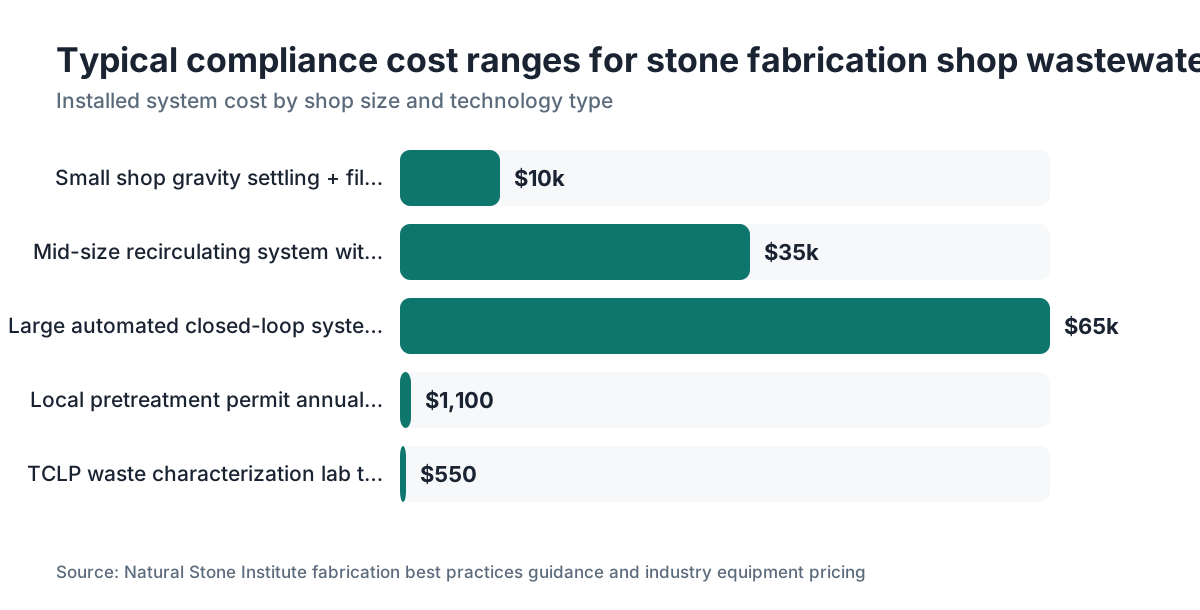
A small shop cutting 20 to 30 slabs a month can often manage with a gravity-settling tank, a pH meter, and a filter press, all in for $5,000 to $15,000 installed. A larger operation with several CNCs and saws runs $30,000 to $80,000 for a fully automated water recycling and pH treatment setup.
Local pretreatment permits usually carry an annual fee of $200 to $2,000 depending on the city and your discharge volume. Some cities charge more for monitoring and reporting.
Lab testing for an initial waste characterization (TCLP) runs $300 to $800. Periodic wastewater monitoring, if your permit calls for it, runs $150 to $400 per sample event.
The penalty side is where it gets serious. Under 33 U.S.C. § 1319(d), Clean Water Act civil penalties run up to $25,000 per day per violation, and the EPA can assess them whether or not actual harm occurred. [1] For knowing violations, criminal penalties under § 1319(c) can reach $50,000 per day and carry prison time. State penalties stack on top in many cases.
Enforcement against stone shops is not common in most regions, but it happens. California, Florida, and the Pacific Northwest have documented cases against fabricators for illegal sewer discharge and stormwater violations. The EPA's ECHO (Enforcement and Compliance History Online) database is searchable by industry code and shows which facilities caught notices of violation. [9]
If you track operational costs and compliance overhead, job-tracking software like SlabWise can log filter maintenance, hauler pickups, and permit renewal dates next to your shop schedule so the paperwork stops slipping through the cracks.
What does a compliant slurry management system look like in practice?
Here is what a well-run shop actually does, concretely.
Every wet-cutting machine drains to a dedicated floor sump, not the general floor drain. The sump feeds a primary settling tank, usually 500 to 2,000 gallons depending on production. Solids settle out over 2 to 8 hours. The clarified water on top spills into a secondary tank, where a flocculant (often aluminum sulfate or a polymer) gets dosed in to pull the last fine particles out of suspension.
That clarified water then either recirculates to the saws (closed loop) or, if it has to be discharged, runs through a pH meter with an automatic alarm set at 6.0 to 9.5. Out of range, the drain valve shuts and an operator fixes the chemistry before anything leaves.
Solids from the settling tanks get pumped to a filter press once or twice a week. The press cycles for 30 to 60 minutes and produces a cake 20 to 30 percent dry weight. That cake goes into lined dumpsters or supersacks for pickup by a licensed solid waste hauler who takes it to a permitted landfill.
The shop keeps a log: press cycle dates, cake volume, discharge pH readings, hauler pickup receipts. When the treatment plant calls for an inspection or a monitoring sample, that paperwork keeps you out of trouble.
None of this is exotic. Equipment suppliers like Evoqua and specialty fabrication vendors sell systems built for stone shops. Stone World and the Natural Stone Institute have both published technical guides on shop wastewater management. [7]
For shops new to countertop installation as a business, building the wastewater system in at lease-signing is far cheaper than retrofitting after the first inspection.
Are there any exemptions or safe harbors for very small fabrication shops?
Sort of, but the exemptions are narrower than most small owners hope.
Under the EPA's NPDES program, a facility with no industrial stormwater exposure (everything indoors, no outdoor drainage) can file a "no exposure" certification and skip most stormwater permit requirements. [8] That is a real, legitimate path for indoor-only shops. You still re-certify on a schedule and document your no-exposure status honestly.
On pretreatment, plants only have to write their own limits for "significant industrial users" (SIUs) as defined at 40 CFR 403.3(v), which generally means operations discharging more than 25,000 gallons per day of process wastewater, or those the plant decides could cause interference or pass-through. [2] A small shop producing a few hundred gallons of slurry a week often sits below the SIU line. That does not mean you can discharge whatever you want. It means the plant may not require a written industrial user permit. The federal bans on interference, pass-through, and harmful pollutants still apply to you.
There is no RCRA small-quantity exemption for stone slurry solids the way there is for small-quantity hazardous waste generators, because stone slurry solids are almost always non-hazardous to begin with. Send them to a permitted landfill and you are fine.
State small-business assistance programs sometimes offer free compliance consultations. The EPA's Small Business Environmental Assistance Program (SBEAP), run through state agencies, gives confidential technical help to small manufacturers, fabrication shops included. [10] Unsure about your obligations? SBEAP is the right first call, not a lawyer. Free, confidential, built for exactly this.
What records do you need to keep, and for how long?
Record-keeping is where shops that think they are compliant get caught during inspections.
If you hold a local pretreatment permit, the permit spells out your record-keeping. Typically: keep monitoring results (pH logs, TSS test results) at least three years, keep permit applications and correspondence with the plant at least three years, and keep any self-monitoring reports you submit. [2]
For solid waste disposal, keep every hauler manifest or receipt permanently, or at minimum five years. Face an RCRA inspection or a Superfund inquiry someday and being able to show where your waste went is what saves you.
For SWPPP compliance, keep the current SWPPP plan plus all inspection records, training records, and monitoring results at least three years. [8]
Shops that did voluntary TCLP testing on their filter cake should keep those lab results indefinitely. They are your defense against a future claim that your waste was hazardous.
Building this into a job-management or shop-operations system helps. SlabWise's job tracking module is not a compliance platform, but shops have used its notes and documentation fields to attach hauler receipts and maintenance logs to shop records, which at least keeps everything in one searchable place.
Do not store records only in the owner's personal email. Shops that get acquired, change managers, or face enforcement years later need records that survive personnel changes.
Frequently asked questions
Can I pour stone slurry down a regular floor drain?
It depends where that drain goes. If it connects to a municipal sanitary sewer, you have to meet your local plant's pretreatment limits first, mainly pH between 6 and 9 and a total suspended solids cap. If the drain connects to a stormwater system, parking lot, or ditch, the answer is no, full stop. That is a Clean Water Act violation regardless of shop size.
Is stone slurry considered hazardous waste?
Almost always no. Natural stone slurry (granite, marble, quartzite) cut with plain water is typically non-hazardous industrial solid waste under RCRA. Add chemical sealers, resin-based adhesives, or solvent-based products to your process water and you should run a TCLP analysis to confirm. Engineered quartz slurry is generally non-hazardous once the resin is cured, which it is in fabrication settings.
How high is the pH of stone slurry and why does it matter?
Marble and limestone slurry regularly tests at pH 9 to 11 because cutting releases calcium hydroxide from calcium carbonate. Most local pretreatment permits require discharge pH between 6.0 and 9.0 or 9.5. High-pH discharge can damage pipes, harm downstream treatment, and violate your permit. A pH meter at the drain and a small CO2 injection or acid drip system usually brings it into range.
What is a SWPPP and do stone fabrication shops need one?
A Stormwater Pollution Prevention Plan (SWPPP) is a written document describing how a facility keeps pollutants out of stormwater. Stone shops with any outdoor cutting, outdoor slab storage, or outdoor drainage areas generally need one under the EPA's NPDES Multi-Sector General Permit (Sector N, stone cutting). Indoor-only shops with no stormwater exposure can often file a no-exposure certification instead.
How often do I need to test my discharge water?
Your local pretreatment permit sets the frequency. Smaller non-significant industrial users might only self-monitor pH daily or weekly and submit periodic reports. Larger operations may need monthly composite sampling for TSS and other parameters. Stormwater permits typically require at least one monitoring event per year. Check your specific permit conditions; requirements vary widely by city and state.
Can I spread filter cake on my land or a farmer's field?
Generally no. Spreading industrial solid waste on land without a permit is prohibited under RCRA and most state solid waste rules. Even non-hazardous industrial waste has to go to a permitted facility. Natural stone filter cake is inert, and some agricultural users have shown interest in it as a calcium amendment, but you need state approval for a beneficial use designation before doing this legally.
What is the EPA's ECHO database and how can I use it?
ECHO (Enforcement and Compliance History Online) is a free EPA database at echo.epa.gov showing permit status, inspection history, and violation records for regulated facilities. Search by SIC code or facility name to see what enforcement actions hit stone fabrication shops in your area, which gives you a realistic read on how hard your region enforces these rules.
How do I find out if my shop needs an industrial user permit from my city?
Call your local water or wastewater utility and ask for the industrial pretreatment coordinator. Say you run a stone fabrication shop with wet-cutting equipment and ask whether you qualify as an industrial user needing a permit. They will tell you your local limits, whether you need a permit, and what the application looks like. Most utilities help at this stage; they would rather permit you than find an uncontrolled discharge later.
What are the fines for illegal slurry disposal?
Federal Clean Water Act civil penalties run up to $25,000 per day per violation under 33 U.S.C. § 1319(d). Knowing violations can trigger criminal penalties up to $50,000 per day plus imprisonment. State penalties stack on top. Real-world settlements for small shops typically run $5,000 to $50,000 plus required capital improvements, but the statutory ceiling is far higher.
Does the type of stone I cut change the disposal rules?
Somewhat. Natural stones like granite, marble, and quartzite produce slurry that is reliably non-hazardous, though pH varies by stone chemistry. Engineered quartz slurry runs higher in crystalline silica, which some states flag for extra scrutiny in stormwater permits. Cutting exotic stones with metal oxides (certain high-iron granites, for example) can occasionally produce slurry with elevated metal levels worth testing once.
What is a no-exposure certification and how does a shop qualify?
A no-exposure certification under the EPA's NPDES stormwater program lets a facility opt out of full stormwater permit coverage if all industrial materials and activities stay sheltered from rain and stormwater. For a stone shop, that means all cutting, all slab storage, and all wastewater handling happen indoors with no drainage to the exterior. You certify this to your state NPDES authority and recertify periodically.
How much does a water recycling system cost for a stone shop?
A basic gravity settling and filter press system for a small shop (one or two saws) runs roughly $5,000 to $15,000 installed. A fully automated closed-loop system with pH treatment for a larger operation with multiple CNCs and saws runs $30,000 to $80,000. Ongoing costs include flocculant chemicals ($50 to $200 per month), filter press maintenance, and periodic solid waste hauling.
Is a septic system an option for slurry discharge at a rural shop?
No. Discharging process wastewater, stone slurry included, to a septic system is prohibited under nearly all state plumbing and environmental codes. Septic systems handle sanitary waste and cannot take the solids load, pH swings, or volume from fabrication. A shop on a septic system needs a closed-loop recirculation setup or a holding tank with scheduled hauler pickup.
What is the Small Business Environmental Assistance Program and is it really confidential?
The EPA's Small Business Environmental Assistance Program (SBEAP) is a federally funded program run through state agencies that gives free, confidential technical compliance help to small businesses, fabricators included. Under its authorizing statute, information you share with SBEAP cannot be used for enforcement. It is the right first call if you are unsure about your obligations and do not want to accidentally self-report a violation.
Sources
- EPA, Clean Water Act 33 U.S.C. § 1319 enforcement provisions and Section 301 discharge prohibition: Clean Water Act prohibits discharge of pollutants to navigable waters without a permit; civil penalties up to $25,000 per day per violation under § 1319(d)
- EPA, National Pretreatment Program overview, 40 CFR Part 403: 40 CFR Part 403 requires indirect dischargers to not interfere with or cause pass-through at POTWs; defines significant industrial users and record retention requirements
- California State Water Resources Control Board, Industrial General Stormwater Permit: California industrial general permit requires SWPPP, monitoring reports, and annual certification; silica flagged as a constituent of concern in fabrication wastewater
- EPA, RCRA Overview and Solid Waste Definition: RCRA governs solid waste disposal; stone filter cake is generally non-hazardous solid waste requiring disposal at permitted facilities; paint filter test applies to waste liquids
- San Francisco Bay Regional Water Quality Control Board, Stone Fabrication Shop Guidance: San Francisco Bay RWQCB has issued guidance for stone fabrication operations covering pH neutralization and solids settling requirements for shop wastewater
- Natural Stone Institute, Fabrication Best Practices resources: Industry trade guidance on water recycling and wastewater management systems for stone fabrication shops, including equipment cost ranges and system design
- EPA, NPDES Multi-Sector General Permit (MSGP) for Industrial Stormwater: MSGP Sector N covers stone cutting, shaping, and finishing; no-exposure certification available for indoor-only facilities; annual monitoring required for covered facilities
- EPA, Enforcement and Compliance History Online (ECHO): ECHO database is searchable by facility and SIC code showing inspection history and violation records for regulated industrial facilities including stone fabricators
- EPA, Small Business Environmental Assistance Program (SBEAP): SBEAP provides free, confidential technical compliance assistance to small manufacturers; information shared cannot be used for enforcement purposes
- EPA, NPDES Permit Writers Manual, EPA-833-K-10-001: NPDES permit writers manual describes total suspended solids limits and pH monitoring requirements for industrial dischargers including stone processing facilities
- OSHA, Silica Rule 29 CFR 1910.1053 and construction standard 29 CFR 1926.1153: Crystalline silica is classified as a known carcinogen; fabrication of engineered stone and natural stone generates respirable silica dust and silica-containing slurry
Last updated 2026-07-11