TL;DR
- A silica exposure monitoring program is a system stone shops use to measure how much respirable crystalline silica workers breathe, compare it to OSHA's permissible exposure limit of 0.05 mg/m³, and document what they do about it.
- OSHA's Silica Standard (29 CFR 1910.1053 and 1926.1153) makes these programs mandatory for most stone fabrication shops.
What is respirable crystalline silica and why does it matter in stone shops?
Respirable crystalline silica is the fine fraction of quartz dust, particles 10 microns or smaller, that slip past the nose and throat and lodge in lung tissue. It lives in granite, marble, quartzite, and engineered stone. Engineered stone (quartz surfaces) is the most dangerous material on a fabrication floor. It runs 90 to 95 percent silica by weight. Granite runs roughly 25 to 45 percent. Marble sits under 5 percent. [1]
Dry-cut, grind, polish, or profile those materials without dust controls and airborne silica can spike to dozens of times OSHA's legal limit. The disease it causes is silicosis, which is irreversible and sometimes fatal. A CDC cluster reported in 2022 documented 18 engineered-stone workers across several U.S. states with silicosis, some with advanced disease, median age 45. [2] A larger cluster in California pushed Cal/OSHA into enforcement actions and a state silica rulemaking that is still active in 2025.
Homeowners, read this part. The workers who fabricated your granite countertops or marble countertops breathed that dust every shift. The monitoring program is how a shop proves those workers are safe.
Fabricators, silica is not new to the trade. What is new is the disease load in engineered-stone shops, and OSHA has responded with targeted inspections. Not knowing the rule exists is not a defense.
What does OSHA's silica standard actually require for stone fabrication shops?
OSHA published two silica rules in 2016. 29 CFR 1910.1053 covers general industry, which is most stone shops running permanent equipment. 29 CFR 1926.1153 covers construction, which is your install crews cutting in the field. Both share the same exposure limits. They differ in how Table 1 compliance works. [3]
Two numbers drive everything:
- Action Level (AL): 0.025 mg/m³ as an 8-hour time-weighted average (TWA). Cross it and periodic monitoring triggers.
- Permissible Exposure Limit (PEL): 0.05 mg/m³ as an 8-hour TWA. Cross it and you owe engineering controls, respirators, medical surveillance, and more frequent monitoring.
The 2016 rule cut the PEL in half from the old OSHA limit. General industry shops had until June 23, 2018, to comply with most provisions. [3]
The standard asks for more than air numbers. It requires a written exposure control plan, a designated competent person, housekeeping rules that ban dry sweeping, and regulated areas anywhere concentrations top the PEL. The monitoring program is the thread that ties all of it together. Without measured data, you can't know which of the other requirements even apply to you.
The construction standard includes Table 1, a list of specific tasks (like running a handheld grinder on mortar) paired with matched controls. Follow the recipe exactly and you skip air monitoring for that task. General industry stone fabrication has no such table. So shops running saws, CNC machines, and edge profilers almost always need real air sampling data.
What are the components of a silica exposure monitoring program?
A silica monitoring program is not one test. It's a running system with at least six moving parts.
1. Initial exposure assessment. You can't manage risk without a baseline. OSHA says the employer must assess exposures either by personal air monitoring or by using objective data (published studies or NIOSH method results for identical tasks) that show exposure below the AL. Wet-cutting shops can often lean on published task data. Shops doing dry grinding, dry polishing, or any engineered-stone work almost always need direct sampling, because no reliable published data covers their exact conditions. [4]
2. Personal air sampling. A certified industrial hygienist (CIH) or competent person clips a sampling pump and filter cassette to the worker's lapel, in the breathing zone, for a representative shift. Samples go to an AIHA-accredited lab that runs NIOSH Method 7500 or 7602. Results come back as a concentration in mg/m³. [5]
3. Periodic monitoring. Results at or above the AL (0.025 mg/m³) but below the PEL mean you repeat sampling at least every six months. Above the PEL, you repeat at least every three months. Two consecutive samples below the AL, taken at least seven days apart, let you stop routine monitoring. Many hygienists still push annual checks, because operations drift.
4. Written records. OSHA requires you to keep exposure monitoring records for 30 years. [3] Each record needs the date, operation monitored, sampling and analytical methods, number of samples, results, worker name and employee ID, and the protective measures in place at the time.
5. Employee notification. Within 15 working days of getting results, you must tell each worker their exposure level and what you're doing about it.
6. Written exposure control plan. A living document that lists every task capable of generating silica, the controls on each one, and how monitoring plugs into those controls. OSHA inspectors ask for this first.
How is air sampling actually done in a stone shop?
Personal air sampling follows NIOSH Method 7500 or 7602. Here's the day.
A calibrated pump set to 1.7 liters per minute pulls air through a 37 mm filter cassette. The cassette clips to the worker's collar or shirt pocket, inside 12 inches of the nose and mouth. The worker runs a full representative shift doing the dustiest tasks: cutting, grinding, polishing. End of shift, the pump stops, the cassette gets sealed, and it ships to the lab.
The lab uses X-ray powder diffraction (NIOSH 7500) or infrared spectrophotometry (NIOSH 7602) to identify and quantify the crystalline silica on the filter. Results come back in mg/m³. NIOSH 7500 is the more precise method for quartz, and most hygienists prefer it for stone work. [5]
Area sampling (stationary monitors around the shop) can back up personal sampling, but it does not replace it. Personal breathing-zone samples are the legally required measurement.
One thing that trips up small shops: the person collecting samples has to be a competent person under the standard. OSHA defines that as someone who can spot existing and predictable silica hazards, has authority to fix them, and has the skills to run exposure assessments. In practice that means hiring a CIH or an industrial hygiene technician for at least the first assessment. AIHA keeps a find-a-hygienist directory. [6]
What are real-world silica exposure levels measured in stone shops?
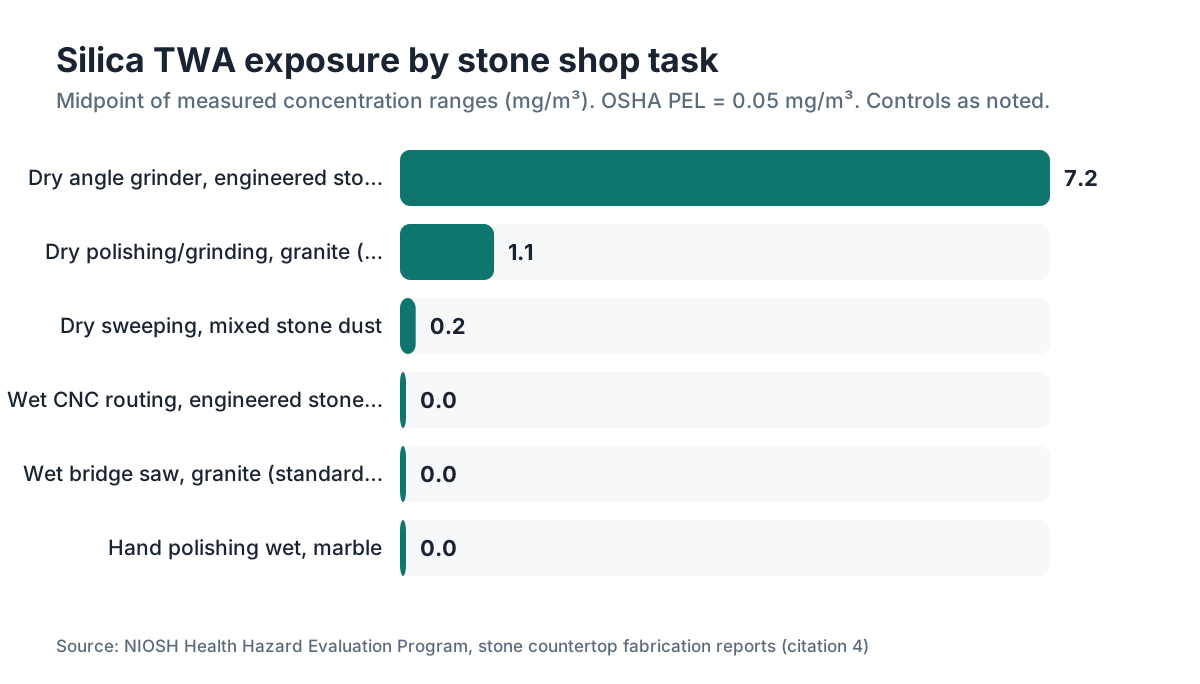
Published NIOSH and Cal/OSHA data give fabricators a real benchmark. The table below sums up measured TWA concentrations for common tasks.
| Task | Material | Typical TWA range (mg/m³) | Controls assumed |
|---|---|---|---|
| Wet bridge saw cutting | Granite | 0.003 to 0.02 | Wet cutting, standard water flow |
| Dry angle grinder | Engineered stone | 0.5 to 14.0 | None |
| Wet CNC routing | Engineered stone | 0.01 to 0.08 | Wet with local exhaust |
| Dry polishing/grinding | Granite | 0.1 to 2.0 | None |
| Hand polishing (wet) | Marble | 0.002 to 0.01 | Water on pad |
| Sweeping (dry broom) | Mixed stone dust | 0.05 to 0.3 | No controls |
Data drawn from NIOSH Health Hazard Evaluation reports and Cal/OSHA enforcement data published through 2023. [4][7] Ranges swing wide based on ventilation, room size, operator technique, and material. Treat them as a map, not a guarantee for your shop.
The single most dangerous act in any shop is dry grinding engineered stone with no local exhaust. Concentrations there can top the PEL by a factor of 100 or more. A bridge saw running steady water flow on granite usually holds exposures well under the AL, which is why wet cutting is OSHA's first recommended engineering control for stone.
Homeowners researching countertop installation, take note. Field installers cutting material dry at your house with no dust extraction face some of the highest short-term exposures in the trade.
What engineering controls reduce silica exposure before monitoring is even needed?
Monitoring tells you where you stand. Controls are what actually protect the worker. OSHA's hierarchy puts engineering controls first and respirators dead last.
Three controls do most of the work in a stone shop: wet methods, local exhaust ventilation, and isolation.
Wet methods kill dust at the source. A bridge saw with adequate water flow, typically 0.5 to 1 gallon per minute at the blade, cuts silica concentrations by 90 percent or more against dry cutting. [4] Flow rate and aim both matter. Water has to hit the cut zone, more than wash across the slab. Plenty of shops choke back water flow to shrink their sludge bill, which throws away the whole benefit.
Local exhaust ventilation (LEV) pulls dust away from the worker before it reaches the breathing zone. For angle grinders and hand tools, OSHA and NIOSH point to a vacuum with HEPA filtration bolted straight to the tool. For CNC machines and edge profilers, on-machine LEV plus enclosure is the standard move. A HEPA vacuum rated for silica filters at least 99.97 percent at 0.3 microns. Your standard shop vac does not.
Isolation means physically separating dusty work from where other people stand. Put the polishing station in the middle of the floor and workers across the room soak up someone else's dust all day. Enclosures, curtains, and traffic routes that steer people away from cutting zones all knock down that secondary exposure.
Respirators are the fallback, not a substitute. If exposures stay above the PEL after engineering controls, OSHA requires a written respiratory protection program under 29 CFR 1910.134, fit-tested half-face or powered air-purifying respirators, and medical clearance for anyone who wears one. [8]
What does a silica monitoring program cost a stone shop?
Cost splits three ways: the hygienist, the lab, and ongoing administration.
A CIH or industrial hygienist runs $150 to $300 an hour for on-site assessment and sampling. A half-day initial visit for a small to mid-size shop (one or two workers doing representative tasks) runs $600 to $1,500 with sample collection included. Lab analysis for silica by NIOSH 7500 runs $30 to $80 per sample at AIHA-accredited labs, and rush turnaround costs more. A first assessment for a shop with five workers in different job classes might need 10 to 15 samples, so lab fees alone land at $300 to $1,200. [6]
If everything comes back below the AL on round one and your wet-cutting controls are strong, first-year cost might be $1,500 to $3,000. If results top the PEL, you're into quarterly sampling, possible engineering upgrades, and medical surveillance (OSHA-required physician exams, chest X-ray or CT, pulmonary function testing) that add $200 to $600 per worker per exam cycle.
OSHA estimated in its 2016 regulatory impact analysis that the annual per-employee compliance cost across general industry averaged roughly $1,000 to $1,500. [9] Stone shops usually run higher, because engineered-stone exposures are elevated and controls often need work.
Here's the math that matters. A workers' comp claim for silicosis, plus the litigation that follows occupational disease, costs orders of magnitude more than a working monitoring program. Do not economize here.
Shops that track operations closely (job types run each day, materials processed, worker hours at each machine) build defensible assessments far faster. Fabrication management software like SlabWise (slabwise.com/demo) can log which jobs ran on which machines, which helps a hygienist pick the right tasks and representative shifts to sample instead of guessing.
How often does a stone shop need to repeat exposure monitoring?
Frequency under 29 CFR 1910.1053 depends on where your measured exposures land against the two thresholds.
Below the action level (< 0.025 mg/m³): no periodic monitoring required, but you need documentation of why you believe exposure stays there. Two consecutive samples below the AL, seven or more days apart, satisfy it. [3]
At or above the AL but below the PEL (0.025 to < 0.05 mg/m³): repeat monitoring at least every six months for each worker in that exposure group.
At or above the PEL (>= 0.05 mg/m³): repeat monitoring at least every three months for affected workers.
You can back off the schedule when two consecutive measurements, at least seven days apart, come in below the next lower threshold. Two consecutive below-PEL quarterly results move you to semi-annual. Two consecutive below-AL semi-annual results let you stop routine monitoring.
But operations change. New materials, new machines, new hires, new tasks, ventilation changes, even seasonal shifts (shutting the shop doors in winter cuts airflow and drives dust up) can push a safe operation over a line. Many hygienists re-sample whenever operations change materially, calendar interval or not.
The 30-year record retention rule is not a typo. Silicosis can surface decades after the last exposure. Courts and workers' comp boards read historical monitoring data to decide whether a shop knew or should have known about overexposure.
What medical surveillance does OSHA require when exposures exceed the action level?
Medical surveillance is a separate requirement from air monitoring, and it fires on the same threshold. OSHA requires you to offer medical surveillance to any worker exposed at or above the AL for 30 or more days a year. [3]
The exam has to be performed by or under the supervision of a PLHCP (physician or other licensed health care professional). It includes:
- A medical and work history focused on respiratory disease and silica exposure
- A physical exam with emphasis on the respiratory system
- A chest X-ray read by a NIOSH-certified B reader, or a low-dose CT scan
- Pulmonary function testing (spirometry)
- Any added tests the PLHCP thinks appropriate
The first exam happens within 30 days of the worker becoming subject to surveillance. Follow-ups run every three years if the worker is under 45, every two years at 45 or older. [3]
You pay for all of it. The worker gets a copy of the written medical opinion. You get only that opinion (fit or not fit, recommended restrictions, conditions needing follow-up), never the underlying medical record. That split matters for HIPAA compliance.
If a PLHCP finds silicosis or another silica-related condition, OSHA does not automatically force job removal, but the written opinion may recommend it. You have to act on those recommendations.
Small shops with part-time crews, do the math carefully. Thirty days at or above the AL is the trigger, and a worker who spends even two hours a day in a dusty area can cross it before you notice.
What are the most common OSHA violations found in stone shops during silica inspections?
OSHA's silica enforcement data and published inspection narratives point to the same failures over and over in fabrication settings. [10]
The most cited violations:
-
No written exposure control plan. Many shops do wet cutting and assume that covers them. The standard requires a written plan no matter what your exposures are.
-
No initial exposure assessment. A shop that has never sampled and has no objective data showing it's below the AL is in violation even if actual exposures happen to be low.
-
Dry sweeping. OSHA flat-out prohibits a dry broom or compressed air to clean silica-containing material when wet cleaning or HEPA vacuuming is feasible. It almost always is.
-
Inadequate LEV on handheld tools. Angle grinders and die grinders used on stone with no attached HEPA vacuum draw citations constantly, especially on install crews.
-
No employee training records. The standard requires annual training on silica health effects, the shop's control measures, and the purpose and results of monitoring. Training has to be documented.
-
Missing or thin recordkeeping. Exposure records that skip required fields (employee ID, sampling method, controls in place at the time) fail the standard even when the sampling itself was done right.
On penalties: OSHA's serious violation penalty as of 2025 runs up to $16,550 per violation, and repeat or willful violations reach $165,514. [11] A shop with five or six separate citation items from a single inspection can face a six-figure penalty proposal.
The upside: a well-documented program, even one showing above-AL exposures, reads as good faith. OSHA inspectors tell the difference between a shop that has data and is working the problem and a shop that ignored the standard cold.
How do stone shops document and manage their silica monitoring records?
OSHA's 30-year retention rule turns recordkeeping into a long-haul job, not a one-time filing. The records have to be transferable. If the shop is sold or closes, records go to a successor employer, or to NIOSH if none exists. [12]
Here's a recordkeeping system that works for a small to mid-size shop.
Keep a sampling log, one row per sample event: date, worker name and ID, task observed, controls in place, pump ID and calibration date, lab sample ID, result in mg/m³, and any corrective action triggered. A spreadsheet is fine as long as it's backed up offsite.
Attach the lab chain-of-custody form and the full analytical report to each event. Labs deliver these as PDFs. Name files with the date and employee ID so you can pull them fast during an inspection.
Keep the written exposure control plan as a version-controlled document with revision dates. Inspectors check whether the plan matches current operations. A plan last touched in 2019 in a shop now running engineered stone is a red flag.
Store medical surveillance records separately from air monitoring records, under HIPAA-compliant controls, with access limited to named people.
Some shops use their fabrication management software to log which materials ran on which days, which supports the hygienist's task analysis. SlabWise tracks job history by material type and machine, and a CIH can cross-reference that against sampling schedules to confirm the sampling days were truly representative.
One practical tip: name one person the silica program manager and write it into their job description. When that person is the owner, and the owner is also running the saw, program maintenance slips.
What resources exist to help small stone shops build a monitoring program?
A handful of free or cheap resources are genuinely useful, more than link bait.
NIOSH's Hierarchy of Controls and its Engineering Controls Database both carry fabrication-specific dust-control guidance. NIOSH has published Health Hazard Evaluation (HHE) reports done inside stone countertop shops, available through the NIOSH HHE program site, that show real sampling data from shops like yours. [4]
OSHA's Small Business Compliance Guide for the Silica Standard gives plain-language summaries and sample written exposure control plan templates. [13] It's the single most useful free document for a shop starting from zero.
AIHA's Exposure Assessment Strategies Committee publishes guidance on similar-exposure group (SEG) sampling, which lets you group workers by task and sample efficiently instead of testing every person. [6] In a 12-person shop where four people run saws, you don't need four simultaneous samples on day one.
State OSHA consultation programs run free confidential on-site consultations with no citations and no fines. The consultant flags hazards and recommends controls. For a shop that has never done any silica work, a free consultation before you hire a CIH is often the right first step. OSHA's On-Site Consultation Program directory is at osha.gov. [14]
For engineered stone specifically, the Silica Safe database maintained by industry groups lists published exposure data by task and control method, and it's a reasonable starting point for an objective-data assessment of wet CNC work.
Don't overlook your workers' comp carrier. Many large WC insurers hand out free loss-control services, including industrial hygiene assessments. Call your agent and ask.
Frequently asked questions
Does a stone shop that only does wet cutting still need a silica monitoring program?
Yes. At minimum you need an initial exposure assessment and a written exposure control plan. Wet cutting drops silica levels hard, and you may be able to use published objective data showing exposures below the action level to satisfy the assessment without live sampling. But you still need documentation that you made that call, and you still need the written plan. Inspectors ask for both.
What is the difference between the silica action level and the PEL?
The action level (AL) is 0.025 mg/m³ as an 8-hour TWA. Cross it and you trigger periodic monitoring and medical surveillance. The permissible exposure limit (PEL) is 0.05 mg/m³. Cross it and you must have engineering controls in place, provide respirators, establish regulated areas, and run monitoring quarterly. Both are set in 29 CFR 1910.1053.
Can a shop owner collect silica air samples themselves, or does it require a certified hygienist?
OSHA requires a competent person, not necessarily a CIH, to run exposure assessments. A competent person has to identify silica hazards and know the sampling method. In practice most small shops are better off hiring a CIH or industrial hygiene technician for at least the initial sampling, because pump calibration errors and bad cassette handling can void your results and leave you with no defensible data.
How long does OSHA require stone shops to keep silica exposure monitoring records?
Thirty years from the date of sampling, per 29 CFR 1910.1020. That's unusually long even for OSHA, and it reflects how late silicosis shows up. If the shop closes or changes hands, records must transfer to a successor employer or go to NIOSH.
What is a similar-exposure group (SEG) and how does it reduce monitoring costs?
A SEG is a group of workers doing the same tasks with the same materials and controls, so they have comparable exposures. Instead of sampling everyone, you sample a representative subset of each group. Four saw operators doing identical wet-cutting work? Sampling two of them the same day can characterize the whole group, cutting lab costs roughly in half against individual sampling.
Are engineered stone (quartz surface) fabricators at higher risk than granite shops?
Yes, by a lot. Engineered stone is 90 to 95 percent crystalline silica by weight, against roughly 25 to 45 percent for granite. NIOSH and CDC data document silicosis clusters specifically among engineered-stone workers in the U.S., Australia, Israel, and Spain. The same OSHA limits apply, but hitting compliance with engineered stone takes more aggressive controls and often tighter monitoring.
What is a written exposure control plan and what must it include?
It's a document listing every task in your shop that can generate silica, the engineering and work-practice controls on each task, the housekeeping rules, the monitoring schedule, the respiratory protection program if it applies, and training requirements. OSHA's Small Business Compliance Guide includes a template. You review and update the plan whenever operations, materials, or controls change.
Does the silica monitoring requirement apply to field installers cutting countertops at job sites?
Yes. Field crews fall under 29 CFR 1926.1153, the construction standard. They can use OSHA's Table 1 path: use a listed control (like a vacuum-attached angle grinder for cutting countertops) exactly as described and you skip air sampling for that task. Deviate from Table 1 methods or do tasks not listed, and air sampling is required.
What happens if OSHA inspects a stone shop and finds no silica monitoring records?
OSHA can cite the shop for failure to conduct an initial exposure assessment, failure to keep a written exposure control plan, and failure to keep records, among other items. Each is a separate serious violation. As of 2025, serious violations carry penalties up to $16,550 each. Repeat or willful violations reach $165,514. A shop with no program at all could face a five- or six-figure penalty proposal from one visit.
Is dry sweeping in a stone shop a violation under the silica standard?
Yes. 29 CFR 1910.1053 prohibits dry sweeping or compressed air to clean surfaces where silica-containing dust is present, when wet cleaning or HEPA vacuuming is feasible. It nearly always is. Dry sweeping is one of the most frequently cited violations during OSHA silica inspections of fabrication shops.
How does medical surveillance relate to air monitoring in a silica program?
Medical surveillance triggers when any worker is exposed at or above the action level (0.025 mg/m³) for 30 or more days a year. The employer pays for exams, which include a chest X-ray or CT, spirometry, and health history. Your air monitoring records identify which workers cross that threshold and how often. Monitoring tells you who needs surveillance and when; the two systems run together.
Can a stone shop use published NIOSH data instead of doing its own air sampling?
Sometimes. OSHA allows 'objective data' to replace direct sampling if it comes from a reliable source and covers tasks, materials, and controls genuinely like yours. Wet bridge-saw cutting of granite has enough published data for this. Dry or semi-dry grinding of engineered stone does not. When in doubt, sample. Objective data that doesn't match your actual conditions gives you no legal protection.
What respirator is required if silica exposures exceed the PEL in a stone shop?
OSHA requires at minimum a half-face air-purifying respirator with N95 or P100 filters for concentrations up to 10 times the PEL. Above that, a powered air-purifying respirator (PAPR) or supplied-air respirator is required. Respirators must be fit-tested, used under a written respiratory protection program per 29 CFR 1910.134, and workers must have medical clearance to wear them.
How does a stone shop qualify as a 'competent person' for silica monitoring under OSHA?
OSHA defines a competent person under the silica standard as someone who, through training and experience, can identify existing and foreseeable respirable crystalline silica hazards and has authority to eliminate or control them. There's no mandatory certification, but the person has to understand sampling methods, pump calibration, and exposure assessment strategy. A shop owner with no industrial hygiene background should hire a CIH for at least the initial assessment.
Sources
- OSHA, Respirable Crystalline Silica in the Stone Countertop Industry: Engineered stone contains 90 to 95 percent crystalline silica by weight; granite contains roughly 25 to 45 percent.
- CDC Morbidity and Mortality Weekly Report, Silicosis in Engineered Stone Countertop Workers, 2022: CDC reported 18 U.S. engineered-stone workers diagnosed with silicosis across multiple states, with median age 45.
- OSHA, 29 CFR 1910.1053, Respirable Crystalline Silica (General Industry): PEL is 0.05 mg/m3 TWA, action level is 0.025 mg/m3 TWA; 30-year record retention required; medical surveillance triggered at or above AL for 30+ days per year.
- NIOSH, Health Hazard Evaluation Program, Stone Countertop Fabrication: Dry angle grinding on engineered stone without controls can produce TWA concentrations of 0.5 to 14.0 mg/m3; wet bridge saw cutting of granite typically yields 0.003 to 0.02 mg/m3.
- NIOSH, Manual of Analytical Methods, Method 7500 (Silica, Crystalline, by XRD): NIOSH Method 7500 uses X-ray powder diffraction to quantify crystalline silica collected on a 37 mm filter cassette at 1.7 L/min.
- American Industrial Hygiene Association (AIHA), Find a Hygienist Directory: AIHA maintains a directory of certified industrial hygienists and publishes exposure assessment strategies guidance including similar-exposure group methodology.
- Cal/OSHA, Division of Occupational Safety and Health: Cal/OSHA enforcement actions and published exposure data confirm elevated silica concentrations in engineered-stone fabrication shops.
- OSHA, 29 CFR 1910.134, Respiratory Protection: When engineering controls cannot reduce exposures below the PEL, a written respiratory protection program, fit testing, and medical clearance are required.
- OSHA, Final Rule to Protect Workers from Exposure to Respirable Crystalline Silica (2016 regulatory impact analysis): OSHA estimated annual per-employee compliance cost for general industry averaged roughly $1,000 to $1,500.
- OSHA, Enforcement Data and Inspection Narratives, Silica Standard: Most common silica violations in stone shops include no written exposure control plan, no initial exposure assessment, dry sweeping, and missing employee training records.
- OSHA, Penalties, Occupational Safety and Health Administration: As of 2025, OSHA serious violation penalties are up to $16,550 per violation; willful or repeat violations reach $165,514.
- OSHA, 29 CFR 1910.1020, Access to Employee Exposure and Medical Records: Exposure monitoring records for substances with a 30-year retention requirement must be transferred to NIOSH if no successor employer takes them.
- OSHA, Small Entity Compliance Guide for the Respirable Crystalline Silica Standard for General Industry: OSHA's compliance guide provides plain-language requirement summaries and sample written exposure control plan templates.
- OSHA, On-Site Consultation Program: OSHA's free confidential on-site consultation program provides hazard assessments with no citations or penalties; available in all 50 states.
Last updated 2026-07-11