TL;DR
- Stone countertop fabrication shops fall under OSHA's general industry and construction standards, but one rule dominates: 29 CFR 1910.1053, the respirable crystalline silica standard.
- The permissible exposure limit is 50 µg/m³ as an 8-hour time-weighted average.
- Shops must also handle machine guarding, noise, hazard communication, respiratory protection, and electrical safety.
- OSHA has targeted stone fabrication specifically since 2015.
Why does OSHA pay special attention to stone fabrication shops?
Stone shops cut, grind, polish, and profile natural stone and engineered quartz. Every one of those operations throws fine dust into the air, and that dust carries crystalline silica. Engineered quartz can run 90 percent or more silica by weight [1]. Granite is around 25 to 30 percent. Marble is under 2 percent. The material you cut most decides how dangerous your air is.
Silica causes silicosis, a lung disease that gets worse over time and never reverses. OSHA and NIOSH both flag stone fabrication as a high-priority industry because young workers are developing accelerated silicosis, sometimes after fewer than five years on the job, instead of the decades-long buildup seen in older industrial cases [2]. Fabricators in their 20s and 30s have died in the U.S. and Australia.
OSHA named stone fabrication in a 2015 National Emphasis Program on silica. That focus stuck after the final silica rule landed in 2016. The agency still runs Regional Emphasis Programs in states like California, Texas, and Florida where shops cluster, and it does both programmed (random) and unprogrammed (complaint-driven) inspections. Run a fab shop, and assume OSHA already knows your trade cold.
What is the OSHA silica standard for fabrication shops, and what does it require?
The rule that governs you is 29 CFR 1910.1053, OSHA's respirable crystalline silica standard for general industry. It took effect June 23, 2018 for most shops [3]. Work that OSHA classifies as construction, like installing countertops at a job site, falls under the parallel construction standard at 29 CFR 1926.1153 instead.
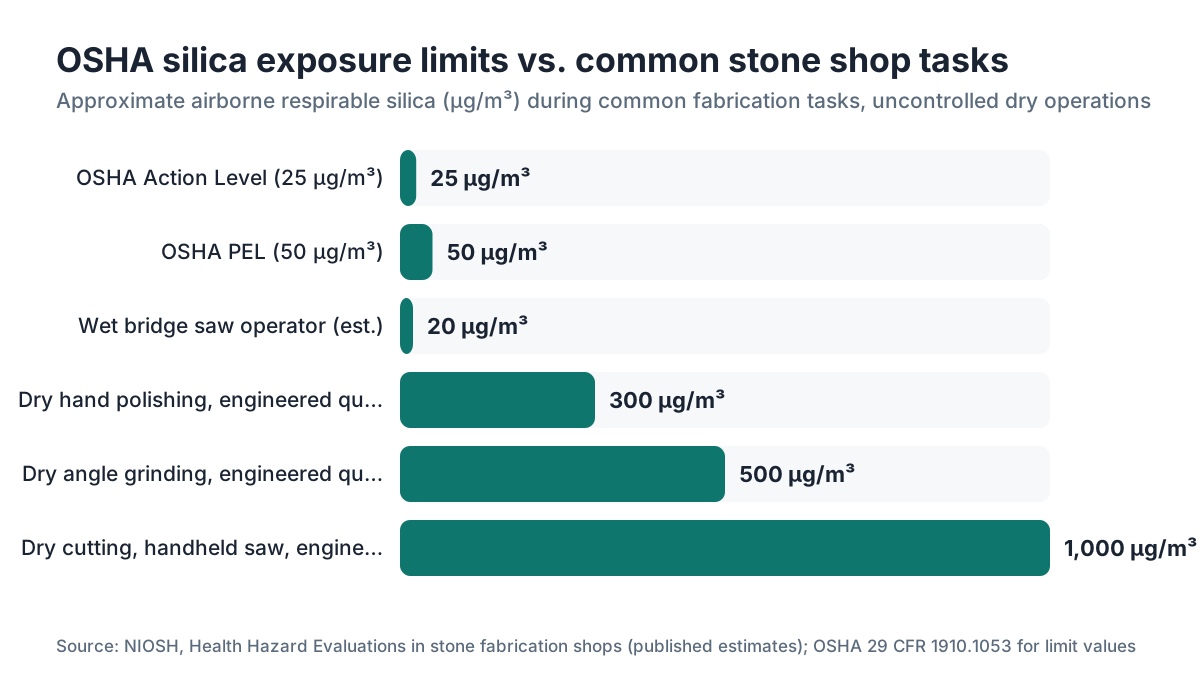
The permissible exposure limit is 50 micrograms of respirable crystalline silica per cubic meter of air (50 µg/m³) as an 8-hour time-weighted average. The action level, which triggers most monitoring and medical surveillance requirements, is 25 µg/m³ as an 8-hour TWA [3].
Here is what the standard actually makes you do:
Exposure assessment. You have to determine each worker's exposure. Use air monitoring, or use objective data (manufacturer data, published studies) that show your specific task stays reliably below the action level. Most dry cutting or grinding in a stone shop can't be waved off without monitoring.
Engineering and work practice controls. The hierarchy matters. Engineering controls come first: wet methods (water suppression during cutting, grinding, and polishing), local exhaust ventilation (LEV) at the tool, or enclosed work areas. Wet saw cutting is the workhorse control in most shops. A well-run wet bridge saw can drop silica exposure below the action level with no respirator needed.
Respiratory protection. When engineering controls alone can't hold exposure at or below the PEL, you provide respirators. NIOSH-approved N95 filtering facepieces are the minimum for exposures up to 5 times the PEL (250 µg/m³). Above that, you need a half-face or full-face supplied-air respirator. Respirators are the fallback under the hierarchy, not the plan.
Written exposure control plan. The standard requires a written plan that lists the tasks involving silica exposure, the engineering controls and work practices in use, and the housekeeping procedures.
Housekeeping. Dry sweeping is banned. So is blowing silica dust off with compressed air. You wet sweep, vacuum with HEPA filtration, or use methods that don't kick settled dust back into the air.
Medical surveillance. Any worker exposed at or above the action level for 30 or more days a year must be offered medical surveillance every three years, starting within 30 days of first assignment. The exam covers medical and work history, a physical, and a chest X-ray read by a NIOSH-certified B reader [3].
Training. Affected workers learn the health hazards of silica, the tasks and spots that create exposure, the controls in use, how to use and maintain respirators, and how the medical surveillance program works.
How does OSHA's silica rule apply differently to dry versus wet operations?
Wet versus dry is the biggest operational split under the silica rule. Get this one right and most of the rest follows.
A wet bridge saw with steady water feed at the blade keeps airborne silica well below the action level for the operator in most published studies. OSHA's Table 1 in the construction standard (1926.1153) lists wet methods for handheld grinders and saws as a compliant control, which means no monitoring is required if you follow the specified water delivery rates. The general industry standard (1910.1053) has no equivalent Table 1, so shops lean on the same logic and back it with their own air monitoring data.
Dry operations are a different animal. Dry angle grinding, dry polishing, dry core drilling, and dry cutting with handheld tools can push silica in the breathing zone to 10 to 100 times the PEL [2]. These tasks nearly always need LEV at the tool (a HEPA vacuum plumbed straight to the grinder or saw) plus respiratory protection. No wet method covers every task in a shop, so LEV-equipped tools aren't optional.
Here's the part that surprises shops: even wet saws throw mist that carries silica particles. The person feeding slabs, the person pulling cut pieces, and anyone standing nearby can still breathe it. Wet doesn't mean zero. It means much less, and for saw operators specifically it usually means staying below the action level.
What other OSHA standards apply beyond silica?
Silica eats most of the enforcement attention, but it's far from your only exposure. A real compliance review touches several other standards.
Hazard Communication (29 CFR 1910.1200). This is OSHA's HazCom or 'Right to Know' rule. Every shop keeps Safety Data Sheets (SDS) for all hazardous chemicals: stone dust (quartz, cristobalite), adhesives, resins, solvents, polishing compounds, epoxies. Workers get trained on chemical hazards, SDS locations, and what labels mean. HazCom is one of OSHA's most-cited standards across every industry [10].
Machine Guarding (29 CFR 1910.212 and 1910.213). Bridge saws, CNC routers, edge profilers, and waterjets all have moving parts that need guarding. The general machine guarding rule says any machine part or process that can cause injury must be safeguarded. Missing blade guards, unguarded nip points on conveyor infeed tables, and exposed CNC toolpaths during setup show up again and again in citations.
Noise (29 CFR 1910.95). Bridge saws and CNC routers can hit 90 to 100 dB or more at the operator. OSHA's action level is an 8-hour TWA of 85 dB(A), which triggers a Hearing Conservation Program. The PEL is 90 dB(A) as an 8-hour TWA [11]. Loud shops have to monitor noise, provide audiometric testing, offer hearing protectors, and train workers.
Electrical Safety (29 CFR 1910.303 and related). Wet shops carry real electrical risk. Water and electricity together at saw tables and polishing stations mean shock and electrocution hazards. GFCI protection is required for receptacles near water. Electrical panels stay accessible (36-inch clearance), and lockout/tagout applies before any maintenance on powered gear.
Lockout/Tagout (29 CFR 1910.147). Any time a worker services or maintains equipment, stored energy has to be controlled. In a fab shop that means CNC machines, bridge saws, edge profilers, and waterjet pumps. You need a written energy control program with machine-specific procedures and annual audits [12].
Personal Protective Equipment (29 CFR 1910.132). You assess PPE hazards in writing, pick the right PPE, provide it at no cost (for most PPE), and train workers on it. In a stone shop that usually means safety glasses or face shields, cut-resistant gloves for stone edges, steel-toed footwear, and hearing protection.
Forklift and Material Handling (29 CFR 1910.178). Most shops move slab bundles with forklifts or pallet jacks. Forklift operators need documented training and an evaluation before they run a powered industrial truck. A-frame slab racks that tip are a serious struck-by hazard.
Walking-Working Surfaces (29 CFR 1910.22). Floors stay clean, dry where you can manage it, and clear of trip hazards. Saw water needs drainage. Slabs leaning on walls or A-frames must be secured so they can't fall.
What are the actual OSHA penalties if a shop gets cited?
OSHA raises its penalty caps every year for inflation. As of 2024, a serious violation tops out at $16,131 per violation [4]. A willful or repeated violation can reach $161,323 per violation [4]. Other-than-serious violations also cap at $16,131 but often get reduced.
Here's how it plays out. A single inspection of a shop that has ignored silica can produce a stack of citations: no written exposure control plan, weak housekeeping controls, no medical surveillance, inadequate respiratory protection. They add up fast. Layer on HazCom for missing SDS documents and a machine guarding cite for an unguarded polisher, and $50,000 to $150,000 in proposed penalties before reductions is an ordinary result, not a worst case.
Reductions exist. Shops under 25 employees can get a 60 percent cut. Good-faith effort and clean history knock more off. Informal settlement conferences often trim proposed penalties by 30 to 50 percent for employers who fix violations quickly. But the opening number for a non-compliant shop in a silica inspection is never small.
Does OSHA treat fabrication differently from countertop installation at a job site?
Yes, and the line is worth knowing. It changes which standard your crew answers to.
Work inside the shop (cutting, grinding, polishing, templating) falls under OSHA's general industry standards, mainly the 29 CFR 1910 subparts. The silica rule there is 1910.1053.
Work at the customer's home or a construction site (delivery, installation, any field cutting or grinding) falls under the construction standards, 29 CFR 1926. The construction silica rule is 1926.1153, and it carries one big difference: Table 1, a list of specific tasks with specified controls (tool-mounted wet suppression or LEV) that, if you follow them exactly, mean no air monitoring is required and workers count as compliant no matter the measured level [9].
Plenty of shops both fabricate and install. Shop employees sit under general industry. Installation crews, if they make field cuts with angle grinders or handheld saws, sit under construction. A two-man shop that fabricates all week and installs on Fridays is covered by both standards, and which one applies depends on the day and the task you're auditing.
For countertop installation work specifically, Table 1 is the cleanest compliance path for handheld saw cutting: use a saw with an integrated water delivery system, feed water to the blade continuously, and run a backup vacuum system. Follow the prescribed controls exactly and you skip monitoring.
How does OSHA enforce silica rules in stone shops? What happens during an inspection?
OSHA inspections in stone shops are either programmed (pulled from a targeted industry list or a national or regional emphasis program) or unprogrammed (kicked off by a complaint, referral, or fatality). Stone fabrication has sat on OSHA's radar under the National Emphasis Program on silica since at least 2015, so a programmed inspection can land even when nobody complained.
At the opening conference, the compliance officer asks to see your written silica exposure control plan, your SDS binder, your respiratory protection program (29 CFR 1910.134), your medical surveillance records (proof workers were offered exams, not that they accepted), and your training records. Coming up empty on any of these at the door sets a bad tone for the whole visit.
The walkaround usually zeroes in on what tasks create silica dust, what controls are actually running (watching the saw, checking water delivery), whether anyone's dry sweeping, PPE in use, machine guards, electrical conditions in wet areas, and housekeeping. The officer may take air samples during the walkaround or ask for your own historical monitoring data.
Citations arrive by mail after the inspection, usually within six months. You get 15 working days to contest. Do nothing and the citations become final orders. Most shops find it worth calling an OSHA attorney or a safety consultant before they contest or settle, because the informal conference can knock down penalties meaningfully when you show genuine good-faith correction.
What is a written silica exposure control plan, and what must it include?
29 CFR 1910.1053(f) requires employers to establish and implement a written exposure control plan for silica. This isn't optional even if you're sure your exposures are low. The plan has to be in writing, available to workers, and reviewed at least once a year or whenever tasks, processes, or controls change [3].
At a minimum the plan identifies each task that involves potential silica exposure (saw cutting, dry grinding, CNC routing, edge profiling, demolition of existing stone), the engineering controls and work practices used for each task, the housekeeping methods, and the respiratory protection program if respirators are in play.
Most shops find it easier to keep air monitoring results, medical surveillance records, and training logs in the same binder, even though those are technically separate recordkeeping duties. One binder makes inspections go smoother and shows you're running a system, not a scramble.
OSHA publishes a model written exposure control plan on its silica topic page [3]. It's a fair starting point. Customize it with your shop's real machines, tasks, and controls. Printing OSHA's generic example and calling it done is exactly the kind of shortcut a compliance officer spots in about ten seconds.
Do state OSHA plans apply instead of federal OSHA in some states?
Yes. Twenty-two states and two territories run their own OSHA-approved State Plans that cover private-sector employers instead of federal OSHA [5]. In those places, the state agency enforces the rules, not the feds.
State plans have to be 'at least as effective as' federal OSHA, and they can be stricter. California's Division of Occupational Safety and Health (Cal/OSHA) is the one that matters most for stone fabrication, because the state holds a large share of the country's shops and has historically set tighter exposure limits and extra requirements.
California adopted its own silica standard (Title 8, Section 5155 and related sections) that predates the federal rule and has been pushed harder in some respects [6]. Cal/OSHA has gone after artificial stone (engineered quartz) fabricators directly after reported silicosis cases. If you operate in California, Hawaii, Michigan, Minnesota, Nevada, Oregon, Washington, or another state plan state, your state agency regulates you, not federal OSHA. Find your plan at OSHA's state plan directory.
Federal OSHA covers the remaining states plus federal employees everywhere. The rules mostly match or closely mirror the federal standards, but check with your state agency for anything they've added on top.
What engineering controls are most effective in a stone fabrication shop?
The controls that actually work in a stone shop, ranked by evidence and by how practical they are day to day:
1. Wet cutting at a bridge saw. A well-maintained wet bridge saw with continuous water flow to the blade is your single highest-impact control. Sampling data consistently puts bridge saw operators at or below the action level when they use continuous wet methods. Continuous is the operative word. Intermittent water, clogged nozzles, or a pump somebody shuts off to 'save time' doesn't give you the same protection.
2. LEV on handheld tools. Angle grinders, hand polishers, and trim saws used for detail work away from the wet saw need LEV, meaning a HEPA vacuum tied to the tool's dust port or a vacuum shroud around the disc. Tool-mounted vacuums can cut airborne silica by 90 percent or more compared to uncontrolled dry grinding [2].
3. Water misting at CNC routers and edge profilers. Most modern CNC bridge saws and edge profilers come with integrated water delivery. Older machines may need a retrofit. Worth the money for any shop moving real engineered quartz volume.
4. Enclosed work areas with negative pressure. Bigger shops sometimes build dedicated grinding rooms with negative pressure and HEPA exhaust. This protects everyone else in the building even while the tool controls do their job.
5. HEPA vacuum housekeeping. Dust settles after every cut and grind. A HEPA shop vacuum instead of a broom stops that dust from getting airborne again. It's cheap and it's simple. Finding dry sweeping in a stone shop in 2026 has no excuse.
A shop running granite countertops, marble countertops, or engineered quartz carries a different silica load for each material, but the controls don't change. Engineered quartz is the highest-risk material by silica content, so treat it with your strictest controls no matter what else is in the mix.
What records does OSHA require a stone shop to keep, and for how long?
Different standards carry different retention clocks. Here's a working summary for stone fab shops:
| Record | Standard | Retention |
|---|---|---|
| Air monitoring results (silica) | 29 CFR 1910.1053(h)(1) | 30 years |
| Medical surveillance records (silica) | 29 CFR 1910.1053(h)(2) | Duration of employment + 30 years |
| Written exposure control plan | 29 CFR 1910.1053(f) | Current version; annual review |
| Audiometric test records | 29 CFR 1910.95(m) | Duration of employment |
| Injury and illness log (Form 300) | 29 CFR 1904 | 5 years |
| Training records (respiratory protection) | 29 CFR 1910.134(m) | 1 year |
| Lockout/tagout program | 29 CFR 1910.147(c)(4) | Current; review after incidents |
| Forklift operator training | 29 CFR 1910.178(l) | 3-year evaluation cycle |
The 30-year retention on silica monitoring and medical records is the one that catches owners flat-footed. Close the business after 20 years and the recordkeeping duty still follows the employees. OSHA requires these records to be transferred to NIOSH or made available to employees and OSHA on request even after the employer stops existing [3].
All OSHA records go to workers and their designated representatives on request. Medical records go to the worker and to OSHA or NIOSH, but not to the employer without the worker's written consent.
How should a shop owner prioritize OSHA compliance if they are starting from scratch?
If your shop has done nothing formal, work in this order, ranked by enforcement risk and by what actually hurts people:
First: silica. Start with an exposure assessment. Hire an industrial hygienist to sample air during your real production tasks, or gather published data specific to your equipment and tasks. Check whether the wet system on your bridge saw is doing its job. Make sure your CNC and edge profiler have working water delivery. Kill dry sweeping today. Write or grab a basic exposure control plan.
Second: hazard communication. Pull SDS documents for every chemical and material in the shop. Confirm the container labels match the SDS. Train your people. A day of work, near zero cost.
Third: machine guarding. Walk every machine. Check that blade guards are on and working. Hunt for exposed nip points on conveyors. Test the emergency stops.
Fourth: electrical safety. Confirm GFCI protection in wet areas. Confirm panel clearances. If an electrician has never reviewed your layout, get one in.
Fifth: LOTO procedures. Service your own equipment and lockout/tagout is required. Write machine-specific procedures for each powered machine.
Shops that tighten operations alongside safety usually find the two feed each other. Software that tracks job production, material usage, and shop scheduling cuts the chaos that makes cutting safety corners tempting. SlabWise, for one, ties quoting and production tracking together in a way that reduces rushed job changeovers, which is often exactly when shortcuts and injuries happen. (Demo at slabwise.com.)
Prioritizing this way doesn't mean you ignore noise, forklifts, or PPE. It means you tackle the hazards most likely to kill or seriously hurt someone first, which happen to be the ones OSHA cites first too.
What resources does OSHA provide to help stone fabrication shops comply?
OSHA funds a free consultation service through state agencies that is walled off from enforcement. A consultant comes to your shop, runs a hazard survey, and hands you written recommendations. No citations, no penalties [7]. Shops with fewer than 250 employees on-site qualify. It's genuinely useful and badly underused in this industry.
OSHA's silica topic page (osha.gov/silica) carries sample exposure control plan templates, guidance built for engineered stone specifically, and links to NIOSH health hazard evaluations done at stone fabrication shops [8]. Those HHEs include real air sampling data from shops like yours, which helps you set expectations before you spend money on your own monitoring.
NIOSH also keeps a page on artificial stone silicosis with surveillance data and clinical guidance, relevant the moment you're dealing with a worker who may have been overexposed [2].
Stone industry groups, including the Natural Stone Institute (which absorbed the old Marble Institute of America), have published compliance guides and can point owners to safety consultants who know stone fabrication. Reach these before your first inspection, not after.
California shops get Cal/OSHA's own consultation service (the DOSH Consultation unit), also free and separate from enforcement. Given California's extra strictness on engineered quartz, that one is especially worth using [6].
Frequently asked questions
What is the OSHA permissible exposure limit for silica in a stone shop?
The OSHA PEL for respirable crystalline silica is 50 micrograms per cubic meter of air (50 µg/m³) as an 8-hour time-weighted average under 29 CFR 1910.1053. The action level, which triggers air monitoring and medical surveillance requirements, is 25 µg/m³. Engineered quartz cutting can produce exposures many times higher than these limits without proper wet cutting or LEV controls.
Does a small stone shop with only a few employees have to follow the silica standard?
Yes. The silica standard under 29 CFR 1910.1053 applies to all employers covered by OSHA, regardless of size. There is no small-employer exemption from the rule itself. Small employers do get penalty reductions if cited (up to 60 percent for shops with fewer than 25 employees), and OSHA's free consultation program is built for small businesses. But the exposure limits and required controls apply fully.
Is wet cutting enough to make a stone shop compliant with OSHA silica rules?
For bridge saw operators, properly maintained wet cutting typically holds silica exposure at or below the action level, and that covers the most exposure-intensive single task in most shops. But it does nothing for dry grinding, dry edge profiling, CNC dry work, or housekeeping. A complete program also requires a written exposure control plan, medical surveillance for exposed workers, HEPA vacuuming, and training, even with a fully wet saw.
What does OSHA consider 'engineered stone' and why is it treated differently?
OSHA and NIOSH use 'engineered stone' or 'artificial stone' for quartz-based composite countertop materials sold under brand names like Cambria and Silestone. These products are typically 90 percent or more crystalline silica by weight, against 25 to 30 percent for granite. OSHA issued guidance in 2023 targeting engineered stone fabrication because of the accelerated silicosis cases tied to this material.
What respirator is required for grinding or cutting engineered quartz countertops?
For exposures at or below 5 times the PEL (250 µg/m³), a NIOSH-approved N95 filtering facepiece is the minimum. Above that level, you need a half-face or full-face air-purifying respirator with P100 filters, or a supplied-air respirator. Respirators must be fit-tested, chosen based on exposure level, maintained, and used within a written respiratory protection program under 29 CFR 1910.134. Surgical masks do not count.
Can OSHA inspect a stone shop without advance notice?
Yes. OSHA inspections are almost always unannounced. Advance notice is generally prohibited under the OSH Act except in very limited circumstances. Programmed inspections targeting stone fabrication can arrive any day. If you operate under a state plan, that agency has the same authority. Tipping off an employer before an OSHA inspection is a violation that can bring criminal penalties for the person who gives the warning.
How often does OSHA require medical exams for workers exposed to silica dust?
Any worker exposed at or above the action level (25 µg/m³) for 30 or more days per year must be offered medical surveillance within 30 days of initial assignment and then every three years. The exam includes a medical and work history, a physical focused on the respiratory system, and a chest X-ray read by a NIOSH-certified B reader. Workers with silicosis or other silica-related conditions may need more frequent evaluation.
What are the most common OSHA violations found in stone fabrication shops?
Based on OSHA inspection history and published enforcement data, the most common violations involve no written silica exposure control plan, weak engineering controls for silica (dry grinding without LEV), dry sweeping, missing or incomplete SDS documents under HazCom, missing or inadequate machine guards on saws and polishers, and no GFCI protection in wet areas. Silica violations lead both in frequency and in penalty dollars.
Does OSHA require air monitoring in every stone fabrication shop?
Not necessarily. The standard requires employers to assess worker exposures, and that can come from air monitoring or from objective data showing exposures stay reliably below the action level. If published data, task similarity, and equipment specs credibly show exposures below 25 µg/m³, monitoring isn't strictly required. In practice, shops doing any dry grinding or cutting of engineered quartz rarely dodge monitoring without real data from similar operations.
What is the difference between OSHA standards for the fabrication shop versus the job site installation?
Shop work falls under general industry standards (29 CFR 1910), including silica rule 1910.1053. On-site installation falls under construction standards (29 CFR 1926), including silica rule 1926.1153. The construction standard has Table 1, which lets employers skip air monitoring for specific tasks if prescribed controls are followed exactly. The general industry standard has no such table, so shop-side compliance leans harder on monitoring data and engineering control documentation.
Are there OSHA training requirements specific to stone fabrication workers?
The silica standard (1910.1053(i)) requires training before initial assignment and again when new silica-related tasks come in. Training covers the health hazards of silica, the specific tasks and locations that generate it, the engineering controls and work practices in place, respirator use and limits, and the medical surveillance program. It must be in a language and at a literacy level the worker understands. Keep records for at least one year.
What should a fabrication shop do if a worker is diagnosed with silicosis?
Refer the worker to a physician for clinical management right away and make sure they get the medical surveillance required under 1910.1053. Investigate the tasks and exposure levels that led to the diagnosis as a serious exposure event, and reassess your engineering controls. Under 29 CFR 1904, silicosis is a recordable illness on the OSHA 300 log. Depending on severity and hospitalization, it may be reportable to OSHA within 24 hours.
Does OSHA regulate the noise from bridge saws and CNC machines in a stone shop?
Yes. The noise standard at 29 CFR 1910.95 applies. The action level is 85 dB(A) as an 8-hour TWA, and the PEL is 90 dB(A). Bridge saws and CNC machines typically run 90 to 100 dB at the operator. Shops must monitor noise, put in feasible engineering controls (enclosures, isolation), and run a Hearing Conservation Program with audiometric testing and hearing protectors when exposures reach the action level.
What is OSHA's free consultation service and how does a stone shop use it?
OSHA funds a free, confidential consultation program run by state agencies, separate from enforcement. A consultant visits the shop, finds hazards, and gives written recommendations. No citations, no penalties. Shops with fewer than 250 employees on-site qualify. To request a visit, contact your state's OSHA consultation program through the directory at osha.gov. It's one of the most cost-effective compliance resources a small shop has.
Sources
- OSHA, Engineered Stone Countertops and Silicosis: Engineered quartz countertops can contain 90 percent or more crystalline silica by weight, making them a high-silica exposure material in fabrication.
- NIOSH, Artificial Stone Silicosis Surveillance: Workers fabricating artificial stone (engineered quartz) have developed accelerated silicosis in under five years, and dry grinding without LEV produces silica exposures many times the PEL.
- OSHA, 29 CFR 1910.1053 Respirable Crystalline Silica (General Industry): The PEL is 50 µg/m³ and the action level is 25 µg/m³ as 8-hour TWAs; the standard requires written exposure control plans, medical surveillance, training, and recordkeeping.
- OSHA, Penalties: As of 2024, the maximum penalty for a serious OSHA violation is $16,131 per violation, and willful or repeated violations can reach $161,323 per violation.
- OSHA, State Plans: Twenty-two states and two territories operate OSHA-approved State Plans that cover private-sector employers instead of federal OSHA.
- California Department of Industrial Relations, Cal/OSHA: California operates its own occupational safety program (Cal/OSHA) which has specifically targeted artificial stone fabricators following reported silicosis cases.
- OSHA, On-site Consultation Program: OSHA's free consultation program allows small employers to receive hazard assessments and compliance recommendations from state-funded consultants with no citations or penalties.
- OSHA, Silica Topic Page: OSHA's silica topic page provides sample exposure control plan templates, industry-specific guidance for engineered stone, and links to NIOSH health hazard evaluations.
- OSHA, 29 CFR 1926.1153 Respirable Crystalline Silica (Construction): The construction silica standard includes Table 1 which specifies tasks and controls that, if followed exactly, exempt employers from air monitoring requirements for those tasks.
- OSHA, 29 CFR 1910.1200 Hazard Communication: The HazCom standard requires employers to maintain SDS for hazardous chemicals and train workers on chemical hazards, and is among OSHA's most frequently cited standards.
- OSHA, 29 CFR 1910.95 Occupational Noise Exposure: OSHA's noise standard sets an action level of 85 dB(A) and a PEL of 90 dB(A) as 8-hour TWAs, requiring a Hearing Conservation Program when the action level is reached.
- OSHA, 29 CFR 1910.147 Lockout/Tagout: The lockout/tagout standard requires written energy control programs and machine-specific procedures for any equipment that undergoes servicing or maintenance.
- OSHA, OSH Act of 1970: The OSH Act prohibits advance notice of OSHA inspections and provides enforcement authority regardless of employer size.
Last updated 2026-07-11