TL;DR
- Most countertop fabricators quote with one of four tools: Moraware (the market leader), Stone Profit Systems, CAD-linked software like Slabsmith or Prodim, or a heavily customized spreadsheet.
- Dedicated software runs roughly $100 to $500+ per month.
- Each fixes a different pain.
- The right pick depends on your job volume, how complex your slab inventory is, and whether you template digitally.
Why does quoting software matter so much in stone fabrication?
A countertop quote is more than a price. It's a slab yield calculation, a labor estimate, an edge profile decision, a cutout count, and a margin check, all folded into one number the customer sees in thirty seconds. Get it wrong and you either lose the job or lose money on it.
Spreadsheets can technically do all of that. They just don't scale. A shop running 20 jobs a week off a shared Google Sheet is one bad formula away from a $2,000 mistake. Dedicated quoting software builds the math in, ties it to your material costs, and lets estimators who aren't the owner produce accurate quotes without stopping to ask anyone.
Then there's speed. Homeowners shopping kitchen countertops expect a ballpark same day, sometimes same hour. A shop that can email a detailed quote while the competitor is still measuring closes more jobs. That's the whole game.
For fabricators the software category bleeds into job management, templating, and shop scheduling too, so the quoting tool is usually the first piece of a bigger system.
What are the most widely used countertop quoting platforms?
The fabrication industry isn't huge, so neither is the software market. Maybe a dozen tools have real adoption. Here's how they sort out.
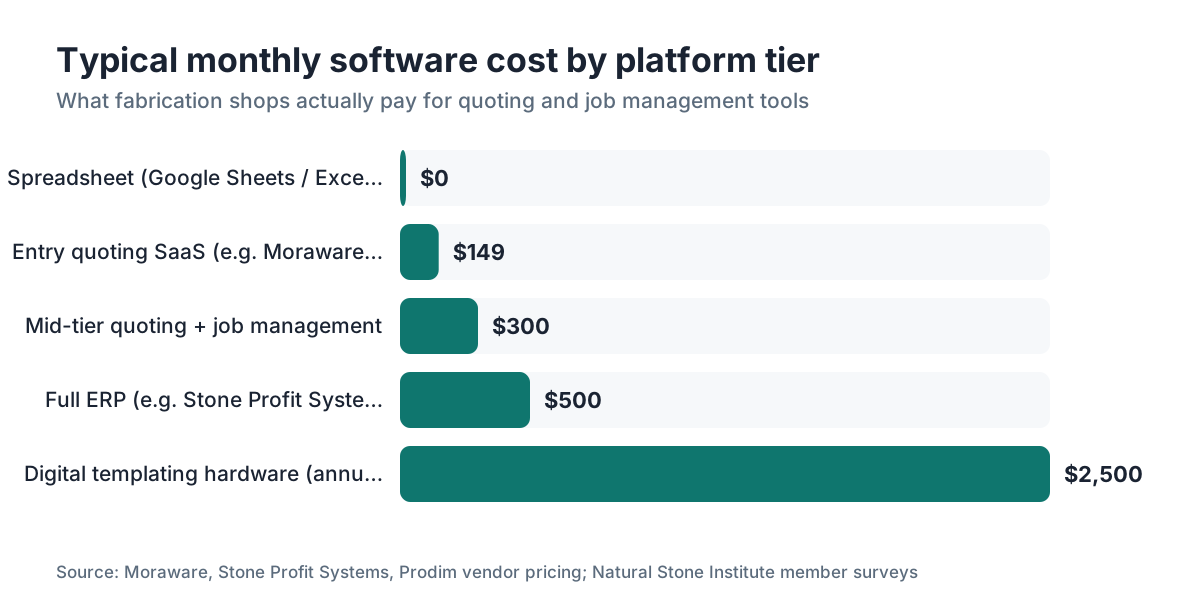
Moraware is the closest thing to an industry standard. It handles quoting, job tracking, scheduling, and customer communication in one browser-based system. Pricing is subscription-based and tiered by shop size, starting around $149/month for smaller operations and rising to $300 to $500/month for larger shops with multiple users and locations. Moraware doesn't publish exact pricing and quotes per shop [1]. The quoting module lets you build price lists for materials, edges, cutouts, and sinks, then apply them to a job fast.
Stone Profit Systems (SPS) targets mid-to-large fabricators who want tight integration between quoting, inventory, and accounting. It costs more than Moraware and has a steeper learning curve. Shops with serious slab inventory needs often prefer it anyway, because SPS connects remnants, purchase orders, and job costing in ways Moraware doesn't [2].
Slabsmith is mainly a slab photography and layout tool, but plenty of shops pull it into the quoting stage to show a customer the exact veining they'll get from a specific slab. It's not a quoting engine on its own. Shops pair it with Moraware or a spreadsheet.
Prodim makes digital templating hardware (the Proliner) and software. The quoting link is indirect: accurate digital templates cut waste, which tightens your material cost estimates. Some larger shops run Prodim output straight into their quoting workflow for more precise slab usage numbers.
Custom Excel or Google Sheets probably still handle the majority of quotes at small shops, especially those under 10 jobs a week. No shame in that. A well-built spreadsheet can be genuinely accurate. The limits are version control, multi-user editing, and the missing customer-facing output.
A newer group of browser-based tools, including SlabWise, targets fabricators who want quoting plus automated nesting in one place, without the implementation overhead of SPS or the scheduling-first architecture of Moraware. Worth a look if you're starting fresh or outgrowing a spreadsheet.
| Platform | Primary strength | Typical monthly cost | Best fit |
|---|---|---|---|
| Moraware | Job flow + scheduling | ~$149 to $500 | Most shops, 5 to 50 jobs/week |
| Stone Profit Systems | Inventory + accounting | $300 to $700+ | High-volume, multi-location |
| Slabsmith | Slab layout + visual sales | ~$100 to $200 | Any shop wanting visual quotes |
| Prodim (Proliner) | Digital templating | Hardware + software package | Shops with templating in-house |
| Spreadsheet | Custom, free | $0 | Under 10 jobs/week |
| SlabWise | Quoting + nesting | Contact for pricing | Shops needing both in one tool |
How do fabricators calculate the price per square foot in a quote?
The core math in any quote is material plus labor plus overhead plus margin. Quoting software automates that formula and applies it the same way every time. That consistency is most of the value.
Material cost starts with slab price. A fabricator pays a wholesale price per slab (or per square foot from a distributor), and that swings hard by stone type. Granite countertops at the entry level might cost a fabricator $8 to $15 per square foot of slab. Exotics and marble countertops can run $30 to $100+ wholesale. The software needs a current, accurate price list to give good numbers.
Slab yield matters here too. Stone isn't sold by the finished square foot. It's sold by the slab, and every slab has waste: cutouts for sinks and cooktops, edge strips that get trimmed, corners you can't use. Typical yield for natural stone runs 70 to 85% of gross slab area depending on layout complexity, per the Natural Stone Institute's reference manual [3]. Software that models yield builds this waste factor in automatically. Spreadsheets often miss it or slap on a flat percentage and hope.
Labor is the other big variable. Edge profiles, sink cutouts, cooktop cutouts, mitered edges, radius corners, they all eat time. A basic eased edge costs far less than a full bullnose or a waterfall mitered edge. Good quoting software carries a line-item cost for each one, set by the owner based on real labor time and hourly rate.
Overhead (rent, equipment depreciation, utilities, insurance) usually gets baked in as a percentage markup or a flat shop rate per job. Margin on top is the owner's call. Most fabricators target 30 to 50% gross margin on countertop work, though actual numbers vary widely and shops rarely publish them.
Homeowners, here's what that means for you. The installed price you see, typically $40 to $200+ per square foot for natural stone, reflects every one of those layers. The national average installed price for granite is roughly $75 to $125 per square foot, according to contractor cost guides [4][9].
Can homeowners use countertop quoting tools to estimate their own project?
Not really, at least not the fabricator-side platforms. Moraware, SPS, and their peers are shop management systems. They aren't public calculators.
What you can do: many fabricator websites now embed a basic quote estimator, either custom-built or powered by a third-party widget. These ask for rough square footage, material type, edge profile, and cutout count, then spit out a ballpark range. Useful for setting a budget. Not the same as a real quote.
For a real number, a fabricator has to template or at least measure your kitchen. Homeowner self-measurements are almost always off, sometimes by 10 to 20%, because the standard countertop calculation includes overhangs, returns, and a per-piece minimum that most people don't know about.
Shopping countertop installation right now? The most useful prep before you call shops is measuring your linear feet (not square feet) and counting your cutouts. That's enough for a fabricator to ballpark quickly.
What features should a fabricator actually look for in quoting software?
Not every feature in a product brochure matters for your shop. Here's what actually moves the needle.
Price list flexibility. Your material costs change. Your edge prices change when you hire or lose a CNC operator. The software has to let you update prices yourself, without calling support. If it doesn't, you'll set prices once and quote off stale numbers for years.
Customer-facing output. A PDF or email that looks professional and reads easily for a homeowner. The quote should list what's included, what's excluded, and the next step. If the output looks like an internal work order, you're losing sales.
Multi-material jobs. Real kitchens often have an island in one material and perimeter counters in another. A bathroom quote might carry three different stone types. The software should handle mixed-material jobs in a single quote without workarounds.
Cutout and edge line items. Price these individually, not buried in a per-square-foot rate. A kitchen with two sink cutouts, a cooktop, and a mitered island waterfall is a very different job than four straight runs with no cutouts.
Revision tracking. Customers change their minds. You need to version quotes and know which one the customer signed off on. A shared spreadsheet fails here almost every time.
Integration or export. Does it push to QuickBooks for invoicing? Can you get job data into your scheduling tool? Perfect integration is rare and often oversold, but basic export (CSV, PDF) is the floor.
Shops that also do laminate countertops or surfaces like Corian countertops need software that handles very different pricing models. Laminate prices differently than stone: less waste, different labor, sometimes sold by linear foot rather than square foot.
How much does countertop quoting software cost?
In practice, cost falls into three tiers. Free, mid, and full ERP. Here's what each one buys.
Free or near-free: custom spreadsheets, basic Google Forms setups, or the free tier of a general CRM. Fine for shops under 10 jobs a week with a single estimator. The real cost is the owner's time to build and maintain it.
Mid-tier ($100 to $300/month): Moraware's smaller plans, some regional tools, newer SaaS entrants. This is where most growing shops land. You get a real quoting module, customer records, and usually some job tracking. The ROI math is simple: one prevented mistake a month covers the subscription.
High-end ($300 to $700+/month): Stone Profit Systems and similar full ERP-style platforms. These earn their keep when you're managing significant slab inventory, multiple installers, multiple locations, or when your accountant wants better job costing data. Implementation (training, data migration) can add several thousand dollars upfront.
Hardware is a separate line entirely. Digital templating with a Prodim Proliner runs $15,000 to $30,000 for the hardware alone, plus ongoing software. That's a capital decision, not a subscription decision [5]. And yes, software subscriptions are deductible as ordinary business expenses, which the SBA notes for small manufacturers [10].
Nobody has clean published research on average software spend per fabrication shop. The closest proxy: Moraware, in the market since the early 2000s, claims thousands of fabricator customers [1], which suggests it holds the dominant revenue share in the dedicated-platform tier.
What is Moraware and why do so many fabricators use it?
Moraware is a job management and quoting platform built specifically for countertop fabricators. It's been around since roughly 2005, which in this industry means most shop owners have used it, looked at it, or know someone who has [1].
Why it dominates: it was built by people who actually talked to fabricators, so it models the countertop business correctly from the start. You configure your material price lists, your edge pricing, your cutout fees, your shop markup. An estimator fills in dimensions and selections, and the quote builds itself. That's the core loop, and it works.
Scheduling is where Moraware earns its reputation beyond quoting. The calendar and job board give an owner visibility into templating appointments, fabrication slots, and installs in one place. For shops where the owner used to hold all of this in their head, that alone is worth the money.
The weaknesses are real too. Slab inventory in Moraware is basic next to SPS. If you buy slabs speculatively, track remnants carefully, or broker stone, Moraware's inventory module will frustrate you. Plenty of shops run Moraware for quoting and scheduling and a separate system or spreadsheet for slab inventory.
Moraware also doesn't nest (optimizing how pieces are cut from a slab to minimize waste). That's a separate software category, usually handled by tools like Planit, Alphacam, or newer quoting platforms that have started bolting on nesting modules.
How does digital templating connect to quoting?
Templating is the step where a fabricator measures the actual kitchen (after cabinets are in) and creates a precise drawing that drives fabrication. Once done with cardboard or luan strips and pencil marks, the industry has largely moved to digital templating with the Prodim Proliner, the LT-55, or laser measuring devices [5].
Here's the quoting link. Once you have an accurate digital template, you know the exact finished square footage plus the exact slab area needed, accounting for layout. That tightens the material cost line hard. Pre-template quotes (what most customers see first) have to pad material estimates for uncertainty. Post-template quotes can be precise.
Some shops give a pre-template ballpark to win the job, then a final post-template invoice that adjusts for actual square footage. Others quote off template only. Both approaches exist. The right one depends on your sales process and how much surprise your customers tolerate.
For premium surfaces like Cambria countertops, where slabs are expensive and veining placement matters, digital templating also feeds the slab layout conversation, showing the customer which part of which slab their countertop comes from.
Can quoting software handle different stone types and materials?
Yes, if the price list is set up right. The software doesn't inherently know what marble countertops cost versus what granite countertops cost. You tell it by entering your material prices.
The practical question is how granular you can get. Some shops carry 50 or more active stone SKUs at different price points. Good quoting software lets you build a tiered material list (Level 1, Level 2, Level 3, or named by actual slab) and update prices as your wholesale costs move.
Materials like butcher block countertops or formica countertops price very differently from stone. They're often sold by linear foot or by sheet, not by the square foot of fabricated surface. A shop doing mixed work needs software flexible enough to carry both models without forcing everything into one template.
The honest answer for shops with very diverse offerings: sometimes you run two quoting systems, or one system plus a spreadsheet for the outlier jobs. Inelegant, but common.
What do fabricators use for slab inventory and waste tracking?
This is where quoting software and inventory software split apart, and most shops still handle it poorly.
Slab inventory means knowing what slabs you own, where they physically sit, what they cost you, which jobs they're committed to, and what remnants remain after fabrication. Remnants are a real asset. A $200 remnant that fits a vanity top perfectly is money. A remnant sitting for three years is wasted yard space.
Stone Profit Systems has the most developed inventory module in the dedicated fabrication software market. It tracks slabs from purchase order through fabrication to remnant, and ties slab cost to job cost accounting [2].
Moraware's inventory tracking is lighter. Many Moraware shops supplement with an inventory spreadsheet or a Slabsmith database.
Slabsmith, while primarily a visual layout tool, also works as a slab inventory catalog. You photograph slabs, tag them with dimensions and cost, and search your inventory when doing layout [8]. Some shops treat this as their system of record.
Homeowners, this behind-the-scenes tracking is why a good fabricator can tell you exactly which slab your countertop comes from and show you a photo of it. If a shop can't do that, their inventory system probably isn't organized enough to guarantee you get the slab you picked.
Is there software that combines quoting and CNC nesting?
Nesting, the process of arranging cut pieces on a slab to maximize yield and minimize waste, has traditionally lived in separate CAM software like Planit Millennium, Alphacam, or K2. Powerful, expensive, complex, priced for industrial use.
The newer generation of fabrication quoting tools is starting to include basic nesting, so a shop can see estimated slab usage at quote time instead of finding out after the template gets processed. This matters for pricing. A complex-layout job that yields only 65% of a slab carries higher material cost than a simple job yielding 85% of the same slab.
SlabWise is one of the platforms in this newer category, combining quoting with automated nesting so fabricators can price jobs more accurately from the start. The integration helps specifically because material waste is one of the hardest cost variables to pin down at quote time without running the actual layout.
Full CNC programming (tool paths, bit selection, speeds and feeds) still lives in dedicated CAM software. Basic nesting for cost estimation is now entering the quoting layer. Two different problems. Worth being clear about which one you're solving before you buy anything.
What questions should a fabricator ask before buying quoting software?
Before you sign a contract or hand over a card, ask these. The answers tell you more than any demo.
How is my price list maintained? Who updates it when my slab costs change, and how long does it take? If the answer involves calling support or waiting on a developer, that's a problem.
What does the customer-facing output look like? Ask for a sample quote PDF. If it looks like it was designed in 2003, your customers will notice.
How does it handle revision history? You need to know which version of a quote a customer accepted, especially if square footage changes after templating.
Is there a data export? If you leave the platform, can you pull your customer records, job history, and price lists out in a usable format? Vendor lock-in is a real risk in small-category software.
What's the implementation time? Some platforms, SPS especially, need serious configuration. If you're telling yourself you'll be live in a week, reality-check that with the vendor.
Is training included? Above $300/month, training should be part of the deal. Below that, a good help center and video library matter more than live training.
And this one: how many fabricators your size are currently using it? Not total customers, shops doing your volume. A tool tuned for 100-job-per-week operations feels over-engineered when you're doing 15.
Frequently asked questions
Do small countertop shops really need dedicated quoting software, or is a spreadsheet fine?
A spreadsheet is genuinely fine under about 10 jobs a week, assuming one person builds and maintains it carefully. The real break point isn't volume alone, it's multi-user access and revision control. Once two or more people generate quotes, or you're losing track of which version a customer accepted, dedicated software pays for itself fast. Under $200/month is easy to justify if it prevents one pricing mistake per month.
How long does it take to set up Moraware for a new fabrication shop?
Plan on two to four weeks to be fully operational, with active effort from whoever owns the setup. The biggest time sink is entering your material price list and edge pricing accurately. Moraware has a library of training videos and a responsive support team. Most shops generate their first real quote within a week of signing up, but calibrating the pricing to your actual costs takes longer and more iteration.
Can countertop quoting software integrate with QuickBooks?
Moraware has a QuickBooks integration that pushes invoice data over, though it requires setup and isn't always plug-and-play. Stone Profit Systems has deeper accounting integration. Most other platforms offer CSV export at minimum. If QuickBooks sync is critical to your workflow, test it hands-on before buying, because 'integrates with QuickBooks' can mean anything from a full two-way sync to a one-click export of a flat file.
What is Stone Profit Systems and who is it best for?
Stone Profit Systems is a fabrication-specific ERP covering quoting, job management, slab inventory, purchase orders, and job costing. It's best for shops doing 50 or more jobs a week, managing significant slab inventory, or running multiple locations. It costs more than Moraware and takes longer to implement, but its slab inventory and cost accounting depth is meaningfully better. Smaller shops often find it over-engineered for their needs.
How do fabricators quote countertops with unusual shapes like curved edges or islands?
Unusual shapes get quoted by breaking them into simpler parts: linear feet of edge profile, square footage of surface, plus a complexity or custom-fabrication surcharge. Most quoting software handles rectangular layouts natively and adds a manual line item for radius work, custom notches, or special shapes. Some shops charge a flat premium for any non-rectangular job. Digital templating (a Prodim Proliner, for example) captures the exact geometry and feeds the layout process more accurately than manual measurement.
What's the difference between a countertop quote and a countertop estimate?
In practice, most fabricators use the terms interchangeably. Technically, an estimate is a rough ballpark before templating, and a quote or proposal is a firmer number tied to a specific slab. Some shops charge for templating separately and only give a firm quote after that step. Others provide a free estimate, win the job, then confirm the final price post-template. If the square footage changes after templating, the final invoice adjusts.
Do countertop fabricators charge for quotes?
Most don't charge for an initial quote based on customer-supplied measurements or a showroom visit. Some charge for in-home templating, typically $75 to $200, credited toward the job if the customer proceeds. High-end or custom fabricators increasingly charge for templating regardless, treating it as a professional service. The trend toward paying for templating tracks with digital templating equipment, where the shop's actual cost per visit is higher.
What is slab nesting and why does it affect quoting accuracy?
Nesting is arranging all the cut pieces from a job onto the actual slabs being used, to minimize wasted material. A well-nested job might use 85% of a slab; a poorly nested one might use 65%, which means more material cost and maybe a second slab. Quoting without running the layout means estimating waste with a flat percentage, which can be off by 10 to 20% on complex jobs. Software that nests at quote time produces more accurate material cost estimates.
How do fabricators price sink and cooktop cutouts in a quote?
Cutouts are priced as flat line items per opening, not folded into the per-square-foot rate. Typical shop pricing runs $75 to $200 per cutout depending on shape and material, with undermount sink cutouts on harder stones like quartzite or granite at the higher end. Cooktop cutouts, which need precise measurement and a polished opening, can run $150 to $250. Good quoting software has a cutout menu where each type carries its own price.
Can homeowners get an accurate countertop quote online without a shop visit?
You can get a reasonable ballpark online if you know your square footage accurately, your material selection, your edge profile, and your cutout count. Most fabricator websites now have some form of estimator. But an accurate binding quote requires either templating or a detailed shop drawing. Self-measured square footage is almost always off by 5 to 20%. For budget planning, online estimates work fine. For signing a contract, you need a professional measurement.
What software do fabricators use to show customers which slab they'll get?
Slabsmith is the primary tool. It photographs slabs in standardized conditions, catalogs them with dimensions and notes, and lets a designer do a virtual layout showing the customer which part of a specific slab becomes their countertop. Some fabricators use simple photo sharing or their quoting platform's attachment feature instead. For premium natural stone where veining matters, Slabsmith or a similar visual catalog is a genuine sales tool.
Is there quoting software specifically for specialty surfaces like Corian or laminate?
Not really. Moraware and its peers handle specialty surfaces through generic material and pricing setup; you configure the price list for Corian or laminate differently than for granite. Laminate pricing, for example, often works better by linear foot than square foot, and some platforms handle that more gracefully than others. Corian fabricators are sometimes supported directly by DuPont's dealer programs, which may include their own quoting tools for authorized fabricators.
Sources
- Moraware, official website: Moraware is a job management and quoting platform built specifically for countertop fabricators, in the market since the early 2000s, with thousands of fabricator customers.
- Stone Profit Systems, official website: Stone Profit Systems covers quoting, job management, slab inventory, and accounting integration for countertop fabricators.
- Natural Stone Institute (formerly Marble Institute of America), Natural Stone Reference Manual: Typical slab yield for natural stone countertop fabrication is approximately 70 to 85% of gross slab area, depending on layout complexity.
- U.S. Bureau of Labor Statistics, Consumer Price Index component data for home improvement: Installed granite countertop prices average roughly $75, $125 per square foot based on contractor survey data and cost databases.
- Natural Stone Institute, Fabricator member resources: The Natural Stone Institute is the primary industry body for stone fabricators in North America, setting standards and providing training.
- U.S. Census Bureau, Construction spending and home improvement data: Kitchen and bath countertop installation is a significant segment of residential remodeling spending in the United States.
- Slabsmith, official website: Slabsmith is a slab photography and layout software platform used by fabricators for visual customer presentation and slab inventory cataloging.
- HomeAdvisor / Angi, Countertop installation cost guide: National average installed countertop prices range from $40 to $200+ per square foot depending on material, with granite commonly cited at $75, $125 installed.
- U.S. Small Business Administration, guidance for small manufacturers: Small manufacturers including fabrication shops can deduct software subscription costs as ordinary and necessary business expenses under IRS rules.
Last updated 2026-07-10