
TL;DR
- A general contractor relationship means a fabricator gets job referrals or subcontracts directly from a GC instead of from homeowners.
- The GC controls the schedule, owns the client, and usually expects 10 to 20% trade pricing.
- In return, the fabricator gets repeat volume, a predictable pipeline, and near-zero marketing spend.
- The trade-off is margin pressure, slower payment, and concentration risk if one GC dominates your book.
What does a GC relationship actually mean for a countertop fabricator?
A general contractor relationship is a business arrangement where a GC sends countertop work to your shop as part of a larger remodel or build. The GC is the prime contractor. You are the sub. The homeowner or developer wrote a check to the GC, and the GC pays you from that.
This is nothing like a homeowner walking into your showroom. In a GC relationship, the GC already decided you were getting the job. They may keep a preferred vendor list with two or three fabricators they rotate, or they may run a true exclusive with you. Either way, you did not win that job at the kitchen counter. You won it at a lunch meeting six months ago.
For a lot of shops, GC volume is the backbone. Residential fabricators who track their revenue sources often find that 40 to 60% of gross sales trace back to a handful of GC relationships rather than direct consumer traffic [1].
The flip side is ugly. Losing one big GC can crater a quarter overnight. That concentration risk is real, and it is worth planning around before it becomes a crisis.
How does the referral and subcontract flow work in practice?
The mechanics vary, but two models dominate. One keeps the homeowner as your client. The other makes the GC your client. That single difference changes your pricing, your payment timing, and your lien rights.
The first is a referral model. The GC tells their client, "Call SlabWise Fabrication, they do all my stone work." The homeowner contacts you, you quote them, you collect payment from the homeowner, and you pay the GC a referral fee or trade discount, usually 5 to 10% of the job price. You carry the contract with the homeowner. You have the direct relationship. The GC gets a cut for the lead.
The second is a true subcontract model. The GC sends you a purchase order or subcontract agreement, you do the work, and you invoice the GC, not the homeowner. The GC marks up your price before presenting it to their client. You never know what the homeowner paid. Payment terms are set by the subcontract, often net-30 or net-45 from completion, which is longer than the deposit-plus-balance cycle most homeowners accept.
The subcontract model dominates new construction and large remodels. The referral model shows up more on smaller residential GC relationships. Plenty of GCs run both depending on project size.
Under the subcontract model, your exposure to mechanic's lien rights and payment bond rules changes. On private residential jobs, you usually still have direct lien rights against the property even as a sub, but you have to follow your state's preliminary notice deadlines exactly or you lose them [2]. On public projects, there is no lien on public property. Your remedy is a claim against the payment bond the prime contractor is required to carry [3].
What pricing structure do GCs expect from their fabricators?
GCs do not want retail pricing. They expect a trade price, and the gap between your retail and trade price is the margin you are handing over in exchange for volume and zero marketing cost.
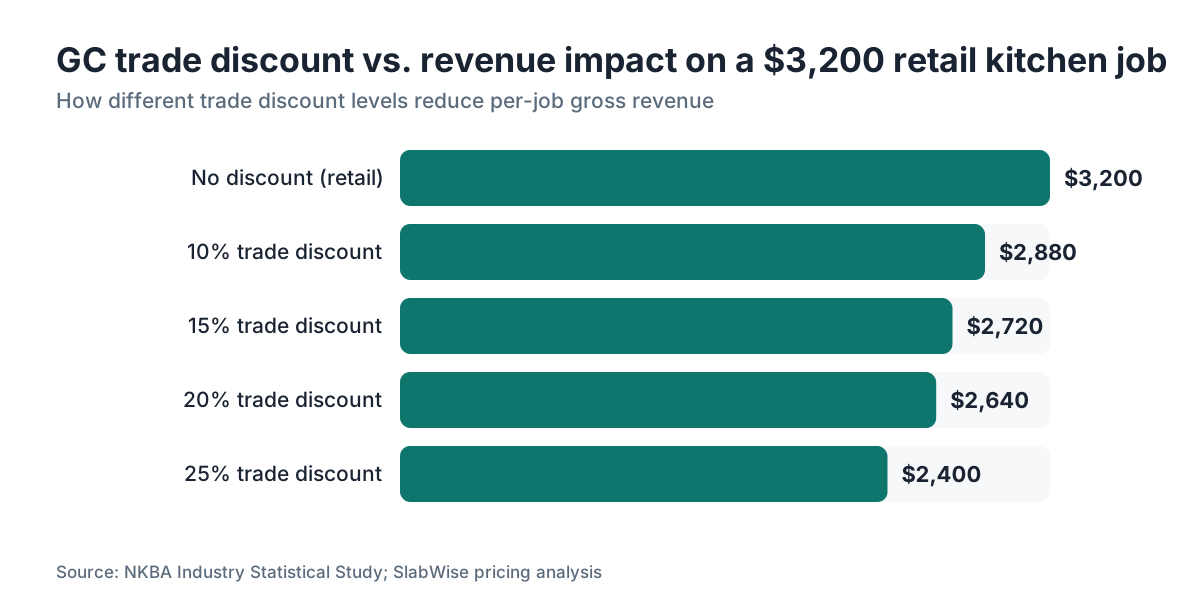
A typical trade discount runs 10 to 20% off your retail price list. Some high-volume GCs push for 25%. Their logic: they bring you predictable work, no showroom time, no tire-kicker consultations, and faster templating because the job is already sold.
The table below shows how the margin math shakes out at different discount levels on a $3,200 retail kitchen job.
| Trade discount | Your invoice to GC | Gross revenue vs. retail |
|---|---|---|
| 10% | $2,880 | -$320 |
| 15% | $2,720 | -$480 |
| 20% | $2,640 | -$560 |
| 25% | $2,400 | -$800 |
Before you sign up for a 20% discount, calculate your real cost per job: stone, labor, template, edge work, delivery. If your shop margin on a retail job runs 35 to 40%, you can survive a 15 to 20% trade discount. If your margin is 20% or thinner, a 20% discount turns the job into a loss.
One honest caveat: pricing data across fabrication shops is thin. The ranges above come from trade forum discussions and trade-publication interviews, not a single published study. Treat them as directional, not gospel [1].
GCs also push for fixed-price contracts on a per-linear-foot or per-square-foot basis across a project type. A production builder might say, "We want white quartz level-2 counters at $45 per square foot installed for all 40 units this year." That number has to cover every edge profile, every cutout, and every template trip. Scope creep is the silent killer in fixed-price GC agreements.
What do general contractors actually want from a fabricator partner?
GCs care about three things above everything else: schedule, schedule, and no callbacks. A fabricator who templates on day one of cabinet completion, turns the slab in five business days, and shows up on install day without rescheduling is worth more to a GC than a shop with a nicer showroom or slightly better stone pricing.
Think about what your delay does to them. A GC is running 15 trades on a job. Your install slipping a week ripples into their plumber, their tile setter, and their punch-list schedule. You are not one problem. You are the first domino.
Quality matters, but GCs define it operationally. They mean no callbacks. No hairline cracks. No chips at the cooktop cutout. No seams that wander three inches from where the drawing showed them. They assume your stone work is good. What they remember is the time your installer forgot to caulk and they had to send someone back.
GCs also want communication that does not require chasing. A text confirming template time. A confirmation the day before install. A heads-up the second anything changes. Shops that make the GC hunt for status updates bleed relationships slowly.
Paper matters more here than in a direct retail sale. The GC needs your certificate of insurance naming them as additional insured, your lien waiver at each payment stage, and a change order process that does not blow up their budget [4]. If you cannot produce a COI within 24 hours of a request, you will lose GC work. It is that simple.
What legal and contract protections should a fabricator have in place?
A handshake GC relationship is a liability. You need a written subcontract or master trade agreement covering at minimum: scope of work, pricing schedule or rate sheet, payment terms, change order process, and what happens when the GC does not pay.
Pay-when-paid and pay-if-paid clauses show up constantly in GC subcontracts, and they are not the same thing. A pay-when-paid clause means the GC must pay you within a reasonable time after they get paid by the owner, even if that payment runs late. A pay-if-paid clause, where courts enforce it, can mean the GC owes you nothing if the owner never pays them. Some states limit or ban pay-if-paid enforcement. California, for example, treats these clauses as a timing condition, not a complete defense to payment [5]. Know your state's rule before you sign anything.
Mechanic's lien rights are your backstop when a GC goes dark. Most states require you to file a preliminary notice (sometimes called a prelim, a notice to owner, or a 20-day notice) within 20 to 30 days of first furnishing labor or materials to preserve your lien rights [2]. Miss that window as a sub and you may have no lien rights at all, even with a valid unpaid invoice sitting on your desk.
Your insurance certificate has to match what the GC's contract requires. Many GC agreements ask for $1 million per occurrence and $2 million aggregate general liability, plus workers' comp if you have employees [4]. Check your current policy limits before your first GC job, not after a claim.
For fabricators juggling multiple GC accounts, job costing by account matters far more than it does in retail. Software that tracks quote-to-job margin per GC shows you whether the "volume" GC is actually profitable once you account for the discount, the net-45 terms, and the extra remakes they generate. SlabWise's job costing is built for exactly this per-account margin tracking, which is worth a look if you are scaling GC work.
How are GC relationships different on new construction versus remodel work?
New construction and remodel GC relationships look similar from the outside and run completely differently under the hood. One rewards throughput. The other rewards craft.
New construction work, especially production building, is high volume with tight specs. A production builder might want 300 kitchen counters a year across identical floor plans. The material is pre-selected, the edge is pre-selected, the price is pre-negotiated. Your job is execution and speed. Margin per job is thin, but velocity is high. The catch: when the housing market slows, the builder's orders vanish fast. The 2008 housing crash wiped out fabrication shops that had over-concentrated in production builder work [6].
Remodel GC work is lower volume, higher margin per job. Every kitchen is different. The GC is usually a custom remodeler or a high-end design-build firm. They expect design collaboration, more material options, and a careful template and install. The homeowner is standing right there, and they have opinions. Your trade discount may be lower (10 to 12%) because the GC is not handing you 50 jobs a year.
The countertop installation process on new construction also differs: cabinets are often not fully set when you are asked to template, there is no existing countertop to tear out, and rough-in dimensions can shift between template and install. Build that variability into your scheduling assumptions.
The right mix depends on your capacity model. High-throughput CNC shops usually prefer production builder volume. Craft-oriented shops with smaller crews usually do better with remodel GCs whose clients pay for the work.
How do you find and vet GC relationships worth having?
Not every GC is worth working for. A GC who pays slow, generates constant scope disputes, and beats up subs on price every year is not a partner. He is a problem with a lot of invoices attached.
Good places to meet GCs: your local National Association of Home Builders (NAHB) chapter, your local Associated General Contractors (AGC) chapter, and design-build associations in your area. These groups run events where subs and GCs actually talk. A referral from a plumber or electrician who already works with a GC you want is often the fastest way in [7].
Vet a GC before you price big work for them. Pull their contractor license status through your state licensing board (most states have an online lookup). Check for judgment liens or complaints filed against them. Search court records for unpaid subcontractor disputes. Ask other subs in your network who have worked with them and listen for hesitation.
Look at their project portfolio. A GC doing $500K kitchen remodels every six weeks is a different partner than one doing $50K bathroom flips. Make sure their typical project includes meaningful countertop work before you invest in the relationship.
When you land a new GC, start with one job before you give them your best pricing. Watch how they communicate, how clean the template conditions are, and how fast the check clears. Scale on real data, not promises.
What does a trade pricing agreement or master service agreement look like?
A master service agreement (MSA) between a fabricator and a GC is a standing contract that governs all future jobs, so you stop negotiating terms project by project. It usually includes a rate sheet or pricing schedule as an exhibit you can update annually.
Here is what belongs in a fabricator-GC MSA.
-
Scope. What you supply (material, fabrication, template, install, removal of existing if applicable). What you do not supply (plumbing reconnection, appliance move, drywall repair after demo).
-
Pricing. Your trade rate schedule, how material upgrades get quoted, and what triggers a change order.
-
Payment terms. Net-30 from completion is common. Define "completion" clearly. Some GCs try to tie it to their final walk with the homeowner, which can push you out weeks.
-
Change orders. Any scope change, including edge profile changes, added cutouts, or stone upgrades, goes in writing before you proceed. A verbal approval from a GC project manager falls apart the moment his boss reviews the final invoice.
-
Insurance and lien waivers. Which documents you provide at each payment milestone.
-
Dispute resolution. Arbitration or litigation, and in which jurisdiction.
You do not need 30 pages. A clean four-page MSA with a clear rate sheet exhibit beats a 30-page document full of boilerplate nobody reads.
How should a fabricator handle GC payment problems?
Late GC payments are common, and the reason is a chain. The GC is waiting on the owner to release a draw. The owner is waiting on the bank to fund a construction loan draw. You are at the end of that line, holding an invoice.
Before you fire off a demand letter or file a lien, make a direct call. A quick ask for a payment ETA often shakes loose a check that was just sitting in accounts payable. Document the conversation. Email a follow-up summary of what you were told and the date payment was promised.
If payment runs 30 or more days past due, send a written demand with your lien rights notice. Most states let you file a mechanic's lien after proper preliminary notice if payment does not come [2]. The lien clouds the property title, which motivates the owner (and therefore the GC) to settle before they can sell or refinance.
On large jobs, request conditional lien waivers at each progress payment and only sign unconditional waivers after the check clears. A conditional lien waiver says, "I waive my lien rights to the extent of this payment, once received." An unconditional waiver says, "I waive my lien rights, period." Signing an unconditional waiver before payment clears is a common, costly mistake [8].
If a GC relationship keeps producing late payments, the trade discount is not buying you anything. Reprice it or walk.
What is the right balance between GC and direct retail work?
There is no universal answer, but most successful mid-size fabrication shops aim for a mix rather than going all-in on either channel. Each channel fixes the other's weakness.
A shop that is 100% direct retail keeps full margin control and owns the customer, but pays for showroom overhead, marketing, and the hours spent educating homeowners who never buy. A shop that is 100% GC-dependent has low customer acquisition costs but eats GC pricing pressure, payment float, and concentration risk.
A common benchmark in the trade press: shops with sustainable margins keep no single GC account above 30 to 35% of annual revenue [1]. That way, losing a GC hurts but does not sink the business.
Your kitchen countertops retail work, your granite countertops and marble countertops showroom inquiries, all of that direct volume is worth protecting even as GC volume grows. Direct retail also keeps your installers and fabricators calibrated on customer-facing quality standards, which makes your GC work better.
One note for homeowners reading this. Your GC is probably marking up the fabricator's price by 15 to 30% before it reaches you. That is standard practice, not a rip-off. The GC is coordinating the job, managing the schedule, and standing behind the work. You can hire the fabricator directly to skip the markup, but then you take on the coordination the GC was doing for you.
How do GC relationships affect material selection and what fabricators stock?
GC relationships, especially production builder accounts, push fabricators toward a tighter, more predictable inventory. A builder who specs Level 1 white quartz across 30 floor plans wants you to have that material on the rack. He is not waiting eight weeks for a container from overseas, and he does not care that you are.
This is the sourcing math most homeowners never see. Shops with production builder relationships may carry $150,000 to $400,000 in slab inventory at any moment to support committed GC volume [1]. That capital commitment is part of what justifies the trade discount from the GC's side. You are holding the inventory risk for them.
Remodel GC work loosens up. The GC's client usually has design input, so you may be presenting laminate countertops, Cambria countertops, or a natural stone option depending on budget. Breadth in your samples and relationships with several distributors matter more here than deep inventory in one SKU.
Some fabricators who lean into GC work also stock or subcontract butcher block countertops and Corian countertops or Formica countertops, because GCs want one vendor for every countertop type in a house. Being the one-stop shop raises your value to the GC and makes it harder for them to switch away from you.
What are the biggest mistakes fabricators make in GC relationships?
Underpricing to win a relationship is the most common mistake by far. A fabricator drops to 20% below retail to land a big GC, then discovers the volume is half what was promised, and the jobs come with complex edges and difficult template conditions. The relationship loses money from day one and is psychologically hard to exit because you fought so hard to get it.
No written agreement is second. An informal setup where a GC sends POs without a master agreement turns every dispute over scope, change orders, or payment into a fresh negotiation under pressure, usually with a check being held hostage.
Ignoring preliminary notice deadlines is third. Fabricators used to direct-to-homeowner work sometimes do not realize their lien rights work differently as a sub. Missing a 20-day notice deadline and then not getting paid is an expensive lesson [2].
Over-reliance on one GC account is fourth. Concentration risk is not theoretical. One account at 50% of your revenue, and then the GC retires, sells the business, or starts sending work to his son-in-law's shop. Now you have an existential problem.
Last is failing to track per-account profitability. A GC who generates 20% of your revenue but 35% of your remakes, callbacks, and scheduling headaches is probably net-negative once you count the real costs. You cannot see that without job-level cost tracking by account.
Frequently asked questions
Do fabricators need a contractor's license to work as a subcontractor under a GC?
It depends on your state. Some states require a separate specialty contractor license for countertop installation. Others cover you under the GC's license when you work as a named sub. Check your state contractor licensing board. In California, a stone installation sub may need a C-54 tile contractor license depending on scope. Verify before you sign a subcontract, not after the job starts.
Can a GC legally prevent a fabricator from doing direct retail work with the same homeowners?
A GC can include a non-solicitation clause in a subcontract that bars you from soliciting their active clients directly. Broad non-compete clauses in subcontracts are generally not enforceable in most states, but narrow non-solicitation clauses targeting current clients often are. Read any exclusivity language carefully before signing. You should never have to give up the right to serve your existing retail customers.
What is a preliminary notice and why does it matter for fabricator subs?
A preliminary notice (also called a 20-day notice or notice to owner) is a document you send early in a project to preserve your right to file a mechanic's lien if you are not paid. Most states require subs to send it within 20 to 30 days of first furnishing labor or materials. Miss the deadline and you can lose your lien rights entirely, leaving only a breach-of-contract claim against the GC.
What insurance does a fabricator need to work with general contractors?
Most GC subcontracts require at minimum $1 million per occurrence and $2 million aggregate commercial general liability, workers' compensation if you have employees, and often commercial auto. The GC will ask to be named as additional insured on your GL policy. Some GCs on larger projects also require umbrella coverage of $1 to $5 million. Get a certificate of insurance from your broker and check it against the subcontract before you start.
How do trade pricing discounts work when material costs change?
A trade discount fixed as a percentage off your retail price list adjusts automatically as your retail prices move, which is the structure you want. An agreement that fixes a dollar-per-square-foot price for a year does not adjust, so if slab costs spike mid-year you absorb the hit. Negotiate annual price adjustments tied to material cost in any fixed-price GC deal, and include a reopener if commodity costs move more than 10% either way.
What is the difference between a conditional and unconditional lien waiver?
A conditional lien waiver releases your lien rights only after you have actually received and cleared payment. An unconditional waiver releases those rights regardless of whether the check clears. Never sign an unconditional waiver before payment clears your bank. Signing one to receive a check that then bounces leaves you with no lien rights and only a bad-check remedy, which is a bad place to stand.
How should a fabricator price change orders on GC jobs?
Change orders on GC jobs should be priced at your retail rate, not your trade rate, unless your master agreement says otherwise in writing. The trade discount covers the quoted scope only. Additional edge profiles, extra cutouts, or material upgrades that were not in the original quote are new scope. Put this in your master agreement upfront so there is no fight when a change order lands mid-job.
What happens if a homeowner complains about work done under a GC contract?
Under a true subcontract model where the GC is your client, homeowner complaints go to the GC first, and the GC contacts you. You are not legally obligated to respond directly to the homeowner unless your sub agreement or state law requires it. Even so, responding professionally when you are not required to often protects the GC relationship. Keep your workmanship warranty terms in writing so the scope of your responsibility stays clear.
Are GC relationships worth it for small fabrication shops?
For a shop doing under $500K in annual revenue, one or two well-chosen GC relationships can stabilize cash flow and cut marketing cost hard. The risk is that a single account starts to dominate the business. Start with a GC whose annual volume with you would represent no more than 25% of your revenue target. Grow the relationship once you have tested their payment behavior and job quality.
Do GC relationships work differently for commercial countertop work than residential?
Yes. Commercial GC work such as office kitchens, multifamily units, and hospitality often involves a design team specification, a competitive bid process, and longer payment cycles. Payment bond requirements are common on commercial projects above certain dollar thresholds, and your lien rights are replaced by bond claim rights on public work. Commercial GC relationships also tend to carry formal pre-qualification requirements, including financial statements and bonding capacity.
How long does it typically take to get paid by a GC versus a direct homeowner?
Direct homeowner jobs usually collect a 50% deposit at signing and the balance at or before installation, so the cash-to-cash cycle is often two to four weeks. GC subcontract terms commonly run net-30 to net-45 from completion, and real-world payment often stretches to 60 days when the GC is waiting on a construction loan draw [10]. Build this float into your working capital model before you scale GC volume.
What are the tax implications of trade discounts given to GCs?
A trade discount reduces your gross revenue rather than acting as a deductible expense. The discounted invoice price is the revenue you recognize. Referral fees paid to GCs under a referral model are a deductible business expense if documented properly. Ask your CPA whether any referral fee arrangement needs 1099 reporting. The IRS requires Form 1099-NEC filing for nonemployee compensation of $600 or more in a tax year [9].
Can a fabricator be held liable for delays caused by a GC's schedule?
If your subcontract holds you to a specific completion date and the GC's own scheduling decisions cause you to miss it, a well-drafted agreement should protect you with an excused-delay or delays-caused-by-others clause. Without that language, you could technically sit in breach even when the delay was not your fault. Always include a clause stating that your performance dates depend on the GC providing ready conditions for template and install.
Sources
- National Kitchen and Bath Association (NKBA), Industry Statistical Study: GC and trade partner volume commonly represents 40 to 60% of residential fabricator revenue; inventory capital for production builders often reaches $150,000 to $400,000; no single GC account should exceed 30 to 35% of annual revenue per common trade guidance.
- National Association of Credit Management, Mechanic's Lien Law Overview: Most states require a preliminary notice within 20 to 30 days of first furnishing labor or materials to preserve mechanic's lien rights as a subcontractor.
- U.S. Department of Labor, Miller Act (40 U.S.C. sections 3131 to 3134): On federal public works contracts, subcontractors cannot lien public property and must instead file claims against the prime contractor's payment bond under the Miller Act.
- Occupational Safety and Health Administration (OSHA), Construction Industry Standards: General contractors regularly require subs to carry workers' compensation insurance and commercial general liability insurance naming the GC as additional insured.
- California Legislative Information, California Civil Code and appellate case law on pay-if-paid: California courts generally treat pay-if-paid clauses in subcontracts as creating only a timing condition on payment, not a complete defense that extinguishes the sub's right to payment.
- National Association of Home Builders (NAHB), Housing Market Impact Studies: The 2008 housing downturn caused severe revenue contraction for fabrication shops heavily concentrated in production builder subcontracts.
- Associated General Contractors of America (AGC): AGC local chapters provide networking opportunities for subcontractors to meet and qualify general contractors seeking specialty trade partners.
- American Institute of Architects (AIA), Standard Lien Waiver Forms Guidance: Signing an unconditional lien waiver before payment clears is a common and costly mistake; conditional waivers protect the sub's rights until payment is confirmed received.
- Internal Revenue Service (IRS), Form 1099-NEC: Businesses must file Form 1099-NEC for nonemployee compensation payments of $600 or more in a tax year, which can apply to referral fees paid to GCs.
- Construction Financial Management Association (CFMA), Subcontractor Financial Benchmarks: Net-30 to net-45 payment terms are standard in GC subcontracts; real-world payment often extends to 60 days when GCs are waiting on construction loan draws.
Last updated 2026-07-11