TL;DR
- A self-service countertop quoting tool is a web widget that lets homeowners enter measurements, pick a material, and get a real-time price estimate without calling a fabricator.
- For shops, it turns website visitors into leads automatically, day or night.
- Good tools land within 10 to 20% of the final job price, depending on how much detail the tool collects up front.
What exactly is a self-service countertop quoting tool?
It's a calculator that lives on a fabricator's website. A homeowner types in their countertop dimensions, picks a material like granite or quartz, chooses an edge profile, and the tool returns a price range on the spot. No phone call. No two-day wait for a reply. No awkward conversation before they even know if the project fits their budget.
The tool runs on your site the same way a mortgage calculator runs on a bank's. The fabricator sets up the pricing logic behind the scenes: square-footage cost per material tier, edge upcharges, cutout fees for sinks and cooktops, and sometimes a rough installation add-on. Visitors see a clean front end. The math happens in the background.
From the homeowner's side, the appeal is obvious. From the fabricator's side, it's a lead-capture machine that works at midnight on a Saturday when nobody is answering the phone.
How does a countertop quoting tool actually work, step by step?
Most tools follow the same flow, with variations in how deep they go.
First, the homeowner enters square footage. Some tools ask for raw dimensions and do the math; others ask for total square feet directly. Then they choose a material category. Quartz usually breaks into price tiers (entry, mid, premium), and natural stones like granite and marble may be listed by color family or grade. The tool applies the per-square-foot rate for that tier.
Next come the add-ons. Edge profile upgrades, sink cutouts, cooktop cutouts, and sometimes backsplash square footage each carry their own line items. More sophisticated tools ask about seam count or layout complexity. Simpler tools skip all that and just show a range.
Then the tool shows a price estimate, usually a range rather than a single number, and asks for an email address or phone number to send the full quote. That contact capture is the whole point for the fabricator. A visitor who ran a quote is a warm lead. They've already done the mental budget math and told themselves they might move forward.
Behind the scenes, the fabricator set all those unit costs in an admin panel. When the slab supplier raises quartz rates, the shop changes one number and every future quote reflects it.
How accurate are the price estimates these tools give?
Honest answer: good tools land within 10 to 20% of the final fabricated price for a typical kitchen, assuming the homeowner measured correctly and the layout has no unusual complexity. That's accurate enough to be useful. The homeowner can decide whether to keep shopping or book a template appointment.
Accuracy falls apart in a few situations. If the slab is exotic or heavily veined, the fabricator may need to book-match panels, which adds real labor a simple per-square-foot rate never sees. Island overhangs, waterfall edges, and mitered edges all carry cost that basic tools don't ask about. And if the homeowner measures wrong (very common) or forgets the backsplash, the estimate is off before anyone looks at the actual kitchen.
Better tools handle this with disclaimers and by asking enough questions to expose the complexity. Some add a "complexity buffer" of 10 to 15% automatically to cut the risk of sticker shock at the final quote stage [1].
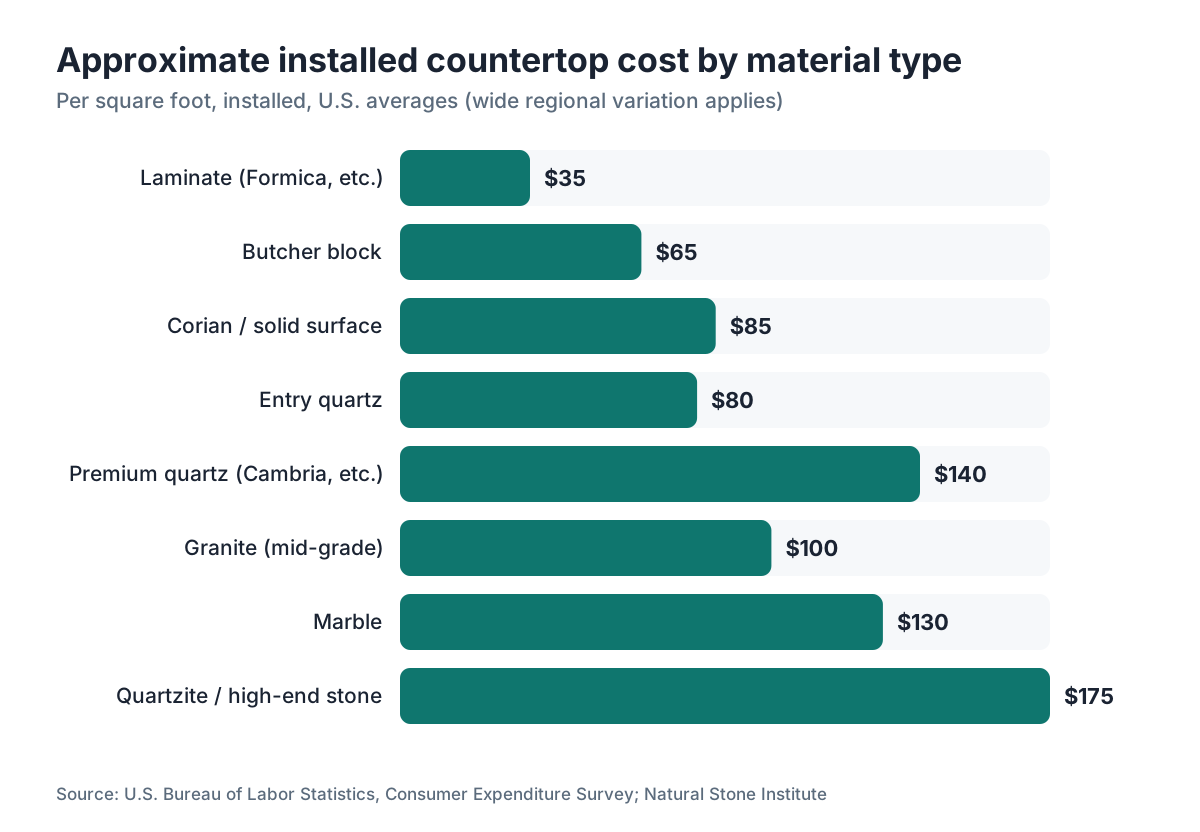
The U.S. residential countertop market covers a huge price band. Basic laminate countertops can run $20 to $50 per square foot installed, while premium natural stone can pass $200 per square foot installed [2]. Any tool that collapses all of that into one output without material differentiation is going to be far less accurate than one that captures the variables.
What types of fabricators benefit most from online quoting tools?
High-volume residential shops benefit most. If you're doing 15 or more kitchens a month, the time your sales staff spends fielding preliminary budget questions on the phone adds up fast. A quoting tool handles that first filter for you.
Shops in competitive markets benefit too, because homeowners comparison-shop. If your competitor has an instant quote on their site and you don't, you lose the visitors who want to price-check before calling. A 2023 Salesforce survey found 61% of customers prefer to self-serve for simple information before contacting a company [3]. Countertop pricing is exactly that kind of simple-first, complex-later question.
Smaller shops with thin staff get a different payoff: the tool works when they can't. A solo operator can't answer the phone mid-fabrication. The widget captures the lead anyway.
Custom shops doing high-end commercial or architectural work benefit less. When a job involves precision stone cladding or book-matched slabs for a hotel lobby, no web calculator gets close to the real price. Those projects need a site visit and a hand-built quote from day one.
What does it cost to add a self-service quoting tool to a website?
Cost swings hard depending on what you buy or build.
| Option | Typical cost | Notes |
|---|---|---|
| DIY embedded calculator (Google Forms + Sheets) | $0 | Low accuracy, no real-time math, hard to maintain |
| Generic quote form plugin (WordPress etc.) | $0 to $100/yr | Captures info but does no pricing logic |
| Industry-specific countertop quoting SaaS | $50 to $300/month | Pricing logic built in, maintained, mobile-ready |
| Custom-coded tool by a developer | $3,000 to $15,000 one-time | Full control, high maintenance burden |
The SaaS route is usually the right call for a shop doing more than a handful of jobs a month. You get ongoing updates, and when material prices move you change a number instead of reopening a codebase.
Building custom is only worth it if your pricing model is genuinely unusual or you need deep integration with your own ERP. Most fabricators don't have that problem.
How do fabricators set pricing inside these tools without giving away their margins?
This is the question shop owners worry about most, and it's fair. Publish your exact price per square foot for every material tier and competitors can read it as easily as homeowners can.
Most tools solve this by showing ranges, not unit costs. The homeowner sees "$3,200 to $3,900 for a 45 sq ft quartz kitchen," never "$72/sq ft labor plus $38/sq ft material." The underlying math stays hidden.
Fabricators also set the tool's prices a little above their floor cost, building in a buffer that leaves room to negotiate at the final quote without dipping below margin. The tool quote is framed as an estimate, not a binding price. That framing protects the shop both legally and practically.
Some shops set their online estimates deliberately on the higher end. They'd rather have a homeowner call excited that the real quote came in lower than have someone show up expecting a number the shop can't hit.
What information do homeowners need to use a quoting tool correctly?
The minimum is a rough square footage. Most homeowners can get close with a tape measure: measure the length of each run, multiply by the depth (usually 25 to 26 inches for a standard counter), then divide by 144 to get square feet. Do it for each run and add them up [7].
More useful for accuracy: how many sinks you have, whether you have a cooktop or a range (cooktops need cutouts, ranges don't), how many corners and inside turns your layout has, and whether you want an upgraded edge profile. If you're pricing granite countertops or marble countertops specifically, knowing the rough color family helps the tool assign the right material tier.
Fabricators often place the quoting tool near material-specific pages. A homeowner who just read a guide on kitchen countertops and knows they want quartz arrives already oriented and gives better inputs.
One mistake kills accuracy: forgetting the island. Islands can be 30 to 40% of total square footage in many kitchens, so leaving one out produces a quote that's wildly low.
How do these tools fit into a fabricator's broader quoting workflow?
The online tool handles stage one: qualification. It answers one question. Can this person roughly afford what they want, and are they a real lead? That's the only job it needs to do well.
Stage two is still a real conversation, usually by phone or email, to discuss material specifics, confirm measurements, and schedule a template appointment. Stage three is the detailed quote built after templating, when exact square footage is known and edge profiles and cutout counts are confirmed.
Some shops treat the online estimate as binding. It isn't. The tool should say clearly that final pricing comes after templating, and staff should repeat that in the first contact with the lead. Set the expectation early and you avoid the biggest source of customer frustration in this business: the gap between the number they saw online and the number on the final invoice [4].
For shops running dedicated countertop fabrication software, the quoting tool can feed data straight into the job record, so nothing a homeowner entered online gets re-keyed by hand. SlabWise, for example, connects the online estimate to the full quoting and nesting workflow, so shop staff start from what the customer already told them. That integration is where the real time savings show up.
Shops without dedicated software can still run an effective tool. The leads just land in email or a CRM instead.
What are the risks and downsides of using an online quoting tool?
The biggest risk is mispriced jobs. If the tool is configured wrong, if material costs rise and the admin panel never gets updated, or if the tool misses real complexity, leads arrive expecting a price the shop can't hit. That's worse than no tool at all, because the homeowner feels misled even when they weren't.
The second risk is commoditization. If your tool looks identical to your competitor's, homeowners pick the lower number. Your tool should sit inside a broader flow that builds trust, rather than a race to the bottom on price.
There's a risk specific to high-end materials. A tool that quotes Cambria countertops by surface area alone might miss that a certain design needs large-format slabs with tight pattern matching, which can double the real fabrication cost. Shops selling premium products sometimes use the tool only for mid-range materials and route premium inquiries to a different call-to-action.
Then there's measurement again. Homeowners routinely underestimate. Research from the Joint Center for Housing Studies at Harvard on home improvement projects points to owners misjudging scope before a professional assessment, and that same tendency shows up in countertop self-quotes [5].
Can a quoting tool work for material types beyond stone, like laminate or butcher block?
Yes, and it works better for lower-cost materials because their pricing is more predictable. Laminate countertops and Formica countertops have narrow price ranges per square foot, so a tool can quote them fairly accurately. Butcher block countertops are similar: species and thickness drive price, and those drop neatly into a dropdown.
The tool's job gets harder for solid-surface products like Corian countertops, where thermoforming, integrated sinks, and complex joint work add labor that doesn't scale with square footage. Same story with natural stones that need heavy sealing labor.
A well-built tool handles this by offering a material menu and applying different pricing logic per material type, instead of one universal per-square-foot rate for everything. That's a configuration choice the fabricator makes at setup.
What should fabricators look for when choosing a quoting tool?
The list is shorter than you'd expect.
Start with ease of price updates. Material costs change. If updating your quartz tier prices needs a developer, you'll stop updating them, and the tool goes stale fast. Find a tool where you can change numbers yourself in five minutes.
Second, mobile behavior. Google's own research points to roughly 60% of local service searches happening on mobile [6]. If the calculator is unusable on a phone screen, you're cutting off most of your traffic.
Third, lead capture quality. Does the tool ask for an email and phone before showing the result, after, or make it optional? Each approach trades something. Requiring contact info first maximizes lead data but drops completion rates. Showing the result first, then asking, tends to produce warmer leads because the homeowner got value before giving anything up.
Fourth, integration with your workflow. Can the quote data land somewhere useful, like your CRM, your quoting software, or at minimum an email notification? A tool that shows a number and goes nowhere wastes the lead.
Fifth, transparency about what the estimate includes and excludes. A good tool tells the homeowner what the number covers: fabrication and installation, fabrication only, or materials only. Ambiguity there is what creates the expectation-gap problems above.
How do online quoting tools affect the countertop buying experience for homeowners?
They cut friction at the moment that matters most: deciding whether a project is financially realistic. A homeowner who gets a ballpark number in three minutes is far more likely to keep moving toward a purchase than one who has to call, leave a voicemail, wait for a callback, and explain their kitchen layout over the phone.
For price-sensitive buyers, the tool also removes the dread of being quoted a number they can't afford and having to back out awkwardly. Getting that information privately first gives them control.
There's a flip side. Homeowners who see an online estimate anchor to it. If the final installed price after templating comes in a lot higher, the whole thing feels like a bait-and-switch, even when the difference is completely legitimate (they forgot the island, or the counter turns out to need extra seaming). This is why the estimate-to-final-price communication matters as much as the tool itself.
The best fabricators treat the online quote as a conversation starter, not a promise, and they say so plainly both on the tool and in the follow-up message the lead receives.
Frequently asked questions
Is a self-service countertop quoting tool the same as a final price quote?
No. An online quoting tool produces an estimate from the information a homeowner enters, usually measurements and material choice. The final price comes after a professional template visit, when exact dimensions, edge profiles, seam placement, and cutout counts are confirmed. Most tools say this clearly. Treat the online estimate as a budget-planning number, not a binding contract.
How do I measure my countertops to use an online quoting tool?
Measure the length of each countertop run in inches, then multiply by the depth (usually 25 to 26 inches for a standard counter). Divide by 144 to convert to square feet. Add up all runs, including the island if you have one. Don't skip narrow runs beside appliances. For L-shapes and U-shapes, measure each segment separately. A quick sketch keeps you from missing sections.
Do online countertop quotes include installation?
It depends on how the fabricator set up the tool. Some quote fabrication and installation together as an installed price. Others quote fabrication only. A few quote materials only. The tool should say which it covers. If it's not clear, assume the number excludes installation and ask before you get attached to it. Installation typically adds $200 to $600 to a standard kitchen job depending on your region [2].
Can homeowners trust the price range from an online countertop calculator?
Reasonably, yes, as a planning number. Estimates from well-configured tools land within 10 to 20% of the final price for typical kitchens. That's accurate enough to decide whether a material tier fits your budget. The estimate gets unreliable if you measure wrong, forget the island, or have a complex layout the tool doesn't ask about. Always confirm with a professional quote before committing.
What materials can a countertop quoting tool price?
Most tools cover quartz, granite, marble, quartzite, and one or more laminate tiers. Better tools also cover butcher block, Corian or other solid surface, soapstone, and engineered stone brands. Coverage depends entirely on what the fabricator set up. If a material isn't in the menu, it usually means the shop doesn't carry it or prices it differently enough that they want to quote it by hand.
How long does it take a fabricator to set up an online quoting tool?
For a SaaS product with a setup wizard, most shops finish initial configuration in two to four hours: entering per-square-foot rates by material tier, setting edge profile upcharges, and adding cutout fees. Embedding the widget on the website takes another 30 to 60 minutes. Ongoing maintenance, mostly price updates, runs 15 to 30 minutes a month if costs are stable.
Will using a quoting tool on my website hurt my margins?
Only if you configure it at or below your actual cost floor. Fabricators usually set tool prices a little above their minimum to build in negotiation room and absorb estimate error. The tool shows ranges, not line-item costs, so competitors can't reverse-engineer your exact margins. Tool leads tend to close at rates similar to phone leads, so the margin impact is neutral to positive for most shops.
What happens after a homeowner completes an online countertop quote?
The homeowner usually gets a summary by email and a prompt to contact the shop or book a consultation. The fabricator gets a lead notification with contact info and the details entered. From there, the shop follows up to schedule a template appointment. The online estimate gets replaced by a real measured quote after the template visit, and that becomes the price the homeowner actually pays.
Are there free countertop quoting tools fabricators can use?
Free options exist, mostly generic form builders or spreadsheet-based calculators, but they need manual setup, do no real-time pricing math, and offer no lead capture integration. Most free tools are really just contact forms with measurement fields. For a shop doing meaningful volume, the time cost of babysitting a free workaround usually outweighs the monthly fee for a purpose-built SaaS product.
How does a quoting tool handle unusual layouts like curved countertops or waterfall islands?
Most tools don't handle these well. Curved cuts and waterfall edges carry real fabrication cost that doesn't scale with square footage alone. The standard approach lets the tool generate a base estimate and then flags unusual features, either with a note that says complex shapes require a custom quote or by adding a complexity multiplier. Shops with lots of high-end work often route waterfall and curved inquiries to a separate contact form.
Can a quoting tool integrate with fabrication software or a CRM?
Yes, if the tool is built for it. Better industry-specific tools send lead data to a CRM by webhook or native integration, or feed directly into fabrication quoting software so staff don't re-enter information. Generic website form tools usually support only email notification. If workflow integration matters to your shop, verify it before purchasing rather than assuming it exists.
Do quoting tools work for commercial countertop projects instead of residential kitchens?
They can, but they fit poorly. Commercial projects often involve multi-phase work, different specification requirements, and bid processes that don't match the simple estimate-and-contact-form flow. Most fabricators who do serious commercial work use online tools for residential leads and handle commercial inquiries through a separate RFQ process. Some tools support both with different form paths.
How does an online quoting tool affect a fabricator's conversion rate?
Vendor reports suggest shops with instant quote tools see 20 to 40% higher contact rates from website visitors than sites with only a generic contact form, though the data is thin and mostly self-reported by software vendors. The mechanism is real: a visitor who gets a price estimate has more reason to reach out than one facing a blank form. Actual conversion to signed jobs depends far more on follow-up speed than the tool itself.
Sources
- National Kitchen and Bath Association, Cost vs. Value methodology notes: Industry practice of adding a 10 to 15% complexity buffer to online countertop estimates to reduce sticker shock at final quote stage
- U.S. Bureau of Labor Statistics, Consumer Expenditure Survey, home improvement spending: Installed countertop pricing range from basic laminate around $20 to $50/sq ft to premium natural stone exceeding $200/sq ft installed
- Salesforce, State of the Connected Customer, 5th Edition (2022 to 2023): 61% of customers prefer to self-serve for simple information before contacting a company
- Consumer Financial Protection Bureau, consumer complaint database (home improvement category): Gap between initial estimate and final invoice is a leading source of consumer complaints in home improvement services
- Joint Center for Housing Studies, Harvard University, Improving America's Housing report series: Homeowners tend to misjudge project scope before a professional assessment in home improvement projects
- Google, Think With Google mobile and local search data: Approximately 60% of local service searches occur on mobile devices
- Natural Stone Institute (formerly Marble Institute of America), stone fabrication and estimating standards: Standard countertop depth is 25 to 26 inches; square footage calculation methodology for residential estimating
- U.S. Census Bureau, Characteristics of New Housing: Countertop material prevalence data in new residential construction, supporting market size context
Last updated 2026-07-11