TL;DR
- Countertop fabricators who cut, grind, or polish engineered quartz face a sharply elevated silicosis risk because quartz-based slabs can contain 90-95% crystalline silica.
- OSHA sets an 8-hour exposure limit of 0.05 mg/m3.
- Real-world data from Australia and California show fabricators developing silicosis in their 30s and dying from it.
- Wet cutting, local exhaust ventilation, and respirators are the core controls.
What is silicosis, and why does it matter for countertop shops?
Silicosis is an incurable, progressive scarring of the lungs caused by inhaling fine particles of crystalline silica. The dust lodges deep in the alveoli, triggers chronic inflammation, and slowly replaces working lung tissue with scar tissue. Nothing reverses the scarring. People either stabilize or decline.
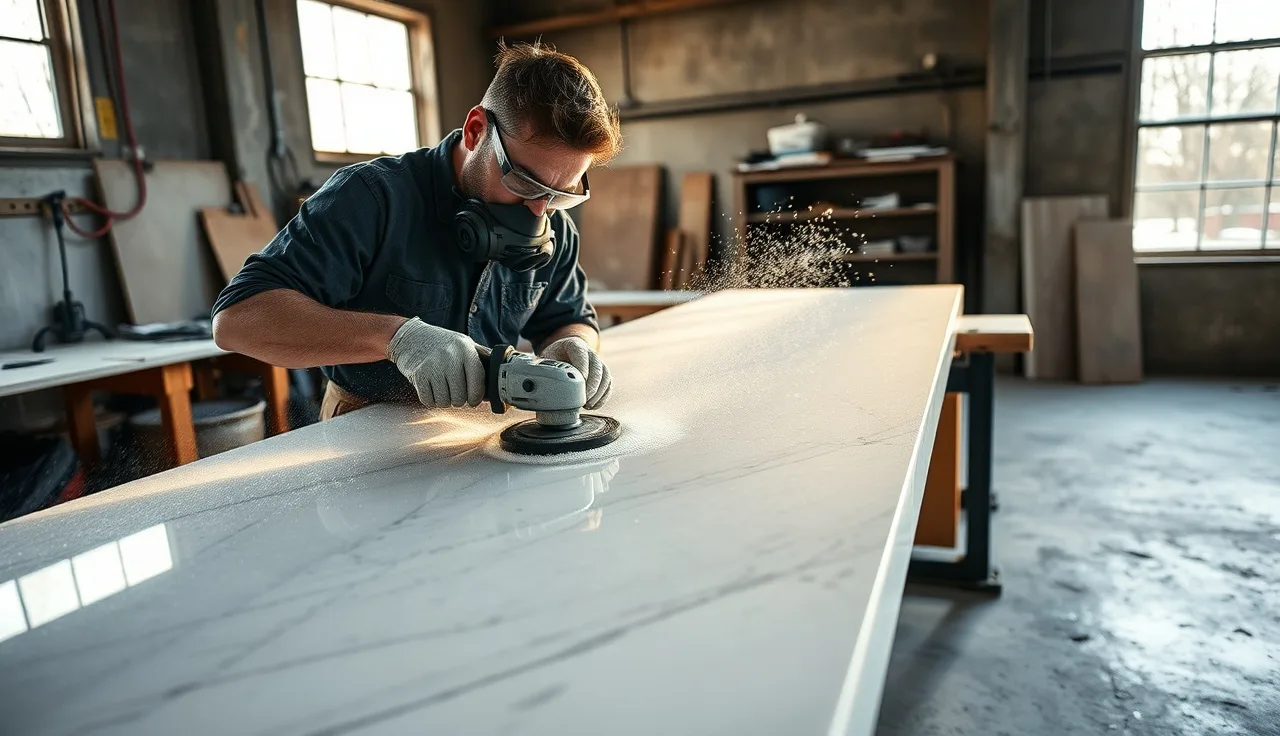
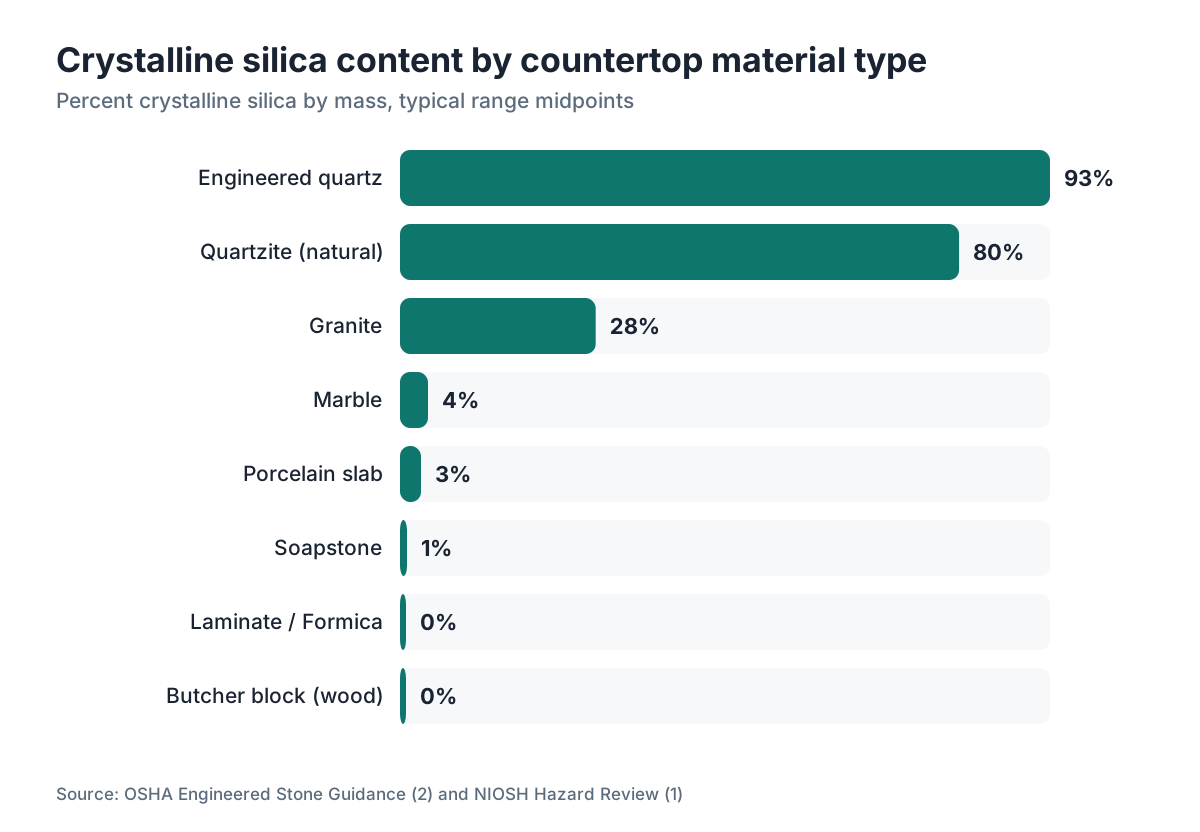
For most of history, silicosis was a miner's or sandblaster's disease. Countertop fabrication barely registered. Then engineered stone (quartz-surface) countertops arrived and changed the math. A natural granite slab typically contains 25-30% crystalline silica [1]. An engineered quartz slab contains 90-95% crystalline silica by mass [2]. Run a dry angle grinder along an engineered stone edge and the cloud that rises is mostly respirable silica.
The disease has three clinical forms. Chronic silicosis develops after 10 or more years of lower-level exposure. Accelerated silicosis appears within 5 to 10 years of higher exposure. Acute silicosis can kill within months to a few years from very high, concentrated exposure. The fabricators showing up in the medical literature are developing the accelerated and sometimes acute form, often in their 30s. That single fact is what moved OSHA, NIOSH, and health agencies in Australia and Israel to issue formal warnings.
How much silica is actually in the materials fabricators work with?
Not every countertop material carries the same risk. The silica content of the slab you're cutting sets how dangerous the dust is.
| Material | Typical crystalline silica content |
|---|---|
| Engineered quartz (e.g., Silestone, Caesarstone, Cambria) | 90-95% [2] |
| Quartzite (natural stone) | 70-90% [1] |
| Granite | 25-30% [1] |
| Marble | < 5% |
| Soapstone | < 1% |
| Porcelain tile | 0-5% depending on formulation |
| Laminate/Formica | Near zero crystalline silica |
| Butcher block / solid wood | Zero |
Engineered quartz drives the current epidemic. Fabricators who mostly cut granite countertops face real but lower risk. Those who cut marble countertops or laminate countertops face much less. Almost every shop today does a mix, and the switch back and forth between slab types is exactly where exposure monitoring gets missed.
Particle size matters as much as content. Respirable silica particles sit below 10 microns in aerodynamic diameter. You cannot see a respirable cloud. The haze that hangs after a dry cut looks like nuisance dust. By the time it settles on your safety glasses, the dangerous fraction is already in your lungs.
What does the research say about how common silicosis is in fabricators?
The epidemiology is alarming and, to be honest, still incomplete, because most countries don't systematically track small-shop tradespeople. The best-documented outbreaks come from Australia, Israel, Spain, and the United States.
Australia mounted the most thorough national response. A 2019 study published in the Medical Journal of Australia identified 99 engineered stone workers with silicosis, of whom 23 had already undergone or been listed for lung transplant [3]. The median age at diagnosis was 34. Australia went on to ban the dry processing of engineered stone nationally in July 2024.
California has the most detailed state-level US data. A 2020 MMWR report from the CDC described 18 engineered stone fabricators in California diagnosed with silicosis; 5 had died, 3 had received lung transplants, and all had worked mainly with engineered quartz [4]. The average time from first exposure to diagnosis was 13 years, but some workers developed disease in as few as 5.
NIOSH has estimated that countertop fabricators may face silicosis risk up to 46 times the general population when exposure controls are absent [5]. The precise multiplier shifts with shop conditions. No serious researcher argues the risk is small.
Spain published a cluster study in 2018 in Archivos de Bronconeumología. It found that 40 of 185 workers in a single geographic cluster of engineered stone shops had radiographic silicosis, and that 10 of those 40 cases were the acute or accelerated form [6]. Forty of 185 is a 21.6% prevalence. In an active workplace. That number should stop you cold.
What are the OSHA exposure limits for crystalline silica?
OSHA's Silica Standard for Construction (29 CFR 1926.1153) and the General Industry standard (29 CFR 1910.1053) both set the permissible exposure limit (PEL) at 0.05 mg/m3 as an 8-hour time-weighted average (TWA) for respirable crystalline silica [7]. The action level is half that: 0.025 mg/m3. Once exposures reach the action level, employers have to begin medical surveillance, exposure assessment, and more frequent monitoring.
The 0.05 mg/m3 PEL took effect in June 2018 for most general industry employers. The old PEL was roughly 0.1 mg/m3 for quartz, calculated by a clunky formula. The new standard is stricter and easier to apply.
The standard also lists specific engineering controls. For fabricators, the relevant Table 1 entries include water delivery systems for handheld grinders and local exhaust ventilation for fixed equipment. Here is the part shops miss: if you follow the Table 1 controls, OSHA deems you compliant without air monitoring. A small shop can hit compliance through equipment choices instead of hiring an industrial hygienist every quarter, though monitoring is still smart practice.
NIOSH's recommended exposure limit (REL) is 0.05 mg/m3 as a 10-hour TWA, matching OSHA's PEL [5]. NIOSH treats that as a ceiling, meaning workers should not be exposed above it at any point, more than as an average.
Shops that run without controls routinely exceed the PEL by 10-fold or more. A 2019 NIOSH field study found dry cutting of engineered stone generated silica concentrations above 1.0 mg/m3, or 20 times the OSHA PEL [8].
What are the early symptoms of silicosis that fabricators should watch for?
Silicosis is sneaky because the early disease is often silent. Lung scarring can show on a chest X-ray or CT scan years before a person feels short of breath. By the time symptoms arrive, the disease is usually well established.
Early-stage symptoms include:
- A dry, persistent cough that antibiotics don't fix
- Shortness of breath on exertion that creeps up slowly, often blamed on being out of shape
- Fatigue that doesn't match the level of activity
- Chest tightness, especially after heavy work
As the disease progresses, shortness of breath shows up at rest, oxygen saturation drops, and some patients develop cor pulmonale (right-sided heart failure from chronically high pulmonary artery pressure). In the accelerated and acute forms, the decline is fast. A worker can go from mild exertion limits to needing supplemental oxygen inside two years.
Silicosis also raises the risk of tuberculosis sharply. The WHO estimates that silicosis increases TB risk by 2.8 to 39 times depending on the setting [9]. For US fabricators, the practical takeaway is that any TB-like respiratory illness in a fabricator should trigger both TB testing and a review of silica exposure history.
Medical surveillance under the OSHA standard requires a baseline chest X-ray or CT within 30 days of starting covered work, then follow-ups every 3 years for workers exposed at or above the action level. Workers with symptoms should see an occupational medicine physician, not a general practitioner, because silicosis gets misdiagnosed as asthma or COPD in primary care all the time.
What engineering controls actually work to reduce silica exposure?
There's a clear hierarchy of controls, and the research on which ones work is solid. In order of effectiveness:
Wet methods. Running water continuously to the blade or grinding disc is the single most effective shop-level control for fixed and handheld cutting. Water knocks the fine respirable fraction down before it goes airborne. A properly designed wet-cutting bridge saw can cut silica concentrations by more than 95% versus dry cutting [8]. The catch: you need continuous water flow, not an occasional spritz, and the delivery system has to actually reach the cutting zone.
Local exhaust ventilation (LEV). For edge profiling, polishing, and routing, LEV captures dust at the source. A well-designed vacuum shroud on an angle grinder, paired with an H-class HEPA vacuum (not a regular shop vac), cuts exposure hard. H-class vacuums filter particles down to 0.3 microns at 99.995% efficiency. Standard shop vacuums don't capture respirable silica. They grab the coarse fraction and blow the dangerous fine particles right back into the air.
Isolation and enclosure. Where possible, putting dry operations (which should be eliminated entirely for engineered stone) in a separated, ventilated area keeps the whole shop from getting contaminated.
General dilution ventilation. Shop-wide ventilation lowers background concentrations but isn't enough on its own for high-silica materials. It supplements source controls. It doesn't replace them.
Administrative controls. Rotating workers to cap individual exposure time, scheduling high-dust work when fewer people are around, and banning eating and drinking in the fabrication area all help. These are the weakest controls in isolation but matter as part of a full program.
For shop owners running estimating and production, tools like SlabWise help track which materials are in a job, which matters because your control protocol for an engineered quartz kitchen should look different from a marble countertops job.
The worst practice, still common in shops, is dry grinding engineered quartz edge profiles with no vacuum attachment and no respirator. NIOSH measurements show this can produce silica concentrations above 10 mg/m3, or 200 times the OSHA PEL [8].
What respiratory protection is required, and when is it enough?
Respiratory protection is the last line of defense, not the first. OSHA's hierarchy puts engineering and administrative controls first; respirators fill the gap that controls can't close.
For silica, the minimum for tasks expected to exceed the PEL is a half-face respirator with an N95 filtering facepiece or higher. In practice, NIOSH recommends a half-face air-purifying respirator with P100 filters for most fabrication tasks, because P100 filters catch fine silica particles more efficiently than N95 filters [5].
For high-exposure tasks like dry grinding (which should be eliminated for engineered stone) or any work that throws visible dust, a powered air-purifying respirator (PAPR) with P100 filters or a supplied-air respirator gives much better protection.
Key requirements shops keep missing:
- Respirators have to be fit-tested before use. A respirator that doesn't seal to the face gives far less protection than its rating suggests.
- Workers with beards can't get an adequate seal with tight-fitting respirators. PAPRs with loose-fitting hoods are the right answer for bearded workers.
- Respirators require a written respiratory protection program under OSHA 29 CFR 1910.134, including a medical evaluation of each worker before they wear one.
- Surgical-style dust masks without a rated filter give no meaningful protection against respirable silica.
Are there legal duties for shop owners around silica exposure?
Yes, and they're specific. Under OSHA 29 CFR 1910.1053 (general industry) and 29 CFR 1926.1153 (construction), employers with workers exposed to silica at or above the action level (0.025 mg/m3 as an 8-hour TWA) must [7]:
- Conduct exposure assessments to determine each worker's exposure level.
- Implement engineering and work practice controls.
- Provide and ensure use of appropriate respiratory protection when controls fall short.
- Establish and maintain a written exposure control plan.
- Offer medical surveillance to workers exposed at or above the action level for 30 or more days per year, starting within 30 days of initial assignment.
- Train workers on silica hazards, the standard's requirements, and the purpose of controls and surveillance.
- Keep records of exposure measurements and medical surveillance for the duration of employment plus 30 years.
Medical surveillance is where a lot of small shops fall short. The standard requires a physician or licensed healthcare professional (PLHCP) to review the worker's medical history, conduct or review a chest X-ray, and give a written medical opinion to the employer. The employer pays for this. Workers can't be charged for required surveillance.
OSHA penalties for willful or repeated violations can reach $156,259 per violation as of 2024 federal adjustments [7]. OSHA has cited multiple fabrication shops in recent years, and the agency has signaled that countertop fabrication is an enforcement priority.
Some states run their own OSHA plans with standards at least as strict as federal OSHA. California (Cal/OSHA) has issued specific guidance on engineered stone and has been active in enforcement following the deaths documented in the CDC's MMWR.
What did Australia's ban on engineered stone actually accomplish?
Australia became the first country to ban the dry processing of engineered stone in July 2024, then extended the prohibition to all engineered stone work that can't be done with adequate wet suppression or local exhaust ventilation [3]. In effect, the Australian rule makes it nearly impossible to legally fabricate engineered stone under conditions that throw hazardous silica concentrations.
The policy came largely out of the Medical Journal of Australia's 2019 data and later follow-up, which counted hundreds of affected workers, many too young to be expected to have progressive lung disease. Trade unions in the construction and stone sector pushed hard for the ban after members were diagnosed in their 30s.
The US hasn't followed with a ban. OSHA has instead stressed engineering controls and medical surveillance rather than prohibition. Some in the occupational health community argue the US approach is weak given how many small shops fail to put controls in place voluntarily. Others argue that proper controls, actually followed, can bring exposure down to safe levels.
So where does this leave US fabricators? In a legal gray zone where the standard is clear but enforcement is stretched thin. A shop that follows the OSHA Table 1 controls sits in a defensible compliance position. A shop that dry-grinds engineered stone without controls does not.
How should fabricators set up a practical silica control program?
A working silica program doesn't have to be elaborate. It has to be real.
Start with material inventory. List every slab type you cut and its rough silica content. Engineered quartz gets the highest-tier controls. Granite gets strong controls. Marble countertops and laminate countertops are lower risk but still earn wet cutting and good housekeeping. Butcher block countertops are wood, near-zero silica risk.
Next, audit your equipment. Every bridge saw should have a working water delivery system. Every angle grinder used on engineered stone or granite should have a shroud tied to an H-class vacuum. Write down what you have.
Write a one-page exposure control plan. It names the high-risk tasks, the controls in place, who maintains them, and what to do when a control fails. OSHA requires this document to be available to workers on request.
Set up medical surveillance. Find a local occupational medicine clinic and schedule baseline chest imaging for anyone who has cut stone more than 30 days in the past year. Then schedule follow-ups every 3 years. This isn't optional. It's a legal requirement for workers at or above the action level.
Train your crew. Workers need to understand why the water stays on, why the H-vac matters, and why they shouldn't eat lunch on the shop floor. Training should be in a language each worker understands, which for many US fabrication shops means Spanish.
For shops running multiple jobs across different slab types, production tracking that logs the material for each job makes it far easier to document exposure assessment by task and material. If your job records already flow through software, that job log becomes part of your exposure documentation.
One last thing: do not rely on your eyes to judge dust. Respirable silica is invisible. If you can see a dust cloud, you're already far above safe levels.
What resources are available to fabricators for silica training and compliance?
OSHA keeps a dedicated silica page with the full standard text, Table 1 (the engineering control options that provide deemed compliance), compliance guidance, and small business resources [7]. The OSHA small entity compliance guide for the general industry standard is a plain-English document that walks through requirements step by step.
NIOSH publishes health hazard evaluations and guidance documents specific to stone fabrication. Its document "Reducing Exposures to Silica Dust in Engineered Stone Countertop Fabrication" gives shop-level advice and references real measurement data [8].
OSHA's On-Site Consultation Program provides free, confidential workplace safety consultations to small and medium-sized businesses. The consultant finds hazards and advises on compliance without citing or fining the employer [12]. It's an underused resource for fabrication shops that want to get compliant without reading the regulation alone.
Several occupational safety coalitions offer training materials, including bilingual resources. Many workers in US fabrication shops are Spanish-speaking immigrants who may never have had formal occupational safety training before.
If your shop does commercial and residential work as well as fabrication, note that countertop installation tasks like field-cutting, grinding out-of-square areas, and wet-setting stone also generate silica dust and fall under the same OSHA standard.
SlabWise has a resources section for fabricators that links to OSHA compliance checklists and silica control guidance, handy if you want a single place to reference while running your shop.
Frequently asked questions
Can I get silicosis from cutting granite, more than engineered quartz?
Yes. Granite contains 25-30% crystalline silica, enough to cause silicosis with repeated unprotected exposure. The risk is lower than with engineered quartz (90-95% silica) but not zero. Wet cutting and local exhaust ventilation are still required for granite work under OSHA's silica standard. Most documented outbreak cases involve engineered stone, but granite workers show up in silicosis registries too.
How long does it take to develop silicosis as a fabricator?
In the documented outbreaks among engineered stone fabricators, the range is roughly 5-20 years from first significant exposure to diagnosis. Workers cutting mostly engineered quartz in shops without adequate controls have developed accelerated silicosis in as few as 5 years. Chronic silicosis from lower exposures usually takes 10 or more years. There is no safe minimum exposure that guarantees no disease.
Is silicosis curable?
No. Nothing reverses the fibrosis in silicotic lung tissue. Management focuses on stopping further exposure, treating complications like respiratory infections, and, in end-stage disease, lung transplantation. Some patients stabilize once exposure stops; others keep progressing. Prevention through dust control is the only effective strategy.
What is the OSHA permissible exposure limit for silica?
OSHA's PEL for respirable crystalline silica is 0.05 mg/m3 as an 8-hour time-weighted average, set in standards 29 CFR 1910.1053 (general industry) and 29 CFR 1926.1153 (construction), both effective June 2018. The action level is 0.025 mg/m3. Exceeding the action level triggers medical surveillance, exposure assessment, and other requirements even if the PEL is not exceeded.
Do N95 masks protect against silica dust?
N95 respirators offer some protection but are the bare minimum for silica work, and only when engineering controls already bring exposure close to acceptable levels. NIOSH recommends at least a half-face air-purifying respirator with P100 filters for most fabrication tasks. N95s must be fit-tested to deliver their rated protection. Dust masks without a NIOSH rating give no meaningful protection against respirable silica.
Are employees or shop owners more at risk?
Both breathe the same dust in a shop, so risk tracks time spent near cutting operations, not job title. Owners who also work the tools face the same exposure as production workers. In small shops, the owner cutting and grinding all day often carries the highest cumulative risk. Administrative staff in connected offices may have lower but non-zero exposure through air infiltration.
What is the difference between crystalline silica and regular quartz?
Quartz is a mineral form of silicon dioxide with a crystalline structure. Crystalline silica is the broader category that includes quartz, cristobalite, and tridymite. When fabricators talk about silica hazard, they almost always mean quartz, the dominant form in both natural stone and engineered products. The crystalline structure is what makes it biologically reactive in lung tissue; amorphous silica (like diatomaceous earth) is much less hazardous.
Is wet cutting always enough to stay safe when cutting engineered stone?
Wet cutting reduces silica exposure by 90-95% for saw cuts, but it doesn't erase all risk, and not every task can be done wet. Edge profiling, polishing, and back-cut notching often rely on handheld grinders where continuous water delivery is harder to hold. Wet cutting plus H-class local exhaust ventilation for grinding plus correct respirators is the combination the evidence supports, not wet cutting alone.
How do I know if my shop's silica exposure levels are safe?
You need either personal air monitoring (a sampling pump clipped to a worker's lapel during a full shift, analyzed by a lab) or documented use of OSHA Table 1 engineering controls for each task. Table 1 compliance is an administrative shortcut that lets you skip routine monitoring if the specified controls are in place and working. If controls are absent or inconsistent, you need industrial hygienist air sampling to know your actual exposure.
Are there specific countertop brands that are safer to cut than others?
Brand differences in silica content are small compared to material-type differences. All major engineered quartz brands, including Cambria, Silestone, and Caesarstone, contain 90-95% crystalline silica because quartz content drives their hardness and durability. Porcelain slabs generally contain less crystalline silica, though formulations vary. The material type, not the brand, sets your exposure risk.
Do homeowners who hire fabricators have any silica risk?
Homeowners aren't exposed to fabrication dust, which is generated at the shop. During installation, field cuts and grinding can produce short-duration dust exposure in the home. The exposure time for a homeowner present during installation is brief next to a full-shift fabricator. Standard precautions like opening windows and keeping family out of the kitchen during cutting drop any residual risk to near zero.
What records do I need to keep for OSHA silica compliance?
OSHA requires records of all exposure measurements and objective data used to assess exposure (kept for 30 years), records of medical surveillance including physician opinions (kept for duration of employment plus 30 years), and a current written exposure control plan available to workers. Training records are best practice too. These retention periods are long because silicosis and silica-related lung cancer have long latency.
Can silica exposure cause cancer, more than silicosis?
Yes. The International Agency for Research on Cancer (IARC) classifies inhaled crystalline silica from occupational sources as a Group 1 carcinogen, meaning there is sufficient evidence of lung cancer causation in humans. OSHA's silica standard cites both silicosis and lung cancer as the primary health endpoints it addresses. Some studies also suggest links to kidney disease and autoimmune conditions.
Does Australia's ban on engineered stone apply to US fabricators?
No. Australia's 2024 ban is Australian law and applies only to businesses operating under Australian workplace safety regulation. US fabricators answer to federal OSHA standards and applicable state plan equivalents. The US hasn't enacted a ban. But the Australian evidence base that drove the ban is public and directly relevant to understanding US occupational risk levels.
Sources
- NIOSH, Hazard Review: Health Effects of Occupational Exposure to Respirable Crystalline Silica: Natural granite contains approximately 25-30% crystalline silica; quartzite can reach 70-90%
- Medical Journal of Australia, Accelerated Silicosis in Stonemasons in Australia (2019): 99 engineered stone workers diagnosed with silicosis in Australia; median age 34; 23 had undergone or been listed for lung transplant
- CDC MMWR, Silicosis Mortality Among Engineered Stone Countertop Workers, California, 2020: 18 California engineered stone fabricators diagnosed with silicosis; 5 died; 3 received lung transplants; average exposure-to-diagnosis time was 13 years
- NIOSH, Current Intelligence Bulletin 69: Revised Occupational Exposure Limit for Crystalline Silica: NIOSH estimates countertop fabricators face silicosis risk up to 46 times the general population without controls; NIOSH REL is 0.05 mg/m3 as a 10-hour TWA
- Archivos de Bronconeumología, Silicosis Epidemic Among Artificial Stone Workers (2018): 40 of 185 workers in a Spanish engineered stone fabrication cluster had radiographic silicosis; 10 were accelerated or acute form; prevalence 21.6%
- OSHA, Occupational Exposure to Respirable Crystalline Silica, 29 CFR 1910.1053 and 29 CFR 1926.1153: OSHA PEL is 0.05 mg/m3 8-hour TWA; action level 0.025 mg/m3; medical surveillance, written exposure control plan, and training required; penalties up to $156,259 per willful violation
- World Health Organization, Tuberculosis and Silicosis Guidance: Silicosis increases tuberculosis risk by roughly 2.8 to 39 times depending on the setting
- NIOSH, Field Study: Silica Exposures During Engineered Stone Countertop Fabrication: Dry cutting of engineered stone generated concentrations exceeding 1.0 mg/m3 (20x OSHA PEL); wet cutting reduced exposure by more than 95%; dry grinding without controls exceeded 10 mg/m3
- IARC Monographs Volume 100C, Crystalline Silica Inhaled from Occupational Sources: IARC classifies inhaled crystalline silica from occupational sources as a Group 1 human carcinogen for lung cancer
- OSHA, On-Site Consultation Program for Small and Medium Businesses: OSHA's free, confidential consultation program is available to small and medium businesses without triggering enforcement
Last updated 2026-07-11