
TL;DR
- Stone countertop fabricators can earn credentials through the International Surface Fabricators Association (ISFA), the Marble Institute of America (now part of the Natural Stone Institute), and OSHA's silica dust programs.
- No single license is federally required, but certification signals quality to buyers and helps shops meet OSHA's 2016 silica rule.
- Costs range from a few hundred to several thousand dollars depending on the program.
Is there a required license to fabricate stone countertops?
No federal law requires a specific fabrication license to cut, edge, or install stone countertops in the United States. What you do need varies by state and trade category. Most states fold countertop installation into a general contractor or specialty contractor license, and a few, California and Florida among the most active, have tile or stone contractor classifications that require a separate exam and proof of insurance.[1]
OSHA, however, does impose mandatory compliance requirements on shops that cut engineered stone. The 2016 crystalline silica rule (29 CFR 1926.1153 for construction and 29 CFR 1910.1053 for general industry) is not optional. Shops dry-cutting quartz or granite that exceed the 50 micrograms per cubic meter action level must run engineering controls, conduct air monitoring, and provide medical surveillance.[2] Failing that is a regulatory violation, more than a best-practice gap.
So the accurate framing is: no certificate of completion from any private organization is legally required, but OSHA compliance on silica is mandatory, and several states require a contractor license before you can legally invoice for installation. Always check your specific state's contractor licensing board before opening a shop.
What is the Natural Stone Institute and what credentials does it offer?
The Natural Stone Institute (NSI) formed in 2016 when the Marble Institute of America (MIA) and the Building Stone Institute (BSI) merged.[3] It's the largest trade body in the natural stone sector, and it runs the most recognized voluntary certification programs for fabricators.
The flagship shop-level credential is the NSI Accredited Natural Stone Fabricator program. Shops go through an audit of equipment, safety practices, employee training, and quality systems. Auditors check whether the shop follows NSI's Fabrication Quality Standards, which cover everything from bridge saw calibration to edge profile tolerances. Accreditation is not a one-time badge. Shops must re-audit to keep the status.[3]
For individual fabricators and installers, NSI offers a Certified Installer credential. Candidates complete training modules on substrate preparation, adhesive selection, setting materials, and natural stone behavior, then pass a written exam. The installer cert is meant to prove competence on natural stone specifically, which matters because engineered quartz and natural granite behave differently under field conditions.
NSI also publishes the Natural Stone Sustainability Standard (NSS), and some fabricators pursue NSS compliance as a procurement differentiator when bidding on commercial or LEED-adjacent projects. That's not a fabricator credential by itself, but it shapes how a shop documents its supply chain.[9]
What does ISFA certification cover and how hard is it to get?
The International Surface Fabricators Association runs what many working fabricators consider the most practical shop-level credential: the Fabricator of Merit (FOM) and the higher Fabricator of Distinction (FOD) designations.[4]
FOM requires a shop to document its processes, submit work samples, pass a facility inspection, and show that employees have received documented training on material handling, safety, and quality control. The evaluation covers solid surface, stone, and quartz fabrication depending on the shop's scope. ISFA auditors look at how jobs are templated, how edges are finished, how seams are placed, and how installations are checked before sign-off.
FOD goes further. It adds a customer satisfaction component and demands a higher threshold on the technical audit. Fewer shops hold FOD than FOM, so it does carry some market weight, particularly with kitchen designers and design-build contractors who have been burned by bad fabrication.
ISFA also offers training workshops and courses that don't lead to a formal credential but count toward continuing education requirements for the FOM and FOD programs. Their annual Summit conference has hands-on fabrication sessions that many shop owners find more useful than the certificate itself.
ISFA membership is a prerequisite for the FOM and FOD programs. Annual membership fees for fabricator members run in the low-to-mid hundreds of dollars depending on shop size, and the audit process adds cost on top.[4] ISFA doesn't publish a single all-in price publicly, so call them directly for a current quote.
How does OSHA's silica rule function as a de facto certification requirement?
OSHA published the final silica rule in 2016, with enforcement for the general industry sector beginning June 23, 2018.[2] The rule set a permissible exposure limit (PEL) of 50 micrograms of respirable crystalline silica per cubic meter of air, averaged over an eight-hour shift. The action level triggering monitoring and medical surveillance is 25 micrograms per cubic meter.
For stone fabrication shops, this is not theoretical. Dry cutting engineered quartz, which can contain 90 percent or more crystalline silica, generates dust at concentrations that routinely exceed the PEL without controls. OSHA's Table 1 for construction operations lists specified controls for tasks like cutting stone with masonry saws. A shop using the Table 1 controls (wet cutting with blade-integrated water delivery, or a properly ventilated enclosed cab on a bridge saw) can operate without full air monitoring. Most fabricators find wet cutting the practical path.
OSHA compliance isn't a certificate you hang on the wall. But shops pursuing NSI or ISFA accreditation get audited partly on whether their silica controls are adequate. California, which has its own silica regulation under Cal/OSHA, has been especially active in enforcement after a cluster of silicosis cases among engineered stone workers showed up in academic literature.[5] A 2023 report in JAMA Internal Medicine described young workers with rapidly progressive silicosis traced directly to engineered stone fabrication.[5]
"Respirable crystalline silica is a human lung carcinogen," per OSHA's own regulatory summary, which is why the agency treats silica control as the single most important safety obligation in any stone shop.[2]
Are there certifications specific to engineered stone or quartz fabrication?
Not from a neutral third party, at least not yet. The major engineered stone brands, Cambria, Caesarstone, Silestone, and others, run their own authorized fabricator programs, but these are manufacturer networks rather than independent certifications. Being a Caesarstone-authorized fabricator means you've finished their product training and agreed to their installation guidelines. It does not mean an independent auditor has vetted your shop.
For homeowners, the practical value of manufacturer authorization is that it often comes with extended warranty coverage on the material itself. If your fabricator is authorized by the brand, the manufacturer warranty on defects is more likely to be honored. That's a real benefit, just not the same as a skills certification.
ISFA has moved into the engineered stone space given the silicosis crisis, and their training content now addresses quartz-specific risks more directly than it did five years ago. NSI historically focused on natural stone, so their standards map better to granite and marble than to engineered quartz, though they've updated guidance.[3]
If you're a fabricator working with granite countertops or marble countertops, NSI accreditation is more directly relevant. For shops doing mostly engineered quartz, ISFA's FOM program plus strict OSHA silica compliance is the combination the industry respects most right now.
What does OSHA 10 or OSHA 30 add for a stone shop?
OSHA 10 and OSHA 30 are general construction safety courses authorized by OSHA's Outreach Training Program.[6] They're not stone-specific, but they're widely recognized, cheap to complete (OSHA 10 typically runs $30 to $80 online), and they signal that a worker has baseline hazard awareness training.
For a stone shop owner or foreman, the 30-hour version covers lockout/tagout, PPE selection, fall protection, and material handling at a depth that's genuinely useful. The 10-hour version fits field installers who need to work safely on job sites but won't be running the safety program.
Neither course covers silica at the depth the 2016 rule demands, so don't treat them as silica compliance training. Think of them as baseline credentials that show you take site safety seriously, which matters when bidding commercial countertop installation jobs where a general contractor may ask to see safety training records before letting your crew on site.
How do state contractor licenses overlap with fabrication certifications?
This is where homeowners and fabricators both get tripped up. A fabrication certification from NSI or ISFA is a quality credential. A state contractor license is a legal authorization to contract for work. They're completely separate systems.
California requires a C-54 (Ceramic and Mosaic Tile) or C-29 (Masonry) license for stone installation, depending on scope, and enforces contractor licensing through the Contractors State License Board.[1] Florida requires a state-licensed contractor or a registered contractor under local jurisdiction for most specialty installation work.[10] Texas, by contrast, has no general contractor license requirement at the state level, though municipalities may set their own rules.
Fabricators who only fabricate in their shop and hand off installation to a separate installer may face different requirements than shops that do both. The safest move: check your state's contractor licensing board website directly, since the rules change and internet summaries (this one included) can lag behind amendments.
The distinction matters for homeowners too. If a shop calls itself "certified," ask whether they mean a voluntary quality credential like NSI or ISFA, or a state license. Those are different claims, and only the state license has legal weight for the installation contract.
What do certifications actually cost, and how long does the process take?
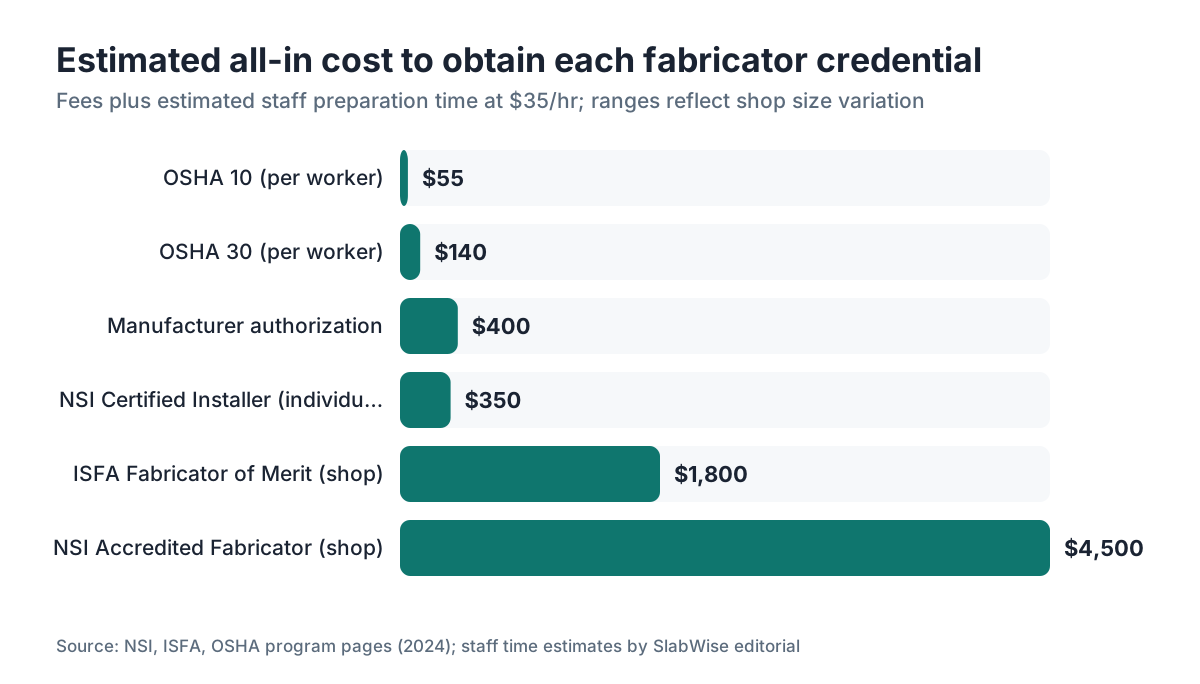
Here's the honest picture by program type, with the caveat that fees update and you should verify directly with each organization.
| Program | Who runs it | Rough cost (2024) | Time to complete | Renewal |
|---|---|---|---|---|
| NSI Accredited Fabricator | Natural Stone Institute | $1,500 to $4,000+ depending on shop size | 3 to 6 months | Every 3 years |
| ISFA Fabricator of Merit | Int'l Surface Fabricators Assoc. | Membership + audit fees, est. $800 to $2,500 | 2 to 4 months | Annual review |
| ISFA Fabricator of Distinction | Int'l Surface Fabricators Assoc. | Higher than FOM, varies | 3 to 6 months | Annual review |
| NSI Certified Installer (individual) | Natural Stone Institute | $200 to $500 approx. | Self-paced + exam, days to weeks | Periodic |
| OSHA 10 (general safety) | OSHA-authorized trainers | $30 to $80 online | 10 hours | Not required but often renewed every 5 years by employer policy |
| OSHA 30 (general safety) | OSHA-authorized trainers | $100 to $180 online | 30 hours | Not required |
| Manufacturer authorization (e.g., Cambria, Caesarstone) | Brand-specific | Free to a few hundred dollars | Days to weeks of product training | Annual re-enrollment |
The NSI shop audit is the most resource-heavy because it needs an on-site visit and documentation prep. Many shops spend 40 to 80 hours of staff time getting paperwork and procedures in order before the auditor shows up. That hidden labor cost is real, and often bigger than the audit fee itself.[3]
For a fabricator running quoting and job documentation in a system like SlabWise, the paperwork side of an NSI or ISFA audit hurts less because job records, material logs, and customer sign-offs already live in one place instead of scattered across spreadsheets.
Does having a certification actually win more business?
Honestly, it depends on your market. In major metros where design-build firms and kitchen designers source fabricators, NSI accreditation and ISFA FOM do get you on short lists. Design professionals who specify stone on large residential or commercial projects often ask for third-party credentials before referring a shop to a client. That's a documented preference in the design community, though I'm not aware of a clean controlled study on conversion rates.
In rural or smaller markets, certifications may matter less than referrals and portfolio photos. Most homeowners don't know what ISFA stands for. They respond to Google reviews, before-and-after photos, and whether the salesperson seems competent during the consultation.
The area where certification pays most reliably is commercial work. Hospitality groups, office developers, and healthcare facility managers increasingly require proof of safety training and quality programs before awarding fabrication contracts. An OSHA 30 card and an NSI accreditation letter can be the difference between making a bid list and not.
For engineered stone specifically, the silicosis story has hit mainstream media, and some commercial general contractors now ask fabricators to show silica safety compliance documentation. That's a form of credential even when it doesn't come with a badge.
What should homeowners look for when evaluating a fabricator's credentials?
Start by asking directly: are you NSI-accredited or ISFA-certified? Then ask for the certificate number or accreditation status and verify it on the organization's website. Both NSI and ISFA maintain member and accredited shop directories.
Beyond formal credentials, ask whether the shop has documented silica safety practices for its workers. This isn't a gotcha question. It's a genuine read on how the shop is run. A shop that takes worker health seriously tends to take job quality seriously too.
For natural stone jobs, granite countertops, marble countertops, or how to clean quartzite countertops situations where you're dealing with a specific stone's behavior, ask whether the fabricator has worked with that particular material. NSI's installer certification covers natural stone types individually, so a certified installer should be able to talk through the material's specific seam and edge considerations.
Also ask for references from jobs finished in the last 12 months, not a glossy portfolio from five years ago. Credentials are a starting signal. Recent work samples and customer references are the actual evidence.
If you want an instant quote from a certified fabricator in your area, compare a few shops before committing. Shops that are open about their credentials and pricing upfront are generally better to work with throughout the project.
How is the silicosis crisis changing certification and training requirements?
This is the fastest-moving area in stone fabrication right now. The cluster of silicosis cases among engineered stone workers, documented in California, Australia, and Israel, has prompted regulatory attention that's likely to tighten over the next few years.[5]
Cal/OSHA has proposed regulations specific to engineered stone fabrication that go beyond the federal standard. The California Department of Industrial Relations has been running targeted inspections of stone shops, particularly those working with high-silica engineered quartz products.[7]
At the federal level, OSHA issued a Hazard Alert about engineered stone in 2023, warning that standard controls may fall short for products with extremely high silica content.[2] Some engineered stone products contain 90 to 95 percent crystalline silica, and OSHA's alert noted that even wet cutting may not cut exposures to safe levels with every product.
Here's what it means for certification: NSI and ISFA are both updating their training content to address high-silica engineered stone specifically. Some industry observers expect that within a few years, engineered stone shops will face either mandatory third-party audits or tougher documentation requirements as a condition of operating, separate from the voluntary credential landscape that exists today.
Fabricators who get ahead of this by earning credentials now, building documentation systems, and putting in reliable wet cutting and local exhaust ventilation are better positioned when those requirements land. The shops waiting for the rule to arrive before acting tend to scramble.
Where can fabricators and homeowners verify credentials and find certified shops?
The Natural Stone Institute maintains a searchable online directory of accredited fabricators at naturalstoneinstitute.org. You can search by location and see current accreditation status.[3]
ISFA's member directory at isfanow.org lists fabricator members, and you can filter for those holding FOM or FOD status.[4]
For OSHA 10 and OSHA 30 completion cards, there's no central lookup database. Cards are issued by the training provider. An employer can ask to see the physical card, which includes the issuing trainer's OSHA authorization number, or request a letter from the training provider.
Manufacturer authorized fabricator lists live on each brand's website. Cambria, Caesarstone, Cosentino (Silestone), and other major brands list their authorized shops by region.
State contractor license status is verifiable through each state's contractor licensing board website. California's is at cslb.ca.gov, Florida's at myfloridalicense.com, and similar boards exist in most licensed states.[1][10]
If you're managing multiple shop credentials and renewal dates as a fabricator, track them in whatever job management software you use, whether that's a spreadsheet or a platform built for fabrication shops. Missed renewal dates are embarrassingly common and easy to avoid with a calendar reminder.
Frequently asked questions
Is NSI accreditation the same as being licensed to fabricate stone?
No. NSI accreditation is a voluntary quality credential issued by the Natural Stone Institute after a shop audit. A contractor license is a state-issued legal authorization to contract for installation work. Some states require a contractor license; no state requires NSI accreditation. They're independent of each other, and you can hold one without the other.
How often do fabricators need to renew their certifications?
NSI accreditation requires re-audit roughly every three years. ISFA's FOM and FOD programs involve annual reviews. OSHA 10 and OSHA 30 cards technically don't expire, but many employers require renewal every five years as a policy matter. Manufacturer authorizations typically require annual re-enrollment and product training updates.
Can an individual installer get certified, or is it only for the whole shop?
Both options exist. NSI's Certified Installer credential is for individual workers. ISFA's FOM and FOD are shop-level accreditations. A shop can hold FOM while individual installers pursue NSI's personal certification separately. Most certification programs encourage both levels because shop systems and individual skills are different things.
Does OSHA require stone shops to have certified employees?
OSHA doesn't require OSHA 10 or OSHA 30 cards specifically. What the 2016 silica rule does require is documented employee training on silica hazards, exposure controls, and medical surveillance rights if exposure levels trigger it. The specific training format is flexible, but shops must document that workers have been trained on the silica standard's requirements.
Are there certification programs specifically for countertop templating?
No standalone templating certification exists as of 2024. Templating is covered within broader ISFA and NSI programs as part of the fabrication quality audit. Some digital templating tool vendors (like Laser Products Industries or Prodim) offer device-specific training, but that's product training, not an independent professional credential.
Do fabrication certifications transfer between states?
Voluntary certifications from NSI and ISFA are national and aren't state-specific, so they carry the same meaning anywhere in the country. State contractor licenses do not transfer. Each state that requires a license requires its own application, exam, and insurance filing. Some states have reciprocity agreements, but you need to verify that directly with the target state's licensing board.
What's the difference between an authorized fabricator and a certified fabricator?
An authorized fabricator has completed a manufacturer's product training and agreed to follow that brand's installation guidelines. A certified fabricator has gone through an independent third-party audit or exam from NSI or ISFA. Authorization comes from the product brand and mainly affects warranty coverage. Certification comes from a trade association and reflects general quality and safety standards.
How much does silica safety training cost for a stone shop?
Costs range widely. Basic silica awareness training through OSHA's free online resources costs nothing beyond staff time. A formal written exposure control plan prepared by an industrial hygienist can run $1,000 to $3,000. Air monitoring by a certified industrial hygienist firm typically costs $500 to $2,000 per monitoring event. Wet cutting equipment upgrades, if needed, are separate capital expenses.
Will a certification help a fabricator win commercial countertop jobs?
It depends on the general contractor or project manager. Many commercial GCs now request proof of safety training and quality documentation before allowing subcontractors on site. NSI accreditation and ISFA FOM are recognized enough in commercial channels that holding them can get a shop on a bid list. In smaller commercial projects or residential work, certifications matter less than portfolio and references.
Does being a certified fabricator affect my liability insurance rates?
Potentially. Some specialty contractors' insurers view third-party quality certifications favorably and may offer modest premium discounts or broader coverage terms. There's no industry-wide rule on this. The best approach is to tell your broker you hold NSI or ISFA accreditation and ask whether it affects your rating. The answer varies by carrier and policy.
Are there certifications for installing specific stone types like quartzite or soapstone?
NSI's training materials cover natural stone types including quartzite, soapstone, and marble individually, since each has distinct absorption, hardness, and seaming characteristics. The Certified Installer exam tests knowledge across stone types rather than issuing material-specific badges. For care specifics on these stones after installation, the behavior differences matter a lot in the field.
How do I find NSI-accredited or ISFA-certified fabricators near me?
The Natural Stone Institute maintains a searchable directory at naturalstoneinstitute.org where you can filter by location and accreditation status. ISFA's member directory at isfanow.org lists shops with FOM and FOD credentials. Both are publicly accessible without creating an account. Manufacturer websites also list their authorized fabricator networks by region.
Sources
- California Contractors State License Board (CSLB), License Classifications: California requires specific contractor license classifications (C-54, C-29) for tile and stone installation, enforced by the CSLB.
- OSHA, Occupational Exposure to Respirable Crystalline Silica (29 CFR 1910.1053 / 1926.1153): OSHA's 2016 silica rule sets a PEL of 50 micrograms per cubic meter and an action level of 25 micrograms per cubic meter; enforcement for general industry began June 23, 2018.
- Natural Stone Institute, Accreditation Programs: NSI offers the Accredited Natural Stone Fabricator shop program and the Certified Installer individual credential, with re-audit required for accreditation maintenance.
- International Surface Fabricators Association (ISFA), Fabricator Certification: ISFA runs the Fabricator of Merit and Fabricator of Distinction shop-level accreditation programs requiring membership, documentation, work samples, and facility inspection.
- JAMA Internal Medicine, Rapidly Progressive Silicosis in Workers Manufacturing Engineered Stone: A 2023 report documented rapidly progressive silicosis among young engineered stone fabrication workers, with cases traced to high-silica quartz countertop products.
- OSHA, Outreach Training Program (OSHA 10 and OSHA 30): OSHA's Outreach Training Program authorizes 10-hour and 30-hour general industry and construction safety courses delivered by authorized trainers.
- Natural Stone Institute, Natural Stone Sustainability Standard (NSS): NSI's Natural Stone Sustainability Standard provides a supply chain documentation framework used by fabricators on LEED-adjacent commercial projects.
- Florida Department of Business and Professional Regulation, Contractor Licensing: Florida requires a state-licensed or locally registered contractor for specialty installation work including stone countertop installation.
Last updated 2026-07-11