TL;DR
- A countertop template technician needs field measuring accurate to under 1/16 inch, practical geometry and math, comfort with tools from a tape measure to laser or camera templating systems, clear communication with clients and fabricators, material knowledge across stone and engineered surfaces, and the stamina to crawl around tight kitchens.
- Most shops train on the job.
- Math and spatial reasoning matter from day one.
What does a countertop template technician actually do?
The template technician visits the job site before a single slab gets cut. The whole job is capturing the exact shape of the space so the shop can cut stone to fit. Get it right and the countertop drops in with tight gaps at the walls, clean sink cutouts, and a cooktop hole nobody has to grind. Get it wrong and you get a crack, a gap, or a full recut.
In practice, that means showing up to a kitchen or bath and measuring every wall run, every corner angle, every window sill return, and every sink or appliance cutout. The tech documents overhang dimensions, requested edge profiles, seam locations, and any scribing needed against irregular tile or plaster. Then they hand that information to the fabricator, either as a physical template made from luan or cardboard, or as a digital file exported from a laser or camera-based system.
The job sounds simple. It isn't.
Cabinet installers leave walls out of plumb, corners that aren't 90 degrees, and appliances set at angles. The tech has to catch all of it and tell the shop what the stone needs to do in response. A bad template is one of the most expensive mistakes in the whole pipeline because it wastes a slab. Natural stone slabs like granite or quartzite run from a few hundred to several thousand dollars depending on grade [1].
What math and geometry skills does the job require?
This is where people underrate the role. You use practical geometry every single day. Not calculus, not trig tables. You need right triangles, the Pythagorean theorem to check squareness, basic area math for material yield, and angle bisection for corners that aren't 90 degrees.
A common field check: measure the diagonals or use the 3-4-5 triangle method to verify a corner is square before you template it. If the corner reads 91.5 degrees on your digital angle finder, you tell the cutter, so the slab edge matches the wall instead of an assumed 90. Miss it and you get a shadow gap the homeowner notices for the life of the kitchen.
Unit conversion matters too. Templates get measured in fractions of an inch, sometimes decimals, and CNC machines often work in millimeters. A tech who muddles 3/8 inch into 9.525 mm under time pressure is a liability.
Area math drives yield. If you're templating a perimeter kitchen and need to know whether a 126-inch by 63-inch slab (a common jumbo size) can nest two runs without a seam landing in a bad spot, you're doing that math on the fly. Fabrication software like SlabWise can automate the nesting, but the tech on site still has to understand what constraints they're feeding the software.
Speed counts. If you're slow with a calculator, you're slow in the field, and field time costs money.
What measuring tools does a template technician need to know?
The classic toolkit is a 25-foot tape measure, a framing square, a digital angle finder, a torpedo level, and a pencil. That combination still works, and experienced techs template a full kitchen with nothing else.
Digital templating systems have changed the trade over the last decade. Two main categories: laser-based systems and photogrammetric (camera-based) systems. Laser tools like the Proliner by Prodim shoot reference points around the countertop perimeter and capture the exact outline as a digital file [2]. Camera-based systems capture reference points using photos and scale markers. Both export files that go straight to a CNC machine with no manual redraw, which cuts a layer of human error out of the process.
Knowing at least one digital system is close to a requirement at mid-size and larger shops. Small shops still template by hand, so tape-and-template skills haven't gone anywhere.
Other tools worth knowing: a scribing tool for fitting stone against irregular surfaces, a laser distance meter for long runs where tape sag introduces error, and a level for checking sink rim planes and cooktop surfaces.
The sink is always its own project. You need the rough-in dimensions, the exact model number if it's undermount (because the reveal edge varies by brand), and confirmation of whether the sink is already set or drops in later. Get the undermount reveal wrong by 1/8 inch and you either grind stone on site or remake a piece [3].
How important is material knowledge for a template tech?
Very. The tech doesn't fabricate stone, but they have to know how different materials behave so they template them correctly.
Natural stone like granite, marble, and quartzite has grain direction and veining. Seam placement has to account for where veining breaks unnaturally and whether bookmatching is expected. A tech who drops a seam at a cooktop without thinking about how a dark granite's movement reads there will create a complaint even when the seam is structurally fine [4].
Engineered stone (quartz) like Cambria has pattern repeats and directional designs. Some Cambria countertops patterns run a clear direction, so a seam placed without thinking about orientation shows a rotation in the pattern.
Laminate like Formica works differently again. Formica countertops and laminate countertops have sheet size limits, grain direction, and post-form radius constraints that change how you plan seams and scribes.
Butcher block adds its own concerns: wood movement, end grain versus face grain, and whether the installers need a floating attachment method. Butcher block countertops can move seasonally by more than 1/4 inch across a wide slab [11], and a tech who doesn't flag that to the fabricator is setting up a crack or a buckle.
These material differences aren't optional knowledge if you want to template without callbacks.
What communication skills does a template technician need?
The tech is often the only person from the shop who meets the homeowner face to face before installation day. That matters enormously.
A homeowner who feels rushed during templating becomes the homeowner who calls to complain about a seam that was explained during the visit, just not explained well. A good tech confirms seam locations out loud, shows the homeowner where seams fall and why, asks about cooktop and sink models, verifies overhangs, and gets sign-off. Some shops use a field checklist or a digital form both parties review.
Talking to the shop matters just as much. The tech has to hand off the template in a format the fabricator can actually use. On a digital system, that's a file with documented notes. On a physical template, you need labels that leave no room for doubt: which side is up, which edge is finished, where seams fall, what edge profile each section gets.
Misread handwriting has sent slab cuts wrong. A tech who writes clearly, labels templates the same way every time, and follows the shop's naming convention keeps the floor running without interruption calls.
For countertop installation to go smoothly on the back end, the installers depend on what the tech noted: which walls need scribing, whether a range sticks out past the cabinets, whether the peninsula needs a waterfall detail. All of that lives in the template notes.
What physical demands should a template technician expect?
The job is harder on your body than it looks. A kitchen template visit runs 45 minutes to 2 hours depending on complexity. During that time you're kneeling on cabinet bases, crawling under peninsulas to measure cabinet depths, crouching to read corner angles at counter height, and hauling heavy template boards or a device kit.
Most shops expect techs to hit 3 to 8 job sites a day when scheduling is dense. That's a lot of van time plus a lot of getting in and out.
Lower back strength matters. So does reach and flexibility. A tech with a chronic knee problem faces a real ergonomic issue on construction sites where knee pads only help so much. The demands aren't crushing, but anyone who pictures templating as a desk job is in for a surprise.
Lifting is part of it. Digital kits stay light (most under 20 pounds), but luan templates for a full kitchen are awkward panels you're loading in and out of a van. Some shops use cardboard, which is lighter and more fragile.
Does a template technician need to know how to use digital or CAD software?
Increasingly yes, though how much depends on the shop's workflow.
At minimum, a tech running a digital templating system has to operate that system's own software to capture, review, and export the file. The Proliner, for one, has its own interface for adding attributes like edge profiles, sink types, and seam annotations directly on the digital outline [2]. That's not AutoCAD, but it's software fluency.
Some shops want techs who can open a DXF or DWG file in a viewer and confirm the export looks right before leaving the site. Basic software literacy means understanding file formats, knowing how to share a file by cloud folder or email, and catching an obvious error like a missing wall segment.
At bigger operations, or shops running their own CNC programming, a tech who can read the nesting output and picture how the template lands on a slab is worth more than one who can't. Fabrication tools that handle both quoting and nesting connect the template file straight to material planning, so a tech who understands that pipeline can flag a run that won't fit the available slab before it becomes a slab-splitting problem.
Full CAD design skill (parametric modeling, engineering drawings) isn't required for most template roles. Software avoidance, though, is a career ceiling in this trade.
What is the typical pay range for a countertop template technician?
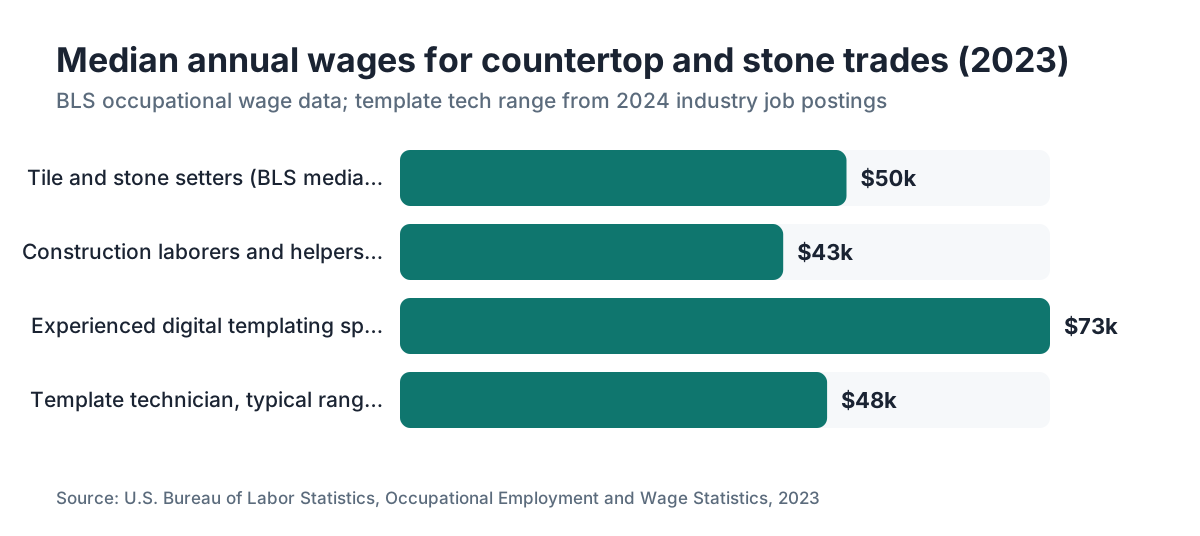
Pay varies by region, shop size, and whether the tech also installs. The U.S. Bureau of Labor Statistics files countertop installers and template techs under broader categories, usually tile and stone setters or construction laborers and helpers. Construction laborers and helpers reported a median annual wage of $42,920 in 2023 [5]. Tile and stone setters reported $50,010 [6].
Shops tend to pay template techs more than general labor because templating errors are expensive. Industry job boards in 2024 show most template roles paying $18 to $28 per hour, with experienced digital templating specialists in high-cost metros reaching $32 to $38 per hour. Techs who also install land toward the top. Some shops pay piece-rate or per-template, which can beat hourly for a fast, experienced tech.
No national license covers template technicians specifically. Some states require a contractor's license for installation work, but pure templating is generally exempt. Certifications from the Natural Stone Institute (formerly the Marble Institute of America) exist for fabricators and installers, and finishing that training can support a pay bump [7].
| Role | Median / Typical Hourly | Source |
|---|---|---|
| Construction laborers and helpers | $42,920/year ($20.63/hr) | BLS 2023 [5] |
| Tile and stone setters | $50,010/year ($24.04/hr) | BLS 2023 [6] |
| Countertop template tech | $18 to $28/hr | Job boards, 2024 |
| Experienced digital templating specialist | $32 to $38/hr | Job boards, 2024 |
How long does it take to learn countertop templating?
Most shops expect a new tech to shadow an experienced one for 4 to 12 weeks before running solo sites. The range is wide because it hangs on the individual's math comfort, spatial reasoning, and hand skills.
Someone coming from carpentry, tile setting, or any trade that required field measurement picks it up in a few weeks. Someone with no trade background usually needs 2 to 3 months of supervised work before the shop trusts them on complex jobs: kitchens with multiple angles, cooktops, and islands.
Digital systems add their own learning curve. Prodim publishes training resources for the Proliner and puts basic proficiency at one to three days of hands-on training [2]. Full efficiency, meaning capturing a complex kitchen without errors and exporting a clean file, usually takes a few weeks of real field use.
The hardest skills to teach fast are the ones you can't see in a measurement but that matter to the installer. Noticing a wall isn't plumb. Flagging a cabinet run that sits higher than standard. Catching a dishwasher opening that's narrower than spec. Those are pattern-recognition skills, and they come from doing a lot of kitchens.
What are the most common templating mistakes and how do techs avoid them?
Bad corner angles cause the most rework. A tech who assumes every corner is 90 degrees without checking creates a gap at the wall or an overhang that wanders. The fix is simple: check corners with a digital angle finder. Most kitchens have at least one corner reading 89 or 91 degrees.
Wrong sink cutout size is probably the single most expensive mistake. Undermount sinks need a specific reveal (the gap between the stone edge and the bowl), and every manufacturer's spec differs slightly [3]. The tech needs the exact model number and should verify it against the shop's sink template library or the manufacturer's spec sheet.
Skipping appliance confirmation causes cooktop holes that miss center by 2 inches, which is visible and embarrassing. The tech verifies that appliances are actually where the template says, more than where the homeowner assumes they'll go.
Poor seam placement is another. Seams should avoid high-stress areas like the middle of a long unsupported run, avoid focal points like the center of a window, and respect veining. A good tech thinks about this before marking the template, not after [4].
For kitchen countertops with complex shapes, techs should also check the sink cabinet centerline against the window centerline, because what looks centered on the plan often isn't centered in the field.
Mislabeled templates round out the list. A flipped label or a missing edge designation has sent fabricators cutting the wrong side as the finished edge. Every section gets labeled: finished edges, seam locations, material type, edge profile, and which corner is which.
Does material type change how a tech approaches templating?
Yes, in several concrete ways.
With natural stone (granite, marble, quartzite, soapstone), every slab is unique. Seam placement becomes a conversation about where the veining or movement looks best, and sometimes the tech has that conversation with the homeowner on site. Marble countertops with dramatic veining are especially sensitive to seam location. The tech isn't picking the slab, but they're setting the constraints the shop uses when they lay the template on the actual material.
Quartzite and similar stones also vary in thickness, which changes how overhangs get calculated. Some slabs come in 2 cm, others 3 cm, a few at 1.2 cm for specific uses. That affects edge build-up details and undermount attachment.
Engineered quartz is more uniform, but directional patterns need orientation flags in the template. Some patterns have a clear up direction that has to be called out.
Soapstone is softer and needs different sink reveal and edge details than hard stone. A tech who's templated 500 granite jobs and templates their first soapstone job the same way can create a weak edge. (Our how to clean soapstone countertops guide gives a sense of how soft the material is in daily use, which reflects the same physical properties that matter at fabrication.)
Laminate and solid surface like Corian have sheet seam requirements that differ from stone entirely. Corian countertops use adhesive seams that go nearly invisible when done right, but the template has to put seams where the adhesive can be clamped properly.
What soft skills separate good template technicians from great ones?
Problem-solving in the field without calling the shop every 15 minutes. Things go wrong: a cabinet installer left a run 2 inches short, the range hood duct sits in a spot that affects the backsplash, the homeowner changed the sink model after the order. A tech who handles these calmly, documents them clearly, and knows which need a shop call versus which they can resolve on site is worth a lot more than one who freezes.
Patience with homeowners. Some clients are anxious about the money, ask a lot of questions, or want to change things during the visit. A good tech explains what's fixable at template stage versus what's already committed, without making the homeowner feel brushed off.
Sequencing awareness. Great techs notice things past the template: the beam running under the peninsula, the electrical rough-in that sits slightly too high, the cabinet that's not level. None of it is the tech's job to fix, but a note saves the install crew a surprise.
Reliability. Show up on time, carry all your tools, get the file back to the shop the same day. Most template errors aren't measurement math. They're lapses in attention or rushed visits. The best techs stay unhurried even under scheduling pressure.
Frequently asked questions
Do you need a degree or certificate to become a countertop template technician?
No degree is required. Most techs learn on the job, shadowing an experienced tech for several weeks before working alone. The Natural Stone Institute offers fabricator and installer certifications that some shops value when hiring, and finishing one can support a pay increase, but it isn't required to get started in the role.
Is countertop templating the same job as countertop installation?
They're different but often done by the same person. Templating is the measurement and documentation visit before fabrication. Installation is setting the finished stone after the shop cuts it. Some shops split the roles so a dedicated tech templates and a separate crew installs. Others have their installers do their own templates. The skills overlap heavily but aren't identical.
What's the difference between a physical template and a digital template?
A physical template is a full-scale cutout of the countertop shape, usually luan or cardboard, that the shop lays directly on the slab to guide cutting. A digital template is a file captured by a laser or camera system that goes straight to a CNC machine. Digital is faster and more accurate but needs equipment that runs roughly $10,000 to $30,000 for a professional setup.
How accurate does a countertop template need to be?
Industry standard for stone countertops is plus or minus 1/16 inch on field measurements. Some high-end shops work to 1/32 inch, especially for precision edge details or tight sink reveals. Digital templating systems can capture to within 0.5 mm. Physical templates introduce slightly more variability because luan can flex or bow during transport.
What is the hardest part of learning to template countertops?
Most people say reading irregular spaces is the steepest part. Kitchens rarely have perfectly square, plumb, or level walls. Learning to catch and communicate those irregularities, instead of assuming the space is ideal, takes real field experience. The math and tool operation come quickly. The spatial judgment takes longer.
Can a homeowner template their own countertops?
Technically yes for simple jobs, especially laminate or tile where small errors are fixable. For stone, most fabricators won't cut from a homeowner-supplied template because one bad measurement costs a slab. If you're set on DIY, a cardboard template checked for square with diagonals and a framing square gives a fabricator something to work with, but expect the shop to add a buffer or verify dimensions before cutting.
How many templates can a technician do in a day?
A typical day runs 3 to 6 job sites, depending on drive times and complexity. A simple bathroom with a single vanity top might take 20 minutes on site. A full perimeter kitchen with an island, cooktop, undermount sink, and multiple corner angles can take 90 minutes to 2 hours. Digital templating is faster than physical on complex jobs.
Does a template technician need to know about sink types and plumbing?
They need enough to capture the right dimensions and flag conflicts, not to do plumbing. Specifically: whether the sink is undermount, topmount, or farmhouse apron-front (each needs different cutout geometry), the exact model, and whether the sink is already set or drops in after stone installation. Plumbing past that is the plumber's job.
What safety considerations apply to countertop templating?
Active construction sites bring real hazards: uneven floors, open wall cavities, loose electrical, and debris. Template techs should wear closed-toe shoes with ankle support, eye protection in dusty conditions, and knee pads for extended kneeling. Driving safety counts too, since many techs cover 50 to 100 miles a day. Silica dust is more a fabrication-floor concern than a field concern, but techs visiting active shops should know the OSHA silica standard.
What OSHA regulations apply to countertop work?
OSHA's silica dust standard for construction (29 CFR 1926.1153) sets an action level of 25 micrograms per cubic meter and a permissible exposure limit of 50 micrograms per cubic meter for respirable crystalline silica over an 8-hour average [8]. This mainly affects fabrication and dry-cutting, not field templating. Template techs working in or near active cutting areas should understand the exposure risk and shop ventilation requirements [9].
How do seam locations get decided during templating?
The tech, working with the fabricator and homeowner, sets seam locations on three factors: slab size (you can only span so far without a seam), structural rules (seams shouldn't run through unsupported spans or over sink cabinets without reinforcement), and looks (keeping seams off focal points and matching veining direction). The tech marks seams on the template and confirms them with the homeowner before leaving.
Is templating outdoor kitchens or commercial countertops different from residential work?
Outdoor kitchens add material constraints (not all stone handles freeze-thaw well) and substrate variations (concrete or steel frames instead of wood cabinets). Commercial templating often means larger runs, ADA height requirements, and tighter coordination with general contractors. Standard kitchen counter height is 36 inches, while ADA work surfaces run about 34 inches [10]. The core measuring skills match residential; the context needs more coordination.
What tools should a new template tech buy first?
Start with a quality 25-foot tape measure (Stanley FatMax or equivalent), a digital angle finder, a 4-foot level, a torpedo level, a framing square, and a sharp pencil. That kit handles most residential jobs. Add a laser distance meter for long runs. If the shop uses a digital templating system, they'll provide the gear and training. Don't buy a digital system on your own until you know which platform the shops in your market use.
Sources
- Natural Stone Institute, Stone Industry Statistics: Natural stone slab prices vary widely by grade and material, from a few hundred to several thousand dollars per slab.
- NKBA (National Kitchen and Bath Association), Kitchen and Bath Planning Guidelines: Undermount sink reveal dimensions vary by manufacturer and must be verified against the specific sink model to ensure correct stone cutout geometry.
- Natural Stone Institute, Fabrication Best Practices: Seam placement in natural stone should account for veining direction, structural support, and aesthetic focal points to minimize visible and structural defects.
- U.S. Bureau of Labor Statistics, Occupational Employment and Wage Statistics, Construction Laborers and Helpers: Construction laborers and helpers had a median annual wage of $42,920 in 2023 according to BLS Occupational Employment and Wage Statistics.
- U.S. Bureau of Labor Statistics, Occupational Employment and Wage Statistics, Tile and Stone Setters: Tile and stone setters had a median annual wage of $50,010 in 2023 according to BLS Occupational Employment and Wage Statistics.
- Natural Stone Institute, Accredited Natural Stone Fabricator Program: The Natural Stone Institute offers fabricator and installer certifications through its Accredited Natural Stone Fabricator program that shops recognize for hiring and compensation purposes.
- OSHA, Respirable Crystalline Silica (29 CFR 1926.1153, Construction): OSHA's silica standard for construction sets an action level of 25 micrograms per cubic meter and a permissible exposure limit of 50 micrograms per cubic meter for respirable crystalline silica (8-hour TWA).
- OSHA, Silica in the Construction Industry Overview: Silica dust exposure is primarily a fabrication and dry-cutting hazard; template technicians working near active cutting areas should be aware of shop ventilation requirements and the applicable OSHA standard.
- National Kitchen and Bath Association, NKBA Kitchen Planning Guidelines with Access Standards: Standard kitchen countertop height is 36 inches from the floor; ADA-compliant work surfaces are typically 34 inches, relevant for commercial and accessible residential templating.
- USDA Forest Products Laboratory, Wood Handbook: Wood as an Engineering Material: Wood moves measurably across the grain with changes in moisture content, meaning a wide butcher block slab can shift more than 1/4 inch seasonally depending on climate and species.
Last updated 2026-07-11