TL;DR
- A small countertop fabrication shop needs five core machines to open: a bridge saw or CNC saw for cutting, an angle grinder or edge polisher for finishing, a seam setter for joins, a vacuum lifter for safe slab handling, and a dust collection system for OSHA compliance.
- Budget $40,000 to $120,000 for a basic used setup, or $200,000-plus for new CNC equipment.
What does a countertop fabrication shop actually do, and why does that determine your equipment list?
Before you spend a dollar, understand what the work physically requires. Countertop fabrication means taking raw stone slabs (granite, quartz, marble, quartzite, and others) weighing 400 to 800 pounds each, cutting them to shape, profiling the edges, polishing the surfaces, cutting sink and cooktop openings, and then delivering and installing finished tops. Every step in that chain has a machine behind it.
The stone drives the equipment choices. Natural stone is abrasive, heavy, and wet-cut to control silica dust. Engineered quartz is just as demanding. Laminate and solid surface machine far easier, but most shops that grow past entry-level move into stone because that's where residential kitchen and bath margins live.
A shop that only does laminate countertops can run on a table saw and a router table. A shop cutting granite countertops or marble countertops needs water-cooled diamond tooling, serious dust control, and a way to safely move slabs that outweigh most employees. That's the fork in the road. Decide it before you price anything.
What is the single most important machine in a stone fab shop?
The saw. Everything else feeds off the saw's output, and your saw choice shapes your throughput, your labor model, your floor space, and your capital needs.
You have two real options for a starting shop:
Bridge saw. A bridge saw runs a diamond blade on a carriage that travels across the slab on a fixed or tilted table. A decent used Italian-made bridge saw (brands like Breton, Donatoni, or Park Industries) runs $15,000 to $40,000 used, and a new mid-range machine is $50,000 to $80,000. Bridge saws require an operator standing at the machine making cuts manually or with semi-automated programming. Learning time is measured in weeks, not months.
CNC machining center. A CNC router or CNC saw (often called a 5-axis CNC in stone) cuts, profiles edges, and drills holes automatically from a digital template. New machines start around $100,000 and go past $300,000 for full-featured systems. Used CNCs exist, but support and parts availability matter enormously. Buying a discontinued brand is a trap. CNC makes sense at volume: most fabricators put the breakeven point versus a bridge saw plus skilled labor somewhere around 15 to 25 slabs per week, though that depends heavily on your labor market.
For a startup shop doing 5 to 15 slabs a week, a used bridge saw is almost always the right first move [1].
What other cutting and shaping tools do you need from day one?
After the saw, you need tools for the cuts the saw can't make cleanly: sink cutouts, cooktop openings, and radius cuts.
Angle grinder. A 4.5-inch or 5-inch angle grinder with diamond cup wheels and polishing pads is the workhorse of stone finishing. Every shop runs at least two or three. Cost: $50 to $200 each. You'll burn through pads constantly, so budget for consumables.
Jigsaw with diamond blade. Used for curved sink cutouts on thin material. Not every shop uses one, but they're cheap enough ($100 to $300) that skipping it is silly.
Wet polisher / hand polisher. Variable-speed wet polishers (Flex, Metabo, and Makita all make popular ones in the $200 to $400 range) hand-polish edges and surfaces after the grinder's coarse work. You need at least two.
Router table or edge profiler. For production edge work, a dedicated edge polisher or shaping machine matters. A manual edge polisher like a used Park Industries EFX or similar runs $8,000 to $20,000 used. Shops doing under ten slabs a week often skip this and do edges by hand with the wet polisher, which is slower but workable.
Think of the saw as your big capital decision and everything else as the supporting cast. You can hand-tool a lot of things in a small shop. You cannot hand-cut a 3 cm quartz slab safely.
How do you safely move slabs in a small shop?
This is the area where new shop owners most often underinvest, and it's where injuries happen. A full slab of 3 cm granite weighs 18 to 22 pounds per square foot. A standard kitchen slab might be 65 square feet, putting you at 1,200 to 1,400 pounds. Humans cannot safely move that without mechanical help.
A-frame slab rack. Stone arrives on A-frame steel racks, and you store it the same way. These run $500 to $2,000 each. You need a minimum of four to six to run a functional shop.
Vacuum lifter. A pneumatic or electric vacuum lifter attaches suction cups to the slab face and lets a single operator tilt and position slabs safely. A basic two-person vacuum lifter (Blick, Wood's Powr-Grip, or similar) runs $1,500 to $4,000. This is not optional for stone. OSHA's guidance on materials handling [2] requires employers to eliminate or control ergonomic hazards, and slab handling without a lifter is exactly the kind of repetitive heavy lift OSHA looks for during shop inspections.
Overhead gantry crane or jib crane. A wall-mounted jib crane or a freestanding gantry with a vacuum attachment lifts slabs from the A-frame to the saw table without dragging. A basic 1-ton jib crane and hoist runs $2,000 to $6,000 installed. This is a "buy by year two" item for many startups, but if you have the ceiling height and the budget, get it on day one.
Shop forklift or pallet jack. You need something to move bundles of slabs from the delivery truck into storage. A used propane or electric forklift rated for 5,000 pounds or more runs $5,000 to $15,000 used. A heavy-duty pallet jack ($300 to $800) is a minimum if you're not ready for a forklift.
What dust control equipment does OSHA require for stone fabrication?
Silica dust is a serious occupational hazard in stone fabrication. Cutting, grinding, and polishing stone generates crystalline silica dust (respirable quartz), which causes silicosis, an irreversible and potentially fatal lung disease. OSHA's silica standard for construction and general industry, 29 CFR 1926.1153 and 29 CFR 1910.1053, sets a permissible exposure limit (PEL) of 50 micrograms per cubic meter of air as an 8-hour time-weighted average [3].
OSHA's table of specified exposure control methods lists wet methods and local exhaust ventilation (LEV) as engineering controls. For stone countertop fabrication, OSHA guidance notes that "using water to wet-cut or wet-grind reduces dust generation at the source" [3]. Most shops combine wet cutting at the saw with local dust collection at grinding stations.
What you actually need in the shop:
Wet cutting throughout. Your saw must run water continuously over the blade. This is built into every bridge saw and CNC stone machine. Not optional.
Dust collector with HEPA filtration. For dry operations (some drilling, overhead work), a dust collector rated for fine silica particles is required. Look for collectors rated to capture particles down to 0.5 microns. Budget $1,000 to $5,000 depending on capacity.
Respiratory protection. Even with engineering controls, you need N95 or P100 respirators available for workers. OSHA requires a written respiratory protection program under 29 CFR 1910.134 [4] when respirators are used.
Slurry management. Wet cutting produces a silica slurry (water mixed with stone dust). You cannot dump this down a municipal drain in most jurisdictions. A settling tank system ($500 to $3,000) lets the slurry solidify for disposal as solid waste. Check your local municipal discharge rules. Some jurisdictions treat stone slurry as a regulated waste.
Ignoring silica compliance is the fastest way to get fined and the slowest way to hurt your employees. OSHA penalties for serious violations run up to $16,131 per violation as of 2024 [5].
What shop infrastructure do you need before any machines arrive?
Equipment without infrastructure doesn't work. Before you sign a lease or order machines, confirm these:
Floor load capacity. Slab storage areas need a concrete floor rated for concentrated loads. A full bundle of slabs (12 to 15 slabs) can weigh 15,000 to 20,000 pounds. Most industrial spaces have 4-inch concrete slabs rated for 250 to 300 pounds per square foot (psf), which is often marginal. A structural engineer review costs $500 to $2,000 and can save you from a catastrophic floor failure.
Three-phase electrical power. A bridge saw typically runs on 220V single-phase, but a CNC or edge polisher often needs 3-phase power. Many small industrial spaces don't have it. Adding 3-phase service runs $2,000 to $10,000 depending on distance from the utility transformer. Ask the landlord before signing.
Water supply and drain. You need a continuous water supply for wet cutting and a floor drain for runoff. The drain must connect to either a settling tank system or a holding tank if your municipality prohibits direct discharge of stone slurry.
Compressed air. Vacuum lifters, pneumatic tools, and some finishing machines need a compressor. A 60-gallon, 5-hp air compressor runs $800 to $1,500 and handles most small shops.
Minimum square footage. A functional small shop needs at least 2,000 to 3,000 square feet: room for slab storage, the saw, a finishing/fabrication table, and a staging area for finished pieces. Any less and you're constantly shuffling material around other material, which kills productivity and creates injury risk.
What templating equipment does a countertop shop need?
Before you cut a slab, you need accurate measurements of the customer's existing cabinets or substrate. Templating is where mistakes happen, and mistakes in stone fabrication are expensive: a miscut slab is usually a total loss.
Traditional template kit. Luan plywood strips (1/4-inch), a hot glue gun, and a utility knife. Total cost under $100. This method works, and many experienced fabricators prefer it because you get a physical template that catches subtle irregularities. Time per kitchen: 30 to 60 minutes on-site, then layout time back at the shop.
Digital laser templating system. Systems like the Laser Products Industries Proliner [6] or the LT-55D use laser rangefinders to capture cabinet dimensions digitally, sending DXF files straight to your CNC or cutting software. A Proliner starts around $15,000 to $20,000 new. For a shop running a CNC, this is close to essential. For a manual bridge saw shop, it's a nice-to-have that speeds up the layout step.
For a startup shop, start with traditional templates. Add digital templating when you're cutting 15 or more jobs per week and the time savings justify the cost. The jump from plywood templates to digital templating typically saves 45 to 90 minutes per job in layout and nesting time, which adds up fast at volume.
Shop software that handles quoting and job nesting (like SlabWise) can import DXF files from digital templating systems and help you lay out cuts to minimize waste before the slab ever hits the saw table. Cutting scrap even 5 to 10% on a $400 slab has a real dollar impact over a year.
What finishing and installation tools does a shop also need?
Fabrication doesn't end at the saw. The finished piece has to reach the job site in one piece and get installed correctly.
Seam setter. When two pieces of stone meet at a seam, they need to sit perfectly flush. A seam setter (or seam phantom) uses suction cups and adjustable clamps to hold pieces level while epoxy cures. A decent seam setter runs $300 to $800. Some shops improvise with clamps and shims, but a real seam setter produces better results faster.
Epoxy and color-matching kit. Two-part epoxy in multiple colors is how you fill seams and repair chips. Budget $50 to $150 per month on epoxy for a small shop.
Stone installation trailer or truck. A cargo van or a trailer with A-frame racks to transport finished pieces. A used cargo van runs $15,000 to $30,000. Some shops use a flatbed trailer with custom racks for $3,000 to $6,000 in rack fabrication, pulling it with an existing truck. You need a way to transport stone vertically (leaned at an angle, not flat) to prevent cracking on bumpy roads.
Suction cups for installation. Heavy-duty lifting suction cups ($50 to $200 per pair) let the install crew move finished pieces without touching the polished surface.
Caulk guns, silicone, and undermount clip systems. The install hardware is cheap ($200 to $500 to stock up), but don't forget it in your startup budget.
For countertop installation specifics, the material changes what's needed, but the transport and seating equipment is fairly universal across stone types.
How much does it cost to start a small countertop fabrication shop?
The range here is wide, and it depends on whether you buy new or used, what materials you'll cut, and your local real estate market. Here's an honest breakdown.
| Equipment / Item | Used Cost Range | New Cost Range |
|---|---|---|
| Bridge saw (manual/semi-auto) | $15,000 - $40,000 | $50,000 - $80,000 |
| Edge polisher (optional at start) | $8,000 - $20,000 | $25,000 - $60,000 |
| Angle grinders (3x) | $300 - $600 | $300 - $600 |
| Wet polishers (2x) | $400 - $800 | $400 - $800 |
| Vacuum lifter | $1,500 - $4,000 | $3,000 - $6,000 |
| A-frame slab racks (6x) | $2,000 - $8,000 | $3,000 - $12,000 |
| Forklift | $5,000 - $15,000 | $20,000 - $40,000 |
| Dust collection + settling tank | $2,000 - $5,000 | $3,000 - $8,000 |
| Compressor | $800 - $1,500 | $800 - $1,500 |
| Template kit or digital templater | $100 - $15,000 | $15,000 - $20,000 |
| Seam setter + hand tools | $1,000 - $2,000 | $1,500 - $3,000 |
| Delivery vehicle/trailer | $5,000 - $30,000 | $30,000 - $60,000 |
| Total (equipment only) | $41,000 - $142,000 | $152,000 - $292,000 |
Add lease deposits, build-out costs (drainage, electrical), business insurance (general liability for a stone shop runs $2,000 to $6,000 per year [7]), and working capital to buy your first slabs. A realistic all-in startup budget for a small stone shop is $80,000 to $180,000 on the lean end, assuming you buy smart at auction and used equipment markets.
The SBA defines a small business in the stone, glass, and concrete products manufacturing sector (NAICS 327) with receipts ranging from under $8 million to $47 million depending on subsector [8]. Most startup fab shops sit well under those thresholds and may qualify for SBA 7(a) loans or SBA 504 loans for equipment and real estate [9].
Should you buy new or used equipment when starting out?
Used, for the saw. New, for the small stuff.
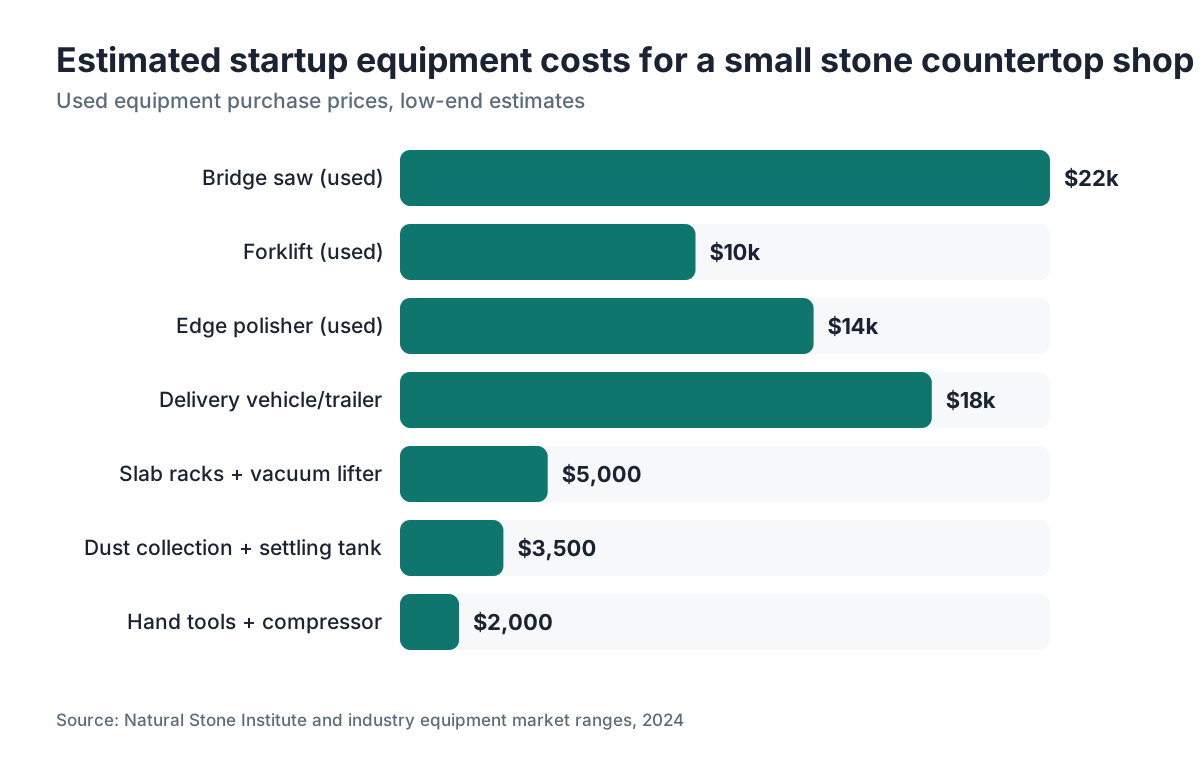
Here's the logic. A used bridge saw from a reputable Italian or American manufacturer (Breton, Donatoni, Park Industries, Northwood) was built to run 15 to 25 years with maintenance. The machines are mechanically simple: a motor, a carriage, a tilt table. Parts are available. Buy a 10-year-old Park Industries bridge saw for $22,000 and you're getting a machine that probably has a decade of life left at a small shop's pace.
CNCs are a different story. A used CNC from a discontinued manufacturer can become a parts orphan fast. The control software on older CNCs sometimes won't talk to current design files. If you go CNC, either buy new with a service contract or buy a used machine from a brand with a strong domestic support network, and get confirmation in writing that parts and software updates are still available.
Angle grinders, wet polishers, and hand tools: buy new. These are consumables with motors. A cheap grinder that dies mid-production costs you more in downtime than the $100 you saved.
Auctions are the best source for used stone equipment. Online platforms like Bidspotter, Proxibid, and IronPlanet regularly list stone fabrication equipment from shops that closed or upgraded. Expect to pay 20 to 50 cents on the dollar versus dealer used prices, but factor in trucking: a 3,000-pound bridge saw doesn't ship cheaply.
What safety certifications and business licenses does a stone fab shop need?
Requirements vary by state and locality, but here's a baseline.
OSHA compliance is federal and applies to any employer with one or more employees. The silica standard (29 CFR 1926.1153 for construction-related work, 29 CFR 1910.1053 for general industry) [3] requires a written exposure control plan, medical surveillance for workers exposed above the action level (25 micrograms per cubic meter), and training. OSHA's silica page [3] has a compliance schedule that's worth reading before you hire your first employee.
State contractor licensing: many states require a contractor's license to do installation work in someone's home. Requirements vary significantly. California's Contractors State License Board (CSLB) [10] requires a C-54 (tile) or D-12 (synthetic products) or C-45 (sign) license depending on what you're installing, and the application process takes months. Check your state's contractor licensing board before you take your first install job.
Business registration: an LLC or corporation at the state level, plus an EIN from the IRS [11], is the minimum business structure for a shop. A sole proprietorship is legally simpler but leaves personal assets exposed to liability claims, which matters a lot when you're moving 1,400-pound slabs in people's homes.
Local business license and zoning: your city or county will require a business license ($50 to $500 per year typically), and your location needs to be zoned for light manufacturing or industrial use. Countertop fabrication is not a permitted use in commercial retail or residential zones in most jurisdictions.
What software and office tools does a starting fabrication shop need?
The physical shop gets most of the attention, but the back office is where most small shops leak money.
At minimum you need: a way to generate quotes, a way to track jobs, and a way to lay out cuts on slabs before you cut them (called nesting).
Many shops start with a spreadsheet for quotes and a whiteboard for job tracking. That works for five jobs a week. Past ten jobs a week, manual tracking produces errors: wrong slab pulled, wrong edge profile quoted, wrong cutout dimensions sent to the saw.
Fabrication-specific quoting and shop management software handles all three problems. SlabWise, for example, handles quoting, slab nesting to reduce material waste, and job tracking in one place, and it's built specifically for countertop shops rather than adapted from a generic CRM. If you're evaluating options, the features that matter are integration with digital templating systems, material cost tracking per slab, and a customer-facing quote that itemizes edge profiles, sink cutouts, and material separately.
Don't forget basic accounting software (QuickBooks, Wave, or similar), a certificate of insurance tracking system for subcontract installers, and a Google Business Profile so residential customers can actually find you. The last one is free and takes thirty minutes.
What should you buy first vs. what can wait?
Day-one list: the saw, a vacuum lifter, A-frame racks, angle grinders, wet polishers, a compressor, dust collection, and your slurry settling tank. Without these, you can't cut stone safely or legally.
Year-one additions: a dedicated edge polisher if you're doing enough volume, a digital templating system if you're running a CNC or doing high-volume residential, and an overhead gantry or jib crane once the physical strain of slab handling starts wearing on your crew.
Defer until volume justifies it: a full CNC machining center, a 5-axis waterjet, and an automated line (sink cutout robot, polishing line). These are $100,000-plus decisions that only make sense when you're cutting 25 or more slabs per week consistently.
One thing I'd buy early that many shops skip: a good slab photography setup. A simple lightbox or a clean wall with consistent LED lighting lets you take professional photos of each slab for customer selection and online marketing. Cost: under $500. Return: measurable in closed sales, because customers buying granite countertops or marble countertops want to see the actual slab they're getting.
Frequently asked questions
Can I start a countertop shop without a CNC machine?
Yes, and most successful small shops do exactly that. A bridge saw plus hand tools handles everything a CNC does, just with more labor per piece. CNCs make economic sense at roughly 15 to 25 slabs per week, where the labor savings offset the machine cost and maintenance. Start with a bridge saw and upgrade when your volume demands it.
How much space does a small countertop fabrication shop need?
A minimum of 2,000 to 3,000 square feet for a functional shop cutting stone. That covers a slab storage area (the largest footprint), a cutting station, a finishing/polishing bench, and a staging area for completed pieces. Under 2,000 square feet you're constantly moving material to make room for other material, which slows production and increases breakage risk.
Do I need a special license to fabricate and install countertops?
It depends on your state. Most states require a contractor's license for residential installation work (the in-home part), but not for shop fabrication itself. California, Florida, and Texas all have different licensing structures. Check your state's contractor licensing board before you take installation jobs, because working unlicensed can void your liability insurance and result in fines.
What are the OSHA silica rules for a stone countertop shop?
OSHA's crystalline silica standard (29 CFR 1910.1053 for general industry) sets a permissible exposure limit of 50 micrograms per cubic meter of air over an 8-hour shift. Stone shops must use wet cutting as an engineering control, provide respiratory protection, conduct medical surveillance for workers exposed above 25 mcg/m3, and maintain a written exposure control plan. First-time violations can cost up to $16,131 per citation.
How do you dispose of stone slurry from wet cutting?
Stone slurry (water mixed with silica-bearing stone dust) cannot go down a municipal drain in most jurisdictions. The standard method is a settling tank system: slurry flows into a tank where the solids settle and the clarified water recirculates or drains. The settled solids dry into a cake and are disposed of as solid waste. Check your local pretreatment or stormwater discharge rules because requirements vary by municipality.
What's the difference between a bridge saw and a CNC for countertop cutting?
A bridge saw is a semi-manual wet saw where an operator guides straight cuts across a stone slab. It requires skilled labor but costs $15,000 to $80,000. A CNC machining center cuts, profiles edges, and drills holes automatically from a digital file with minimal operator involvement, but costs $100,000 to $300,000 new. Small shops typically start with a bridge saw and move to CNC when volume passes 15 to 25 slabs per week.
Can I cut laminate and stone in the same shop?
Yes, many shops do both. Laminate cuts with a table saw, router, and standard carbide tooling. Stone requires water-cooled diamond tooling and dust control. The infrastructure overlap is mostly in the shop space, forklift, and delivery vehicle. The main friction is that laminate work and stone work have very different time-per-job economics, and mixing them in one production schedule takes discipline to manage without stone jobs crowding out the faster laminate work.
What insurance does a countertop fabrication shop need?
At minimum: general liability insurance (covering property damage and bodily injury at job sites, typically $1 million per occurrence), commercial auto on your delivery vehicle, workers' compensation as required by your state, and inland marine or equipment insurance on your machinery. A stone shop doing residential installation will also want completed operations coverage, which covers claims arising after the job is done. Annual premiums for a small shop run roughly $4,000 to $10,000 combined.
How long does it take to learn to operate a bridge saw?
Basic operation takes one to two weeks for someone mechanically inclined. Producing clean, accurate cuts consistently at production speed takes two to three months of full-time practice. The hardest skills to develop are setting up angled cuts accurately, managing blade wear to maintain cut quality, and reading stone grain to anticipate where a cut might crack or chip. Formal training programs through the Marble Institute of America (now part of Natural Stone Institute) exist but are not required.
What is a seam setter and do I really need one?
A seam setter is a device that uses suction cups and adjustable clamps to hold two stone pieces flush and level while two-part epoxy cures at a seam. You can improvise with bar clamps and shims, but a real seam setter (costing $300 to $800) produces a cleaner, faster result and reduces the chance of a lippage (step) at the seam that requires grinding down later. For a shop doing more than five seams a week, buy one.
How do small countertop shops finance their equipment?
Common options include SBA 7(a) loans for working capital and equipment (up to $5 million, with terms up to 10 years for equipment), SBA 504 loans for major fixed assets (typically requiring 10% borrower equity), equipment financing through manufacturers or third-party lenders, and equipment leasing. Used equipment bought at auction is often paid in cash from savings. The SBA Lender Match tool at sba.gov connects borrowers with participating lenders.
What's the best first material to specialize in as a new shop?
Granite is the most forgiving stone to learn on: it's harder than marble (less likely to scratch during fabrication), more consistent than quartzite, and there's a large supply of affordable slabs. It's also the most common residential stone countertop, giving you the broadest customer pool. Once your crew's skills are solid, adding quartz (engineered stone) opens the contractor and production builder market, which has high volume but lower per-job margin.
Do I need a digital templating system or is plywood template still fine?
Plywood templates are still used by many experienced fabricators and work fine for manual bridge saw shops doing under 10 to 15 jobs per week. Digital laser templating (systems like the Laser Products Proliner) saves 45 to 90 minutes per job in layout time and integrates directly with CNC cutting software. For a startup shop, start with plywood templates and add digital templating when your volume and CNC investment justify the $15,000 to $20,000 cost.
What's the biggest mistake new countertop shop owners make on equipment?
Buying a CNC before they have the volume to justify it. A $150,000 CNC that runs at 30% capacity for the first two years is a much heavier burden than a $25,000 bridge saw plus two skilled fabricators. The second most common mistake is underinvesting in slab handling equipment (vacuum lifters, gantry crane) and then having a serious injury within the first year that's completely preventable.
Sources
- Natural Stone Institute, Fabrication Resources: Bridge saws are the standard starting machine for small stone fabrication shops; CNC equipment is typically justified at higher production volumes.
- OSHA, Ergonomics - Materials Handling: OSHA requires employers to eliminate or control ergonomic hazards including heavy manual materials handling such as slab movement.
- OSHA, Crystalline Silica Standard for General Industry (29 CFR 1910.1053): OSHA PEL for crystalline silica is 50 micrograms per cubic meter as an 8-hour TWA; wet methods are a required engineering control for stone cutting.
- OSHA, Respiratory Protection Standard (29 CFR 1910.134): OSHA requires a written respiratory protection program when respirators are used in the workplace.
- OSHA, Penalties: OSHA maximum penalty for a serious violation is $16,131 per violation as of 2024.
- Laser Products Industries, Proliner Digital Templating: The Proliner is a laser-based digital templating system used in countertop fabrication, starting at approximately $15,000 to $20,000 new.
- Insurance Information Institute, Small Business Insurance: General liability insurance for small manufacturing operations typically costs $2,000 to $6,000 annually.
- U.S. Small Business Administration, Size Standards: SBA size standards for NAICS 327 (stone, glass, concrete products) define small businesses by annual receipts, ranging by subsector.
- U.S. Small Business Administration, Loans: SBA 7(a) and 504 loan programs are available for small business equipment purchase and facility build-out.
- California Contractors State License Board: California requires a contractor's license for installation work in residential settings; applicable classifications for countertop installation include C-54 and related trades.
- IRS, Employer Identification Number: Businesses with employees or operating as a corporation or partnership must obtain an EIN from the IRS.
- OSHA, Silica in Construction - Table 1 Specified Exposure Control Methods: OSHA Table 1 specifies wet methods and local exhaust ventilation as engineering controls for stone countertop fabrication tasks.
Last updated 2026-07-09