TL;DR
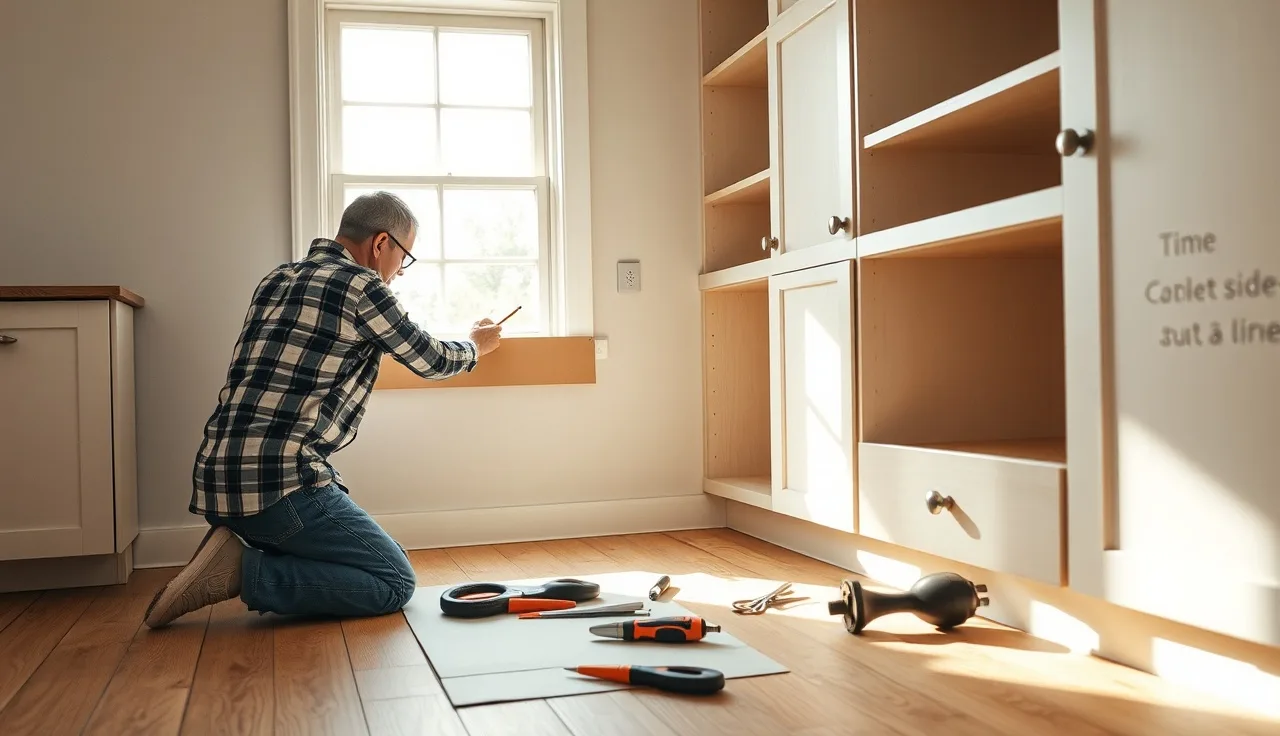
- A countertop template kit is a set of thin material strips, connectors, and measuring tools that let a homeowner build a flat, to-scale model of their cabinet layout.
- The shop cuts stone, quartz, or solid surface from that model without visiting the house.
- Kits cost $30 to $150 and work best on simple straight or L-shaped runs.
What exactly is a countertop template kit?
A countertop template kit is a physical tracing system. Instead of a fabricator sending a tech to your house with a laser measurer, you build a flat cardboard or plastic model of your cabinets and ship or photograph it so the shop can cut from that profile.
Most kits include thin strips of corrugated cardboard or polystyrene (usually 1.5 to 2 inches wide), snap-together connectors or tape, a pencil scribe, a straightedge, and an instruction booklet. Some add a digital piece: a measuring app and a submission form so you can send dimensions without mailing anything.
The goal never changes. Give the shop an accurate outline of every edge the countertop covers, every inside corner, every notch around a column or windowsill, and every sink or cooktop opening. Get the template right and the stone comes back right. Get it wrong and you pay to recut or patch a slab.
Who actually makes and sells these kits?
Several fabricators and countertop retailers sell proprietary kits. Lowe's and Home Depot have offered mail-in templating programs tied to their installed-countertop services, where they ship you the kit and you mail the assembled template back. Independent online retailers sell generic kits built for DIY slab orders.
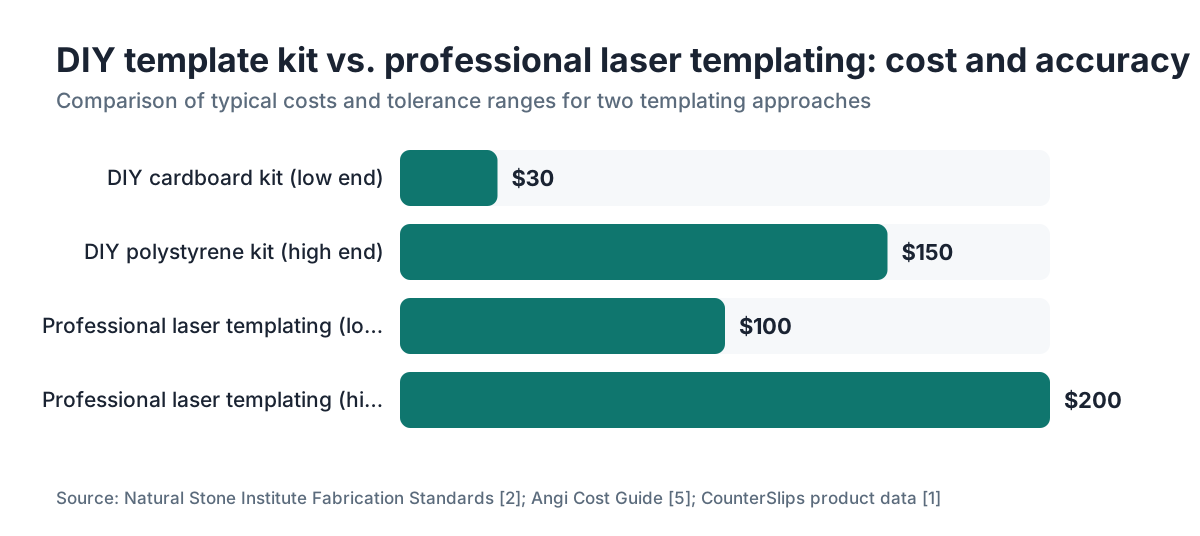
Two consumer-facing systems came up most often as of 2024: the CounterSlips cardboard template system and similar offerings from Cabinets To Go plus regional stone shops running online quote portals. Prices cluster between $30 and $80 for basic cardboard systems and $80 to $150 for polystyrene or plastic-strip kits that hold their shape better in transit [1].
Some fabricators skip the physical kit and ask homeowners to use a measuring app (MagicPlan or similar) and submit a dimensioned PDF. That works for a straight run. It gets shaky on complex sink cutouts or radius edges, where a physical template still wins.
What materials and tools come in a typical kit?
Contents vary, but a mid-range kit for a standard kitchen usually includes:
| Item | Purpose |
|---|---|
| Template strips (cardboard or poly) | Form the outline of each countertop section |
| Corner connectors or snap clips | Lock strips at angles without gaps |
| Pencil scribe tool | Mark the wall line onto the strip |
| Tape measure (sometimes) | Double-check overall dimensions |
| Sharpie marker | Label each piece (sink wall, window wall, etc.) |
| Instruction sheet | Walk you through the sequence |
| Submission form or QR code | Get the template to the shop |
What most kits leave out: a sink template (most shops want you to trace your actual sink basin), any tool for checking cabinet levelness, and a corner radius gauge. You buy those separately.
Scribing to a wall trips up more people than anything else. Kitchen walls are almost never straight. The scribe tool traces the wall's real curve onto the strip so the stone gets cut to that exact profile instead of a theoretical straight line.
When does a DIY template kit make sense and when does it not?
Template kits work well for straight or gently L-shaped runs with no unusual features. A galley kitchen with a single sink, no cooktop, and walls that run roughly plumb is a fair candidate. So is a bathroom vanity with a simple rectangular bowl. Those shapes forgive small errors, and if you are off by 1/8 inch on a straight run, the installer can scribe it at install.
Kits get risky fast in a few spots. Anything with an inside radius or curved section needs skills the instructions rarely cover. Complex cooktop cutouts with gas line positions demand precision a cardboard strip can approximate but not guarantee. Angled or irregular rooms, older homes especially, hide surprises a laser-measuring templater would catch on sight. More than three seams or a waterfall edge? Hire a pro.
Stone tolerances are tight. Granite and quartz slabs get cut to plus or minus 1/16 inch on straight edges by CNC machines [2]. A template error that vanishes on laminate leaves a visible gap or a lip on stone. A granite slab often runs $400 to $1,500 or more for material alone [3], which usually makes the $100 to $200 professional template fee worth it.
How do you actually build the template? A step-by-step overview
Every kit has its own instructions, so treat this as orientation, not a replacement for reading yours.
First, clear the cabinets completely. No appliances, no cutting boards, nothing on the surface. If old countertops are still in place, many kits ask you to template on top of them, since the shop cuts to those dimensions. Others want them removed so you template from the cabinet top directly. Check your kit.
Second, set the overhang. Standard countertop overhang past base cabinet doors is 1.5 inches [4]. Position your strips to reflect where the finished edge lands, not the cabinet edge. Mark the intended overhang before you lay a single strip.
Third, run strips along every edge, snapping or taping connectors at corners. Scribe the wall profile at every wall-contact edge. Label every piece clearly: which wall it faces, which section it belongs to (island, perimeter left, perimeter right).
Fourth, cut out sink or cooktop openings. Most kits tell you to set your actual sink upside down on the strip and trace it, then mark the cutout line about 3/4 inch inside that trace to account for the rim. Follow the kit's exact number here.
Fifth, photograph everything from directly above before you disassemble for shipping. That photo is your backup if pieces shift in transit.
How accurate does your template need to be?
Accurate enough to matter. Stone shops work to 1/16 inch on CNC-cut edges [2]. Your template does not need that precision, because the operator usually adds a small allowance for scribing at install. But you do need to land within 1/8 inch on the dimensions that count: wall to front edge (which controls overhang), the width of any sink cutout, and the total length of each run.
The most common failure is not a bad measurement. It is an out-of-square corner. If two walls meet at 89 degrees instead of 90 and you build the template as if it were square, the slab comes back with a gap at one wall and an overhang at the other. The scribe handles wall waviness on straight sections. Corners need you to physically align the strips to the real angle.
Here is a check that catches most problems. After you assemble the template on the cabinets, set a straightedge along the intended front edge and confirm it does not rock. Then measure the diagonal of each rectangular section, corner to corner both ways. Matching diagonals mean the section is square. If they do not match, fix it before you call it done.
What does a countertop template kit cost, and is it worth it?
Basic cardboard kits run $30 to $50. Polystyrene kits with reusable connectors run $80 to $150 [1]. Some fabricators hand you the kit free when you commit to ordering your slab through them, then deduct the kit cost from your order.
Professional laser templating as a standalone service usually costs $100 to $200, though many shops fold it into the installed price [5]. The break-even math is plain. Simple layout, confident with instructions? The kit saves you money. Complex layout or expensive stone? The professional fee is cheap insurance against a $1,000-plus recutting bill.
For laminate countertops or formica countertops, the stakes drop because material costs a fraction of stone. DIY templating fits well there. For granite countertops or marble countertops, think twice before you trust a cardboard kit alone.
An honest read: the kit pays for itself on simple jobs. On anything complex, you are gambling the price of the kit against the risk of a miscut slab.
Do fabricators actually accept homeowner-made templates?
Some do. Some do not. This is the question to settle before you buy anything.
Many online stone retailers and mail-order countertop shops built their whole business around homeowner-submitted templates. They price for it, with lower labor margins, and they often run a review step where a tech checks your dimensions against a sanity range before cutting.
Local fabricators are a mixed bag. A shop doing 50 kitchens a month with its own templating crew often refuses homeowner templates flat out, or charges a re-templating fee when it finds errors. A smaller shop or one running an e-commerce portal may welcome them.
Confirm before you buy the kit. Ask whether they accept customer-built templates, what format they need (physical mail, photo, or PDF), and what happens if the template turns out wrong. Get that policy in an email before you commit.
For countertop installation in general, templating is where most errors start, no matter who does it. Shops that accept homeowner templates usually require a liability acknowledgment putting template errors on you.
What are the most common mistakes homeowners make with template kits?
Skipping the scribe on wall edges. People assume their walls are straight and lay the strip flush. Then the stone arrives with a gap every few feet because the wall curves. Always scribe.
Mislabeling sections. An L-shaped kitchen kit might have six or eight pieces. Label them poorly (or not at all) and the shop cannot tell which edge faces the window versus the wall. Cuts get made in the wrong direction.
Ignoring appliance clearances. A freestanding range usually needs 30 inches of space. Template tight to the existing range opening without confirming your new range, and the stone can arrive too narrow or too wide for the swap.
Getting the sink rim width wrong. Rim widths differ by model. A template cut for a 33-by-22-inch sink with a 1-inch rim does not fit a rimless undermount of the same outer size. Measure the sink in your hands, not the marketing sheet.
Rushing corner angles. An off-square corner is the single most expensive mistake, because it affects every piece that meets there. Slow down at the corner.
How does DIY templating compare to professional laser templating?
Professional laser templating uses a device (Proliner by Prodim is a common one) that measures every point in a room to within 1 millimeter and outputs a digital file straight to the CNC machine [6]. No ambiguity, no scribe technique, no shipping damage.
Homeowner kits capture shape by physical contact. Conceptually reliable, execution-dependent. The kit is only as good as the person using it.
| Comparison point | DIY kit | Laser templating |
|---|---|---|
| Cost | $30 to $150 | $100 to $200 (often bundled) |
| Accuracy | +/- 1/8 inch typical | +/- 1 mm typical |
| Who does the work | Homeowner | Trained tech |
| Complex shapes | Difficult | Handles easily |
| Turnaround | Shipping time plus review | Same day digital file |
| Error liability | Homeowner | Shop |
For kitchen countertops with multiple pieces, angles, or specialty features, laser templating is the standard and the accuracy gap matters. For a simple two-section bathroom vanity, the DIY kit is a fair substitute.
Shops running software like SlabWise can import digital template files from laser devices straight into their quoting workflow, part of why the professional route got faster over the last few years.
Can you use a template kit for materials other than stone?
Yes, and often it fits better. Laminate and solid-surface materials like corian countertops or formica countertops forgive seams and trim on-site if the template runs slightly off. The technique is the same: build the profile, mark openings, label everything.
Butcher block countertops work with homeowner templates too, though wood swells and shrinks with humidity, so the shop usually wants to know your kitchen's typical moisture so it can build the right gap at walls.
The one material where kits rarely make sense is tile. Tile countertops get set in place by a tile setter working directly off the substrate, not from a pre-cut slab. No template needed.
Any material where cuts happen at a remote shop and the piece has to arrive ready to install fits the kit method. The precision standard just shifts with the material.
What should you ask a shop before submitting a homeowner template?
A short checklist that saves a lot of grief:
First, confirm they accept homeowner-made templates at all. Do not assume.
Second, ask what template material they prefer. Some shops distrust cardboard because it warps in transit and want polystyrene strips or a specific brand of kit.
Third, ask how they handle discrepancies. If their review team flags a dimension that looks wrong, do they call you before cutting, or cut to whatever you submitted?
Fourth, pin down the re-cut policy. If the error is clearly yours (and you signed a liability form), do they recut at cost or full price? Some shops set a fixed re-cut fee, worth knowing upfront.
Fifth, ask about lead times. A shop taking physical mail-in templates may need two weeks from receipt to delivery. A shop with a digital portal may turn it around in days. For a renovation with a hard move-in date, that timeline decides everything.
SlabWise has a guide to what information shops need from templates to generate accurate quotes, which helps you see what level of detail the shop is working from.
Frequently asked questions
Can a homeowner template a countertop without any kit at all?
Yes, using cardboard boxes, a straightedge, and tape. Plenty of homeowners have sent shops accurate templates built from flattened shipping boxes. Commercial kits just make the process faster and give you pre-cut strips of consistent width. If you measure carefully and label every piece, a roll of masking tape and grocery-store cardboard can work for a simple layout.
Will a countertop template kit work for an L-shaped kitchen?
It can, but the inside corner is the hard part. Most kitchen corners sit close to 90 degrees and rarely exactly 90. You need to align the strips to the actual corner angle instead of assuming square. Most kits include a corner connector, but you still set it to the real angle. Measure the diagonal of each rectangular section to verify squareness before shipping.
How long does it take to build a countertop template at home?
Plan on two to four hours for an average kitchen. A simple bathroom vanity might take 30 to 45 minutes. A large L-shaped kitchen with an island, sink, and cooktop cutout can eat a full morning, especially if your walls have any irregularity. The scribe step along each wall takes the most time if you do it carefully, which you should.
What happens if my homeowner template turns out to be wrong?
If you signed a liability acknowledgment, you generally pay for the recut. Stone shops are explicit about this. Recuts on granite or quartz can cost $200 to $600 or more depending on how much material gets wasted. Some shops set a fixed rework fee. This is the core financial risk of DIY templating on expensive stone, and why professional laser templating is often worth the extra $100 to $200.
Do online countertop companies ship you a template kit automatically?
Some do, some make you buy it separately. Lowe's installed countertop program and several direct-to-consumer stone retailers build template kits into the ordering flow. Others send instructions and ask you to source your own cardboard. Read the ordering process carefully before you buy, since the kit shipment timing can shift your whole project schedule.
Is a digital measuring app as good as a physical template kit?
For simple straight runs with no unusual openings, a dimensioned drawing from a measuring app gets close. For anything with an inside corner, a sink cutout, or irregular walls, a physical template that captures the actual shape is more reliable. Apps measure distances well but do not automatically capture wall waviness or corner angles the way a scribed physical template does.
Can I use a template kit to order a quartz countertop online?
Yes. Several quartz suppliers, including some Cambria dealers, accept homeowner templates for simple layouts through an online portal. The key is confirming the shop's tolerance requirements and submission format before you build. Quartz gets cut to tight tolerances by CNC, so template accuracy matters as much as it does for granite.
What is the standard countertop overhang and how do I set it in the template?
Standard overhang past base cabinet doors is 1.5 inches. Some designers push to 1.75 inches for a more finished look. Set your strips so the front edge sits 1.5 inches (or your chosen overhang) past the front face of the cabinet frame, not the door front. Mark this clearly so the shop knows which edge is the finished front.
Do I need a separate template for an undermount sink cutout?
Most kits have you mark the sink cutout directly on the template. You trace your actual sink basin upside down on the strip, then mark the cut line a set distance inside that trace based on the shop's instructions, usually about 3/4 inch. Do not use marketing dimensions. Use the physical sink you have, since manufacturing tolerances vary.
Are there template kits designed specifically for bathroom vanities?
Most kits sell as universal and work for any countertop shape. Vanities are usually simpler than kitchens, so a standard kit is plenty. The main vanity-specific detail is the sink style: drop-in, undermount, or vessel. Vessel sinks need no cutout at all. Undermount vanity bowls often have tighter radius corners than kitchen sinks, so pull the actual bowl dimensions from the manufacturer spec sheet.
How do I ship the template to the shop without it getting damaged?
Photograph the assembled template from directly above before you disassemble. Lay pieces flat in a large box (or a tube for polystyrene strips), with cardboard separators so they cannot shift. Label every piece on both sides with a permanent marker. Some shops ask you to include a printed order form inside the box. Polystyrene kits survive shipping better than cardboard; if your layout is complex, spend the extra $40 on the sturdier material.
What is the difference between a template kit and a countertop measuring service?
A template kit is a product you buy and use yourself to capture your layout. A measuring service sends a trained technician to your home, usually with a laser device, to capture the same information professionally. The service costs more but moves the error liability to the shop. For expensive stone or complex layouts, the measuring service is the lower-risk option even at a higher upfront price.
Can I reuse a countertop template kit for a different project?
Polystyrene and plastic-strip kits are reusable as long as the connectors stay intact. Cardboard kits are usually single-use because the strips deform when you scribe or cut them. If you are doing multiple rooms or expect to renovate again in a few years, the polystyrene kit pays for itself on reuse.
Sources
- Marble Institute of America (MIA) / Natural Stone Institute, Fabrication Standards: CNC fabrication tolerances for natural stone countertops are typically plus or minus 1/16 inch on straight edges.
- U.S. Bureau of Labor Statistics, Consumer Price Index for home improvement materials: Granite slab material costs for kitchen countertops commonly range from $400 to $1,500 depending on grade and region.
- National Kitchen and Bath Association (NKBA), Kitchen Planning Guidelines: Standard countertop overhang over base cabinet doors is 1.5 inches per NKBA planning guidelines.
- HomeAdvisor / Angi, Countertop Installation Cost Guide: Professional laser templating as a standalone service typically costs $100 to $200, and many shops include it in the installed countertop price.
- U.S. Consumer Product Safety Commission, Home Improvement Safety: CPSC provides guidance on safe practices for home renovation projects including tool use during countertop templating and installation.
- Penn State Extension, Kitchen Remodeling Costs and Planning: Kitchen countertop replacement is one of the most common home improvement projects, with material choice strongly affecting total project cost.
- Natural Stone Institute, Architectural and Design Manual: Template accuracy is identified as the primary source of fabrication errors in stone countertop projects, preceding CNC cutting errors in frequency.
- U.S. Census Bureau, American Housing Survey, kitchen renovation data: Kitchen renovations are among the most frequently undertaken home improvement projects reported in the American Housing Survey.
Last updated 2026-07-11