TL;DR
- A countertop fabrication shop needs general liability, commercial property, workers' compensation, commercial auto, inland marine (tools and slabs in transit), and an umbrella policy.
- Most small to mid-sized shops pay $8,000 to $20,000 a year across all lines.
- Skip one and a single job-site injury or dropped slab can turn into a six-figure loss you pay yourself.
Why does a countertop fabricator need more coverage than a typical contractor?
Most contractors install things they did not make. Fabricators build and install, so the liability clock starts the moment a slab hits the saw and keeps running long after the crew drives away.
That double exposure, fabricator plus installer, is what makes insurance for this trade genuinely different. If a granite counter cracks six months after install because a tech cut the sink hole wrong, you own that claim. If a worker's angle grinder pushes silica dust into a client's open HVAC return, you own that one too. Neither event shows up neatly in a contractor policy written for framers or roofers.
Stone work also carries silica dust risk that most trades don't. OSHA finalized its silica rule in 2016 (29 CFR 1926.1153), and it covers construction and adjacent trades like stone cutting. [1] Insurers know this. Some markets now grill fabricators about wet-cutting practices and respirator programs before they'll quote, and a shop that can't answer clearly pays a surcharge or gets declined.
The raw material is expensive, too. A single slab of book-matched quartzite runs $2,000 to $6,000 before anyone touches it. A shop with 40 slabs on the floor is sitting on $80,000 to $240,000 of inventory. Standard commercial property forms often exclude stone stock unless it's scheduled correctly, so the gap between what an owner thinks is covered and what the policy actually says can be enormous.
What are the core insurance policies every fabrication shop needs?
Here's the honest list. None of these are extras. Each one covers a category of loss that happens in this trade.
General Liability (GL) This is the base policy. It covers bodily injury and property damage you cause to third parties: clients, homeowners, bystanders. Your installer drops a slab and cracks a client's hardwood floor, GL pays. A customer trips on a pallet in your showroom, GL pays. Standard limits for a fabrication shop start at $1 million per occurrence / $2 million aggregate, but contractors in many markets now demand $2 million per occurrence before they'll let you on a job site. [2]
GL for a shop doing $1M to $3M a year usually runs $3,000 to $7,000 annually. A claims history or sloppy safety records push it up.
Commercial Property This covers your building (if you own it), your equipment, and your inventory against fire, theft, vandalism, and most weather events. The detail that trips up fabricators: you have to schedule slab inventory on purpose. A generic "stock" sublimit of $25,000 means nothing when $200,000 of material is on the floor. Get an accurate slab value to your broker and make sure the policy reflects it.
Equipment is a real number. A CNC bridge saw costs $80,000 to $200,000. A waterjet runs $150,000 to $500,000. [3] If a machine dies in a fire and your policy pays only actual cash value (depreciated), you may not get enough to replace it. Ask for replacement cost value on equipment.
Workers' Compensation Required by law in 49 states for any business with employees. Texas is the exception, but most Texas general contractors still require subs to carry it as a contract condition. [4] Stone fabrication rates as a hazardous occupation under most state systems because of the heavy material, power tools, and silica exposure together. Expect a workers' comp rate of $8 to $18 per $100 of payroll for fabrication employees, well above the median across trades.
This is the one policy you can't shop your way to a low price on. The rate is filed with the state and tied to your experience modification factor (EMR). A clean safety record drops your EMR below 1.0 and cuts the premium. A bad year spikes it, and the effect lasts three years.
Commercial Auto Personal auto policies exclude vehicles used for business. Your delivery driver hauls a slab in a company truck and causes a wreck, a personal policy denies the claim. Commercial auto covers owned, leased, and hired vehicles, and it adds non-owned auto coverage for employees driving their own cars on company errands. A $1 million combined single limit is standard in the trades. [2]
Inland Marine (Tools and Equipment in Transit) This is the coverage new fabricators forget. Inland marine covers tools, equipment, and materials while they're moving or temporarily off your premises: at a job site, in a van, staged in a driveway. Commercial property stops at your shop door. A $15,000 polishing head falls off a trailer on the highway, inland marine pays. Somebody breaks into your install van overnight and takes $8,000 in tooling, inland marine pays.
Annual premiums for a well-equipped crew's tools usually run $1,200 to $3,500 depending on total scheduled value.
Umbrella / Excess Liability An umbrella sits above your GL, commercial auto, and sometimes your employer's liability limits, paying claims that blow through those underlying policies. A $1 million umbrella on top of a $1M GL policy is cheap, often $800 to $2,000 a year, and it's the least expensive way to add real coverage. One catastrophic job-site injury can produce a multi-million dollar lawsuit. The math on an umbrella is hard to argue with.
What does typical insurance cost for a countertop fabrication shop?
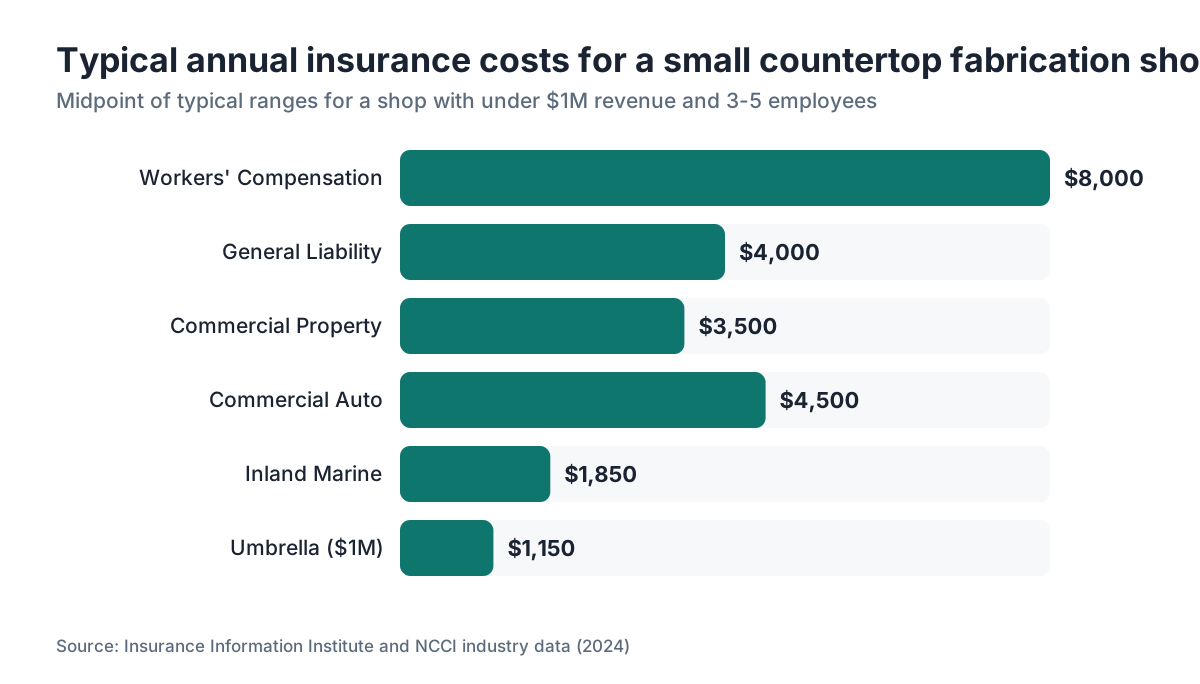
There's no single authoritative survey of fabrication-specific insurance costs. What follows comes from broker guidance and state workers' comp rating bureau data, cited where possible. Treat these as ranges, not guarantees. Your actual premium depends on revenue, payroll, claims history, location, and which carrier market you land in.
| Policy | Typical Annual Cost (small shop) | Typical Annual Cost (mid-sized shop) |
|---|---|---|
| General Liability | $3,000 - $5,000 | $5,000 - $10,000 |
| Commercial Property | $2,000 - $5,000 | $5,000 - $12,000 |
| Workers' Compensation | $4,000 - $12,000 | $12,000 - $35,000 |
| Commercial Auto (2-4 vehicles) | $3,000 - $6,000 | $6,000 - $14,000 |
| Inland Marine | $1,200 - $2,500 | $2,500 - $5,000 |
| Umbrella ($1M) | $800 - $1,500 | $1,500 - $3,000 |
| Total (rough) | $14,000 - $32,000 | $32,000 - $79,000 |
Small shop here means roughly under $1M in annual revenue with 3-5 employees. Mid-sized means $1M to $5M revenue with 8-20 employees.
Workers' comp is the biggest single line item once you pass two or three employees, which is why safety programs and EMR management matter so much to the bottom line. Drop your EMR from 1.2 to 0.85 on a $20,000 workers' comp base premium and you save $7,000 a year, every year, automatically. [5]
Does a fabricator need product liability coverage, and what does it cover?
Product liability covers bodily injury or property damage caused by a product you made or sold, after the product has left your hands. For a countertop fabricator, that matters most in two situations: a structural failure in the stone (a crack that drops a section and hurts someone) and a chemical exposure (a sealer or adhesive that causes a reaction).
The good news is that product liability is usually built into your general liability policy, not a separate buy. It covers completed operations, meaning the work you've already finished and delivered. The GL policy has two sublimits worth checking: the per-occurrence limit and the products/completed operations aggregate, which is often set equal to the general aggregate but can run lower. Read the declarations page and confirm those numbers match what you need.
The bad news is that some carriers write contractor GL policies that exclude or restrict stone-specific operations. Ask your broker to confirm in writing that the policy covers stone cutting, waterjet operations, and epoxy application. A policy built for a general tile installer may not respond the same way for a CNC fabrication shop.
One thing product liability does not cover: your cost to redo defective work. Template wrong, cut a slab that doesn't fit, and the fix comes out of your pocket. That's where errors and omissions (E&O), or a contractor's professional liability policy, would apply, and it's a coverage more fabricators should at least price out.
Is workers' compensation required for a countertop fabrication shop?
In 49 states, yes. The only state that doesn't mandate workers' compensation for private employers is Texas, and Texas has its own nonsubscriber liability framework that can hurt just as much. [4]
For fabricators, this isn't a paperwork checkbox. Stone work is genuinely dangerous. The Bureau of Labor Statistics consistently puts stone cutting and finishing among the higher-risk construction-adjacent occupations, with a nonfatal injury rate above the all-industry average. [6] Silica exposure adds a long-tail disease risk that can produce claims years, even decades, after the exposure happened.
Owners often ask whether they can exclude themselves from the policy to save money. Most states let sole proprietors and partners opt out, and some let corporate officers opt out by filing a form. The savings are real. If your payroll contribution to the premium is $4,000 a year, excluding yourself saves that. But if you're running equipment regularly and something goes wrong, you're uninsured for your own injury. Whether that trade makes sense depends on what other disability coverage you carry.
For any employee, including W-2 workers and, in many states, workers you misclassify as 1099 contractors, skipping workers' comp makes you personally liable for their medical bills and lost wages if they're hurt on the job. State penalties for non-compliance land on top of that.
What is inland marine insurance and why does a fabricator need it?
The name is confusing, a holdover from marine cargo law, but the idea is simple: inland marine covers movable property and tools that leave your premises regularly. [7] For a fabricator that means your install van's tool inventory, slabs staged at a job site, diamond blades, polishing heads, laser templating gear, and any specialty tooling you carry to customer homes.
Commercial property insurance covers what's inside your building at one address. The moment a $12,000 laser templater rides in a van, it's off your property policy. Inland marine picks it up.
There are two ways to write it. A blanket form covers all tools and equipment up to a stated limit without listing each item. A scheduled form lists specific pieces by serial number and insured value. Blanket is simpler but can underinsure high-value gear. Scheduled takes more upkeep but pays replacement cost on each named item. For any single piece worth more than $5,000, get it scheduled.
Slab transit is a related exposure that sometimes gets handled separately. If you haul slabs in your own trucks and one cracks on the road, confirm who pays: your inland marine, a cargo policy, or your GL. Close that gap with your broker before a $3,000 slab becomes a dispute.
Do you need contractor's professional liability (E&O) insurance?
Contractor's professional liability, sometimes called errors and omissions or design-build professional liability, covers claims from errors in your design, templating, measurements, or specs. It's separate from general liability. GL covers physical damage and injury, not the economic loss a client eats because you measured wrong.
Here's a real scenario. A fabricator templates a kitchen, cuts a slab to spec, installs it, and the overhang is off by an inch and a half. Nobody is hurt. Nothing is damaged in the GL sense. But the client wants the counter remade and reinstalled, which costs $4,500 in material plus $1,800 in labor. GL won't cover that. E&O might.
Most small fabrication shops skip E&O, and many never need it because their contracts cap remeasure-error liability at the cost of the replacement stone. But as shops move into higher-end custom work, especially islands with complex miters, integrated sinks, and waterfall edges, the remeasure exposure grows. E&O for a small trade contractor typically runs $1,500 to $4,000 a year and is worth pricing every couple of years.
Shops that offer design services, helping clients select and lay out stone in a consultant role, have a stronger case for E&O than pure cut-and-install operations.
What insurance do you need if you have delivery and installation crews on the road?
Commercial auto is the obvious answer, but the details matter. A commercial auto policy for a fabrication business should include at minimum:
- Owned vehicles: anything titled to the business
- Hired vehicles: rentals and vehicles you borrow
- Non-owned auto: employees driving their own cars on company errands
- Uninsured/underinsured motorist coverage: for when a driver hits your vehicle and carries no insurance
If you haul slabs in a company truck, confirm whether your commercial auto policy includes cargo or whether you need a separate motor truck cargo endorsement. Standard commercial auto covers damage to your vehicle and liability for wrecks you cause. It does not automatically cover the $4,000 slab that slides and shatters when you brake hard.
Some fabricators run deliveries through a third-party logistics company or subcontract installs. That changes the liability picture. The sub's insurance becomes your first line of defense, but you should still require a certificate of insurance naming your business as an additional insured, and verify the limits are adequate. A subcontractor certificate with $300,000 auto limits is not the same protection as one with $1 million.
Drivers with claims or moving violations raise your premium. A clean fleet means a written driver policy, MVR checks at hire and annually, and a clear protocol for reporting accidents. Most carriers want to see that documentation before they'll quote preferred rates.
What should a fabricator look for in a certificate of insurance from subcontractors?
If you hire subs for installation, templating, or delivery, the certificate of insurance (COI) they hand you decides whether their insurance, not yours, responds when something goes wrong on a job they touched.
Four things to verify on any COI:
Additional insured status. Your business name needs to appear as an additional insured on the sub's GL policy, more than named on the certificate. The certificate is only evidence of coverage. It grants no rights. The endorsement on the policy grants rights. Ask for a copy of the additional insured endorsement, more than the certificate.
Limits. Match or exceed the limits your own contracts require. If your GC contracts demand $2M per occurrence, your subs should carry at least $1M to keep the exposure reasonable.
Workers' comp. Confirm the sub carries workers' comp in your state. A sub without it means that if their worker gets hurt on your job site, your policy may be on the hook.
Policy expiration dates. A certificate showing a policy that expired three months ago is worthless. Set a calendar reminder to refresh COIs annually.
The Small Business Administration flags certificate of insurance management as one of the gaps small contractors most often overlook as they scale up their use of subs. [8] It's administrative work, but it's real risk management.
How does silica dust exposure affect your insurance and safety obligations?
This is the issue that has reshaped the fabrication insurance market over the past decade, and fabricators who aren't paying attention get surprised at renewal.
OSHA's final rule on respirable crystalline silica (29 CFR 1926.1153, effective June 2016) requires stone fabricators to put in engineering controls (wet cutting is the most common), provide respirators, run medical surveillance for exposed workers, and keep a written exposure control plan. [1] The rule is not optional, and OSHA does inspect fabrication shops. The agency describes crystalline silica as "a known human lung carcinogen."
On the insurance side, some carriers now ask detailed underwriting questions about silica controls before they'll quote workers' comp and GL. A shop that cuts dry, has no written respiratory protection program, and can't produce exposure monitoring records is a harder risk to place. Some admitted carriers have declined certain fabrication accounts entirely, pushing those shops into the excess and surplus (E&S) market where premiums run higher and terms are less standardized.
Engineered stone (quartz composite) draws particular attention because it contains 90 to 95 percent crystalline silica, far above natural granite. Australia banned engineered stone fabrication in July 2024 over silica-induced lung disease rates in stone workers. [9] The United States hasn't followed with a ban, but OSHA issued a hazard alert for engineered stone in 2023. [1] Underwriters read those alerts.
The practical takeaway: invest in your silica safety program because it directly affects your insurability and premium, not only because the law says so. Wet cutting, local exhaust ventilation, and documented medical surveillance are line items that pay for themselves in workers' comp savings.
How should a fabrication shop buy insurance, and what mistakes do owners make?
Buy through a commercial broker who actually knows the stone trades, not a generalist who has never seen a bridge saw. The language that matters, products/completed operations coverage, silica exclusions, slab transit, equipment breakdown, is specialized enough that a broker quoting you on a standard artisan contractor form may be missing half your real exposure.
A few mistakes show up over and over in this trade.
Underinsuring slab inventory. Property policies often cap stock at a per-occurrence limit. If your actual slab value on a given day tops that limit, you're self-insuring the rest. Update your broker with current inventory values at least once a year.
Treating workers' comp class codes as fixed. If your shop does both fabrication and installation, you may have workers in different class codes. Shop fabrication usually carries a different (sometimes lower) rate than field installation. Splitting payroll by activity, with clean records, can cut your premium legitimately.
Skipping the equipment breakdown endorsement. Also called boiler and machinery coverage, it pays for mechanical or electrical failure of your CNC, waterjet, or HVAC. It's not part of standard commercial property. A bridge saw controller failure can cost $15,000 to $40,000 to repair or replace, and equipment breakdown coverage often runs $500 to $1,500 a year.
Buying the cheapest GL without reading the exclusions. Some low-cost contractor GL policies bury a silica exclusion in the manuscript endorsements. That exclusion denies any claim tied to silica, including a worker's dust exposure. Read the exclusions page.
If you run quoting and job costing through software like SlabWise, you already have the revenue and job-count data your broker needs to write accurate coverage. Annual revenue, payroll by role, number of vehicles, and equipment values are the four numbers that drive most of your premium math. Having them organized and current saves time and often money at renewal.
One last point. Shop your coverage every two to three years, not every year. Constantly switching carriers scrambles your loss-run history and your standing with underwriters. But sitting with the same carrier for a decade without ever getting competitive quotes usually means you're overpaying by the third renewal.
What happens if a fabricator operates without the right insurance?
The honest answer: nothing, right up until something goes wrong. That's the nature of insurance risk.
When something does go wrong, though, the numbers are severe enough that going without is hard to justify.
Without workers' comp, a single serious injury to an employee, a hand under a saw, a back blown out carrying a 400-pound slab, produces a medical claim that can run $50,000 to $300,000 in the first year alone, plus lost wages, plus state penalties for non-compliance. Texas reports that uninsured employers who lose a workplace injury lawsuit forfeit their common-law defenses and often face uncapped damages. [4]
Without GL, a broken floor, a cracked countertop that falls and injures a homeowner, or a client's kitchen left water-damaged because a plumbing connection got disturbed during install becomes entirely your personal financial problem. Fabrication damage claims that reach court routinely settle in the $30,000 to $150,000 range depending on severity.
Without commercial auto, a wreck while hauling a slab can produce a liability judgment against you personally if the business lacks the insurance and structure to absorb it.
General contractors increasingly demand proof of coverage before letting any sub on a job site. Operating without GL effectively shuts you out of GC-sourced work, which for many shops is 20 to 40 percent of revenue.
Countertop installation is genuinely physical and genuinely risky. A good insurance program doesn't erase the risk. It makes the risk survivable.
Frequently asked questions
How much does general liability insurance cost for a countertop fabricator?
For a small shop under $1 million in annual revenue, general liability typically runs $3,000 to $5,000 a year with $1 million per occurrence limits. Larger shops at $1M to $5M revenue pay $5,000 to $10,000 or more. Claims history, state, and whether you cut engineered stone all push the number up. Get at least three quotes from brokers who know the stone trades.
Do I need insurance before I start a countertop fabrication business?
Yes. General liability and, if you have employees, workers' compensation should be in place before the first job. Most general contractors and homebuilders require a certificate of insurance naming them as additional insured before they'll let you on a job site. Setting up insurance after your first big project inquiry is too late. Budget two to three weeks for underwriting and binding as a new account with no loss history.
What is the difference between general liability and workers' compensation for a fabrication shop?
General liability covers damage or injury you cause to other people: clients, bystanders, third parties. Workers' compensation covers your own employees when they get hurt on the job. Different people, separate policies. You need both. A shop that carries GL but not workers' comp is exposed to massive personal liability the moment an employee is injured.
Does a countertop fabricator need to be bonded?
Bonding and insurance are different. A surety bond protects the client if you fail to finish a job or cause financial harm through dishonest acts. Some states require a contractor's license bond for certain trades. Many GC contracts and licensing boards require a performance or payment bond on larger projects. Check your state's contractor licensing rules; bonding is often a licensing condition rather than a client preference.
Is equipment breakdown coverage separate from commercial property insurance?
Yes. Standard commercial property covers fire, theft, and vandalism, but not mechanical or electrical failure of your equipment. A CNC bridge saw controller burning out is not a covered property claim without an equipment breakdown endorsement. Since major fabrication equipment costs $80,000 to $500,000 to replace, equipment breakdown coverage at roughly $500 to $1,500 a year is worth adding. Confirm it covers electrical failure, not only pressure vessels.
What workers' compensation class code applies to stone fabrication?
Class codes vary by state because each state's rating bureau sets its own codes and rates. Common codes for stone fabricators include NCCI code 5027 (masonry) and 5348 (marble or stone work), but your state may differ. Payroll for shop fabrication and field installation can sometimes be split into different codes with different rates. A workers' comp specialist who knows your state's rating rules can audit this and potentially save real money.
Does my insurance cover a slab that cracks during installation?
It depends on why it cracked and whose fault it was. If a worker drops a slab and it breaks, GL covers resulting property damage to the client's home, but the replacement cost of the slab itself is usually not covered by GL. Inland marine may cover the slab in transit. If a manufacturing defect in the stone caused the failure, the supplier's product liability may apply. This is exactly why your contract should spell out who owns the slab and when title transfers.
Can a subcontractor use my insurance instead of buying their own?
No. Requiring subs to carry their own insurance exists specifically to keep their claims off your policy and your loss history. If a sub leans on your policy, their incidents raise your premiums and eat your aggregate limits. Always require subcontractors to show a current certificate of insurance with your business named as an additional insured on their GL and auto policies, and verify they carry their own workers' comp.
How does cutting engineered stone (quartz) affect my insurance?
Engineered stone contains 90 to 95 percent crystalline silica, far above natural granite. OSHA issued a hazard alert for engineered stone in 2023. Some insurers now ask detailed underwriting questions about whether you cut engineered stone and what silica controls you run. Shops without documented wet-cutting practices and a written respiratory protection program may face surcharges or market restrictions. Your silica compliance program directly affects your insurability.
What is an experience modification rate (EMR) and how does it affect my workers' comp premium?
An EMR (or experience mod) is a multiplier applied to your base workers' compensation premium based on your actual claims history versus expected claims for your industry. An EMR of 1.0 is average. An EMR of 0.85 means you pay 15 percent less than base; 1.25 means you pay 25 percent more. For a shop with a $20,000 base premium, the gap between a 0.85 and 1.25 mod is $8,000 a year, compounding annually.
Do I need a commercial auto policy if I just use my personal truck for deliveries?
Yes. Personal auto policies exclude business use in almost every case. Drive your personal truck to deliver a countertop and cause a wreck, and your personal insurer will likely deny the claim, leaving you personally liable. Commercial auto, or a business-use endorsement on a personal policy if the carrier offers one, is required the moment your vehicle moves product or tools for business. This gap catches owners by surprise at the worst possible moment.
How often should a fabrication shop review or update its insurance coverage?
Review coverage at every renewal and any time the business changes meaningfully: you add employees, buy significant equipment, move buildings, start cutting new materials, or take on a large commercial project. Equipment values and slab inventory values should go to your broker at least once a year. Competitive requotes from multiple carriers make sense every two to three years, not annually, so you keep underwriter relationships intact without scrambling your loss-run history.
What is a certificate of insurance and why do GCs and homeowners ask for it?
A certificate of insurance (COI) is a one-page summary showing that a policy exists, its limits, the named insured, and the expiration date. General contractors ask for one before letting subs on a job site. Some homeowners ask too. The COI does not grant coverage rights; the actual policy does. When a GC asks to be named as an additional insured, that requires an endorsement on the policy itself, more than a notation on the certificate.
Sources
- OSHA, Respirable Crystalline Silica Standard for Construction (29 CFR 1926.1153) and engineered stone hazard alert: OSHA's silica rule for construction trades, finalized 2016, requires engineering controls, respirators, and written exposure control plans for stone cutting; OSHA issued an engineered stone hazard alert in 2023 and calls crystalline silica a known human lung carcinogen.
- Insurance Information Institute, Commercial Liability Insurance: Standard GL limits for contractors often start at $1M per occurrence / $2M aggregate; many general contractors require $2M per occurrence from subcontractors, and $1M combined single limit is standard for commercial auto.
- Natural Stone Institute, Stone Industry Education Resources: CNC bridge saws cost $80,000 to $200,000; waterjet systems range from $150,000 to $500,000 in the stone fabrication industry.
- Texas Department of Insurance, Workers' Compensation for Texas Employers: Texas is the only state that does not mandate workers' compensation for private employers, and nonsubscribers lose common-law defenses in injury lawsuits.
- NCCI, Experience Rating Plan Manual: Experience modification rates (EMRs) are multipliers applied to base workers' comp premiums; an EMR below 1.0 reduces the premium proportionally based on favorable claims history.
- Bureau of Labor Statistics, Injuries, Illnesses, and Fatalities program: Stone cutting and finishing occupations carry nonfatal injury rates above the all-industry average, per BLS occupational injury and illness statistics.
- Insurance Information Institute, Inland Marine Insurance: Inland marine insurance covers movable property and tools that leave the policyholder's premises, including equipment in transit and at temporary job sites.
- U.S. Small Business Administration, Get Business Insurance: Certificate of insurance management is among the common compliance gaps for small contractors using subcontractors, per SBA business insurance guidance.
Last updated 2026-07-11