
TL;DR
- A countertop quote should include material specs, square footage with overage, edge profiles, cutouts, sink and cooktop prep, removal of existing countertops, backsplash scope, seam placement, payment schedule, warranty terms, permit responsibility, and a change-order clause.
- Missing any of these is where disputes start.
- Fabricators and homeowners both benefit from the same clarity.
Why do countertop disputes happen in the first place?
Most countertop disputes don't start with bad materials or sloppy cuts. They start with a number on a piece of paper that one party read one way and the other party read a different way.
The quote is the contract's backbone. If the quote is vague, the contract is vague, and vague contracts are how you end up arguing in a small-claims courtroom over whether 'includes installation' meant the fabricator would also haul away your old laminate.
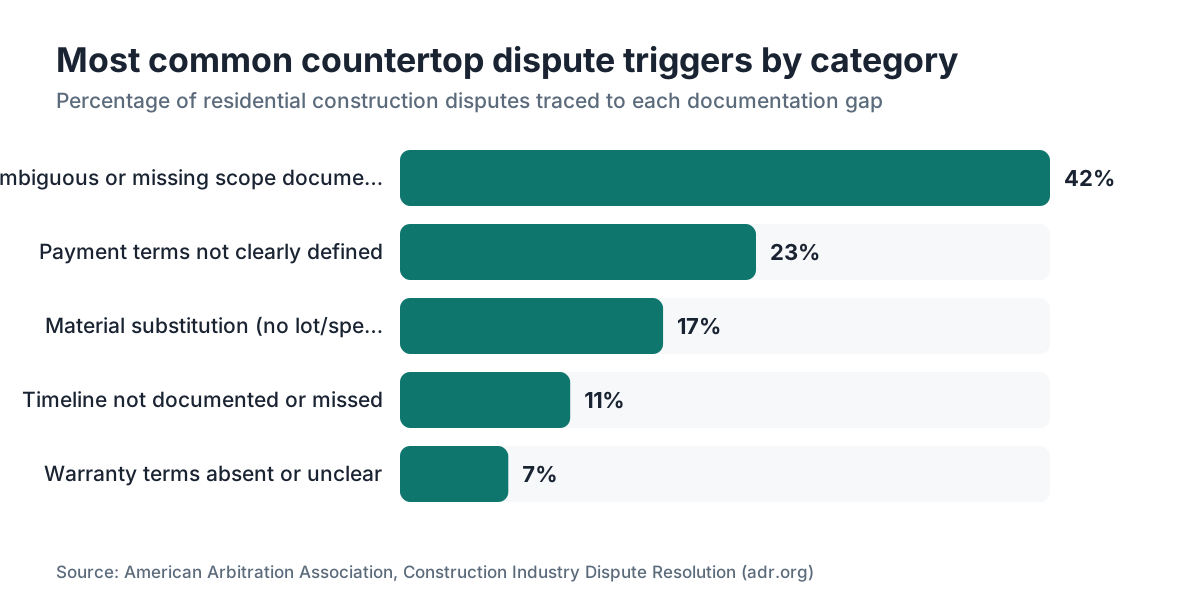
The American Arbitration Association's construction dispute practice points to incomplete or ambiguous contract documentation, not workmanship failures, as the more frequent root of residential renovation fights. [1] The fix is front-loading clarity into the quote before a single slab gets measured.
This article covers what every line item should say, what language protects both sides, and what to do when a quote shows up missing key sections.
What material information must the quote spell out?
The single biggest source of post-installation disappointment is a customer who expected one slab and received something else. 'Granite, white' is not a material spec. It's a category with hundreds of variants that range from $40 per square foot installed to well over $200.
A proper material section names:
- The exact material (e.g., quartz, natural granite, marble, quartzite, soapstone, laminate)
- The brand and product line where applicable (e.g., Cambria Brittanicca, Silestone Eternal Statuario)
- The slab lot or bundle number for natural stone, because slabs from different lots won't match
- The finish (polished, honed, leathered, brushed)
- The thickness, stated in both nominal and actual terms (e.g., 3 cm nominal / 1.18 inches actual)
Lot numbers matter more than anything else on the list. Two slabs from the same quarry and color name can look completely different if they come from separate quarry pulls. A quote that identifies the bundle number gives the homeowner legal recourse if a different-looking slab shows up on installation day.
If you're still comparing materials, the differences between granite countertops, marble countertops, and engineered options like Cambria countertops are significant in both appearance and pricing, and the quote should make clear which one is locked in.
Fabricators: include a photo reference or an 'as approved on [date]' notation with the material selection. That one step kills half of all material disputes.
How should square footage and measurement be documented?
Square footage is where money gets made or lost. The quote should show how the number was calculated, more than the number itself.
A transparent measurement section includes:
- A dimensioned sketch or diagram of each surface being fabricated (even a rough top-view drawing helps)
- Raw measured area in square feet
- Any overage or waste factor applied, stated as a percentage and the reason for it (mitering, difficult layout, grain matching)
- Whether the quoted price is based on template measurements yet to be taken or estimates from a site visit or floor plan
The industry waste factor for natural stone runs 15 to 20 percent for most residential kitchens, higher for layouts with lots of angled cuts or book-matched veining. [2] If your quote shows exactly the measured square footage with no waste factor, either the fabricator is very confident in their layout efficiency or they've hidden the overage somewhere else in the pricing. Ask.
Confirm one more thing: whether the quoted square footage includes the material at the edge of a sink cutout. Some shops charge for the slab area consumed by a cutout even though that piece gets removed. Others credit it back. Neither approach is wrong, but the quote should say which method is being used.
| Measurement Item | Should Be Explicit in Quote | Common Problem If Missing |
|---|---|---|
| Raw measured area (sq ft) | Yes | Homeowner can't verify math |
| Waste/overage factor (%) | Yes | Surprise charge for extra slab |
| Whether quote is estimated or post-template | Yes | Price changes after templating |
| How sink cutout area is handled | Yes | Dispute over credited vs. charged area |
| Number of slabs needed | Recommended | Lot-matching conflict later |
What edge profiles, cutouts, and details should be itemized?
Edge profiles are a classic upsell and a classic dispute. The base price on most quotes assumes an eased or standard straight edge, which is the cheapest to produce. If a homeowner wants an ogee, waterfall, or dupont profile, that's a separate charge, and it needs to be spelled out on its own line, not buried in a generic 'fabrication' figure.
The quote should list:
- Edge profile name and a brief description or photo reference
- Linear feet of that edge being produced
- Price per linear foot, or a total charge for the edge work
- Whether mitered edges (used in thick waterfall islands) are included and at what price
Cutouts deserve their own line items too. Sink cutouts, cooktop cutouts, faucet holes, soap dispensers, air gaps, and outlet cutouts get priced individually. A standard undermount sink cutout might run $75 to $150 depending on the shop and region. A farmhouse apron cutout can run $200 to $350 or more because the front apron has to be cut precisely to fit the sink reveal. [3] If the quote just says 'sink cutout included,' ask which type.
Cooktop cutouts for gas ranges with unusual configurations, or induction tops with tight tolerances, may carry a premium. Get the model number of the appliance into the quote language so there's no question later about what the fabricator agreed to cut.
Seam placement looks minor and causes real friction. If you have a long run that requires a seam, the quote should state where it goes and why. Seams near sinks, over dishwashers, or in high-visibility centerline positions draw the most complaints. Some fabricators mark seam location right on the drawing. That's best practice.
Does the quote need to address removal of old countertops?
Yes. This is one of the most frequently misunderstood scope items in any remodel.
Many fabrication shops do not include demo and removal of existing countertops in a standard quote. The homeowner assumes it's included. The crew shows up expecting a clear surface. That's a day-of-installation problem that delays the job and sometimes costs $150 to $400 extra for an unplanned removal service call. [3]
The quote should state one of three things, explicitly:
- Removal and disposal of existing countertops is included (and specify material, because tile tear-out is labor-intensive compared to laminate lift-off)
- Removal is excluded, and the homeowner clears surfaces before the crew arrives
- Removal is available for an additional charge of $[X], and must be added to the order by [date]
If your current counters are laminate countertops or a product like Formica countertops, removal is usually quick. If they're tile set in a mortar bed, removal can pull in a general contractor, and the quote has to address who coordinates that work.
Disposal of old stone, granite or marble specifically, may also require special haul-away because the weight exceeds standard trash service limits. Clarify this in the quote if it applies.
What should the quote say about backsplash and related scope?
Backsplash is where countertop quotes go silent at exactly the wrong moment. A standard countertop job often includes a 4-inch integral backsplash, a short vertical piece of the same slab material running along the wall. Full-height backsplash up to the upper cabinets is a completely different scope item, usually priced separately.
The quote should be clear on:
- Whether a 4-inch integral backsplash is included and on which walls
- Whether a full-height slab backsplash is in scope or excluded entirely
- Who supplies and installs tile backsplash if the homeowner is doing that separately
- How the top edge of the stone gets finished at the wall (square cut, bullnose, pencil edge) and whether that's included
Full-height stone backsplash behind a range can add $400 to $1,200 depending on size, material, and whether there's a special outlet or outlet box cut required. [3] None of that scope should be implied. Write it down.
If the countertop installer is coordinating with a tile contractor, note that handoff in the quote: who makes sure the field tile installer's work meets the top of the stone, and whether the fabricator will return to trim or adjust after tile is set.
What payment terms should a countertop quote include?
Payment schedules are legally significant, more than administrative housekeeping. Most states have contractor payment regulations that affect when a contractor can demand payment and what rights a homeowner has to withhold final payment if work is incomplete or defective. [4]
A properly written payment section should include:
- Deposit amount (typical range is 50 to 60 percent at contract signing)
- Balance due trigger (most shops ask for payment in full before or at the time of installation, not after, because stone can't easily be returned)
- Accepted payment methods
- What happens to the deposit if the homeowner cancels after materials have been ordered
- Late payment terms if applicable
The 'balance due at installation' structure is standard. If a fabricator asks for 100 percent up front before templating, that's unusual and worth asking about. If they ask for nothing until completion, ask how they finance material purchases, because that can signal a cash-flow problem that becomes a delivery risk for you.
Homeowners should know one hard fact: in most states, a contractor who hasn't been paid in full retains lien rights on your property even after the work is done. The quote, once signed, starts that clock. [4] Make sure the payment schedule is one you can actually execute on the proposed timeline.
How should the quote handle timeline, installation, and coordination?
A timeline is more than a scheduling nicety. It sets when your kitchen goes out of service, when your plumber needs to return for the final sink hookup, and when your appliance delivery can land. Vague timelines create cascading delays.
The quote should state:
- Estimated days from signed contract to templating
- Estimated days from template to fabrication complete
- Estimated installation date or a clear process for scheduling it
- Whether the fabricator handles final sink and faucet hookup or if that's a plumber's scope
- What the homeowner needs ready on installation day (base cabinets level and secured, appliances out of the way)
Sink and faucet reconnection is a common scope gap. Most stone fabricators do not do plumbing. They set the stone and leave. If the homeowner assumes the crew will reconnect the garbage disposal, they'll be without running water until they call a plumber separately. The quote should name this explicitly.
For countertop installation jobs involving multiple surfaces or complex layouts, some fabricators do a dry-fit before final adhesive set. If that's part of the process, note it in the timeline, because it adds a step.
Fabricators using quoting software like SlabWise can auto-populate timeline estimates and link them to shop capacity, which cuts the chance of overpromising on install dates the production floor can't hit.
What warranty and workmanship language belongs in the quote?
Warranties on countertop work have two separate layers: the material warranty from the manufacturer and the workmanship warranty from the fabricator. Address both.
For engineered stone products like quartz, most manufacturers offer a limited lifetime warranty on the material itself, but those warranties typically require installation by a certified fabricator and proper care. The Cambria warranty, for example, is a limited lifetime warranty on manufacturing defects that explicitly excludes damage from impact, improper cleaning, and heat. [5] If the fabricator is certified by the manufacturer, the quote should say so.
For natural stone, there's no material warranty because it's a natural product. The fabricator's workmanship warranty is what covers seam adhesion, edge finish, and installation quality.
The quote should state:
- What workmanship defects the fabricator will repair or replace and for how long
- What voids the warranty (modifications by others, improper use)
- The process for submitting a warranty claim (who to contact, inspection process)
A common workmanship warranty is one year on seams and installation. Some shops offer two. Be skeptical of shops with no stated warranty. That's not confidence, it's a gap.
For natural stone care after installation, resources like how to clean stone countertops or material-specific guides on how to clean quartzite countertops and how to clean soapstone countertops can help homeowners maintain surfaces in ways that keep warranty coverage intact.
Does the quote need to address permits or code compliance?
Countertop replacement in an existing kitchen typically does not require a permit in most jurisdictions. But if the project involves a new island, a change to the structural layout, or gas appliance work tied to the cooktop cutout, local building codes may apply. [6]
The quote should state which party (homeowner or fabricator) is responsible for:
- Determining whether any permits are required for the scope of work
- Pulling those permits if required
- Scheduling any required inspections
In practice, most countertop-only replacement projects skip this section entirely because permits genuinely aren't needed. But the quote should still acknowledge scope. A single line saying 'work scope does not include structural modifications; homeowner responsible for permit review if required' protects the fabricator from a homeowner who later claims they didn't know a permit was needed.
If the job is part of a larger remodel managed by a general contractor, permit responsibility likely sits with the GC, and the countertop quote should reference that relationship explicitly.
What does a change-order clause need to say?
Change orders are how honest projects get derailed. The homeowner adds two linear feet of island extension, assumes it's minor, and argues later that it should have been free. Or the fabricator finds the cabinets aren't level, needs extra time to scribe the stone, and invoices $250 the homeowner never saw coming.
A change-order clause doesn't have to be long. It needs to establish three things:
- Any change in scope from the original quote requires a written change order signed by both parties before work on that change begins
- The method for pricing changes (materials at cost plus a markup percentage, labor at a stated hourly rate)
- The effect on timeline when changes occur
Oral change orders are a legal risk for both parties. Courts in residential construction disputes consistently find that oral modifications to written contracts are hard to enforce and often collapse into he-said-she-said outcomes. [7] Written change orders, even a brief email exchange where both parties confirm the change and cost, are far easier to enforce.
For fabricators, this clause protects against scope creep that eats margin. For homeowners, it protects against a bill that's thousands over the original quote with no paper trail explaining why.
What red flags in a countertop quote should make you pause?
Some quote problems are obvious omissions. Others are structural issues that tell you the fabricator isn't running a tight operation, which matters well beyond paperwork.
Red flags in a countertop quote:
- A single lump-sum number with no line items at all. You can't verify what's included and you have no basis for comparing other quotes accurately.
- No material spec beyond a generic category name. 'Quartz counters, white' leaves enormous room for substitution.
- A 'subject to change after templating' note with no stated cap or process. Some adjustment after template is normal, but the quote should say how price changes get communicated and what your options are if the price jumps beyond a set percentage.
- No mention of how disputes get resolved. Binding arbitration clauses are legal in most states and increasingly common in residential renovation contracts. If your quote is silent on dispute resolution and the relationship sours, you're headed to court by default. [7]
- Payment terms that demand full payment before any work begins, including templating. This is not standard.
- A very short quote turnaround with pressure to sign immediately. Complex fabrication jobs take real time to quote accurately. A quote generated in five minutes for a full kitchen with an island, farmhouse sink, and matching backsplash is almost certainly missing detail.
If you're comparing fabricators, the quality of the quote is itself a signal about the quality of the shop. A fabricator who runs a kitchen countertops job with a precise, itemized quote is showing you their operational competence before a single measurement gets taken.
For fabricators who want a systematic way to produce quotes that catch all these line items automatically, quoting tools like SlabWise are built specifically so nothing gets left off the document.
Sample quote checklist: what every line item covers
Pull this checklist before signing or sending any countertop quote.
| Quote Section | What It Should Include |
|---|---|
| Material spec | Exact product name, brand, finish, thickness, slab lot (for stone) |
| Square footage | Raw area, waste factor, whether pre-template or post-template estimate |
| Edge profiles | Profile name, linear feet, price per LF |
| Cutouts | Type (undermount, farmhouse, cooktop), quantity, price each |
| Faucet/accessory holes | Count and price |
| Seam placement | Location noted on diagram |
| Removal of existing | Included or excluded, material type, disposal method |
| Backsplash scope | 4-inch integral vs. full-height vs. none, which walls |
| Sink/plumbing reconnect | Included or excluded, who handles it |
| Timeline | Template date, fab completion, install date |
| Payment schedule | Deposit amount, balance trigger, cancellation policy |
| Warranty | Workmanship coverage period, exclusions, claim process |
| Permits | Which party is responsible for review and pulling |
| Change orders | Written requirement, pricing method, timeline impact |
| Dispute resolution | Arbitration, mediation, or court; jurisdiction |
That's 15 sections. Most one-page quotes cover four or five. The gap between those two numbers is where disputes live.
Frequently asked questions
Is a countertop quote legally binding?
A signed quote can function as a binding contract if it contains an offer, acceptance, and consideration (payment terms). In most states, once both parties sign a quote with price, scope, and payment terms, it's enforceable as a contract. A quote alone, sent but not signed, is generally just an offer. If you want it binding, both parties need to sign it or confirm acceptance in writing.
Should the price change after the fabricator does the template?
Small adjustments after templating are normal, typically 2 to 5 percent, because field measurements may differ slightly from estimates based on floor plans. What's not acceptable is a large price jump with no explanation. The quote should state upfront that any post-template price change will be communicated in writing before fabrication begins, and the homeowner can approve or decline before the shop cuts stone.
What is a realistic deposit for countertop work?
The industry standard deposit is 50 to 60 percent at contract signing. Some shops ask for more if they need to purchase slabs to hold for your job. 100 percent upfront before templating is unusual and carries more risk for the homeowner. Some states cap contractor deposits by law, so check your local regulations if a deposit request seems excessive.
Can a fabricator change the seam location without telling me?
If the seam location isn't documented in the quote or on a diagram, the fabricator has wide discretion. Once it's in writing, they need your approval to change it. Seam location matters aesthetically and structurally. Always ask for seam placement to be marked on the measurement drawing before you sign, especially for islands or long runs with high visual exposure.
What happens if the slab I chose isn't available when my job is scheduled?
If the slab lot number or bundle is specified in the quote, the fabricator is contractually obligated to source that material or get your approval before substituting. If the quote just says 'white quartz,' they can swap to a different product that still fits that description. This is why material specs with lot numbers matter for natural stone and why named brand and SKU matter for engineered stone.
Does the countertop quote need to mention who reconnects the plumbing?
Yes. Most stone fabricators set the countertop and leave. They don't reconnect sinks, garbage disposals, or faucets because that's licensed plumbing work in most states. The quote should explicitly say whether reconnection is included or excluded. If it's excluded, plan to schedule a plumber for the same day or the day after installation, because your kitchen will be without water until that's done.
What if the cabinets aren't perfectly level and the fabricator has to do extra work?
Out-of-level cabinets are extremely common and they do add fabrication time. If the quote doesn't address this, the fabricator may invoice a change order for scribing or shimming. Best practice is a quote clause that says any additional labor required due to conditions not visible at the time of measurement will be communicated and approved before proceeding, with a stated hourly rate.
Should the quote specify who disposes of the old countertops?
Absolutely. Many fabricators don't include old countertop removal in a base quote, and debris disposal from heavy materials like stone can be logistically complex. The quote should state clearly whether removal and disposal are included, whether there's an add-on charge, and what type of existing material the price applies to. Tile tear-out with mortar bed is far more labor-intensive than lifting off an old laminate top.
Is there a standard format for a countertop quote?
No universal standard exists. The Kitchen Cabinet Manufacturers Association and the National Kitchen and Bath Association publish installation standards and guidelines, but quote format is up to each shop. What matters is content coverage, not format. A well-structured quote can be a simple table or a detailed PDF. A one-line quote that says 'kitchen countertops installed, $4,200' gives almost no protection to either party.
Can I use a countertop quote as the only contract document?
You can if the quote covers scope, materials, payment, timeline, warranty, and dispute resolution in full. Many residential countertop jobs run on a signed quote alone with no separate contract. The risk is that quotes are often brief and skip important terms. A fabricator-prepared estimate plus a one-page terms-and-conditions document that addresses the items a simple quote misses is a cleaner structure.
What should a countertop quote say about defects discovered after installation?
The warranty section should cover this. It should state the window for reporting defects after installation, usually 30 to 90 days for visible issues, what constitutes a covered defect versus normal variation in natural stone, and what the remedy is: repair, replacement, or credit. If the quote is silent on post-installation defects, you're relying entirely on the fabricator's goodwill, which is a bad position to be in.
Do countertop quotes need to address permits for a kitchen remodel?
For a countertop-only replacement, permits are usually not required in most jurisdictions. If the project involves new construction, moving plumbing, or adding gas lines for a cooktop, permits likely apply. The quote should either confirm that the scope doesn't trigger permit requirements or identify which party is responsible for researching and obtaining them. Leaving it ambiguous puts both parties at risk if an inspection issue arises later.
What is the difference between an estimate and a quote for countertops?
An estimate is a preliminary figure, usually given before a site visit or template, that's understood to be approximate. A quote is a firm price for a defined scope of work. When you sign a quote, you're accepting that price for that scope. When you sign an estimate, you're acknowledging a ballpark. Always confirm in writing which one you have before making decisions based on the number, because the difference can be hundreds or thousands of dollars.
How do I compare two countertop quotes that seem to be for the same work?
Line them up by category: material spec, square footage and waste factor, edge profile, cutouts, removal, backsplash, timeline, and warranty. Where one quote is silent on a category and the other specifies it, the silent quote is hiding either an exclusion or a problem. Price differences almost always trace back to scope differences once you do this comparison. A lower quote that excludes removal and plumbing reconnection may cost more in practice than a higher quote that includes both.
Sources
- American Arbitration Association, Construction Industry Dispute Resolution: Construction-related disputes most often trace back to incomplete or ambiguous contract documentation rather than workmanship failures.
- Natural Stone Institute, Dimensional Stone Design Manual: Industry standard waste factor for natural stone in residential kitchens runs 15 to 20 percent for most layouts.
- HomeAdvisor (Angi), Countertop Installation Cost Guide: Undermount sink cutouts typically cost $75 to $150; farmhouse apron cutouts can run $200 to $350 or more; old countertop removal costs $150 to $400 for an unplanned service call.
- National Conference of State Legislatures, Contractor Licensing and Payment Laws: Most states have contractor payment regulations affecting when payment can be demanded and what rights homeowners have to withhold final payment for incomplete or defective work; unpaid contractors retain lien rights on property.
- Cambria, Limited Lifetime Warranty: Cambria offers a limited lifetime warranty on manufacturing defects but explicitly excludes damage from impact, improper cleaning, and heat.
- U.S. Department of Housing and Urban Development, Home Improvement and Permit Guidance: Countertop replacement in an existing kitchen typically does not require a building permit; structural changes, new gas lines, or plumbing modifications may trigger permit requirements under local building codes.
- Federal Trade Commission, Hiring a Contractor Consumer Guidance: Written contract modifications and change orders are essential for consumer protection; oral changes to a written home improvement agreement are difficult to enforce and a frequent source of disputes.
- National Kitchen and Bath Association (NKBA), Kitchen and Bathroom Planning Guidelines: NKBA guidelines address countertop installation standards, seam placement considerations, and coordination between fabricators and other trades in kitchen remodel projects.
- Natural Stone Institute, Fabrication and Installation Standards (ANSI A108.19): ANSI A108.19 sets industry standards for natural stone countertop fabrication and installation including seam placement, edge finish, and substrate requirements.
Last updated 2026-07-10