TL;DR
- A double-sink vanity quote is built from five things: slab square footage (with waste), two undermount cutouts at $60 to $150 each, an edge profile, faucet holes, and installation.
- Installed cost usually runs $400 to $1,800 depending on material and location.
- Fabricators should add a complexity charge when the stone bridge between the two sinks is narrow.
What goes into a double-sink vanity countertop quote?
A double-sink vanity quote has more line items than most homeowners expect and more places for a shop to lose money than most owners admit. The core price comes from five things: slab square footage, sink cutouts, edge profile, faucet holes, and installation. Backsplash height, material grade, and layout complexity get stacked on top.
The double-sink part is where quotes go sideways. Two undermount cutouts are more than twice the work of one. They need careful placement against the cabinet centerlines, tight spacing so the stone bridge between the bowls is thick enough not to crack, and usually extra templating time because bathrooms are almost never square. Miss any of that in the quote and the shop eats it.
For homeowners, the move is simple. Get a quote that itemizes each element on its own line. A lump-sum number is nearly impossible to compare across shops, because one shop folds in the cutouts and the next one bills them separately.
How do you measure square footage for a vanity countertop?
Measure the vanity top wall to wall (or edge to edge if it's freestanding), then multiply length by depth. Most bathroom vanities run 19 to 22 inches deep and 48 to 72 inches wide for a double-sink setup, according to the National Kitchen and Bath Association's planning guidelines [1]. A 60-inch by 21-inch top is 1,260 square inches, or 8.75 square feet.
Fabricators don't charge for the finished piece alone. They charge for the slab area consumed, which includes the stone that gets cut away and thrown out. The standard is to quote to the nearest full square foot and add a waste factor. For a plain rectangular vanity with no odd angles, 10 to 15 percent is reasonable. If a coved backsplash has to come from the same slab, count it separately.
Here's the actual math for a typical 60-inch double-sink vanity:
| Dimension | Value |
|---|---|
| Length | 60 in (5.0 ft) |
| Depth | 21 in (1.75 ft) |
| Raw square footage | 8.75 sq ft |
| + 15% waste factor | 10.06 sq ft |
| Rounded up for billing | 10.5 sq ft |
Add a 4-inch backsplash across the full 60-inch width and you tack on another 1.67 square feet (60 in x 4 in = 240 sq in), rounded up to 2.0. The backsplash strip usually has to come off the same slab run, so it drives cost even when it shows up as a separate line.
One note on depth. Some double-sink vanities have an offset or asymmetric bowl layout. Measure to the actual finished edge of the stone on each side, not to the cabinet box. If the top overhangs the cabinet by more than an inch, count the overhang.
What does each undermount sink cutout cost?
An undermount cutout is a labor and tooling cost, not a material cost. The stone that comes out is scrap. You're paying for the time to template the cutout, program or hand-cut it, and finish the exposed inside edge so it looks clean and doesn't chip.
Most shops charge $60 to $150 per undermount cutout, with the range driven by region, material hardness, and the finish on the cut edge [2]. Granite and quartzite are harder to cut than marble or engineered quartz, so some shops charge more for those. A polished interior edge (sometimes called a finished or honed cutout edge) costs more than a plain eased edge because it adds grinding and polishing steps.
Budget $120 to $300 total for the two cutouts on a double-sink vanity. That's a real line, not an afterthought. Some shops bundle one cutout into the base price and bill the second one, so always ask which.
The stone bridge between the bowls matters here too. Put two 18-inch rectangular bowls on each half of a 60-inch vanity and the bridge between them may only be 6 to 8 inches wide. That's not a structural problem for most stone, but it raises the odds of a crack running during transport or install. The Natural Stone Institute's technical standards recommend a minimum bridge of 4 to 6 inches between cutouts [7]. A good fabricator flags a narrow bridge and may reinforce the underside with fiberglass mesh or an epoxy rod. That reinforcement runs $30 to $80 and is worth every cent.
How much do edge profiles add to the price?
Edge profiles are where a quote quietly balloons. The finished edge runs along the front and the two short sides. On a 60-inch by 21-inch top that's roughly 102 linear inches, about 8.5 linear feet before any backsplash.
Shops price edges by the linear foot. A simple eased or flat-polish edge is often in the base price or runs $5 to $10 per linear foot. Complex profiles (ogee, dupont, waterfall, or stacked) run $15 to $40 per linear foot [2]. On 8.5 feet of edge, the gap between a plain eased edge and a stacked ogee is about $85 versus $340. Real money.
For a bathroom, an eased edge or a slight bevel is almost always the right call. It cleans easily, it doesn't chip as badly when something gets dropped on it, and it looks current. A heavy ogee in a bathroom dates fast. That's my opinion, but I've watched it age poorly across a lot of remodels.
Vessel sinks change the math. When the sink sits on top, the edge profile becomes the visible design feature and may be worth splurging on. For undermount sinks, where the edge mostly reads from the side, keep it plain.
Do faucet holes cost extra?
Yes, almost every time. Each faucet hole is a separate drill operation, and most shops charge $25 to $60 per hole [2]. A single-handle faucet needs one hole. A widespread set needs three. Multiply across two sinks and you're at two to six holes, or $50 to $360 in drilling.
Hole placement has to match the cabinet cutout and the faucet centerline. Obvious, but it's a common templating miss on double-sink vanities, because the fabricator has to coordinate with whatever faucet the homeowner already bought or plans to buy. If the faucet isn't picked at quote time, flag it in the notes and get the spec before anything gets cut.
Some homeowners want to drill their own holes to save money. Bad idea for stone. You need diamond core bits and water cooling to keep the top from cracking, and one mistake means a new slab. The $40 fabricator charge is cheap insurance.
How does material choice affect the total price?
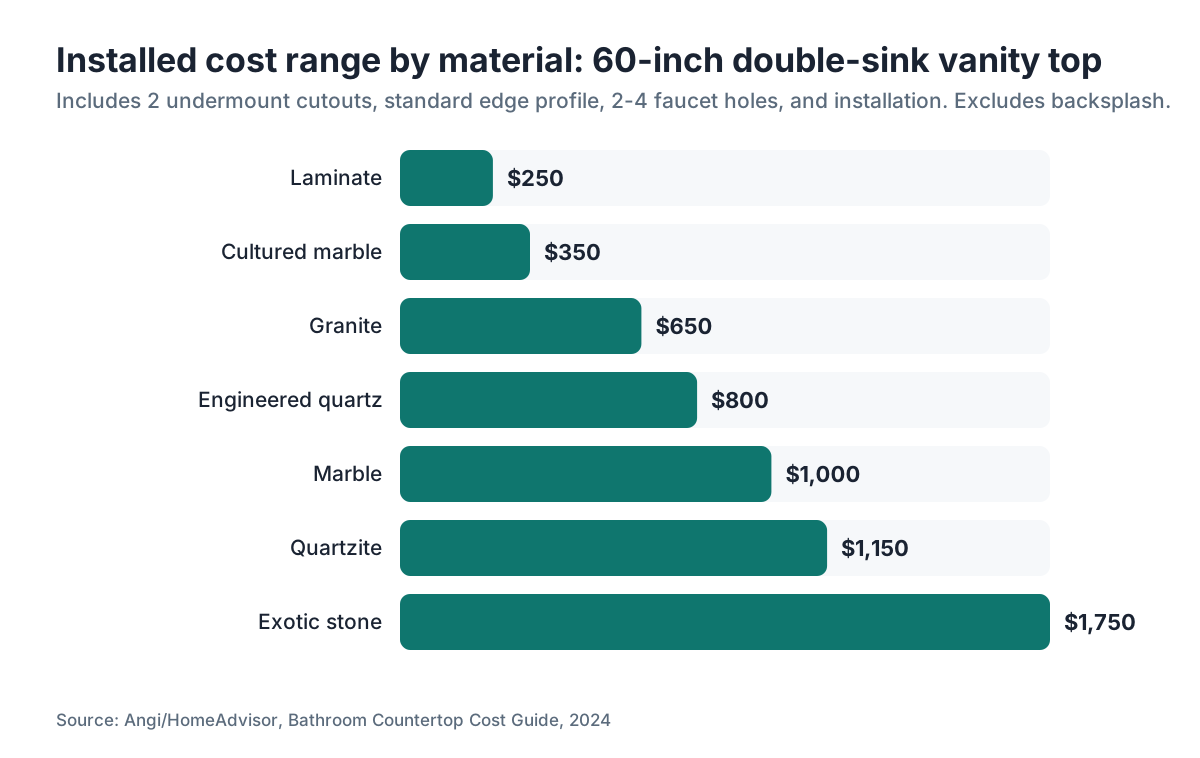
Material is the biggest single variable in the quote. The same 60-inch double-sink top runs from under $200 in laminate to over $2,000 in book-matched marble, with granite, quartz, and quartzite filling the middle [3].
Here's a realistic installed price range for a 60-inch double-sink vanity top by material, including cutouts, a standard edge, and two faucet holes but no backsplash:
| Material | Installed price range (60" top, 2 sinks) |
|---|---|
| Laminate | $150 - $350 |
| Cultured marble | $200 - $500 |
| Ceramic tile | $300 - $600 |
| Granite | $400 - $900 |
| Engineered quartz | $500 - $1,100 |
| Marble | $600 - $1,400 |
| Quartzite | $700 - $1,600 |
| Exotic/imported stone | $1,000 - $2,500+ |
These are real ranges, not floor prices. The spread inside each material comes from slab grade, regional labor, and shop overhead. A shop in Manhattan or San Francisco charges more than one in rural Tennessee for the identical piece of stone.
For most bathroom remodels, engineered quartz or granite hit the sweet spot. Both handle water well, neither needs sealing as often as marble, and both come in enough colors to match any design. If you want to see how quartz brands stack up on price, Cambria countertops sit at the premium end of engineered quartz and are worth understanding before you set a budget.
Laminate deserves a real look for a rental or a budget remodel. Modern laminate profiles fool the eye, they swap out easily, and the price gap against stone is money you keep. See laminate countertops and Formica countertops for the full breakdown.
What does installation add to the quote?
Installation for a bathroom vanity top usually runs $150 to $400, depending on access, floor height, and whether the old top has to come out [4]. Bathrooms are tight. A crew carries the stone through the house, often up stairs, and threads it into a room with a door frame barely wider than the slab. That physical difficulty is real and it belongs in the price. Stone setting is skilled trade work with specialized tools, which the Bureau of Labor Statistics documents in its handbook for tile and stone setters [5].
Removal and disposal of the old top usually adds $50 to $100. Some shops include it, many don't. Ask.
Disconnecting and reconnecting plumbing is a plumber's charge, not the fabricator's. Budget $100 to $250 for a plumber to pull the drain and supply lines, let the fabricator work, and hook everything back up. Some fabricators handle the reconnect as a courtesy, but don't count on it.
For the full picture of what install day looks like, countertop installation walks the sequence in detail.
How do fabricators calculate a quote for this job internally?
A shop's internal quote for a double-sink vanity starts with slab cost per square foot, adds cutting and finishing labor, then layers on itemized charges for cutouts, edge profile, faucet holes, and installation. Most shops carry a minimum job charge, often $300 to $500, because even a small vanity needs full templating, programming, and a trip to the site.
Shops running quoting software move faster because material cost, labor rate, and markup are already loaded. SlabWise, for example, lets a fabricator set material costs and shop rate once, then generate a line-item quote for any job without rebuilding the math. For a double-sink vanity, the cutout charges, edge profile linear footage, and faucet holes all calculate from the template measurements. That matters because the margin on a small bathroom job vanishes fast when the quote is sloppy.
The internal variables that move profit on a double-sink vanity:
- Slab yield: can the vanity top nest efficiently with other jobs on the same slab?
- Bridge width between sinks: narrow bridges force slower cutting and more care
- Travel distance: a 45-minute drive each way is real labor cost
- Stair carries or tight access: add a two-person crew charge
- Plumbing reconnect: if the fabricator does it, price it
Shops that don't itemize these end up with quotes that pencil out on a kitchen job but bleed on bathrooms. Bathrooms eat proportionally more time relative to material cost.
What templating details matter most for a double-sink vanity?
Templating turns the physical reality of the bathroom into the cut file. For a double-sink vanity, these are the measurements that decide whether the top fits:
- Overall top dimensions with actual wall returns (walls are almost never plumb)
- Sink centerlines, measured from the wall and from each other
- Faucet hole locations relative to each sink centerline
- Cabinet height, so the backsplash meets the mirror or wall tile without a gap
- Obstacles like pipes, drawers, or existing tile that affect the fit
Sink centerlines are the most error-prone number. On a 60-inch double-sink vanity with two 15-inch rectangular bowls, each center usually sits 15 inches from its end wall and 30 inches from the other center. But typical varies with the actual cabinet. Measure the box in front of you, not the spec sheet.
Templaters work with physical boards (luan or cardboard) or digital laser templating. Digital is faster and more accurate in a complex bathroom. For a vanity with no strange angles, either one works. Physical templates go wrong more often when the room is tight and the templater is bent into an awkward position, which is the normal state of affairs in a bathroom.
After templating, the shop programs the CNC cuts. For undermount sinks, the cutout is sized about 1/4 to 3/8 inch smaller than the bowl rim on all sides so the sink lip bears on the stone. The Natural Stone Institute lists that 1/4 to 3/8 inch reveal as the standard range [7]. The exact number comes from the sink maker's installation guide and shifts by model.
What questions should a homeowner ask before accepting a quote?
A double-sink vanity quote should read like a line-item document, not a single number. Confirm what's included, and what's excluded and priced separately:
- Is the per-square-foot price for the finished top, or for the slab consumed (waste in)?
- Are both sink cutouts included, or just one?
- What edge profile is the price based on? What does a different profile cost?
- How many faucet holes are included, and at what locations?
- Is a 4-inch backsplash included, or is that extra?
- Is installation included? From what distance? Any stair or access charges?
- Is removal of the existing top included?
- What's the lead time from deposit to installation?
- What's the warranty on fabrication defects?
The last one matters more than most homeowners realize. Cracking during transport, chip-out at the cutout edge, and color drift from the sample slab are all real. A reputable shop has a clear policy on each.
Get quotes from at least two shops. Price differences of 20 to 30 percent on the same material are normal and almost always trace to overhead, not quality. A shop with cheap rent prices differently than one in a commercial district.
Are there ways to reduce the cost without sacrificing quality?
A few moves genuinely save money. Others just feel like they do.
Real savings:
- Pull material from the fabricator's existing slab inventory instead of ordering a specific slab. Remnants are often available for small vanity tops at 30 to 50 percent off the slab cost, because they're left over from bigger kitchen jobs. A 60-inch vanity top fits on most remnants.
- Pick a simple edge profile. The functional difference between an eased edge and a dupont edge is zero. The price difference is not.
- Provide your sink template dimensions up front so the fabricator doesn't wait on a physical sink delivery to size the cutout.
- Coordinate templating and install around the plumber's schedule to avoid two separate install trips.
False economies:
- Skipping the backsplash and caulking the gap instead. Water gets in. The cabinet gets wrecked. The repair costs more than the backsplash would have.
- Buying a cheap sink with off-standard dimensions that needs a custom cutout. The savings on the sink evaporate at the cutout charge.
- Cutting your own faucet holes after the fact. The odds of cracking a finished top are high, and stone fabrication throws crystalline silica dust that OSHA regulates for a reason [9].
One budget option worth knowing: cultured marble vanity tops come as a pre-formed unit with integrated sinks and price aggressively, usually $150 to $400 installed for a 60-inch double-sink top. They aren't stone, the surface scratches more easily, and they read different from natural or engineered stone, but they do the job in secondary bathrooms and rentals.
How long does the whole process take from quote to installation?
The timeline from quote acceptance to installed countertop runs 1 to 3 weeks at most shops, with the variation coming from slab availability and scheduling [4].
Typical sequence:
- Quote accepted and deposit paid (day 1)
- Templating scheduled and done (day 2 to 5)
- Slab selected (same day as templating, or day 6 to 10 if a specific slab has to be ordered)
- Fabrication (2 to 4 business days after template)
- Installation scheduled (1 to 3 days after fabrication)
Ordering an exotic or specialty material that's not in the yard adds 1 to 4 weeks for slab delivery. Some imported stones take longer.
The bottleneck is almost always scheduling, not fabrication speed. A shop with a full queue might push a small vanity out two weeks simply because the install crew is booked. On a tight renovation timeline, ask about the current lead time before you commit to a shop.
For how this fits a broader bathroom renovation, countertop installation lays out the full order of trades and timing.
Frequently asked questions
What is the average cost of a double-sink vanity countertop installed?
For a standard 60-inch top in granite or engineered quartz, expect $500 to $1,100 fully installed, including two undermount cutouts, a standard edge, two to four faucet holes, and installation. Upgrading to marble or quartzite pushes it to $700 to $1,600. Laminate or cultured marble drops it below $400.
How much does a single undermount sink cutout cost?
Most shops charge $60 to $150 per undermount cutout. The range reflects regional labor, material hardness (granite and quartzite are harder to cut than marble), and whether the interior cutout edge is polished. For two cutouts on a double-sink vanity, budget $120 to $300 total as a separate line item.
What is the minimum stone bridge width between two undermount sinks?
The Natural Stone Institute recommends a minimum of 4 to 6 inches of stone between two undermount cutouts to reduce crack risk. In practice, 6 to 8 inches is more comfortable. Narrow bridges can be reinforced with epoxy rods or fiberglass mesh on the underside, which adds $30 to $80. Verify the bridge dimension during templating before cutting.
Can I use a remnant slab for a bathroom vanity top?
Yes, and it's often the smartest move for a vanity. A 60-inch by 21-inch top needs about 9 to 11 square feet of material, which fits on most remnants left over from kitchen jobs. Remnants usually price 30 to 50 percent below full slab rates. Ask your fabricator what's in the remnant yard before pricing from a full slab.
Does the quote include removing the old vanity countertop?
Not always. Removal and disposal of the existing top adds $50 to $100 to most jobs and often shows up as an optional line. Confirm it explicitly. If the old top is tile or glued-down laminate, removal gets more involved and can cost more. Some fabricators credit the removal against the installation charge.
How many faucet holes do I need for a double-sink vanity?
It depends on faucet style. A single-handle faucet needs one hole per sink, so two total. A widespread set (separate hot, cold, and spout) needs three per sink, so six total. Each hole costs $25 to $60 to drill. Confirm your faucet selection before templating, since the hole locations are permanent.
Is a backsplash included in a vanity countertop quote?
Usually not automatically, though some shops fold a standard 4-inch strip into the base price. Confirm in writing. A 4-inch backsplash across a 60-inch vanity adds roughly 1.7 square feet of material and some cutting time. Most fabricators charge $50 to $150 for a basic strip, more for a full-height or coved version.
How do I know if the quote is per square foot or per finished piece?
Ask directly. Some fabricators quote a flat price for the finished piece; others quote per square foot of slab consumed. The slab-consumed method includes the waste factor and is the more transparent approach. Either can be fair, but you can't compare quotes across shops unless you know which method each one uses. Get an itemized breakdown regardless.
What edge profile works best for a bathroom vanity?
An eased, beveled, or simple bullnose edge is the practical best choice. These profiles clean easily, chip less than sharp or heavily layered edges, and look current without being trendy. Complex profiles like ogee or dupont add $10 to $30 per linear foot and date faster in bathroom design. Save the elaborate profiles for kitchen islands where they read better.
What stone material is best for a double-sink bathroom vanity?
Engineered quartz is the most practical pick for most bathrooms. It's non-porous (no sealing), consistent in color, and priced mid-range. Granite is a close second and often cheaper per square foot. Marble looks beautiful but etches from toothpaste and acidic products, which the Natural Stone Institute documents, making it high-maintenance for daily use. Quartzite is harder than marble but still needs sealing.
How does quoting a vanity top differ from quoting a kitchen countertop?
Vanity tops have lower square footage but proportionally higher cutout and edge costs per square foot. Kitchens benefit from scale: more square footage spreads the fixed templating and installation costs. A bathroom job often hits the shop's minimum charge, so the effective per-square-foot cost is higher. Fabricators should apply a minimum job charge of $300 to $500 to stay profitable on small bathroom jobs.
Do fabricators charge more for harder stones like quartzite on a vanity top?
Some do, especially for the cutouts and edge profiling. Quartzite and granite wear through diamond tooling faster than softer stones like marble or soapstone. A surcharge of $20 to $50 per cutout for harder materials is reasonable and worth asking about up front. The slab cost itself is also generally higher for quartzite than for standard granite.
What warranty should I expect on a fabricated vanity countertop?
Reputable shops typically offer a one-year warranty on fabrication workmanship, covering issues like cutout chipping, edge defects, or cracks that start in the fabrication process. Natural material variations (veining, color drift from the sample) are generally excluded. Damage from installation, transport by others, or homeowner use is not covered. Get the terms in writing before signing.
Can quoting software help fabricators price double-sink vanity jobs accurately?
Yes. Software built for countertops can pre-load material costs, cutout charges, edge profile rates by linear foot, and faucet hole prices so every job generates an accurate line-item total automatically. On small bathroom jobs, where manual quoting errors erode thin margins, that consistency pays off. SlabWise is built for this workflow and offers a demo for fabrication shops.
Sources
- National Kitchen and Bath Association (NKBA), Bathroom Planning Guidelines: Standard bathroom vanity depth is 19 to 22 inches; double-sink vanities typically run 48 to 72 inches wide.
- HomeAdvisor (Angi), Countertop Installation Cost Guide: Undermount sink cutout charges typically run $60 to $150 per cutout; edge profiles range from $5 to $40 per linear foot depending on complexity; faucet holes cost $25 to $60 each.
- HomeAdvisor (Angi), Bathroom Countertop Cost Guide: Installed bathroom countertop costs by material: laminate $150-$350, granite $400-$900, engineered quartz $500-$1,100, marble $600-$1,400 for a standard double-sink vanity top.
- HomeAdvisor (Angi), Stone Countertop Installation Cost: Stone countertop installation labor runs $150 to $400 for bathroom vanity tops; typical fabrication-to-installation timeline is 1 to 3 weeks.
- U.S. Bureau of Labor Statistics, Occupational Outlook Handbook: Tile and Stone Setters: Stone installation is skilled trade work requiring specialized tools and training; cited to support labor cost and skill justification.
- U.S. Census Bureau, American Housing Survey: Bathroom remodeling is among the most common home improvement projects; supports context for countertop replacement frequency.
- Natural Stone Institute, Fabrication Standards and Technical Manual: Industry standards for undermount sink cutout sizing recommend a reveal of 1/4 to 3/8 inch inside the sink rim; minimum bridge width between cutouts is recommended at 4 to 6 inches.
- Natural Stone Institute, Stone Care and Maintenance: Marble etches from acidic substances including common bathroom products; engineered quartz is non-porous and requires no sealing.
- Occupational Safety and Health Administration (OSHA), Silica in Construction: Stone fabrication generates crystalline silica dust; supports context for why professional cutting is required and DIY cutouts are not advisable.
- National Association of Home Builders (NAHB), Cost of Constructing a Home: Bathroom countertop and vanity work is a standard line item in residential construction cost accounting; supports installed price ranges.
Last updated 2026-07-10