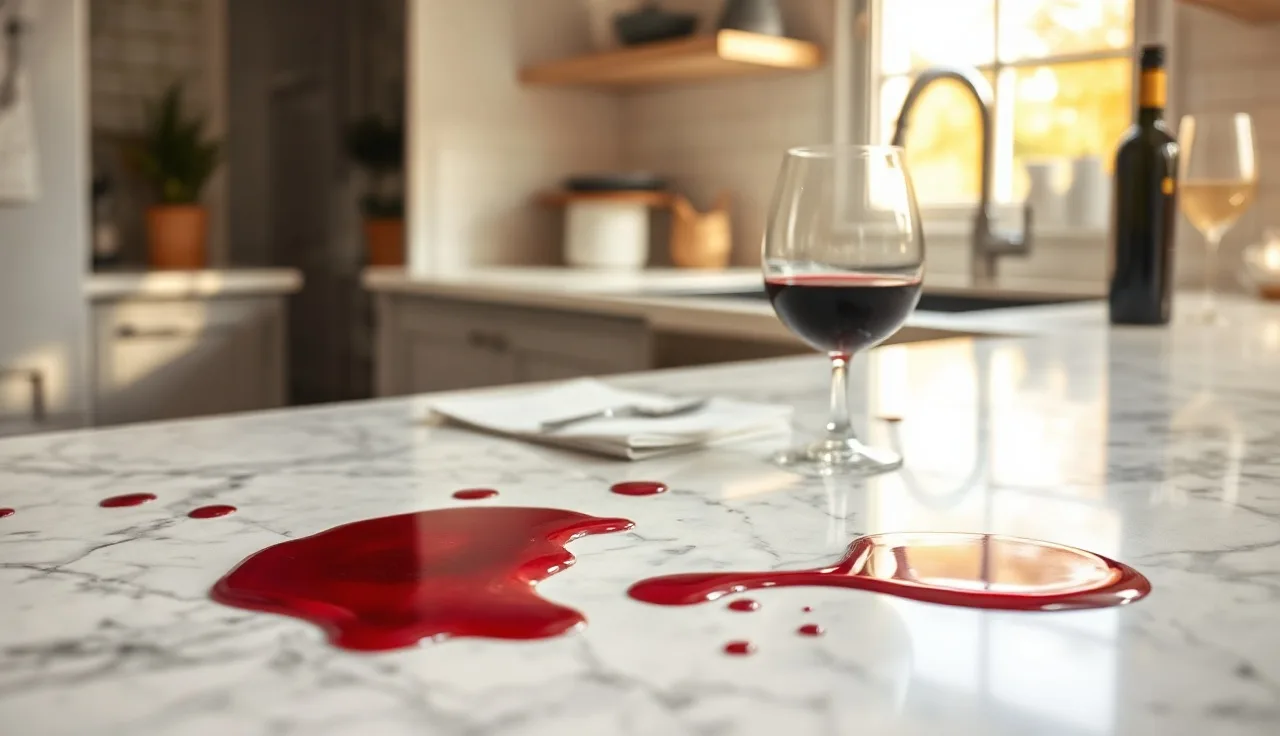
TL;DR
- Most countertop stains come out with the right poultice, cleaner, or light abrasive matched to the surface.
- Marble and limestone need alkaline-safe products.
- Quartz hates bleach at full strength.
- Laminate tolerates more than people think.
- Catch a stain within 24 hours and you'll remove about 90% of them yourself.
- Wait weeks and you may need professional resurfacing or a new slab.
Why is my countertop staining so easily?
The honest answer is that most countertops stain easily when people don't know what they're made of. Different materials fail in completely different ways, and the fix for one will wreck another.
Natural stone like marble and limestone is porous and reacts chemically with acids. A lemon wedge sitting on unsealed marble for ten minutes can etch the surface, leaving a dull gray patch that looks like a stain but is actually surface damage. Granite is denser but still porous enough that cooking oil will darken it if left overnight. Quartzite, which many homeowners confuse with quartz engineered stone, behaves like natural stone and needs sealing. [1]
Engineered quartz (brands like Cambria, Silestone, and Caesarstone) has very low porosity, so true absorption stains are rare. What people call quartz stains are usually surface deposits from hard water, dried food residue, or chemical discoloration from cleaning products that weren't rinsed off. Bleach left sitting on quartz can bleach the pigment in the resin binder. That damage is not reversible. [2]
Laminate and Formica countertops are sealed at the factory, so liquid doesn't absorb, but the melamine surface scratches and those scratches trap pigment. Corian countertops and other solid surface materials are non-porous but can be scratched or scorched, and both show as discoloration.
Butcher block countertops are porous wood and will absorb anything wet. An unsealed or under-oiled butcher block develops black mold stains fast.
So before you treat anything, identify your surface.
How do I identify my countertop material before treating a stain?
Get this wrong and you can make the stain permanent. Here's a quick field test.
Drop a tiny bit of water on an inconspicuous spot. If it beads up, the surface is sealed or non-porous. If it darkens in under two minutes, you have porous unsealed stone or wood. Now try a single drop of white vinegar in a hidden corner. If it fizzes or you hear a faint hiss, the surface contains calcium carbonate. That means marble, travertine, limestone, or some quartzites. Do not use acid-based cleaners, citrus, or vinegar anywhere on those surfaces.
If neither test shows a reaction and the surface is smooth, hard, and uniform in color with no veining variation, it's likely engineered quartz or solid surface. If it's a thin sheet with visible substrate at the edge, it's laminate.
Wood is obvious. Sand it and it smells like wood.
Still unsure? Look at your purchase paperwork, or photograph the edge profile and the full surface and ask your countertop fabricator. Many will identify it from a photo in under five minutes.
What removes stains from granite countertops?
Granite stains split into two camps: oil-based (cooking oil, grease, cosmetics, lotion) and water-based (coffee, wine, juice, food coloring). Each needs a different poultice. [1]
For oil-based stains on granite countertops, the Marble Institute of America recommends a poultice made from baking soda and acetone or mineral spirits. Mix to a thick peanut-butter paste, spread it about a quarter inch thick over the stain, cover with plastic wrap taped at the edges, and let it sit for 24 to 48 hours. The acetone draws the oil out of the stone into the absorbent paste. Wipe clean, rinse, and repeat if needed. Two or three applications usually clear a stubborn oil stain. [3]
For water-based stains, use hydrogen peroxide (12% concentration, available at beauty supply stores, not the 3% drugstore version) mixed with a white absorbent powder like diatomaceous earth or kaolin clay. Same application method. The hydrogen peroxide oxidizes the colored compounds.
After any stain removal, reseal. The Natural Stone Institute recommends the water test to check seal integrity: pour a tablespoon of water on the surface and watch it. If it absorbs in under four minutes, the stone needs sealer. Most granite should be resealed every one to three years depending on use and the specific stone's density. [3]
What doesn't work: dish soap rubbed in circles, WD-40, bleach on dark granite (it can discolor), and any acidic cleaner. Skip them all.
For ongoing help, how to clean stone countertops goes deeper on daily maintenance.
How do I get stains out of marble countertops?
Marble stains are often actually etches, and people treat them wrong because they mix up the two. A stain is discoloration from absorbed material. An etch is surface damage where acid has dissolved the calcium carbonate and left a dull, slightly rough patch. They look similar but need different treatment. [4]
For true stains (coffee, red wine, juice that soaked into unsealed marble), use the hydrogen peroxide poultice method described for granite. Never use anything acidic on marble. Not lemon juice, not white vinegar, not most bathroom cleaners, not many granite cleaners that contain citric acid. The Marble Institute of America guidance states that acidic cleaners "will permanently etch the marble surface."
For etch marks, the fix is light abrasion and repolishing. Use a marble polishing powder (tin oxide or aluminum oxide based), applied with a damp cloth in circular motions with light pressure. It removes a microscopic layer and brings the polish back. This works on polished marble. Honed marble is easier to spot-repair because the matte finish hides minor etches.
Deep etches need a stone restoration professional. They use variable-speed angle grinders with diamond abrasive pads, working through grits from 50 up to 3,000, then polish and reseal. Expect to pay $4 to $10 per square foot for professional etch removal and repolishing as of 2024, though prices vary by region and access. [4]
See also: marble countertops for a full care guide, and how to clean quartzite countertops if you're not certain which stone you have.
Can you remove stains from quartz countertops without damaging them?
Yes, most of them. Engineered quartz has a resin binder that makes it nearly impervious to absorption, so what you're cleaning is almost always a surface deposit. [2]
For everyday stains (coffee, wine, food), a soft cloth with warm water and mild dish soap gets 95% of them. For dried-on deposits, use a plastic scraper or the back of a spoon gently, then soapy water. Never use a metal scraper or steel wool.
For hard water marks and mineral deposits, a 50/50 mix of water and white vinegar applied briefly (under 30 seconds) then rinsed completely is fine. The resin binder resists acid. The caveat: don't let vinegar sit for extended periods.
For permanent markers, dried paint, or nail polish, use isopropyl alcohol or acetone on a cloth, not poured directly. Rub gently and rinse. Most manufacturers explicitly allow this. [10]
What genuinely damages quartz: undiluted bleach left sitting (it discolors the resin binder), oven cleaners or drain cleaners (very high pH, will dull the surface), and heat. Quartz is not heat-resistant. A hot pan set directly on quartz can cause discoloration or micro-cracking in the resin that looks like a stain but is structural damage. Always use trivets. [2]
For Cambria countertops specifically, Cambria publishes its own care guide that permits most common cleaners but warns against high-pH products and prolonged acid exposure.
If quartz has a permanent discoloration that won't respond to any cleaning, the options are limited. A professional may be able to spot-polish, but deep resin discoloration usually means replacing the section.
How do you get stains out of laminate countertops?
Laminate is more forgiving than its reputation suggests, and also more fragile than people expect. The top layer is a printed paper sheet sealed under melamine resin. It doesn't absorb liquids, but it scratches, and scratches trap stain.
For surface stains on laminate countertops, start with baking soda paste and a soft cloth, rubbed gently in the direction of any grain pattern. This handles most coffee, wine, and food stains. For stubborn stains, a small amount of acetone nail polish remover on a cloth works well. Test in an inconspicuous spot first, because some laminate patterns can lose their finish gloss.
For ink or marker, isopropyl alcohol is your first stop. Rubbing alcohol lifts most marker and ink off laminate without damage.
Bleach diluted to about 10% works on laminate for mold stains near the sink area, but rinse completely and don't let it sit more than two or three minutes. Undiluted bleach will lighten some laminate patterns permanently.
What won't help: poultices do nothing, because laminate doesn't absorb. Deep scratches that have taken on color can't be chemically cleaned out. You can try a laminate repair pen or paste to fill them, but results are mixed. If a laminate surface has widespread scratching and staining throughout, replacement is cheaper and more satisfying than ongoing repair attempts. Laminate countertops typically cost $25 to $50 per square foot installed, which makes replacement accessible. [5]
What takes stains out of butcher block countertops?
Butcher block stains fall into three types: surface stains, deep absorption stains, and mold or mildew stains. Each needs a different approach. [6]
Surface stains from coffee, berries, and most food: cut a lemon in half, dip it in coarse salt, and scrub directly on the stain. The citric acid and mechanical abrasion lift the discoloration. Rinse with water and dry immediately. This works because wood can handle mild acid in brief contact, unlike marble.
Deep absorption stains (red wine, beet juice, or anything left for hours): sand them out. Start with 80-grit sandpaper going with the grain, then finish with 120 or 150-grit. Clean the dust, then apply food-safe mineral oil or a butcher block conditioning oil. Howard Products' Butcher Block Conditioner is a common option that uses food-grade mineral oil and beeswax. The USDA guidelines for food-contact wood surfaces specify that finishes must be food-safe once cured. [7]
Mold and black stains (usually near the sink from standing water): mix one tablespoon of bleach with a cup of water, apply, let sit two to three minutes, then rinse and dry completely. If the mold has penetrated more than a millimeter into the wood, sand down past it.
After any treatment, butcher block needs immediate oiling. Dry, unprotected wood absorbs stains faster than anything else in a kitchen. Oiling every one to three months with plain mineral oil is the single best prevention.
Are there stains that can't be removed without professional help?
Yes. Some stains are permanent or require equipment you don't have at home.
Rust stains on natural stone are particularly stubborn. Iron compounds react with the stone and lock in. Commercial rust removers contain oxalic acid or phosphoric acid, which can damage polished marble and limestone. A stone restoration professional has the right products and knows which stones can tolerate them. The Natural Stone Institute maintains a directory of certified stone restoration professionals. [3]
Turmeric stains on porous stone can be nearly impossible to remove fully. The curcumin compound bonds aggressively with calcium carbonate. Multiple poultice applications over weeks sometimes get 80 to 90% removal, but a faint yellow ghost often remains. Some fabricators combine hydrogen peroxide with UV light exposure, but results are inconsistent.
Solvent-based stains (paint, epoxy) that have fully cured on quartz or granite may need professional polishing to remove without scratching. The risk of a DIY attempt on a $5,000 slab is real.
For stone countertops with widespread staining from years of neglect, a professional grind-and-polish restores the surface without replacement. For solid surface materials like Corian, a certified fabricator can sand and buff almost any damage because the material is the same color all the way through. Corian countertops are uniquely repairable this way. [11]
What are the best products for countertop stain removal?
Here's an honest breakdown. Most of what you need costs under $30 total.
For natural stone (granite, marble, quartzite): the most versatile kit is a bag of kaolin clay or diatomaceous earth (garden supply stores or online), acetone, and 12% hydrogen peroxide. These form the basis of every DIY poultice. Add a stone-specific sealer from a brand like Miracle Sealants or Aqua Mix. Both sell at tile and stone distributors and in most big-box home improvement stores.
For engineered quartz: Bar Keepers Friend in powder form (containing oxalic acid and gentle abrasives) works for mineral deposits and some surface stains. Many fabricators and quartz manufacturers recommend it explicitly. Use the soft cleanser version, not the regular powder, to cut scratch risk. Rinse completely. [10]
For laminate and solid surface: the Magic Eraser (melamine foam) is underrated. It handles scuffs, light stains, and residue on laminate and solid surface without chemicals. Use light pressure.
For butcher block: food-grade mineral oil from the pharmacy or grocery store is identical to the expensive stuff sold as "butcher block oil." Howard Cutting Board Oil is mineral oil with added walnut oil and vitamin E. If you or anyone in your household has a tree nut allergy, stick to plain mineral oil, since the FDA has not specifically cleared walnut-containing products as allergen-free for food surfaces the way plain mineral oil is cleared. [7]
What to skip: multi-surface sprays that claim to work on "all countertops." They compromise on every surface. Use material-specific products.
Stain removal by countertop material: a quick comparison
| Material | What stains it most | Best first response | What to avoid | Pro needed? |
|---|---|---|---|---|
| Granite | Oils, coffee, wine | Poultice (oil: acetone; water-based: H2O2) | Acid cleaners, bleach | Only for rust or deep set |
| Marble | Coffee, juice, rust | H2O2 poultice; etch marks need polishing powder | Any acid (vinegar, citrus, most cleaners) | Deep etches, rust |
| Quartzite | Same as marble | Same as marble | Same as marble | Deep damage |
| Engineered quartz | Hard water, paint, bleach damage | Soapy water; IPA for markers; Bar Keepers Friend for minerals | Undiluted bleach, oven cleaner, metal scrapers | Resin discoloration |
| Laminate | Scratched-in color, marker | Baking soda paste, acetone, IPA | Metal scrubbers, prolonged bleach | Not usually |
| Butcher block | Oil, mold, red pigment | Salt + lemon, then sand and oil | Nothing needed | Structural mold |
| Solid surface (Corian) | Scratches, burns, dye | Wet sanding (180+ grit), then polish | Heat sources | Burns, gouges |
This table is a starting point, not a complete protocol. Always test any method in an inconspicuous area first.
How do I stop my countertop from staining again?
Prevention beats removal every time, and the steps are simple.
Seal porous stone. A properly applied penetrating sealer is the single most effective thing you can do for granite, marble, quartzite, and limestone. The Marble Institute of America's care guidelines recommend sealing these surfaces after installation and retesting annually using the water bead test. [4] The sealer soaks into the pores and slows liquid absorption from minutes to hours, which gives you time to wipe up a spill before it sets.
Build a wipe-up reflex. On any surface, time is the enemy. A glass of red wine wiped up in five minutes is a non-event on almost every countertop material. The same spill left overnight becomes a problem on any porous surface.
Use cutting boards, trivets, and mats consistently. This is where most countertop damage happens. Cutting directly on stone dulls your knives and risks surface abrasion. Setting a hot pan on quartz causes resin damage that mimics staining. Setting a hot pan on marble creates thermal expansion micro-cracks over time.
Clean with pH-neutral products on stone. Most spray cleaners sold for kitchens are acidic or mildly alkaline and are fine for tile and laminate. On marble and limestone they act as slow stain accelerators. A simple mix of a few drops of dish soap in water cleans stone well.
For fabricators tracking stone jobs and maintenance schedules for clients, tools like SlabWise help manage which jobs used which materials, so you can send accurate care instructions with each delivery. Homeowners getting an estimate can use the SlabWise instant quote tool to get ballpark numbers for countertop replacement if a surface is too far gone to save.
For kitchen countertops in general, the best long-term strategy is matching your surface choice to your actual habits, not to what looks nice in the showroom.
When should I replace a stained countertop instead of trying to fix it?
There's a real cost-benefit calculation here, and most people lean too far toward replacement when a professional restoration would have cost a quarter as much.
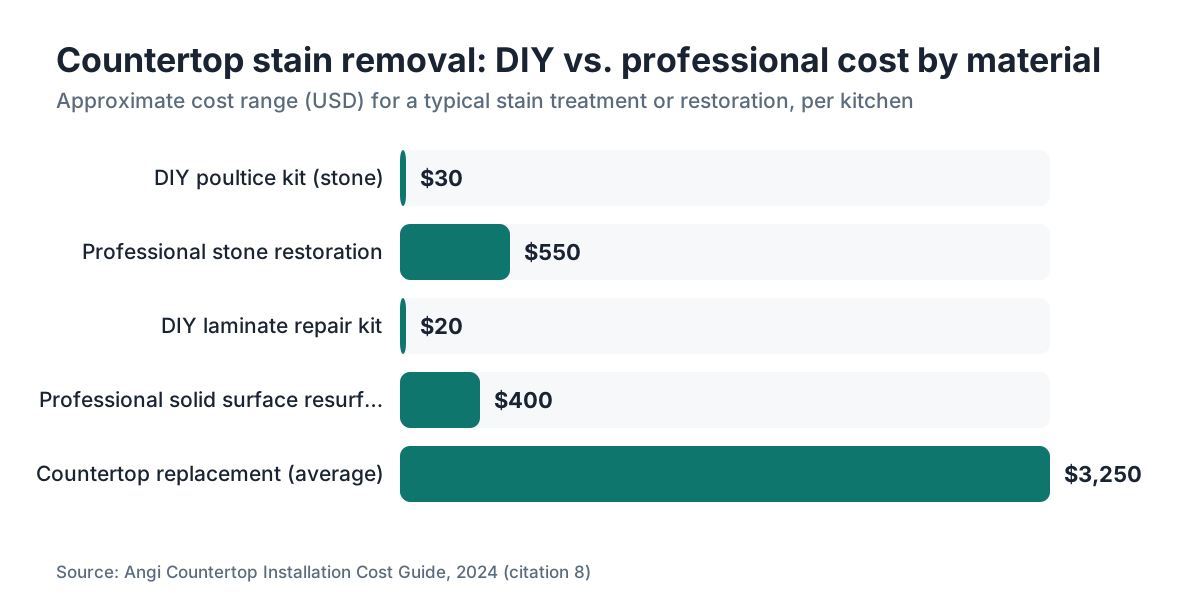
Consider restoration first if: the stone or material is structurally sound (no cracks, no delamination), the staining is surface-level or pore-deep (not physical damage), and the countertop was expensive enough that a $200 to $800 professional restoration pencils out against a $3,000 to $10,000 replacement. Natural stone in particular is almost always worth restoring. [8]
Consider replacement if: the laminate has widespread delamination or swelling (usually from water intrusion at seams), the butcher block has deep structural mold that sanding can't reach, the quartz has resin cracking or discoloration from heat damage in multiple spots, or the solid surface has burns and gouges throughout. At some point, the visual result of repair looks worse than living with the damage.
Get a restoration quote before you commit to replacement. A certified stone restoration professional can usually tell you in 15 minutes whether a surface is salvageable. For laminate, a laminate specialist (not the big-box installer) may be able to do a section replacement. For solid surface, the manufacturer's network of certified fabricators can sometimes replace a single damaged section invisibly because the material color runs all the way through.
The countertop replacement market in the US averages $2,000 to $4,500 for a typical kitchen depending on material and region, according to contractor data compiled by Angi. Compare that to $300 to $800 for professional stone restoration before you decide. [8]
Frequently asked questions
Can I use baking soda and vinegar to clean a stained stone countertop?
Not on marble, travertine, limestone, or quartzite. Vinegar is acidic and will etch calcium carbonate surfaces permanently, turning a stain into physical surface damage. Baking soda alone as a paste is fine on granite and quartz. On marble, skip the vinegar entirely and use a hydrogen peroxide poultice for stains instead.
Why does my granite countertop have a dark spot that won't come out?
Dark spots on granite are almost always oil or fat that has absorbed into the stone. Cooking oil, butter, lotion, and even hand cream leave this mark. Try an acetone-and-baking-soda poultice: paste it thick, cover with plastic wrap taped down, leave 48 hours, then wipe and rinse. Repeat two or three times. Reseal after removal. If the spot returns, the stone may need professional cleaning.
How long does a countertop poultice take to work?
Most poultice applications need 24 to 48 hours of contact time to draw out absorbed material. Stubborn or deep stains may require two or three applications over a week. Rushing it and removing the poultice at 12 hours usually just redistributes the stain. Patience is the main variable in DIY poultice work.
What's the fastest way to get a red wine stain off a countertop?
On quartz or laminate: soapy water immediately, then a damp cloth. On granite: blot (don't wipe), then club soda to lift the remaining color, then a hydrogen peroxide poultice if a mark remains. On marble: blot immediately, apply a hydrogen peroxide poultice the same day. On butcher block: salt and lemon scrub. Speed is the biggest factor. A fresh red wine stain is usually gone in under five minutes if you act fast.
Can bleach damage my countertop?
Yes, on several surfaces. Undiluted bleach left on engineered quartz can permanently discolor the resin binder. On marble and natural stone, bleach can strip sealer and cause discoloration with repeated use. On laminate, prolonged contact lightens some patterns. Diluted bleach at around 10% concentration, used briefly then rinsed, is acceptable for mold treatment on laminate, butcher block, and unsealed granite, but never leave it sitting.
My countertop looks dull, not stained. What's the difference?
Dullness on natural stone is usually an etch, not a stain. Acid (from citrus, vinegar, tomato, or most common cleaners) dissolves the calcium in stone and creates a micro-rough surface that scatters light instead of reflecting it. Etches need mechanical polishing with a marble polishing powder or professional refinishing, not chemical stain removal. A poultice won't help an etch.
Is it safe to use Magic Eraser on countertops?
Yes on laminate, solid surface (Corian), and quartz, with light pressure. Magic Eraser is melamine foam with a very fine abrasive action. It removes surface scuffs and minor stains well. Avoid it on polished natural stone (it dulls the finish) and on high-gloss acrylic surfaces where the micro-abrasion will show. Use it wet and don't scrub hard.
How often should granite countertops be sealed to prevent staining?
Most granite needs resealing every one to three years, but the honest answer depends on the specific stone's porosity and how heavily the surface is used. Test it yourself: pour a tablespoon of water on the surface and time how fast it absorbs. If it darkens in under four minutes, seal it. Some dense granites like Black Pearl may go five years between sealings. Others need annual attention. The water test beats a calendar schedule.
What causes yellow stains on white quartz countertops?
Yellow staining on white quartz almost always comes from cleaning products, not food. Products with orange or lemon oil, some all-purpose cleaners, and prolonged contact with bleach can all discolor the resin binder. Turmeric is another culprit. For yellowing from cleaners, try Bar Keepers Friend (the soft cleanser version) with a soft cloth. Turmeric sometimes responds to hydrogen peroxide. If the yellowing doesn't clean off, it may be resin oxidation from UV exposure near a sunny window, which is not reversible.
Can a scratched countertop be polished back to look new?
It depends on the material. Solid surface countertops like Corian can be sanded and polished back to a like-new finish because the color goes all the way through. Granite and marble can be professionally repolished. Quartz can be polished to remove minor surface scratches but not deep ones. Laminate scratches are permanent because the decorative layer is thin. Repair pastes help cosmetically but aren't invisible. Butcher block can be sanded flat.
What household items can I use as a countertop stain remover right now?
For most surfaces: baking soda paste for light stains, isopropyl alcohol for ink and marker, hydrogen peroxide (the 3% drugstore version works for mild stains on granite, though 12% is stronger) for water-based stains, and table salt with lemon for butcher block. Avoid anything acidic on marble. Avoid bleach on quartz and natural stone. Acetone nail polish remover works on laminate and quartz surface deposits. These aren't perfect but they're a solid first pass.
How much does professional countertop stain removal or restoration cost?
Stone restoration professionals typically charge $4 to $10 per square foot for polishing and etch removal on marble or granite, based on 2024 market rates. A full kitchen restoration covering 40 to 60 square feet runs $160 to $600. Deep cleaning and resealing alone is usually $100 to $250. Compare that to countertop replacement averaging $2,000 to $4,500 installed for a typical kitchen. For most stone surfaces in reasonable condition, restoration is the better financial call.
Does sealing a countertop make it stain-proof?
No. A penetrating sealer slows absorption, which gives you a longer window to wipe up spills before they set. It does not make the surface impervious. Sealers need reapplying periodically as they degrade from cleaning, heat, and wear. A sealed granite may absorb a red wine spill in 30 minutes instead of 5, but leave that spill overnight and you may still have a stain to deal with.
Sources
- Natural Stone Institute, "Natural Stone Care and Maintenance Guide": Natural stone including granite and marble is porous and requires penetrating sealers to resist absorption; oil-based and water-based stains require different poultice formulations
- Cambria Company, LLC, "Cambria Care and Maintenance": Engineered quartz has very low porosity and staining is typically surface-level; undiluted bleach and high-heat exposure can cause permanent damage to the resin binder
- Marble Institute of America, "Care and Cleaning for Natural Stone Surfaces": Oil-based stains on granite respond to acetone poultice; the water test (darkening within 4 minutes) indicates sealing is needed; resealing frequency is 1 to 3 years depending on porosity
- Marble Institute of America, "Marble Care and Cleaning": Acidic cleaners will permanently etch marble surfaces; etches require mechanical repolishing, not chemical stain removal; professional etch removal runs $4 to $10 per square foot
- U.S. Bureau of Labor Statistics, "Consumer Price Index: Home Improvement Materials": Laminate countertops cost approximately $25 to $50 per square foot installed as of recent survey data
- University of California Agriculture and Natural Resources, "Cutting Board Safety": Wood surfaces including butcher block are porous and absorb staining liquids; salt and lemon are effective for surface stain removal; regular oiling reduces absorption
- U.S. Food and Drug Administration, "Food Contact Substances: Guidance on Mineral Oil and Other Coatings": Food-grade mineral oil is FDA-approved for food contact surfaces; finishes used on food-contact wood must be food-safe once cured
- Angi (formerly Angie's List), "Countertop Installation Cost Guide": Average countertop replacement cost in the US ranges from $2,000 to $4,500 for a typical kitchen; professional stone restoration typically costs $300 to $800
- Occupational Safety and Health Administration (OSHA), "Silica in Construction: General Guidance": Stone fabrication and sanding of engineered stone produces silica dust; references to professional stone work should note that certified fabricators follow exposure control plans
- Cosentino Group, "Silestone Care and Maintenance Guide": Engineered quartz surfaces tolerate isopropyl alcohol and acetone for spot cleaning; Bar Keepers Friend is listed as acceptable for mineral deposit removal with rinsing
- DuPont / Corian, "Corian Solid Surface Care Guide": Solid surface countertops can be sanded and buffed by a certified fabricator to remove burns, scratches, and deep stains because the color is consistent throughout the material thickness
Last updated 2026-07-09