TL;DR
- A winning countertop quote itemizes every cost the homeowner will actually pay: slab square footage with waste factor, edge profile, cutouts, sink type, backsplash, demo, and delivery.
- Vague quotes lose to clear ones at the same price.
- Attach a written scope of work next to the total.
- Shops that do this fight fewer change-order battles and close more.
Why do so many fabrication quotes lose jobs they should win?
The quote that loses is almost never the highest price. It's the vague one. Picture two quotes at the exact same number. One says "granite supply and install, 45 sq ft, $3,200." The other says "45 sq ft Uba Tuba granite, 3 cm, eased edge, undermount sink cutout, two faucet holes, haul-away of existing laminate, $3,200." The homeowner trusts the second shop. Same dollars, better close.
That's the tension in quoting. Fabricators know their own scope cold, so they write in shorthand. Homeowners don't know the trade, so they fill the gaps with fear. Specificity is free. Ambiguity costs you the job, or it costs you the margin when the homeowner expects something you never quoted.
There's a quieter problem underneath. Shops that write thin quotes also write thin scopes, and thin scopes turn into change-order fights. A plumber bumps the schedule, the sink cutout shifts two inches, and now you're arguing about whether that's a free fix or a charge. A detailed quote with a written scope attached gives you the paper to have that conversation like a professional instead of a defendant.
What does a complete countertop fabrication quote actually include?
A complete quote has eight categories. Miss one and you're either leaving money on the table or building a dispute you'll finish later.
1. Material description. Name the stone or surface, the finish (polished, honed, leathered), the thickness (2 cm vs 3 cm changes both price and how far it can span unsupported), and where the slab comes from if that matters to the sale. A homeowner buying marble countertops wants to know if it's Carrara C, Bianco Estremoz, or a domestic substitute.
2. Net square footage and the waste factor. Measure the actual countertop area, then add your shop's waste percentage. Most shops run 15 to 25 percent waste depending on layout complexity, grain direction, and whether the homeowner wants a specific vein match [1]. Quote the gross square footage you'll have to buy, not the net you'll install.
3. Edge profile. Eased and beveled edges usually sit inside the base price. Ogee, waterfall, dupont, mitered, and laminated edges carry labor upcharges of $10 to $40 per linear foot depending on complexity [2]. List the profile name and the per-linear-foot charge.
4. Cutouts. Each one takes time. Undermount sinks run $75 to $150 per opening. Cooktops $100 to $200. Faucet holes $25 to $50 each. Outlet knockouts $25 to $60 [2]. List every one.
5. Backsplash. A full-height slab backsplash is a different line item from a 4-inch integrated splash. Tile is usually owner-supplied or a separate subcontract. Spell out what's in scope.
6. Demo and haul-away. Pulling old laminate, tile-on-plywood, or existing stone adds 30 to 90 minutes of labor per kitchen [2]. Some shops sub it out, some do it in-house. Either way it goes on the quote: in scope, out of scope, or priced separately.
7. Delivery, install, and support requirements. Does the price include leveling the cabinets? Who owns it if the cabinets are out of plane? Who reconnects the plumbing? Plumber coordination is the number one source of schedule fights, so name it.
8. Sealer and warranty. Some shops throw in a first-year sealer application or a fabrication warranty. If you do, put it on the quote. It's a real reason to pick you over the next guy.
How should you price square footage for a countertop quote?
The standard unit is price-per-square-foot installed, one number that bundles material, fabrication labor, and install. Some shops break material and labor apart, which is cleaner for internal accounting and more confusing for homeowners. Pick one and stay consistent.
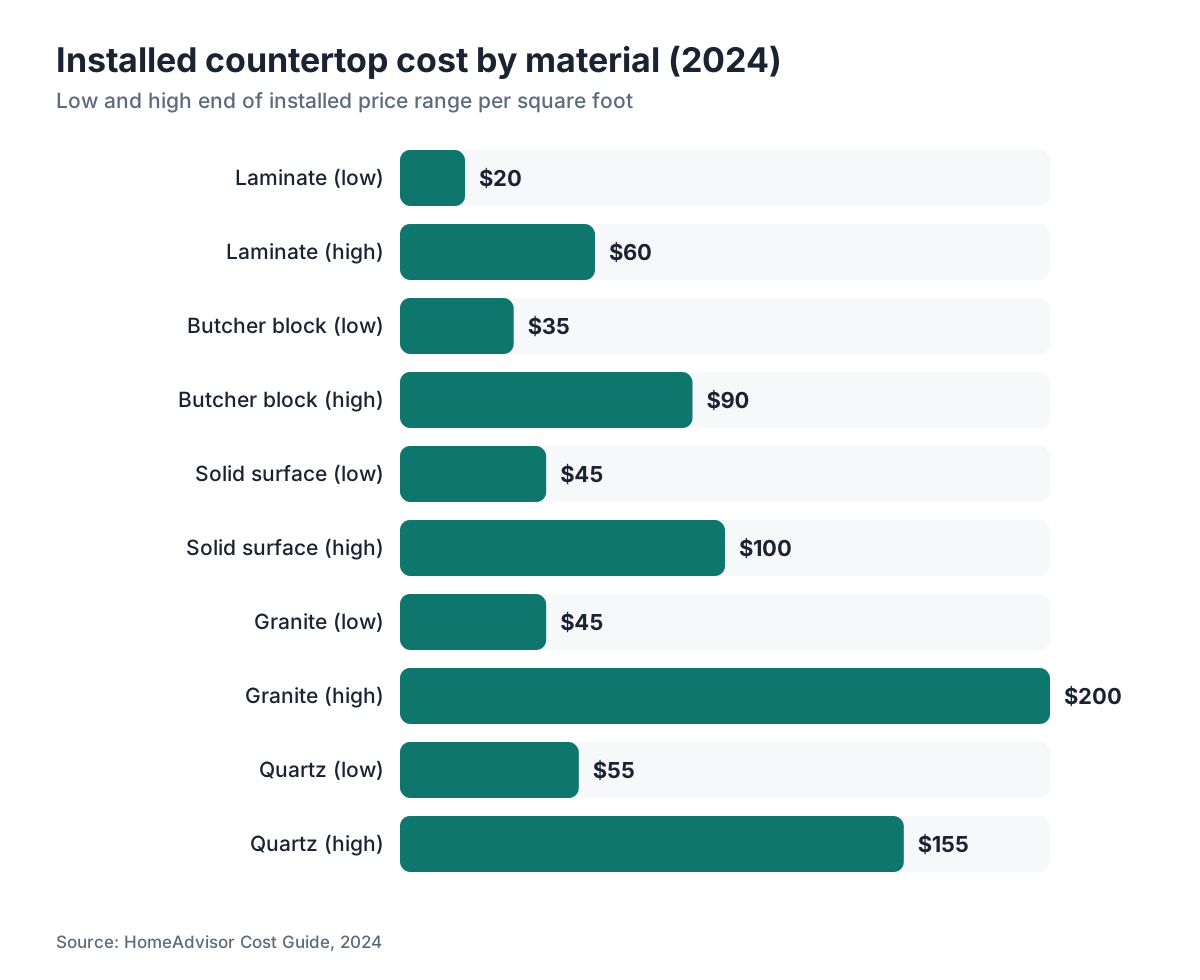
For natural stone, the total installed price-per-square-foot in 2024 runs roughly:
| Material | Low (installed) | High (installed) | Source |
|---|---|---|---|
| Granite | $45 | $200 | HomeAdvisor / RSMeans [3] |
| Quartz (engineered) | $55 | $155 | HomeAdvisor [3] |
| Quartzite | $60 | $200 | HomeAdvisor [3] |
| Marble | $75 | $250 | HomeAdvisor [3] |
| Butcher block | $35 | $90 | HomeAdvisor [3] |
| Laminate | $20 | $60 | HomeAdvisor [3] |
| Solid surface (Corian) | $45 | $100 | HomeAdvisor [3] |
These ranges are wide on purpose. They have to swallow regional labor variation, slab grade, and edge complexity. A shop in rural Alabama and a shop in suburban Boston carry different floor costs for the identical stone.
For your own pricing, work backward from your target gross margin. Say you pay $18/sq ft for mid-grade granite and your total shop cost (labor, overhead, delivery) is $25/sq ft. You need a price that clears your margin before you ever start competing on the quote. Most well-run fabrication shops target 40 to 55 percent gross margin on installed jobs [4]. Drop under 35 percent and you're probably not covering overhead in the slow months.
The biggest pricing mistake shops make is quoting net square footage instead of gross. Kitchen has 42 sq ft of net countertop, your waste factor is 20 percent, so you're buying 50.4 sq ft of slab. Quote off 42 and you ate $150 in material before the truck even left the yard.
What's the right format for a countertop quote document?
The document doesn't need to be fancy. It needs to hit four things: a clear project description, an itemized price breakdown, a defined scope of work, and clear payment terms. A one-page quote a homeowner reads in two minutes beats a four-page estimate that buries the total.
Here's the structure that works.
Header: Business name, license number if your state requires one, date, and quote expiration date. A quote that expires in 30 days builds a little urgency and shields you from material price swings.
Project address and contact: Obvious, but shops skip it on returning customers and then can't remember which kitchen the quote covered.
Line items: One line per charge category. Material, edge profile, cutouts (itemized), backsplash, demo, delivery/install, any permits or inspections. Then a subtotal, applicable sales tax, and a total.
Scope-of-work paragraph: Three to five sentences on what you'll do and what you won't. Something like: "This quote covers supply, fabrication, and installation of the countertops described above. Homeowner is responsible for plumber reconnect. Cabinet leveling is included up to 1/4-inch variance; significant structural cabinet repairs are not in scope." That paragraph kills most post-install arguments before they start.
Payment terms: Most shops run 50 percent deposit at signing, 50 percent on completion. Some do 50/25/25 with a progress payment at template. Write the terms flat out. Charge a credit card fee? Say so here.
Signature line: Both parties sign. Even when you email a PDF, require a signed return before you schedule template.
How do you handle edge profiles and cutouts in a quote without confusing the customer?
Edge profiles are where homeowners go blank. They've heard "ogee" and "waterfall" and have no picture in their head. Fix it with a one-page visual reference (printed, or a link to a photo guide on your site) and point the quote at it: "Edge profile: Full bullnose, per profile sheet, $18/LF."
Don't list 15 edge options in the quote. That's choice paralysis on paper. Name the one profile chosen at the design meeting and price it. If the homeowner hasn't picked yet, drop in a line that reads "edge profile TBD, estimated $0 to $35/LF, finalized at template."
Cutouts are cleaner to itemize than people expect. Just list each one by name and price:
- Undermount kitchen sink: $125
- Cooktop: $150
- Faucet hole x2: $50
- Soap dispenser hole: $25
Total cutouts: $350
A homeowner reads that in five seconds. It also protects you when someone later swears they wanted a third faucet hole and you have no record of the conversation. If it's not on the quote, it's not in the price. Say that out loud, kindly, once, and you rarely have to say it twice.
How does templating affect the quoting process?
Templating and quoting bump into each other in two ways, and plenty of shops handle both badly.
First, some shops quote before template and some quote after. Quoting before template is faster for the homeowner and carries measurement risk. Quoting after is more accurate and slows the decision. The right call depends on your workflow and your customer mix. High-volume production shops usually do a preliminary quote from kitchen dimensions, then lock it at template. Custom fabricators often refuse to hand over a final number until they've templated in person.
If you quote before template, say so on the document: "This quote is based on customer-supplied dimensions. Final price will be confirmed after template measurement and may adjust by +/- 5 percent." That sets the expectation without stalling the sale.
Second, treat the template appointment as either a charge or a real commitment. Some shops charge $150 to $300 for template and credit it back when the job proceeds [2]. That fee screens out tire-kickers and pays for your time when the job dies. Others give free template to stay competitive. Neither is wrong. Your quote just has to state which one you do.
For shops juggling several jobs at once, digital templating (laser measuring, digital layout software) trims the error rate on complex kitchens. A countertop with multiple peninsulas, islands, and radius corners templated by hand has a lot more room for a costly re-cut than the same job measured digitally.
What should the sales tax and permit language say?
Sales tax on fabricated countertops changes by state and sometimes by county. In most states the installed countertop counts as a real property improvement, which means the contractor pays tax on materials at purchase and the customer pays no extra sales tax on the final invoice [5]. That hinges on how your state classifies the deal (sale of goods vs. construction contract).
In other states, fabricated stone is taxable as tangible personal property until it's installed, so you may have to charge sales tax on the full contract price [5]. The right answer for your state comes from your state's department of revenue, not from the shop down the road.
Safest quote language: "Sales tax will be applied in accordance with [State] Department of Revenue rules for installed countertop fabrication. Current estimate: $X." Then get a ruling from your CPA or the state agency if you never have.
Permits rarely apply to a countertop swap by itself. But move a sink, add a gas cooktop, or touch electrical, and permits can attach to those trades [6]. Note it: "Permit fees, if required by the jurisdiction, are the responsibility of the homeowner unless otherwise noted."
Leaving the language out doesn't make the issue disappear. It just means you have the argument later with nothing written to point at.
How do you compete on price without destroying your margin?
The worst way to win a quote war is to cut margin until you're working for free. The better way is to compete on clarity and confidence, not the dollar number.
Few homeowners buy the cheapest countertop quote. A kitchen or bath countertop is a 10 to 20-year decision they stare at every single day. Their fear isn't overpaying, it's picking wrong. Your quote's job is to shrink that fear by being specific, professional, and honest about what's included.
Three things you can do without touching your price:
Add a photo of a comparable past job. Skip testimonials (they need permission and often read as staged). Just attach a clean photo of a finished kitchen with similar stone to the quote email.
Shorten your turnaround. A quote that lands in four hours reads more confident than one that takes three days. Speed signals competence.
Offer a two-minute call before the quote goes out. "I'm sending this over in 30 minutes and I want to make sure it covers everything you're after." That call closes the job before the homeowner ever opens the PDF.
On the numbers side, protect margin in accurate square footage and honest waste accounting. Over-estimate waste and you price yourself out of jobs. Under-estimate it and you eat slab. Run a quarterly check of your waste factor against actual slab usage. Most shops find they're off by 3 to 8 percent one way or the other [4].
How do quoting software tools change the process for fabrication shops?
Manual quoting in a spreadsheet or a word processor works fine at low volume. At 10 or more jobs a week the friction piles up: copying line items between documents, keeping material prices current, tracking which revision the customer is actually looking at.
Quoting software built for fabricators (not general contracting software) handles a few things generic tools don't. Material price lists tied to your real supplier costs. Automatic waste factor application. Edge profile libraries with per-linear-foot pricing. Cutout pricing that fills in from a menu.
SlabWise, for one, is built for countertop shops and runs quoting alongside slab nesting, which matters when you're squeezing yield out of a slab and pricing the job in the same session. Running more than two or three full kitchens a week and still building quotes by hand? The time cost is real, and it compounds.
Software won't fix the thing that actually matters, though: your pricing logic. A tool that spits out a beautiful quote with wrong numbers is worse than a plain-text quote with right ones, because the wrong numbers look more official and nobody questions them. Lock down your cost structure before you buy any tool. Material cost per square foot by stone type. Labor rate by job complexity. Target margin. The software is only the output layer.
For homeowners reading three quotes, understanding what feeds a fabricator's number takes the mystery out of the total. If one quote comes in far lower than the rest, ask that shop to walk you through each line item before you sign anything.
What payment terms and cancellation policies should a fabrication quote include?
Payment terms belong on the quote because they shape the homeowner's cash flow and your risk. The industry standard is 50 percent deposit at contract signing, balance due at installation completion [2]. Big custom jobs (full kitchen plus multiple baths, or commercial work) often add a progress payment at template or at cut.
The deposit does two jobs. It covers your material buy, and it creates a switching cost that cuts cancellations after you've already ordered stone. If a customer walks after you've templated and bought an unusual slab, the deposit may not even cover the material.
Write the cancellation policy right into the quote:
"Deposits are non-refundable after template is complete or material is ordered, whichever comes first. Cancellation before template and material order will receive a full deposit refund less a $X scheduling fee."
That's honest and fair, and it's far easier to enforce than a mushy "deposits may be forfeited" line.
On credit cards, most processors charge shops 2.5 to 3.5 percent per transaction [7]. On a $6,000 job that's $150 to $210 in fees. Absorb it or surcharge it, that's your call. The Durbin Amendment to the Dodd-Frank Act (15 U.S.C. 1693o-2) does let merchants surcharge credit card transactions in most states, subject to card network rules and state law [8]. If you surcharge, the quote has to say so.
How do you write a countertop quote for a bathroom versus a kitchen?
Bathrooms run shorter in linear footage but higher in complexity per square foot. Tight spaces. Odd shapes around vessels or undermount sinks with fussy reveal requirements. Decorative ogee edges on vanity fronts. Sometimes very expensive stone (a small vanity in book-matched onyx costs more per square foot than a whole kitchen in granite). All of it pushes up the per-unit cost.
The same eight categories apply to a bathroom, but a few need extra attention.
Vanity cutout type matters more. A vessel sink needs no cutout but may need a specific overhang. An undermount in 3 cm stone is straightforward. An undermount in 2 cm stone may need a laminated edge for structural support, which adds cost.
Toilet surrounds and knee wall caps get forgotten constantly. If the quote is for the vanity top only, say so. If it includes a toilet tank cap or a knee wall cap piece, list them separately.
Bathroom jobs also come in small, often 10 to 25 sq ft, which is exactly where minimum job charges kick in. A 12 sq ft vanity at $85/sq ft is only $1,020 in material and labor, but the truck, the template visit, the cutout, and the install burn through roughly $800 in time. Plenty of shops carry a job minimum of $800 to $1,200 for that reason [2]. Put your minimum on the quote.
What are the most common quoting mistakes that cost fabricators jobs or money?
These are the mistakes that show up most, based on how shops actually bleed margin.
Not expiring the quote. Natural stone prices can move 10 to 20 percent over a few months on supply chain and currency swings (most of it is imported) [9]. A quote with no expiration date is a liability. Thirty days is standard. Sixty is the most you should ever hold a price.
Quoting the wrong edge type. The showroom conversation said "something simple" and you quoted eased edge. The homeowner pictured a full bullnose. That's a scope fight that never had to happen. Get the edge selection in writing before the quote goes out.
Missing the seam locations. On a long run, seam placement drives both the fabrication and the look. If the homeowner didn't know a seam was landing in the middle of the island, that's a problem you built. Note seam locations on the quote or an attached layout drawing.
Ignoring the reveal. The reveal (how far the top overhangs cabinet doors) is usually 1 to 1.5 inches on standard cabinetry. Want a bigger overhang for seating at a peninsula? That adds material and changes the number.
Not following up. A quote sent and forgotten closes at a much lower rate than one nudged with a short email 48 to 72 hours later. No script needed. "Did you have any questions on the quote I sent over?" does the job.
Pricing from memory instead of current costs. Veteran fabricators price intuitively. That works right up until a supplier jumps 15 percent and your mental model didn't. Reconcile quoted material prices against real invoices every quarter.
Where do warranty and liability terms fit in a countertop quote?
A quote isn't a full contract, but it should reference the warranty terms that will govern the finished job. Most homeowners can't tell a fabrication warranty from a stone characteristic from a manufacturer's product warranty. Sort it for them on paper before anything goes wrong.
For natural stone (granite, marble, quartzite, soapstone), the fabricator's warranty covers workmanship: the cuts, the seams, the edge finish, the install level. It does not cover natural fissures inherent in the stone, color variation between the slab they saw and the top you installed (if they skipped slab selection), or staining from bad homeowner maintenance [10].
For engineered quartz (Cambria, Silestone, Caesarstone, and the rest), the manufacturer carries a separate product warranty, often 15 years to lifetime for residential use [11]. Cambria offers a lifetime limited warranty on its residential quartz [11]. Your fabrication warranty covers your work, not the product.
For laminate (Formica countertops, Wilsonart) and solid surface (Corian countertops), the manufacturer warranty covers the material and yours covers fabrication.
One sentence on the quote does it: "Fabrication and installation is warranted for one year against workmanship defects. Product warranties for engineered surfaces are provided separately by the manufacturer." That line sets expectations before there's a problem, which is the only moment setting expectations works.
Frequently asked questions
How long should a countertop fabrication quote take to write?
For a standard kitchen with known material and layout, a well-organized shop should produce a complete quote in 20 to 45 minutes. If it's taking two hours, you probably don't have a standardized pricing sheet and cutout schedule to pull from. Saved line items and a current material price list cut quoting time hard. For complex multi-room jobs, 60 to 90 minutes is reasonable.
What's a reasonable quote expiration date for a countertop job?
Thirty days is the industry standard. Natural stone prices move with exchange rates and supply, and holding a price past 30 to 45 days exposes you to cost increases you can't absorb. Some shops stretch to 60 days on larger jobs where the homeowner needs time to decide, but beyond that require a new quote. Always print the expiration date on the document itself.
Should I charge for a countertop template appointment before quoting?
Many shops charge $150 to $300 for the template visit, credited back if the job goes forward. This screens out homeowners shopping without intent and covers your time if the job dies. Other shops offer free template as a competitive move. Either works, but your policy should be on every quote so there's no surprise. Free template offers sometimes drive higher cancellation rates after the shop has already spent measurement time.
Do I need to charge sales tax on a countertop installation quote?
It depends on your state. Most states treat an installed countertop as a real property improvement, so the contractor pays tax at material purchase and the customer isn't charged extra on the invoice. Some states tax the full contract price. Check with your state's department of revenue or a CPA who works with contractors. Don't model your tax treatment on what neighboring shops do; they may be wrong.
What's the average cost of a countertop installation that I should quote around?
National average installed cost runs about $45 to $250 per square foot depending on material, with granite at $45 to $200 and marble at $75 to $250 installed. A typical kitchen has 30 to 45 square feet of countertop. That puts most kitchen projects in the $1,500 to $9,000 range, though high-end stone in complex kitchens runs higher. These figures come from HomeAdvisor's cost data and RSMeans construction cost guides.
How do I handle a quote when the homeowner hasn't picked their stone yet?
Issue a preliminary quote with a material allowance range. For example: "Material allowance: $18 to $45/sq ft depending on selection; all other costs fixed as quoted." Then schedule a slab selection appointment before finalizing. Don't let an open material choice stall the rest of the quote. The homeowner needs the full cost picture to choose a slab anyway, so give them the range and let them pick their comfort level.
What is the standard waste factor to apply when quoting a countertop job?
Most fabrication shops apply a 15 to 25 percent waste factor when calculating how much slab to buy for a job. Simple rectangular layouts in a neutral-directional stone run closer to 15 percent. Kitchens with multiple angles, L-shapes, or directional stone that needs vein matching can push waste to 25 to 35 percent. Quote off net installed square footage with no waste built in and you underprice every single job.
Can a homeowner negotiate a countertop fabrication quote?
Yes, and asking rarely hurts. The most flexible areas are usually edge profile (dropping from a premium ogee to an eased edge saves $10 to $30 per linear foot), haul-away (homeowner disposes of the old countertops), and material grade (a comparable stone one grade below the original pick). Fabricators rarely have room to cut the labor rate, but bundling multiple rooms into one job often earns a better total price.
What should a countertop quote say about seams?
The quote or an attached layout should note where seams will fall. Seams are unavoidable whenever the run is longer than slab width (usually 110 to 130 inches for most stones). A seam in an awkward spot, like the center of an island visible from the living room, can be a nasty surprise. Noting seam locations up front prevents the argument at installation, when it's far too late to change anything.
How do countertop quotes differ for commercial versus residential projects?
Commercial quotes usually need a formal bid document, prevailing wage documentation in some jurisdictions, bonding and insurance certificates, and longer payment terms (net 30 to net 60 rather than payment at completion). Material specs come from the architect's spec sheet, not the homeowner's taste. Warranty terms on commercial jobs tend to run shorter (1 year vs. the 15-year or lifetime warranties common on residential engineered quartz). Markup structures differ too, since commercial work carries higher overhead.
Should the countertop quote include a photo or layout drawing?
A layout drawing helps a lot on complex jobs (multiple rooms, islands with seating overhangs, radius corners). It doesn't need to be CAD-quality. A labeled sketch with dimensions, seam locations, and cutout positions gives the homeowner something to react to and cuts down on misunderstandings at installation. On simple straight-run kitchens, a drawing may not earn the time. Attach one whenever the layout has any real complexity.
What's the best way to follow up after sending a countertop quote?
Send the quote, then follow up by email or text 48 hours later with one short message: "Just checking in to see if you had any questions on the quote." Don't oversell, don't push. If they go quiet, one more nudge at day seven is fair. After that, let them come to you. Aggressive follow-up on a home-improvement decision tends to push people away rather than pull them in.
How do I quote a countertop job when cabinets aren't installed yet?
Quote from designer drawings or architect plans with a clear note that final square footage and cutout positions get confirmed at template after cabinets are set. Include a range: "Final price may vary by +/- 10 percent based on field-measured square footage." Never template over uninstalled or unlevel cabinets. Require that cabinets be fully set and level before template. Put that condition on the quote so there's no scheduling dispute later.
Sources
- Natural Stone Institute, Dimension Stone Design Manual: Stone layout complexity, grain direction, and vein matching requirements drive waste factors of 15 to 25 percent on most residential countertop jobs.
- HomeAdvisor, Countertop Installation Cost Guide: Edge profile upcharges run $10 to $40 per linear foot; undermount sink cutouts $75 to $150; template fees $150 to $300; demo and haul-away adds 30 to 90 minutes of labor per kitchen.
- HomeAdvisor, Countertop Cost Data by Material: Installed countertop prices by material: granite $45 to $200/sq ft, quartz $55 to $155/sq ft, quartzite $60 to $200/sq ft, marble $75 to $250/sq ft, butcher block $35 to $90/sq ft, laminate $20 to $60/sq ft, solid surface $45 to $100/sq ft.
- Freedonia Group, Countertops Industry Study: Well-run fabrication shops target 40 to 55 percent gross margin on installed countertop jobs; shops below 35 percent typically struggle to cover overhead in slower periods.
- Federation of Tax Administrators, State Sales Tax Treatment of Construction Contractors: Sales tax treatment of installed countertops varies by state; most states treat installation as a real property improvement (contractor pays tax on materials at purchase), but some states tax the full contract price as a sale of tangible personal property.
- U.S. Department of Housing and Urban Development, Residential Rehabilitation Inspection Guide: Permit requirements for countertop work vary by jurisdiction; moving a sink or adding a gas cooktop typically triggers permit requirements for the associated trades even when the countertop replacement itself does not.
- Consumer Financial Protection Bureau, Credit Card Surcharging: Credit card processing fees for merchants typically run 2.5 to 3.5 percent per transaction.
- Dodd-Frank Wall Street Reform and Consumer Protection Act, 15 U.S.C. 1693o-2 (Durbin Amendment): The Durbin Amendment permits merchants to surcharge credit card transactions in most states, subject to card network rules and applicable state law.
- U.S. Geological Survey, Mineral Commodity Summaries: Stone (Dimension): Most natural stone used in U.S. countertop fabrication is imported; exchange rate and supply chain fluctuations can shift material prices 10 to 20 percent within a few months.
- Natural Stone Institute, Care and Cleaning for Natural Stone Surfaces: Fabrication warranties on natural stone cover workmanship but not natural fissures inherent to the stone, color variation between slab samples and installed tops, or staining from improper maintenance.
- Cambria, Residential Warranty Documentation: Cambria offers a lifetime limited warranty on its residential quartz products covering manufacturing defects.
- RSMeans Building Construction Cost Data, 2024 Edition: Installed granite countertop costs and regional labor variation data used as reference for per-square-foot pricing ranges.
Last updated 2026-07-10