TL;DR
- A stand-alone countertop reseal runs $150 to $300 for an average kitchen, or bundle it as a fabrication add-on for $2.50 to $5.00 per square foot on complex jobs.
- Sealer material costs almost nothing ($0.30 to $0.80 per square foot).
- The money is in labor efficiency and timing.
- Quote flat rate for simple kitchens, per square foot for multi-surface work.
What does a countertop reseal job actually involve?
A reseal is not the same as the factory or post-fabrication seal. The first seal goes on in the shop, usually right after polishing. A reseal happens months or years later, out in the field, once the original sealer has worn enough that water stops beading on the surface.
The work itself is simple. Clean the stone thoroughly, let it dry completely, apply one or two coats of a penetrating (impregnating) sealer, then buff off the excess before it hazes. On a typical kitchen island, that sequence takes 45 to 90 minutes depending on square footage and how grimy the surface is. Most residential countertops run 40 to 80 square feet, so a full kitchen job lands in that window.
Prep is what makes a reseal harder than it looks. If there's grease, hard water scale, or old sealer buildup, you need a stone-safe cleaner or a light stripping agent before the new product goes down. That prep step is where most DIY reseals fail and where a professional quote has to account for real time. Skipping prep is why homeowners sometimes call saying their reseal 'didn't work.'[1]
Natural stones absorb a penetrating sealer: granite, quartzite, marble, travertine, soapstone. Engineered quartz, porcelain, sintered stone, and solid-surface materials like Corian don't need it and won't take it. Know the substrate before you quote. You don't want to charge for a service the surface can't use, and you don't want to skip quoting it on a porous stone that genuinely needs it.
Which stone types need resealing and how often?
Not every countertop needs a reseal, and quoting one for the wrong material is a fast way to lose a homeowner's trust. Here's a working guide.
| Stone Type | Porosity | Typical Reseal Interval |
|---|---|---|
| Marble (Carrara, Calacatta) | High | 6 to 12 months |
| Travertine | High | 6 to 12 months |
| Limestone | High | 6 to 12 months |
| Quartzite (true) | Medium-High | 1 to 2 years |
| Granite (most varieties) | Medium | 1 to 3 years |
| Soapstone | Low (oiled, not sealed) | N/A (oil, not sealer) |
| Slate | Low-Medium | 1 to 2 years |
| Engineered quartz (Cambria, Silestone) | None | Never |
| Porcelain / sintered | None | Never |
| Laminate / Formica | None | Never |
| Butcher block / wood | N/A (oiled or waxed) | Re-oil, not reseal |
Soapstone trips up a lot of people. It gets oiled, not treated with an impregnator, and quoting a sealer application on soapstone is flat wrong. Butcher block countertops work the same way: food-safe oil or wax, never a stone sealer. Laminate countertops and Formica countertops need neither.
For granite countertops, the water-drop test tells you whether a reseal is due. Pour a tablespoon of water on the surface. If it beads for 15 to 30 minutes, the sealer is still working. If it soaks in and darkens the stone within a few minutes, it's time.[1] Some darker granites are dense enough that they barely need sealing at all. Quote honestly.
For marble countertops, the interval is shorter because marble is porous and acid-sensitive. Marble in a heavily used kitchen often benefits from resealing every year. That's an easy recurring revenue conversation.
True quartzite countertops are natural stone and do need sealing. Don't confuse them with engineered quartz, which never does. That single point of confusion trips up so many homeowners that it's a real service opportunity. You can explain it, test the surface, and quote accurately where competitors might not.
What does it cost to reseal a countertop, and what should you charge?
Material cost for a penetrating sealer runs roughly $0.30 to $0.80 per square foot at typical dilution rates for professional-grade products. A 1-quart bottle of quality impregnating sealer (Tenax, Aqua Mix, StoneTech by Custom Building Products) covers 100 to 200 square feet depending on stone porosity, and those bottles cost $20 to $35 at wholesale.[2] Two coats on porous marble pushes you toward the low end of that coverage range.
Labor is where the real number lives. If you or a tech is already on-site for something else (an installation, a repair, a callback), the drive time is already absorbed. The reseal then takes 1 to 1.5 hours total, and at a field labor rate of $65 to $95 per hour for a skilled installer, the labor alone runs $65 to $140. Add materials and you're at $75 to $175 in pure cost before any overhead allocation.
What fabricators actually charge falls into two models.
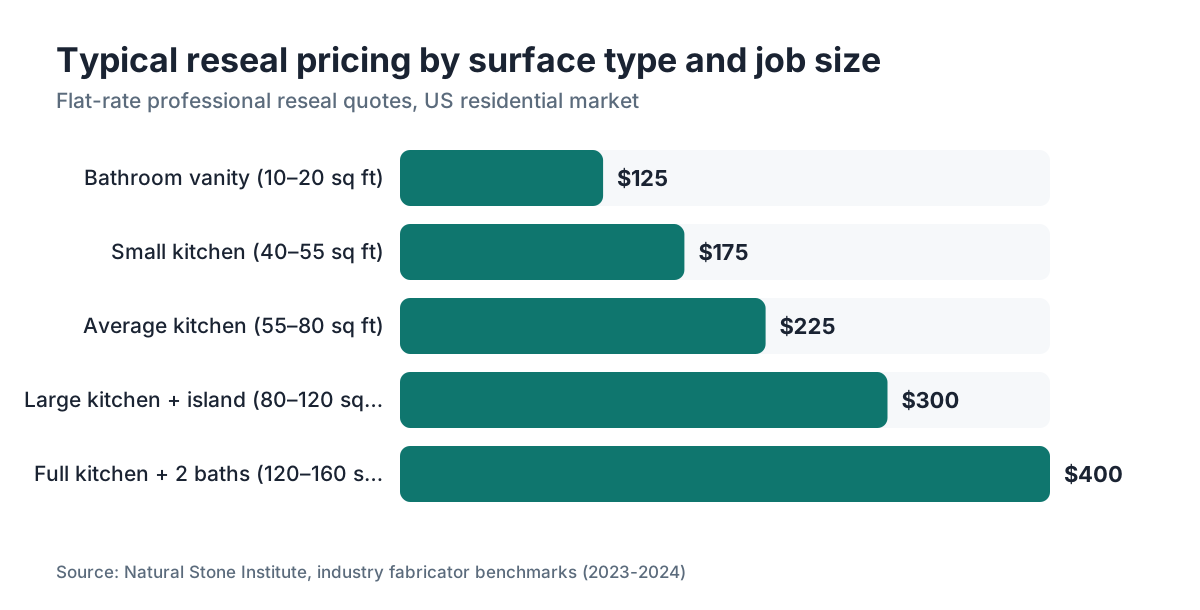
Flat rate per job: Most common for residential kitchens in the 40 to 80 sq ft range. The going rate is $150 to $300 for a kitchen, with a $75 to $125 minimum for bathrooms or smaller jobs. Shops in high-cost markets charge $350 to $450 for a full kitchen reseal with prep.
Per-square-foot rate: Better for large or complex jobs (kitchen plus island plus bar plus bathrooms). $2.50 to $5.00 per square foot is reasonable. At 80 square feet, that's $200 to $400, which covers a more involved job with proper prep time built in.
Margin on a well-run reseal is good. Material cost as a share of revenue typically runs 15% to 25%, which leaves solid gross margin as long as you're not burning drive time. The mistake is pricing too low to seem competitive. That turns a profitable add-on into a break-even favor.
How do you structure the quote, line by line?
A reseal quote doesn't need to be long, but it should be clear enough that the customer knows what they're getting and you know what you committed to. Here's a template structure that works.
Line 1: Surface assessment / water test (included in the quote, or billed as a $0 diagnostic if you're already on-site) Line 2: Surface prep and cleaning (either included or broken out at $0.50 to $1.00/sq ft if heavy degreasing or hard water removal is needed) Line 3: Sealer application, X coats (your primary billable line) Line 4: Buff and final inspection Line 5: Sealer product name and coverage warranty (many professional sealers carry a 5-year manufacturer warranty if professionally applied)[2]
Breaking out prep separately matters because a customer with a clean, well-maintained surface shouldn't pay the same as one with years of cooking grease and calcium scale. It also protects you. If you discover during prep that the job is more involved than the initial quote suggested, you have a line item to point to.
For homeowners, putting the sealer brand name and its stated coverage period in the quote builds confidence. It signals this isn't a generic spray-and-go job.
If you run shop management or quoting software, reseal should be a saved service item you can drop into any quote in seconds. Tools like SlabWise let fabricators add service line items to a countertop quote during the initial sale, which is the easiest moment to close the upsell before the customer's attention moves on.
Always note the stone type and the surface square footage in writing. If you quote by flat rate, spell out what's included: 'up to 80 sq ft, one kitchen, two coats of [product], standard prep.' That one sentence stops scope creep at the job site.
When is the best time to offer a reseal as an add-on?
The highest-conversion moment is countertop installation. The stone is brand new, the homeowner is engaged, and they just spent $3,000 to $8,000 (or more) on their kitchen. A $200 first-year reseal add-on at installation is a natural fit.[3] In-transaction upsells close far better than cold outreach months later. Nobody has published hard data on this specific metric for stone fabricators, but general field service research consistently shows point-of-sale upsells convert at 20 to 40 percent versus 5 to 10 percent for follow-up outreach.
The second-best moment is during a repair visit. If a customer calls because their marble looks etched or their granite seems dull, you're already there. Once you've addressed the primary issue, the reseal is a logical next step and the customer is already thinking about maintenance.
Annual reminder outreach also works, especially for marble and quartzite customers you know have porous stone. A short email or text 10 to 12 months after installation, with a flat-rate quote already included, costs almost nothing to send. It converts a slice of your install base into recurring revenue. Most fabrication shops don't bother, which is exactly why it works.
Don't cold-call granite customers who haven't asked. The water-drop test is easy for homeowners to run themselves, and if their stone passes, they'll feel oversold. Teach them the test and let them reach back out when it's time.
What prep work affects the final price?
Prep is the most variable cost in a reseal job. A countertop that gets wiped down regularly and has no hard water deposits needs maybe 10 minutes of cleaning before sealer goes on. A countertop with calcium scale around the faucet, cooking grease near the range, and old sealer buildup gone cloudy needs a completely different approach.
Hard water scale needs a stone-safe acidic cleaner. Not pure vinegar on marble or limestone, which will etch. Products like Aqua Mix Sealer & Coating Remover break down old sealer residue.[11] These take time and cost money in product. If you hit this often, build a 'heavy prep' upcharge into your quoting options from the start.
Grease and oils near cooking surfaces respond to an alkaline stone cleaner. Apply, dwell, rinse thoroughly, and let the surface dry before sealing. Moisture under a sealer is the single most common cause of cloudy, failed seals. The stone has to be dry, which means at least 24 to 48 hours after cleaning for very porous stones in humid climates.[1]
If the customer has put a topical coating (wax, or a spray-on 'countertop protector' from a home improvement store) over a penetrating sealer, you may have to strip that before you can do anything useful. Topical coatings sit on the surface and block the new impregnator from soaking in. Stripping takes time. Quote it separately.
For marble countertops specifically, etch marks from acidic foods don't disappear with resealing. Sealing prevents future staining, but etching is a physical change to the calcium carbonate surface. If a customer thinks a reseal will fix their etched marble, correct that before you quote, or you're setting up a callback.
How do product choice and quality affect what you can charge?
Not all sealers are the same, and the product you use affects both your results and your defensible price. Better product, documented on the quote, justifies a higher number.
Penetrating (impregnating) sealers are the professional standard for natural stone. They fill the pores below the surface so liquids can't get in, and the stone still looks natural.[7] Solvent-based impregnators generally penetrate deeper and faster than water-based ones, though water-based formulas have improved a lot and many fabricators now run them for low-VOC compliance.[2]
Topical sealers (acrylics, urethanes, waxes) coat the surface. They change the look, can yellow over time, trap moisture, and are hard to remove. Most professional fabricators avoid them on natural stone countertops. If you see a homeowner's counter with a topical coating, price in stripping time.
Fluoropolymer-based impregnators give the best oil and water repellency and are standard in commercial work. They cost more per unit but cover more square footage and carry longer manufacturer warranties, sometimes 10 to 15 years on dense stone.[2] You can legitimately charge more when you're using a better product and documenting it.
For the customer, the product name and warranty period on the quote read as professionalism. 'I'm applying a fluoropolymer impregnating sealer with a 10-year manufacturer warranty on coverage' beats 'I'll seal your counters.' Price accordingly.
For shops quoting at scale, keep one or two standard sealer SKUs rather than five. It simplifies your cost model and your field techs' workflow.
How does resealing differ from repolishing or refinishing?
This matters for quoting because customers confuse the services constantly, and what they need is often different from what they're asking for.
Resealing restores protection against staining. It doesn't change surface texture, remove scratches, or fix etching. If a homeowner says 'my counters look dull, I want them resealed,' the real issue is probably etching or surface abrasion, not a worn sealer. Reseal a dull marble and it stays dull. It's just stain-resistant now.
Repolishing (honing or polishing) is a physical process using diamond abrasives to refinish the surface. It removes a tiny amount of material and brings the stone back to its original finish. Different equipment, different skill, and it costs a lot more, typically $8 to $20 per square foot for honing and polishing by a stone restoration contractor.[4]
A reseal after a repolish makes sense and bundles naturally. Quote them as separate line items so the customer sees what each one does.
Refinishing engineered quartz is a different animal. Quartz surfaces aren't repolishable by the same methods. Chips and deep scratches in quartz usually mean patching or slab replacement, not refinishing. Worth knowing for your own quoting sanity, because customers will absolutely ask.
For kitchen countertops in general, setting the right expectation upfront prevents disputes after the job. A short written description on the quote of what the service does and doesn't address is worth adding every time.
How do you handle resealing as part of a larger countertop installation quote?
The cleanest approach is a named line item at the bottom of your installation quote, priced clearly, with a checkbox or 'add to quote' option. Something like: 'First-year professional reseal (applied at 12 months): $175. Includes surface assessment, prep, two coats [Product Name] penetrating sealer, and buff-out.'
A maintenance line item after a $5,000 countertop purchase is a small ask. A $175 annual service on a $5,000 investment is 3.5%. Customers who care about protecting their stone see the logic, and many say yes at this stage even when they'd hesitate to call and schedule it separately later.
Another model is a maintenance plan at $175 to $300 per year that includes the annual reseal plus a phone or text line for care questions. For shops with a service department, that's recurring revenue with almost no overhead. You schedule all the reseals in one or two week-long bursts per year and route efficiently.
If you manage quote line items in software, SlabWise's quote builder supports custom service add-ons alongside fabrication line items, so reseal doesn't have to be a manual calculation on every job.
For commercial projects (restaurant countertops, bar tops, reception desks), quote resealing as a recurring annual service right in the initial bid package. Commercial stone takes far more abuse and needs resealing more often, and facilities managers usually prefer bundled maintenance contracts.
Bundle countertop installation with a reseal at a slight discount off the sum of the individual prices and you're more likely to close both. You also make scheduling easy, since you're already on-site.
What questions should you ask a homeowner before sending a reseal quote?
A few quick questions before you quote save you from under-quoting and save the customer from surprises.
- What type of stone is it? (If they don't know, a site visit or photo helps. Engineered quartz versus natural stone changes everything.)
- How old is the current seal? (Or: when was it last professionally sealed?)
- How does the surface look right now? Any staining, cloudiness, or dull patches?
- Is there hard water buildup or visible scale near the faucets?
- What square footage are we working with, including islands and any adjoining surfaces?
- Can you be home for 2 to 3 hours, and can the surface stay dry for 24 hours afterward?
Question 5 matters more than most fabricators realize. A homeowner might say 'just the kitchen' and mean a 120 sq ft kitchen plus a 30 sq ft island plus two bathroom vanities. That's a different job than a 45 sq ft galley counter.
Question 6 is pure logistics. If the surface can't stay dry (small kids in the house, or it's the primary bathroom vanity with no backup), you schedule around it or warn the customer up front that the sealer needs time to cure.
For granite countertops specifically, running a quick water-drop test during or before the quote removes all ambiguity about whether a reseal is warranted. If the stone passes, say so, and schedule a follow-up check instead of selling a service that isn't needed yet. That honesty is why they call you next time.
What do fabricators commonly underprice or forget to include in a reseal quote?
Drive time and minimum job fees are the two items shops leave off most often. If a reseal takes 90 minutes on-site but requires 45 minutes of round-trip drive time for a dedicated visit, you're at 2.25 hours total. At even a modest $75 per hour fully loaded, that's $168 just in time before materials. A $99 reseal special doesn't cover it.
A minimum job fee of $125 to $150 is standard practice in the service trades for exactly this reason. Post it clearly in your service menu and on your quotes.
Other commonly forgotten line items:
- Stripping old or failed sealer (separate line, $50 to $100 depending on scope)
- Hard water deposit removal (labor-intensive, quote as additional time)
- Multiple surfaces at the same address (each surface after the first gets its own line)
- Travel fees for jobs outside your standard service radius
- Product upsell for premium fluoropolymer sealer versus standard water-based
Tax treatment is another place shops don't think clearly. Whether a reseal service is subject to sales tax depends on your state. Some states tax labor on repair and maintenance services, others don't, and the answer can turn on whether the sealer product is sold as a separate line item.[5] Check your state revenue department's guidance on 'repair and maintenance services' before you set pricing, because collecting and remitting correctly is on you.
For shops chasing true job costing, track time per reseal for a few months and see whether your flat rates actually make money. Most fabricators who do this find they've been pricing reseals on optimistic time estimates that ignore real-world prep variability.
How should you handle warranty and liability on a reseal job?
Written terms matter more than most fabrication shops realize, especially on reseal work, where customer expectations and reality sometimes drift apart.
A basic service agreement for a reseal should spell out what the sealer does (stain resistance, not etch or scratch resistance), the product name and manufacturer warranty period, what voids the coverage (topical cleaners, bleach, acidic products on marble), and your own call-back policy if the customer believes the seal failed within a stated period.
Manufacturer warranties on professional-grade impregnating sealers typically run 3 to 15 years and are usually conditional on professional application and proper surface prep.[2] Document that you ran the water-drop test before and after, that prep was completed, and that two coats went on. If a dispute comes up, that documentation is your protection.
Spell out in the agreement that sealing does not make stone bulletproof. A homeowner who leaves tomato sauce on Carrara marble for six hours will see a stain despite a fresh seal, because sealing slows penetration, it doesn't create an impenetrable barrier. Say that honestly up front and you head off unrealistic callbacks.
For shops doing volume reseal work, a one-page service agreement reviewed by your business attorney is worth the money once. Use it on every job. Courts in most states hold that clear written terms defeat oral claims about what was promised.
When you point customers to a care guide at the time of service (how to clean stone countertops), you protect your work and set yourself up as the expert they call when the next service is due.
Frequently asked questions
How much does it cost to have granite countertops resealed professionally?
A professional granite reseal runs $150 to $300 for an average kitchen (40 to 80 square feet). Material cost for a quality penetrating sealer is $0.30 to $0.80 per square foot at professional coverage rates. The rest is labor and overhead. Some markets charge up to $400 to $450 for a full kitchen with heavy prep.
How often do natural stone countertops need to be resealed?
Marble and travertine typically need resealing every 6 to 12 months. Granite usually runs 1 to 3 years depending on stone density and kitchen use. Quartzite falls in the 1 to 2 year range. Engineered quartz, porcelain, and laminate surfaces never need sealing. The water-drop test is the most reliable check: if water absorbs and darkens the stone within a few minutes, it's time.
Can you quote a reseal job without visiting the site first?
Yes, for most standard residential jobs, a phone or email quote based on surface type and square footage works. Ask the customer: stone type, approximate square footage, any visible staining or hard water scale, and when it was last sealed. Add a clause that the final price may adjust for heavy prep discovered on-site. A site visit before quoting is smarter on large or complex jobs.
What sealer products do professional fabricators use?
Common professional-grade options include Tenax Proseal, StoneTech BulletProof (by Custom Building Products), and Aqua Mix Sealer's Choice Gold. Fluoropolymer-based impregnators give the longest protection and carry the strongest manufacturer warranties, sometimes 10 to 15 years on dense stone. Solvent-based versions penetrate faster; water-based versions have lower VOCs. Avoid topical coatings (acrylics, waxes) on natural stone countertops.
Is it worth offering reseal as a recurring maintenance contract?
Yes, for shops with a service department. Annual reseals priced at $175 to $300 per visit, bundled into a maintenance plan, create predictable recurring revenue with low material cost and efficient scheduling if you batch visits by area. Marble and quartzite customers are the best targets, since they genuinely need annual resealing. The close rate is highest at the point of original installation sale.
Does resealing fix dull or etched marble countertops?
No. Sealing restores stain resistance, not surface polish. Dull or etched marble has a physically altered surface from acid contact (lemon juice, wine, vinegar). That requires honing or repolishing with diamond abrasives, a separate service costing $8 to $20 per square foot. Resealing after a repolish makes sense as a bundle, but resealing alone won't fix the dull appearance.
Is labor on countertop resealing subject to sales tax?
It depends on your state. Some states tax repair and maintenance service labor; others exempt it. The treatment may also differ based on whether the sealer product is sold as a separate line item. Check your state's revenue or taxation department guidance on 'repair and maintenance services.' Incorrect collection and remittance creates liability, so verify before you set prices.
What is the difference between a penetrating sealer and a topical sealer?
A penetrating (impregnating) sealer soaks into the stone's pores and blocks liquid from entering while leaving the surface looking natural. A topical sealer coats the surface, can alter the appearance, may yellow over time, and traps moisture. Professional fabricators almost exclusively use penetrating sealers on natural stone countertops. Topical coatings require stripping before a new impregnator can work.
How long does a reseal job take from start to finish?
On a clean surface, a typical 40 to 80 square foot kitchen reseal takes 45 to 90 minutes on-site. Heavy prep (degreasing, hard water removal, stripping old sealer) can add another 30 to 60 minutes. The sealer needs 24 to 48 hours of cure time before the surface should get wet, though most impregnators allow light use within 2 to 4 hours. Quote total on-site time, not cure time.
Should I reseal countertops before or after grout work or backsplash installation?
After. Grout installation involves wet tools, grout haze, and cleaning chemicals that would immediately compromise a fresh sealer. Reseal the stone countertop after all adjacent trades are done and the surface is cleaned to its finished state. On a new installation, a post-fabrication seal in the shop is fine, but a field reseal after construction is smart before the homeowner starts using the kitchen.
What's a fair minimum job fee for a reseal service call?
Most fabrication shops and stone care specialists set a minimum of $125 to $150 for a dedicated reseal visit. This covers drive time, which is otherwise unpaid travel, plus setup and a minimum billable period. Smaller jobs like a single bathroom vanity (10 to 15 sq ft) are priced at the minimum rather than by square footage. Post the minimum clearly in your service menu to avoid customer friction.
How do you price a reseal when it's bundled with a new countertop installation?
List it as a named line item at a flat rate ($150 to $250 for a full kitchen), described as a first-year reseal service scheduled 10 to 12 months after installation. At that stage in the sale, it's a small add-on to a large purchase. You're already acquiring the customer, the scheduled visit creates a touchpoint, and you're routing a field visit you can batch with others nearby.
Can you reseal around an undermount sink or in tight corners?
Yes, but it takes more time and care. Sealer applied too close to silicone caulk beads can lift or cloud the caulk if it makes contact before curing. Work carefully around undermount sinks, let the sealer dwell only in open stone areas, and wipe off any excess quickly before it touches silicone or grout. Account for this extra care in your per-job time estimate, especially on complex cut-outs.
Do Cambria or other engineered quartz countertops need resealing?
No. Cambria and other engineered quartz products are non-porous. According to Cambria's own care documentation, their surfaces do not require sealing. The same applies to Silestone, Caesarstone, and other quartz brands. Quoting a reseal on engineered quartz is incorrect and won't help the stone. If a customer with quartz calls about surface protection, the conversation should be about proper cleaning instead.
Sources
- Natural Stone Institute, Stone Maintenance & Restoration technical resources: Water absorption test (water drop left for 10-15 minutes) indicates whether penetrating sealer is still active; proper drying of stone before sealer application is required to prevent clouding
- Custom Building Products, StoneTech Professional product line: Professional-grade penetrating sealers carry manufacturer warranties of 5 to 15 years depending on stone density; coverage rates of 100 to 200 sq ft per quart depending on porosity
- Marble Institute of America (now Natural Stone Institute), Care and Maintenance Guidelines: Sealing at point of installation and recommending annual maintenance for porous stones (marble, travertine, limestone) is standard professional practice
- Natural Stone Institute, Stone Restoration and Maintenance Encyclopedia: Professional honing and polishing of natural stone countertops is a separate physical process from sealing, typically priced at $8 to $20 per square foot by restoration contractors
- U.S. Small Business Administration, Pay Taxes business guide: State sales tax applicability on repair and maintenance service labor varies by state; business owners must verify with their state revenue department
- Occupational Safety and Health Administration (OSHA), Hazard Communication Standard for solvent-based products: Solvent-based sealers contain VOCs subject to OSHA hazard communication requirements; SDS documentation required on job sites
- Tile Council of North America, Handbook for Ceramic, Glass, and Stone Tile Installation: Penetrating impregnating sealers are the recommended treatment for porous natural stone surfaces; topical coatings are not recommended for kitchen countertop applications
- Cambria, Care and Maintenance official documentation: Cambria quartz surfaces do not require sealing due to their non-porous composition
- U.S. Bureau of Labor Statistics, Occupational Employment Statistics: Field installer and stone restoration labor rates in the trades context for cost benchmarking
- National Kitchen and Bath Association (NKBA), Kitchen and Bath Market Index: Natural stone (granite, quartzite, marble) remains the dominant countertop material category in kitchen remodeling projects
- Aqua Mix (Custom Building Products), Technical Data Sheets for Sealer's Choice Gold and Sealer & Coating Remover: Stripping agents such as Sealer & Coating Remover are required before applying new penetrating sealer over failed topical coatings; water-based impregnators have lower VOC profiles than solvent-based options
Last updated 2026-07-10