TL;DR
- Most stone fabricators set a shop minimum between 25 and 40 square feet of finished countertop, no matter how small the job is.
- That floor exists because templating, delivery, and machine setup cost the same whether you cut 10 square feet or 100.
- Homeowners with tiny jobs pay a flat minimum fee.
- Fabricators who skip the minimum lose money on small orders.
Why do fabricators have a minimum square footage at all?
Every countertop job triggers the same fixed costs, no matter how small it is. A technician drives out to template. Someone programs the CNC or sets up the saw. A crew loads the truck and installs the piece. None of that shrinks because your bathroom vanity top is 8 square feet.
The math is simple. Template and installation labor alone runs $150 to $300 for a single trip in most markets [1]. If a shop charges $65 per square foot for granite and the piece is 10 square feet, that's $650 in material revenue against $200 or more in fixed labor, plus saw time, edging, and polish. The margin is gone before the truck leaves the yard.
That's why minimums exist. It isn't a fabricator being difficult. It's the floor price at which a shop covers its costs and stays open.
What is the industry-standard minimum square footage for countertop quotes?
No trade body publishes an official standard, but the range most shops land on is 25 to 40 square feet of finished countertop [1][2]. Some shops write it as a flat dollar minimum instead, often $400 to $800, which does the same job.
Here is how the common minimums break down by shop type:
| Shop type | Typical minimum | How it's expressed |
|---|---|---|
| Full-service stone fabricator | 25 to 40 sq ft | Square footage floor |
| Big-box installer (Home Depot, Lowe's) | ~15 sq ft | Dollar minimum (~$300 to $400) |
| Remnant-only shop | None, or 5 to 10 sq ft | Per-piece pricing |
| Quartz manufacturer installer | 30 to 40 sq ft | Square footage floor |
| Laminate/Corian shop | 10 to 15 sq ft | Linear foot or dollar min |
Big-box programs run lower minimums because their installation is subcontracted at negotiated volume rates, which spreads fixed costs across hundreds of jobs per region [2]. A small independent shop doing 3 jobs a week can't absorb it the same way.
Pricing a kitchen countertop replacement at 45 or more square feet? You're above every shop's minimum and the conversation is easy. A single bathroom vanity top at 8 square feet is where the minimum starts to bite.
How do fabricators calculate their minimum charge?
The calculation has two pieces: job overhead and material cost.
Job overhead is every cost that happens regardless of slab size. Template trip, fuel, CNC setup time, polishing time, delivery and installation labor. Across a large sample of independent stone shops, those fixed per-job costs run $250 to $500 depending on market [1][3]. A rural shop with long drive times sits near the top of that range.
Material cost works differently. Natural stone sells by the slab, and slabs have a minimum order size from the distributor. A shop can't buy 8 square feet of granite from a yard. They buy a whole slab, usually 45 to 60 square feet, cut your piece from it, and keep the remnant [3]. That remnant has some resale value as a vanity top or small project piece, but nobody guarantees it sells. So the shop bakes some of that waste risk into the minimum.
Add the two together and a $400 to $600 job minimum makes sense even when the stone itself is worth $80.
For fabricators, the clean approach is to calculate your exact break-even on a single-trip job, add your target margin, and post that as your minimum. Some shops using quoting software like SlabWise build this floor into every quote automatically, so the estimator never sells below cost on a small job by accident.
What counts toward the minimum: finished surface area or slab usage?
This is where homeowners get confused, and the difference matters. Most fabricators quote finished square footage, meaning the actual countertop surface they deliver to you. That's length times depth in feet, usually including the sink cutout area (they cut it but don't credit you for it, because the cutting still takes labor).
Slab usage is a bigger number, always. When a fabricator cuts your countertop, the kerf (saw blade width), any grain-matching repositioning, and the remnant offcuts all pile up. A simple L-shaped kitchen counter with 40 square feet of finished surface can eat 55 to 65 square feet of slab to cut cleanly [3].
When a shop says the minimum is 25 square feet, they almost always mean 25 square feet of finished countertop. The slab consumption is their problem to manage. If a shop quotes you on raw slab square footage, ask them to say so. Some remnant shops price per slab piece, and then you're comparing apples to oranges against another bid.
Can a homeowner with a small job avoid the minimum charge?
Yes. A few moves actually work.
Buy a remnant. Stone shops pile up remnant pieces from larger jobs all the time. A remnant is already cut from a slab, already polished on at least one edge, and the shop has no material setup cost to absorb. Many shops sell remnants at $10 to $30 per square foot depending on stone type, then cut and edge your vanity top from one for a fraction of the full job price [3][4]. Ask specifically for remnant pieces when you call.
Bundle your projects. Need a small vanity top now and a kitchen remodel in six months? Schedule them together. Shops will often waive or trim the minimum when two jobs ride the same truck.
Go laminate or solid surface for small projects. For a 10-square-foot laundry room counter, laminate countertops and Corian-type solid surface carry much lower minimums because they're fabricated differently, skip the stone saw, and have fewer fixed costs per trip. A Formica countertop at 10 square feet is a routine job for a cabinet shop.
Use a prefab option. Big-box stores sell prefabricated granite, quartz, and marble vanity tops in standard sizes for $80 to $300, no template required. You lose custom sizing but skip the minimum entirely.
Should fabricators quote jobs below their minimum, and under what conditions?
Most experienced fabricators say the same thing: rarely, and only with a plan.
Some below-minimum jobs make sense. A builder relationship you want to keep. A customer with a much larger project queued up. A small job that uses a remnant you'd have discounted anyway. In those cases the small job is a relationship cost, not a production job.
What doesn't work is taking small jobs out of habit or because saying no feels awkward. If your shop minimum is 25 square feet and you keep running 8-square-foot vanity tops at your standard rate, you're eating $100 to $200 per job in absorbed fixed costs. Over a month that's real money walking out the door.
The right answer for most shops is a clear minimum on every quote, enforced every time. When a customer asks for an exception, offer the remnant route, or quote them honestly with the minimum applied to whatever their square footage falls short of. A 12-square-foot vanity top under a 25-square-foot minimum gets quoted as 25 square feet. That's not gouging. That's accurate cost recovery.
For countertop installation businesses juggling several jobs a week, the minimum needs to live in the quoting workflow, not in the estimator's memory.
How does material type change the minimum square footage threshold?
Material changes the number a lot. The minimum isn't uniform across countertop types.
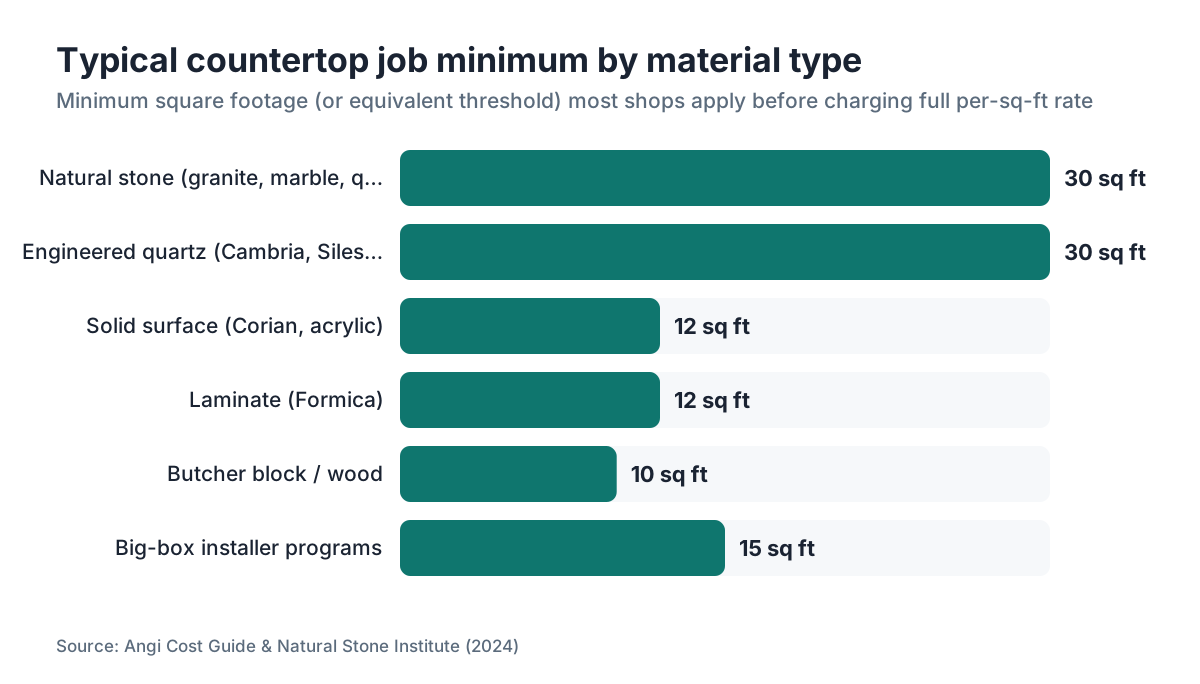
Natural stone (granite, quartzite, marble) carries the highest fixed cost per job. CNC programming, waterjet, and polishing gear cost real money to run and set up. Most shops set stone minimums at 25 to 40 square feet [1][2]. Comparing bids for granite countertops or marble countertops? Assume you're in that range.
Engineered quartz, like Cambria, carries similar minimums because it runs on the same equipment as natural stone. Brand programs from Cambria countertops and other manufacturers usually mirror stone shop minimums.
Laminate (Formica) has lower setup costs because it's cut with simpler tools and bonded to substrate, not polished on a CNC. A cabinet or millwork shop can often drop to 10 to 15 square feet without losing money.
Butcher block countertops behave like laminate on fabrication overhead. A woodworking shop building a custom block piece prices small jobs more easily because there's no stone yard, slab storage, or CNC to amortize.
Soapstone and specialty stones usually come from lower-volume, higher-margin shops. Their minimums can run higher in dollar terms even at a similar square footage, because the labor to work softer or harder specialty material is different from standard granite.
What should a homeowner expect to pay for a small countertop job?
Under 25 square feet, budget for the minimum charge, not the per-square-foot math.
For a natural stone or quartz job under 25 square feet, expect $400 to $900 all-in at most shops [1][2][4]. That's the minimum charge covering template, fabrication, delivery, and installation, regardless of actual square footage. Premium markets (major metros, high-end shops) run higher.
A remnant changes the picture. A remnant slab already on the shop floor might be priced at $150 to $400 for the piece, with an edge polish and cutout adding $100 to $200. That's a much better deal for a small vanity top.
Prefab countertops from big-box stores are the cheapest option for truly small projects, though sizing is limited. A 25-inch by 22-inch granite vanity top runs roughly $80 to $200 at retail [4].
One thing homeowners underestimate: the sink cutout usually adds $75 to $150 regardless of slab size [1]. On a small job that's a big slice of the total, so ask whether it's inside any minimum quote.
How does the minimum square footage affect a multi-room or whole-house quote?
Past the minimum threshold, the per-square-foot logic takes over and the minimum stops mattering.
On a whole-house remodel, the kitchen alone typically runs 40 to 70 square feet of countertop [5]. Add a master bath at 15 to 25 square feet, one or two secondary baths at 8 to 15 square feet each, and a laundry top, and you're at 80 to 140 square feet across the project. At that scale the minimum is irrelevant. The talk turns to material cost, edge profiles, and lead time.
The minimum still bites in a big project if the homeowner wants different materials in different rooms, each quoted separately by a different shop. A kitchen in quartz from one fabricator, a bathroom vanity in marble from another. That marble bathroom at 12 square feet, standing alone with a new fabricator, trips their minimum. Source both from one shop and you usually dodge it.
For fabricators building a whole-house bid, apply the minimum at the order level, not per room. A customer handing you 110 square feet across four rooms shouldn't pay four minimums. That's confusing and a fast way to lose the job.
How should fabricators set and communicate their minimum in quotes?
Be explicit. Hiding the minimum inside a fuzzy per-square-foot number breeds distrust the moment the homeowner compares bids.
The clearest way to show it: list your actual square footage, list your minimum square footage, and charge whichever is larger. A quote for a 12-square-foot vanity top at a 25-square-foot minimum shop reads like this:
"Finished surface: 12 sq ft. Minimum billable: 25 sq ft. Rate: $65/sq ft. Subtotal: $1,625."
That's honest. The customer sees what they pay and why. Some push back. Most understand once you explain it plainly.
Or frame it as a flat minimum charge instead of a minimum square footage. "Minimum job charge: $650, includes template, fabrication, and installation for orders under 25 sq ft." That framing is often easier for homeowners to swallow because it reads like a service fee, not a phantom slab they're paying for.
Quoting software can enforce this automatically, so estimators aren't deciding case by case. SlabWise's quoting tools let shops set a minimum billable quantity that applies at the line level, which kills the guesswork and keeps pricing consistent across the team.
For shops posting prices online, list the minimum where people see it. A customer with a 6-square-foot project who spots a $500 minimum can self-select toward a remnant shop or prefab option instead of booking a template visit that won't convert.
Are there regional or market differences in countertop minimums?
Yes, and they're meaningful.
In high-cost metros like San Francisco, New York, or Boston, labor and overhead run higher, so minimums land around $600 to $1,000 or 30 to 40 square feet [1]. In mid-size Midwest or Southeast markets, $350 to $600 and 20 to 30 square feet is more typical. Rural areas swing wide depending on whether the shop is a local one-truck operation or a regional outfit doing volume.
Nobody has published a rigorous national survey of fabricator minimums. The ranges here come from industry pricing guides and fabricator forum discussions, not a controlled study. The honest move: call three shops in your area and ask straight out. Their answers tell you what the local market has settled on.
One pattern holds everywhere. Shops with higher volume and better equipment utilization can afford lower minimums, because their fixed costs spread across more jobs. A shop doing 20 installs a week eats the overhead on a 10-square-foot vanity top more easily than one doing 5. Even so, the high-volume shop still applies a minimum, because the per-trip cost is real at any scale.
Frequently asked questions
What is the typical minimum square footage a stone fabricator will quote?
Most stone fabricators set a minimum between 25 and 40 square feet of finished countertop. Below that, they charge a minimum job fee equal to that square footage at their standard rate, typically $400 to $900 depending on market and material. The minimum covers fixed costs like templating, CNC setup, delivery, and installation that hit every job regardless of size.
Can I get a countertop quote for less than 10 square feet?
You can get a quote, but you'll almost certainly pay a minimum charge that makes the per-square-foot math look steep. The practical routes for a sub-10 sq ft project: buy a remnant piece from a shop's inventory, use a prefabricated vanity top from a big-box store, or choose laminate or solid surface, which carry lower fabrication minimums. A full custom stone quote on 8 square feet often costs the same as one for 25 square feet.
Why does the sink cutout cost extra even on small jobs?
Sink cutouts need a separate CNC or waterjet program, a specific template or measurement, and extra polishing around the opening. That labor exists whether the job is 8 square feet or 80. Most shops charge $75 to $150 per cutout as a separate line item. On a small job it's a big chunk of the total, one reason small jobs feel so expensive per square foot.
Do big-box store countertop programs have lower minimums than independent fabricators?
Generally yes. Big-box countertop programs, like those through Home Depot or Lowe's, run minimums around 15 square feet or a dollar floor of $300 to $400. They pull it off by subcontracting at high volume, spreading fixed trip costs across many regional jobs. The trade-off is less material selection and less flexibility on edge profiles, thickness, and layout than a local independent fabricator.
What is a remnant countertop and how does it help with small jobs?
A remnant is a leftover slab piece from a larger job, already cut and sitting in the shop's inventory. Because the material cost is partly sunk, shops sell remnants at $10 to $30 per square foot, well below full slab pricing. For vanity tops, small bar tops, or laundry counters under 15 square feet, a remnant is usually the cheapest route. Call local shops and ask what remnant inventory they have.
How do fabricators calculate what their minimum charge should be?
The calculation adds fixed per-job overhead (templating, delivery, installation labor, CNC setup) plus a share of material waste risk. Fixed overhead for a single-trip job runs $250 to $500 depending on market. Add the cost of the slab section and any remnant waste that won't resell, and you have the floor price. Most shops then express it as either a minimum square footage or a flat minimum job charge.
Does the minimum square footage apply separately to each room in a whole-house quote?
At a well-run shop it shouldn't. If a customer gives you 100-plus square feet across a kitchen and multiple bathrooms, the minimum applies at the order level, not per room. Charging a separate minimum for each small bathroom inflates the quote unfairly and tends to cost you the job. The minimum exists to make the trip worth taking, and one trip covering multiple rooms is still one trip.
Is a minimum square footage charge the same as a minimum job fee?
They do the same thing, framed differently. A minimum square footage means you pay for at least X sq ft even if your job is smaller. A minimum job fee is a flat dollar amount charged no matter the square footage. Both protect the shop's fixed per-trip costs. The flat fee framing is sometimes easier for customers to accept because it reads as a service charge instead of phantom square footage.
What materials have the lowest minimum square footage requirements?
Laminate and solid surface (like Corian) have the lowest minimums, often 10 to 15 square feet or a modest dollar floor, because they're fabricated with simpler equipment than CNC stone saws. Butcher block from a woodworking shop is similar. Natural stone and engineered quartz have the highest minimums, typically 25 to 40 square feet, because the machinery and per-trip costs run higher.
Should I combine a small bathroom and kitchen project to avoid paying multiple minimums?
Yes, if the timing works and you can source both from the same fabricator. A shop doing your kitchen at 50 square feet and your bathroom at 12 square feet on the same day runs one template trip and one install trip. Better economics for them and for you. Ask the shop straight out whether they'll apply one minimum across the combined order. Most will, because the alternative is losing the bathroom job to a remnant shop.
How do I compare quotes when one shop charges by minimum square footage and another charges a flat minimum fee?
Convert both to a total dollar cost for your actual project. If shop A charges $65 per square foot with a 25 sq ft minimum, your 12 sq ft vanity costs $1,625. If shop B charges a $900 flat minimum, that's $900. Compare the totals, not the structure. Also check what's included: template, installation, and edging may be bundled differently. Get line-item quotes from both so you're comparing the same scope.
Can I negotiate a fabricator's minimum charge?
You can ask, but the minimum reflects real costs, so it rarely moves much. What you can sometimes negotiate: combining a small job with a future project for a single trip, buying a remnant at a discounted rate, or getting the minimum applied as a credit toward your next order. Hard-bargaining on the minimum alone usually just burns goodwill, because the shop knows exactly what the job costs them.
What square footage counts as a 'small' countertop job versus a standard one?
Most fabricators file anything under 25 square feet as a small job and anything over 40 square feet as routine. The 25 to 40 sq ft range is the gray zone where some shops apply a minimum and others don't. A single-wall kitchen with no island is usually 30 to 45 square feet. A bathroom vanity is 8 to 20 square feet. An L-shaped kitchen with an island clears 60 square feet easily and is a standard job at any shop.
Sources
- Angi (formerly HomeAdvisor) - How Much Do Countertops Cost: Per-job fixed costs for countertop installation including template, fabrication, and installation labor; typical market ranges for granite and quartz pricing; sink cutout charges of $75–$150.
- The Home Depot - Countertop Installation Services: Big-box countertop installation programs and their minimum order thresholds relative to independent fabricators.
- Natural Stone Institute (formerly Marble Institute of America) - Stone Industry resources: Slab yield and remnant waste ratios in stone fabrication; typical slab sizes of 45–60 sq ft; remnant pricing and management practices in stone shops.
- Lowe's - Countertop Buying Guide: Prefabricated granite vanity top retail pricing ($80–$200); big-box countertop program minimums and standard size availability.
- National Kitchen and Bath Association (NKBA) - Research: Typical kitchen countertop square footage ranges (40–70 sq ft) and whole-house countertop scope in residential remodels.
- Occupational Safety and Health Administration (OSHA) - Crystalline Silica: Context on stone fabrication shop operations and equipment usage relevant to per-job fixed costs.
- U.S. Bureau of Labor Statistics - Occupational Employment and Wage Statistics: Labor cost context for stone fabrication workers supporting per-job overhead calculations.
- U.S. Census Bureau - Characteristics of New Housing: Countertop material prevalence in new residential construction as context for market volume and shop job mix.
Last updated 2026-07-10