TL;DR
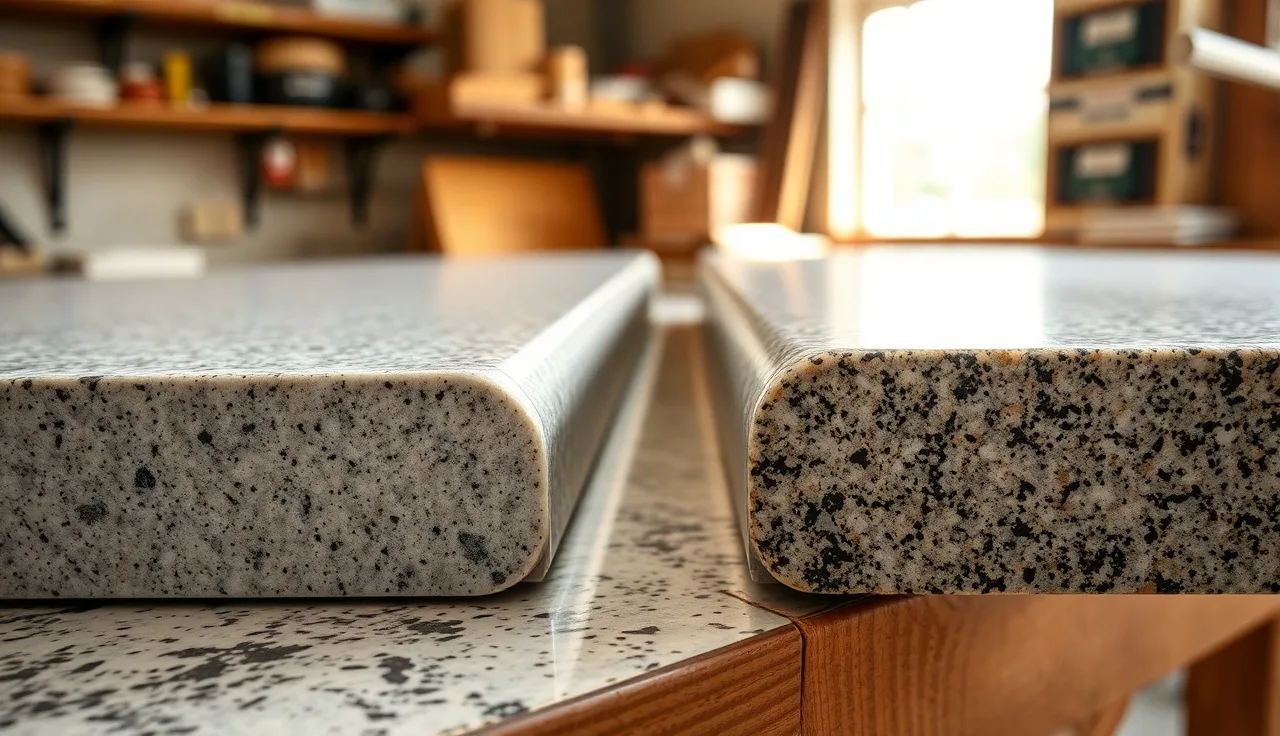
- A half bullnose rounds only the top corner of a countertop edge into a smooth quarter-circle curve and leaves the underside flat.
- A full bullnose rounds the whole edge into a complete semicircle, so top and bottom corners both curve.
- Full bullnose costs roughly $10-$20 more per linear foot to fabricate and looks best on thicker slabs.
What exactly is a half bullnose edge?
A half bullnose is exactly what the name says: half a round. The fabricator profiles the top edge of the countertop into a quarter-circle curve, usually with a 3/4-inch or 1-inch radius depending on slab thickness. The face of the edge stays flat and vertical. The underside corner stays square, or gets a very slight eased break, but it doesn't curve.
The result looks clean and soft from above without looking fussy. Run your hand across it and you feel a smooth transition from the countertop surface down to the vertical face. No sharp corner to catch a hip or a small child. That mix of subtlety and safety is why half bullnose became the default profile on laminate countertops decades ago and stayed popular as stone came down in price [1].
Fabricators also call it a "demi bullnose" or just "half round." Same profile, different names. If a quote lists any of those three, you're getting the same cut.
What exactly is a full bullnose edge?
A full bullnose carries the curve all the way around: top corner, face, and bottom corner, forming a complete semicircle when you look at the edge head-on. On a 3/4-inch slab the finished profile is about 3/4 inch wide front to back, fully rounded. On a 1.25-inch slab (the common "3 cm" stone) you get a noticeably rounder, more dramatic half-cylinder.
The profile goes back at least to the early 1900s in furniture and architectural millwork [2]. In countertop work it got popular during the granite boom of the late 1990s and 2000s, partly because it shows off thick stone beautifully. A 3 cm granite slab with a full bullnose reads as solid, heavy, and expensive in a way a 3/4-inch laminate never could.
One thing homeowners don't always realize: full bullnose is harder to keep clean on the underside curve. Grease and dust collect in the lower radius, especially near a cooktop. Not a dealbreaker. Just something to know before you commit.
How are the two profiles different visually and by the numbers?
The clearest way to see the difference is side by side. Here's the core comparison:
| Feature | Half Bullnose | Full Bullnose |
|---|---|---|
| Top curve | Quarter-circle (90°) | Half-circle (180°) |
| Bottom corner | Flat / square | Curved |
| Typical radius on 3 cm stone | 5/8" to 3/4" | 5/8" to 3/4" (both sides) |
| Visual weight | Light, modern | Heavy, traditional |
| Cleaning difficulty | Easy | Moderate (lower curve traps debris) |
| Works on 2 cm stone | Yes | Marginal (thin full bullnose looks weak) |
| Works on 3 cm stone | Yes | Yes, preferred |
| Relative fabrication cost | Base price | +$10-$20 per linear foot [3] |
The numbers add up on a long run of countertop. A kitchen with 30 linear feet of edge at $15 extra per foot adds $450 to a job. That's real money. Some fabricators charge more when the stone is hard (think quartzite or dolomite) because full bullnose needs more grinding passes to get a smooth continuous curve on dense material.
Slab thickness drives the visual difference too. On 2 cm stone a full bullnose looks almost fragile, because the semicircle is too small to read as intentional. Half bullnose on 2 cm stone looks perfectly proportioned. On 3 cm, or a mitered edge built up to 6 cm, full bullnose is the stronger choice. Proportion is everything here.
Which edge profile is more popular right now?
Half bullnose and its close cousin the eased edge dominate residential installs by a wide margin. The National Kitchen and Bath Association tracks design trends every year, and soft, minimal edges have led for several years running [4]. Full bullnose peaked during the early-to-mid 2000s granite wave and has been sliding since roughly 2012, as the look shifted toward cleaner, more architectural lines.
That doesn't make full bullnose wrong. If your kitchen has raised-panel cabinets, ornate hardware, or a traditional European feel, full bullnose fits the room. If your kitchen is flat-front cabinetry and minimal fixtures, full bullnose looks out of place, and half bullnose or a simple eased edge suits it better.
Showroom staff often push half bullnose as the default partly because it's faster to make. A full bullnose forces the grinder to work both sides of the edge, roughly doubling the time on that step. Shops with CNC edge profiling machines handle it quickly. Small shops doing hand polishing charge more and take longer [3].
Does the edge profile affect countertop durability or safety?
Both profiles kill the sharp 90-degree corner that bruises a hip or chips under impact. That's the main safety argument for any bullnose variant, and it holds for both.
Durability is a different question. A full bullnose exposes more of the stone on the edge, which means more surface to chip if something hits it hard. The lower curve is the weak spot: a dropped cast-iron pan catching that curve can chip or crack it. Half bullnose keeps the bottom corner square and thick, which is stronger in practice.
The Marble Institute of America (now part of the Natural Stone Institute) notes in its fabrication guidelines that outside corners on bullnose profiles are the most common location for field damage, particularly on marble and softer stones [5]. Think about that if you're choosing a full bullnose on a marble or travertine island where heavy pots come down hard.
For families with young kids, both profiles beat a raw square edge. The Consumer Product Safety Commission tracks countertop-related injuries from sharp edges through its NEISS injury data, with the highest incidence in kitchens where children under five are present [6]. Either bullnose profile lowers that risk.
How does the choice affect countertop cost?
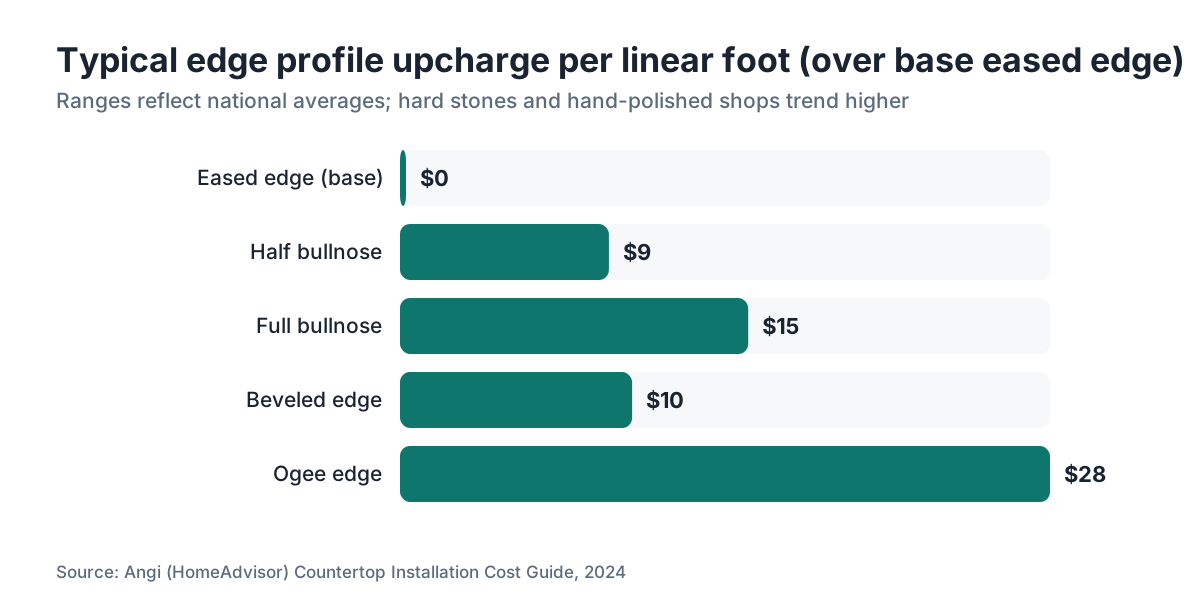
Edge profiles are priced as an upcharge over the base "eased edge" price. An eased edge (just a slight 1/8-inch bevel top and bottom) is usually baked into the base fabrication cost. Half bullnose adds roughly $5-$12 per linear foot over that baseline. Full bullnose adds $10-$20 per linear foot, sometimes more on hard stones or at shops without CNC profiling equipment [3].
Those are industry-wide ranges. Your local market, the specific stone, and the shop's equipment all move the number. A well-equipped fabricator with a CNC router might charge $8 extra for a full bullnose on standard granite. A small shop doing it by hand might charge $25.
The upcharge compounds on islands. A 4x8-foot island has roughly 24 linear feet of exposed edge. At $15 extra per foot for full bullnose over half bullnose, that's $360 more on the island alone. For a full kitchen with 40 linear feet of edged countertop, the gap between the two profiles can easily hit $400-$600 on the total quote.
Fabricators who use quoting software, including tools like SlabWise, often build edge profile pricing into the line items so homeowners see exactly what each choice adds before they approve the job. That transparency heads off sticker shock at the invoice stage.
If budget is the deciding factor, go half bullnose. You get nearly the same softness and safety at meaningfully lower cost.
Does the edge profile choice change for different countertop materials?
Yes, and this is one area where fabricators often steer homeowners without explaining why.
For natural stone (granite, quartzite, marble), both profiles work on 3 cm material. On 2 cm material, full bullnose usually isn't recommended, because the radius is too small and the profile looks pinched. If you want a thicker-looking edge on a 2 cm slab, fabricators laminate a strip of matching stone underneath and then profile the layered edge, a technique called a "mitered edge" or "built-up edge" [7].
For granite countertops, the hardness of the stone (Mohs 6-7) means profiling takes longer and costs more than on softer stones. The full bullnose upcharge is real on granite. For marble countertops, the softness (Mohs 3-4) means both profiles machine fast, but that same softness makes the full bullnose's lower curve more prone to chipping over time.
For laminate countertops and Formica countertops, a true bullnose comes from either post-forming the laminate over a curved substrate or gluing on a matching laminate strip. Post-formed half bullnose is the most common laminate edge by far, because the process wraps the laminate in one piece. A full bullnose on laminate almost always has a visible seam on the underside, and the profile usually gets done with a contrasting edge band rather than a true wrap.
For solid surface like Corian countertops, profiling happens with routers and both bullnose profiles are easy, because the material cuts cleanly. Full bullnose on solid surface looks clean with no seam issues.
For wood like butcher block countertops, both profiles are common and easy for a woodworker to route. Full bullnose on a thick butcher block (1.5 inches or more) looks genuinely good.
How do fabricators actually cut a bullnose edge?
Most production shops today use CNC router or bridge saw setups with diamond-tipped profiling wheels. The wheel is shaped to the exact profile, and the machine runs the edge through in a single controlled pass (for half bullnose) or two passes (for full bullnose, once for the top and once flipped for the bottom). CNC machines produce consistent profiles with tight tolerances and polished finishes in one setup [8].
Smaller shops, or shops working unusually curved edges like a kidney-shaped island, do hand profiling with angle grinders and a sequence of diamond pads in ascending grits, typically 50, 100, 200, 400, 800, 1500, and 3000 grit before buffing. The skill required is real. A badly hand-polished bullnose has flat spots where the radius isn't constant, which reads as amateurish under raking light.
Templating accuracy matters here too. The edge profile gets cut after the slab is cut to shape, so the quality of the original template determines whether the finished edge holds consistent depth along its whole run. Shops using digital templating (laser or photogrammetry) produce more consistent results than those using cardboard templates [8].
The practical takeaway for homeowners: ask to see a sample edge before you approve the job. Any decent fabricator has edge samples on hand or can point you to previous installs. If they can't show you an example, that's a yellow flag.
Can you change the edge profile after the countertop is installed?
Technically yes. Practically, it's disruptive and expensive enough that most people don't bother.
To re-profile an installed countertop, a fabricator would have to either work in place (difficult, messy, and hard to finish consistently in a confined space) or remove the slab, rework the edge, and reinstall. Removal carries real risk of cracking the stone, especially on longer runs or around a sink cutout [7].
A half bullnose can be converted to a full bullnose by grinding the bottom corner to match, in theory. The problem is doing that in place without damaging the cabinet face below or the wall behind. It's possible with a skilled hand polisher, but it's not a quick job, and the result may not perfectly match the polish level of the rest of the edge.
The better answer: decide before fabrication. Edge profiles are one of those choices that sound reversible and turn out not to be reversible at reasonable cost. When you review your quote and approve the job, confirm the edge profile explicitly in writing.
Which should you actually choose?
Here's a direct opinion: for most modern kitchens, half bullnose is the better call. It costs less, cleans easier, chips less, and fits the current design direction of residential kitchens better than full bullnose does.
Full bullnose makes sense in a few specific situations. If your kitchen is traditionally styled with detailed cabinetry and you're installing a thick natural stone or engineered stone (Cambria and similar engineered stones profile beautifully, as you'd see looking at Cambria countertops), the full bullnose adds a finished, intentional look that reads well in that context. If you're doing a bathroom vanity with a thick decorative stone and low traffic, full bullnose is lovely and the cleaning concern barely matters.
For a busy family kitchen, a high-traffic bar, or any surface where heavy objects get set down near the edge, half bullnose is the more practical choice. The lower curve of a full bullnose takes the most abuse and is the hardest to repair if it chips.
If you're a fabricator building quotes for kitchen countertops, spelling out the cost difference and trade-offs in your quote documentation cuts change orders and sets expectations right. Most homeowners don't fully grasp the visual difference until they see a sample, so keeping current edge samples in your showroom pays off every week.
What about other edge profiles: how do bullnose options compare to alternatives?
Bullnose profiles are popular, but they're far from the only options. Here's how they sit against the rest:
An eased edge (also called a slightly beveled edge) just breaks the sharp corner with a flat 1/8-inch chamfer. It's the standard included in most base fabrication prices. Very clean, very modern, zero upcharge.
An ogee edge has a classic S-curve profile, a concave section above a convex section. It's the most ornate common profile, signals "traditional kitchen," and costs the most of any standard profile, typically $20-$35 per linear foot over eased edge baseline [3].
A beveled edge (45-degree chamfer, usually 1/4 to 1/2 inch) sits between eased and bullnose in both cost and character. It has a European, geometric feel that pairs well with flat-front contemporary cabinetry.
A waterfall edge carries the countertop material vertically down the side of the cabinet to the floor. That's a fabrication method, not strictly an edge profile, but it belongs here because it's a competing choice for islands. Waterfall edges don't use a profiled edge at all. They use a mitered corner.
For a look at how different edge profiles interact with different stone choices, the countertop installation process, and how those decisions land in your final quote, countertop installation covers the full sequence from template to final polish.
The Natural Stone Institute publishes installation and fabrication standards that cover edge profile specifications and tolerances for natural stone [5]. That's the closest thing to an industry-wide standard on what dimensions and finishes are acceptable.
Frequently asked questions
Is a full bullnose edge more expensive than a half bullnose?
Yes. Half bullnose typically adds $5-$12 per linear foot over a base eased edge price. Full bullnose adds $10-$20 per linear foot over baseline, sometimes more on hard stones or at shops that profile by hand rather than CNC. On a 30-linear-foot kitchen, the difference between the two profiles can be $150-$300 depending on the shop and material.
Which bullnose edge is easier to clean?
Half bullnose is easier. The flat face and square bottom corner don't trap grease or debris. Full bullnose has a lower curve that collects dust and kitchen grease, especially near a cooktop. It's not a major maintenance burden, but if you wipe down your countertops daily you'll notice the full bullnose lower curve needs deliberate attention that half bullnose doesn't.
Can I get a full bullnose edge on a 2 cm stone slab?
Technically yes, but it's generally not recommended. On 2 cm (roughly 3/4 inch) stone, the full bullnose radius is very small and the profile looks pinched rather than intentional. If you want a thicker, rounder edge on 2 cm material, fabricators usually recommend building up the edge with a laminated strip of matching stone before profiling, which adds cost but looks much better.
What's the difference between a bullnose edge and an eased edge?
An eased edge just breaks the sharp top corner with a small flat chamfer, usually 1/8 inch, and is typically included in base fabrication pricing at no upcharge. A bullnose (half or full) replaces that small bevel with a smooth rounded curve. Half bullnose rounds the entire top corner into a quarter-circle. The visual difference is clear: eased is geometric and minimal, bullnose is soft and rounded.
Does the bullnose edge choice affect resale value of my home?
There's no reliable data showing edge profile has a measurable effect on home sale price. Design preference matters more in aggregate, and right now minimal edges like eased or half bullnose appeal more broadly to buyers than traditional full bullnose. Choosing full bullnose in a very traditional home is fine. In a modern or transitional kitchen it can look dated to some buyers, but that's a design judgment call, not a documented pricing factor.
What does a full bullnose look like compared to a half bullnose on thick stone?
On 3 cm (1.25 inch) stone, a half bullnose shows a soft rounded top corner with a flat face below it. A full bullnose shows a complete rounded edge from top to bottom, almost like the edge of a thick wooden dowel cut in half. The full bullnose reads as heavier and more traditional. The half bullnose reads as lighter and more contemporary. The difference is obvious once you see edge samples side by side.
Is a full bullnose edge more prone to chipping than a half bullnose?
Yes, somewhat. The lower curve of a full bullnose is the most exposed and most vulnerable part of the edge. An impact from a dropped pan or a hard object at counter height catches that curve and can chip or crack it, particularly on stone with natural fissures like marble or certain granites. Half bullnose keeps the lower corner thick and square, which is structurally stronger under impact.
Do fabricators charge by the linear foot for edge profiles?
Yes. Edge profile pricing is almost always quoted per linear foot. The base edge (eased or slightly beveled) is usually included in the slab price. Upgraded profiles like half bullnose and full bullnose are line-item upcharges per linear foot of exposed edge. Perimeter edges, island edges, and bar overhangs are measured separately. Always confirm how many linear feet of each profile are included in any quote you receive.
Is a half bullnose or full bullnose better for a bathroom vanity?
Both work well on a bathroom vanity, and the lower-traffic environment reduces the chipping concern that applies to kitchens. Full bullnose looks particularly good on a thick stone vanity top with undermount sink, where the edge is a design feature you see and touch constantly. Half bullnose gives a cleaner, more modern look. The choice comes down to the style of the bathroom cabinetry and fixtures, not durability.
Can laminate countertops have a full bullnose edge?
Post-formed laminate naturally creates a half bullnose on the top edge by wrapping the laminate sheet over a curved substrate in one piece. A true full bullnose on laminate requires a separate edge strip on the underside and almost always has a visible seam. It's possible but less common and less clean-looking than the same profile on stone. Post-formed half bullnose on laminate is the industry standard for a reason.
What's a demi bullnose and is it the same as a half bullnose?
Yes, demi bullnose and half bullnose are the same profile. Both terms describe a quarter-circle curve on the top edge of the countertop with a flat face and square or slightly eased bottom corner. Some fabricators say "demi bullnose," others say "half round" or just "half bullnose." If you see any of those three terms on a quote or sample board, they all mean the same cut.
How long does it take to profile a bullnose edge during fabrication?
On a CNC-equipped shop, edge profiling for a typical kitchen runs 20-45 minutes of machine time after the slab is cut to shape. Half bullnose is a single pass; full bullnose requires flipping the slab or running a second pass, adding 15-30 minutes. Hand polishing at a smaller shop takes significantly longer, sometimes 1-2 hours for a complete kitchen, which is part of why upcharges vary so widely between shops.
Should I ask to see a sample before choosing an edge profile?
Absolutely, and any fabricator worth hiring will have physical edge samples you can handle and compare. Photos are helpful but they don't convey how a profile feels under your hand or how the radius looks at the actual scale of your slab thickness. Ask to see samples in the same material you're buying if possible. The visual weight of a full bullnose on 3 cm granite looks very different from the same profile on a thin 2 cm piece.
Sources
- Natural Stone Institute, Dimensional Stone Design Manual: Half bullnose (demi bullnose) is one of the most commonly specified edge profiles in residential countertop fabrication, standard on laminate and widely used on stone.
- Encyclopaedia Britannica, 'Bullnose' architectural term: The bullnose profile has been used in architectural millwork and tile since the early 20th century.
- Angi (HomeAdvisor), Countertop Installation Cost Guide: Edge profile upcharges: half bullnose $5-$12 per linear foot, full bullnose $10-$20 per linear foot, ogee $20-$35 per linear foot over base eased edge price.
- National Kitchen and Bath Association, NKBA Design Trends Report: Minimal and soft edges including eased and half bullnose have led residential countertop edge profile preferences for several years running.
- Natural Stone Institute, ANSI/NSI 373 Fabrication and Installation Standards: Outside corners on bullnose profiles are the most common location for field damage on natural stone countertops; fabrication standards specify acceptable edge tolerances.
- U.S. Consumer Product Safety Commission, National Electronic Injury Surveillance System (NEISS): The CPSC documents countertop-related injuries from sharp edges with highest incidence in kitchens involving children under five.
- Natural Stone Institute, Stone Installation Standards for Countertops: Removal of installed stone countertops carries significant cracking risk, especially on longer runs and around sink cutouts; edge changes are best made before installation.
- Marble and Granite Inc., CNC Stone Fabrication Technology Overview: CNC router and bridge saw setups with diamond-tipped profiling wheels produce consistent bullnose profiles in controlled passes; digital templating improves finished edge consistency.
- Remodeling Magazine, Cost vs. Value Report: Kitchen countertop material and finish choices affect perceived value in home resale; design trend alignment is a factor cited by appraisers.
- Countertop Specialty, Edge Profile Guide for Stone Countertops: Full bullnose requires grinding both top and bottom curves, roughly doubling profiling time versus half bullnose; cost differential reflects this added fabrication step.
Last updated 2026-07-09