TL;DR
- Physical templating means a technician builds a cardboard or luan wood cutout of your countertop layout on-site.
- Digital templating uses a laser or structured-light device to capture the same geometry as a point cloud or CAD file.
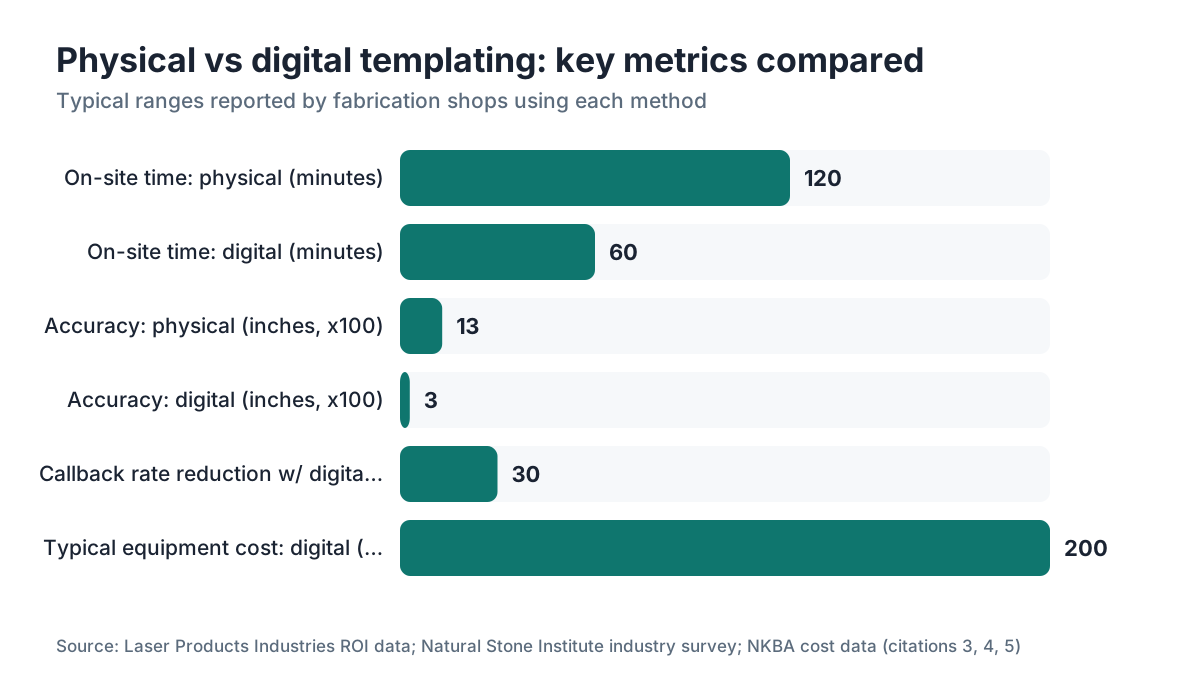
- Digital is faster (30-90 minutes vs 1-3 hours), tighter (±1/32 in vs ±1/8 in), and cuts fabricator labor 20-40% over time, though the gear runs $8,000-$40,000 upfront.
What is physical countertop templating?
Physical templating is exactly what it sounds like. A technician drives to your home, takes the template material (usually thin luan plywood or heavy cardboard strips), and pieces it together directly on top of your cabinet bases. They trace the walls, mark sink and cooktop cutouts, note edge profiles, and label every section. That finished template leaves with the crew, goes to the shop, and the fabricator pins it to the slab to cut.
The method has been standard in the stone trade for decades. It needs no special gear beyond straight edges, a staple gun, and a marker. Most experienced templaters read a kitchen accurately in 60 to 90 minutes once their materials are set up, though a complicated island or an L-shaped peninsula with an undermount sink and a cooktop cutout can push that to two or three hours.
The obvious downside is tolerance. Walls are rarely straight. Cardboard shifts slightly between the moment it's built and the moment it's cut. A skilled technician handles this through scribing and deliberate overbuild, but the real-world accuracy of physical templates usually lands around plus or minus 1/8 of an inch [1]. For most standard granite or quartz jobs, that's fine. For a book-matched slab with tight miters, it starts to matter.
What is digital countertop templating?
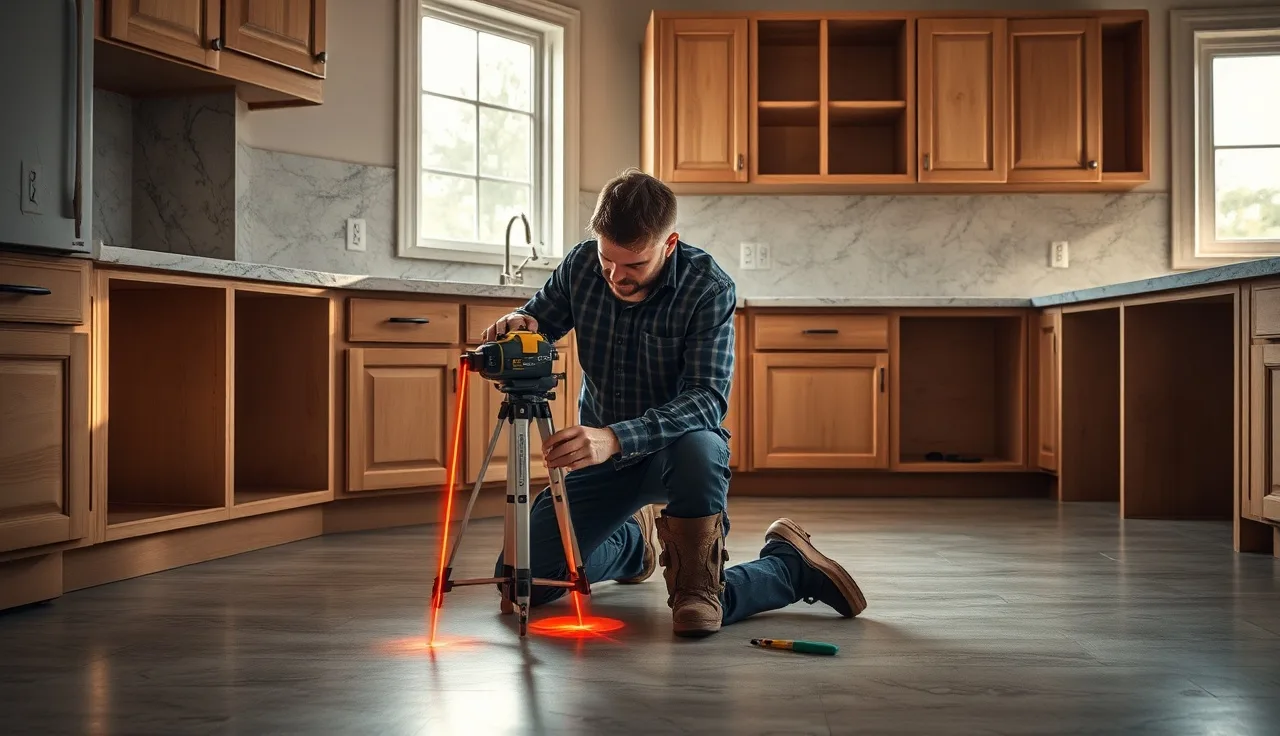
Digital templating swaps the physical material for a measurement device, usually a laser-based or structured-light scanner. The two brands you hear most in fabrication shops are Proliner (made by Prodim) and LT-2D3D (made by Laser Products Industries). A technician sets reference points around your countertop area, sweeps the device around the perimeter, and the system builds a precise 2D or 3D file in real time [2].
The output is a DXF or DWG file that drops straight into CAD or stone-specific software. No tracing. No pinning a cardboard shape to a slab. The fabricator imports the file, nests the pieces on a digital slab layout, and sends cut paths to a CNC bridge saw or waterjet. Professional laser templating systems hit ±1/32 of an inch or better, roughly four times tighter than hand templating [2].
Structured-light scanners (sometimes called 3D scanners) go further. They capture the perimeter plus countertop height variations and irregular topography, which matters in older homes where substrate levels change across a run. That level of detail is rarely needed for a standard kitchen replacement. It earns its keep on curved bars, island waterfall edges, or any install where a vertical panel has to meet an unlevel floor.
How accurate is each method, and does the difference actually matter?
For most residential kitchens in standard slab stone, the accuracy gap between a careful physical template and a quality digital template never shows up in the finished product. Fabricators build in a reveal at the wall (usually 1/4 inch, hidden under backsplash or caulk) precisely because walls aren't perfectly straight no matter how the template was made.
The gap starts to matter in three situations. First, tight miters on 90-degree corners: a 1/8-inch error can open a visible seam gap that needs filling with epoxy. Second, stone with a strong pattern direction, like a dramatic veined quartzite or matched marble countertops: even a small rotation error places the pattern off-axis, and that shows. Third, complex shapes: curved islands, arched knee walls, or custom range-hood corbels that have to fit within millimeters.
A 2019 industry survey by the Marble Institute of America (now the Natural Stone Institute) found that fit and measurement errors accounted for roughly 15 to 20 percent of all fabrication callbacks and remakes [3]. Digital shops consistently report lower remake rates, though the exact difference is hard to isolate because shops that buy digital systems also tend to buy better CNC equipment and hire trained staff.
Here's the honest version. If your fabricator is deep-experienced with physical templates and your kitchen is a simple U-shape or L-shape, you probably won't know the difference. If the job is complicated or the stone is expensive, the risk math shifts toward digital.
How long does each type of template take, and how does that affect your installation schedule?
Physical templating usually takes 1 to 3 hours on-site depending on job complexity, plus the time for the template to ride back to the shop, get checked, and get pinned to the slab before cutting can start. Some shops let the template sit flat overnight to make sure nothing shifted. Realistically, fabrication starts the day after the physical template appointment.
Digital templating runs 30 to 90 minutes on-site. The file is done before the technician leaves your house. It can be emailed to the shop from the driveway. A fabricator with CNC equipment can start programming cuts the same afternoon.
Most shops don't compress the schedule that hard, though. They still want at least a day to review the file, check for anomalies, and slot the job into the cutting queue. But if you're on a tight renovation timeline (contractors waiting for countertops before they finish tile or a backsplash), every day counts. Digital templating generally shaves two to five days off the total lead time when the shop runs CNC fabrication downstream [4].
One question for homeowners: ask your fabricator whether their shop uses digital files to drive CNC cutting. If they're still hand-cutting after a digital template, the time advantage shrinks fast.
What does digital vs physical templating cost the homeowner?
Most fabricators don't bill homeowners separately for templating. The cost is folded into the overall fabrication quote, usually priced per square foot of finished countertop. Whether the shop uses digital or physical methods rarely changes your line-item price directly.
What it can change is the total project cost in less obvious ways. Shops with digital templating and CNC cutting tend to run slightly higher base square-footage rates because of the capital equipment. A physical-template shop cutting by hand may quote a lower rate. But its error rate may run higher, and if it comes back to remake a section, that cost either eats into margin or gets passed on through a dispute. Countertop installation mistakes that force remakes average $300 to $800 per section in extra material and labor, according to remodeling cost data from the National Kitchen and Bath Association [5].
If a fabricator offers digital templating as a paid add-on (some do, especially for complex jobs), it typically runs $75 to $150 extra. For expensive stone, that's cheap insurance.
What equipment do fabricators use for digital templating?
The Prodim Proliner is the most widely deployed digital templating system in North American fabrication shops. It uses a measuring wheel on an articulated arm to trace the perimeter and outputs DXF files directly [2]. The current Proliner 8CS model retails around $20,000 to $30,000 depending on configuration.
Laser Products Industries makes the LT-2D3D, which uses a laser pointer and a calibrated board to capture outlines. It costs less, roughly $8,000 to $12,000, and it's popular in smaller shops making their first move off physical templates [4].
Photogrammetry systems (calibrated cameras plus reference dots placed around the countertop area) are a third option. They're less common in stone fabrication but show up in some shops handling very complex 3D forms.
For fabricators who want the digital template to feed quoting and nesting software, the workflow depends on what the shop runs. Systems like the one offered by SlabWise accept DXF imports and use the file to calculate material yield, price the job, and generate cut layouts, killing the manual re-entry that used to sit between templating and quoting.
The equipment investment is real, and payback math varies. A busy shop doing 15 to 25 kitchen jobs per month typically recoups a mid-range digital system within 12 to 18 months through labor savings and fewer remakes [4]. A shop doing 4 to 6 jobs per month may wait longer, or may find that a very experienced physical templater costs less overall.
Which method is better for complex countertop shapes?
Digital wins here, and it's not close. Curved islands, radius corners, irregular peninsulas, angled walls that don't meet at 90 degrees, any shape with a non-standard geometric form: these are the cases where cardboard or luan shows its limits.
When a physical templater hits a curved edge, they score and bend the template material to approximate the curve, then transfer that approximation to the slab. The fabricator then freehands or uses a template routing approach to cut it. Small errors stack up. With digital templating, the curve is captured as a true spline and sent straight to a CNC router or waterjet, which cuts it exactly.
This matters for kitchen countertops with a curved breakfast bar or an island with a wave edge. It also matters for material reasons: engineered stone like Cambria countertops carries a manufacturer's warranty that improper cuts can void, and precise CNC cutting driven by a digital template is the method Cambria and other quartz brands point to for warranty compliance [6].
For simple rectangular layouts, the physical method in skilled hands still produces perfectly good results. The honest answer: complexity decides which method earns its cost.
Does digital templating affect how the slab is cut or fabricated?
Yes, and a lot. A digital template file is the input that drives CNC fabrication. Without a digital file, a CNC bridge saw or waterjet can't be programmed automatically. So the two technologies, digital templating and CNC cutting, are built to run together as one pipeline.
Physical templates traditionally pair with hand-guided cutting, where the fabricator traces the template shape on the slab with a marker and cuts along the line on a manual-feed bridge saw, or shapes detail with angle grinders. This is skilled work and it produces good results in experienced hands, but it reintroduces human error at every step.
When a digital template file goes straight to a CNC machine, the only human judgment left is reviewing and approving the toolpaths before cutting starts. That's one reason high-volume shops have moved almost entirely to digital: it creates a clean data path from measurement to cut that's auditable and repeatable.
For stone that already carries natural variation, like the vein patterns in granite countertops, digital nesting software can also use the template to position pieces for the best pattern yield, something that's nearly impossible with physical templates.
What are the trade-offs fabricators actually weigh between the two methods?
Physical templating pros: low upfront cost (materials run a few dollars per job), no equipment to maintain, no software integration required, and an experienced templater who's been doing it for 20 years is genuinely fast and accurate enough for most residential work. In rural or smaller markets where jobs are less frequent, a physical operation can be perfectly profitable.
Physical cons: higher labor time, material to store and haul, an accuracy ceiling around ±1/8 inch, no automatic connection to downstream cutting, and templates that get damaged or lost (more common than shops like to admit).
Digital pros: faster on-site time, tighter accuracy, files you can copy and store forever, direct CNC integration, and lower labor cost per job once the system is running. Shops report 20 to 40 percent reductions in measuring-related callbacks after switching [4].
Digital cons: $8,000 to $40,000 in equipment, a learning curve for technicians (typically two to four weeks to proficiency), and a system that needs calibration and occasional service. Battery or connectivity trouble in the field creates rare but real delays.
Most fabricators who switch say they wouldn't go back. But the switch makes more sense at volume. A one-person shop doing a handful of jobs per month has a fair argument for staying physical, especially if the owner has 15 years of templating behind them.
How should homeowners ask about templating when getting quotes?
You usually don't need to specify a templating method unless your job is complex. But asking about it gives you useful signal about the shop's capabilities and how tight their workflow is.
Four questions worth asking any fabricator before you sign:
-
Do you use digital or physical templating? If digital, what system?
-
Does your shop use CNC equipment to cut from digital files, or is cutting done by hand after templating?
-
How many days between the template appointment and installation?
-
What's your policy if the countertop doesn't fit correctly?
The answer to question four tells you a lot. A shop with a clear, no-hassle remake policy is confident in its accuracy. A shop that hedges or blames the homeowner for changes made between template and install is one to watch closely.
For context, an average countertop installation for a medium-sized kitchen (40 to 60 square feet of finished stone) runs between $1,800 and $4,500 fully installed depending on material and region, according to 2024 cost data from HomeAdvisor and the NKBA [5][7]. At that price, asking a few questions about measurement accuracy is reasonable due diligence, not nitpicking.
Are there materials where one templating method is clearly preferred?
A few cases stand out.
Porcelain slabs and thin quartzite (3/4 inch or thinner) are unforgiving. These materials have very little tolerance for on-site adjustment. Cut a piece even 3/16 inch too long and you can't just grind it down without risking a crack. Digital templating with CNC cutting is the standard for these materials in any serious fabrication operation.
Laminate countertops, Formica countertops, and Corian countertops are typically templated and cut with router templates in a shop rather than stone-specific digital systems. The method differs from both stone approaches, using shop-made routing templates, though some larger laminate fabricators do use digital templating for commercial jobs.
Butcher block countertops are almost always templated physically, then rip-cut in the shop and scribed on-site, because the material is workable with hand tools in a way stone isn't.
For high-end natural stone, like the slabs behind marble countertops or premium granite countertops jobs where a single slab can cost $2,000 to $6,000 before fabrication, digital templating is the defensible choice. The cost of a mistake on a book-matched slab is too high to accept extra accuracy risk.
What should fabricators know about transitioning from physical to digital templating?
The sticking points in the transition are rarely the equipment. They're the workflow changes around it. Here's what shops that have done it repeatedly report.
First, the DXF file is only as useful as what you do with it downstream. If your fabricators translate the digital file back to paper and cut by hand, you bought expensive gear without changing the outcome. The transition has to run all the way to CNC cutting to pay off.
Second, your shop staff needs real training. The devices aren't hard to use, but the two to four weeks to proficiency is real. Some shops run parallel (one person learns digital while another keeps templating physically) for a month before going all-in.
Third, calibration matters. A Proliner that hasn't been calibrated in six months can drift 1/16 to 1/8 inch, which partly defeats the point. Build calibration checks into the routine, more than when something seems off [2].
Fourth, file management. Digital template files need to be organized and backed up. A lost physical template is a disaster you can see. A folder full of unlabeled DXFs is a slower disaster. Set a naming convention on day one.
For shops shopping for software to handle the quoting and nesting side of the digital pipeline, tools built for fabrication (rather than generic CAD) handle stone-specific work like remnant tracking and slab layout natively. That's where a platform focused on the full fabricator workflow, like SlabWise's quoting and nesting tools, saves real time compared to bending general-purpose software to the job.
Frequently asked questions
Is digital templating always more accurate than physical templating?
Generally yes. Professional laser templating systems like the Proliner hit ±1/32 inch, against ±1/8 inch for careful physical templating. But a highly experienced physical templater on a simple rectangular layout can produce results indistinguishable from digital in the finished install. Digital's edge is clearest on complex shapes, expensive materials, and jobs where CNC cutting runs downstream.
How long does a digital template appointment take vs a physical one?
Digital templating typically takes 30 to 90 minutes on-site. Physical templating runs 1 to 3 hours for a similar layout. The difference comes from not having to piece together and trim template material. For a full kitchen and island, digital can save an hour or more on-site, and the completed file is ready to use immediately rather than needing to be hauled to the shop.
Will the type of templating affect my countertop installation timeline?
It can. Digital templating can shave two to five days off the total lead time when paired with CNC fabrication, because the file reaches the shop immediately and can be programmed for cutting the same day. Physical templates need to travel to the shop, get checked, and get pinned to the slab before cutting starts, which often adds a day or two. Ask your fabricator how long between template and install.
Do homeowners pay extra for digital templating?
Usually not as a line item. Most fabricators bundle templating into the per-square-foot price. Some shops offer digital templating as an upgrade for complex jobs at $75 to $150 extra. If a fabricator charges a separate templating fee regardless of method, that's normal and typically runs $100 to $250 for a residential kitchen visit, credited toward the final job cost.
What is a Proliner and how does it work?
The Proliner, made by Prodim, is the most widely used digital templating system in North American stone fabrication shops. It uses a measuring wheel on a long articulated arm to trace countertop edges and record precise coordinates. The device outputs a DXF file directly, which feeds into CAD or CNC software. Current models run about $20,000 to $30,000. Regular calibration keeps it at ±1/32 inch accuracy.
Can digital templating be used for curved countertop edges and islands?
Yes, and this is one of its clearest advantages. Curved edges are captured as true splines in the digital file and cut exactly by CNC equipment. Physical templating approximates curves by scoring and bending the template material, then transferring that approximation to the slab, which adds error. Any curved island, radius corner, or wave-edge bar top is a strong candidate for digital templating.
What happens if the template (physical or digital) is wrong and the countertop doesn't fit?
The fabricator typically eats the cost of a remake if the error was in measurement or cutting. A remake for a single section usually runs $300 to $800 in material and labor. Most reputable shops have a clear policy on this, so ask before you sign. With digital templating, the file is a permanent record, so it's easier to pin down exactly where an error happened, which speeds up dispute resolution.
Does digital templating work for all countertop materials, including laminate or butcher block?
Digital stone templating systems (Proliner, LT-2D3D) are built mainly for stone fabrication workflows. Laminate and butcher block use different methods: router-based shop templating for laminate and rip-cutting with on-site scribing for butcher block. Some commercial laminate shops use digital measuring tools, but usually not the same systems stone fabricators run. For quartz and natural stone, digital templating is the mainstream standard in modern shops.
How does the templating method affect slab yield and waste?
Digital templating connects directly to slab yield optimization. Because the template is a precise digital file, nesting software can arrange multiple pieces on a virtual slab to minimize waste before any cutting happens. Physical templating gives the fabricator a physical object to trace, which makes digital nesting impossible or forces re-measuring. Shops using digital templating plus nesting software typically cut stone waste by 10 to 20 percent per job.
Is physical templating becoming obsolete in the countertop industry?
Not yet, but the trend is clear. High-volume shops and those buying CNC equipment have moved mostly to digital. Smaller shops with lower job counts, or fabricators specializing in materials that don't pair with CNC cutting, still use physical methods well. In markets where digital equipment ROI is harder to reach, skilled physical templaters stay competitive. The likely endpoint: digital becomes the default over the next decade as equipment costs keep dropping.
What file format does a digital template produce, and how is it used in fabrication?
Most digital templating systems output DXF files (Drawing Exchange Format), a standard CAD format. Some also export DWG or proprietary formats. The DXF file goes into stone fabrication software or a CNC programming interface, where toolpaths get generated for cutting. It can also import into quoting software to calculate exact square footage for pricing. The file is reusable: if a piece breaks during install, the shop recuts from the same file.
Should I ask my fabricator to use digital templating for an expensive slab?
Yes, it's a reasonable request. For any slab worth $1,500 or more, or for book-matched stone where veining alignment matters, digital templating lowers the risk of a costly mistake. Most fabricators working at that price already use digital methods, but confirming doesn't hurt. Ask whether they use CNC cutting too, since a digital template feeding a hand-cut job recovers only part of the accuracy advantage.
How do fabricators calibrate digital templating equipment, and how often is it needed?
Calibration procedures vary by device. For Proliner systems, Prodim recommends calibration checks before each day of use and a full reference calibration at the intervals in the device manual. A drifting device can lose 1/16 to 1/8 inch of accuracy, partly closing the gap with physical methods. Shops should document calibration checks. If accuracy complaints show up, calibration history is the first thing to review.
Sources
- Natural Stone Institute, Fabrication Best Practices: Physical hand templating accuracy typically ranges around ±1/8 inch under field conditions
- Natural Stone Institute (formerly Marble Institute of America), Industry Survey Data: Fit and measurement errors accounted for roughly 15 to 20 percent of fabrication callbacks and remakes in the stone industry
- Laser Products Industries, LT-2D3D System Overview and ROI Data: Digital templating shops report 20-40% reductions in measuring-related callbacks; payback for mid-range systems typically 12-18 months at 15-25 jobs per month; total lead time reduction of 2-5 days with CNC downstream
- National Kitchen and Bath Association (NKBA), Cost of Kitchen Remodeling Data: Countertop remakes due to fit errors average $300 to $800 per section in extra material and labor; average kitchen countertop installation runs $1,800 to $4,500 fully installed
- Cambria, Care and Warranty Documentation: Cambria recommends CNC cutting driven by precise digital measurement for warranty compliance on their engineered stone products
- HomeAdvisor (Angi), Countertop Installation Cost Guide 2024: Average countertop installation cost for a medium kitchen ranges from $1,800 to $4,500 fully installed depending on material and region (2024 data)
- U.S. Bureau of Labor Statistics, Construction and Extraction Occupations: Labor cost context for skilled trades including stone cutters and countertop installers
- Natural Stone Institute, ANSI/NSI Standards for Fabrication: Industry standards for dimensional tolerances in stone fabrication, including countertop fitting allowances
Last updated 2026-07-11