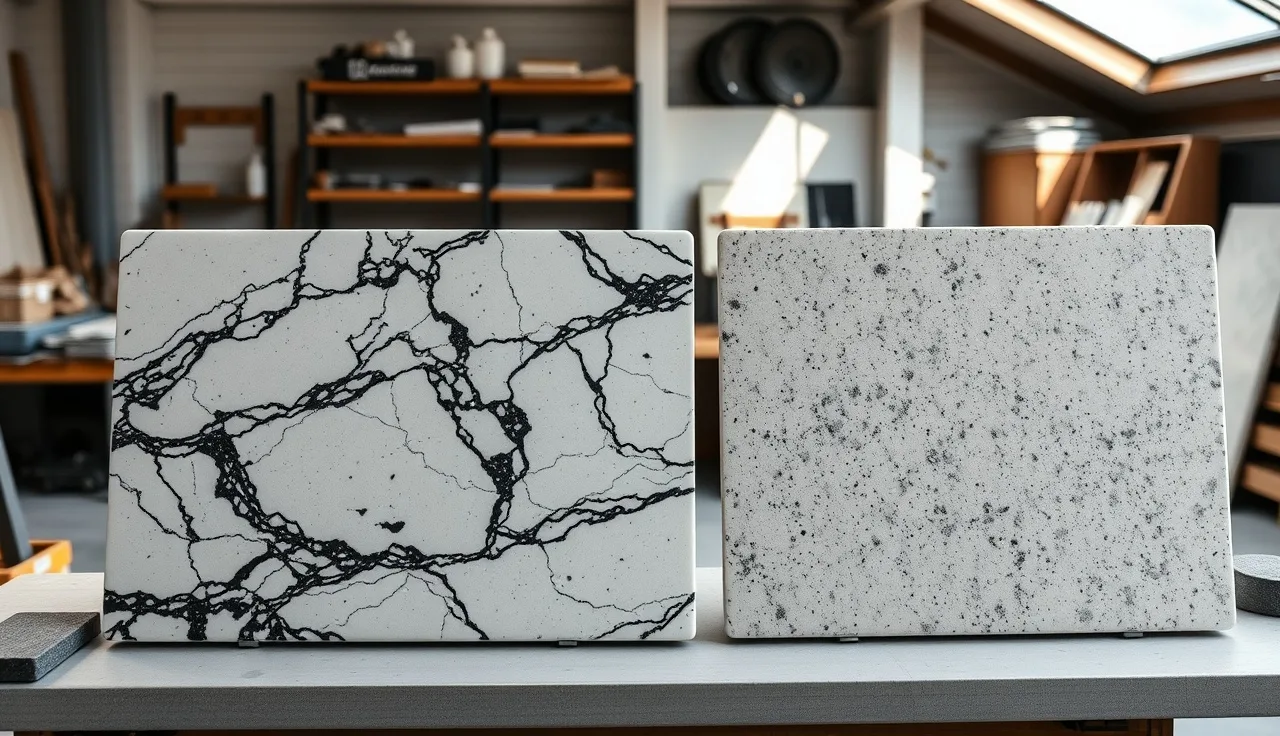
TL;DR
- Polished granite is usually the cheaper finish to produce, because most slabs arrive from the quarry already polished.
- Honed granite makes the fabricator grind that polish back off, adding roughly $10 to $30 per square foot in labor and abrasive cost.
- For a standard 40-square-foot kitchen, plan on $400 to $1,200 more for honed.
- The gap shrinks if your shop can source a pre-honed slab.
What does 'finish' mean in granite fabrication?
A granite finish is the surface texture left on the stone after the last abrasive grit passes over it. That's what you pay for when you pick honed or polished. Fabricators run progressively finer diamond pads, starting around 50-grit and climbing to 400-grit for honed or 1,500 to 3,000-grit for polished, depending on the stone.
The finish changes three things at once: how the stone looks, how it feels under your hand, and how it behaves around water and cooking oils. A polished surface has a tight, reflective sheen because the pores at the surface are burnished nearly closed. A honed surface reads matte or satin. The abrasive sequence stops before the high-gloss stage, so the micro-pores stay more open.
Why does any of this touch cost? Because where you stop in that grit sequence decides how much machine time, tooling wear, and skilled labor a slab soaks up. Stopping at 400-grit honed on a CNC polishing machine can actually take longer than running a slab all the way through a standard polishing line, if the factory already did the heavy lifting.
Why does polished granite usually cost less than honed?
Polished sounds fancier, so it should cost more. It doesn't. The reason is boring and mechanical: almost every granite slab sold in the U.S. arrives at the distributor already polished [1].
Brazilian, Indian, and Chinese processing plants polish slabs by default. It's efficient at scale, it shows the stone's color at its best, and it's what most buyers order. So when a fabricator buys a polished slab and you want polished counters, the finish work is basically done. The shop cuts, edges, and installs. Finish labor is small.
Want honed? Now the fabricator has to reverse that factory polish. That means running the slab back through an abrasive sequence, taking the glossy surface down to roughly 400-grit. You're doing more than stopping early. You're removing material and killing shine on purpose. That eats machine time on a CNC or hand polisher, burns through diamond pads, and leans on a skilled operator to keep the surface even across the whole slab. Some shops farm the honing step out to a specialty stone shop and add margin on top.
There's a workaround. A handful of granite varieties come as raw-honed slabs straight from overseas processors, which closes the gap. If your fabricator can source an already-honed slab, the finish difference might drop to $5 to $10 per square foot instead of $20 to $30. Ask specifically. Most shops don't advertise it because carrying two finish inventories is a headache.
How much more does honed granite cost compared to polished?
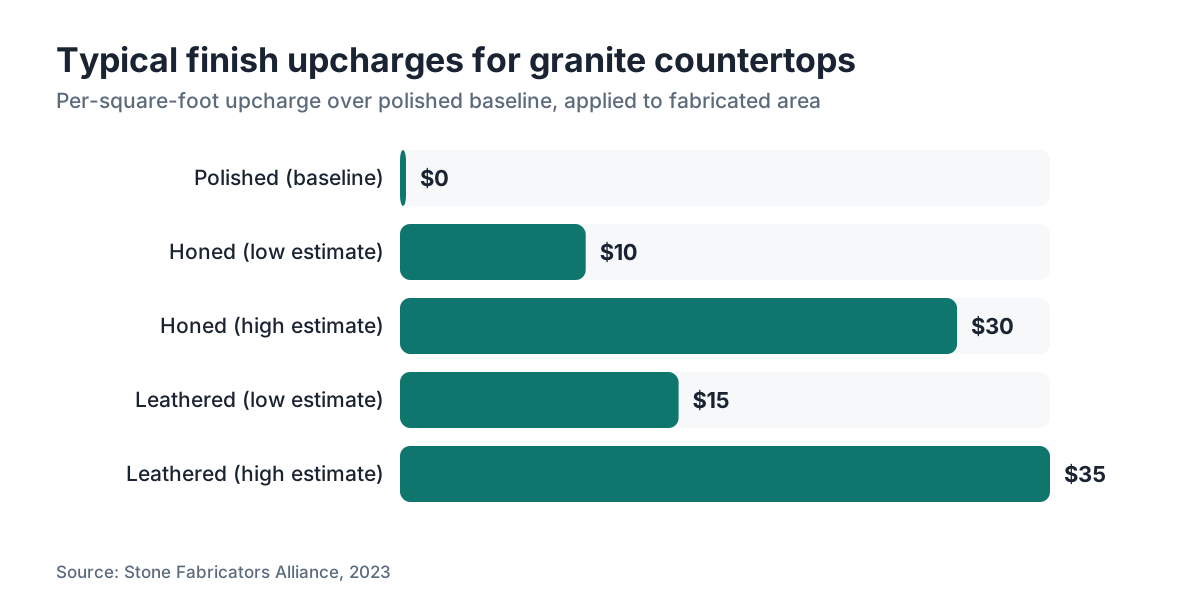
Plan on roughly $10 to $30 per square foot more for honed, which lands at $400 to $1,200 on a 40-square-foot kitchen. Real numbers are hard to pin down because labor rates, shop overhead, and slab sourcing swing so much by region. Still, the quoted range is consistent enough to plan around.
| Finish Type | Typical finish upcharge ($/sq ft) | 40 sq ft kitchen total upcharge |
|---|---|---|
| Polished (baseline) | $0 (included in slab price) | $0 |
| Honed (fabricator grinds back polish) | $10, $30/sq ft | $400, $1,200 |
| Leathered/brushed (related texture) | $15, $35/sq ft | $600, $1,400 |
Those ranges come from fabricator pricing surveys and Stone Fabricators Alliance community data [2]. The low end applies to simple layouts on soft granites that hone quickly. The high end shows up on dense black granites and busy layouts with lots of linear footage, where keeping a matte finish consistent across seams is slow, tedious work.
Honed can add cost two more ways. Sealing is one: honed surfaces are more porous at the top and want sealer before install and roughly once a year after, at $50 to $150 per application [3]. Special-ordering is the other. If you want honed and the fabricator has to bring in a specific slab, or refuses to grind back a pricey book-matched piece, lead time and slab cost both climb.
Some shops fold one sealing into the honed upcharge. Others don't. Ask before you sign.
What drives the cost gap: labor, tooling, or materials?
Labor drives it, with tooling a close second. Materials barely register by comparison.
Diamond polishing pads run $8 to $40 each depending on grit and quality, and honing burns through more of them than a standard polish because you're grinding against an already-dense polished surface [4]. A shop running honed jobs regularly might spend $200 to $500 more per month on abrasives for that workflow.
Labor is the bigger line. A CNC polishing machine can polish a standard slab in 20 to 40 minutes inside the normal production flow. Honing that same slab, especially one that showed up polished, can take 45 to 90 minutes, because the operator runs multiple passes, checks for consistency, and works to avoid burning the stone with friction heat. At shop labor rates of $50 to $90 an hour, that extra half hour to hour is real money.
Then the seams. On a polished top, a well-cut seam filled with color-matched epoxy nearly disappears. On a honed top, the seam edge has to be hand-honed to match the surrounding matte, because a shiny seam line on a matte counter jumps right out at you. Careful seam work on honed stone adds 30 to 60 minutes of hand labor per seam.
Shops that do a lot of honed work buy dedicated honing machines or spindle attachments and speed the whole thing up. Shops that hone once in a while pass more of their inefficiency straight to you. Want honed granite at a fair price? Find a fabricator who runs at least a few honed jobs a month.
Does the type of granite affect the price difference?
Yes, a lot. The stone you pick can move the honed upcharge from the bottom of the range to the top.
Soft granites hone easily and show a cleaner matte. Some of these are granite in name only, mineralogically closer to gneiss or schist, but they behave well under the pad. Ubatuba and Santa Cecilia, two common mid-grade stones, are forgiving to hone, and the upcharge tends to stay near the low end.
Dense, hard granites like Absolute Black (Zimbabwe or South Africa origin) are notoriously hard to hone evenly. They look great done right, but they need slower machine speeds and more passes. Fabricators often quote the top of the range or tack on a surcharge for Absolute Black honing specifically.
Exotic stones with heavy movement, veining, or large crystal structure (Blue Bahia or Azul Macaubas, which are often sold as granite but are actually quartzite) bring their own trouble. The honing has to stay uniform across wildly different mineral hardnesses inside the same slab.
One more thing on looks. Honing softens the visual pop of strongly patterned granite countertops. Some stones look better polished, full stop. Others, like soapstone or leathered Absolute Black, look better with a non-polished finish. Have your fabricator show you a sample in the actual finish before you commit.
Is honed granite harder to maintain, and does that add long-term cost?
Yes, but the gap is smaller than some fabricators make it sound. A good sealer closes most of it.
Because honing stops short of burnishing the surface pores closed, a honed finish soaks up more than polished on the same stone. Cooking oils, citrus acid, even plain water spot more easily on honed granite. That's cosmetic, not structural, and an impregnating sealer handles most of it [5].
The Marble Institute of America recommends sealing honed granite countertops every 1 to 3 years depending on use, against every 3 to 5 years for polished [3]. A pro sealing service runs $75 to $200. Do it yourself with a $25 to $40 bottle of penetrating sealer. Hire it out annually for 10 years and you've added $750 to $2,000 in maintenance over the life of the counter.
Most homeowners with honed granite just seal it themselves once a year and forget about it. The bigger day-to-day difference cuts the other way: honed doesn't broadcast fingerprints, grease smears, or water spots the way polished does. Plenty of people find honed easier to keep looking clean, even though the stone itself wants sealing more often.
The routine in how to clean stone countertops works for both finishes. Just be a little quicker to wipe acidic spills off honed surfaces.
How do fabricators quote honed vs polished granite jobs?
Most quotes break into three parts: slab cost, fabrication labor (cutting, edging, finishing), and installation. Finish type lands on the fabrication labor line.
For a polished job, finish labor is minimal because the slab arrived polished. The shop charges for edge profiling, which carries its own cost ($10 to $30 per linear foot depending on profile complexity), and for seaming. The polished surface itself is essentially free, since the processing plant already did the work.
For a honed job, shops add the cost one of three ways. Some charge a flat per-square-foot upcharge across the whole countertop area (most common). Some bill time-and-materials for the honing step. Some list it as a separate line labeled 'finish modification' or 'custom finish.' Ask to have it broken out. Lump-sum quotes make it impossible to compare shops honestly.
Quoting software used by fabricators, including SlabWise, can track finish type as a modifier on the fabrication cost per square foot, so you can hand a customer an accurate comparison on the spot instead of guessing. If you run a shop and your honed quotes keep coming out inconsistent, systematizing that upcharge in your quoting workflow is the fastest fix.
Homeowners, the smart move is simple. Get quotes from at least three fabricators, say 'honed finish' out loud, then ask each one whether the slab is already honed or will be ground back. That single answer reshapes the real cost, even when the final numbers look close.
When is honed granite actually worth the extra cost?
For most residential kitchens, polished is the sensible pick. It's cheaper to produce, cheaper to maintain, and it shrugs off the acid and grease a kitchen throws at stone better than honed does.
Honed earns its premium in specific spots. Say you have strong natural light hitting the counter at a low angle. Polished granite throws glare and shows every scratch and smear by midday. Honed reads quieter and more even in that harsh light. A lot of high-end designers spec honed for exactly this reason: it makes the stone look like a material, not a showroom display.
Bathroom vanity tops are a strong case. The cooking-acid problem is gone, traffic is lighter, and the matte look fits contemporary and transitional baths. The maintenance trade-off barely matters in a bathroom.
Fireplace surrounds and covered outdoor areas fit well too. Polished granite on a fireplace can look stark and commercial. Honed reads warmer and more architectural. No cooking oil or citrus, so the sealing schedule is easy to keep.
If you're weighing options beyond granite, marble countertops in a honed finish are even more common in European-style kitchens. The finish cost logic is similar, though marble hones faster because it's softer than granite.
Can you convert a polished granite countertop to honed after installation?
Yes, and shops do it regularly. It's more involved than honing before install, but it's routine work for a stone restoration specialist.
Converting an installed counter means hand-held equipment, since the top is now fixed to the cabinets with walls and appliances crowding it. A bridge saw or CNC spindle is out. The specialist uses variable-speed angle grinders with wet-diamond pads and works through the grits in order.
On-site honing typically runs $8 to $20 per square foot for labor alone, on top of any sealer and edging work [6]. It's slower than shop honing because the operator is on hands and knees with wet gear in your kitchen. Expect plastic sheeting, dust management, and a messy day.
The real risk is consistency. Shop-honed slabs run flat on CNC machines that hold even abrasive contact across the whole surface. On-site honing rides on operator skill to dodge lap marks, dull patches near edges, and uneven sheen between sections. The quality range is wide. Get references and photos before you hire anyone for on-site refinishing.
One piece of timing advice. If you want honed and you already have polished installed, get the restoration done before you're attached to how the kitchen looks. The result is usually very good with a real specialist, but it's not as predictable as shop-processed honing.
How does honed granite compare to leathered or brushed finishes in cost?
Leathered and brushed finishes get confused with honed constantly, but they're different processes and they almost always cost more.
Honing stops the abrasive sequence at a smooth, flat matte. Leathering uses a different tool, a diamond-encrusted brush or bush-hammer head, to build a textured surface that follows the natural pits and fissures in the stone. Brushed is similar but leaves a directional grain instead of random texture. Both need specialized tooling and a lot more machine time than honing.
Leathered upcharges typically run $15 to $35 per square foot against $10 to $30 for honed, and that premium covers the extra tooling and time [2]. Not every granite leathers well, either. Dense, fine-grain stones like Absolute Black leather beautifully. Coarse-grain exotics sometimes tear unpredictably along the fissure lines.
Maintenance is where leathered surprises people. It's easier than honed. The texture hides fingerprints and smears better than any flat surface, and the open leathered texture reads oil absorption far less than a flat matte hone does. Some fabricators argue leathered is the best real-world finish for heavy kitchen use, budget permitting.
If you're already eyeing alternatives to granite, engineered stone changes the whole finish conversation. Cambria countertops ship in a consistent matte or polished finish from the factory, with no field finish modification available or needed.
What questions should you ask your fabricator about finish costs?
Five questions will tell you fast whether a fabricator knows honed work and whether the quote is honest.
First: is the slab you're quoting already honed, or will you grind back a polished slab? The answer moves both cost and quality. A pre-honed slab usually has a more consistent finish than a shop-honed one, because the plant controls the abrasive sequence at scale.
Second: is the honing upcharge per square foot on the full countertop area, or just the top surface? Some shops only charge the flat field area and roll edge honing into the edge profile price. Others charge honing on total square footage including the edge faces. Know exactly what each number covers.
Third: does the quote include a penetrating sealer application before delivery? For honed granite this should be standard. If it isn't in there, add $75 to $150 to your comparison number.
Fourth: how do you handle seam consistency on honed countertops? This one reveals experience. A shop that hand-hones seam edges and dry-fits before final epoxy is doing it right. A shop that never thought about it will hand you a shiny seam line on a matte counter.
Fifth: can I see a honed sample on this specific stone? Honing looks different on every granite. What's elegant on one slab goes chalky on another. Never commit to honed without seeing it on your actual stone or the closest available sample.
Frequently asked questions
Is honed granite always more expensive than polished?
Almost always, for residential jobs where the slab arrives polished. The exception is when your fabricator can source a slab already honed at the processing plant, which can shrink or erase the upcharge. Ask specifically whether a pre-honed slab exists for the stone you want. For most common granites it doesn't, but for popular honed choices like Absolute Black, some distributors stock honed slabs.
How much does honed granite cost per square foot compared to polished?
Expect $10 to $30 per square foot more for honed than polished, as a finish upcharge on top of the slab and base fabrication cost. On a typical 40-square-foot kitchen, that adds $400 to $1,200 to the invoice. The range is wide because it depends on the granite type, your fabricator's workflow, and whether a pre-honed slab is available.
Does honed granite need to be sealed more often than polished?
Yes. The Marble Institute of America recommends sealing honed granite every 1 to 3 years versus every 3 to 5 years for polished granite on the same stone. Honing leaves the surface pores more open, so the stone absorbs oil and liquid more readily. A good penetrating impregnating sealer handles it, and most homeowners apply it themselves with a $25 to $40 product.
Is honed granite harder to keep clean than polished?
It's different, not simply harder. Honed granite absorbs cooking oils and acidic liquids more readily if unsealed, which can stain. But honed surfaces hide fingerprints, water spots, and grease smears far better than polished because there's no reflective sheen to amplify them. Most homeowners with honed counters find daily cleaning easier, even though deliberate sealing comes up more often.
Can you hone granite after it's already installed?
Yes. A stone restoration specialist can hone an installed polished counter using handheld wet-diamond equipment. Expect $8 to $20 per square foot for labor, plus sealer. Quality leans heavily on operator skill, since on-site honing lacks the precision of shop CNC equipment. Get references and photos of previous work before hiring anyone for on-site refinishing.
What is the difference between honed, leathered, and brushed granite finishes?
Honed means smooth and matte, made by stopping the abrasive sequence before the high-gloss stage. Leathered uses diamond-bristle brushes to build a textured surface that emphasizes natural pits and fissures. Brushed creates a directional grain texture. Leathered and brushed typically cost $5 to $10 per square foot more than honed because they need specialized tooling and more machine time.
Does the type of granite affect the honing upcharge?
Yes. Soft, fine-grain granites like Ubatuba hone quickly and cost toward the low end of the $10 to $30 per square foot range. Dense stones like Absolute Black take longer to hone evenly and often carry a specific surcharge. Some fabricators add a flat premium for notoriously difficult stones. Always ask whether your specific stone changes the finish price before signing.
Which finish is better for a kitchen countertop: honed or polished granite?
Polished is the more practical default for kitchens. It's cheaper to produce, resists staining better without aggressive sealing, and is easier to maintain around cooking acids and oils. Honed makes sense if strong directional light causes glare or you prefer the matte look and commit to annual sealing. For bathroom vanities or fireplace surrounds, honed is an excellent choice with minimal trade-offs.
How do fabricators charge for a honed finish: by the job or per square foot?
Most charge per square foot as an upcharge on the total fabricated area. Some bill time-and-materials for the finish step. A few bundle it into an overall custom-finish line. Ask for the honing charge to be listed separately so you can compare quotes across shops fairly. Lump-sum quotes with finish modifications buried inside make comparison nearly impossible.
Is honed granite worth the extra cost?
For most kitchens, polished granite is the better value. The $400 to $1,200 upcharge on a typical job, plus more frequent sealing, rarely delivers enough practical benefit to justify unless aesthetics are the priority. In bathrooms, on fireplace surrounds, or in rooms with harsh direct light where polished granite glares badly, the honed premium often earns its keep.
Do all granite fabricators offer honed finishes?
Most do, but not all are equally experienced. Shops that specialize in polished work and rarely hone tend to charge more and deliver less consistent results. Look for a fabricator who can show you completed honed jobs, preferably on the same stone you're ordering, and who can explain how they handle seam consistency on matte surfaces.
Does a honed finish make granite look lighter or darker?
Honing typically makes granite look slightly lighter and more muted than polished. Polishing intensifies color by reflecting light off the dense surface. Honing breaks up that reflection and drops the color saturation. This shows most on dark granites like Absolute Black, which looks dramatically different polished versus honed. Always request a physical sample in the actual finish before committing.
Are there granite alternatives that come standard in a matte finish without extra cost?
Yes. Some engineered quartz and porcelain slab products are made with a matte finish as a standard option at no upcharge. Soapstone is naturally matte with no honing step. Leathered quartzite is increasingly available pre-finished from distributors. If you want a matte stone surface without a finish upcharge, ask your fabricator which materials in their current inventory ship in a non-polished state.
Sources
- USGS Minerals Yearbook: Stone, Dimension: Granite slabs are predominantly processed and exported from Brazil, India, and China in polished form as the industry standard.
- Stone Fabricators Alliance: Honed finish upcharges range from $10, $30 per square foot and leathered finishes from $15, $35 per square foot based on fabricator community pricing data.
- Marble Institute of America, Care and Maintenance Guidelines: The Marble Institute of America recommends sealing honed stone surfaces every 1 to 3 years and polished surfaces every 3 to 5 years depending on use and stone porosity.
- Natural Stone Institute, Technical Bulletins: Diamond abrasive pads for stone range from $8 to $40 each, and honing workflows consume pads at a higher rate than standard polishing production runs.
- Natural Stone Institute, Sealer Recommendations: Penetrating impregnating sealers are recommended for honed granite to reduce surface porosity and limit oil and liquid absorption.
- HomeAdvisor (Angi), Stone Restoration Cost Guide: On-site stone honing and restoration labor costs typically range from $8 to $20 per square foot depending on surface area and job complexity.
- Occupational Safety and Health Administration (OSHA), Silica in Construction: Stone fabrication including grinding and honing operations generate respirable crystalline silica dust requiring exposure controls under 29 CFR 1910.1053.
- EPA, Safer Choice Program: Penetrating sealers used on stone countertops are assessed under EPA Safer Choice criteria for indoor VOC emissions and occupant safety.
- National Kitchen and Bath Association, Design and Specification Standards: NKBA design guidelines reference surface finish specification as a key element of countertop selection affecting durability and maintenance expectations.
Last updated 2026-07-09