TL;DR
- A fissure is a natural separation in granite that formed while the rock cooled millions of years ago.
- A crack is fresh structural damage from stress, impact, or bad installation.
- Fissures are normal and rarely need repair.
- Cracks need attention.
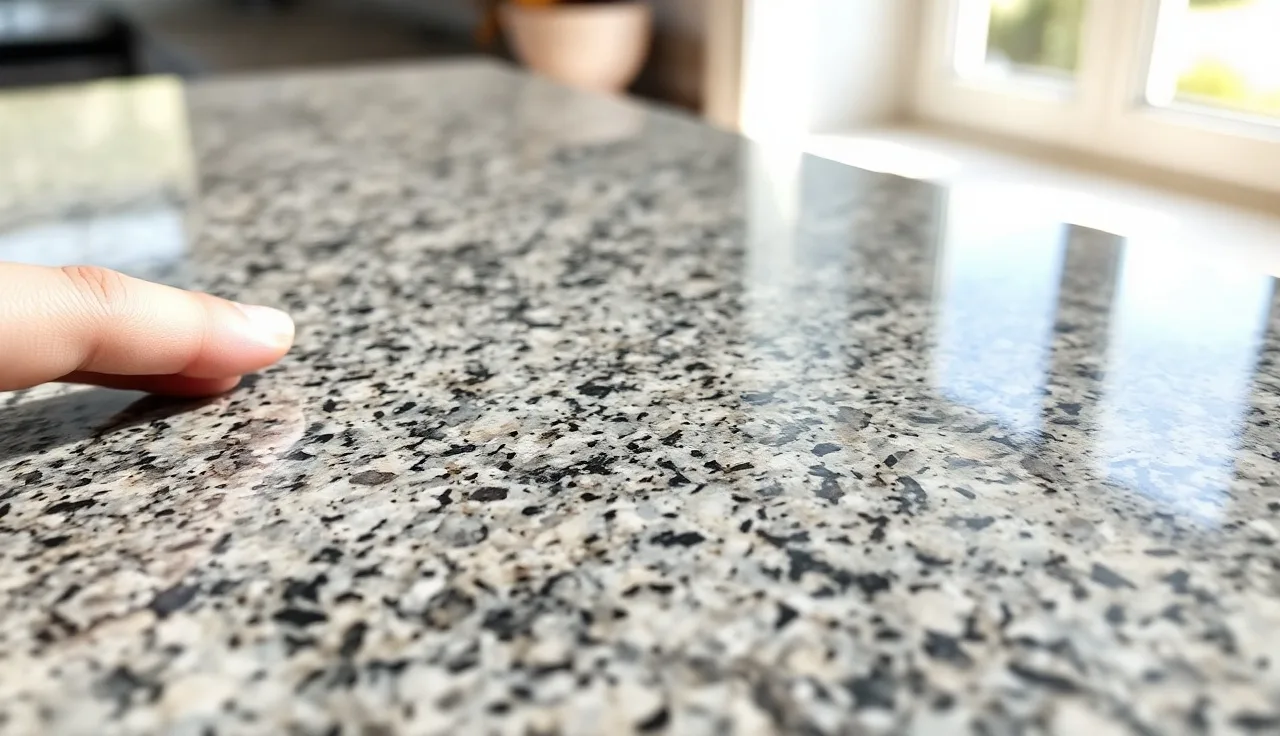
- The fastest test: run a fingernail across the line.
- A fissure feels smooth.
- A crack has a ridge or lip you can feel.
What exactly is a fissure in granite?
A fissure is a natural separation between mineral grains that formed while the granite cooled, and it was already in the slab the day it left the quarry. Granite forms when magma cools deep underground over thousands to millions of years. The cooling is never perfectly even, so tiny gaps open along the boundaries where crystals meet. Those gaps are fissures.
A fissure is part of the stone. The fabricator saw it when they cut and polished the slab. Good fabricators orient cuts to keep fissures out of high-stress zones, but nobody can remove them entirely. Some finishes make them louder. Leathered and honed surfaces show fissures more than a high polish does.
Fissures tend to run with the grain. They look like a wispy line, a little lighter or darker than the stone around it, tracking parallel to the crystal banding. Both sides sit at the same height. That flush, integrated feel is the whole tell.
The Marble Institute of America (now part of the Natural Stone Institute) describes fissures in its technical documentation as "a visible separation along intercrystalline boundaries," noting they are "a naturally occurring characteristic of stone and do not affect its structural integrity" [1]. That is the industry position, and it holds up on the job.
What is a crack in granite and what causes it?
A crack is a break that happens after the stone is quarried, cut, or installed. Something caused it. A hard impact, thermal shock (a scorching pan set on a cold slab), a cabinet that flexed, a substrate with no support, or a cutout for a sink or cooktop placed too close to an edge with not enough stone left behind.
Cracks have nothing to do with the mineral structure. They cross grain lines, run in directions the crystal pattern never suggested, and start at a stress concentration point. Look at the inside corners of sink cutouts first, then cooktop openings, then the edges near unsupported overhangs.
A crack changes how the slab behaves. The two sides can move on their own, which means they widen, chip at the lip, and turn into a hygiene problem as moisture and bacteria settle into the gap. A crack near a kitchen sink almost always gets worse if you ignore it.
Installation choices drive a lot of this. Our countertop installation guide covers substrate prep and support requirements in detail.
How do you tell a fissure from a crack at home?
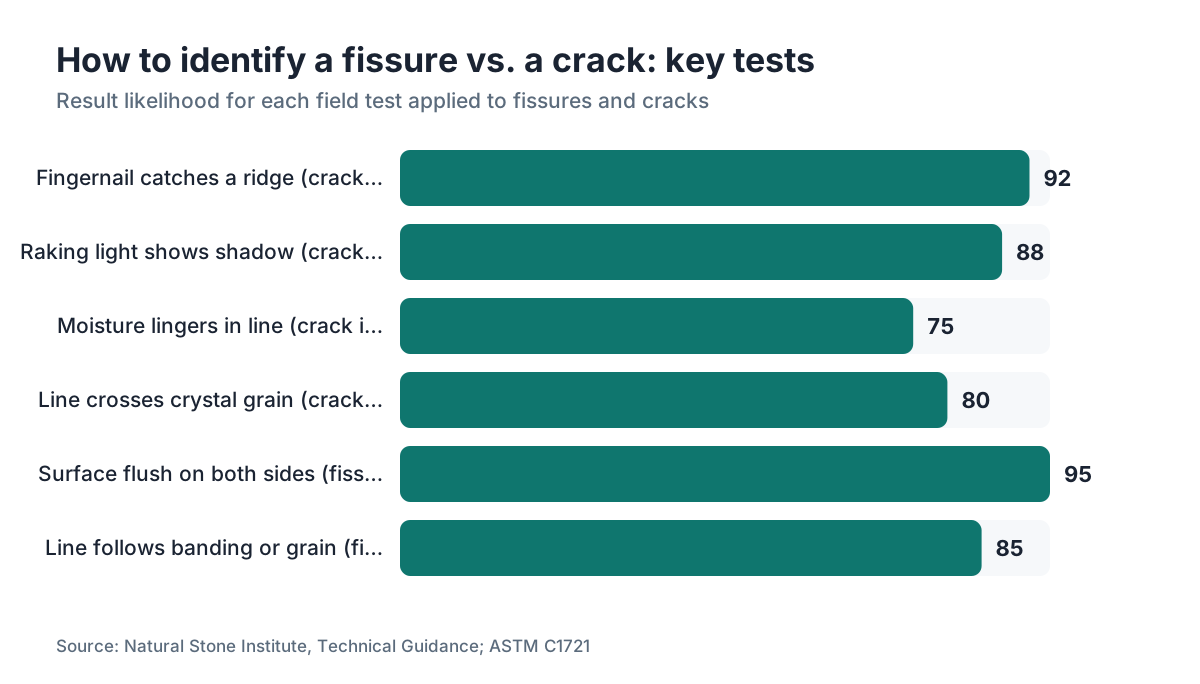
Run your fingernail across the line, perpendicular to it. If your nail glides over with no catch, it is a fissure. If you feel a ridge, a step, or any displacement between the two sides, it is a crack. That single test settles most cases with no tools at all.
The flashlight test adds detail. Hold a small light almost flat against the surface, nearly parallel to it. This is raking light. A fissure throws no shadow because both sides sit at the same height. A crack casts a thin shadow on the low side, which confirms there is vertical displacement.
The moisture test takes longer but works. Clean and dry the surface, wet a small section over the line, and watch it dry. Water leaves a fissure at about the same rate as the stone around it. A crack holds moisture longer because water wicks into the gap.
Now look at the line under good light with no magnification. A fissure has a soft, hazy edge that melts into the minerals around it. A crack has a sharper edge, sometimes with tiny chips along the lip.
None of these tests is perfect. A very fresh hairline crack with almost no displacement can pass the fingernail test. When you are not sure, get a fabricator to look in person. They answer this question all the time, and a good one tells you straight without pushing a repair you do not need.
Can a fissure turn into a crack over time?
Yes. Under the right stress, a fissure can propagate into a crack, and this is the single most useful thing to understand about them.
Trouble starts when stress concentrates at the fissure. Run a fissure through a spot with weak cabinet support, or across an area that takes constant thermal cycling (the stone right next to a range), and the natural separation can widen and develop displacement. At that point it is a crack.
The main risk factors are simple: unsupported spans past 24 inches with no extra support, heavy objects dropped straight onto the stone, repeated thermal shock, and weak adhesive at seams near a fissure. Granite is very hard, rating 6 to 7 on the Mohs scale, but it is brittle in tension [2]. Hard and brittle are not the same thing. Granite cracks more easily than most homeowners expect.
This is why layout matters. A good fabricator reads the slab's fissure pattern before cutting and keeps fissures away from the inside corners of cutouts. The inside corner of a sink opening is the highest-stress point in most kitchen layouts. Put a pre-existing fissure there and you are asking for a crack.
Does a fissure affect the structural integrity or value of granite?
Structurally, no. A fissure that has not propagated into a crack does not change the slab's load-bearing behavior in any way that matters for a countertop. The Natural Stone Institute's guidance treats fissures as cosmetic characteristics, not defects [1].
For resale, visible fissures in a prominent spot can raise buyer questions, but they are not damage a seller has to disclose. If a listing shows a beautiful granite counter and the buyer later spots fissures, that is a knowledge gap, not concealment, because fissures come with the stone.
Appearance is stone-specific. A visible fissure in a dark, dense stone like Absolute Black or Nero Marquina can look jarring because the contrast is sharp. In stones with heavy movement like Fantasy Brown or River White, the same fissure disappears into the veining.
What moves value is whether the line is a fissure or a crack. A crack near a sink, or one with visible separation, gets flagged by a home inspector and drags on price. A fissure does not, as long as it stays put.
What does a crack in granite look like compared to a fissure?
Side by side, the differences are usually clear once you know the tells. Here is the short version.
| Characteristic | Fissure | Crack |
|---|---|---|
| Origin | Natural, formed during cooling | Post-fabrication damage or stress |
| Surface texture | Flush, smooth across the line | Ridge, lip, or step you can feel |
| Edge definition | Soft, hazy edges, blends with minerals | Sharp, defined edges, sometimes chipped |
| Direction | Follows crystal grain or banding | Often crosses grain; radiates from stress point |
| Moisture behavior | Dries at same rate as surrounding stone | Holds moisture longer, may harbor bacteria |
| Under raking light | No shadow | Casts a visible shadow on the low side |
| Structural concern | None in normal use | Yes; can widen and worsen over time |
| Typical repair needed | None | Epoxy fill, or in severe cases slab replacement |
Here is what trips people up: a slab often has both. Old quarry fissures, plus a fresh crack from years of use. The two can even intersect. If a long line reads smooth under your nail along part of its length and has a ridge along the rest, you are probably watching a fissure that started to propagate.
When should you actually worry about a line in your granite?
Worry the moment you feel displacement under your fingernail. Worry when the line sits near a cutout corner and keeps getting longer. Worry when moisture pools in the line and never dries, or when dark staining tracks along it because water is carrying minerals or bacteria into the gap.
Do not worry about a smooth, integrated line that has been there since day one and has not changed. Plenty of granite slabs carry fissures that homeowners never notice until they go looking, and those lines can be decades old without ever causing a problem.
Here is a rule I trust. Photograph any line you are unsure about the first time you see it, with something for scale in the frame (a coin works). Check it again in three months. Same as before, it is almost certainly a fissure. Longer or changed, treat it as a crack and call a fabricator.
The sink area is the highest-risk zone in any kitchen. The cutout corners concentrate stress, the surface stays wet, and hot water cycles the temperature constantly. A line anywhere near your sink cutout is the one to keep an eye on.
How do fabricators and installers identify fissures before installation?
Before cutting, an experienced fabricator inspects the slab under good light, usually with a handheld light held at a raking angle. They mark fissures with a soapstone pencil and check that fissure map against the cut plan for the job.
The aim is to keep fissures out of high-stress spots: inside corners of cutouts, the front edge near overhangs, and seam locations. When a fissure has to land in a high-stress zone, the fabricator can apply epoxy or a penetrating consolidant to stabilize the area before cutting. That is standard practice.
At templating, a good fabricator points out fissures and explains where they will fall in the finished layout. If you are buying granite, ask to see the slab before it gets cut and have them walk you through the fissures. Ten minutes now saves an argument later.
Shop software like SlabWise lets fabricators log fissure locations in the slab record so the templater and installer work from the same information. That cuts the odds of a fissure landing in a bad spot because of a gap between the shop and the field.
For the full arc of the job, our countertop installation guide goes deeper on what to expect from template through final polish.
Can a crack in granite be repaired, and does the repair last?
Yes. A well-done crack repair can hold for years. The standard method: clean the crack thoroughly, sometimes with acetone to strip oils and moisture, then fill it with a color-matched epoxy or polyester resin. The filler cures, then gets polished flush with the surface.
Longevity comes down to the cause. Fix the underlying problem (reinforce the cabinet, add support to a long span) and the repair holds. Leave the cause in place and the crack reopens. Epoxy is rigid, so if the slab keeps flexing, the filled line pops.
For small cosmetic cracks away from a stress point, a skilled epoxy repair is often invisible from a few feet away. Up close you might catch a subtle color shift. Dark granites are harder to match than light ones.
Severe cracks are different. A break that runs fully through the slab, or one that hits structural support near a cutout, may not be reliably repairable. That usually means replacement. Nobody wants to hear it, but patching a through-slab crack near a sink with epoxy buys you a few months, not a fix.
How do granite fissures compare to what you see in other natural stones?
Fissures are not a granite-only thing. Marble, quartzite, soapstone, and travertine all get them. What changes is how they look and how easily you spot them.
Marble fissures run with the veining and can hide inside the decorative pattern. Quartzite, which forms under high-pressure metamorphism, can carry very fine fissures that flash almost iridescent in direct light. For care specifics on those stones, see our how to clean quartzite countertops and how to clean stone countertops guides.
Granite fissures are usually less dramatic than marble veining because granite's mineral structure is more uniform (it is igneous, not metamorphic). But granite is harder and more brittle than marble, so when granite breaks under impact, the fracture tends to run cleaner and sharper than a marble break.
Soapstone is the odd one out. It is softer and more ductile than granite or marble, so it scratches easily but rarely cracks catastrophically. If you are weighing stone options, those differences in how each material fractures are worth knowing before you sign.
Engineered stones like Cambria countertops have no fissures at all, because they are made from ground quartz and resin. Any line in an engineered quartz surface is a crack. No exceptions.
What questions should you ask a fabricator if you find a line in your countertop?
Start with the baseline: "Was this line in the slab before installation?" A fabricator who inspects their slabs can answer that, and many document it. Yes, and they can show you? It is a fissure. Not sure? The fingernail and raking-light tests are your next move.
Ask them to look in person before you accept any phone answer. A texted photo rarely captures the surface detail you need to tell a fissure from a crack.
If it turns out to be a crack that showed up during or after installation, ask whether the fabrication warranty covers it. Most fabricators offer at least a 1-year workmanship warranty, though the terms swing widely. Read your contract.
Ask whether the crack sits near a stress concentration (cutout corner, unsupported span, seam) and whether anything about the install contributed. A crack that opens within 60 days of installation is rarely a homeowner problem. A crack that appears after you dropped a cast iron skillet on that exact spot is a different conversation.
Get a written repair estimate before you authorize work. A hairline epoxy fill runs roughly $150 to $400 depending on length and complexity [3]. Full slab replacement is a fabrication job and gets priced like one, usually starting near the cost of a new countertop for that area.
Frequently asked questions
Is it safe to use a granite countertop that has a fissure?
Yes, completely. A fissure is a natural mineral boundary that formed as the stone cooled and has no effect on the slab's structural integrity for countertop use. The Natural Stone Institute classifies fissures as characteristics, not defects. Clean over them normally, seal the stone on schedule, and you have nothing to worry about as long as the surface stays flush and the line shows no sign of growing.
Can I seal a fissure in granite to prevent it from becoming a crack?
A standard penetrating sealer applied to the whole counter will enter a fissure and help keep moisture out, which is good general practice. It will not structurally reinforce the stone. If the fissure sits in a stress-prone area (near a sink cutout or an unsupported overhang), ask a fabricator whether a thin epoxy consolidant makes sense. That is a more targeted treatment than a sealer.
Does a fissure in granite need to be disclosed when selling a house?
Generally no, because a fissure is an inherent material characteristic of natural stone, not damage. A crack is different and could count as a material defect depending on your state's disclosure laws. If you cannot tell whether you have a fissure or a crack, get a fabricator's written assessment before you list. Disclosure rules vary by state, so ask your real estate attorney for jurisdiction-specific guidance.
How long does a granite crack repair with epoxy actually last?
A clean epoxy fill on a stable crack, where the underlying stress cause has been fixed, can last 5 to 10 years or longer. If the slab keeps flexing or the support situation has not changed, the repair can reopen within 1 to 3 years. Color matching fades a little over time, especially in direct sunlight. There is no industry-standard warranty on crack repairs, so ask your fabricator what they stand behind before paying.
Why does my new granite countertop already have lines in it?
Almost certainly fissures, not damage. Granite slabs arrive from the quarry with fissures already present, and they show up in finished counters as wispy lines that follow the crystal grain. A good fabricator should have pointed these out during templating or slab selection. Run your fingernail across the line: smooth means a fissure, which is completely normal. A ridge means you should contact your fabricator.
What causes cracks in granite countertops near the sink?
The inside corners of a sink cutout are the highest-stress point in most kitchen granite layouts. Stress concentrates at corners geometrically, and the mix of repeated thermal cycling from hot water, moisture, and mechanical stress from the cutout can propagate an existing fissure or start a fresh crack. Fabricators leave a small radius at cutout corners (instead of a sharp right angle) specifically to reduce that stress concentration.
Can granite crack from a hot pan?
Rarely from one event, but thermal shock is real if the temperature difference is extreme. Set a 500-degree pan on cold granite and you create a sharp thermal gradient that can drive an existing fissure into a crack. The risk climbs with thinner slabs (2 cm versus 3 cm) and with stones that carry more fissures. Trivets cost almost nothing and remove the risk entirely.
Are fissures more common in some granite colors or types than others?
Yes. Exotic, highly figured granites with dramatic movement (Blue Bahia, Typhoon Bordeaux, River White) tend to have more fissures because their complex mineral makeup reflects more varied cooling rates. Dense, fine-grained blacks like Absolute Black have fewer fissures but make any line jump out by contrast. Uniform granites like Uba Tuba or Santa Cecilia usually have fewer prominent fissures.
How do I tell if a granite seam is cracking?
A seam is where two pieces of stone join with epoxy adhesive. Run your fingernail across it: a good seam is nearly flush with a tight, consistent gap. Feel a step, or watch the gap widen, and the adhesive may be failing. Seam failure near a sink is common because moisture breaks down the epoxy over time. A fabricator can re-epoxy a failing seam, though the repair shows up close.
Does granite thickness (2 cm vs 3 cm) affect how likely it is to crack?
Yes, noticeably. Three-centimeter granite is much stiffer in bending than 2 cm because stiffness scales with the cube of thickness. Most residential kitchen counters today use 3 cm. Two-centimeter slabs were common in older installs and needed a plywood substrate for support. A 2 cm slab with no plywood backer makes any unsupported span a real crack risk.
Will homeowners insurance cover a cracked granite countertop?
Standard homeowners policies cover sudden, accidental damage (a heavy object falling on the stone) under dwelling or personal property coverage, but they typically exclude gradual damage, settling, and manufacturing defects. A crack that developed over time from stress or from a fissure propagating is unlikely to be covered. Review your policy's exclusions and take dated photos of any damage the moment it happens, before you file a claim.
How do fabricators prevent cracks during the cutting process?
Fabricators use diamond blade wet saws with continuous water cooling to stop thermal stress during cutting. They also use core bits for rounded cutout corners, which spread stress better than a plunge cut with a straight blade. Supporting the slab so it does not flex or drop under its own weight as the cut runs is equally important. A slab that falls even a fraction of an inch mid-cutout can crack on the spot.
Is a granite fissure the same as a vein?
Not exactly. A vein is a mineral deposit that filled a pre-existing fracture, usually a different mineral (often quartz or feldspar) than the surrounding rock. Veins are typically a distinct color from the host stone and are structurally bonded to it. A fissure is an open or partly open separation along a mineral boundary that never got filled. Both are natural features; veins are generally more stable than open fissures.
Sources
- Natural Stone Institute, Technical Bulletin: Fissures in Natural Stone: Fissures are 'a visible separation along intercrystalline boundaries' that are 'a naturally occurring characteristic of stone and do not affect its structural integrity'
- U.S. Geological Survey, Mineral Resources Program: Granite rates 6 to 7 on the Mohs hardness scale
- Angi, Granite Countertop Repair Cost Guide: Epoxy crack fill repairs for granite countertops typically range from $150 to $400 depending on length and complexity
- ASTM International, ASTM C615 Standard Specification for Granite Dimension Stone: ASTM C615 sets physical property requirements for granite dimension stone including modulus of rupture and absorption, relevant to structural behavior
- University of Minnesota Extension: Natural stone countertops including granite contain inherent fissures and mineral variations that are part of the material's character
- Natural Stone Institute, The Fabricator's Guide to Natural Stone: Industry guidance recommends fabricators inspect slabs for fissures before cutting and orient layouts to minimize fissure presence at stress concentration points
- U.S. Geological Survey, National Minerals Information Center: Granite is an igneous rock formed by slow cooling of magma, producing interlocking mineral crystals that create the stone's characteristic texture and fissure patterns
- ASTM International, ASTM C1721 Guide for Petrographic Examination of Dimension Stone: Petrographic examination of dimension stone identifies fissures, grain boundaries, and microcrack patterns as natural features requiring documentation
- National Kitchen and Bath Association, NKBA Planning Guidelines: NKBA guidelines address countertop substrate support requirements that, when not followed, increase risk of stress cracking in stone surfaces
Last updated 2026-07-10