TL;DR
- Shop labor rates for countertop fabrication typically run $35 to $100 per hour when you account for all direct labor roles, from saw operators to installers.
- The all-in loaded cost per hour, which includes wages, payroll taxes, and benefits, is usually 25 to 40 percent higher than the base wage.
- Regional pay, shop size, and material type all move the number significantly.
What does 'shop labor rate' actually mean in countertop fabrication?
"Shop labor rate" means three different things depending on who says it, and mixing them up is how shops lose money without knowing why. Pin down which one you mean before you benchmark anything.
First, it can mean the direct wage you pay a fabrication employee per hour. That's the number on their pay stub before taxes. Second, it can mean the loaded labor cost, which adds payroll taxes, workers' comp, health insurance, and any paid time off on top of the wage. Third, some shops use a billable shop labor rate, which is the number baked into their quotes to cover labor costs plus overhead and profit. That third number is always higher than the first two.
Most industry talk about "the average shop labor rate" is really talking about loaded direct labor cost, because that's what decides whether a job pencils out. A shop paying a saw operator $22 per hour in base wages is probably spending $28 to $30 per hour all-in once you fold in payroll taxes (7.65 percent FICA alone) [1], workers' comp premiums (which run high in fabrication, often 8 to 15 percent of wages depending on state) [2], and any benefits.
The billable rate is a separate animal. That number has to cover loaded labor plus overhead (rent, equipment depreciation, utilities, insurance) plus a target profit margin. Most shops aim for somewhere between 10 and 20 percent net margin on the finished job, and labor is usually 25 to 40 percent of a job's total cost.
What is the average hourly wage by role in a countertop shop?
The closest federal wage data puts stone cutters and sawyers at a median of roughly $20 to $22 per hour nationally, with the 75th percentile near $27 to $30. But a countertop shop runs several distinct roles, and wages swing hard by position. That national median hides more than it tells you.
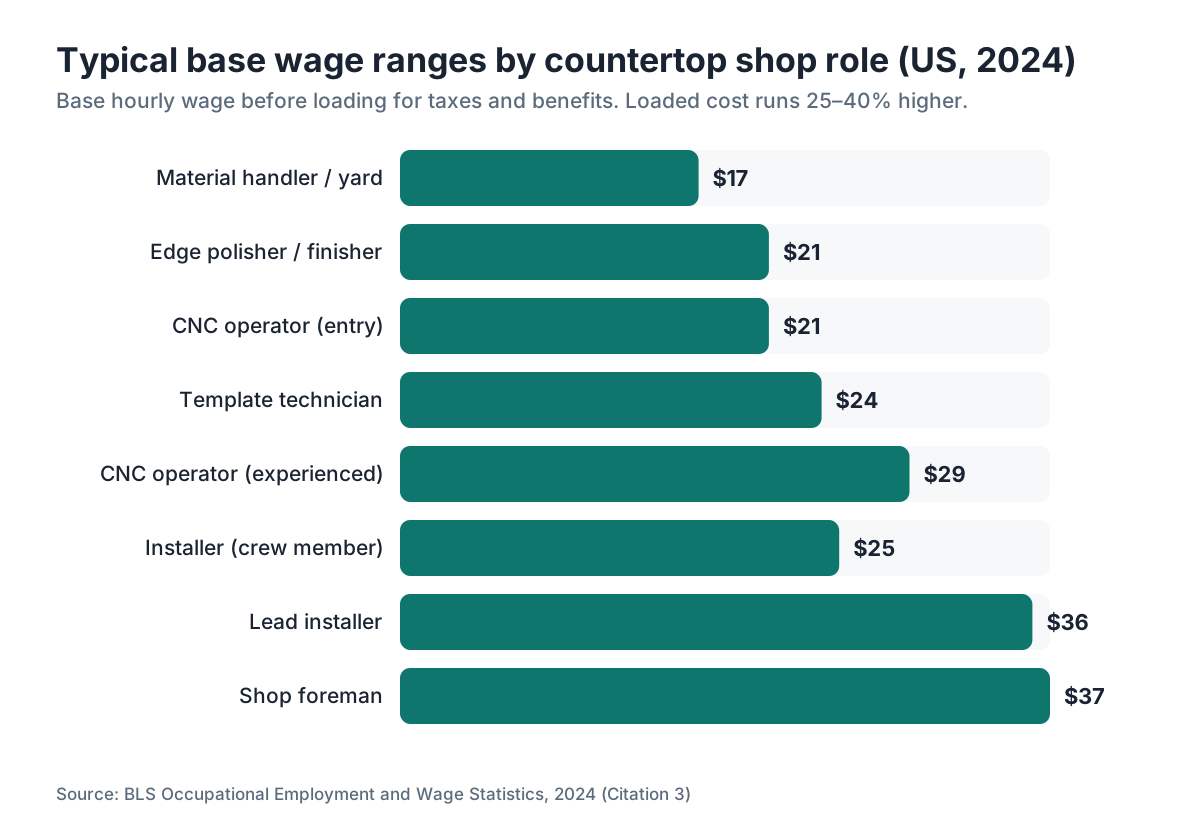
The Bureau of Labor Statistics tracks the trade closest to countertop fabrication under SOC code 51-9195, Stone Cutters and Sawyers, in its Occupational Employment and Wage Statistics survey [3]. Here's how the roles inside a real shop break out:
| Role | Typical Base Wage Range (US, 2024) |
|---|---|
| Material handler / yard worker | $15, $20/hr |
| CNC operator (entry) | $18, $24/hr |
| CNC operator (experienced) | $24, $35/hr |
| Edge polisher / finisher | $17, $25/hr |
| Template technician | $20, $28/hr |
| Installer (crew member) | $20, $30/hr |
| Lead installer | $28, $45/hr |
| Shop foreman / production manager | $25, $50/hr |
Those are base wages before loading. A lead installer in a high-cost market like the Bay Area or New York might pull $50 to $60 per hour in base wages. The same role in a rural Midwestern market might top out at $28 to $32. Neither number is wrong. They reflect local labor markets.
For job costing, the number that matters is the loaded cost per labor hour, not the base wage. A $22/hr edge polisher costs the shop closer to $30 to $32 per hour in real dollars once you add FICA, state unemployment tax, workers' comp, and even a modest benefit contribution.
How do regional differences affect shop labor rates?
Region is the single biggest driver of labor cost differences between shops. A fabricator in Nashville and a fabricator in San Jose can run near-identical operations, same material, same CNC, and the San Jose shop's loaded labor cost per hour still lands 60 to 80 percent higher. Geography sets the floor, not skill.
BLS Occupational Employment and Wage Statistics data breaks out wages by metropolitan area [3]. Stone cutting and processing wages in California metro areas run 30 to 50 percent above the national median [10]. Texas markets tend to run at or slightly below the national median. The Southeast, particularly Georgia, Tennessee, and the Carolinas, often runs 10 to 20 percent below the national median for fabrication labor.
State-level workers' comp rates compound this. Workers' comp classifications for stone fabrication (NCCI class codes around 1803 and 1731 are common, depending on whether the insurer treats the work as stone cutting or installation) carry base rates that vary enormously by state. California's base rates for comparable classifications run several times higher than those in Texas or Florida, though actual premiums depend on the shop's experience modification rate [2].
Minimum wage floors matter at the bottom of the scale too. As of mid-2025, 30 states plus the District of Columbia have minimum wages above the federal $7.25 floor [4]. In California ($16.50 statewide), Washington, or New York City (up to $17), the floor pulls up wages across the board, including entry-level yard and handling roles.
If you're benchmarking against published averages and the numbers look off, region is almost always the reason.
What is the typical billable labor rate used in countertop quotes?
Billable shop labor rates inside quotes typically run $75 to $110 per shop hour for stone fabrication, even though the employee's paycheck reflects far less. The billable rate is not the wage. It covers loaded wages, a share of shop overhead, and a contribution to profit, all in one number.
A simple formula: Shop Rate = (Annual Loaded Labor Cost + Annual Overhead) / Annual Billable Hours, then adjusted upward for target margin.
Take a shop with one fabricator at a loaded $30/hour cost, 1,800 productive hours per year, and $90,000 of annual overhead tied to that position. The fully loaded shop cost per hour lands around $80 before any profit. Add a 15 percent net margin target and the billable rate pushes toward $94. That's the gap between the check and the quote.
Some shops price by the square foot instead of an explicit hourly rate, which makes this harder to back-calculate. But the math still has to work. A shop pricing by the square foot is implicitly betting on a labor productivity number (square feet per shop hour) to get there, whether they've written it down or not.
The Natural Stone Institute (formerly the Marble Institute of America) has documented that labor typically runs 25 to 35 percent of total job cost for natural stone fabrication, though this shifts a lot with job complexity [5].
How does material type affect the labor cost per job?
Different materials take different labor to fabricate, and this is one of the most underrated drivers of job-level cost. Harder stone eats tooling and time. Softer stone chips and slows the crew down. The material you're cutting changes the math before you make a single cut.
Granite and quartzite are hard and abrasive. They wear tooling faster and need more passes on waterjet or CNC equipment. A complex edge profile takes longer to run and finish than the same profile on a softer material. Granite countertops and quartzite carry higher labor cost per square foot than softer stones.
Marble countertops are softer and cut more easily, but they chip during fabrication, so fabricators work more carefully and waste rates climb. The net labor cost per square foot often lands close to granite.
Engineered quartz (Cambria, Silestone, and the like) is consistent in hardness and machinability. Cambria countertops and similar products give you predictable, lower tooling wear and faster setup because the material is uniform. Labor cost per square foot is often lower than natural stone for a comparable layout.
Laminate countertops and Formica countertops need entirely different skills and tools. Fabrication labor cost is lower per square foot, but so is the sale price, so the margin math isn't automatically better.
Butcher block countertops have their own labor profile: more carpentry-adjacent work, different joinery concerns, finishing steps stone shops never touch.
Job complexity beats material alone. A 40-square-foot granite island with two cutouts, a farmhouse sink reveal, and a mitered waterfall edge is nothing like a 40-square-foot rectangle. Shops that price by the square foot without adjusting for complexity undercharge on the hard jobs and overcharge on the easy ones.
What is a loaded labor cost and how do you calculate it?
Loaded labor cost is the real cost of an employee per hour: base wage plus everything the shop pays on top. A common shortcut is to multiply the base wage by 1.25 to 1.40. A $22/hr employee actually costs the shop roughly $27.50 to $30.80 per hour. Here are the pieces that make up the load.
- Base wage (the number on the pay stub)
- FICA taxes: the employer pays 7.65 percent of wages for Social Security and Medicare [1]
- Federal Unemployment Tax (FUTA): 6 percent on the first $7,000 of wages per employee per year, though credits typically cut this to 0.6 percent for most employers [4]
- State Unemployment Insurance (SUI): rates vary by state and employer experience, typically 1 to 5 percent of wages
- Workers' compensation insurance: highly variable, but fabrication and stone installation are expensive classifications, often 8 to 20 percent of payroll [2]
- Health insurance contribution: depends on the plan, commonly $200 to $600 per month per employee if the shop chips in
- Paid time off: two weeks of PTO on a $22/hr employee adds roughly $1.70/hr to the effective cost once you spread it across working hours
A $35/hr lead installer, run through the same math, costs $44 to $49 per hour loaded.
This calculation matters. Shops that price off base wages without loading them consistently underprice labor and bleed margin over time without ever seeing where it went.
How do shop size and production volume affect labor rates?
Bigger shops spread fixed overhead across more square feet per year, which lets them carry higher absolute labor costs and still hit margin. A shop running 15,000 square feet per month has a fundamentally different cost structure than a two-person operation running 1,500. Volume changes what you can afford to pay.
Higher-volume shops also invest in automation (CNC saws, automated polishing lines, robotic material handling) that raises output per labor hour. If a shop runs 60 square feet per labor hour on a CNC versus 20 on manual equipment, the effective labor cost per square foot drops hard even when the hourly wage is identical.
Small shops usually compete by keeping overhead lean, not by paying lower wages. The owner works on the floor and eliminates a labor position. That hides a cost, though. The owner's time has value, and if it never shows up in pricing, the business is quietly subsidizing jobs with unpaid labor.
For tracking labor cost per job against your quoted rates, tools like SlabWise are built for fabrication operations, so you can see whether your actual shop hours matched what you estimated when you priced the job. (Full disclosure: SlabWise publishes this guide.)
One honest caveat: nobody has current, detailed survey data on average labor costs specific to countertop fabrication shops broken out by size tier. The closest public benchmarks come from BLS occupational wage data [3] and Natural Stone Institute business reports [5], but shop-level profitability isn't reported at fine enough resolution to give you confident peer comparisons.
How does installation labor compare to shop fabrication labor?
Installation and shop fabrication are different labor pools with different pay, risk, and skills. Lead installers usually earn more per hour than production floor fabricators, because the job carries more physical risk and demands customer-facing skills the shop floor doesn't. When you compare the two, compare productive output, more than wages.
Installation crews handle finished stone on job sites. They carry back injury, cut, and drop risk, work in whatever conditions the site throws at them, and talk to homeowners directly. The shop floor is controlled. The job site is not.
Productivity math differs too. A shop fabricator's output is measured in square feet processed per hour in a controlled space. An installer's on-site time gets eaten by drive time, setup, leveling, adjusting cabinets that aren't square, and whatever surprise the job site hands them. Effective square feet installed per labor hour on-site is usually far lower than shop production rates.
Some shops price installation as a separate line item. Others bundle it into the per-square-foot price. Bundling is simpler for the customer quote but hides cost analysis internally. Track installation labor separately and you can see your true install cost per square foot and figure out whether second stories, tight kitchens, and commercial sites are actually profitable after travel and install time.
For countertop installation broadly, the labor line in a homeowner quote typically runs $10 to $30 per square foot for stone, on top of fabrication. The range is wide because it reflects huge variation in job complexity and regional labor costs.
What do homeowners actually pay for labor in a countertop project?
Homeowners rarely see labor as a line item. You get a price per square foot for a material, thickness, and edge profile, and labor is buried inside that number. For natural stone in 2024, homeowners typically paid $40 to $100 per square foot installed, with the national middle around $55 to $70 [6]. Labor, shop plus installation, usually runs 30 to 45 percent of that total.
On a $60/sq ft job, that's $18 to $27 per square foot in labor cost to the fabricator.
Engineered quartz costs more in material but sometimes less in fabrication labor thanks to consistent machinability. Installed prices of $70 to $120 per square foot are common for premium engineered quartz [6].
Corian countertops and laminate countertops sit at the low end of installed price: $20 to $55 per square foot, with labor a higher share of the total because material costs less.
If a bid looks unusually low, the usual reason is lower-grade material, thinner slabs, or labor priced at rates that won't keep the business alive. A rock-bottom labor number can also mean an inexperienced crew, and that shows up in the install. The kitchen countertops decision is worth doing right the first time.
How should fabricators benchmark and adjust their shop labor rate?
Benchmarking your shop labor rate takes three numbers measured with some precision: your actual loaded labor cost per hour, your actual productive output per labor hour (your average, not your best day), and your current priced-in labor rate per square foot. Get those three and the gap, if there is one, becomes obvious.
If your priced-in labor rate is lower than your loaded labor cost times your real hours per square foot, you're losing money on labor no matter how busy you are. This happens constantly, and shops usually find it slowly, which is exactly why regular job costing pays for itself.
Here's the drill:
- Take last month's total payroll cost (wages plus employer taxes, workers' comp, benefits) for production staff.
- Divide by total productive hours worked (hours on billable work, not hours paid).
- That's your actual loaded labor cost per productive hour.
- Divide total square feet shipped last month by total productive hours.
- Multiply: loaded cost per hour times hours per square foot.
- Compare it to what you're actually charging per square foot for labor.
Plenty of shops find a gap they never knew was there. The Natural Stone Institute's member resources include financial benchmarking guidance to help calibrate where your margins should sit for your shop size [5].
For quoting, SlabWise lets fabricators build labor rates into quote templates so every job calculates labor cost automatically off the shop's real rates, not a rough guess. That keeps the gap from compounding across hundreds of jobs.
Raising rates is uncomfortable and often necessary. The labor market for experienced fabricators is tight in most US metros. Holding your rates at 2019 levels while wages have climbed 15 to 20 percent since then means you're pricing jobs at a loss on labor.
What trends are pushing shop labor rates higher right now?
Four pressures have pushed fabrication labor costs up since 2020, and none of them are fully resolved. Wage inflation, workers' comp, a skilled labor shortage, and rising state minimum wages all pull in the same direction. A shop that set its rates in 2020 and never revisited them is almost certainly underpriced today.
First, wage inflation. The Employment Cost Index from the Bureau of Labor Statistics shows private-sector wages and salaries rose roughly 4 to 5 percent annually in 2022 and 2023 before moderating in 2024 [7]. Fabrication shops, competing against construction trades for the same workers, felt it directly.
Second, workers' comp costs. Fabrication is genuinely dangerous work: heavy slabs, water-fed tools, silica dust. OSHA's silica standards (29 CFR 1926.1153 for construction and 29 CFR 1910.1053 for general industry) raised compliance costs, and shops running proper wet-cutting and dust control carry higher operating costs as a result [8]. Insurers price that in.
Third, the skilled labor shortage. Experienced CNC operators and lead installers are hard to find. Shops bid against each other for a thin bench of qualified people, and that pushes wages up.
Fourth, state minimum wage increases keep coming. California's minimum wage hit $16.50 in 2024 [4], lifting the floor for lower-wage positions and compressing the whole wage scale above them.
The net effect: a shop still running its 2020 labor rates is probably 15 to 25 percent too low. That's not a rounding error. On a $100,000 month of sales, it's $15,000 to $25,000 in labor cost you never recovered.
Frequently asked questions
What is the average hourly labor rate for a countertop fabricator?
The Bureau of Labor Statistics reports a median hourly wage of around $20 to $22 for stone cutters and sawyers nationally, as of the most recent OEWS data. Experienced CNC operators and lead installers earn more, often $28 to $45 per hour. Loaded cost to the shop, including taxes and benefits, runs 25 to 40 percent above base wages. Regional variation is large: California and Northeast markets run 30 to 50 percent above the national median.
How much of a countertop job's total cost is labor?
For natural stone fabrication, labor (shop and installation combined) typically represents 25 to 40 percent of total job cost, according to Natural Stone Institute industry guidance. On a $3,000 granite countertop job, that means $750 to $1,200 in labor cost to the fabricator. Jobs with complex cutouts, mitered edges, or difficult site conditions push the labor share toward the high end. Simple rectangular layouts with standard edges sit closer to 25 percent.
What is a loaded labor rate and how is it different from base wage?
A loaded labor rate is the true cost of an employee per hour, including base wage plus employer-paid payroll taxes (7.65 percent FICA), workers' compensation insurance, state unemployment tax, and any benefits like health insurance or PTO. For fabrication workers, a common rule of thumb is to multiply the base wage by 1.25 to 1.40. A $22/hr wage becomes roughly $27 to $31 per hour in actual shop cost.
What hourly rate do countertop shops use when building quotes?
Billable shop labor rates used inside quotes typically run $75 to $110 per shop hour for stone fabrication, though some shops use a square-foot pricing model that obscures the hourly calculation. The billable rate has to cover loaded labor cost, a share of fixed overhead (rent, equipment, utilities), and target profit margin. The difference between what an employee earns and what the shop bills per hour is not profit; most of it is overhead recovery.
How does workers' comp insurance affect my shop's labor cost?
Workers' comp premiums for stone fabrication and installation are expensive. Depending on the state and the shop's claims history, premiums can run 8 to 20 percent of wages for production and installation roles. A shop paying $500,000 in annual fabrication wages could easily spend $50,000 to $100,000 on workers' comp alone. Shops with good safety records and low experience modification rates pay significantly less. OSHA silica compliance programs can help reduce claims over time.
How much does countertop installation labor cost as a separate line item?
When priced separately, countertop installation labor for natural stone typically runs $10 to $30 per square foot depending on region, job complexity, and crew efficiency. Simple kitchens with standard layouts sit at the low end. Second-story installs, commercial sites, or unusually complex layouts push toward $30 or higher. Drive time, setup, and site variables like out-of-square cabinets eat into installer productivity and raise effective cost per square foot.
Are countertop fabrication wages rising faster than other trades?
The Bureau of Labor Statistics Employment Cost Index shows private-sector wages rose roughly 4 to 5 percent annually in 2022 and 2023. Fabrication shops compete with construction trades for skilled labor, and that sector saw some of the steepest increases. The shortage of experienced CNC operators and stone fabricators in most markets has created wage pressure on top of general inflation. Most fabrication shop owners report labor costs are the line item that has moved most since 2020.
How do I calculate whether my shop is charging enough for labor?
Take last month's total payroll cost (wages plus all employer taxes, workers' comp, and benefits) for production staff. Divide by productive billable hours worked. That's your actual loaded labor cost per hour. Then divide total square feet shipped by productive hours to get your labor productivity rate. Multiply those two numbers to get your actual labor cost per square foot. Compare it to what you're charging. If your charged rate is lower than your actual cost, you're losing money on every job.
Does the type of stone affect how much labor a job requires?
Yes, significantly. Hard materials like granite and quartzite wear tooling faster and take longer per linear foot of edge profiling. Engineered quartz is consistent in hardness and often faster to run on CNC equipment. Marble cuts easily but chips more readily, so fabricators work carefully and waste can run higher. Job geometry matters more than material alone: a simple rectangle in granite takes far less labor per square foot than a complex island with waterfall edges and multiple cutouts in any material.
What OSHA rules affect labor costs in a stone fabrication shop?
OSHA's crystalline silica standards (29 CFR 1926.1153 for construction and 29 CFR 1910.1053 for general industry) require exposure assessment, engineering controls (wet methods, local exhaust ventilation), medical surveillance for exposed workers, and training. Compliance costs real money: wet-cutting equipment, dust collection, PPE, and medical monitoring add to operating expenses. Shops running compliant programs also tend to see fewer workers' comp claims over time, which partially offsets the investment.
Why do countertop bids vary so much between shops in the same city?
Several factors drive quote variation beyond just material cost. Shops with higher overhead (large facilities, newer equipment, larger crews) need higher revenue per square foot to survive. Shops with lower labor costs, whether because they're paying below-market wages or running leaner operations, can bid lower. Experience and waste rates matter too: a skilled crew wastes less slab. Finally, some shops simply misprice jobs, either too high out of habit or too low out of competitive pressure that isn't sustainable.
How do large fabrication shops compare to small shops on labor cost per square foot?
Large shops benefit from automation that raises output per labor hour, spreading loaded labor cost across more square feet. A shop running automated polishing lines might achieve 50 to 80 square feet per labor hour on production; a small manual operation might run 15 to 25. Even if the large shop pays higher wages, its labor cost per square foot can be lower. Small shops compete by keeping overhead lean and often by having the owner working on the floor, effectively subsidizing the business with unpaid management labor.
What's the difference between shop labor rate and cost per square foot?
Shop labor rate is measured per hour of a worker's time. Cost per square foot is a derived number that combines the hourly rate with how many square feet get produced per hour. A shop with a $30/hr loaded labor cost that produces 30 square feet per labor hour has a $1.00 per square foot labor cost. The same shop at 20 square feet per hour has a $1.50 per square foot labor cost. Productivity is what converts your hourly rate into a per-square-foot impact on margin.
Sources
- IRS, Understanding Employment Taxes: Employers pay 7.65 percent of employee wages for FICA (Social Security and Medicare) as the employer share of payroll taxes.
- NCCI (National Council on Compensation Insurance): Workers' compensation premiums for stone fabrication and installation classifications vary widely by state and employer experience modification rate, commonly running 8 to 20 percent of payroll for these trade categories.
- Bureau of Labor Statistics, Occupational Employment and Wage Statistics (OEWS), SOC 51-9195 Stone Cutters and Sawyers: BLS OEWS data reports a median hourly wage of approximately $20 to $22 for stone cutters and sawyers nationally, with 75th percentile wages around $27 to $30.
- U.S. Department of Labor, Wage and Hour Division, Minimum Wage: As of mid-2025, 30 states plus DC have minimum wages above the federal $7.25 floor; California's statewide minimum wage is $16.50.
- Natural Stone Institute, Industry Resources and Business Benchmarking: The Natural Stone Institute (formerly Marble Institute of America) has documented that labor typically represents 25 to 35 percent of total job cost for natural stone fabrication projects.
- Angi, Countertop Installation Cost Guide: Installed natural stone countertop prices for homeowners typically range $40 to $100 per square foot nationally, with engineered quartz running $70 to $120 per square foot installed.
- Bureau of Labor Statistics, Employment Cost Index: The BLS Employment Cost Index shows private-sector wages and salaries rose approximately 4 to 5 percent annually in 2022 and 2023 before moderating in 2024.
- OSHA, Crystalline Silica Standard for Construction (29 CFR 1926.1153) and General Industry (29 CFR 1910.1053): OSHA's silica standards require stone fabrication shops to implement engineering controls, exposure monitoring, medical surveillance, and employee training, adding to operating costs.
- Bureau of Labor Statistics, Occupational Employment and Wage Statistics, Metropolitan Area Data: BLS OEWS metropolitan area data shows stone cutting and processing wages in California metro areas run 30 to 50 percent above the national median for the occupation.
Last updated 2026-07-10