
TL;DR
- Countertop fabrication labor runs $10 to $30 per square foot for most shops, depending on material, edge complexity, and local wages.
- To calculate it, divide your total shop labor cost (wages plus burden) by billable square footage per day.
- Most granite jobs land between $12 and $20 per square foot in labor alone, before material or markup.
Why does labor cost per square foot matter so much in countertop fabrication?
Labor is the hardest cost to recover if you get it wrong. Material is visible on an invoice. Labor is invisible until you pull a job report and realize you made $4 a square foot on a kitchen that took two guys most of a day.
For homeowners, understanding labor cost helps you read quotes honestly. A low total price often means a shop cut corners on labor, which shows up as poor polishing, rushed templating, or a sink cutout that needed to go back. For fabricators, knowing your real labor cost per square foot is the foundation of every profitable quote.
The national average installed price for granite countertops runs roughly $40 to $100 per square foot, with labor and installation making up $10 to $30 of that range [1]. Quartz and engineered stone land in a similar band. But those are retail figures. What you need as a shop owner is the cost side, not the sell side, and that means building the number from scratch.
What goes into the total labor cost calculation?
There are four components. Miss any one of them and your number is wrong.
1. Direct wages. This is the hourly rate you actually pay your fabricators, templaters, and installers. The Bureau of Labor Statistics puts the median wage for stone cutters and slabbers (SOC 51-9195) at around $20 to $22 per hour nationally as of recent survey years, but shops in high-cost metros like Seattle or Boston often pay $28 to $35 [2]. Rural shops may pay $16 to $18. Use your actual payroll, not a benchmark.
2. Labor burden. This is the multiplier that covers payroll taxes, workers' compensation insurance, health benefits, paid time off, and any retirement contributions. A reasonable burden rate for a small fabrication shop is 25 to 35 percent of base wages [3]. So if you pay someone $22 an hour, their fully burdened cost is closer to $27.50 to $29.70 per hour. Many shop owners skip this and then wonder why profit disappears.
3. Productive hours vs. paid hours. A full-time employee is paid for roughly 2,080 hours per year. But they are not productive for all of them. Subtract vacation, sick time, safety training, equipment maintenance, and shop downtime. A realistic productive hour count is 1,700 to 1,850 hours per year for a well-run shop [3]. That gap matters because you divide total labor cost by productive hours to get your real cost per hour.
4. Overhead allocation (optional but honest). Some shops fold a portion of fixed overhead into their labor rate rather than applying it as a separate line. If you do this, be consistent. Adding $4 to $8 per burdened hour to cover equipment depreciation, shop rent per square foot of floor space used, and utilities is common. Others keep overhead separate. Either method works as long as you pick one and stick with it.
What is the step-by-step formula to calculate labor cost per square foot?
Here is the actual math. Walk through it once for your shop and you will have a number you can trust.
Step 1: Calculate your fully burdened hourly labor cost. Take total annual payroll for production staff (wages only) and multiply by your burden rate. If you pay three fabricators a combined $180,000 in wages and your burden rate is 30%, your total burdened labor cost is $234,000.
Step 2: Estimate productive hours. Multiply headcount by productive hours per year. Three fabricators at 1,800 productive hours each is 5,400 hours.
Step 3: Calculate your cost per productive hour. $234,000 divided by 5,400 hours = $43.33 per productive hour for those three people combined, or about $14.44 per person per hour.
Step 4: Measure your square footage output. Track how many finished square feet your shop produces per day, per person. A well-equipped CNC shop can cut, polish, and stage 80 to 120 square feet per person per 8-hour day on a straightforward granite job. A hand-finishing shop with complex edges might do 40 to 60 [4]. Be honest about this number. Pull three months of job tickets and divide.
Step 5: Divide cost by output. If one fabricator costs $14.44 per productive hour and produces 10 square feet per hour (80 sq ft / 8 hours), the labor cost per square foot is $1.44. That seems low. It is, because that is just the cutting cost. Add templating time, edge work, sink cutouts, and installation and the full job cost per square foot climbs fast.
Full job example:
- Template: 1.5 hours per job, 30 sq ft average kitchen = 3 minutes per sq ft
- Fabrication (cutting + polishing): 8 minutes per sq ft for eased edge granite
- Installation: 5 minutes per sq ft
- Total: roughly 16 minutes per sq ft
- At $14.44 per productive hour: ($14.44 / 60) x 16 = $3.85 per sq ft in direct labor cost
- Burden is already baked into the $14.44 figure above
- Add overhead allocation of $5 per sq ft
- Total labor + overhead cost: roughly $8.85 per sq ft
That is a production cost, not a sell price. Most shops sell at 2x to 3x cost, which gets you to the $15 to $25 range seen in retail quotes [1].
How does material type change the labor cost calculation?
Material choice changes fabrication time a lot, and that flows straight into your per-square-foot labor cost.
| Material | Relative Fabrication Difficulty | Typical Labor Time Multiplier vs. Eased-Edge Granite |
|---|---|---|
| Laminate (post-form) | Very low | 0.3x |
| Butcher block | Low-medium | 0.5x |
| Granite, eased edge | Baseline | 1.0x |
| Marble | Medium-high | 1.2x to 1.5x |
| Quartzite | High | 1.4x to 1.8x |
| Cambria / engineered quartz | Medium | 1.0x to 1.3x |
| Ultra-compact (Dekton, Neolith) | Very high | 1.8x to 2.5x |
Why such a range? Quartzite is harder than granite and dulls blades and bits faster, so you spend more time per cut and more on tooling. Ultra-compact surfaces need slower feed rates, specialized blades, and careful handling to avoid chipping. Marble is softer but scratches and stains easily during fabrication, so fabricators slow down to protect the surface.
Laminate countertops and Formica countertops cut and install so fast that labor cost per square foot is genuinely low, which is part of why they hold on in rental and commercial settings. The material cost is low and so is the labor.
For any material that is new to your shop, track time on the first three or four jobs before quoting aggressively. The learning curve is real.
What does edge profile complexity do to labor cost per square foot?
Edge work is where shops bleed money on poorly quoted jobs. An eased or beveled edge on granite might take 2 to 3 minutes per linear foot of polishing. An ogee, dupont, or waterfall mitered edge can take 8 to 15 minutes per linear foot, especially on harder stones [4].
The industry rule of thumb: price complex edges by the linear foot, not the square foot, because the square footage of the slab does not change but the labor does. A 30-square-foot island with 12 linear feet of ogee edge at 12 minutes per foot is 144 minutes of edge polishing alone. At $14.44 per productive hour, that is $34.65 just for the edge labor, or $1.15 per square foot added to the job.
For a shop doing high volumes of mitered waterfall edges, that add-on labor cost per square foot can beat the base fabrication cost. Build a lookup table for your edge profiles that converts linear feet to minutes, then to dollars, and add it to every quote.
Sink cutouts and cooktop openings are another line item that gets swallowed into per-square-foot pricing incorrectly. A standard undermount sink cutout takes 15 to 25 minutes including coring, grinding, and polishing the apron. A farmhouse sink or a cooktop with a tight reveal can take 45 to 60 minutes. Charge for this separately.
How do shop overhead and equipment costs factor in?
Labor cost and overhead cost are different things, but they interact. A shop with a CNC saw and automated polisher produces more square footage per labor hour than a shop working by hand. The same wage dollar goes further, and the per-square-foot labor cost drops, even though the shop carries higher fixed costs.
The way to handle this is to separate labor cost from equipment cost. Calculate your labor cost per square foot as described above. Then calculate your equipment and overhead cost per square foot separately by dividing total monthly fixed costs by monthly square footage output.
Example: a shop with $15,000 per month in fixed costs (rent, equipment payments, insurance, utilities) that produces 1,200 square feet per month has an overhead cost of $12.50 per square foot. Add that to labor cost to get your total production cost before material.
Buying a $120,000 CNC machine does lower your labor cost per square foot over time, but only if your volume is high enough to spread the fixed cost. At 300 square feet per month, that machine's overhead contribution is $33 per square foot in payment alone (assuming a 60-month loan at roughly $2,400 per month, not counting interest). At 1,500 square feet per month, it is $1.60. Volume is what makes the machine pay.
Shops running countertop installation in-house versus subcontracting also see different cost structures. In-house installation gives you control over quality but adds vehicle costs, fuel, and crew time that must be recovered in the square-foot price.
What are realistic labor cost per square foot benchmarks by job type?
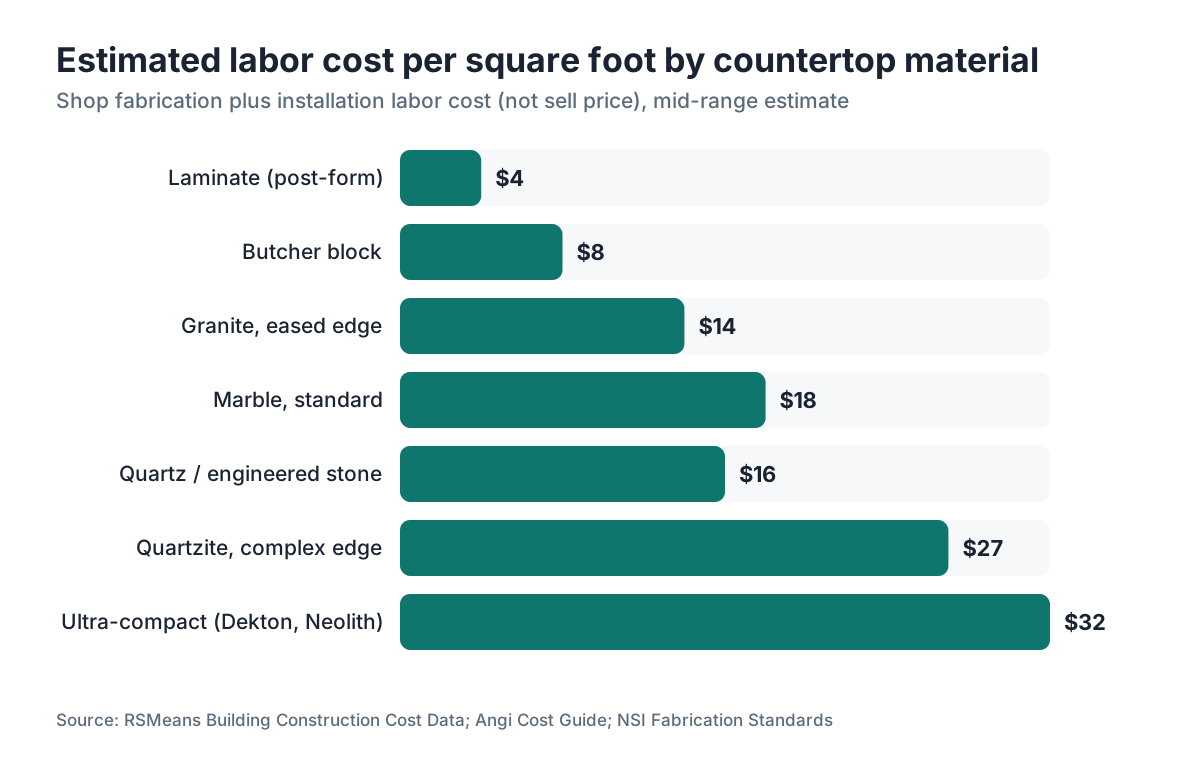
Nobody publishes clean industry benchmarks on fabrication labor cost specifically, because most shops treat this as proprietary. The closest public data comes from BLS wage surveys [2], RSMeans construction cost data [5], and HomeAdvisor / Angi survey aggregates on installed prices [1]. Working backward from installed price ranges and known material costs, you can estimate reasonable labor cost bands.
| Job Type | Estimated Labor Cost per Sq Ft (shop + install) | Notes |
|---|---|---|
| Basic laminate, post-form | $2 to $6 | Pre-formed edges, minimal cutting |
| Granite, eased edge, standard kitchen | $10 to $18 | Industry midpoint |
| Granite, ogee or bullnose, complex layout | $16 to $26 | More edge work, more seams |
| Quartz / engineered stone, standard | $12 to $20 | Slightly slower cutting |
| Quartzite, complex edge | $20 to $34 | Hard material, slow tooling |
| Marble, standard | $14 to $22 | Careful handling required |
| Ultra-compact (Dekton, Neolith) | $24 to $40 | Specialized tooling, slow feed rates |
These are labor cost estimates, not sell prices. A shop selling at 2.2x cost on granite would price the installed labor at $22 to $40 per square foot, which tracks with retail quotes for granite countertops in most markets [1].
Regional wage differences move these numbers a lot. A shop in Mississippi paying $16 per hour all-in versus a shop in San Francisco paying $38 per hour will have labor cost per square foot that differs by a factor of 2 or more, even with identical production efficiency.
How do you track labor cost accurately if you don't have job costing software?
Start with a paper timesheet. Have every production employee write down the job number and time in and out for each task: templating, cutting, edge work, polishing, delivery, installation. Do this for 30 days. Then pull total hours by job, multiply by fully burdened cost per hour, and divide by the square footage of that job. You now have a real labor cost per square foot for real jobs, not a guess.
The exercise almost always produces a surprise. Jobs you thought were profitable have high labor cost because a templater drove 90 minutes each way. Jobs you thought were marginal turn out efficient because the layout was simple and the material cut clean.
Once you have 20 or 30 jobs of data, you will see patterns. Certain material types or edge profiles always run over. Certain crew combinations move faster. That data is worth more than any benchmark.
For shops ready to systematize this, fabrication quoting software can automate the labor cost calculation by linking time standards to job parameters. SlabWise, for example, lets you set per-task time standards and applies them automatically when you build a quote, so you see labor cost per square foot before the job goes out the door rather than after. A demo takes about 20 minutes and the difference in quote accuracy is immediate.
If software is not in the budget yet, a simple spreadsheet with columns for job number, material, square footage, total labor hours by task, burdened cost, and resulting cost per square foot does the job. Update it after every completed job.
How does installation labor fit into the per-square-foot cost?
Installation is often calculated separately from fabrication, but it is still part of the total labor cost per square foot that a shop must recover.
A two-person installation crew can typically set and seam 80 to 150 square feet of standard granite per day, including tear-out of old countertops, template verification, leveling, and cleanup [5]. Complex jobs with many pieces, heavy stone, or difficult access (stairs, no elevator) can cut that to 40 to 60 square feet per day.
If your installation crew costs $60 per combined burdened hour ($30 per person x 2) and they install 100 square feet in an 8-hour day, the installation labor cost is $4.80 per square foot before vehicle and fuel costs. Add $1 to $2 per square foot for a work truck and fuel on a local job, and you are at $5.80 to $6.80 per square foot for installation alone.
That number rises on jobs with tear-out (add 30 to 60 minutes per kitchen), silicone and caulking work, appliance disconnects, or plumbing reconnection. Some shops bundle a flat allowance for these into their per-square-foot rate. Others itemize. Itemizing is more honest and easier to defend to a customer who questions the price.
For kitchen countertops specifically, the combination of fabrication and installation labor typically runs $15 to $28 per square foot for granite, based on RSMeans and Angi data for 2023 to 2024 [1][5].
What mistakes do fabricators most often make when calculating labor cost?
Forgetting labor burden is the most common and most expensive mistake. A shop owner who thinks labor costs $22 an hour when the real burdened cost is $29 is underbidding every job by 24 percent. Over a year that gap can wipe out all profit.
Using paid hours instead of productive hours is the second one. Paying 2,080 hours but getting 1,750 productive hours means your labor cost per hour is 19 percent higher than a naive calculation suggests.
Undertracking small tasks is the third. Templating drive time, waiting for a customer to clear a room, remakes on jobs that came back wrong, callbacks for a loose seam. These are real labor hours with real burdened cost attached. They rarely show up in job cost tracking because no one writes them down. A shop with a 5 percent remake rate is absorbing that cost somewhere, and it usually surfaces as mysteriously thin margins.
Pricing complex jobs off a flat square-foot rate is the fourth. If your standard rate is $18 per square foot in labor and you apply it to a job with 20 linear feet of waterfall mitered edge, you will lose money. Complex jobs need a labor cost buildup by task, not a blended rate.
The last one is failing to update the calculation as wages rise. If you set your labor cost per square foot two years ago and wages went up 8 percent (which BLS data shows they did in fabrication trades from 2021 to 2023 [2]), your cost number is stale and your margins are shrinking.
How do you use labor cost per square foot to set your sell price?
Once you know your true labor cost per square foot, you add material cost and overhead, then apply a markup or margin target.
A simple pricing formula: Sell price = (Material cost + Labor cost + Overhead cost) x Markup multiplier
For most small fabrication shops, a markup multiplier of 1.8 to 2.5 on total production cost is typical. That translates to a gross margin of 44 to 60 percent before sales, marketing, and administrative costs. Larger shops with more volume and lower overhead per square foot sometimes work at lower multipliers because their volume makes up for thinner unit margins.
If your total production cost (material + labor + overhead) on a standard granite job is $40 per square foot and you apply a 2.0x multiplier, your sell price is $80 per square foot installed. That is comfortably within the national retail range of $40 to $100 for granite [1], meaning the market can absorb the price and you are not giving money away.
Knowing your labor cost per square foot also tells you where you have pricing room. If your labor cost is $10 per square foot and a competitor quotes $65 all-in on a job where your quote is $80, you can look at where your labor hours differ rather than assume they are cutting corners. Maybe they have more efficient equipment. Maybe they are underpaying workers and will have turnover problems. Maybe they are undercharging and will not be in business in three years. Understanding your own cost structure lets you make that call.
Frequently asked questions
What is the average labor cost per square foot for countertop installation?
For standard granite with a simple edge profile, installed labor (fabrication plus installation) typically runs $10 to $18 per square foot in shop cost, and $15 to $28 per square foot at retail pricing. Complex materials like quartzite or ultra-compact surfaces can push installed labor cost to $30 or more per square foot. Regional wages move these numbers, with high-cost metros running 40 to 60 percent above national averages.
How do I calculate my shop's fully burdened labor rate?
Take the employee's base hourly wage and multiply by 1.25 to 1.35 to cover payroll taxes (FICA is 7.65% for the employer), workers' compensation, health benefits, and paid time off. A fabricator earning $22 per hour has a fully burdened cost of roughly $27.50 to $29.70 per hour. Use your actual benefit costs when you have them; the multiplier is just a starting estimate.
How many square feet of countertop can a fabricator produce per day?
In a CNC-equipped shop on a standard granite job with a simple edge, one fabricator can cut, polish, and stage 80 to 120 square feet per day. A hand-finishing shop or one doing complex edge work on hard material like quartzite may produce 40 to 60 square feet per person per day. Track your own output over 60 to 90 days for a number you can rely on.
Should I price countertop labor by the square foot or by the hour?
Both, in combination. Use square-foot pricing for your base fabrication rate, because that is what customers understand and what makes quoting fast. Price edge work by the linear foot and special cuts (sink cutouts, cooktop openings, mitered waterfalls) as flat line items. Pricing everything into a single square-foot rate causes you to lose money on complex jobs and overcharge on simple ones.
How does a CNC machine affect labor cost per square foot?
A CNC bridge saw or machining center can raise output per labor hour by 50 to 100 percent on compatible jobs, which directly lowers labor cost per square foot. But the machine adds fixed overhead that must be spread across enough volume to net a benefit. At less than 500 to 600 square feet per month, the math often does not work in favor of a large CNC investment for a small shop.
What is a reasonable markup over labor cost for countertop fabrication?
Most small to mid-size shops apply a markup of 1.8x to 2.5x over total production cost (material plus labor plus overhead). That produces a gross margin of 44 to 60 percent, from which you cover sales, administrative, and owner costs. Shops competing on volume in commodity markets sometimes run lower. Custom shops with complex work often run higher because the labor cost itself is higher and customers expect a premium.
How do I account for drive time and job site delays in my labor cost?
Track drive time and wait time as separate labor categories on your job sheets. If a two-person crew spends 90 minutes driving to and from a job site, that is 3 combined burdened labor hours with no productive output. Divide your total non-productive labor hours by total square footage per month and add that to your per-square-foot rate. For rural shops or shops taking distant jobs, this can add $2 to $6 per square foot.
How much does a sink cutout add to the labor cost of a countertop job?
A standard undermount sink cutout typically takes 15 to 25 minutes of fabricator time including coring, grinding, and polishing the apron edge. At a fully burdened rate of $28 per hour, that is $7 to $11.67 per cutout. A farmhouse or apron-front sink can take 45 to 60 minutes. Price sink cutouts as flat line items, not included in your square-foot rate, or you will systematically undercharge on kitchen jobs.
Do labor costs differ between quartz and granite fabrication?
Yes, but not dramatically for standard jobs. Engineered quartz (including brands like Cambria) cuts at similar speeds to granite on a well-tuned saw, so fabrication labor cost per square foot is close. Quartz is heavier per slab, which adds install labor slightly. The bigger difference is tooling cost: quartz dulls blades faster than granite on average, which raises your cost-per-cut even if time-per-cut is similar.
How often should I recalculate my labor cost per square foot?
At minimum, once per year after wage reviews. Any time you add or lose a crew member, buy major equipment, or see your output per day change materially, recalculate. Wage inflation in construction trades ran 6 to 9 percent annually from 2021 to 2023 per BLS data, which is enough to make a two-year-old labor cost number dangerously stale. Build it into your annual pricing review.
What percentage of the countertop retail price is labor?
On a mid-range granite job retailing at $60 to $80 per square foot installed, labor typically represents 20 to 35 percent of the final price, or roughly $12 to $28 per square foot. Material is usually 30 to 45 percent, and overhead plus margin accounts for the rest. The labor share rises for complex jobs and premium materials where fabrication time is higher relative to slab cost.
Can homeowners use labor cost data to negotiate countertop quotes?
You can use it to judge whether a quote is reasonable, not really to negotiate it down. If a quote for standard granite installation is $35 per square foot all-in including material, that is almost certainly below true cost and you should ask what is being skipped. If a quote is $120 per square foot for standard granite with no unusual complexity, asking for a cost breakdown is fair. Knowing the labor benchmarks gives you a reference point, not a bargaining chip.
How does a remake or warranty callback affect my labor cost per square foot?
A remake is pure cost with zero revenue. If your shop does 10 remakes per year averaging 20 square feet each at a labor cost of $15 per square foot, that is $3,000 in labor absorbed annually. Spread over 12,000 square feet of annual production, it adds $0.25 per square foot to your real labor cost. Higher remake rates, common in shops that rush templating or skip quality checks, can add $1 to $2 per square foot or more.
Sources
- Angi (HomeAdvisor), Countertop Installation Cost Guide: Installed granite countertops retail at roughly $40 to $100 per square foot nationally, with labor and installation making up a significant share of that range.
- U.S. Bureau of Labor Statistics, Occupational Employment and Wage Statistics, SOC 51-9195 Stone Cutters and Carvers: Median wages for stone cutters and slabbers (SOC 51-9195) nationally, used to establish baseline fabricator wage benchmarks.
- U.S. Small Business Administration, Managing Business Finances and Accounting: Labor burden rates of 25 to 35 percent above base wages are standard for small manufacturing businesses covering payroll taxes, insurance, and benefits; productive hours typically fall 10 to 15 percent below paid hours.
- Marble Institute of America (now Natural Stone Institute), Fabrication and Installation Standards: Edge profile complexity significantly affects fabrication time, with decorative profiles taking multiple times longer per linear foot than simple eased edges; ultra-compact surfaces require slower feed rates and specialized tooling.
- Gordian RSMeans, Building Construction Cost Data (annual edition): RSMeans unit cost data for countertop installation labor, used to cross-reference installed labor cost per square foot benchmarks by material type.
- U.S. Bureau of Labor Statistics, Employer Costs for Employee Compensation: Employer payroll tax and benefit costs (including FICA at 7.65% employer share) as a percentage of wages, supporting the labor burden rate calculation.
- U.S. Bureau of Labor Statistics, Employment Cost Index, Construction: Wage inflation in construction trades ran 6 to 9 percent annually from 2021 to 2023, making regular recalculation of labor cost benchmarks necessary.
- U.S. Internal Revenue Service, Publication 15 (Circular E), Employer's Tax Guide: Employer FICA contribution rate of 7.65 percent (6.2% Social Security plus 1.45% Medicare) used in labor burden calculations.
- Natural Stone Institute, Technical Manual Volume 1 (Quarrying, Processing, Fabrication): Quartzite and ultra-compact surfaces require higher tooling consumption and slower processing speeds than standard granite, increasing per-square-foot fabrication labor time.
- U.S. Bureau of Labor Statistics, Occupational Outlook Handbook, Construction Trades: Annual paid hours for full-time workers average 2,080, with productive hours in manufacturing trades typically 15 to 20 percent lower after accounting for non-productive time.
Last updated 2026-07-11