
TL;DR
- Piece-rate pay ties a fabricator's wages to output, like a dollar amount per square foot cut and polished.
- Federal law still requires piece-rate workers to earn at least minimum wage for every hour worked, plus overtime figured on their regular rate.
- Good rates start with your real labor cost per square foot, a number most shops don't track closely enough.
What is piece-rate pay and how does it work in a fabrication shop?
Piece-rate pay means you pay an employee a fixed amount for each unit of work finished instead of a flat hourly wage. In countertop fabrication, the "piece" is usually a square foot of finished material, a linear foot of finished edge, a templated job, or some mix of those. A saw operator might earn $1.80 per square foot of slab cut and passed to polish. A polisher might earn $1.40 per square foot of edge finished. A template tech might earn $18 per kitchen templated.
The appeal is simple. Output goes up because pay goes up with it. Slow days cost you less in labor because you're paying for work done, not hours stood around. For workers who are fast and skilled, piece rate can push effective hourly earnings well past what you'd pay by the hour, which pulls in good people and keeps them.
The risk is just as clear. Employees chasing piece counts cut corners on quality, skip safety steps, or hurt themselves. You need quality checkpoints and safety rules that get enforced, more than posted on a wall, or piece rate makes problems faster than it solves them.
Piece rate also lives or dies on accurate production tracking. If you can't count what each person produced each day, the whole thing collapses into guesswork and arguments over paychecks.
What does federal law require for piece-rate workers?
The Fair Labor Standards Act governs piece-rate pay for most private employers in the United States, and it sets two floors you cannot waive even with a signed agreement [1].
First, minimum wage. Every workweek, total piece-rate earnings divided by total hours worked has to hit at least the federal minimum wage, $7.25 per hour since 2009, though many states set a higher floor [1]. Say a fabricator earns $280 in piece-rate wages over a 42-hour week. That's an effective rate of $6.67 an hour, which breaks the FLSA. You owe the difference.
Second, overtime. Piece-rate workers who pass 40 hours in a workweek are owed overtime. The math is not 1.5x the piece rate per unit. You calculate the regular rate by dividing total piece-rate earnings for the week by total hours worked, then pay an extra 0.5x that regular rate for every overtime hour [1]. The DOL calls this the "half-time" method for piece workers.
Here's a clean example. A fabricator earns $600 in piece-rate wages over a 48-hour week. Regular rate: $600 / 48 hours = $12.50/hr. Overtime premium: 8 overtime hours x $6.25 (half of $12.50) = $50. Total owed: $650. Plenty of shop owners skip that last step. That's how they end up with a Department of Labor investigator in the office.
State law can be stricter. California requires piece-rate employees to be paid separately for rest periods and other non-productive time at no less than minimum wage, a rule from the 2015 amendments that added Labor Code Section 226.2 [2]. If you run a shop in California, that state's rules control over the federal ones.
How do you calculate a fair piece rate per square foot?
Start with your target labor cost per square foot, not with what sounds reasonable or what a competitor mentioned at a trade show. Pull your actual payroll records and your actual production records for the last six to twelve months.
Divide total direct labor dollars paid (wages only, not benefits or burden) by total square feet fabricated. That number is your current blended labor cost per square foot. If it lands at $4.20/sqft, you have a baseline. Piece rates should sit under that number, because piece-rate workers usually produce more per hour than hourly workers once the system is dialed in.
A rough framework many shops use:
| Task | Typical piece rate range | Notes |
|---|---|---|
| CNC/waterjet cutting | $0.90 - $1.60 / sqft | Higher for complex shapes |
| Hand fabrication / cutting | $1.20 - $2.00 / sqft | Varies heavily by material |
| Edge polishing (straight) | $0.80 - $1.40 / sqft | Per linear foot of edge sometimes used |
| Edge polishing (ogee/complex) | $1.50 - $2.50 / edge lf | Complexity premium |
| Install (2-person crew) | $2.50 - $4.00 / sqft | Or per-job flat |
| Templating | $15 - $30 / job | Flat rate common |
These ranges come from informal industry surveys and fabricator forums. There is no published federal or trade-association benchmark for countertop-specific piece rates. Treat them as starting points, not gospel. Your material mix, your equipment, and your crew's skill will move the numbers.
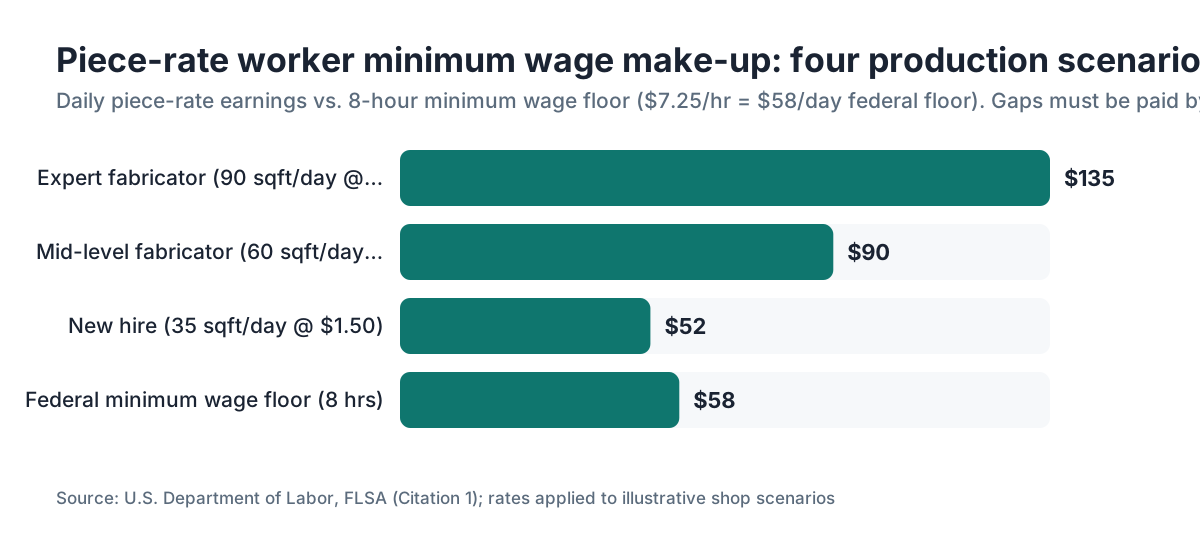
Once you have a target rate, run it against your minimum wage obligation. If your fastest worker produces 60 sqft of edge-polished material in an 8-hour shift at $1.20/sqft, they earn $72 for the day, or $9.00/hr, clear of the federal floor. But if a slower new hire does 35 sqft in 8 hours, they earn $42, or $5.25/hr, below the $7.25 federal minimum. You have to top them up. Build that makeup cost into your rate-setting math.
How do you handle overtime for piece-rate fabricators?
The half-time method is what the FLSA prescribes for piece-rate overtime, and it pays to understand it exactly, because getting it wrong is one of the most common wage violations in manufacturing [3].
Step 1: Add up all piece-rate earnings for the workweek. Step 2: Divide by all hours worked, overtime hours included. That gives you the regular rate. Step 3: Multiply the regular rate by 0.5 to get the overtime premium per hour. Step 4: Multiply that premium by the number of overtime hours. Step 5: Add the premium to total piece-rate earnings. That's the paycheck.
This differs from the hourly overtime method, where you'd multiply the regular rate by 1.5 for every overtime hour. With piece rate, the piece earnings already pay for the time worked during overtime hours, so you owe the extra half-time premium, not a full 1.5x on those hours [8].
Some shops dodge overtime by keeping piece-rate workers under 40 hours. That's legal but painful during busy stretches. A better move is to set piece rates that keep labor cost predictable even in overtime weeks. If your margin can absorb the premium, let people work it. If it can't, the problem is your pricing, not your pay structure.
Do piece-rate workers still get paid for downtime and breaks?
Yes, and this is where shops quietly build liability. Under the FLSA, compensable time covers any time an employee is "suffered or permitted to work," including time waiting for a machine to be repaired, waiting for a slab delivery, or sitting in a safety meeting [4]. You cannot legally pay zero for those hours just because no pieces got made.
For rest periods of 20 minutes or less, federal law requires you to pay the employee. Bona fide meal breaks of 30 minutes or more, where the employee is completely relieved of duties, do not have to be paid [4].
California goes further. Assembly Bill 1513 (2015) codified that piece-rate employees get separate, additional pay for rest and recovery periods and other non-productive time, at a rate no less than the applicable minimum wage or the employee's average piece-rate earnings for the pay period, whichever is higher [2] [10]. If you're in California and you haven't restructured your piece-rate agreements to track and pay non-productive time on its own line, you have exposure.
The practical fix for most shops outside California is to set piece rates generous enough that even on slow, downtime-heavy days, workers clear minimum wage for every hour clocked. Machine goes down for two hours and a worker makes nothing? You still owe those two hours at minimum wage. Log the downtime. Pay it. Move on.
How do you track piece-rate production accurately enough to pay it?
Production tracking is the unglamorous part that makes or breaks a piece-rate system. Without it, you're either overpaying workers who pad their counts or underpaying workers who can't prove what they made. Both wreck trust.
The minimum viable system is a daily paper tally sheet per worker: date, name, task, quantity, plus a lead or supervisor signature to verify it. You enter those into a spreadsheet weekly before payroll runs. It works. It's also slow, error-prone, and miserable to audit.
Better shops tie production tracking to their job management software. When a job is cut and checked off as complete, the square footage from the cut sheet ties straight to the worker who ran it. Software that connects templating, quoting, and shop floor tracking makes this far cleaner. SlabWise, for one, tracks square footage and job status through the quoting and production workflow, which hands you the per-job output data you need for accurate piece-rate payroll without a separate tally process. That kind of connection matters more than most shops realize until they're reconciling 200 line items by hand before a Friday payroll run.
Whatever system you use, keep records for at least three years. The FLSA requires employers to retain payroll records, including piece-rate records, for at least three years, and the records used to compute wages for at least two [5].
What are the advantages of piece rate over hourly pay for a fab shop?
The biggest real advantage is knowing your labor cost per square foot before the job hits the floor. Pay by the piece and that number is fixed. Hourly labor cost per square foot swings with machine downtime, speed differences between workers, and job complexity, and those swings are hard to forecast.
Piece rate also cuts the supervisory load on throughput. You don't need a manager hovering over a saw operator counting pace. The paycheck does that. Workers manage their own output because it lands directly in their income. In trade, you shift supervisory effort toward quality inspection, which is where it probably belonged all along.
For experienced fabricators, piece rate can mean a lot more take-home. A skilled granite fabricator who reliably cuts and finishes 90 sqft a day at $1.50/sqft earns $135 a day from piece rate alone, about $16.88/hr on an 8-hour shift, likely more than the hourly rate you'd post for the same job in most markets.
The system also surfaces your slowest workers. That's uncomfortable and useful at the same time. Someone who can't clear minimum wage on piece rate is telling you something about their fit for production.
What are the risks and downsides of piece-rate pay in fabrication?
Quality degradation is the most common failure. Workers optimizing for output per hour skip a second pass on an edge, rush a cutout, or ignore a hairline crack that should have been flagged. Your inspection process has to catch that before it becomes a callback or a broken countertop in someone's kitchen. Build rework into the economics: if a worker's piece has to be redone, they shouldn't get paid for it, but you need a clear, fair process for deciding fault before you dock anyone.
Safety is the second concern. OSHA has long tied production pressure to higher injury rates when safety culture is weak [6]. Workers hurrying to cut more sqft per hour take shortcuts with blade guards and lifting. Your safety program has to be non-negotiable and enforced apart from the piece-rate system.
There's a morale risk when rates aren't set fairly. If workers think the rates are impossible to live on, or set to squeeze more work out of them for the same money, you get turnover and resentment. Set rates in the open. Show workers the math. Give them a path to earn more as they get faster.
Administrative complexity is real too. Piece-rate payroll is harder than hourly. Minimum wage makeup, overtime premiums, non-productive time, and multi-rate weeks (a worker who cuts and installs in the same week) all take careful math. If your payroll system can't handle it, you'll do it by hand, and by hand means errors.
Can you use multiple piece rates in the same week for one employee?
Yes, and it's common in shops where people do more than one task. A worker might cut slabs in the morning and install in the afternoon, each with its own piece rate. Paying multiple rates in a single workweek is legal under the FLSA. The overtime calculation just gets more involved [11].
The FLSA allows two methods for multi-rate overtime [11]. First is the weighted average: add up all earnings from all rates for the week, divide by total hours, and use that blended regular rate to figure the overtime premium. Second is the rate-in-effect method: pay 1.5x the rate in effect during the actual overtime hours. That second method requires a written agreement with the employee ahead of time.
Most shops use the weighted average because it doesn't need a written agreement for every task. But you have to track which hours went to which task, because the calculation needs total earnings by task to blend the rate correctly.
This is another spot where production tracking software earns its keep. Rebuilding by hand which worker did what task for how many hours across a 48-hour week is slow and easy to botch. Automated job assignment logs make multi-rate overtime fast and auditable.
How do piece rates affect workers' compensation and payroll taxes?
Piece-rate wages are ordinary wages for tax purposes. You withhold federal income tax, Social Security (6.2% employee share, 6.2% employer share), and Medicare (1.45% each) on all piece-rate earnings, same as hourly wages [7]. No special treatment.
For workers' compensation insurance, most states set premiums on total payroll, and piece-rate wages count as payroll. The classification code for the job (fabricator, installer) sets the rate, not the pay structure. If a piece-rate fabricator earns more because they produce more, your workers' comp premium climbs with it. Model this before you switch from hourly to piece rate. If piece rate lifts total payroll 15% because workers produce more, your workers' comp cost goes up about 15% too. That can still be a net win, but count it.
Some states have specific workers' comp rules for piece-rate workers, especially around computing the "average weekly wage" for an injured worker's benefit. Check with your state's workers' compensation board or your broker before you assume the standard formula applies.
How do you introduce piece-rate pay to an existing crew without losing people?
Don't flip the switch on a Monday with no warning. Moving from hourly to piece rate changes the employment relationship, and how you handle it decides whether your best people stay.
Run a shadow period first. For four to six weeks, track what each worker would have earned under the proposed piece rates without actually changing their pay. Show them the numbers. If your rates are fair, most experienced workers will see they'd earn the same or more. If the shadow period shows certain workers taking a pay cut, the problem is your rate setting, not the worker.
Be transparent about the math. Explain how the minimum wage guarantee works. Explain how overtime is calculated. Put it in writing. The FLSA doesn't require a written piece-rate agreement, though some states require written disclosure of pay rates before work begins, and a written agreement protects both sides from later fights.
Give workers input on the rate structure, especially task definitions. Someone will argue whether a particular edge profile counts as "simple" or "complex." Define those categories before you start paying, not after.
For new hires, piece rate with a training-period floor is common. A new fabricator might get their piece-rate earnings or a minimum hourly floor (say $16/hr), whichever is higher, for the first 90 days. That protects them while they build speed and protects you from someone quitting after 60 days because they can't make rent on trainee production.
What records do you need to keep for piece-rate compliance?
The FLSA requires specific records for piece-rate workers. According to the Department of Labor Wage and Hour Division, required records include the employee's full name and social security number, address, occupation, the time of day and day of week the workweek begins, total daily or weekly straight-time earnings, total overtime pay for each workweek, total wages paid each pay period, and the date of payment [5].
For piece-rate workers specifically, you also need records showing the pieces or units produced, the rate per piece, and enough detail to verify that minimum wage and overtime calculations were done right.
Retention: payroll records (amounts and periods of payment) for three years. Records used to compute wages (time cards, work schedules, piece-rate count sheets) for two years [5].
Digital records are fine. Cloud backups beat filing cabinets. Whatever the format, those records have to be retrievable on short notice if the DOL shows up. In fiscal year 2022, the DOL's Wage and Hour Division recovered over $154 million in back wages for workers across manufacturing and other industries, often from exactly the overtime and minimum wage errors piece-rate shops make [3].
For a clean, auditable record of what each fabricator produced each day, connecting your shop floor production data to your quoting and job management system is the most reliable route. That connection also makes it easy to confirm the square footage on a worker's tally sheet matches the square footage on the cut sheet for that job.
Are there alternatives to pure piece rate that work well for fabrication shops?
Pure piece rate isn't the only option, and it isn't always the best one. Many shops run hybrid models that keep the incentive without the full administrative load or quality risk.
Hourly plus production bonus is the simplest hybrid. Workers get a base hourly wage plus a bonus tied to shop output above a threshold. For example: $18/hr base, plus $0.40 per sqft above 500 sqft of shop output per day. The bonus is cheaper to administer than true piece rate because you calculate one number for the whole shop or team instead of individual counts. The trade is a weaker individual incentive.
Team piece rate splits a pool among a crew. If the grinding and polishing crew earns $1.20/sqft collectively and they finish 200 sqft in a day, the $240 pool splits proportionally among crew members. This softens the pressure to rush individually while keeping the production incentive for the team, and it cuts tracking complexity.
Job-completion bonuses pay a flat amount when a job finishes on time and passes quality inspection. A kitchen that finishes in 4 hours against a 5-hour estimate pays a $40 bonus split among the crew. This ties incentive to finishing jobs rather than raw output, which matters more when your bottleneck is throughput time, not square footage per day.
For shops running a mix of countertop installation and fabrication, install crews usually do better on flat per-job rates than per-square-foot rates, because install time varies more with layout complexity, site conditions, and cutouts than with raw square footage.
Frequently asked questions
Is piece-rate pay legal for countertop fabrication workers?
Yes. Piece-rate pay is legal under the Fair Labor Standards Act for most employees, fabrication shop workers included. The law doesn't restrict the pay method, but it requires that piece-rate workers earn at least the federal minimum wage for every hour worked and receive overtime for hours over 40 in a workweek. State laws can add requirements, particularly in California.
What happens if a piece-rate worker doesn't earn minimum wage in a given week?
You make up the difference. If a worker's piece-rate earnings divided by hours worked fall below the applicable minimum wage (federal $7.25/hr, or your state's higher rate), you owe additional pay to bring them to that floor. This makeup pay is required by the FLSA and cannot be waived by agreement. Skipping it is a wage violation that carries back pay and penalties.
How do you calculate overtime for a piece-rate fabricator?
Use the FLSA's half-time method. Add up all piece-rate earnings for the workweek, divide by total hours worked to get the regular rate, then multiply that rate by 0.5 for the overtime premium per hour. Multiply the premium by the number of overtime hours and add it to total piece-rate earnings. The piece earnings already cover the time worked in overtime hours, so you owe only the added half-time premium.
Do piece-rate workers get paid for machine downtime or safety meetings?
Yes. The FLSA requires pay for any time an employee is required to be at work, including waiting time when the wait benefits the employer. A machine breaks down and a worker waits for repairs? That time is compensable. Safety meetings and mandatory training count too. You cannot offset those hours against piece-rate earnings; you owe wages for the time even if no pieces got made.
What piece-rate records am I required to keep under federal law?
The Department of Labor requires payroll records for at least three years and the records used to compute wages, including piece-rate count sheets and time records, for at least two years. Records have to include the employee's name, occupation, hours worked, pieces or units produced, rate per piece, and enough detail to verify minimum wage and overtime compliance. Digital records are acceptable.
Can I pay a fabricator different piece rates for different tasks in the same week?
Yes. The FLSA allows multiple piece rates in a single workweek. For overtime, use the weighted average method: add all earnings from all tasks, divide by total hours worked for the blended regular rate, then figure the half-time overtime premium on that rate. Alternatively, with a prior written agreement, pay 1.5x the rate in effect during the actual overtime hours. The weighted average is more common.
How do you set a fair piece rate per square foot for granite fabrication?
Start with your actual blended labor cost per square foot from recent payroll and production records. Set piece rates below that number, since output per hour usually rises under piece rate. Verify that even your slowest workers can clear minimum wage at realistic speeds. Run a shadow period for four to six weeks before switching pay so workers see projected earnings and you can calibrate rates before they go live.
Does California have special rules for piece-rate employees?
Yes. California Labor Code Section 226.2, effective January 2016, requires piece-rate employers to pay separately for rest and recovery periods and other non-productive time at no less than the applicable minimum wage or the employee's average piece-rate earnings for the pay period, whichever is higher. Standard piece-rate agreements that lump all time together don't satisfy this. California employers also face the state's higher minimum wage floor, so check the current schedule.
How does piece-rate pay affect workers' compensation premiums?
Piece-rate wages count as payroll for workers' comp premium calculations in most states. If piece-rate incentives raise total payroll because workers produce more and earn more, your premium rises with it. The classification code for the job (fabricator, installer) sets the rate; the pay structure doesn't change the code. Model the workers' comp cost impact before converting from hourly to piece rate.
Should installation crews be paid by piece rate or a flat job rate?
Flat per-job rates usually beat per-square-foot piece rates for install crews. Install time varies more with site conditions, number of cutouts, layout complexity, and access than with raw square footage. A flat rate per job (or per job type) is simpler to administer and ties the crew's incentive to finishing the job cleanly and on time instead of rushing through footage.
Can I dock piece-rate pay for defective or rejected work?
You can withhold piece-rate pay for pieces that fail quality standards, but tread carefully. You cannot cut an employee's earnings below minimum wage through deductions or withheld piece rates. Any rejection policy has to be defined in writing before work begins, applied consistently, and based on an objective standard. Arbitrary or retaliatory rejections create legal exposure. Build a documented quality-check process before you set any rejection policy.
What is the best way to track piece-rate production in a small shop?
At minimum, use a daily tally sheet per worker signed by a supervisor and tied to the cut sheet for each job so counts can be verified. Better shops link production tracking to job management software so completed square footage automatically ties to the worker who ran it. That kills end-of-week reconciliation disputes and builds a clean audit trail for payroll records and Department of Labor compliance.
Does switching to piece rate from hourly pay require a new employment agreement?
Federal law doesn't mandate a written piece-rate agreement, but several states require written disclosure of pay rates before work begins. Even where it isn't required, a written agreement spelling out how rates are set, how overtime is calculated, how non-productive time is paid, and what happens with rejected work protects both parties. At a minimum, put the rate structure in writing and have employees acknowledge it before the first piece-rate paycheck.
How do I handle a week where a piece-rate worker was partly sick or on leave?
Sick or leave time is typically paid at the base rate or the applicable paid leave rate under your policy and state law, not piece rate, since no pieces are produced. For that week's overtime calculation, include only hours actually worked and earnings actually generated from pieces. Don't average in leave hours, which would dilute the regular rate. Keep leave hours and piece-rate hours clearly separated in payroll records.
Sources
- U.S. Department of Labor, Wage and Hour Division, Fair Labor Standards Act: Piece-rate workers must earn at least minimum wage for all hours worked and receive overtime at a rate calculated using the half-time method on their regular rate of pay.
- California Legislative Information, Labor Code Section 226.2: California requires piece-rate employers to separately compensate rest and recovery periods and non-productive time at no less than the higher of minimum wage or the employee's average piece-rate for the period.
- U.S. Department of Labor, Wage and Hour Division, enforcement data: In fiscal year 2022, the DOL Wage and Hour Division recovered over $154 million in back wages for workers, frequently from overtime and minimum wage calculation errors.
- U.S. Department of Labor, Wage and Hour Division, Fact Sheet #22: Hours Worked Under the FLSA: Rest periods of 20 minutes or less are compensable work time under the FLSA; bona fide meal breaks of 30 minutes or more where employees are completely relieved of duties are not.
- U.S. Department of Labor, Wage and Hour Division, Fact Sheet #21: Recordkeeping Under the FLSA: Employers must retain payroll records for at least three years and records used to compute wages, including piece-rate count sheets, for at least two years.
- U.S. Department of Labor, Occupational Safety and Health Administration: Production incentive pressure is associated with higher injury rates where safety culture is weak, which is why safety programs must be enforced separately from incentive pay.
- IRS, Publication 15 (Circular E), Employer's Tax Guide: Piece-rate wages are ordinary wages subject to standard federal income tax withholding, Social Security, and Medicare tax at the same rates as hourly wages.
- U.S. Department of Labor, Wage and Hour Division, Fact Sheet #23: Overtime Pay Requirements of the FLSA: The FLSA's half-time method allows piece-rate workers' overtime premium to be calculated as an additional 0.5x the regular rate for overtime hours, since piece earnings already compensate for time worked in those hours.
- U.S. Department of Labor, Wage and Hour Division, overtime pay guidance: Non-exempt employees, including piece-rate workers, are entitled to overtime pay regardless of how their wages are structured.
- California Department of Industrial Relations, Division of Labor Standards Enforcement: California Assembly Bill 1513 (2015) established the requirement that piece-rate employees be paid for rest periods and other non-productive time separate from piece-rate earnings.
- U.S. Department of Labor, Wage and Hour Division, Fact Sheet #56C: Bonuses and the Regular Rate: When an employee is paid two or more piece rates in the same week, the regular rate for overtime is the weighted average of all piece-rate earnings divided by all hours worked.
Last updated 2026-07-10