TL;DR
- Laminated edge buildup is a strip of the same stone glued to the underside of a countertop edge so it looks thicker than the raw slab.
- Most fabricators use it to make a 1.5-inch edge from a 3/4-inch or 1.25-inch slab.
- It's standard on granite, quartz, and quartzite.
- Nearly every kitchen island and waterfall edge you see uses it.
What exactly is laminated edge buildup on a countertop?
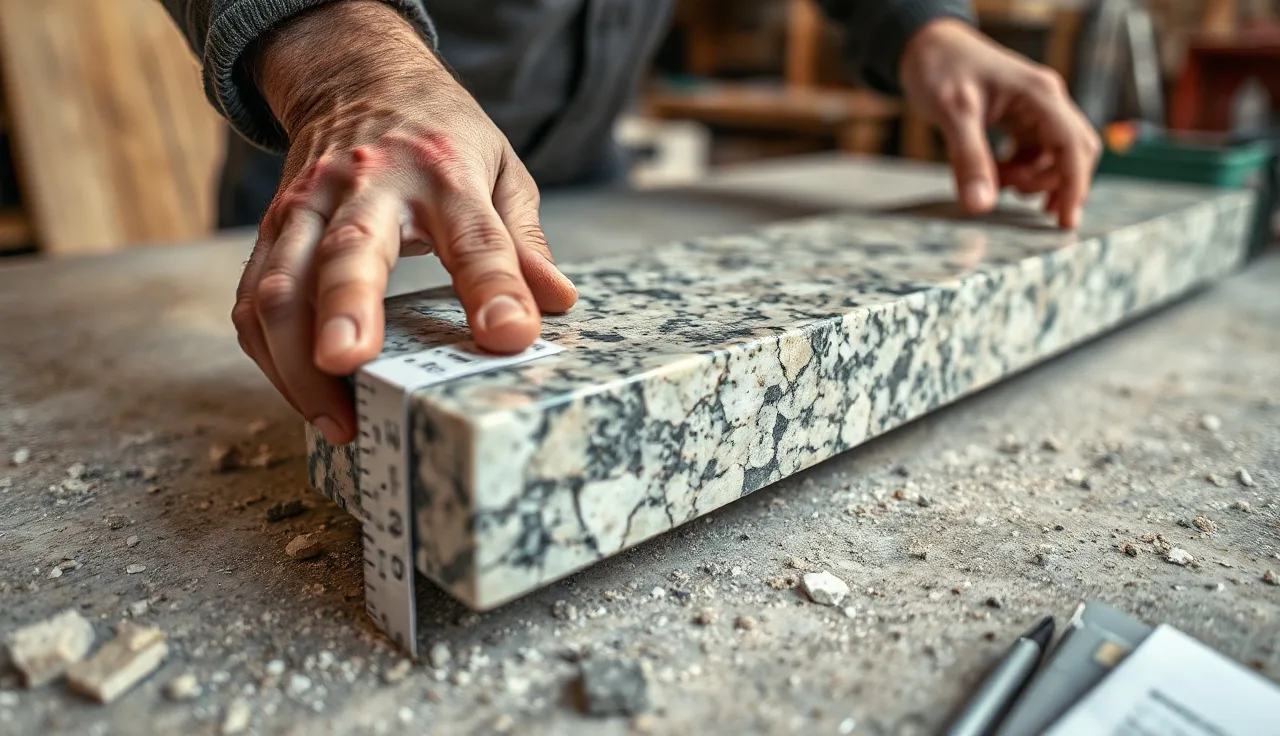
Laminated edge buildup is a separate strip of stone bonded to the front underside of a slab so the finished edge looks thicker than the raw material actually is. The slab might be 3/4 inch or 1.25 inches thick. After the buildup strip is glued and polished, the edge reads as 1.5 inches, 2 inches, or even 4 to 5 inches for waterfall and furniture-style looks.
The word "laminated" here has nothing to do with plastic laminate countertops like Formica. It just means layered, bonded together. The strip is usually cut from the same slab so the color and veining match as closely as possible, then it's epoxied in place and the seam is polished flat so it vanishes into the edge profile.
Fabricators also call this a "build-up," "eased edge build-up," "mitered build-up," or just "laminated edge" depending on region and shop culture. Same basic thing every time: extra thickness added at the perimeter to change how the finished edge looks and feels.
Why do fabricators use edge buildup instead of just buying thicker stone?
The short answer is cost and availability. Standard slab thickness from most quarries and distributors runs at either 2 cm (roughly 3/4 inch) or 3 cm (roughly 1.25 inches) [1]. Slabs thicker than 3 cm exist, but they're rare, expensive to ship because of the weight, and hard to handle in most shops. A single 5 cm granite slab, if you could even source it, would cost two to three times the material and demand specialized lifting gear.
Buildup skips all of that. The fabricator cuts a strip from offcut material or the same slab, bonds it under the front edge with polyester or epoxy adhesive, and grinds the seam smooth. The result looks identical to a solid thick slab from any normal viewing angle. Nobody standing at your kitchen island can tell the difference.
There's a weight argument too. A true 5 cm slab across a 10-foot island would weigh a lot more than a 3 cm slab with a laminated edge, putting more stress on the cabinet substrate and making the install harder. Buildup keeps overall slab weight manageable while still giving you the thick, substantial edge that most designers and homeowners want.
For laminate countertops and similar sheet-goods products, a different kind of buildup (usually MDF or particleboard) gets used at the substrate level, but the visual principle is the same. The edge needs to look thicker than the core material actually is.
What are the common edge buildup thicknesses and configurations?
Most residential countertop work uses one of three buildup configurations:
| Configuration | Raw Slab | Buildup Strip | Finished Edge Appearance |
|---|---|---|---|
| Standard 1.5" | 3 cm (1.25") | ~0.25" strip | 1.5" total |
| Standard 1.5" | 2 cm (0.75") | ~0.75" strip | 1.5" total |
| Thick/mitered 2"+ | 3 cm (1.25") | 0.75"+ strip | 2" or more |
| Furniture/waterfall | 3 cm (1.25") | 3"+ strip(s) | 4", 5" total |
The 1.5-inch finished edge is by far the most common in American kitchens. Most cabinet heights assume it. Many designers spec it as a default. When a homeowner sees a granite or quartz countertop at a showroom and thinks it looks "solid," they're almost always looking at a 3 cm slab with a laminated buildup.
The thick mitered or waterfall look (4 to 5 inches of apparent thickness) takes more strip material and a 45-degree miter joint rather than a simple flat glue joint. That's a more demanding process, and it shows up most often on kitchen islands, high-end bath vanities, and commercial jobs.
Full-thickness solid edges cut from a single very thick slab do exist, mostly in commercial or ultra-luxury residential, but they're the exception. For most kitchen countertops, laminated buildup is simply how a thick edge gets done.
When is laminated edge buildup actually required?
Sometimes buildup isn't optional. It's the only way to hit the result the design calls for or the install requires. Four situations force the issue.
First: any time the design calls for an edge thicker than your slab. If the spec says 1.5-inch edge and you're running 2 cm slab, buildup is required. Full stop. There's no other way to reach that dimension with a single layer of stone.
Second: undermount sinks. Most undermount installations need the countertop reinforced and thickened at the sink cutout so there's enough material for the sink clips to grab and enough mass to avoid cracking over time. Fabricators often add a buildup strip around the inside perimeter of the cutout specifically for this, even when the main edge shows no visible buildup.
Third: waterfall edges. A waterfall edge runs the stone vertically down the side of a cabinet to the floor or near it. The vertical panel and the horizontal top need to look continuous and thick. That takes a mitered joint with a buildup strip, or in some designs a separate bonded piece. Skip the lamination and the vertical panel's edge looks thin and cheap.
Fourth: overhangs past code recommendations. Natural Stone Institute guidance notes that unsupported overhangs on 3 cm stone should generally not exceed 12 inches without added support [2]. If a design calls for a longer overhang (say, a 15-inch bar seating ledge), a laminated buildup on the underside can help spread the load and cut flex stress. At that point you're also looking at corbels or hidden steel, depending on the stone.
For granite countertops, buildup is nearly universal at undermount sinks. Granite is strong but brittle, and the extra material around the cutout measurably lowers the risk of cracking from point loads.
When is buildup optional or even a waste of money?
Not every countertop needs edge buildup, and pushing it on clients who don't need it is a real thing in the trade.
If the design calls for a thin, modern edge (an eased or beveled edge on 3 cm stone at full 1.25-inch thickness), buildup adds cost for no visual benefit. The thin-edge look is popular in contemporary and minimalist kitchens precisely because it feels lighter and more refined.
Bathroom vanities with above-counter vessel sinks rarely need buildup. The sink sits on top, not underneath, so there's no cutout to reinforce. The counter doesn't need to look thick from the side because the vessel dominates the view anyway.
Laundry rooms, garage shop counters, and utility surfaces almost never need buildup. Function over form. Nobody's studying the edge thickness in a laundry room.
Drop-in (self-rimming) sinks don't need buildup around the cutout the way undermount sinks do, because the sink rim covers and supports the cutout edge.
For butcher block countertops and solid wood surfaces, buildup isn't usually done the same way. Wood counters are often made thick from the start (1.5 inches or more of solid wood), so the visual thickness is built in. Some shops laminate thinner butcher block panels edge-to-edge for wider surfaces, but that's a different construction entirely.
For Corian countertops and other solid surface materials, buildup works differently too. Solid surface uses the same material bonded with color-matched adhesive, and because it's workable and repairable in ways stone isn't, fabricators sometimes rout and bond more freely.
How is a laminated edge buildup actually made in the shop?
The process isn't complicated, but it lives or dies on fit and cure time.
The fabricator cuts a strip from the same slab, usually on the CNC machine or a bridge saw. Strip width gets calculated to hit the target finished thickness. On a 3 cm slab with a 1.5-inch target, the strip needs to be roughly 6 to 8 mm wide, allowing for the grind pass that flushes everything up.
The mating surfaces (the bottom face of the slab edge and the top face of the strip) get cleaned, dried, and lightly abraded. Then a two-part epoxy or polyester adhesive is mixed, often with color pigment to match the stone, and applied to both faces. The strip is clamped or wedged in place and left to cure. Cure time for most stone-fabrication epoxies is 30 to 90 minutes before safe handling, and full strength takes longer [3].
After cure, the shop grinds the seam flush with an angle grinder or CNC toolpath, then runs the finished edge profile (bullnose, ogee, beveled) across the full stacked thickness. Done right, the seam disappears after polishing. Done poorly, with mismatched epoxy color, weak clamping, or a rushed cure, the seam shows as a line, a gap, or a color mismatch.
Mitered buildups for waterfall edges need even more precision. The 45-degree cuts on both pieces have to be exact, because any gap grows after polishing. Most experienced fabricators dial in their miter on a test piece before touching the client's material.
Shops running quoting and production software (like SlabWise) often tag buildup as its own line item, because the labor to cut, glue, cure, and finish a strip is real and shouldn't get buried in a generic "edge profile" price.
How much does laminated edge buildup add to countertop cost?
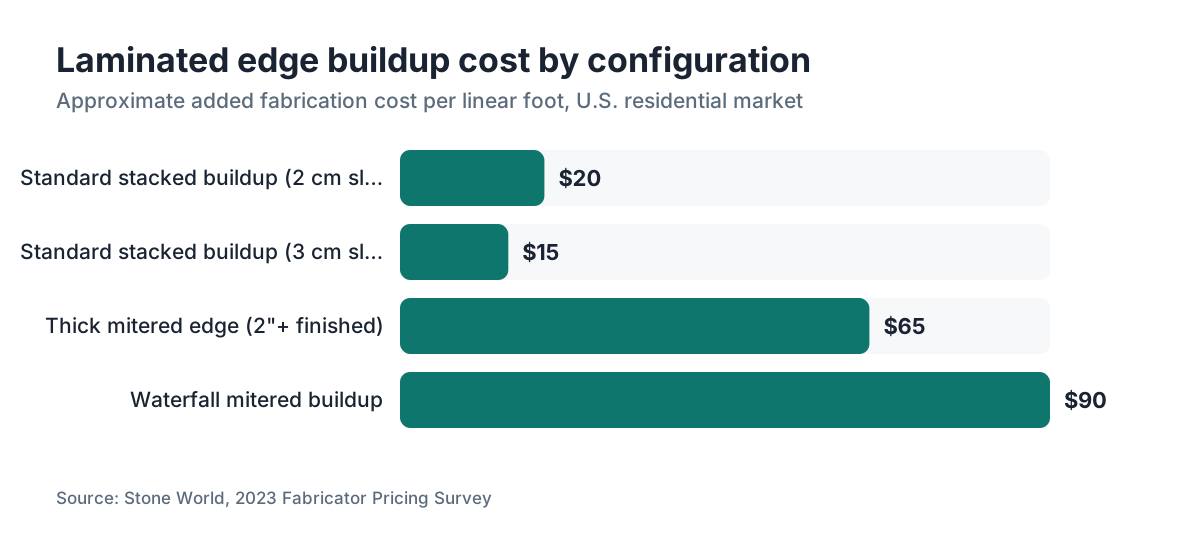
Edge buildup is almost always a line-item add-on, not part of the base slab price. A standard laminated buildup on granite or quartz typically adds $10 to $25 per linear foot to fabrication cost [4]. Mitered waterfall buildups take more labor and can run $50 to $100 per linear foot or more, especially in high-cost markets.
On a typical kitchen with roughly 25 linear feet of perimeter edge needing buildup, that's $250 to $625 added to the quote for a standard configuration. A full waterfall island with mitered drops on both sides can add $800 to $1,500 or more in buildup and edge work alone.
Nobody has clean national data on this. The ranges above come from published shop pricing sheets and fabricator trade discussion rather than a formal study, so treat them as directional. Your actual quote depends on your local market, the stone type, and the profile complexity.
For marble countertops, buildup pricing runs close to granite, but marble's softness means more careful handling during glue-up and grinding, which some shops price at a small premium. For Cambria countertops and other engineered quartz, pricing usually lands in the same range as granite since the steps are essentially identical.
One honest note. Some shops quote buildup "included" in their edge profile price, meaning they've baked it into the per-foot edge rate. Always ask whether the quote counts buildup material and labor separately. If a salesperson lines up two quotes, one with buildup included and one without, those two numbers aren't measuring the same thing.
Does laminated edge buildup affect countertop durability or structural integrity?
Done correctly, a laminated edge buildup is structurally sound for normal kitchen use. The epoxy bond between slab and strip can exceed the tensile strength of the stone itself in some directions [5]. If something fails, the stone cracking is more likely than the glue joint opening.
There are real failure modes worth knowing. A strip that wasn't clamped evenly during cure can carry voids in the adhesive layer, which shows up later as a visible crack or a section that rings hollow when tapped. Strips too thin for the overhang they're meant to reinforce can still crack under a heavy load at the overhang edge.
Moisture matters too, especially in wet areas. If the epoxy joint takes repeated water exposure (say, around a sink where the caulk has failed), some adhesive formulas soften over years and the strip can work loose at the bottom corner. This doesn't happen fast, and it's almost always the result of deferred maintenance (failing caulk left unrepaired), not a fabrication defect.
For structural overhangs, buildup alone isn't a substitute for real support. The Natural Stone Institute specifies support requirements for cantilevered stone that go beyond edge thickness [2]. Planning a seating overhang longer than about 12 inches on a 3 cm slab? Ask your fabricator about corbels or hidden steel brackets. The buildup helps, but it isn't the primary structural answer.
Bottom line: a properly executed buildup on a well-supported countertop outlasts the kitchen. A rushed glue job on an undersupported overhang is a problem waiting to happen.
Can you see the seam on a laminated edge buildup?
On a professionally fabricated countertop with color-matched epoxy and good polishing, no. You genuinely can't see the seam under normal viewing. The join line sits at the very bottom of the visible edge face, and on most profiles (bullnose, ogee, beveled) the geometry of the profile crosses that line and hides it.
On a flat-polished edge (also called a pencil edge or eased edge), where the whole front face is one flat plane, a seam line is theoretically visible if you go looking for it. With matched epoxy it's still very subtle.
Mismatched epoxy color is the most common reason a seam shows. Stone varies, and one tube of beige epoxy doesn't match every beige stone. Good fabricators mix custom epoxy colors by eye to match the specific slab. When they don't bother, you get a gray or tan stripe running horizontally across the edge. Not structurally bad, just obvious.
Veining mismatch is the second issue. Stone with strong linear veining (think Calacatta marble or a heavily veined quartzite) shows the buildup strip as a break in the vein pattern even when the epoxy color matches perfectly. Experienced fabricators cut the strip from an area of the slab with matching vein direction and density, but perfect alignment is impossible on highly veined stone. Some designers deliberately spec a thin eased edge on dramatic stones for exactly this reason. It sidesteps the buildup problem entirely.
For marble countertops and heavily veined quartzite, this is worth talking through with your fabricator before you commit to a thick built-up edge.
Is laminated edge buildup different from a mitered edge?
Yes, though they're related. A mitered edge is a specific type of laminated buildup. In a standard stacked buildup, the strip is glued flat to the underside of the slab and the two pieces meet at a horizontal seam. In a mitered buildup, both the slab edge and the strip are cut at 45 degrees so they meet in a V, tucking the seam inside the joint and making the transition nearly invisible.
A mitered buildup gives a cleaner result on very thick edges (2 inches and up) and is required for waterfall edges where the horizontal top and the vertical panel need to flow together. The miter hides what would otherwise be an obvious horizontal glue line mid-face on a 4-inch edge.
Mitered work costs more because the cuts have to be precise. A 45-degree miter on stone can't be shimmed or caulked to hide a poor cut the way wood can, and the glue-up needs more careful clamping and fixturing. Some shops charge 50 to 100 percent more per linear foot for mitered waterfall work than for a standard stacked buildup.
Not every thick edge needs a miter. A 1.5-inch stacked buildup on 3 cm stone works fine with a flat glue joint because the seam sits so close to the bottom of the profile that geometry hides it. Once you hit 2 inches or more, or you're doing a waterfall, the miter is worth paying for.
For details on how your specific job gets executed, the countertop installation guide covers field conditions and what to watch for on install day.
Does every stone type handle edge buildup the same way?
Mostly the same in process, but material properties create differences worth knowing.
Granite handles buildup extremely well. It's hard, dimensionally stable, and bonds reliably with epoxy. The main challenge is color-matching epoxy to the wide range of granite colors and patterns. The structural bond is rarely a worry.
Quartz (engineered stone) is just as straightforward. Brands like Cambria, Caesarstone, and Silestone are made to consistent thickness tolerances, which makes cutting accurate buildup strips easier than working with natural stone that varies slightly in thickness across a slab.
Marble and softer limestones are more fragile during the grinding and polishing phase after glue-up. Aggressive grinding to flush the seam can cause micro-fractures in softer material if the fabricator isn't careful. A good marble fabricator knows to use lighter passes.
Soapstone is dense and relatively soft. It's usually worked thick from the start (1.5 inches or more in raw slab form) because quarries tend to produce it that way, so buildup is less common. If you want soapstone care specifics, the how to clean soapstone countertops guide covers maintenance.
Quartzite (natural, not to be confused with engineered quartz) varies widely in hardness and porosity. Some quartzites are nearly as hard as granite. Others are softer, closer to marble. Buildup on quartzite works fine, but edge polishing on very hard quartzite takes longer and costs more in tooling. See the how to clean quartzite countertops guide if you're working with quartzite and want to understand the material better.
For sheet-goods materials like Formica countertops and other high-pressure laminates, the "buildup" is a wood or MDF substrate at the edge, wrapped in the laminate sheet. The concept matches (adding thickness at the edge), but the execution is nothing like stone work.
How do you know if your countertop quote includes edge buildup?
Ask directly. That's honestly the only reliable way.
Most fabricator quotes list edge profiles by name (bullnose, ogee, waterfall) and sometimes by price per linear foot. What they often don't clarify is whether the quoted price assumes a 2 cm slab (which needs more buildup strip) or 3 cm (which needs less), and whether the buildup labor and material sit inside the edge line item or ride as a separate add-on.
A quote that says "eased edge, $15/LF" might include a standard 3 cm buildup strip, or it might be priced for a 3 cm slab where the fabricator considers the native thickness enough and adds no buildup. You won't know without asking.
Some fabricators are very clean about this. They list "3 cm granite slab," "standard laminated buildup for 1.5" finished edge," and "eased edge profile" as three separate line items with separate prices. That's the transparent way to do it, and it makes comparisons easy. If your quote doesn't show buildup as a line, ask the fabricator whether the countertop will have a built-up edge and whether that's included in the price shown.
For shops using modern quoting software, buildup is increasingly a configurable option the estimator toggles per job rather than something buried in the edge rate. That's how you avoid the "but I thought it was included" conversation after the slab is already cut.
Frequently asked questions
Is laminated edge buildup standard on all countertops?
It's standard on most stone countertops where the design calls for a 1.5-inch or thicker finished edge, which covers the majority of American kitchen installs. It's not standard on thin-edge modern designs, vessel-sink vanities, utility counters, or materials like butcher block that come thick from the factory. Roughly 70 to 80 percent of residential stone jobs include some form of edge buildup, but no official industry survey has published an exact figure.
Can a laminated edge buildup fail or fall off?
Yes, though it's uncommon on properly executed work. Failure modes include voids in the epoxy from poor clamping, moisture intrusion at a failed caulk line over years, or a strip cut too thin for the overhang it supports. A well-bonded buildup on a supported countertop under normal use essentially never fails on its own. If you tap the edge and hear a hollow sound in a section, that's a sign of a void and worth flagging to your fabricator.
How thick should a laminated edge buildup strip be?
Strip thickness depends on the target finished edge depth and the raw slab thickness. On a 3 cm (1.25-inch) slab targeting a 1.5-inch finished edge, the strip needs to be about 6 to 8 mm wide after allowing for the grind pass. For thicker finished edges (2 inches or more), the strip is proportionally wider or multiple strips get stacked. Your fabricator calculates this from your slab and design spec.
Does edge buildup cost extra on a countertop quote?
Usually yes, though some shops bake it into the edge profile rate. A standard laminated buildup typically adds $10 to $25 per linear foot to fabrication cost. A mitered waterfall buildup can run $50 to $100 per linear foot or more depending on market and complexity. Always ask whether your quote counts buildup material and labor as a distinct item so you're comparing apples to apples across bids.
What glue is used for countertop edge buildup?
Most stone fabricators use two-part polyester or epoxy adhesive, often from brands like Integra Adhesives or Tenax. The adhesive is mixed with pigment to match the stone color. Polyester adhesives cure faster (30 to 60 minutes) and cost less. Epoxy adhesives generally have higher bond strength and better moisture resistance. The choice depends on shop preference, stone type, and application. Both are industry-standard for this use.
Can I add edge buildup to an existing countertop after it's installed?
Technically possible but rarely practical. Gluing a strip to an installed countertop means getting the adhesive and clamps to work in a finished kitchen, where access under the slab is limited and you can't flip the piece. The result is almost always worse than shop work. If your existing edge looks thin and you want it thicker, replacement or an edge-banding solution specific to your material is a more realistic path.
Does a waterfall countertop edge always need laminated buildup?
Yes, almost always. A waterfall edge needs the stone to look thick continuously from the horizontal top down the vertical side panel. Getting that look on a standard 3 cm slab requires a mitered laminated buildup at the joint between the horizontal and vertical pieces. Without it, the horizontal slab edge would look thin at the top of the waterfall drop, which defeats the whole point of the design.
Is edge buildup visible on quartz countertops?
Not if it's done correctly. Engineered quartz is made to tight color and pattern tolerances, which makes color-matching the epoxy easier than on highly variable natural stone. The seam on a well-executed quartz buildup is invisible under normal viewing. Consistent patterning in engineered quartz also means veining mismatch at the seam is less of a problem than with natural stone.
Do undermount sinks require edge buildup?
Fabricators often add a buildup strip around the inside perimeter of an undermount sink cutout even when the main edge shows no visible buildup. The extra material gives sink clips more to grab and adds mass at the cutout edge, reducing crack risk from point loads. On 2 cm slabs, this internal buildup around sink cutouts is essentially mandatory for structural reasons.
What is the difference between a laminated edge and a full-thickness slab edge?
A full-thickness edge is cut from a single slab already at the desired thickness throughout. That requires sourcing thick slabs (5 cm or more), which are rare, expensive, and heavy. A laminated edge reaches the same visible result by bonding a strip to a standard-thickness slab. Full-thickness edges show up mainly in very high-end or commercial work. Laminated buildup is the standard method for residential countertops.
How long does it take to fabricate and cure a laminated edge buildup?
Cutting and gluing the strip takes 20 to 45 minutes of direct labor per countertop section. Epoxy cure time before safe handling is typically 30 to 90 minutes. Full cure to maximum strength takes longer, with some products specifying 24 hours. Most shops schedule buildup so pieces cure overnight before the grinding and profile pass the next day. Total added time is roughly half a day in a countertop's production timeline.
Can laminated edge buildup be used on laminate (plastic laminate) countertops?
The concept is similar but the materials and method are completely different. Plastic laminate countertops like Formica use a wood or MDF substrate built up at the edge, then wrapped with the laminate sheet. This is called a "self-edge" or "post-formed edge" depending on configuration. It's done at the time of manufacture or fabrication and involves no stone adhesive. The visual goal (a thicker-looking edge) matches, but it's a different process.
Does edge buildup affect how an edge profile is cut?
No. The CNC router or hand profiler cuts the final edge profile after the buildup is glued and cured. The machine treats the stacked thickness as one piece and runs the profile (bullnose, ogee, beveled) across the full face in a single pass. This is one reason the finished buildup looks like solid stone: the profile grinding crosses and blends the seam line rather than leaving it exposed as a flat horizontal stripe.
Sources
- Natural Stone Institute, Slab Sizing and Thickness Standards: Standard commercial slab thicknesses are 2 cm (approximately 3/4 inch) and 3 cm (approximately 1.25 inches); thicker slabs are produced but are rare and expensive.
- Natural Stone Institute, Fabrication and Installation Standards for Countertops: Unsupported overhangs on 3 cm stone countertops should generally not exceed 12 inches without additional support such as corbels or steel brackets.
- Integra Adhesives, Stone Adhesive Technical Data Sheets: Cure time for polyester and epoxy adhesives used in stone fabrication is typically 30 to 90 minutes before safe handling, with full strength achieved after longer cure periods.
- Stone World, 2023 Fabricator Pricing Survey: Standard laminated edge buildup on granite or quartz adds approximately $10 to $25 per linear foot to fabrication cost in most U.S. markets.
- Tenax USA, Epoxy Adhesive Technical Guide for Stone: Two-part epoxy adhesives used for stone buildup bonds can exceed the tensile strength of some natural stone substrates when properly mixed and cured.
- Marble Institute of America (now Natural Stone Institute), Countertop Installation and Support Guidelines: Additional support mechanisms are required for stone countertop overhangs beyond specified limits, with buildup alone insufficient as a structural substitute for corbels or brackets.
- U.S. Geological Survey, Dimension Stone Statistics and Information: Dimension stone slabs including granite, marble, and quartzite are produced and sold in standard thickness grades; non-standard thicknesses represent a small fraction of U.S. production.
- Kitchen and Bath Industry Show (KBIS), Design Trend Report: Thick-edge countertop profiles including waterfall and furniture-style edges have been among the most consistently specified design trends in U.S. kitchen and bath design for several consecutive years.
- Caesarstone, Technical Installation Guide for Engineered Quartz: Engineered quartz countertops are manufactured to consistent thickness tolerances, and edge buildup for undermount sinks and thick-edge profiles follows the same adhesive bonding process as natural stone.
- Occupational Safety and Health Administration (OSHA), Silica Exposure in Stone Fabrication: Stone fabrication operations including cutting, grinding, and finishing countertop edges generate respirable crystalline silica dust, requiring engineering controls and respiratory protection under OSHA's silica standard (29 CFR 1910.1053).
Last updated 2026-07-10