TL;DR
- Homeowners buying countertops ask about five things more than anything else.
- What does the material cost (quartz runs $50 to $120 per square foot installed, granite $40 to $100).
- Which material holds up best.
- How long does installation take.
- Do I have to seal natural stone.
- And what makes one quote higher than another.
- This article answers all five, plus the follow-ups fabricators hear every day.
How much do countertops cost?
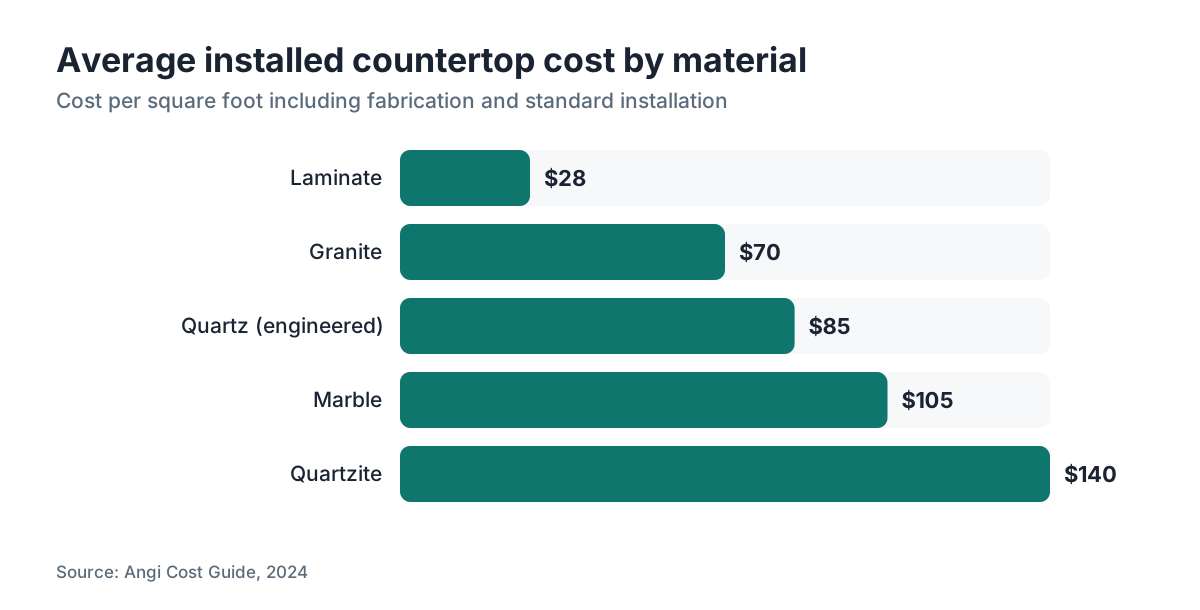
The range is wide, and honestly it should be. Laminate starts around $15 to $40 per square foot installed. Quartz sits at $50 to $120. Natural granite runs $40 to $100. Marble tends to land between $60 and $150. Quartzite, which buyers often confuse with quartz, can hit $80 to $200 because the slabs are harder to source and process. Those figures come from contractor and supplier surveys compiled by Angi, and they include a basic edge profile and a standard sink cutout. [1]
The number that surprises people is how fast the square footage stacks up. A typical kitchen has 30 to 40 square feet of countertop. At $80 per square foot for mid-grade quartz, that is $2,400 to $3,200 before a single upgrade. Add a waterfall island, a fancy edge, or a layout riddled with cutouts, and the bill climbs quick.
See the cost comparison chart below. Prices move with your region, the slab lot, and shop overhead, so treat these as starting points, not quotes.
If budget is driving the decision, laminate countertops and formica countertops are good products now, not the sad consolation prize they were in 1985. Modern laminate can fake stone convincingly and costs a fraction of the price.
What is the best countertop material for a kitchen?
There is no single best material. There is a best material for your situation, and finding it takes about five questions. How hard do you cook? Do you have kids? How much do you hate maintenance? What is your budget? And do you want something that looks perfect for twenty years, or something that earns a little character along the way?
For most households that want low maintenance and durability, engineered quartz (brands like Caesarstone, Silestone, or Cambria countertops) is the practical pick. It is non-porous, never needs sealing, shrugs off most stains, and comes in hundreds of colors. The tradeoff is heat. Set a hot pan directly on it and you can crack or discolor the surface. And it will never have the one-of-a-kind look of a natural slab.
For buyers who want natural stone, granite countertops are the workhorse. Granite is hard, heat-resistant, and every slab is different. It needs sealing once every one to three years depending on porosity, but day to day it handles a busy kitchen fine.
Marble countertops are beautiful, and they etch and stain if you cook acidic food on them. That is not a reason to skip marble. Just go in clear-eyed. A well-used marble counter shows its history. Some people love that. Others hate it by month six.
Butcher block countertops are warm, cheap, and safe for food prep when maintained. They scratch and can warp near a wet sink. They are also the only material you can sand and refinish yourself.
How long does countertop installation take?
The install itself is usually one day. A typical kitchen with one or two sections and a sink cutout takes three to six hours once the crew shows up with the finished slabs. [2]
The fuller timeline is longer. Most shops run this sequence: you sign a contract, book a template appointment (a laser or physical measure of your actual cabinets), the shop fabricates the slabs (usually five to ten business days after templating), then they install. Start to finish is often two to four weeks from deposit to install. Busy seasons in spring and early summer can stretch that to six weeks at some shops.
Before install day, the old tops come off, the plumber disconnects the sink and faucet, and you lose your kitchen for the day. After install, the plumber hooks everything back up. Budget an extra day without a kitchen on either side if you are coordinating plumbing.
We break the full process down in our countertop installation guide.
Do I need to seal my countertops?
It depends entirely on the material. Engineered quartz, laminate, solid surface like Corian, and porcelain tile never need sealing. They are non-porous by nature or by manufacturing. [3]
Natural stone is a different story. Granite, marble, quartzite, soapstone, and limestone are porous to varying degrees. A sealer soaks into the stone and temporarily fills those pores to slow liquid absorption. The key word is slow. A sealer is not a permanent waterproof coating. It buys you time to wipe a spill before it stains.
How often you reseal comes down to stone density and the product you use. A tight, dark granite might pass the water-bead test for three or four years. A soft white marble in a busy kitchen might need attention every year. The test is dead simple: drip water on the surface. If it beads up, the sealer is working. If the water absorbs and the stone darkens within a few minutes, it is time to reseal. [4]
For care on specific materials, the how to clean stone countertops guide covers the basics, and there are dedicated pages for how to clean quartzite countertops and how to clean soapstone countertops.
What affects the final price of a countertop quote?
Six things move the number in a real way.
Material comes first. A basic quartz color costs less than a premium lot of book-matched quartzite. Ask to see the actual slab before you commit.
Square footage is second. Bigger kitchens cost more, which is obvious. Less obvious is the cutout count. Each sink, cooktop, or outlet cutout adds $50 to $150 depending on the shop. [1]
Edge profile is third. A standard eased edge is usually baked into the base price. An ogee, waterfall, or mitered edge can add $15 to $40 per linear foot.
Thickness is fourth. Most residential stone is 3 cm (about 1.25 inches) thick. Cheaper jobs sometimes use 2 cm with a laminated edge to fake the heft. Thicker stone costs more, but it is also stiffer and less likely to crack during transport and install.
Layout complexity is fifth. An L-shaped kitchen with a peninsula, lots of seams, and an odd angle is harder to template and fabricate than a straight run of cabinets. Complexity adds labor.
Removal and disposal is sixth. If you are replacing old tops, ask upfront whether demo and haul-away is included. Many shops charge $150 to $400 to pull existing counters. Some do not offer it at all.
Fabricators who run software like SlabWise can turn out itemized quotes fast, which means you spend less time waiting and more time comparing real numbers instead of vague estimates.
What is the difference between quartz and quartzite?
This is the single most common point of confusion in any showroom, and some salespeople make it worse by treating the names as interchangeable. They are completely different products.
Engineered quartz (what most people just call quartz) is a manufactured slab made from roughly 90 to 95% ground natural quartz crystal, bound with polymer resins and pigments. [5] It is consistent, non-porous, and never needs sealing.
Quartzite is a natural metamorphic rock. It forms when sandstone gets cooked under heat and pressure until the quartz grains fuse. It gets quarried, cut, and sold as a natural stone slab. It is porous, it needs sealing, and it can look strikingly like marble. Quartzite is harder than marble too, so it resists scratches better, though some varieties still etch from acids.
The price gap reflects all this. Engineered quartz typically runs $50 to $100 installed. Quartzite, being rarer and harder to process, often runs $80 to $200. If a showroom is selling you quartzite at the same price as engineered quartz, start asking questions.
How do countertops affect home resale value?
Remodeling Magazine's Cost vs. Value report tracks renovation return on investment across U.S. metro markets, and it consistently shows a minor kitchen remodel returning more than a major one as a percentage of cost. The 2023 report found a mid-range minor kitchen remodel (which includes countertop replacement) returned about 85.7% of its cost at resale nationally. [6]
That does not mean every dollar you sink into countertops comes back. Buyers do notice material and condition, and worn or dated tops drag perceived value. But drop $15,000 on imported marble in a neighborhood where comparable homes sell with $3,000 laminate tops, and you will not see that money again at closing.
The practical rule: match the neighborhood. Look at what comparable homes near you have, then aim to sit at that level or modestly above. Going far past it rarely pays back at sale.
Can I install countertops myself?
For laminate and some tile, yes. Laminate sheet and post-form tops are DIY-friendly with basic carpentry skills, and many home improvement stores sell pre-cut sections that make a simple straight kitchen doable. Formica countertops have a long history as a DIY material.
For stone, the honest answer is almost certainly not. Natural stone and engineered quartz slabs weigh 15 to 20 pounds per square foot. [7] A 30-square-foot counter weighs 450 to 600 pounds in slab form. It takes specialized lifting gear, seaming tools, and real experience to cut cleanly without cracking. Bad installation also voids many manufacturer warranties on engineered quartz.
Plenty of homeowners do rip out their own old counters to save on demo. That part is genuinely manageable if you are comfortable disconnecting plumbing. Just coordinate with your fabricator first so demo happens at the right point in the workflow.
For solid surface materials like Corian countertops, install is a certified-installer-only situation for most manufacturers. The seaming technique needs brand-specific tools and adhesives.
How do I compare quotes from different fabricators?
Get at least three quotes, and make sure they are pricing the same thing. A quote that looks cheaper might leave out removal of old tops, the sink cutout, or an edge profile the others include.
Ask each shop for a line-item breakdown: material cost per square foot, fabrication labor, edge profile cost per linear foot, cutout charges, delivery and install fee, and any demo or haul-away cost. Once everything is itemized, you can actually compare.
Ask about the slab lot too. Two shops quoting quartz at the same price per square foot might be using entirely different grades. Ask to see the slab in the yard, not a small sample tile. Color and veining vary a lot from lot to lot.
Turnaround time is worth asking about. If one shop quotes three weeks and another quotes six, ask why. High volume and good software usually shorten lead times. A shop still measuring by hand and scheduling on paper is slower than one with a digital workflow.
Warranty terms differ widely. Many engineered quartz makers offer 10- to 15-year warranties on the material, but the warranty only holds if an authorized installer does the work and you follow the care rules. [8] Get that in writing.
What edge profiles are available and do they cost extra?
An edge profile is the shape given to the exposed front edge of your countertop. They run from flat and plain to sculptural.
Here are the common profiles and what to expect:
| Profile | Description | Typical upcharge |
|---|---|---|
| Eased (flat bevel) | Slight top corner relief, very clean look | Usually included |
| Beveled | Angled cut at top edge, 45 degrees typical | $0 to $8/LF |
| Bullnose | Fully rounded top edge | $5 to $12/LF |
| Half bullnose | Rounded on top, flat underneath | $5 to $12/LF |
| Ogee | S-curve profile, more traditional | $15 to $30/LF |
| Dupont | Similar to ogee, popular on granite | $15 to $25/LF |
| Waterfall mitered | Slab continues down the cabinet side | $40 to $80/LF or flat fee |
Those upcharges are per linear foot of exposed edge. A kitchen might have 20 to 30 linear feet of it. Choosing an ogee over a simple eased edge can add $400 to $900 to a project. For most modern kitchens I would pick eased or slightly beveled. It photographs well, wipes clean, and the saved money goes further on better material.
Thicker mitered edges that fake a 6 cm slab (two 3 cm pieces mitered at 45 degrees) are popular and add $200 to $600 depending on the linear footage.
How do I maintain my countertops long term?
The maintenance load swings hard by material.
Engineered quartz: wipe spills promptly, clean daily with mild dish soap and water, skip abrasive pads. No sealing. Keep prolonged direct heat off it (trivets are free insurance). [9]
Granite: seal once every one to three years, skip acidic cleaners (vinegar, lemon-based products), wipe spills before they sit. Do not use it as a cutting board even though it will not scratch. It dulls your knives fast.
Marble and quartzite: similar to granite on sealing, but more sensitive to acids. A lemon left sitting on marble etches the surface within minutes. Use pH-neutral cleaners. If etching bugs you, look at honed finishes, which hide etches better than polished.
Butcher block: oil regularly with food-grade mineral oil, keep standing water away from the sink area, sand and refinish when the surface shows wear. It is more work, but a well-kept butcher block can outlast its kitchen.
Soapstone and slate: soapstone darkens naturally over time, and many owners speed that up with mineral oil. Slate is fairly low maintenance but can chip at thin edges.
For detailed routines, see the guides on how to clean stone countertops and how to clean soapstone countertops.
What should I ask the fabricator before signing a contract?
A handful of questions separate shops that run clean jobs from ones that leave you frustrated.
Ask about templating. Do they use a digital laser templater or physical sticks? Laser templating is more accurate and cuts down on seam alignment errors. Ask whether your cabinets need to be fully installed and level before they template (yes, always, but not every shop checks this upfront).
Ask where the seams will land. Seams in natural stone and engineered quartz are visible up close. A good fabricator places them away from high-traffic sightlines and talks through the options with you before cutting.
Ask about lead time from template to install, in writing. If they say one week and it takes three, a written promise gives you something to hold them to. If nothing is written down, you have nothing.
Ask what happens if the slab cracks during install. It is rare, but it happens. Who eats the cost of a replacement slab? Most reputable shops absorb it. Some try to split it with you. Get the answer before you need it.
Ask whether they pull permits when required. In most jurisdictions, countertop replacement is exempt from permit requirements, but if the job involves structural changes or plumbing rerouting, a permit may be needed. Verify with your local building department.
For homeowners who want a fast, itemized estimate before setting foot in a shop, tools like the SlabWise instant quote calculator let you enter your dimensions and get a realistic ballpark before you pick up the phone.
Frequently asked questions
How long do countertops last?
Most stone countertops (granite, quartz, marble) last the life of the house unless heavy impact cracks or chips them. Laminate typically lasts 15 to 25 years before delaminating or wearing through at the edges. Butcher block can last decades with regular oiling and occasional sanding. Solid surface like Corian is very durable and repairable. The weakest point on any countertop is usually the edge and the area around the sink.
Does the color of a countertop material affect the price?
Yes, a lot for natural stone and somewhat for engineered quartz. In natural stone, rare colors or unusual veining command higher slab prices because supply is limited. In engineered quartz, entry-level solid colors are cheaper than premium lots with complex veining that takes more manufacturing steps. Expect to pay 20 to 40% more for a dramatic vein pattern than a simple solid color in the same product line.
What is the thinnest countertop material available?
Ultra-compact sintered surfaces like Dekton and Neolith come in 4 mm thickness for vertical work and 12 mm for countertops. Porcelain slab countertops run 6 to 12 mm. Standard residential stone is 2 cm or 3 cm (about 0.75 or 1.25 inches). Thinner materials are harder to fabricate and more prone to chipping at cutouts, so they cost more to install despite using less material.
Can heat damage my countertops?
Natural stone (granite, quartzite, soapstone) handles heat well. Engineered quartz is polymer-bonded and can crack or discolor from thermal shock if a very hot pan sits directly on it. Laminate blisters. Solid surface scorches but can often be sanded out. The safe habit with any material is a trivet or hot pad. It costs nothing and prevents the one scenario every warranty excludes.
How do I know if a countertop quote is fair?
Compare at least three line-itemized quotes covering the same scope: square footage, edge profile, cutout count, removal of old tops, and installation. Mid-grade quartz averages around $75 to $100 per square foot installed nationally. Quotes well below that deserve scrutiny about what is excluded. Quotes well above it deserve an explanation of what premium you are paying for. Use regional pricing from sites like Angi as a rough sanity check.
Is quartz better than granite?
Quartz is more consistent, never needs sealing, and forgives spills more easily. Granite has a natural look no engineered product fully copies, handles heat better, and tends to be cheaper at the lower price tiers. Neither is objectively better. Want zero maintenance and a uniform look? Choose quartz. Want natural stone character and are fine sealing it occasionally? Granite is excellent. Both last decades when installed properly.
Do countertops need to match my cabinets?
There are no rules, but high contrast usually reads well (dark cabinets with light tops, or the reverse). Tone-on-tone works if there is enough texture variation. The mistake most homeowners make is picking countertops from a small sample without seeing them next to their actual cabinet door in their kitchen's lighting. Always take a sample home before ordering.
What is an undermount sink and does it affect countertop cost?
An undermount sink mounts below the countertop surface, so no rim sits on top. That means the stone edge around the sink opening must be finished (polished or honed) and the cutout has to be very precise. It adds roughly $100 to $200 to the job depending on the shop. Drop-in sinks hide under a rim that sits on the counter, which is cheaper and easier to replace but collects debris at the rim edge.
How many seams will my countertop have?
Seam placement depends on your layout and slab size. Most stone slabs are 55 to 65 inches wide and 110 to 130 inches long. Any run of countertop longer than that needs at least one seam. L-shaped kitchens almost always have a seam at the corner. Fabricators try to place seams away from sinks and high-visibility areas. Ask to see the layout drawing showing seam placement before fabrication starts.
Can I see the actual slab before it is cut?
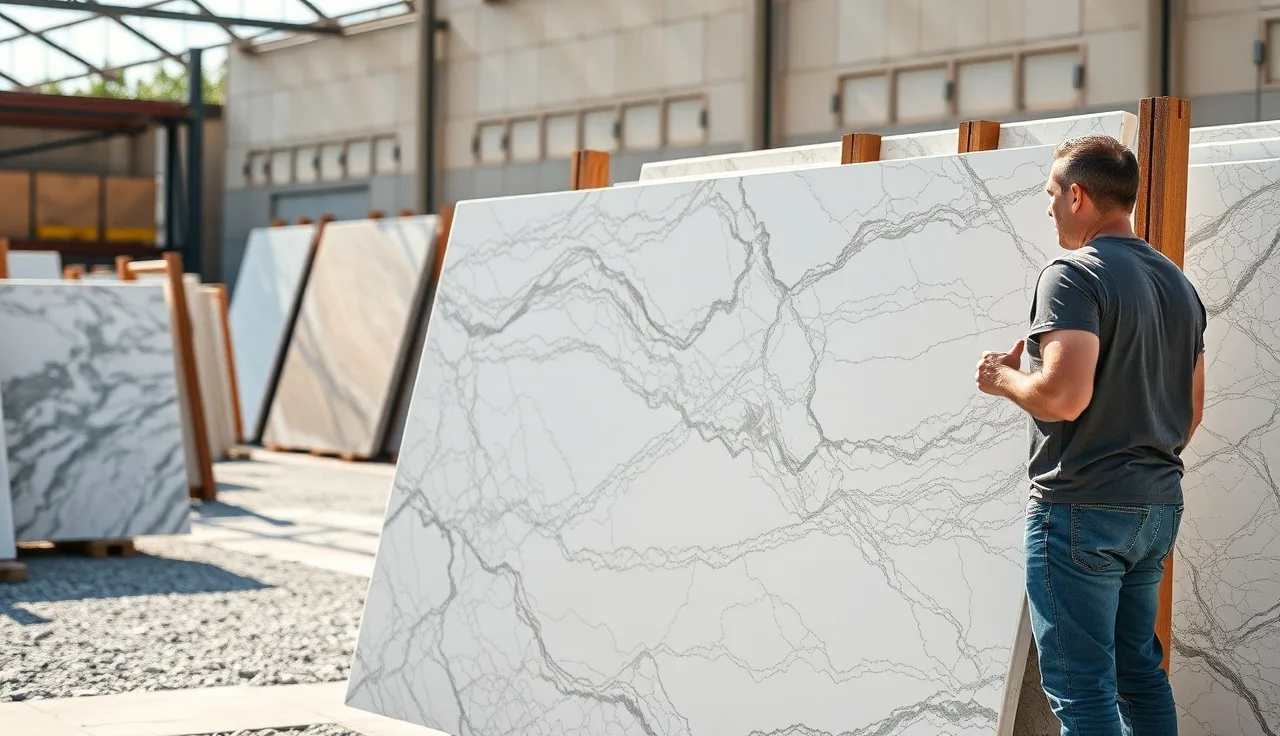
Yes, and you should insist on it for natural stone. Slabs vary dramatically from one another even within the same quarry lot. The sample tile in a showroom is the best-case version of that material. Visit the stone yard and find the specific slab your countertop will come from. Many fabricators will chalk-mark your slab once you pick it. This step costs no extra money and prevents a lot of disappointment.
Does countertop overhang matter?
Standard overhang on wall cabinets is about 1.5 inches. Island overhangs meant for seating typically run 12 to 15 inches for knee clearance. Overhangs beyond 10 to 12 inches in stone usually need corbel or bracket support to prevent cracking over time, especially in 2 cm material. Ask your fabricator at what point they recommend supporting an overhang, and get their answer in writing for warranty purposes.
What questions should I ask about countertop warranties?
Ask: Who backs the warranty, the manufacturer or the shop? What does it cover (defects in material, workmanship, or both)? What voids it (heat damage, wrong cleaning products, DIY modifications)? How long does it last? Engineered quartz makers like Caesarstone and Cambria offer 10- to 15-year limited warranties, but only when installed by authorized fabricators. Natural stone has no manufacturer warranty since it is a natural product; workmanship warranties come from the shop.
Are there countertop options that are safe for food prep directly on the surface?
All countertop materials are safe for incidental food contact once properly sealed (for stone) or as manufactured (for quartz and solid surface). For cutting directly on the surface, butcher block is the intended choice. Cutting on stone or quartz will not harm you, but it dulls your knives immediately. Granite is hard enough to wreck a blade edge within a few uses. Use a cutting board regardless of material.
How do I prepare my kitchen for countertop installation day?
Clear everything off the existing counters and out of the cabinets near the work area. Disconnect or arrange for a plumber to disconnect the sink, faucet, and any cooktop. Keep a clear path from the entry to the kitchen for the crew to carry heavy slabs. Protect your flooring and cabinets with cardboard or moving blankets. The crew will tell you not to use the counters for 24 hours after install to let adhesive and caulk cure fully.
Sources
- Angi (formerly HomeAdvisor), Countertop Installation Cost Guide: Installed countertop price ranges by material: laminate $15 to $40/sq ft, quartz $50 to $120/sq ft, granite $40 to $100/sq ft, marble $60 to $150/sq ft
- National Association of the Remodeling Industry (NARI), Project Timeline Guidance: Typical kitchen countertop installation takes 3 to 6 hours on installation day; full project from template to install runs 2 to 4 weeks
- NSF International, Countertop Material Safety Standards: Engineered quartz and solid surface materials are non-porous and do not require sealing
- Natural Stone Institute, Care and Maintenance of Natural Stone: The water-bead test is the standard field method for checking whether a stone sealer is still performing; absorption within minutes indicates resealing is needed
- Caesarstone, What Is Quartz? Product Composition Information: Engineered quartz slabs are composed of approximately 90 to 95% ground natural quartz crystal bound with polymer resins
- Remodeling Magazine, 2023 Cost vs. Value Report: A mid-range minor kitchen remodel returned approximately 85.7% of its cost at resale nationally in 2023
- Natural Stone Institute, Slab Weight and Handling Guidelines: Natural stone and engineered quartz slabs weigh approximately 15 to 20 pounds per square foot
- Cambria, Limited Lifetime Warranty Terms: Cambria offers a limited lifetime warranty on its quartz surfaces when installed by an authorized fabricator following manufacturer guidelines
- Silestone by Cosentino, Care and Maintenance Instructions: Quartz manufacturer guidelines specify mild dish soap and water for daily cleaning; abrasive pads and prolonged direct heat are listed as warranty-voiding conditions
- U.S. Bureau of Labor Statistics, Consumer Expenditure Survey, Housing Expenditures: Kitchen and bath remodeling consistently ranks among the top discretionary housing expenditures tracked in annual consumer spending surveys
- National Kitchen and Bath Association (NKBA), Design and Planning Guide: Island overhangs intended for seating should be 12 to 15 inches for adequate knee clearance per NKBA planning guidelines
Last updated 2026-07-11