TL;DR
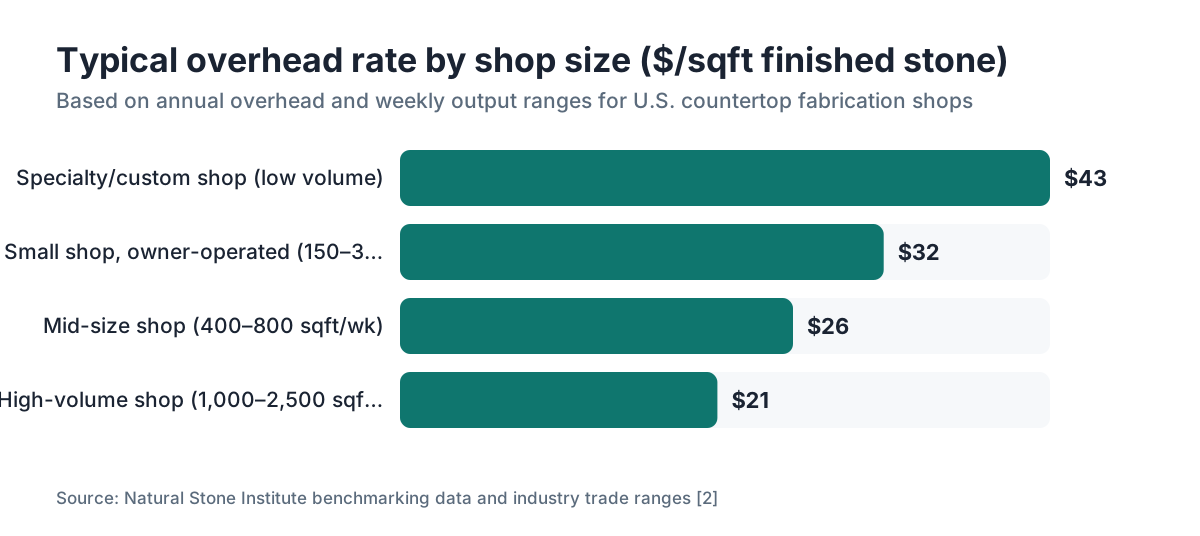
- Most countertop fabrication shops carry overhead of $18 to $38 per finished square foot, with the midpoint around $25, $28 for a shop doing 400 to 800 square feet per week.
- That range covers rent, equipment depreciation, utilities, insurance, and non-production labor.
- Your actual number depends on shop size, equipment investment, and how efficiently you fill your capacity.
What counts as overhead in a countertop shop?
Overhead is every dollar the shop spends that doesn't attach cleanly to a single job. It's the cost of keeping the lights on, the CNC running, and the phones answered whether you sell one slab this week or twenty.
In fabrication, overhead breaks into four buckets:
- Occupancy: rent or mortgage on the shop and yard, property taxes, and any lease payments on storage.
- Equipment costs: depreciation on saws, CNCs, polishers, forklifts, and water treatment systems, plus any loan interest on that equipment.
- Fixed operating costs: utilities (water, electricity, compressed air), insurance (general liability, workers' comp, commercial auto), software subscriptions, and phone or internet.
- Non-production labor: owner salary when the owner isn't cutting stone, office staff, estimators, sales reps, and any shop manager who isn't on the floor running a machine.
What is NOT overhead: the stone itself, direct labor on a job (your saw operator's time on that specific slab), consumables like blades and pads that you use on a specific project, and subcontractor costs for installation crews.
The line between overhead and direct cost is where a lot of shops get fuzzy. A fabricator who does his own templating on every job, that template time is a direct job cost. But if he drives across town to look at a job that never converts, that drive time is overhead. The distinction matters. Misclassify direct costs as overhead (or the reverse) and your per-job margins look wrong while your overhead rate lies to you.
What does overhead per square foot actually mean, and how do you calculate it?
Overhead per square foot is your total annual overhead dollars divided by the total finished square feet your shop produces in a year. It's the simplest way to load overhead into a quote.
The formula:
Overhead rate ($/sqft) = Total annual overhead $ / Total annual production sqft
Example: A shop spends $520,000 per year in overhead and produces 20,000 finished square feet. That's $26 per square foot.
Production square footage means the finished, installed square footage on customer invoices. Not slab square footage purchased (which includes waste), and not template square footage (which runs slightly larger than what gets invoiced in some shops). How you define the denominator is the whole ballgame. Pick one definition and never move it.
A few things to watch:
Capacity utilization changes everything. That same $520,000 shop producing only 15,000 square feet suddenly carries a $34.67/sqft overhead rate. Fixed costs don't shrink because you had a slow quarter. This is why shops running at 60% capacity for a year often bleed money even on jobs that look profitable on paper.
Monthly beats annual for active management. Divide total monthly overhead by that month's square footage to catch trends before they turn into crises. A CNC breakdown in March that slows output spikes your overhead rate for the month even though your fixed costs never moved.
Don't forget the owner. Many small shops skip the owner's salary from overhead because the owner "just pays himself from profit." That habit hides the real cost of running the business and pushes you to under-price, especially the day you finally hire someone to do what you've been doing for free. The Small Business Administration recommends including a reasonable market-rate salary for owner-operators in any true cost analysis [1].
What is a typical overhead range for a countertop fabrication shop?
No government survey tracks countertop shop overhead specifically. The data just doesn't exist at that granularity. So the ranges below come from industry association benchmarking, fabricator forums, and public stone trade data. Take them as directional, not gospel.
| Shop Type | Annual Overhead | Weekly Output (sqft) | Overhead Rate ($/sqft) |
|---|---|---|---|
| Small shop, 1-2 CNC bays, owner-operated | $180,000, $320,000 | 150 to 300 | $23, $41 |
| Mid-size shop, 3-5 bays, dedicated office staff | $420,000, $750,000 | 400 to 800 | $20, $32 |
| High-volume shop, 6+ bays, full admin team | $900,000, $2,000,000 | 1,000 to 2,500 | $14, $28 |
| Specialty/custom shop (thick stone, exotic materials) | $280,000, $500,000 | 100 to 250 | $32, $55 |
Here's the counter-intuitive part: bigger shops usually have lower overhead per square foot because fixed costs spread over more volume. But those same big shops carry higher absolute risk if volume drops.
The Marble Institute of America (now merged into the Natural Stone Institute) historically cited that U.S. stone fabrication businesses average operating overhead between 28% and 35% of gross revenue [2]. If your shop's average ticket is $85 per finished square foot (a reasonable residential figure in many markets as of 2024), 28 to 35% overhead on that revenue works out to $23.80, $29.75 per square foot in overhead alone. That tracks with the table above.
Equipment-heavy shops sit at the top of these ranges. Buy a $350,000 waterjet in the last three years and depreciation is real money even though it never leaves your checking account monthly. Five-year straight-line depreciation on a $350,000 waterjet is $70,000 a year straight into your overhead bucket [3].
What are the biggest drivers of overhead in a stone shop?
Rent or building payment is usually the largest single line, often 30 to 45% of total overhead in high-cost markets. A 6,000-square-foot shop in a metro area at $14/sqft NNN is $84,000 per year before you turn on a single machine. In a rural area at $5/sqft, the same footprint is $30,000. Where you put the shop is the biggest single lever on your overhead structure.
Equipment depreciation is the sneaky one. Finance a CNC bridge saw, a waterjet, and a forklift in the same year and you can easily have $80,000, $150,000 in annual depreciation. Most fabricators think about loan payments, not depreciation. Your accountant and your pricing should both use depreciation, because that's the real economic cost of using equipment up.
Insurance is rising faster than inflation. General liability for a stone shop in most states runs $8,000, $20,000 per year depending on revenue and claims history. Workers' compensation in fabrication is expensive because it's a high-injury trade. NCCI (National Council on Compensation Insurance) classifies stone cutting under codes with rates that can run 8 to 18% of direct labor wages in many states [4]. A shop with $400,000 in annual direct labor can spend $32,000, $72,000 on workers' comp alone.
Non-production labor is the growth trap. Every estimator, CSR, or shop foreman you hire adds a fixed overhead cost. That person costs the same in January as in June. Shops that grow their admin staff ahead of their revenue base often watch their overhead rate jump $4, $8 per square foot before they realize it.
Utilities are real but underrated. Stone fabrication uses serious water (blade cooling, slurry management) and serious electricity (CNCs, compressors, dust collection). A mid-size shop can spend $2,500, $5,000 per month on electricity, plus $500, $1,500 on water and wastewater, depending on local rates and slurry disposal rules [5].
How do you separate overhead from direct job costs when building a quote?
Run two cost sheets for every job. One holds direct costs (material, direct labor hours times a labor rate, consumables traceable to the job, and subcontractor installation). The other applies your overhead rate per square foot to the job's square footage. Keep them separate and your pricing stops lying to you.
If a kitchen is 52 finished square feet and your overhead rate is $26/sqft, you add $1,352 in overhead to that job. On top of that you layer direct costs, then margin.
The full pricing stack for one job might look like:
- Stone material cost: $18/sqft x 52 sqft = $936
- Direct labor (template + cut + polish + install): $22/sqft x 52 sqft = $1,144
- Consumables (blades, pads, adhesive): $3/sqft x 52 sqft = $156
- Overhead allocation: $26/sqft x 52 sqft = $1,352
- Subtotal (true cost): $3,588
- Gross margin (30%): $1,538
- Job price: $5,126
- Per square foot to customer: $98.58/sqft
That math lands in the right ballpark for residential granite or quartz in a mid-size U.S. market in 2024, though prices swing wide by region and material. A quartz slab in San Francisco has a very different cost structure than granite countertops in rural Tennessee.
Here's where shops get in trouble. They skip the overhead allocation, price on material-plus-labor, hit their revenue target, and still lose money because nobody accounted for the rent, the CNC loan, and the office manager.
Shops that track jobs carefully, using software that logs actual hours and material per job against the quote, keep finding the same pattern: overhead gets underestimated on small complex jobs and overstated on large simple slabs. A 10-square-foot accent piece on a countertop installation can carry an overhead allocation wildly out of line with the shop time it actually ate.
How does shop size and volume affect your overhead rate?
Fixed cost spread is the core idea. Your rent, insurance, equipment depreciation, and salaried staff barely move as volume rises. So more square footage out the door means a lower overhead burden per square foot.
A shop paying $240,000 per year in fixed overhead:
- At 10,000 sqft/year output: $24.00/sqft
- At 15,000 sqft/year output: $16.00/sqft
- At 8,000 sqft/year output (slow year): $30.00/sqft
That $14/sqft swing between a good year and a slow year is the difference between a healthy margin and a loss, assuming prices hold. This is why fabricators chase volume, sometimes past the point of sense. Taking low-margin jobs to keep the CNC busy feels smart until you notice those jobs still burn direct labor and material, and the margin on them may not even cover the overhead they were supposed to offset.
Break-even math matters here. Overhead of $240,000/year against an average contribution margin (price minus direct costs) of $28/sqft means you need to produce and sell 8,571 square feet per year just to cover overhead. Below that, you lose money no matter how busy the shop feels.
Smaller shops selling through Cambria's dealer network or high-end custom residential work often offset their higher overhead rate with higher prices. Selling Cambria countertops at $120+/sqft changes the math compared to commodity jobs at $65/sqft.
What overhead percentage of revenue should a countertop shop target?
Target overhead at 25 to 33% of gross revenue. That's a common target range in custom manufacturing, backed by Small Business Administration and SCORE financial benchmarking data for manufacturing trades [1].
Above 40% overhead as a share of revenue, something is structurally off. You're either under-pricing, over-spending on fixed costs, or running at low capacity utilization. Below 20%, either you're genuinely lean and high-volume, or you're not counting everything (leaving out owner salary is the usual culprit).
The Fabricators and Manufacturers Association (FMA) publishes financial benchmarking for custom fabrication shops and consistently finds that top-quartile profitable shops hold overhead to 22 to 28% of revenue [6]. Bottom-quartile shops often show overhead at 38 to 45%, usually because volume dropped and fixed costs didn't.
As a share of revenue, overhead swings a lot by material type. Shops focused on laminate countertops or Formica countertops move more pieces faster at lower per-piece revenue, so the overhead allocation per sqft gets tighter and less forgiving. Stone shops selling marble countertops at premium prices can absorb a higher overhead dollar amount per sqft because the price point carries it.
How do equipment and technology investments change your overhead structure?
Every machine purchase trades variable cost for fixed cost. A CNC bridge saw kills some outsourcing or manual cutting labor (variable), but adds depreciation, maintenance contracts, and maybe a skilled operator's salary (fixed overhead).
A $180,000 CNC bridge saw depreciated over seven years is roughly $25,700 per year in depreciation. Add a $6,000/year maintenance contract and you've stacked $31,700 onto your annual overhead. If that machine lets you produce an additional 4,000 square feet per year, the machine's overhead cost works out to about $7.93/sqft, which is usually worth it. But if you already had enough cutting capacity and bought it for redundancy, those 4,000 extra square feet never show up and you're carrying $31,700 in new overhead against the same output.
Water treatment systems are an often-forgotten overhead line. Many municipalities now require shops to treat and test slurry water before discharge, and the EPA regulates wastewater from stone cutting operations under the Clean Water Act [7]. A basic recirculating water system costs $15,000, $40,000 installed and adds $3,000, $8,000 per year in operating costs (electricity, filter media, disposal).
Digital quoting and job management software adds a small but real overhead line, typically $200, $600/month for a mid-size shop. The payback is simple: shops that catch overhead miscalculations in their quotes recover that cost fast. Tools that track actual production square footage against quotes hand you the data to recalibrate your overhead rate quarterly instead of annually.
SlabWise is one example of fabrication software built to track job-level costs and show whether your quoted overhead rate matches your actual overhead spend. That's the kind of tool that turns quarterly recalibration from a good intention into a real process.
How should a countertop shop track and recalibrate its overhead rate over time?
Quarterly is the right cadence. Annual reviews miss the slow cost creep that turns a $24/sqft overhead rate into a $31/sqft rate over 18 months without anyone noticing.
A simple quarterly overhead review:
- Pull all overhead spending for the quarter from your books (QuickBooks, Xero, or whatever you run), separated from direct job costs.
- Pull total finished square feet invoiced in the same quarter.
- Divide. Compare to last quarter and to your target rate.
- Flag which line items grew faster than volume.
The usual surprises: an insurance renewal hitting mid-year with a 20% jump, a new hire added in month two of the quarter whose salary wasn't in the original rate, or equipment rental for a job that crept into the overhead bucket.
If your overhead rate drifts more than $3/sqft from your target without a clear reason (a specific investment you planned), investigate before you touch your quote template. Raising your quoted rate is easy. Understanding why you had to is how you actually fix the problem.
Shops running both residential and commercial work should track overhead allocation by job type separately. Commercial jobs often carry longer payment cycles, higher material-to-labor ratios, and different insurance requirements. Your overhead rate can legitimately differ by $5, $8/sqft between a residential kitchen and a hotel lobby.
What overhead mistakes do countertop shops make most often?
Not counting owner labor is the biggest one, already mentioned, but worth saying twice. If the owner manages jobs, writes quotes, and handles customer calls 30 hours a week, that's roughly $60,000, $100,000 of labor value per year depending on market rates for those functions. Leave it out and the business looks more profitable than it is while the owner's time looks free.
Mixing depreciation with loan payments is the second most common mistake. Borrow $200,000 for a CNC at a $3,800/month payment and only the interest portion is an actual expense in a cash-accounting sense. But the economic cost of using that machine up (depreciation) is separate and belongs in your overhead calculation no matter how you financed it. Ask your CPA which method your books use and make sure your pricing reflects economic reality, more than cash flow.
Using last year's overhead rate without adjustment hits hardest in inflationary periods. Insurance, utilities, and wages all moved up materially in 2022 and 2023 [8]. A shop still pricing on a 2021 overhead rate in 2024 is leaving money on the table or quietly losing it.
Ignoring waste and yield is adjacent to overhead but drains the same bottom line. Stone cutting yields 65 to 80% usable material from a raw slab depending on job complexity. Shops that base their output numbers on invoiced sqft without accounting for how much slab they consumed will underestimate their true cost per square foot. Not overhead exactly, but it decides whether your overhead rate is spreading over the right denominator.
Treating marketing spend as overhead is fine. Categorizing it inconsistently is the problem. Some shops drop advertising, Google Ads, and trade show costs into overhead. Others expense them directly. Pick one and stick to it so your overhead rate stays comparable year over year.
How does overhead per square foot compare to other countertop cost components?
Put overhead next to the other numbers and it stops looking mysterious. Here's how the cost components stack for a typical residential stone countertop job:
| Cost Component | Range ($/sqft installed) | Notes |
|---|---|---|
| Stone material (slab cost) | $8, $40 | Varies enormously by material; marble countertops vs. granite countertops vs. engineered quartz |
| Direct fabrication labor | $12, $28 | Template, cut, edge, polish, install |
| Consumables (blades, pads, adhesive) | $2, $6 | Varies with edge complexity and material hardness |
| Overhead allocation | $18, $38 | This article's subject |
| Gross margin (profit) | $15, $35 | Typically 20 to 35% of total price |
| Total customer price | $55, $145 | Typical residential range; high-end materials push higher |
Overhead is usually the second-largest cost component after material on stone jobs. On cheaper materials like butcher block countertops or Corian countertops, overhead per square foot can top the material cost.
The useful takeaway: overhead is the most controllable cost in the long run. Material prices are set by suppliers. Labor rates are set by the market. Overhead is set by your own decisions about space, equipment, and staffing. Shops that stay lean on those calls and run at high capacity price more competitively without giving up margin.
For homeowners trying to read the quotes coming in: the overhead in a fabricator's price is not padding and it's not profit. It's the real cost of the building, the machines, and the people it takes to make and deliver your countertop. The profit sits on top of it.
Can you benchmark your overhead against other shops?
Formally, this is hard. No annual public survey breaks out countertop shop financials by overhead rate. The closest proxies:
The Natural Stone Institute (formerly Marble Institute of America) publishes an annual Buyers Guide and periodic business data for member companies. Its financial benchmarking surveys, available to members, typically report operating expense ratios (which approximate overhead as a share of revenue) for stone fabricators [2].
The Fabricators and Manufacturers Association publishes financial ratio studies for custom manufacturers. Stone fabrication isn't always split out, but custom manufacturing benchmarks translate reasonably well [6].
SCORE and the SBA maintain industry financial ratios by NAICS code. Stone cutting falls under NAICS 327991 (Cut Stone and Stone Products Manufacturing). The SBA's size standards and financial benchmarks for this code are public [1]. The average net profit margin in this NAICS code has historically run 6 to 12% of revenue, which means overhead plus direct costs eat 88 to 94 cents of every revenue dollar. That's a tight business.
Practically, the best benchmark is your own shop, quarter over quarter. External benchmarks tell you what the median looks like. Your trend line tells you whether you're moving toward profit or away from it.
Shops on fabrication management platforms sometimes share anonymized benchmarking data through those platforms. SlabWise, for example, aggregates production and cost data across shops to show members where their overhead rate falls relative to similar-size operations, though participation in any such benchmarking is always opt-in.
Want a rough self-check? Pull your last 12 months of total overhead spend, divide by total invoiced square feet, and compare to the $18, $38/sqft range in this article. Above $38, look hard at fixed costs and capacity utilization. Below $18, make sure you're counting everything.
Frequently asked questions
What is a good overhead cost per square foot for a small countertop shop?
For a small owner-operated shop doing 150 to 300 square feet per week, overhead of $28, $41 per finished square foot is typical. Small shops can't spread fixed costs (rent, insurance, equipment) over as much volume, so their rate runs higher than a larger operation. Staying in the $30, $38 range while running above 80% capacity is a reasonable target for a shop in that size bracket.
Should I include my own salary in overhead?
Yes, always. If you're doing work that would require a paid employee if you weren't there, that work has a market cost and it belongs in your overhead. Leaving the owner salary out makes the business look artificially profitable and pushes you to underprice jobs. Use a reasonable market rate for the functions you perform: estimating, shop management, sales. Most small shop owners spend time across all three.
How does equipment depreciation factor into overhead per square foot?
Depreciation is the annual cost of using equipment up, and it belongs in overhead even if you paid cash or your loan payment differs from the depreciation amount. A $300,000 CNC depreciated over seven years adds roughly $43,000 per year to overhead. Divide that by your annual square footage output to see how many dollars of overhead that machine adds per square foot.
What overhead percentage of total revenue should a stone fabrication shop target?
Target 25 to 33% of gross revenue in overhead. Shops above 38% are usually running below capacity or carrying too many fixed costs for their volume. Shops below 20% are either genuinely lean or aren't counting everything. The Natural Stone Institute's benchmarking data historically places overhead for stone fabricators at 28 to 35% of revenue, which maps to roughly $23, $30 per square foot at typical residential price points.
How often should I recalculate my overhead rate?
Quarterly is the right cadence for most shops. Annual reviews miss mid-year cost increases (insurance renewals, new hires, utility rate changes) that can shift your rate by $3, $6 per square foot before you notice. Run a simple calculation each quarter: total overhead dollars divided by total invoiced square feet. Compare to your target and last quarter. Investigate any drift above $3 per square foot.
Does overhead per square foot change based on material type (granite vs. quartz vs. laminate)?
Your shop's overhead rate in dollars per square foot doesn't automatically change by material, since fixed costs are fixed. But the practical impact differs. On a $12/sqft laminate job, a $26/sqft overhead rate means overhead exceeds material cost, so every pricing mistake matters more. On a $35/sqft granite slab, overhead is a smaller share of total cost. Complex materials that take longer to cut (quartzite, sintered surfaces) effectively carry higher per-job overhead because they eat more shop time per square foot.
How does capacity utilization affect overhead per square foot?
Directly and dramatically. Fixed overhead barely changes with volume, so every square foot of unused capacity raises your overhead rate. A shop with $400,000 in annual overhead running at 70% capacity has an effective overhead rate 43% higher than the same shop at full capacity. This is why fabricators aggressively price to fill the schedule during slow periods, even taking lower margins, to keep the overhead rate from spiking.
What NAICS code applies to countertop fabrication shops, and does it affect benchmarking?
Most stone countertop fabrication shops fall under NAICS 327991 (Cut Stone and Stone Products Manufacturing). Shops that also handle laminate or solid surface materials may use 332321 or 337110 depending on primary product focus. The NAICS code matters for SBA loan eligibility, workers' comp classification in some states, and access to industry financial ratio data. The SBA's size standard for NAICS 327991 is 500 employees or fewer for small business classification.
Is workers' compensation insurance included in overhead?
Yes. Workers' comp premiums are a fixed overhead cost allocated to the shop as a whole, not to individual jobs. For stone fabrication, workers' comp rates run high because the injury risk is real: NCCI classifies stone cutting with rates that can run 8 to 18% of direct wages in many states. A shop with $400,000 in annual direct labor wages might spend $32,000, $72,000 on workers' comp annually, which alone adds $1.60, $3.60 per square foot to overhead at 20,000 sqft annual output.
How do I calculate overhead per square foot if my shop tracks hours, not square feet?
Convert hours to square feet using your historical average production rate. If your shop consistently produces one finished square foot per 0.35 direct labor hours, and your annual direct labor hours total 7,000, your effective output is about 20,000 square feet. Divide your total overhead by that number. Tracking both metrics, hours and square footage, is better because it reveals when you're producing more complex work that takes more time per square foot.
What is the overhead cost per square foot for outsourced or subcontracted fabrication?
If you outsource cutting to a waterjet or CNC shop and act mainly as a sales and installation company, your overhead structure changes a lot. You shed most equipment depreciation and may reduce space needs, potentially bringing overhead down to $10, $18 per square foot. But your material cost effectively rises because the fabrication charge is baked into what you pay the subcontractor. Total cost per square foot to your customer usually doesn't change much; the cost just moves between buckets.
Do waste and yield losses affect overhead per square foot calculations?
Indirectly, yes. Waste affects how much slab you buy per invoiced square foot, which is a direct material cost issue. But if you define output as invoiced square feet (which you should), overhead divides over those invoiced feet regardless of how much stone got wasted producing them. Where yield matters for overhead: shops with high waste rates must produce more slab volume to hit the same invoiced square footage, eating more shop time and resources per invoiced foot.
How does a residential shop's overhead compare to a commercial-focused shop?
Commercial shops often carry higher absolute overhead because they need larger bays, more equipment, and more project management staff to handle large-scale bids. But they also run higher volumes, which can pull the per-square-foot rate down. Commercial work has longer payment cycles too, which can strain cash flow even when the overhead rate looks fine. Many shops find a residential-commercial mix around 60/40 gives the best balance of volume stability and manageable overhead structure.
Sources
- U.S. Small Business Administration, Financial Benchmarks and Industry Data: SBA recommends including a market-rate owner salary in cost analysis for owner-operated businesses; overhead target of 25–33% of revenue is consistent with SBA manufacturing benchmarks
- Natural Stone Institute (formerly Marble Institute of America), Industry Data: Stone fabrication businesses in the U.S. average operating overhead between 28% and 35% of gross revenue per NSI/MIA benchmarking surveys
- IRS Publication 946, How to Depreciate Property: Straight-line depreciation method for equipment; a $350,000 asset depreciated over five years equals $70,000 per year in depreciation expense
- National Council on Compensation Insurance (NCCI), Workers Compensation Classification Codes: Stone cutting operations carry workers' compensation rates of 8–18% of direct labor wages in many states under NCCI classification
- U.S. Energy Information Administration, Commercial Buildings Energy Consumption Survey: Manufacturing and fabrication facilities have significant electricity consumption; EIA data supports typical utility cost ranges for light manufacturing operations
- Fabricators and Manufacturers Association International, Financial Benchmarking for Custom Fabricators: Top-quartile profitable custom fabrication shops hold overhead to 22–28% of revenue; bottom-quartile shops show overhead at 38–45% of revenue
- U.S. Environmental Protection Agency, Clean Water Act Section 402 NPDES Program: EPA regulates wastewater discharge from stone cutting operations under the Clean Water Act; shops must treat slurry water before discharge in many jurisdictions
- U.S. Bureau of Labor Statistics, Producer Price Index for Construction Materials: Insurance, utilities, and wages rose materially in 2022 and 2023; BLS PPI data documents input cost inflation for fabrication businesses
- U.S. Census Bureau, NAICS 327991 Cut Stone and Stone Products Manufacturing: Stone countertop fabrication falls under NAICS 327991; average net profit margin in this code has historically been 6–12% of revenue
- SBA Size Standards, NAICS 327991: SBA size standard for NAICS 327991 Cut Stone and Stone Products Manufacturing is 500 employees or fewer for small business classification
Last updated 2026-07-11