TL;DR
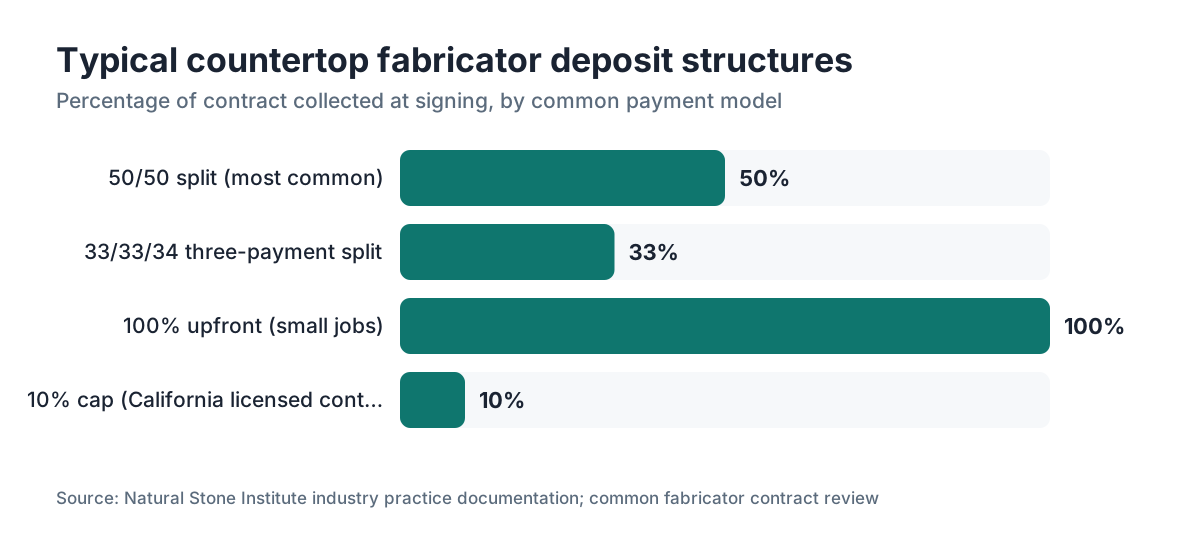
- Most countertop fabricators collect 50% when you sign the contract and the remaining 50% before or at installation.
- Some shops use a 33/33/34 split tied to templating, fabrication, and install.
- Cash, check, and credit card are all common; financing is rarer.
- Fabricators almost never extend net-30 terms to homeowners, though they sometimes do for GCs and builders.
What is the standard payment schedule for countertop fabricators?
The most common structure in the countertop industry is a 50/50 split: half due when the contract is signed and half due before or on the day of installation. You'll see this at independent stone shops, mid-size regional fabricators, and big-box installation programs alike. The first payment locks your slab, reserves fabrication time, and pays for any templating appointment. The second payment clears the job before the crew loads the truck.
Some shops, especially those that fabricate high-ticket custom pieces or work with architects, use a three-payment schedule instead. A typical three-way split runs 33% at signing, 33% at template or material confirmation, and 34% at delivery or installation. The middle payment exists because the shop needs cash to buy the slab before cutting starts, and that slab runs $500 to several thousand dollars depending on the stone.
A smaller number of shops ask for payment in full upfront, particularly for small jobs (like a single vanity top), or when a customer has chosen a rare or exotic slab that must be special-ordered and is non-returnable. That's not predatory. It reflects real financial exposure for the shop.
What you almost never see is net-30 or net-60 payment terms for a residential homeowner. That kind of extended credit is reserved for commercial GCs and production builders who have ongoing volume relationships with the shop.
Why do fabricators require so much money upfront?
The short answer is material cost. Natural stone, engineered quartz, and even higher-end laminate countertops or Formica countertops require the shop to buy and warehouse material before any labor happens. A 3cm quartzite slab from a specialty importer can cost $800 to $2,500 for the raw stone alone [1]. The fabricator pays their supplier on delivery, often within 30 days, so they need your deposit to avoid floating that cost.
Labor and overhead are the other piece. CNC bridge saws, polishing equipment, and waterjet machines are expensive to run. Most fabrication shops carry heavy fixed costs every month regardless of how many jobs are in the queue. A 50% deposit collected across multiple jobs is what keeps the lights on while those jobs move through production.
There's also a risk angle. A custom-cut countertop has no resale market. If a homeowner backs out after fabrication, the shop is left with pieces that fit exactly one kitchen. The deposit partially covers that scenario. A slab of granite countertops or marble countertops cut to a specific layout is worthless to anyone else.
Sequencing matters too. Most shops won't put your job on the production calendar until a deposit clears. No deposit, no slot. That's normal in any trade that does custom work.
How do payment terms differ between homeowners, contractors, and builders?
Homeowners almost always pay upfront-heavy terms with no credit extended. There's simply no ongoing relationship to justify the risk.
General contractors and remodelers who bring the shop consistent volume often negotiate net-15 or net-30 terms on completed jobs, especially once they've built a payment history. Some shops require a blanket credit application and a signed trade account agreement before extending any credit. A GC who does 20 kitchens a year with the same fabricator is a very different customer than a homeowner doing one.
Production builders, at the high end of the volume spectrum, sometimes negotiate net-45 or even net-60 terms with fabricators who want that contract badly enough. The tradeoff is that builders demand lower per-unit pricing, so the shop accepts both thinner margins and delayed payment. That's a business model decision each shop makes differently, and plenty of shops decide it isn't worth it.
If you're a GC reading this, the practical advice is to ask for trade terms after your first two or three jobs are paid cleanly. Most shops will consider it. Come in with a credit reference from another supplier and the conversation goes faster.
What payment methods do countertop fabricators accept?
Cash and check are accepted everywhere and typically carry no surcharge. Personal checks sometimes need a few business days to clear before fabrication starts, so if you're paying the deposit by check, expect a brief delay.
Credit cards are accepted at most shops, but many add a convenience fee, usually 2.5% to 3.5%, to cover merchant processing costs [2]. That's legal in most U.S. states following the Supreme Court's 2017 ruling in Expressions Hair Design v. Schneiderman, which limited state laws banning credit card surcharges [3]. A few states still have surcharge restrictions, so rules vary by location.
ACH bank transfers and wire transfers show up more and more for larger jobs, especially for the final payment on a high-ticket project. Many shops waive the processing fee for ACH because it's cheaper for them to receive than a credit card.
Venmo and other peer-to-peer apps turn up occasionally at very small shops, but most fabricators with any volume avoid them. There's no clean paper trail for accounting and chargebacks are harder to dispute.
Financing through a third-party lender (GreenSky, Synchrony, or similar) is offered by some larger shops and big-box install programs. The shop pays a dealer fee to the lender, which can run 5% to 10% of the financed amount, so smaller fabricators often skip it [4]. If a shop offers 0% financing for 12 or 18 months, that dealer fee is what makes it possible on the lender's end.
When exactly is each payment due in the process?
This varies by shop, but the logic follows the production milestones:
For a 50/50 structure: First payment is due at contract signing, before anything gets scheduled. Second payment is due before installation, meaning before the crew leaves the shop, or sometimes collected on-site at completion but before the installers leave.
For a 33/33/34 structure: First payment at signing. Second payment at template appointment or upon slab selection confirmation (some shops won't send the template crew until payment two clears). Third payment at or before installation.
The template appointment is a real milestone. That's when a technician comes to your home with a laser templating system or physical rods and captures the exact dimensions of your space [5]. After template, the digital file goes to the CNC saw and cutting begins. Shops that collect their second payment at template are essentially saying: once we cut, there's no turning back, and we need to be paid before we start.
One thing to watch: some shops say "balance due at installation" but actually mean before the installers start unloading, not after they finish. Get that in writing. A few homeowners have been surprised to learn that installers won't proceed without a cleared payment on-site.
Can you negotiate payment terms with a fabricator?
Yes, sometimes, but your bargaining position depends on the job size and your relationship with the shop.
For a large kitchen plus multiple bathrooms where the total might run $8,000 to $15,000 or more, you have more room to ask. A three-payment structure instead of two, with the final payment after you've had a few days to inspect the finished installation, is a reasonable ask on a big job. Some shops will agree to a 48-hour or 72-hour hold on the final 10% to cover any punch-list items like minor polishing or a caulk touch-up.
For a small vanity top at $400, you have essentially no room and it's not worth the friction.
What you should never expect to negotiate away is the initial deposit. That deposit is what gets your job on the schedule. No shop is going to reserve slab, block fabrication time, and send a template crew without collecting money.
If cash flow is the issue, ask about financing options before you assume the shop won't work with you. Many larger shops have lender relationships and would rather close a financed sale than lose the job.
What happens if you withhold final payment or dispute charges?
This is where things get legally interesting. Most states give material suppliers and contractors mechanic's lien rights, meaning a fabricator who isn't paid can file a lien against your property [6]. Stone countertops are a permanent improvement to real estate, so they typically qualify as lienable work. The specifics vary by state, including notice requirements and filing deadlines, but a fabricator has real legal tools available if a homeowner refuses to pay.
In practice, most disputes don't get there. A shop will usually negotiate a credit or revisit the work before filing anything. But the lien right is real, and homeowners who know about it tend to settle disputes faster.
From the fabricator's side, the cleanest protection is a clear written contract that spells out the scope of work, the payment amounts, the payment due dates, and what happens if either party defaults. The American Institute of Architects and trade groups like the Natural Stone Institute offer model contract language, though most fabricators use their own forms [7].
If you have a genuine dispute about quality, document everything in writing before the final payment. Photos, texts, emails. Pay in full and then complain, and your position drops significantly.
How do fabricator payment terms compare by material type?
The payment structure is mostly the same regardless of material, but a few nuances are worth knowing.
Natural stone (granite, marble, quartzite, soapstone) often requires the largest deposits because the slab is bought specifically for your job and can't be returned. If you've picked a particular slab from a yard and it's being held for you, the deposit also compensates the supplier for taking it off the market.
Cambria countertops and other engineered quartz brands are different. The material is manufactured consistently and can often be ordered by the sheet, so the supply risk is slightly lower. Even so, payment terms from the fabricator are usually identical to natural stone.
Butcher block countertops and other wood-based surfaces are sometimes faster to fabricate, which shortens the time between deposit and final payment. Some shops that specialize in wood tops collect in full upfront because the job is done in a few days.
Corian countertops and other solid surface materials are typically fabricated by certified dealers and use the same 50% deposit structure as stone shops.
The table below summarizes typical deposit ranges across material types based on common industry practice:
| Material | Typical Deposit | Notes |
|---|---|---|
| Natural stone (granite, marble, quartzite) | 50% | Slab purchase triggers deposit requirement |
| Engineered quartz (Cambria, Silestone, etc.) | 50% | Same structure; material ordered to job |
| Solid surface (Corian, etc.) | 50% | Certified dealer programs often match stone terms |
| Butcher block / wood | 50-100% | Faster turnaround; some shops collect in full |
| Laminate / Formica | 50% or full | Lower ticket; some shops require full payment upfront |
What should a countertop contract say about payment terms?
A solid fabrication contract has a few non-negotiable elements on the payment side. You want the exact dollar amounts for each payment, more than percentages. You want the due dates tied to specific events (signing, template, installation). You want the accepted payment methods listed. And you want language about what happens if either party fails to perform.
Beyond payment, the contract should describe the scope clearly: which rooms, which materials, square footage, edge profiles, cutouts for sinks and cooktops, and what a finished installation includes and excludes. Seam location is a common dispute source. Get it specified, or at least documented after the template appointment [5].
For fabricators running a shop, clean and consistent contract language means your team can quote and close jobs without reinventing the wheel each time. Quoting software like SlabWise can generate job documents that include payment schedules, scope details, and edge profile specs, which cuts the back-and-forth and gives both sides a clear paper trail from the start.
If you're a homeowner, read the cancellation clause before signing. Most contracts specify that the deposit is non-refundable after a certain point, often after material is ordered or template is complete. That's fair. Knowing the policy upfront avoids bad surprises.
Are there consumer protection rules that affect countertop payment terms?
There's no federal law that sets specific payment term requirements for home improvement contractors, but several states have home improvement contractor regulations that cap how much a contractor can collect before work begins [8]. California's Business and Professions Code, for example, limits contractor down payments to 10% of the contract price or $1,000, whichever is less, for most home improvement contracts [9]. If a California-licensed contractor is doing your countertop installation, that rule applies.
Other states with notable home improvement laws include Maryland, Virginia, and New Jersey, which require contractor registration and have rules around contract content and deposits [10]. The details vary a lot by state, so looking up your state's contractor licensing board is worth the ten minutes if you're wondering whether a large deposit is legal where you live.
Note that these rules apply when the fabricator is the party contracting directly with the homeowner. If a GC hires the fab shop as a sub, the GC-to-homeowner contract is governed by these rules, but the fab shop's agreement with the GC is a business-to-business contract and generally isn't subject to the same caps.
The Federal Trade Commission's cooling-off rule gives you three days to cancel certain door-to-door sales contracts, but it typically doesn't apply to work contracted at a showroom or the fabricator's place of business [11].
What red flags should homeowners watch for in payment terms?
Asking for 100% upfront on a large job is the biggest warning sign, particularly from a shop you haven't worked with before. Reputable fabricators don't need full payment before any work is done on a $10,000 kitchen. A large upfront demand could mean cash flow problems at the shop, or it could be a setup for a contractor who disappears.
Pressure to pay in cash only, especially with a discount offer for doing so, should make you pause. Some shops legitimately prefer cash and offer a small discount because it saves them the credit card fee. But if a contractor insists on cash-only with no receipt and no contract, that's a different situation.
Vague contract language about the final payment milestone is another issue. "Balance due upon completion" means different things to different people. Completion by whose judgment? What if you find a problem after installation? Get specifics.
A shop that can't give you a written contract at all should be walked away from, full stop. The countertop installation process involves measuring, cutting, and permanently modifying your space. If there's a problem, you need a document.
For fabricators, a related concern runs the other direction: customers who ask you to skip the contract, customers who want to pay the final balance after you leave the site rather than before or at installation, and customers who dispute the scope after fabrication starts. None of those are good signs.
How do fabricators handle refunds and cancellations?
Most fabrication contracts specify that deposits are non-refundable once material is ordered or once templating is complete. That's a standard and defensible position because the shop has committed real resources.
If you cancel before template and before the slab is bought, many shops will refund at least part of the deposit, possibly minus a cancellation or restocking fee. That fee might be $100 to $300 for administrative work already done.
If you cancel after the slab is cut, you're almost certainly forfeiting the entire deposit and possibly owing more, depending on how the contract is written. Custom-cut stone has no secondary market. The shop ate that material cost.
For fabricators, a clear written cancellation policy in the contract prevents disputes. State the non-refundable milestone explicitly, whether it's material order, template, or fabrication start. The more specific you are, the less room for argument later.
One practical middle ground some shops use: if a customer cancels after template but before cutting, the shop applies the deposit as a credit toward a future job rather than forfeiting it outright. That keeps goodwill intact and keeps the customer in the ecosystem.
Frequently asked questions
Is a 50% deposit normal for countertops?
Yes. A 50% deposit at contract signing is the most common structure in the countertop fabrication industry. It covers the shop's cost to buy your slab and reserve production time. The remaining 50% is typically due before or at installation. Some shops use a three-payment split instead, but 50/50 is the baseline you should expect.
Can I pay for countertops with a credit card?
Most fabricators accept credit cards, but many charge a convenience fee of 2.5% to 3.5% to cover merchant processing costs. This surcharge is legal in most U.S. states. If the fee bothers you, ask whether a check or ACH transfer avoids it. Some shops waive the fee for ACH because it's cheaper for them to receive.
Do countertop fabricators offer financing?
Some larger shops and big-box installation programs offer third-party financing through lenders like GreenSky or Synchrony. Smaller independent shops less commonly do because the dealer fee (5% to 10% of the financed amount) cuts into margins. If a shop offers 0% promotional financing, the shop is paying that dealer fee, not you. It's worth asking even if it's not advertised.
What happens if I refuse to make the final payment?
A fabricator who isn't paid has the right to file a mechanic's lien against your property in most U.S. states. Countertop installation qualifies as a permanent improvement to real estate, which is the basis for lien rights. In practice, most shops try to resolve disputes before filing. If you have a quality concern, document it in writing before making final payment, not after.
Is the deposit refundable if I cancel my countertop order?
Usually not after material is ordered or template is complete. Most contracts specify a non-refundable point. If you cancel before any material is purchased or scheduled, some shops will refund partially minus a cancellation fee. Always read the cancellation clause before signing. Custom-cut stone cannot be resold, which is why the policy is strict.
Can a contractor legally ask for more than 50% down in California?
No. California's Business and Professions Code limits home improvement contractor down payments to 10% of the contract price or $1,000, whichever is less. This applies to licensed contractors doing home improvement work directly for homeowners. If you're in California and a contractor demands a large deposit upfront, that is a red flag and potentially illegal.
Do GCs and builders get better payment terms than homeowners?
Often yes. General contractors and production builders who bring consistent volume can sometimes negotiate net-15, net-30, or even net-60 terms with a fabricator they have an ongoing relationship with. Homeowners doing a single project have no such standing. Trade terms require a credit application and payment history; they aren't extended automatically.
When exactly is the final payment due, before or after installation?
This varies by shop, but most fabricators require final payment before unloading begins or before installers start work, not after they finish. Some shops collect it the day before installation. A few will accept payment on completion but before the crew leaves. Get this milestone in writing in your contract so there's no ambiguity on installation day.
What payment terms do big-box stores use for countertop installation?
Home Depot and Lowe's installation programs typically collect payment in full upfront or at time of order, after an in-home measurement. Financing options are often available through their own credit programs. The terms are less negotiable than with an independent shop, but the process is standardized and the consumer protection recourse through the retailer is clearer.
How do I protect myself as a homeowner when paying a countertop deposit?
Get everything in writing before any money changes hands: the material specified, the square footage, the edge profile, the payment schedule, the installation date, and the cancellation policy. Pay by check or credit card rather than cash so you have a paper trail. Take photos of the slab before and after installation. If a dispute arises, written documentation is everything.
Do fabricators charge a restocking fee if I change my mind on the stone?
Yes, commonly. If the slab has already been ordered or held, a change in material often means a restocking fee from the supplier, which the fabricator passes on to you. This can range from a small administrative charge to a significant percentage of the slab cost depending on the supplier's policy. The later in the process you change your mind, the more it costs.
What does a countertop fabrication contract need to include?
A solid contract should specify: the material by name and slab number if applicable, the rooms and pieces being fabricated, the square footage, edge profiles, cutout locations, seam locations, payment amounts and due dates, accepted payment methods, cancellation policy, and warranty terms. Vague contracts protect neither party. If a shop hands you a one-page form with no payment dates, ask for more detail before signing.
Sources
- Natural Stone Institute, Stone Industry Education: Natural stone slab costs vary widely by origin and rarity; specialty quartzite slabs can cost hundreds to several thousand dollars before fabrication labor.
- Consumer Financial Protection Bureau, Credit Card Surcharges: Merchants who accept credit cards may charge consumers a surcharge to cover processing fees, which typically run 2% to 4% of the transaction.
- Supreme Court of the United States, Expressions Hair Design v. Schneiderman, 581 U.S. 37 (2017): The Supreme Court ruled in 2017 that state laws prohibiting merchants from charging credit card surcharges implicate First Amendment free speech protections, effectively limiting such bans.
- GreenSky, Dealer Program Overview: Home improvement financing programs like GreenSky charge merchant dealer fees that can range from roughly 5% to 10% of the financed transaction amount depending on the promotional plan offered.
- Natural Stone Institute, Fabrication Best Practices: Digital templating captures precise field measurements; the template file drives CNC cutting, making template completion a key production milestone.
- Cornell Law School Legal Information Institute, Mechanic's Lien: A mechanic's lien is a security interest in real property granted to those who have supplied labor or materials to improve it; most U.S. states provide this right to contractors and material suppliers.
- Natural Stone Institute, Industry Standards and Resources: The Natural Stone Institute publishes industry standards and educational resources for stone fabricators, including guidance on contracts and scope documentation.
- Federal Trade Commission, Consumer Advice on Hiring Contractors: State and local laws govern home improvement contracts, including deposit limits and required contract terms, and the FTC advises consumers to review these before signing.
- California Business and Professions Code Section 7159: California law limits home improvement contractor down payments to 10% of the contract price or $1,000, whichever is less, with limited exceptions.
- Maryland Home Improvement Commission: Maryland requires home improvement contractors to be licensed and mandates written contracts for jobs over $500, with specific content requirements including payment terms.
- Federal Trade Commission, Cooling-Off Rule: The FTC cooling-off rule gives consumers three days to cancel certain sales made at their home or away from the seller's normal place of business, but generally does not cover sales made at the seller's own showroom.
- Synchrony Financial, Home and Auto Financing Programs: Synchrony offers promotional financing plans for home improvement retailers and contractors, with dealer fees that vary based on promotional term length.
Last updated 2026-07-10