TL;DR
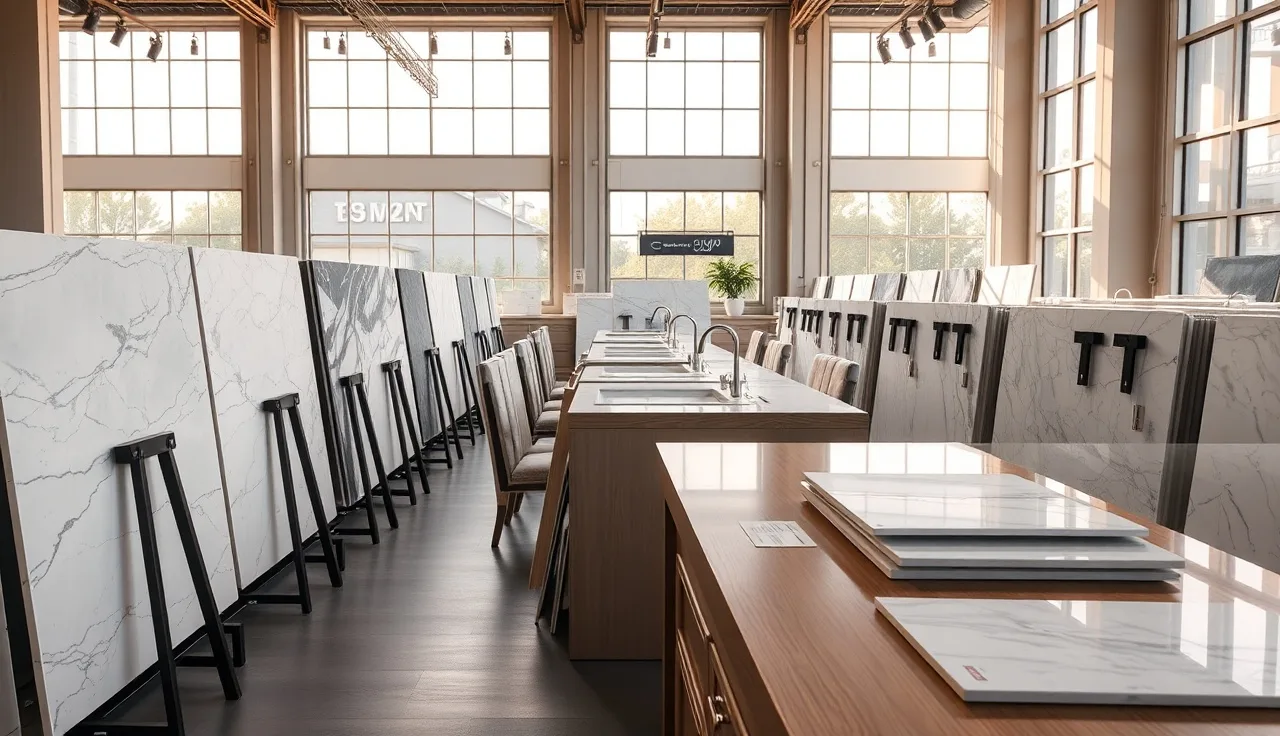
- A working countertop showroom needs large offcuts (at least 12x12 inches) in every material you sell, plus edge profile boards, finish comparison boards, and a sink cutout display.
- Plan for 8 to 15 material categories and rotate samples every 12 to 18 months.
- The goal is letting customers see color variation, texture, and edge detail under real light before they commit.
Why does showroom sampling matter so much for fabricators?
Customers who touch a sample close a job faster. That's not a sales cliché, it's what every experienced fabricator notices once they upgrade from a folder of 4x4 chips to a real walk-through showroom. When someone can hold a 12-inch piece of Calacatta marble under your shop's lighting, run a finger across a leathered finish, and set it next to a cabinet door they brought in, the "let me think about it" rate drops sharply.
The stakes for fabricators are higher than for tile or flooring. Countertops are large, expensive, and permanent. A homeowner buying a kitchen island top in quartzite may spend $3,000 to $8,000 on a single piece, and the slab they pick will look different in their kitchen than it does on a distributor's website. If your showroom can't demonstrate that variation, a competitor's showroom will.
A good sample program also cuts remakes and unhappy installs. The number one source of post-installation complaints in the stone trade is color or veining expectation mismatch, not workmanship. Samples bridge that gap. Every dollar you put into a display board is cheap insurance against a $4,000 remake.
What material categories should every fabricator have samples of?
The baseline answer is every material you quote on a regular basis. If you're building from scratch or auditing what you have, here's how to think about coverage.
Natural stone is non-negotiable. Granite is still the most-installed stone countertop in North America, and your customers will compare your granite samples against Home Depot's display [1]. Marble is a close second in kitchens and bathrooms, and you need at least three or four slab-cut sections that show veining, because a 4x4 chip of Carrara looks nothing like a 96-inch slab [2]. Quartzite has grown fast as customers move up from engineered stone; show it with a note explaining it is not the same as quartz. Marble and quartzite samples should sit next to each other so customers can see the difference.
Engineered quartz is the highest-volume category for most fabricators. Brands like Silestone, Cambria, and Caesarstone supply their own sample kits, but supplement those kits with your own larger offcuts showing real edges and installed thickness. Cambria countertops in particular market hard to consumers, so people will walk in asking by name. Have the samples ready.
Solid surface (Corian and its competitors) keeps loyal customers in healthcare and commercial kitchens, and the welded joint is impossible to demonstrate without a physical sample. Put one in your Corian countertops section.
Laminate and budget materials matter more than you might think. Laminate countertops like Formica countertops are often a gateway product, and displaying them professionally (not apologetically) keeps budget-conscious customers in your shop instead of sending them to a big-box store. Many fabricators ignore this segment and lose the whole job.
Wood is a niche but high-margin category. Butcher block countertops are popular in islands and prep areas; a small display with oiled and unoiled finish comparison earns its space.
Soapstone is small-volume with a devoted following. If you work in a market with older homes or a culinary audience, a soapstone sample with a pre-oiled patch showing the color transformation sells itself. See how to care for the material at how to clean soapstone countertops.
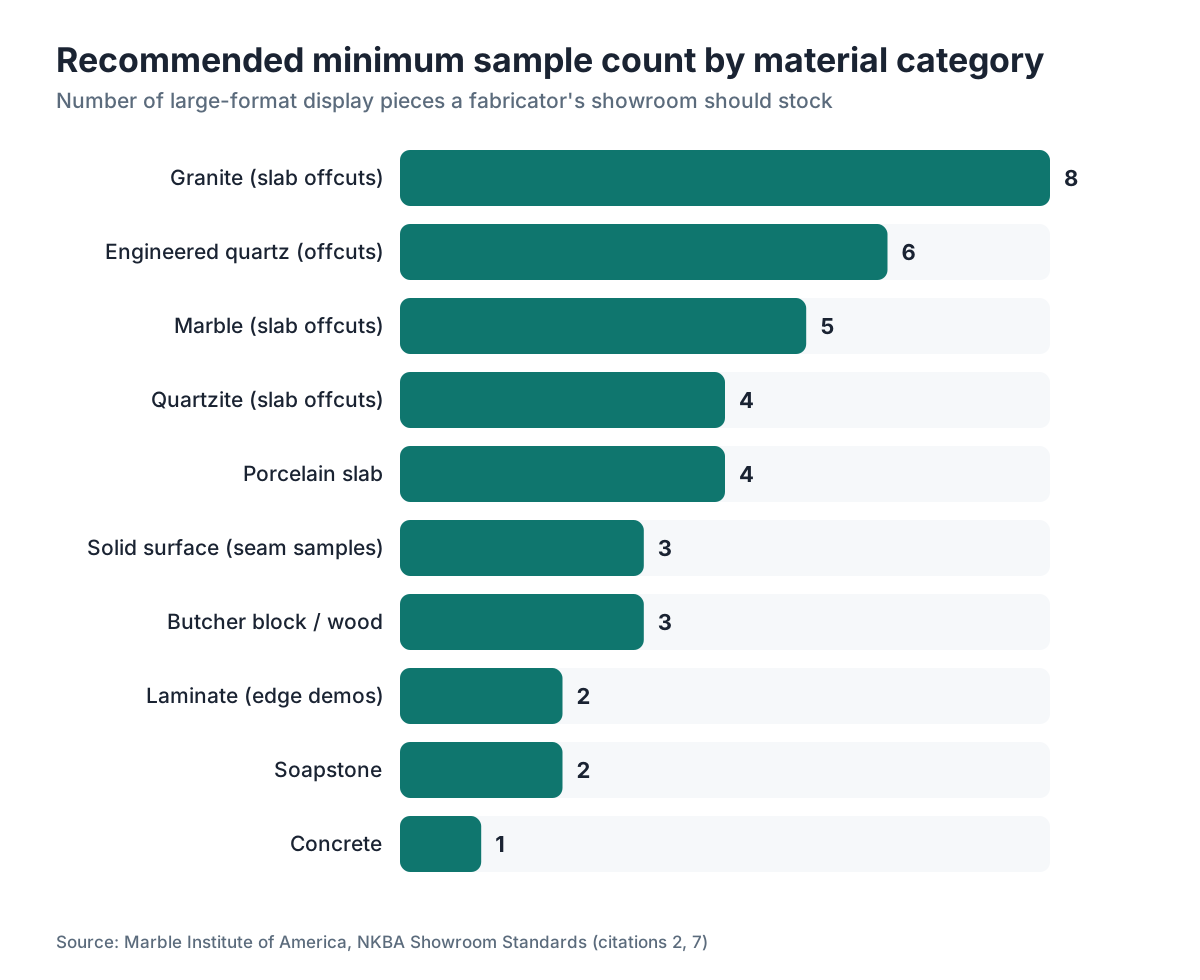
| Material Category | Minimum Sample Count | Recommended Format |
|---|---|---|
| Granite | 6-10 slabs or large offcuts | 12x18" minimum |
| Marble | 4-6 slabs or offcuts | 12x18" minimum |
| Quartzite | 3-5 slabs or offcuts | 12x18" minimum |
| Engineered quartz | Full brand kits + 4-6 own offcuts | Manufacturer kit + 12x12" offcuts |
| Solid surface | 3-4 joined seam samples | Show welded joint |
| Soapstone | 1-2 with oiled/dry comparison | 6x12" |
| Butcher block / wood | 2-3 species, oiled + unoiled | 6x12" |
| Laminate | Manufacturer binder + 2-3 full edge samples | Chip binder + edge demo |
| Porcelain slab | 3-4 patterns | 12x18" |
| Concrete | 1-2 if you offer it | 6x12" with sealer applied |
What size should countertop samples be in a showroom?
The minimum useful size is 12x12 inches. The size where customers can actually read veining and color variation is 18x24 inches. Fabricators argue about this constantly, usually because large samples cost money to make, weigh a lot to hang, and eat floor space.
A 4x4 chip tells you almost nothing about a stone like Blue Bahia granite or a heavily veined White Princess quartzite. The veining pattern on those materials repeats on a scale of 12 to 24 inches, so a small chip might show nothing but gray background. A chip that small is fine for laminate colors and solid surface, where the pattern is uniform. For natural stone and large-format porcelain, go big or your customers will be surprised by the finished slab.
The industry standard for manufacturer-supplied engineered quartz samples is about 6x6 inches [3]. Those work for color reference. Fabricators who display a 12x24 offcut next to the chip consistently report that customers respond better and understand thickness and edge weight.
If you can't afford large stone samples for every color, prioritize the materials with the highest surprise factor: book-matched marble, exotic granites, and quartzite. For workhorse products like Uba Tuba granite or white Carrara marble, smaller samples are fine because customers have usually seen them before.
For slab yard displays, some fabricators stand full or half slabs on A-frames. That's ideal but not required for every material. Even propping three or four full slabs of your best-sellers near the entrance creates a visual impact no sample board can match.
Do fabricators need edge profile samples, and how many?
Yes, and most shops underdisplay this. Edge profile is one of the few upgrade decisions a customer makes after picking material, and a verbal description of "eased" versus "ogee" means nothing to most homeowners. Seeing them side by side on a stick of stone closes the upsell faster than any explanation.
A standard edge profile board is a length of stone (usually 18 to 24 inches long, cut from scrap) with each profile routed along a short segment and labeled with the profile name and price tier. You run the profiles edge-to-edge so a customer can slide a finger from one to the next and feel the difference. Most fabricators make one board per major material group: one in granite, one in quartz, one in marble. That's a minimum of three boards.
How many profiles to include? The typical fabricator offers 8 to 15 standard profiles. Common ones are eased, beveled, bullnose, half bullnose, ogee, dupont, waterfall, laminated (mitered), and chiseled. Display all of them. The ones you don't display are the ones customers don't upgrade to.
Price the profiles on the board itself. "Standard: included" and "Premium: +$X per linear foot" labels do two things: they set price expectations early, and they make the premium options feel like a real choice instead of a surprise line item on the invoice. Fabricators who label pricing on the edge board report fewer sticker-shock conversations at quote time.
A separate waterfall edge and mitered section display is worth building if you do modern kitchens. A small 90-degree corner sample showing a mitered waterfall edge in quartz or quartzite sells hard, because customers rarely see it anywhere until it's in someone's magazine photo.
What finish samples should a fabricator display?
Finish is where customers make expensive mistakes when they trust photos. Polished, honed, leathered, and brushed finishes all behave differently in daily use, and the difference is only legible in person.
Polished is the default for most stone and quartz, so it's easy to show. The display value comes from pairing a polished sample with a honed version of the same material. Carrara marble honed looks completely different from Carrara polished, both in appearance and in how it ages [4]. Quartzite in a leathered finish adds texture that photographs poorly and sells itself in person.
Every finish sample needs to be the same material so the comparison is apples-to-apples. Cut four pieces from one slab of granite: polished, honed, leathered, and brushed. Mount them on the same board. That's it. The customer sees in ten seconds what takes 20 minutes to explain out loud.
For engineered quartz, most manufacturers offer matte and polished finishes, and some offer textured surfaces. Your manufacturer sample kits should cover this, but ask your rep specifically for finish-comparison samples if they don't come standard.
Soapstone and how to clean quartzite countertops both raise care questions that a finish sample can preempt. A soapstone sample with one half oiled and one half dry shows the color deepening that is the material's most common surprise.
Should fabricators display sink cutouts and undermount samples?
Yes. A sink cutout display is one of the highest-return investments in a showroom, and most fabricators skip it.
An undermount sink installation is invisible until something goes wrong, and customers have no mental model for it. A small display showing stone with a finished undermount reveal, the reveal clip, and a cross-section of the stone thickness gives customers immediate confidence. It also lets you show the difference between a standard reveal and a recessed reveal, an upsell that's genuinely hard to describe verbally.
Mount a 12x18 inch piece of 3 cm granite with a template cut for a single bowl undermount. Polish the edge, add an eased finish, and set it at counter height on a pedestal or wall bracket. That's $100 to $200 in materials and an hour of fabrication time. The number of "how does that work exactly" questions it answers is substantial.
If you install apron-front (farmhouse) sinks, a cross-section showing the stone notch and front overhang is worth building. Apron-front installs have a higher callback rate than undermount when customers don't understand how the overhang works, and a physical sample heads off that conversation [5].
Drainboard samples are niche but effective for customers doing wet bar or prep sink areas. A small piece of stone with a routed drainboard groove shows craftsmanship that photos flatten.
How should fabricators organize a countertop showroom physically?
Organization is a sales workflow question, not a design question. The sequence that works in most fabrication showrooms is material type first, then brand or origin, then finish and edge options at the point of decision.
Group natural stone together. Separate it clearly from engineered quartz, which should sit in its own branded sections if your brand agreements allow it. Laminate and solid surface can share a budget zone at one end. Keep wood and specialty materials (soapstone, concrete) in a small section that rewards exploration without being the first thing a customer sees, unless wood is a big part of your volume.
Lighting is a bigger factor than most fabricators realize. Fluorescent shop lighting makes most stone look flat and cold. A mix of warm overhead LED and focused directional lighting on your hero slabs makes colors read more accurately and more attractively. The Marble Institute of America has noted that lighting temperature significantly affects how customers perceive stone color [6]. If your showroom lights are identical to your shop floor lights, you're losing sales.
Height matters. Samples at counter height (34 to 36 inches) let customers hold cabinet samples, tile, or flooring up to the material in a natural way. Wall-hung boards are fine for reference but don't replace a counter-height display for the decision moment.
Label everything. Material name, origin (when known), finish, thickness, and a price range. Customers who can read a label without flagging down a salesperson spend more time in the showroom and self-qualify. Fabricators who put QR codes on sample labels linking to care instructions and pricing report faster quote conversations.
How often should a fabricator update and rotate showroom samples?
More often than most shops do it. Practice varies widely, but fabricators who serve design professionals generally replace or refresh samples every 12 to 18 months [7]. Homeowner-focused showrooms can stretch to 24 months for workhorse products that don't change, but exotic stone and new quartz colors should come in whenever your supplier introduces them.
Samples degrade in ways that matter. Stone samples in high-traffic showrooms pick up fingerprint oils, chip at the edges, and fade slightly under UV lighting. Quartz samples can yellow near windows. A sample that looks worn tells customers your shop is worn too, even if your shop is immaculate.
The practical trigger for replacement is supplier discontinuation. When a quartz color is discontinued, pull it immediately. Nothing damages trust faster than a customer falling in love with a sample that turns out to be unavailable. Have someone check your sample inventory against current supplier catalogs at least twice a year.
Ask your stone and quartz reps to supply updated sample kits on a regular cycle. Most reps will do this free or nearly free for active dealers. If you're paying full retail for sample replacements, renegotiate your dealer relationship.
For quoting and inventory software that tracks which materials you're actively selling versus what's sitting in your sample room, tools like SlabWise connect your showroom material list to your quoting workflow so discontinued colors don't appear in new quotes.
What do fabricators often forget to include in a countertop showroom?
The short list of things most shops miss: backsplash coordination samples, seam placement mockups, and thickness comparison boards.
Backsplash pairing matters enormously to homeowners. A customer picking a kitchen countertop is usually also thinking about backsplash tile. Fabricators who display stone samples alongside a curated set of tile pairings (even printed photos or a few actual tiles mounted nearby) shorten the decision cycle, because customers can picture the full install. You don't need to sell tile. You just need to show compatibility.
Seam placement is the topic customers ask about least and think about most after installation. A display showing how a seam in a long run looks in natural stone (with a visible joint) versus quartz (nearly invisible with color-matched epoxy) sets realistic expectations. It's also a chance to show your seam quality without waiting for a reference job.
Thickness comparison is underrated. Most natural stone is sold in 2 cm and 3 cm thicknesses. Side by side, the difference is obvious, and 3 cm carries a premium that's hard to explain until you see it. A small board with the two thicknesses stacked and labeled justifies the upcharge on its own.
Cleaning and care samples are another gap. A how to clean stone countertops demonstration card near your stone samples, or a display of sealed versus unsealed granite with a water drop test, gives customers practical information they remember. It also positions you as an expert, more than a fabricator.
For a broader overview of kitchen countertops options from a homeowner's perspective, handing customers printed or digital reference material at the end of a visit keeps your shop top of mind after they leave.
What's the budget range for building out a fabricator showroom sample program?
This range is wide because shop size, real estate, and market segment drive costs. Here are honest numbers based on reported industry practice.
A minimal functional sample program for a fabricator doing $500K to $2M per year in revenue: $3,000 to $8,000 in materials, displays, and lighting improvements. That covers manufacturer sample kits for quartz brands, a dozen large natural stone offcuts, two or three edge profile boards, finish comparison boards, and basic labeled mounting hardware.
A mid-tier showroom built for a dedicated customer-facing space, separate from the shop floor: $8,000 to $25,000. That adds full slab A-frame displays for hero materials, branded quartz wall installations, counter-height display pedestals, and professional lighting.
A premium design-center-level showroom: $25,000 and up, sometimes well over $100,000 for fabricators targeting architects, designers, and luxury residential. At this level you're paying for interior design, branded millwork, integrated lighting, and materials that match the aesthetic of your best customers' projects.
The number most fabricators underestimate is the cost of not having a showroom. If even two or three customers per month choose a competitor because your shop doesn't feel professional, that's roughly $15,000 to $40,000 in annual revenue gone at typical residential margins. The sample program pays for itself in the first year for most active fabricators.
Materials cost is your biggest lever. Most of your best natural stone samples can come from job scrap and offcuts. A 3 cm quartzite offcut from a bathroom job is otherwise landfill; mounted and labeled in your showroom it's a $0 sample that might close a $5,000 kitchen.
For the countertop installation side of customer education, a small display showing templating tools, installation clips, and a cross-section of a finished install costs almost nothing and answers the "what happens after I pick the material" question that often stalls a decision.
How do digital samples and visualizers compare to physical samples for closing sales?
Digital visualizers are genuinely useful for a first conversation or a remote customer. Most major quartz brands have them. Some slab distributors have them too. They let a customer drop a material onto a photo of their kitchen and get a rough sense of scale. Use them.
They do not replace physical samples for closing. Research on decision-making in high-consideration categories consistently shows that tactile engagement increases purchase confidence and reduces post-purchase regret [8]. A customer who has held a piece of your stone, run a thumb across the leathered finish, and set it against a cabinet sample is a different buyer than one who looked at a screen.
The workflow most experienced fabricators use: digital visualizer for the first meeting or for customers early in the process, physical samples for the decision meeting. Offer to loan samples out for 24 to 48 hours so customers can see material in their own kitchen lighting. Drop a care card and a business card in the sample bag.
Loaning samples is the highest-conversion activity a fabricator can do short of a home visit. When a customer has your material sitting on their counter at home, they're deciding about that slab, not a competitor's. The return rate for loaned samples is high (most customers bring them back or arrange pickup), and the close rate for customers who took a sample home runs meaningfully higher than for those who didn't, according to anecdotal reports from fabricators on trade forums like Stone World and the Marble Institute's member community [6][9].
Frequently asked questions
How many samples does a fabricator need in a showroom to be taken seriously?
A credible fabricator showroom needs at least 30 to 50 distinct sample pieces: large offcuts covering your 8 to 12 main material categories, plus edge profile boards and finish comparison boards. Manufacturer quartz sample kits add 50 to 100 chip-size references on top of that. The floor area can be small, maybe 200 to 400 square feet, if the samples are well-organized and well-lit.
Should fabricators display discontinued materials in their showroom?
No. Pull discontinued materials immediately. Nothing damages customer trust faster than spending 20 minutes with a sample only to find out it isn't available. Check your sample inventory against current supplier catalogs at least twice a year and flag discontinued items in any quoting software you use so they can't appear on new quotes.
Do fabricators need to display laminate and budget countertop options?
Yes, and most shops underdisplay them. Laminate and solid surface represent real revenue, and budget-conscious customers who don't see those options in your showroom will go to a big-box store instead. Display them cleanly and without apology. A laminate edge sample with a wood-grain pattern can look sharp and close a job that would otherwise leave your shop entirely.
What's the minimum sample size for natural stone that gives customers accurate color information?
12x12 inches is the practical minimum for most natural stones. Materials with large veining, like Calacatta marble or White Princess quartzite, need 18x24 inches or larger to show the actual character of the stone. A 4x4 chip of a heavily veined material is nearly useless for decision-making and risks customer disappointment at installation.
How do fabricators get free or low-cost showroom samples?
Quartz brand reps supply sample kits free to active dealers; ask your rep directly. Natural stone samples are best sourced from your own job scrap and offcuts, which cost nothing except the time to cut, polish, and label them. Ask your stone distributor if they have offcuts from discontinued slabs. Most distributors give these away or sell them cheaply to fabricators willing to display them.
Should a fabricator showroom include outdoor or specialty material samples?
If you actively quote and fabricate outdoor kitchens, quartzite, porcelain, and granite are the right materials to highlight with an outdoor-rated label. Specialty materials like concrete and soapstone are worth a small display if you sell them more than two or three times per year. Otherwise, a catalog or binder for specialty materials is enough.
What edge profiles sell most frequently and should be featured prominently?
Eased and beveled edges are the most common and usually standard (no upcharge). Bullnose and mitered waterfall edges are the most common upgrades in current residential kitchens. Ogee is declining in popularity but still moves in traditional kitchen markets. Display all your profiles side by side, and label which are standard versus premium so customers self-select the upgrade conversation.
How should a fabricator handle sample loans to homeowners?
Keep a simple loan log: customer name, phone, and sample number. Set a 48-hour or one-week return window. Include a care card explaining what the material is and a business card in the bag. Loan samples are one of the highest-converting activities a fabricator can do. Customers who take material home and see it under their own lighting close at a significantly higher rate than those who decided only in the showroom.
Do fabricators need to show thickness options like 2 cm versus 3 cm?
Yes, and most shops miss this. Side by side, 2 cm and 3 cm stone look obviously different, and 3 cm justifies a real price premium that's hard to explain in words. A small comparison sample, two pieces of the same material at both thicknesses mounted on the same board, is a trivial display to build and pays back quickly in upsells.
What lighting works best for a countertop sample showroom?
A mix of warm overhead LED (around 3000K color temperature) and focused directional spotlights on hero slabs reads closest to how stone looks in an installed home kitchen. Avoid pure fluorescent or cool-white LED (5000K+), which makes most stone look flat and bluish. The Marble Institute of America notes that lighting temperature significantly affects how customers perceive stone color and veining.
How can a fabricator use sample displays to reduce post-install complaints?
Post-install complaints are most often about color or veining expectation mismatch, not workmanship. Large-format samples showing real variation, seam mockups showing what a visible seam looks like in natural stone, and finish comparison boards showing how materials age all set accurate expectations before the sale. A customer who chose the material after seeing a realistic sample has little ground for complaint.
Should fabricators build their own sample boards or buy premade displays?
Both work. For edge profiles and finish comparisons, fabricating your own boards from scrap is free or nearly free and shows your craftsmanship directly. For quartz color chips, accept manufacturer-supplied kits since replacing them is easy and free from your rep. For large natural stone display pieces, your own offcuts are better than anything you'd buy because they show exactly what your shop works with.
Sources
- U.S. Geological Survey, Mineral Resources Program: Stone (Dimension): Granite is one of the most-installed natural stone countertop materials in North America, tracked annually in USGS dimension stone production surveys.
- Marble Institute of America (MIA+BSI), Technical Bulletin: Industry guidance on sample sizes for natural stone; small chips do not adequately represent the visual character of heavily veined stone.
- NSF International, Standard NSF/ANSI 51 Food Equipment Materials: Engineered quartz and solid surface standards referenced in countertop material compliance; manufacturer sample kits typically ship at 6x6 inch format per industry practice.
- Marble Institute of America (MIA+BSI), Care and Maintenance of Natural Stone: Honed marble finishes look and age differently than polished, and the difference is most legible through side-by-side physical samples.
- National Kitchen and Bath Association (NKBA), Kitchen and Bath Market Index: Apron-front sink installations have higher callback and adjustment rates when customers have not reviewed installation cross-section details before signing off.
- Marble Institute of America (MIA+BSI), Design and Installation Guide: Lighting temperature significantly affects how customers perceive stone color and veining in a showroom environment.
- National Kitchen and Bath Association (NKBA), Showroom Standards and Best Practices: Design professionals and fabricators serving the design trade generally refresh showroom material samples every 12 to 18 months.
- Journal of Consumer Psychology, Peck and Childers (2003), 'To Have and to Hold': Tactile engagement with products increases purchase confidence and reduces post-purchase regret in high-consideration purchase categories.
- Stone World Magazine, Industry Practice Reports: Fabricators on trade forums report higher close rates for customers who take samples home versus those who decided only in the showroom.
- U.S. Small Business Administration, Retail Layout and Customer Experience: Physical product display at decision-relevant height and lighting conditions improves conversion rates in specialty retail settings.
- Occupational Safety and Health Administration (OSHA), Silica Dust in Stone Fabrication: Stone fabrication shops must comply with crystalline silica exposure standards; sample cutting and grinding is covered by the same standard.
Last updated 2026-07-11