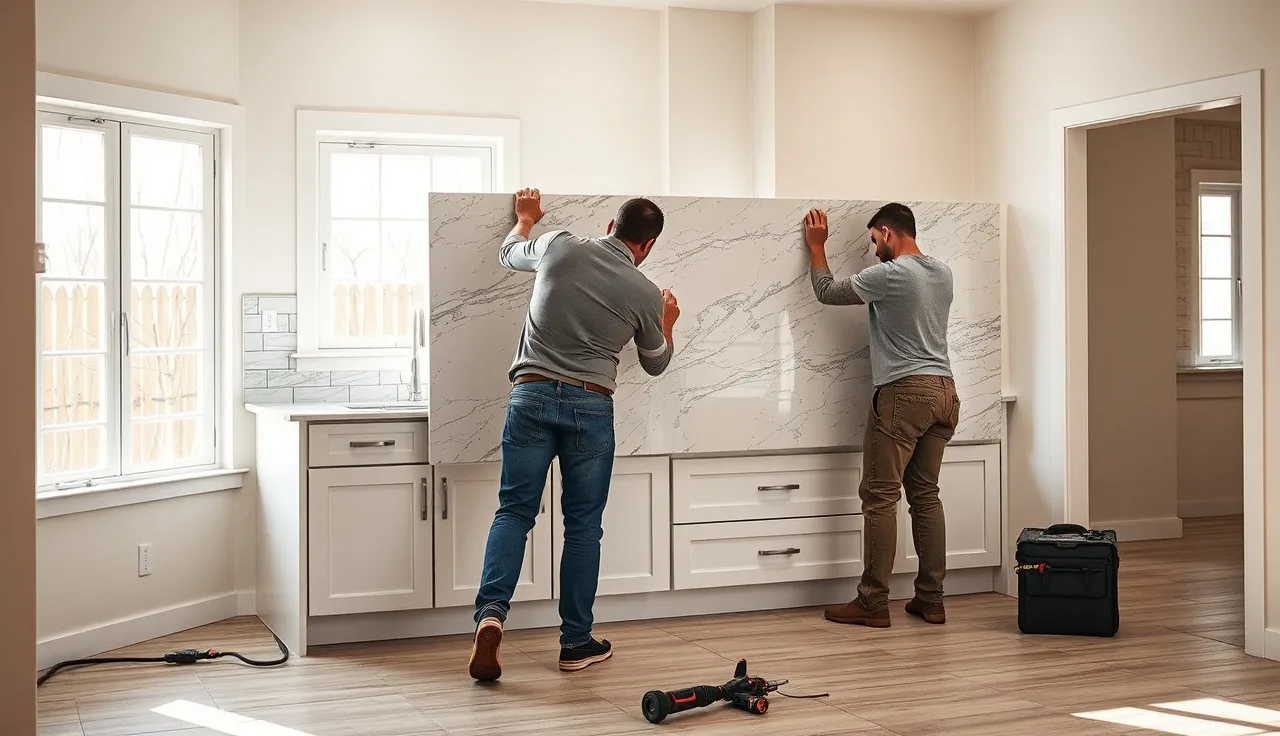
TL;DR
- Most countertop fabrication shops pay installers a piece rate of $8 to $18 per square foot of finished stone delivered and set, with the middle of the market sitting around $10 to $13 per square foot.
- The exact number depends on material type, job complexity, local labor costs, and whether the installer also does tearout, plumbing disconnect, and caulking.
- Simpler laminate or tile work pays less; natural stone and quartz pay more.
What does a piece rate for countertop installation actually mean?
A piece rate pays the installer a set dollar amount per unit of work done instead of an hourly wage. In countertop shops, that unit is almost always square footage installed, though some shops pay per job (a flat per-kitchen or per-bathroom rate) or per piece (per slab set).
The appeal for shop owners is predictability. If you pay $11 per square foot installed and your crew does 400 square feet in a day, your labor cost is $4,400 for that output regardless of whether the job took six hours or nine. The appeal for experienced installers is upside: a fast, clean two-person crew can comfortably out-earn what an hourly wage would produce on a productive day.
The risk for installers is the slow day, the callbacks, and the jobs that eat time without adding square footage. A bathroom with a pedestal vanity and one eight-square-foot piece still requires the same truck, the same drive, the same setup. Piece rate structures have to account for that or installers get burned.
Not every shop uses pure piece rate. Many use a hybrid: a base hourly floor (often $18 to $22 per hour) that converts to piece rate when the piece rate would pay more. That floor protects against nightmare jobs while keeping the productivity incentive alive on normal days.
What is the typical piece rate range per square foot?
The honest answer is $8 to $18 per square foot installed, with most shops clustered between $10 and $13 [1]. That range is wide enough to be nearly useless without context, so here is what actually moves the number.
Material type is the biggest factor. Laminate and solid surface installs (think Formica or Corian) are lighter and less fragile, so rates often sit at the low end, $8 to $11. Natural stone like granite and marble, plus engineered quartz like Cambria, pays $11 to $15 because slabs are heavy, breakable, and need final seaming in the field. Thick 3cm material with complex edges or waterfall ends can push $15 to $18.
Scope of work included matters enormously. Is the installer just setting pre-cut slabs, or are they also pulling the old tops, disconnecting and reconnecting the plumber's rough-in, cutting sink knockouts in the field, and caulking all perimeters? Each task added should add to the rate or get paid as a separate line item. A lot of rate disputes come from installers assuming tearout is included and owners assuming it is not.
Market and geography shift the baseline. Bureau of Labor Statistics data from May 2024 puts median wages for tile and stone setters (SOC 47-2044) at $26.10 per hour nationally, with the 75th percentile at $35.14 [2]. A piece rate that will not let a competent installer clear at least the 50th percentile wage equivalent is going to churn your crew. In high-cost metros (San Francisco, New York, Seattle), a rate of $14 to $18 is more realistic to keep installers from walking.
Crew structure also changes the math. A two-person crew splitting a piece rate means each person earns roughly half. Some shops pay the lead installer a higher share (60/40 splits are common) to reflect their skill and liability.
| Material / Scope | Typical piece rate per sq ft |
|---|---|
| Laminate / solid surface, drop-in sink only | $8, $11 |
| Granite / quartz, pre-cut slabs, basic seams | $11, $14 |
| Natural stone with field seaming, undermount sink | $13, $16 |
| Premium stone, waterfall, complex radius work | $15, $18 |
| Add tearout of old tops | +$1, $2 per sq ft |
| Add plumbing disconnect/reconnect | +$50, $150 flat per job |
How do piece rates compare to hourly wages for installers?
BLS data for May 2024 shows the median hourly wage for tile and stone setters at $26.10, and for carpet, floor, and tile installers broadly at $22.99 [2]. Countertop installers specifically are often categorized under construction laborers (SOC 47-2061) or finish carpenters, where median pay runs $23 to $28 per hour depending on region [9].
Run the numbers. A two-person crew at $12 per square foot who installs 350 square feet in an eight-hour day earns $4,200 gross, or $2,100 each, which is $262.50 per person per day, roughly $32.80 per hour. That beats median wage meaningfully, which is the point. The productivity incentive works when the rate is set right.
If that same crew only does 200 square feet on a slow day (small jobs, long drives, a difficult site), their per-person daily gross drops to $1,200, or $150 each, $18.75 per hour equivalent. That is below median for their skill level. This is exactly why the hybrid floor matters: without it, a $12/sqft piece rate can pay less than a fast food job on bad days.
For shop owners doing the math: if your shop charges customers $35 to $50 per square foot for countertop installation labor (material is separate), paying installers $11 to $14 per square foot leaves a margin that has to cover the truck, fuel, insurance, the shop lead who handled scheduling, and any warranty callbacks. That spread is usually tight enough that rate creep without a matching price increase will squeeze you fast.
What factors should a shop use to set its piece rate?
Start with your local labor market. Pull BLS Occupational Employment and Wage Statistics for your metro area (available at bls.gov/oes) [2]. Find the median and 75th percentile for tile and stone setters or construction craft workers in your region. Your piece rate, averaged over a normal week of output, should let a competent installer land somewhere between those two benchmarks. If it does not, you will lose the experienced installers to competitors who have done this math.
Next, calculate your own revenue per square foot. If your shop nets $38 per square foot on installation (after material cost), a $13 piece rate is 34% of revenue on labor, which is reasonable. If you are netting $28 per square foot, $13 is 46% and you are in trouble unless your other overhead is unusually lean.
Factor in drive time and minimum job payments. A flat minimum per job, typically $150 to $300 regardless of square footage, protects installers on small bathroom vanities or single-piece jobs. Without this, installers learn to hate small jobs, which creates its own operational problems.
Review your callback policy. If installers are paid back for callbacks at their same piece rate (meaning they fix mistakes on their own time), that is unpaid labor by another name. Most shops handle this with a tiered system: the first callback for a clean install issue (caulk cracking, minor settling) is the installer's responsibility; callbacks for design or material errors are paid. Whatever your policy is, write it down before you announce the rate.
Revisit the rate at least once a year. Material prices, fuel costs, and local wages all drift. A rate that was fair in 2022 may be extractive now. The Bureau of Labor Statistics Employment Cost Index shows construction labor costs rose roughly 4 to 5 percent per year on average from 2020 to 2024 [3]. A piece rate frozen since 2020 has lost real value.
Should piece rates include sink cutouts, seams, and other add-ons?
This is where most installer disputes live. The base piece rate covers the core task: move the slab, set it level, attach it, done. Everything beyond that should be defined clearly, either as included (and priced into the base rate) or as a separate line item.
Common add-on line items shops pay separately:
- Undermount sink cutout: $35 to $75 per sink, depending on material
- Cooktop cutout: $35 to $60
- Field seam polishing: $25 to $50 per linear foot of seam
- Backsplash set (tile, stone): sometimes a separate per-piece rate or hourly
- Old countertop tearout and haul: $1 to $2 per square foot or flat $75 to $150 per kitchen
- Laminate edge buildup or drop-in modifications: flat fee per occurrence
When shops roll everything into one per-square-foot number, the installers doing complex jobs with three seams and two sinks earn the same rate as installers doing straight runs with no cutouts. That breeds resentment fast. The cleaner approach is a modest base rate plus defined add-ons, because the complexity is real and the time difference is real.
For kitchen countertops specifically, a typical mid-size kitchen (40 to 55 square feet, one undermount sink, one or two seams) might pay the installer $12 base plus $50 for the sink cutout plus $60 for two seams, totaling around $650 to $720 gross on a job that takes a two-person crew three to four hours. That works out to roughly $85 to $90 per person-hour, competitive for skilled trades.
How do piece rates work for employee installers vs. subcontractors?
This is a legal question as much as a pay question. The IRS uses a multi-factor test to sort employees from independent contractors, and misclassification carries real penalties [4]. Whether someone is a W-2 employee or a 1099 subcontractor changes how piece rates get structured.
For W-2 employees paid on piece rate, the Fair Labor Standards Act requires that the effective hourly rate (total piece rate earnings divided by hours worked) equal or exceed the federal minimum wage of $7.25 per hour [5]. Most states are higher: California's is $16.50 as of January 2025, Washington's is $16.66 [6]. A shop paying piece rates to employees has to track hours and verify the floor is met every pay period, or it faces FLSA liability.
For 1099 subcontractors, the piece rate is just a price for a service. The sub sets their own hours, controls their own method, typically supplies their own tools, and invoices the shop. The IRS test asks whether the worker is economically dependent on the shop and whether the shop controls how (more than what) the work is done [4]. If your "sub" shows up every day, uses your truck, and follows your installation procedure step by step, the IRS may call them an employee no matter what your contract says.
Many mid-size shops use a genuine subcontractor model where the installer runs their own LLC, carries their own general liability insurance ($1 million per occurrence, $2 million aggregate is the industry standard), and works for multiple shops. That structure is cleaner. It also typically means the sub needs to earn $3 to $5 more per square foot to cover self-employment taxes, insurance, and overhead, so the gross piece rate for a sub runs higher than for an employee.
What do experienced countertop installers actually earn per year?
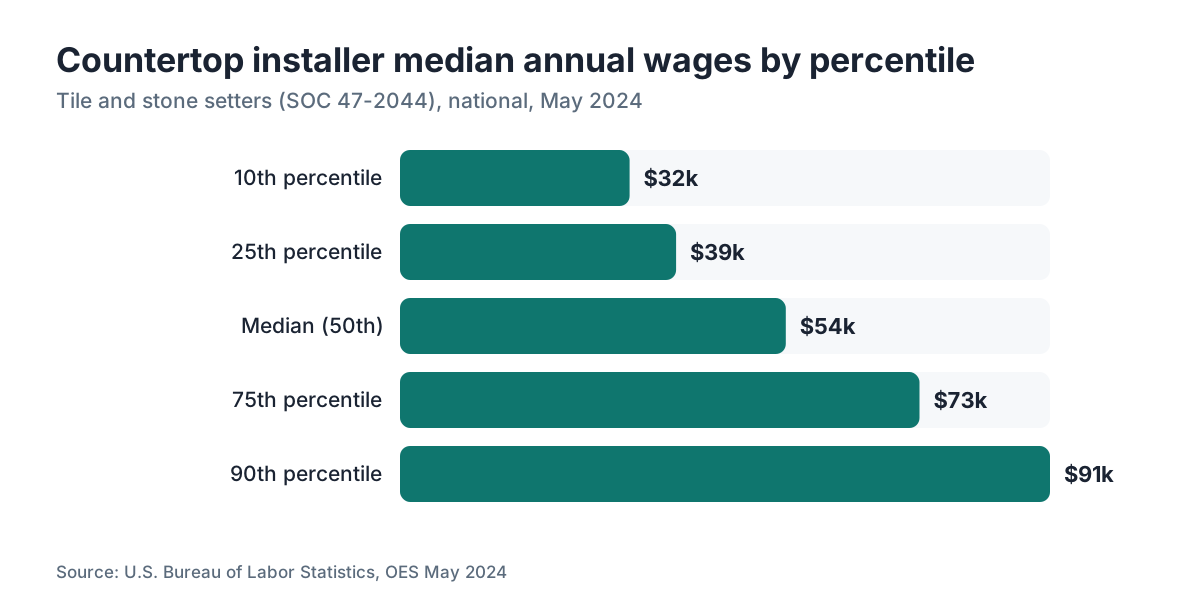
BLS May 2024 data puts the median annual wage for tile and stone setters nationally at $54,290, with the 25th percentile at $38,860 and the 75th percentile at $73,100 [2]. Countertop installers specifically are not broken out as their own BLS category, but they generally earn at or above tile setters because the material values are higher and the tolerance for error is lower.
A skilled two-person crew that consistently installs 350 to 450 square feet per day, five days a week, 48 working weeks per year can put up 84,000 to 108,000 square feet annually as a team. At $12 per square foot split two ways, the lead on a 60/40 split earns roughly $30,000 to $38,000 as their share from that single crew. That alone is below median, which is why lead installers at productive shops often manage multiple crews or take on their own route, pushing annual earnings to $60,000 to $90,000.
Owner-operators running their own installation subcontracting business, with one truck and one helper, often report gross revenues of $180,000 to $280,000 annually in strong markets. After the helper's pay, truck costs, insurance, and taxes, net income often lands around $70,000 to $110,000. Those numbers match what trade forums and industry Facebook groups discuss, though nobody has audited survey data specifically on countertop install subcontractors.
How should installers negotiate a better piece rate?
Show up with data, not feelings. Pull the BLS OES data for your metro area [2], calculate what your current piece rate actually yields per effective hour worked over the last two or three months, and present the gap if one exists. A shop owner who sees "your rate works out to $19.40 per hour for me on typical jobs" responds differently than to "I think I deserve more."
Track your own output carefully. The installer who can say "I averaged 380 square feet per day over the last 60 days with zero callbacks" has a very different negotiating position than one who cannot produce that number. Piece rate pay is a performance contract in disguise: if you are performing, you have standing to renegotiate.
Propose specific adjustments rather than a blanket rate increase. Ask for a separate line item for tearout if tearout is currently folded in. Ask for a minimum per-job floor if small bathroom jobs are eating your day. Ask for an annual adjustment tied to the BLS Employment Cost Index for construction [3]. These targeted asks are easier for shop owners to say yes to than a flat "pay me more per square foot."
If the shop will not move and your output is strong, the market tells you the truth fast. Post your resume or talk to other shops. A genuinely skilled stone installer with clean callbacks in a metro market is not easy to replace.
How can fabrication shops track piece rate productivity accurately?
The biggest operational problem with piece rate pay is accurate square footage tracking per job and per installer. If your shop quotes jobs in a software system that outputs a square footage figure per order, that number should flow directly to payroll without manual re-entry. Shops that track this on paper or in spreadsheets routinely deal with disputes about the final installed footage, especially when field conditions forced a re-cut or a piece got wasted.
SlabWise, the quoting and nesting software this site runs on, ties job square footage to the quote so there is one consistent number of record from quote through fabrication. That same figure can drive the piece rate calculation without a separate measurement step, which cuts out a common source of installer-shop disagreement.
Beyond software, build a simple daily install log: installer name, job number, address, material type, total square footage confirmed by the lead, add-on items completed. Have the installer sign it. That log is your payroll backup and your callback record in one document. If a dispute arises, you have a signed record of what was done on what date.
Measure callback rates by installer over rolling 90-day windows. A high-performing installer on square footage who generates twice the callbacks of their peers is not actually a high performer. They are pushing cost onto the shop. Piece rate systems that do not track quality alongside quantity slowly reward speed over craft.
Are there legal minimums or rules that affect piece rate countertop pay?
Yes, and they matter more than most shop owners think.
The Fair Labor Standards Act mandates that piece-rate employees receive at least the applicable federal or state minimum wage for every hour worked [5]. The FLSA also requires overtime at 1.5x the regular rate for hours over 40 in a workweek, and for piece-rate workers the "regular rate" is total piece-rate earnings divided by total hours, including the overtime hours [5]. So a piece-rate employee who earns $800 over a 50-hour week has a regular rate of $16 per hour and is owed an extra 0.5x $16 for each of the 10 overtime hours, or $80 in overtime premium on top of the $800. Many shops get this wrong.
Several states add their own layers. California's piece rate law (Labor Code Section 226.2) requires employers to pay piece-rate workers a separate, additional hourly rate (at least minimum wage) for rest periods and any time spent on tasks not producing piece-rate output, like driving between jobs, cleaning the truck, or attending shop meetings [7]. California shops that pay pure piece rate without this separate rest period compensation face significant class action exposure.
Workers' compensation classification also matters. Installers working with stone are typically classified under NCCI code 5348 (Marble Setting) or related codes [8]. The premium rate for that classification is higher than general construction labor codes, reflecting the injury risk from heavy material handling. Misclassifying installers into a cheaper workers' comp code to save on premiums is insurance fraud and creates gaps in coverage if an installer is hurt.
Before you finalize a piece rate structure, run it by an employment attorney in your state. The FLSA piece rate rules are the federal baseline, but state law frequently demands more.
What do installers and shop owners say are the most common piece rate mistakes?
Setting the rate once and never touching it is the most common error. A $10 per square foot rate set in 2019 has lost real purchasing power as construction labor costs rose nearly 20% between 2020 and 2024 per the BLS Employment Cost Index [3]. Shops that did not adjust are now paying below market and wondering why their best installers left.
Not defining scope clearly is the second most common mistake. When a shop owner says "piece rate covers the install" and an installer hears "piece rate covers everything I do on site," the gap creates resentment on both sides. The owner feels the installer is slow. The installer feels they are doing unpaid work on tearout and caulking.
Using a single rate across all material types is another frequent error. Paying the same per-square-foot rate for a butcher block countertop install (light, forgiving, cut with a circular saw) as for a 3cm marble waterfall island (physically demanding, expensive if damaged, careful seaming required) ignores real differences in skill, risk, and time.
Forgetting about minimum job payments guarantees that small jobs will be resented. An installer who drives 45 minutes each way to set a 12-square-foot bathroom vanity for $144 gross at $12 per square foot is working for poverty wages after fuel and time. A $200 to $250 minimum job payment solves this instantly.
Frequently asked questions
What is a fair piece rate for countertop installers per square foot?
Most shops pay $10 to $14 per square foot for standard granite or quartz installation. Simpler laminate work sits closer to $8 to $11, and complex premium stone work with multiple seams and undermount sinks can justify $15 to $18. The right number lets a competent two-person crew earn at or above the BLS median wage for their region on a typical production day.
Do countertop installers get paid by the hour or by the piece?
Both models exist. Smaller shops and residential remodelers often pay hourly ($20 to $30 per hour is common for experienced installers). Larger fabrication shops that run multiple crews on production volume tend to use piece rate, sometimes with an hourly floor to protect installers on slow or complex days. Piece rate rewards output; hourly rewards time on site. Many shops use a hybrid of both.
How much do countertop installation subcontractors charge shops per square foot?
Installation subcontractors typically charge fabrication shops $14 to $22 per square foot, noticeably higher than what employee installers earn. The gap covers the sub's self-employment taxes (roughly 15.3% on net earnings), general liability insurance, vehicle and fuel costs, and the fact that subs get no employer benefits. Shops that use subs often pay less per job overall once you strip out benefits and payroll overhead.
What is the minimum wage rule for piece-rate countertop installers?
The Fair Labor Standards Act requires that any piece-rate employee's total earnings for a pay period, divided by total hours worked, equal or exceed the applicable minimum wage. Federal minimum wage is $7.25 per hour, but most states are higher. California requires a separate hourly payment for rest periods even for piece-rate workers under Labor Code Section 226.2. Shops must also pay overtime correctly when hours exceed 40 per week.
Should tearout of old countertops be included in the piece rate?
Most experienced shop owners handle tearout as a separate add-on, either $1 to $2 per square foot or a flat fee of $75 to $150 per kitchen. Rolling it into the base piece rate without raising that rate is the fastest way to create installer resentment. Tearout takes real time, generates debris that needs disposal, and carries its own injury risk from old fasteners and adhesive.
How do I calculate what my shop can afford to pay per square foot?
Take your shop's net revenue per square foot on installation (what customers pay for labor, minus your direct overhead for that job). Labor cost as a share of that revenue should generally run 30% to 45%. If you net $40 per square foot on installation, a $14 to $18 piece rate is defensible. If you net $28, $12 to $13 is probably your ceiling before margin disappears. Run this math job-by-job for a month before setting a rate.
What is the piece rate for a two-person countertop installation crew?
The shop typically pays a single piece rate to the crew as a whole (for example, $12 per square foot on 300 square feet equals $3,600 for the job), and the crew splits it. Common splits are 50/50 for two equally skilled installers or 60/40 where the lead takes more. Some shops pay the lead directly and let them hire and pay their own helper, which simplifies payroll but creates a subcontractor relationship.
How much do countertop installers make per year?
BLS May 2024 data puts the median annual wage for tile and stone setters at $54,290 nationally, with the 75th percentile at $73,100. Countertop-specific installers are not separately tracked, but skilled stone installers in productive shops often earn $60,000 to $85,000 as employees. Independent subcontractors who run their own route and crew can net $70,000 to $110,000 after expenses, depending on market and volume.
Is it legal to pay countertop installers purely on piece rate with no hourly guarantee?
You can pay pure piece rate for 1099 independent contractors, but for W-2 employees the FLSA requires the effective hourly rate to meet or exceed the minimum wage for every workweek. California adds further requirements: piece-rate employees must receive a separate hourly payment for rest breaks and unproductive on-the-clock time, regardless of their piece-rate earnings that shift. Other states may have similar rules; check with an employment attorney in your state.
What workers' comp classification applies to stone countertop installers?
Stone countertop installers are typically classified under NCCI code 5348, which covers marble, slate, and stone setting work. This classification carries a higher base workers' compensation premium than general construction labor codes, reflecting the injury exposure from heavy slab handling. Using the wrong code to save on premiums is a coverage gap and potential insurance fraud. Verify the correct code with your carrier or a licensed insurance broker.
How often should a fabrication shop adjust its piece rate?
At minimum, once a year. The BLS Employment Cost Index for construction labor rose roughly 4 to 5 percent per year on average from 2020 to 2024. A piece rate frozen since 2020 has effectively been cut by 18 to 22 percent in real terms. Many shops tie their annual rate review to their price increase cycle: when they raise prices to builders or homeowners, they pass a portion through to installers.
What add-ons to the base piece rate are standard in the industry?
The most common paid add-ons are: undermount sink cutouts ($35 to $75 each), cooktop cutouts ($35 to $60), field seam polishing ($25 to $50 per linear foot), old top tearout ($75 to $150 flat or $1 to $2 per square foot), and plumbing disconnect/reconnect coordination ($50 to $150 flat). Minimum job fees of $150 to $300 are also standard to keep small jobs from being economically punishing.
How does local market affect what a fair piece rate is?
Dramatically. BLS OES data shows tile and stone setter wages in San Francisco average over $40 per hour at the median, versus $21 in parts of the Southeast. A $12 per square foot piece rate might yield fair compensation in Birmingham but be exploitative in Seattle. Always benchmark your rate against BLS OES data for your specific metropolitan statistical area, not national averages.
Can a countertop installer negotiate piece rate by material type?
Yes, and it is reasonable to do so. Stone installers who specialize in premium materials like thick quartzite or book-matched marble take on higher financial risk (a broken slab can cost thousands) and need more skill than installers doing standard laminate drops. Negotiating a tiered rate, lower for commodity materials and higher for premium stone, is fair to both parties and increasingly common in production shops.
Sources
- Stone World Magazine, industry wage and rate surveys: Piece rates for countertop installation generally range from $8 to $18 per square foot depending on material and scope, with the industry center of gravity around $10 to $13.
- U.S. Bureau of Labor Statistics, Occupational Employment and Wage Statistics, May 2024: Median annual wage for tile and stone setters (SOC 47-2044) was $54,290 in May 2024; median hourly was $26.10; 75th percentile hourly was $35.14.
- U.S. Bureau of Labor Statistics, Employment Cost Index, Construction: Construction labor costs rose approximately 4 to 5 percent per year on average from 2020 to 2024 per the BLS Employment Cost Index.
- IRS, Independent Contractor (Self-Employed) or Employee?: The IRS uses a behavioral, financial, and type-of-relationship multi-factor test to determine whether a worker is an independent contractor or employee; misclassification carries tax and penalty exposure.
- U.S. Department of Labor, Fair Labor Standards Act (FLSA) Wage and Hour Division: The FLSA requires piece-rate employees to earn at least the applicable minimum wage per hour worked and receive overtime at 1.5x the regular rate for hours over 40 per workweek; regular rate for piece-rate workers is total earnings divided by total hours.
- U.S. Department of Labor, Wage and Hour Division, Minimum Wage by State: California minimum wage was $16.50 per hour and Washington's was $16.66 per hour as of January 2025.
- California Labor Code Section 226.2 (via California Legislative Information): California Labor Code Section 226.2 requires employers to pay piece-rate employees a separate hourly rate, at least minimum wage, for rest and recovery periods and other non-productive on-the-clock time, in addition to piece-rate earnings.
- National Council on Compensation Insurance (NCCI), Class Code Lookup: Stone countertop installers are typically classified under NCCI workers' compensation code 5348, covering marble, slate, and stone setting work, which carries a higher base premium rate than general construction labor codes.
- U.S. Bureau of Labor Statistics, OES May 2024, Construction Laborers (SOC 47-2061): Median hourly wage for construction laborers nationally was approximately $23 per hour in May 2024, with wide regional variation by metropolitan statistical area.
- U.S. Department of Labor, Wage and Hour Division, Piece-Rate Pay guidance: DOL guidance confirms piece-rate pay is legal under the FLSA provided effective hourly earnings meet minimum wage and overtime rules are properly applied.
Last updated 2026-07-11