
TL;DR
- Corian countertops need an authorized Dupont fabricator or a shop trained in solid-surface work.
- Installed cost usually runs $40 to $150 per square foot depending on edge profiles, cutouts, and region.
- The seams are heat-welded and sanded flat until they vanish, which takes specific tooling.
- Hire the wrong installer and that is the single biggest reason Corian looks bad years later.
What does a Corian countertop installer actually do?
Corian is an acrylic-based solid surface made by Dupont. It is not stone, not laminate, and not quartz composite. The fabrication and installation process is genuinely different from any of those materials, and most general contractors who install granite countertops or marble countertops are not set up to handle it properly.
A solid-surface installer measures the kitchen, cuts Corian sheets to size with router and table-saw setups, thermoforms any curved sections using a heat blanket, glues pieces together with color-matched seam adhesive, and then hand-sands the seam flat until it disappears. That last step is the art. When done right, you legitimately cannot feel or see the joint. When done wrong, you get a ridge or a ghost line that shows in raking light forever.
They also route the sink cutout, usually glue an undermount sink directly to the underside of the material, and sand and buff the entire surface to a consistent finish. The finish level (matte, satin, semi-gloss) is set by the abrasive grit used at the end, not by any coating. That matters because scratches and stains can be sanded out later, which is one of Corian's real advantages over stone.
The install itself usually takes one day for an average kitchen. A complex layout with multiple seams, a tight thermoformed curve, or an integrated sink can push it to two days [1].
Why does Corian have to be installed by an authorized fabricator?
Dupont keeps a network of authorized Corian fabricators. This is more than a marketing program. The material warranty, which covers manufacturing defects, requires that fabrication and installation be done by an authorized shop [2]. If a general handyman cuts and installs your Corian, you have no material warranty coverage.
Authorized fabricators get access to color-matched seam adhesive kits for every Corian color. They are trained on the specific joint-prep technique Dupont requires: edges must be perfectly flat and mated before the two-part adhesive goes in, or the seam will show. They also have access to Corian's technical support line when something unusual comes up.
That said, "authorized" does not automatically mean "good." Authorization means the shop completed Dupont's training and agreed to the program terms. It does not mean they do beautiful work or that they have been doing this for 15 years. You still have to vet the specific shop.
You can search for authorized dealers and fabricators directly on the Corian design website [2]. Enter your zip code and it returns shops in your area. Use this as a starting list, not an ending list.
How much does Corian countertop installation cost?
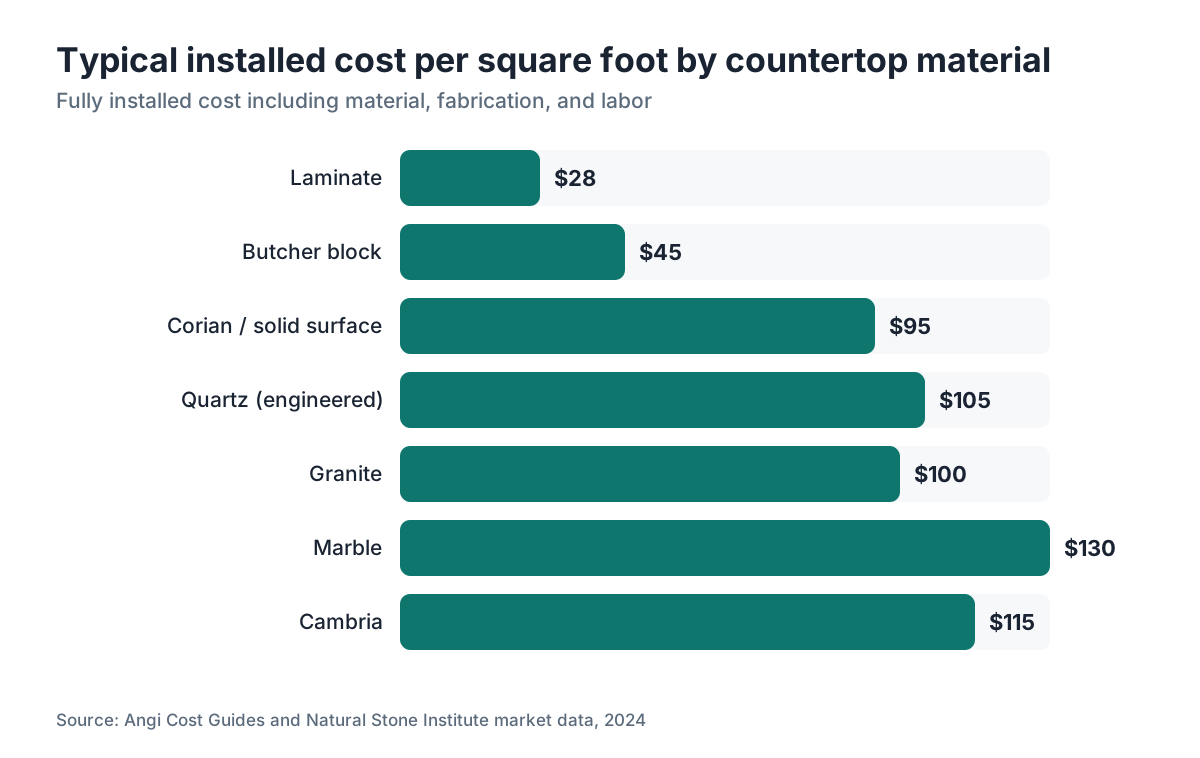
Installed cost for Corian, meaning material plus fabrication plus installation combined, usually runs $40 to $150 per square foot [3]. The wide range reflects real variables: color tier, edge profile complexity, number of cutouts, and local labor market.
Here is how the cost breaks down in practice:
| Cost component | Typical range |
|---|---|
| Corian sheet material (basic colors) | $15, $35/sq ft |
| Corian sheet material (premium colors) | $35, $65/sq ft |
| Fabrication labor | $10, $30/sq ft |
| Installation labor | $10, $25/sq ft |
| Eased or beveled edge (standard) | Included or $5, $10/ln ft |
| Ogee or other decorative edge | $15, $30/ln ft upcharge |
| Undermount sink cutout and glue-up | $150, $400 each |
| Thermoformed curve or cove backsplash | $200, $600 per section |
A typical 40-square-foot kitchen in the middle of the country, with a basic color and a simple layout, comes in around $2,000 to $3,200 installed. Upgrade to a premium color, add an integrated sink, and throw in a coved backsplash, and you are looking at $5,000 to $7,500 for the same 40 square feet.
Compare this to laminate countertops, which run $15, $40 installed, or cambria countertops at $80, $150. Corian sits in the mid-range. It is not cheap, but you get renewability and no-joint sinks that neither laminate nor stone can match.
Get at least three quotes. Prices for the same Corian color in the same city can vary 30 to 40 percent between shops, and that gap is usually labor efficiency and overhead, not material quality [9].
How do you find a good Corian installer near you?
Start with Dupont's authorized fabricator locator [2]. Then cross-reference those shops against:
- Google reviews (look for photos of actual installs, not general contractor work)
- Houzz project portfolios, specifically filtering for solid surface or Corian projects
- The National Kitchen and Bath Association (NKBA) member directory, which lists vetted trade professionals [4]
When you call a shop, ask one direct question: "How many Corian or solid-surface jobs do you do per month?" A shop that does two or three a month has current muscle memory on the material. A shop that installs it twice a year probably got it wrong a few times before they figured it out.
Ask to see seam work specifically. Any shop worth hiring should be able to show you a photo of a dry-sanded seam under good light, or better yet, take you to a completed job nearby. If they cannot show you seam quality, walk away.
Also ask who physically does the installation. In some larger shops, the owner sells the job and a less experienced fabricator does the cut-and-install. You want to know who will be in your kitchen with a router.
For fabricators running multiple Corian jobs per week, quoting software matters. SlabWise is built for exactly that workflow, letting shops generate accurate solid-surface quotes with cutout pricing and edge profile line items in minutes rather than spreadsheets.
The NKBA offers a "Find a Pro" search tool that lets you filter by specialty and location [4]. It is not Corian-specific, but NKBA members carry continuing education requirements that tend to filter out fly-by-night operations.
What questions should you ask a Corian installer before hiring?
Here is what to actually ask, and what the answers tell you.
"Are you an authorized Corian fabricator?" If no, the material warranty is void. Full stop.
"Who do you buy Corian from?" Legitimate shops buy through authorized Dupont distributors. If they say they "source it from a supplier" without naming the distributor, probe further.
"Do you fabricate in-house or subcontract the cutting?" Some small shops template themselves but outsource the actual cutting to a larger fab shop. That is not inherently bad, but you want to know who is accountable for quality.
"What does your seam process look like?" A good installer can explain the joint prep, the adhesive mix ratio, the clamp time, and the sanding sequence without hesitating. Vague answers are a red flag.
"What is your process if a seam fails in the first year?" Solid surface seams rarely fail, but knowing the shop stands behind their work matters.
"Do you carry liability insurance and are your workers covered?" This is non-negotiable. A fabricator working in your home without insurance is your liability problem if someone gets hurt [5].
"What is your lead time?" Quality shops are often booked 3 to 8 weeks out. If someone can start next week, ask why.
Get everything in writing: the Corian color code, edge profile, number of cutouts, seam locations, and total price. Seam location matters especially in kitchens. A seam placed at the sink is invisible; a seam placed in the middle of an island is not.
How is Corian installation different from quartz or granite installation?
Stone and engineered quartz are cut, polished at the edge, and dropped into the cabinet opening. The seams are filled with color-matched epoxy and they stay slightly visible if you look for them. The material is not reworkable on-site in any meaningful way.
Corian installation is closer to woodworking than stone work. The material can be heated and bent. Seams are chemically welded, not filled. The surface can be sanded and buffed in the field. An experienced solid-surface fabricator uses routers, heat blankets, color-matched two-part adhesive, random orbital sanders, and multiple grits of wet-dry paper on every single job.
The tooling overlap with countertop installation generally is minimal. A stone shop without solid-surface experience will struggle, and vice versa. Some large shops handle both, but they often have dedicated crews for each material.
This also changes the template process. For stone, a template captures the exact slab cut. For Corian, the template is used to plan seam placement and identify any curves that need thermoforming. A good Corian templater is thinking about thermal expansion (Corian expands and contracts with temperature), seam placement for looks, and which sections can be fabricated in one piece to keep joints out of the design.
Corian also allows integrated sinks, drain boards, and backsplashes that are physically one piece of material with no joint at all. Stone cannot do this. That integration capability is part of why architects and high-end kitchen designers have used Corian in demanding commercial applications for decades [1].
Can a homeowner install Corian countertops themselves?
Technically yes. Corian is not regulated. Anyone can buy it and install it.
Practically, it is a bad idea for most people. The seaming process needs specific two-part adhesive, color-matched per Corian color code, which is only available through authorized distributors. Sanding out a seam means knowing which grit sequence to use and how to avoid burning through the surface. Thermoforming a cove backsplash without the right heat blanket and temperature control gives you lumps and cracks.
Corian sheets are also heavy and awkward. A full 30-by-144-inch sheet weighs around 85 to 100 pounds depending on thickness (half-inch versus three-quarter-inch). Getting it into a kitchen and positioned without chipping a corner takes two people who know what they are doing.
The one DIY scenario where it can work: you are replacing a flat, single-piece run with no seams, no curve, and no undermount sink, and you are willing to settle for a visible butt joint with silicone. That is a real downgrade from what Corian can do, and it voids the warranty.
If budget is the issue, compare Corian DIY to formica countertops or butcher block countertops, both of which are genuinely DIY-friendly and cost less. Corian's value comes from professional fabrication. Without it, you are paying solid-surface prices for laminate-level results.
What does the installation process look like from start to finish?
Here is a realistic timeline for a standard kitchen Corian install.
Day one: the fabricator or a separate templater comes out with a laser measure or physical template material. They measure every cabinet run, document sink type and location, note any corners that need coping or end-cap treatment, and confirm the Corian color code. This takes 30 to 90 minutes. Some shops combine templating and install in one visit if the layout is simple, but most schedule them separately.
Fabrication happens in the shop, usually over 3 to 10 business days depending on backlog. Sheets are cut, seams are dry-fit, edges are routed and sanded, and the sink cutout is made. Any thermoforming happens here.
Installation day: the crew arrives with the fabricated pieces, seam adhesive, clamps, and finishing supplies. They set the pieces on the cabinets, confirm fit, then pull them back up to apply adhesive to seams. Pieces get clamped, excess adhesive scraped off, and the shop waits 20 to 30 minutes for cure before unclamping. Seams get sanded and blended. The full surface gets a final sanding and buffing to the specified finish. Undermount sink gets adhesive-bonded and supported with clips or straps from below.
The cabinets need to be level before the installer arrives. If they are off by more than a quarter inch across a run, the material will stress at the seams. Most installers will shim the cabinets themselves, but ask ahead of time so there are no surprises.
Total time on-site for a standard kitchen: 4 to 8 hours. You cannot use the countertops for 24 hours while the adhesive fully cures [1].
How do you care for Corian after installation?
Corian is low maintenance but not zero maintenance. The surface is non-porous, so it does not need sealing, which is a real advantage over marble countertops or quartzite. Bacteria cannot penetrate the surface, which is part of why it is used in healthcare settings [6].
For everyday cleaning, mild soap and water or a non-abrasive household cleaner is all you need. Avoid anything with methylene chloride or paint stripper chemistry. Acetone in small amounts is fine for stubborn adhesive, but do not let it pool.
The real advantage is renewability. Scratches, scorch marks, and even minor burns can be sanded out. Light scratches sand out with 400-grit wet-dry paper followed by a ScotchBrite pad. Deeper damage needs a coarser starting grit and more blending. The key is to blend the sanded area out to a large radius so the sheen matches the surrounding surface. A spot the size of a dinner plate that is sanded with 800-grit will look different from the rest of a 120-grit matte finish, and you will have to feather it out to fix that.
Corian is not heat-proof. Hot pans directly on the surface can cause localized expansion and potentially crack the material, especially near a seam or a cutout. Use trivets. The material's coefficient of thermal expansion is much higher than stone [7], which is also why installers leave a small gap at walls and caulk rather than running the material tight.
For more on maintaining solid and stone surfaces, the approach to how to clean stone countertops has some overlap, though Corian's non-porous nature means you skip the sealing steps entirely.
What are the most common Corian installation problems?
Visible seams are the most common complaint, and almost always come down to poor joint prep or wrong adhesive. The two mating edges must be dead-flat and parallel. Even a slight gap means the adhesive cures with a void, which telegraphs through the surface after sanding. A good fabricator does a dry-fit of every seam before applying adhesive. If you see a gap during installation, say something.
Cracking at cutouts is the second most common issue. Corian needs a minimum radius at sink corners, usually at least three-eighths of an inch. A square corner concentrates stress and the material will eventually crack there, usually within the first year. Ask your installer what corner radius they use for undermount cutouts.
Uneven finish is a subtler problem. If one section of the counter got more sanding passes than another, or if the buffer pad wore out mid-job, you get a patchwork of sheen levels that shows in morning light. Walk your kitchen in raking light before the crew leaves. Point out anything that looks different.
Thermoform failures show up as flat spots or ripple in what should be a smooth curve. This usually means the heat blanket was not evenly applied or the material was not hot enough when bent. These are very hard to fix after the fact without redoing the section.
Expansion cracking can happen if the installer did not leave adequate movement gaps at walls and appliances. Corian expands roughly 1.6 to 2.0 times more than wood per degree of temperature change [7]. In a kitchen that gets hot, a run trapped tightly between a wall and a refrigerator can crack. The fix is a bead of silicone at the wall, not hard caulk.
Is Corian still worth choosing, or are there better options now?
This is a real question worth answering honestly. Corian came out in 1967 and dominated solid-surface countertops for decades. The market has changed. Quartz engineered stone now takes the largest share of countertop sales [8], and there are legitimate reasons: quartz is harder, more scratch-resistant, and comes in patterns that mimic stone convincingly.
But Corian still does things quartz cannot. The seams genuinely disappear. You can thermoform it into curves. You can integrate a sink with no joint. The surface is renewable. For commercial kitchens, healthcare, and high-traffic spots where renewability matters more than hardness, solid surface is still the right answer. NSF certifies Corian as appropriate for food zones [6], which matters for restaurant and commercial installs.
For residential kitchens, it comes down to what you care about. If you want a surface that looks like natural stone, quartz or actual stone wins. If you want integrated sink capability, easy repair, and a surface that will look exactly the same in 20 years with basic care, Corian is a strong choice. It is not a wrong choice. It is just a different set of tradeoffs.
For fabricators tracking material mix across jobs, quoting each material type accurately matters a lot. If your shop handles Corian alongside quartz and stone, a platform like SlabWise lets you configure material-specific pricing structures so solid-surface quotes are as fast and accurate as stone quotes, without separate spreadsheets.
Corian's warranty on the material itself is 10 years for residential use [2]. Most competing quartz brands offer 15 to 25 years. That gap exists because acrylic solid surface is more renewable but also more susceptible to impact and heat damage than engineered stone. It is not that Corian is lower quality. The material just works differently.
Frequently asked questions
How long does Corian countertop installation take?
Templating takes 30 to 90 minutes. Fabrication in the shop takes 3 to 10 business days depending on the shop's backlog and job complexity. Installation day runs 4 to 8 hours for a typical kitchen. You should not use the countertops for 24 hours after installation to let the seam adhesive fully cure. Plan for roughly two weeks between template appointment and completed install.
Can a general contractor install Corian countertops?
A general contractor can cut and place Corian, but they almost certainly cannot weld and sand seams to an invisible finish, thermoform curves, or properly execute an integrated sink. More practically, using a non-authorized fabricator voids the Dupont material warranty. Hire a shop that specifically does solid-surface work and holds current authorized fabricator status through Dupont.
How do I find Dupont authorized Corian fabricators near me?
Use the dealer and fabricator locator on the official Corian Design website. Enter your zip code and it returns nearby authorized shops. Also cross-check with the NKBA's Find a Pro tool, which lists vetted kitchen and bath professionals. Use both lists to build a short list of shops, then vet them on seam quality and references before committing.
What is the warranty on Corian countertops?
Dupont offers a 10-year limited warranty on Corian for residential applications. The warranty covers manufacturing defects in the material. It requires installation by an authorized fabricator. Damage from misuse, heat, or improper cleaning is not covered. The warranty is non-transferable, meaning it does not follow the home to a new owner. Read the full warranty terms on Dupont's Corian website before signing a purchase agreement.
How much does it cost to repair Corian countertops?
Minor scratch removal and buffing by a professional typically costs $100 to $300 for a standard kitchen surface. Seam repair or a section replacement for crack damage runs $200 to $800 depending on how much material needs to be replaced. Deep burns or severe damage in high-visibility spots may require replacing an entire run, which approaches the cost of new installation. Many homeowners handle light scratch repair themselves with sandpaper and a scotchbrite pad.
Are Corian countertops sanitary and food-safe?
Yes. NSF International has certified Corian solid surface as acceptable for food-contact applications and commercial food preparation zones. The non-porous surface does not harbor bacteria the way natural stone with open pores can. This is why Corian is common in healthcare, restaurant, and laboratory environments in addition to residential kitchens. Standard soap and water cleaning is sufficient for food prep surfaces.
Can Corian countertops be installed over existing countertops?
Some installers will overlay Corian on top of existing laminate if the substrate is flat, stable, and well-adhered. This avoids demolition cost but adds height, which can conflict with appliance specs and backsplash tile. Most experienced solid-surface fabricators prefer to work on fresh cabinet tops for better control of flatness and seam quality. Ask the installer to assess your specific situation before committing to an overlay approach.
How do Corian seams compare to quartz or granite seams?
A properly executed Corian seam is chemically welded and sanded flush, making it invisible to the eye and touch. Quartz and granite seams are filled with color-matched epoxy and stay visible as a thin line in raking light. For continuous-surface applications, especially around sinks and in high-visibility island locations, Corian's joint-free capability is a genuine functional advantage that stone cannot replicate.
What thickness of Corian should I specify for countertops?
The standard countertop thickness is half-inch Corian with a built-up edge to achieve a full three-quarter-inch or thicker profile. Three-quarter-inch solid sheet is also available and gives a more substantial look and feel without edge build-up. Half-inch with a laminated edge is most common and most cost-effective. Ask your fabricator what edge build-up is included in their quote, because pricing differences between options can be significant.
Do Corian countertops need to be sealed?
No sealing is required or useful. Corian is a non-porous acrylic composite, not a natural stone. Sealers designed for granite or marble will not penetrate the surface and will leave a residue. Skip the sealer entirely. The only maintenance Corian needs is regular cleaning with mild soap and water, plus periodic light sanding to refresh the finish if the surface picks up scratches over years of use.
Can Corian countertops be used outdoors?
Dupont does not recommend Corian for outdoor installations exposed to direct UV and weather. Prolonged UV exposure causes the acrylic to yellow and become brittle over time. For outdoor kitchens, porcelain tile, engineered stone specifically rated for exterior use, or stainless steel are better choices. Some fabricators have used Corian in covered, shaded outdoor applications with reasonable results, but it is outside the warranty parameters.
What colors and finishes does Corian come in?
Corian comes in over 100 colors across multiple series, from solid whites and blacks to stone-look patterns with veining. Finish options are matte, satin, and semi-gloss. The finish is set by the grit of abrasive used during fabrication, not a coating, which means a scratched section can be sanded back to match the original finish. Your authorized fabricator can show physical samples; online color photos are not reliable enough to make a final decision.
How do I know if my Corian installation was done correctly?
Walk every seam under raking light before the crew leaves. A properly welded and sanded seam should be invisible at normal viewing distance and smooth under your fingertip. Check the sink glue-up by pressing down on the sink rim; it should feel completely solid with no flex. Confirm the reveal at the wall is consistent and caulked, not caulk-free and tight against the wall, which would prevent thermal expansion. Address any concerns before signing off on the job.
Sources
- Dupont Corian Design Technical Manual: Corian installation involves thermoforming, seam welding with two-part adhesive, and surface sanding; residential kitchens typically take one day to install
- Corian Design official website, authorized fabricator program and warranty terms: Dupont requires installation by an authorized fabricator to maintain the 10-year limited residential material warranty
- HomeAdvisor (Angi), Corian Countertop Cost Guide: Installed cost for Corian countertops typically ranges from $40 to $150 per square foot depending on color, edge profile, and region
- National Kitchen and Bath Association (NKBA), Find a Pro directory: NKBA maintains a searchable directory of vetted kitchen and bath trade professionals with continuing education requirements
- U.S. Small Business Administration, business insurance guide: Contractors working in homes should carry general liability insurance; homeowners may bear liability for uninsured workers injured on their property
- NSF International, certified product listings for food zone surface materials: NSF certifies Corian solid surface as acceptable for food-contact and commercial food preparation zone applications
- Dupont Corian Technical Data Sheet, coefficient of thermal expansion: Corian has a coefficient of thermal expansion significantly higher than natural stone, requiring expansion gaps at walls and appliances during installation
- Natural Stone Institute (formerly Marble Institute of America), U.S. countertop market data: Engineered quartz now holds the largest share of residential countertop sales in the United States, surpassing natural stone and solid surface
- U.S. Bureau of Labor Statistics, Occupational Outlook Handbook, Tile and Stone Setters: Regional labor rates for skilled countertop installers vary significantly across U.S. markets, affecting total installed cost ranges
- U.S. Consumer Product Safety Commission, home improvement safety guidance: Homeowners should verify contractor insurance and licensing before allowing trade work in occupied residences
Last updated 2026-07-09