TL;DR
- Stone countertop pieces weigh 12 to 20 lbs per square foot and snap if they flex.
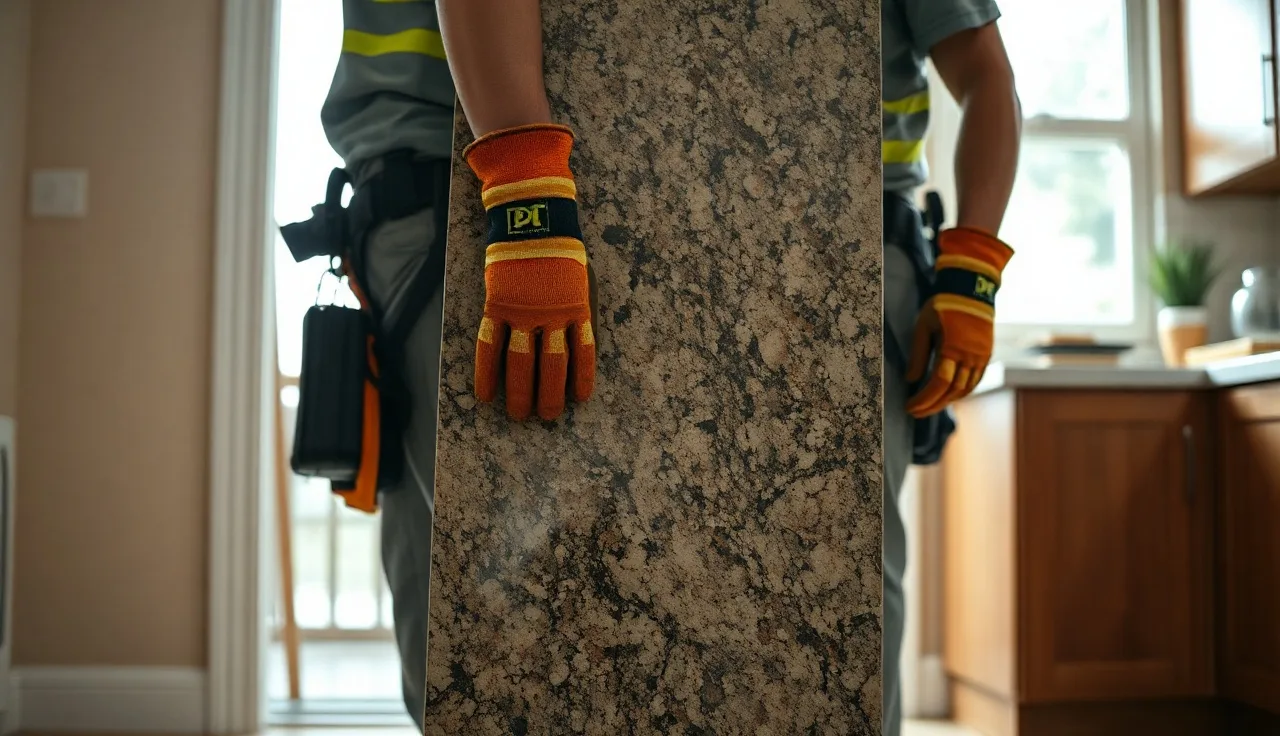
- Always carry slabs on edge with at least two people, use suction cups rated for the load, protect corners, and clear the path before you lift.
- Most installation injuries and slab breaks happen in the last 10 feet, not during transport.
Why is carrying a stone countertop so dangerous compared to other materials?
Stone is heavy, brittle, and deceptive. A 3 cm granite slab weighs roughly 18 to 20 lbs per square foot [1]. A modest L-shaped kitchen top covering 40 square feet comes in as two or three pieces, each potentially 150 to 250 lbs. Quartz and granite are hard enough to resist scratching but have almost no tensile strength, meaning they don't bend before they break. Flex a slab even a few inches past its support span and it will crack clean across, usually right through a sink cutout or a narrow bridge between an undermount cutout and the edge.
Compare it to wood. A 3/4-inch hardwood butcher block countertop at the same size might flex noticeably and survive. Stone will not. Laminate countertops and Formica countertops are light enough that one person can carry a section. Stone is in a different category entirely.
The injury picture matches this. The Bureau of Labor Statistics tracks musculoskeletal injuries for the stone, clay, and glass product manufacturing sector, and overexertion (lifting, pushing, pulling heavy objects) consistently ranks as the leading injury type [2]. Installation work is physically similar to fabrication handling: same weights, same awkward geometries, same risk. A slab that breaks mid-carry can also lacerate hands and feet from shards, so the danger is more than back strain.
How much does a stone countertop piece actually weigh?
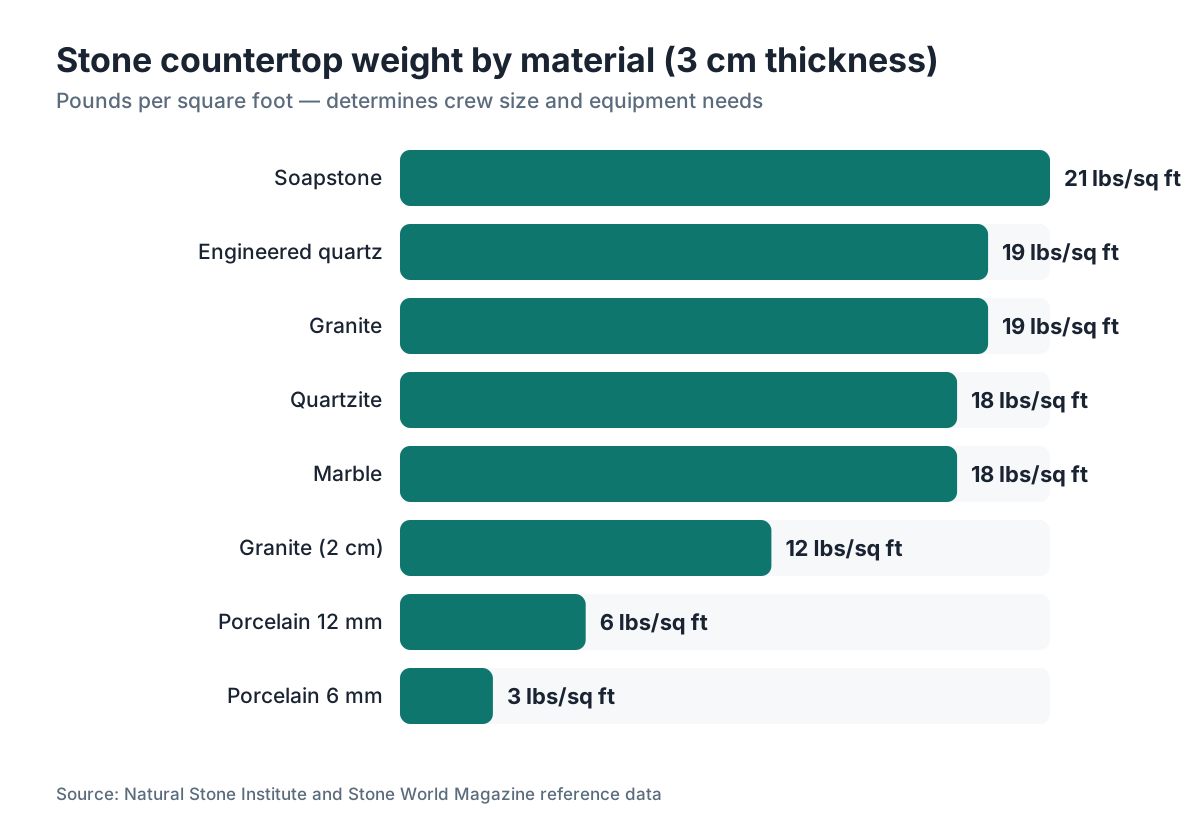
Weight varies by material and thickness. The table below gives real-world ranges for the materials fabricators handle most often.
| Material | Thickness | Weight per sq ft |
|---|---|---|
| Granite | 2 cm (3/4") | 12 to 13 lbs |
| Granite | 3 cm (1-1/4") | 18 to 20 lbs |
| Marble | 3 cm | 17 to 19 lbs |
| Quartzite | 3 cm | 17 to 19 lbs |
| Engineered quartz (Cambria, etc.) | 3 cm | 18 to 20 lbs |
| Soapstone | 3 cm | 20 to 22 lbs |
| Porcelain slab | 6 mm | 3 to 4 lbs |
| Porcelain slab | 12 mm | 6 to 7 lbs |
Soapstone is the heaviest common countertop material, pound for pound [3]. Porcelain slabs are the outlier on the light end, though they have their own fragility problems at thin gauges.
Here's the planning math. Measure your countertop square footage, multiply by the weight per square foot above, and add 10% for overhangs and edge profiles. That number tells you how many people and what equipment you need before anyone lifts anything.
How many people does it take to safely carry a stone countertop piece?
Two people for pieces under 100 lbs on a clear, flat path. Three people for anything over 100 lbs, any piece with a sink cutout, or any carry involving stairs, a tight turn, or an uneven floor. Four people when a piece exceeds roughly 200 lbs or when the install path is unusually long or complex.
OSHA's manual material handling guidance recommends that no single worker lift more than 50 lbs without assistance, and that team lifts be coordinated with a designated leader [4]. On a job this means one thing: one person calls all the movement commands. Nobody shifts position, changes grip, or steps until the caller says so.
Sink cutouts trip up even experienced crews. A piece with a large undermount sink opening has almost no structural cross-section at the cutout location. Under bending load, that's where it fails. Carry those pieces with a third person in the middle, hands supporting the underside directly below or just behind the cutout, never at the ends only.
Don't let ego shrink your crew. A two-person team that struggles through a 180 lb piece is one stumble away from a broken slab, a broken foot, and an ER visit. Two hours of a third set of hands costs almost nothing against any of those outcomes.
Should you carry a stone slab flat or on edge?
On edge, always, for transport. Flat only for the final set.
A stone slab carried flat is a beam loaded in bending. If the carriers' hands are at the ends and there's no support in the middle, the slab wants to sag at its center. With a long piece, that sag can exceed the stone's modulus of rupture before you've taken three steps. Carrying on edge turns the slab into a column loaded in compression, which stone handles extremely well.
The industry standard is vertical or near-vertical transport. A-frames, panel carts, and slab dollies all carry stone on edge for exactly this reason. Most professional shops transport slabs at 5 to 10 degrees off vertical rather than perfectly upright, leaning slightly backward into a padded rack so they can't tip forward [5].
For hand-carries inside a home, angle the piece at about 70 to 80 degrees from horizontal (nearly upright) and walk it in. Two people on opposite ends, suction cups on the face, moving in sync. Set it flat only when you're within a foot or two of the final position and lowering it onto the cabinets.
The exception is short, thick pieces. A small 3 cm granite piece that's 12 inches square and weighs 15 lbs can go flat safely. The risk scales with length, more than weight.
What equipment do you need to carry stone countertop pieces safely?
Suction cups are the most important tool. Get vacuum suction lifters rated for stone, not the small retail ones meant for glass. Professional-grade suction cups for stone handling are rated at 50 to 150 lbs each and have a gauge that shows whether vacuum is holding [6]. Before you lift, pump the cup, check the gauge, and verify it's seated on a clean, dry, flat area of the stone surface. Honed and leathered finishes cup better than polished surfaces that have any micro-texture. Test the seal before any weight goes on the stone.
Beyond suction cups:
- Slab dolly or A-frame cart for any piece too heavy to hand-carry from the truck. These let you roll the piece in on edge and cut the hand-carry distance way down.
- Knee pads and steel-toed boots. A stone corner hitting an unprotected foot can break toes.
- Cut-resistant gloves rated for glass and stone handling (ANSI A4 cut level minimum). Regular work gloves won't protect from a shard.
- Moving blankets and edge padding. Corners hit door frames and cabinet edges; padding prevents chips and protects walls.
- Forearm lifters or lifting straps if you're setting a heavy piece onto cabinets without a mechanical assist. These shift the load from your hands to your forearms and help with level control during the final placement.
For very large pieces, some installers use a vacuum lifter attached to a beam or small gantry crane in the garage or driveway to get the slab from truck to dolly with zero flex. That's overkill for most residential jobs but makes sense for commercial work or extremely large islands.
Shops that use SlabWise for project management sometimes track equipment checklists per job. If you're running a shop, building that into your pre-install workflow catches the jobs where someone forgot suction cups at the warehouse.
How do you protect a stone piece from cracking during a carry?
Support the span. That's the whole job. Stone cracks when unsupported sections flex under their own weight, so any carry method that leaves a long section hanging is wrong.
For pieces over 48 inches long, put hands or support points no more than 12 to 18 inches from each end and add a center support for anything over 72 inches. If you're using suction cups, position one cup at roughly one-quarter of the length from each end, not at the very ends. Suction cups at the ends leave the middle section to hang on its own.
Corners are fracture initiation points. Pad them. Closed-cell foam corner guards (the cheap kind sold for baby-proofing furniture work fine) protect both the stone corner from chipping and the wall or cabinet it might bump.
Sink cutouts, cooktop cutouts, and narrow necks between cutouts and the edge need direct support during carry. Position a hand directly under the weakest point, even if it feels awkward, because that's where the crack will start if you don't.
Temperature matters less than most people think. Stone that's been in a cold truck and then comes into a warm kitchen has some thermal differential, but that alone rarely cracks a slab during a residential install. The real risk is setting a cold slab onto a warm surface too quickly during a commercial application near heat sources. In normal residential work, this isn't a major concern.
For marble countertops and quartzite countertops, the mineral cleavage planes in natural stone mean some slabs have slightly lower tensile strength in one direction. Your fabricator will know if a specific slab had any unusual characteristics. Ask before install day.
What's the right way to carry a stone piece through a doorway or tight space?
Measure first. Every time. The widest point of the piece, usually at an inside corner or overhang extension, must clear the narrowest point of the path with at least 2 to 3 inches to spare. That sounds obvious, but slab crews have had to put pieces back on trucks because a refrigerator wasn't moved or someone forgot about a door hinge adding an inch to the frame.
The sequence for a tight doorway:
- Remove the door entirely. Seriously. A door swinging into a crew carrying 200 lbs of granite has caused real injuries. Thirty seconds to pull the hinge pins is always worth it.
- Identify the pivot point. On a near-vertical carry through a doorway, one end leads and the other person walks forward; the pivot is the mid-point of the piece. Walk the leading end through the opening first, then angle the tail through.
- Move at a controlled, slow pace. Quick movements cause momentum shifts that the other carrier can't anticipate.
- Communicate every step. "I'm stepping left. Ready? Stepping now."
For 90-degree turns in hallways, common when going from a garage entry to a kitchen, you may need to briefly tip the piece to a shallower angle to get through the turn. This raises flex risk for a moment. Plan to have an extra person at the center during the turn specifically.
Stairs are the hardest case. If a kitchen is on an upper floor and there's no way to bring the piece up through an exterior opening (some crews use ladders or a window on the second floor, which requires mechanical lifting equipment), you need at minimum three people on stairs: one at the bottom holding the lower end, two above controlling the upper end and the pace. The lead person on stairs walks backward; they need a clear view of where they're stepping. Have a fourth person walking alongside just to watch the stair path and call out hazards.
What personal protective equipment (PPE) do countertop installers need?
This is a question OSHA actually answers through its construction industry standards, which apply to countertop installation work performed at residential and commercial job sites [7]. The protections that matter:
- Foot protection: ANSI Z41-rated steel-toed boots when carrying objects that could crush feet. A 200 lb piece of granite dropped from waist height generates more than enough force to cause crush injuries through a regular work boot.
- Hand protection: Cut-resistant gloves. ANSI 105 standard rates cut resistance from A1 to A9; for stone handling, A4 or higher is right. Regular leather gloves stop abrasion but offer minimal cut protection from a shattered slab edge.
- Eye protection: Safety glasses during any breaking, cutting, or grinding near the install site. Not usually required for a clean piece carry, but if there's any trimming at the site, glasses go on.
- Back support: OSHA's position on back belts is careful. The agency says there's insufficient evidence that back belts prevent injury but does not prohibit them [4]. More useful is proper lifting training. Lift with legs, keep the load close to the body, avoid twisting while loaded.
For fabricators running crews, the OSH Act's General Duty Clause requires employers to provide a workplace free from recognized hazards likely to cause death or serious physical harm [8]. Stone carrying is a recognized hazard. Written lift plans and crew training aren't optional once you're running a commercial operation.
How do you set a stone countertop piece down without cracking it or hurting anyone?
The final placement is where most breaks happen, and it's almost always because someone lowered one end before the other or set the piece down onto an uneven support.
Before the carry even starts, prepare the landing zone:
- Verify cabinet tops are level to within 1/8 inch across the span. Significant high spots create a fulcrum; lower the piece onto a fulcrum and the ends hang in the air under load.
- Place shims and silicone beads before the piece arrives. Once you're holding 150 lbs, you can't adjust.
- Mark exactly where the piece goes. Tape lines on the cabinet top if needed. You want to lower it once, not scoot it.
During the set, keep the piece nearly vertical until the last few inches, then rotate it toward horizontal as a team. Both carriers lower their end at the same time on the call. "Lower together. Three, two, one, lower." If one end goes down first, the entire weight of the piece transfers to that fulcrum point and the opposite end rises, creating a lever arm that can snap the stone.
For island pieces or spans without a continuous cabinet support, use temporary wooden supports (2x4 blocks or shims) spaced every 18 inches along the underside until the silicone cures and the piece is permanently supported. Don't rely on silicone alone on day one.
After the set, do not walk away. Hold the piece in position for 30 seconds and confirm no edge is hanging unsupported and no corner is sitting proud of a cabinet edge. A piece that looks right from above can still be touching just one cabinet rail. A gentle push confirms full contact.
What mistakes do even experienced crews make when carrying stone?
Skipping the path walk is the most common. A crew that's installed 500 kitchens still needs to physically walk the carry path before the piece comes off the truck. You're looking for obstacles at knee height (chairs slid under a table, a dog bowl), floor height changes (a lip between tile and hardwood), and overhead clearance (a low ceiling fan, a light fixture someone didn't remove).
Underestimating the last 10 feet. Most crews move a slab confidently across a driveway and through a door, then rush the final positioning because the end is in sight. This is where the piece gets banged into a cabinet corner or lowered unevenly. Slow down as you approach the set point.
Putting suction cups on dirty or wet stone. Suction cups fail on grit, dust, or water. Wipe the stone surface dry and clean before attaching cups, and re-test the vacuum after any contact with a dusty wall or floor.
Carrying too far without a rest point. On a long carry, set the piece down on a padded surface midway through if fatigue is building. A rested crew carrying 80 feet in two segments is safer than a fatigued crew carrying 80 feet straight.
Not communicating grip changes. If your hands need to shift, say so before you move them. "I need to change grip. Hold still." Silently repositioning while the other person thinks you're stable is how pieces get dropped.
For granite countertops, the specific risk is deceptive rigidity. Granite feels very stiff compared to, say, a butcher block countertop, but that rigidity hides the fact that it has no flex reserve before fracture. The confidence granite inspires can lead crews to take it on with too few people or too little support.
Are there specific rules for carrying stone on a job site?
Yes, and they come from multiple directions. OSHA 29 CFR 1926 Subpart X covers stairways and ladders at construction sites; 29 CFR 1926 Subpart E covers personal protective equipment at construction worksites; and the General Duty Clause of the OSH Act (Section 5(a)(1)) applies to all employers [8]. Residential construction and remodeling work falls under OSHA's construction standards when performed by an employer, not a homeowner doing their own work.
Many states run their own OSHA-approved plans with standards at least as protective as federal OSHA. California's Cal/OSHA, for instance, has specific ergonomic standards (California Code of Regulations, Title 8, Section 5110) requiring employers to identify and address repetitive motion and manual handling injuries when workers have work-related musculoskeletal disorders [9]. Stone handling is a high-risk manual handling activity under ergonomic analysis frameworks.
For homeowners doing their own install, no OSHA standard applies directly to you. But the physics doesn't care. The weight limits and technique guidelines exist because the injuries are real and predictable.
Some jurisdictions require a licensed contractor for countertop installation as part of kitchen remodel permitting. Check your local building department before deciding to DIY a stone install. A countertop-only swap usually doesn't require a permit, but it varies. The countertop installation process overall has several steps where professional involvement makes sense beyond just the carry.
When should a homeowner just hire professionals instead of carrying stone themselves?
Any piece over 80 lbs that you don't have three fit, coordinated people to help with. That's a practical threshold, not a legal one.
Beyond that: if your install path has a staircase, a 90-degree turn in a hallway narrower than 40 inches, or the kitchen is anything other than a straight shot from the entry, hire professionals. The cost of re-fabricating a broken slab, which can run $300, $800, or more for a typical piece depending on material and complexity, exceeds almost any professional installation fee [10].
If your slab has a large undermount sink cutout and you haven't carried stone before, don't attempt it. The geometry is genuinely tricky and the failure mode (crack through the cutout) is expensive and irreversible.
If you're committed to DIY, rent professional suction cup lifters from a tool rental shop rather than buying consumer-grade versions. Many equipment rental companies carry stone suction cups; call ahead to confirm. That single equipment decision meaningfully lowers drop risk.
For context on material costs: a typical Cambria countertop slab piece costs significantly more per square foot than granite, so the cost of a break is proportionally higher. Know your material cost before deciding how much to invest in safe handling.
Shops and fabricators running multiple installs per week should think about systematizing the pre-install equipment and crew check. If your estimating software, like SlabWise, already tracks job complexity and piece count, tying that to a crew-size recommendation in your install workflow can prevent the understaffed jobs that lead to incidents.
Frequently asked questions
How heavy is a typical granite countertop section?
A 3 cm granite piece weighs 18 to 20 lbs per square foot. An average L-shaped kitchen has roughly 35 to 50 square feet of countertop, split into two or three pieces. Each piece can easily run 150 to 250 lbs. Even a small 10-square-foot section at 3 cm weighs around 190 lbs. Measure your piece dimensions and multiply to know your actual load before any carry.
Can one person carry a stone countertop piece alone?
For very small pieces under 50 lbs on a flat, clear path, technically yes. In practice, pieces that light are rare in residential stone work; most sections exceed that easily. A small 3 cm granite backsplash strip might qualify, but anything approaching a full countertop run needs two people minimum, three if there's a sink cutout or any path complexity.
What type of gloves should you wear when carrying stone?
Cut-resistant gloves rated ANSI A4 or higher. Standard leather work gloves resist abrasion but offer minimal protection from a slab edge or shard. Stone has sharp, unpredictable fracture edges, and cut-resistant gloves reduce the severity of hand injuries if a piece slips or breaks. Make sure the gloves still let you feel and maintain grip; a glove so thick you lose tactile feedback is counterproductive.
Is it safe to carry a stone countertop with sink cutout by yourself or with one helper?
No. A sink cutout reduces the stone's cross-section to almost nothing at that point. Under bending load, that narrow bridge cracks first. You need a third person positioned to support the underside directly at or behind the cutout during the full carry. Two-person carries on sink-cutout pieces are how fabricators get expensive callbacks and how DIYers destroy slabs.
Should you carry a granite slab flat or upright?
Upright for transport, flat only for the final set. A flat carry leaves the slab's length as an unsupported beam that sags under its own weight, and stone fails in bending long before it looks like it's flexing. Carrying nearly vertical (about 70 to 80 degrees from horizontal) loads the stone in compression, which it handles well. Rotate to flat only in the last foot or two of the set.
What suction cups work best for carrying stone?
Professional vacuum suction cups rated for stone at 50 to 150 lbs each, with a visible vacuum gauge. The gauge lets you confirm seal before weight goes on the stone. Position cups at roughly one-quarter of the slab's length from each end, not at the very ends. Test the seal on a clean, dry area of stone surface. Consumer glass-suction cups from hardware stores are not rated for this load and can release without warning.
How do you get a heavy stone countertop up a flight of stairs?
Three to four people minimum. One at the lower end, two controlling the upper end and pace, and ideally a fourth watching the stair path ahead. The lead person walks backward up the stairs; they need a clear sightline to their steps. Move slowly, communicate every move, and consider whether a window or exterior access point on the upper floor would let you use mechanical lifting assistance instead.
How do you keep a stone countertop from cracking when setting it down?
Lower both ends at the same time on a count. One end going down before the other creates a lever arm across the piece and a fulcrum point at the cabinet edge; the opposite end hangs unsupported and the stone can snap. Before the carry, verify the cabinet tops are level within 1/8 inch and place supports or shims at any low spots. Mark the set position so you lower it once, correctly.
Do OSHA rules apply to countertop installation workers?
Yes. OSHA 29 CFR 1926 construction standards apply to countertop installation workers employed by a contractor working at job sites. The General Duty Clause requires employers to protect workers from recognized hazards, which includes heavy manual lifting. State OSHA plans like California's Cal/OSHA may have additional ergonomic standards. Homeowners doing their own install are not covered by OSHA, but the physical risks are identical.
What should you do before carrying a stone slab inside a house?
Walk the full carry path before the slab comes off the truck. Measure the narrowest point, remove the door if it's a tight fit, clear everything at knee and ankle height, check for floor level changes, note any overhead obstructions, and prepare the landing zone with shims and silicone in place. Assign roles and a caller before anyone lifts. This five-minute path walk prevents most carries from going wrong.
Can a stone slab break during installation even without being dropped?
Yes, and it's common. The most frequent cause is bending: a long piece carried with hands only at the ends, an unsupported sink cutout, or a piece set onto an uneven cabinet top that creates a fulcrum point. Stone has very low tensile strength and will crack cleanly at its weakest cross-section under sustained flex load. You don't need an impact event; gravity and poor support are enough.
Is porcelain slab easier to carry than granite?
Much lighter, yes. At 6 mm thickness, porcelain slab weighs 3 to 4 lbs per square foot versus 18 to 20 lbs for 3 cm granite. But porcelain at thin gauge is extremely brittle and chips from edge impacts more easily than granite. You still carry it on edge, still use suction cups (especially on large format pieces), and still protect corners. The weight advantage is real; the fragility trade-off is also real.
How far in advance should installation equipment be prepared?
The day before at minimum. Confirm suction cups are at the job site, check that vacuum cups hold seal (they can slowly leak over time), verify the slab dolly wheels roll freely, and walk the path if you can access the home. Equipment failures discovered after the slab is off the truck and sitting in the driveway waste time and sometimes force improvised methods that increase risk.
What's the most common injury when installing stone countertops?
Overexertion injuries (back, shoulder, and wrist strain from heavy lifting and carrying) are the leading category for workers in stone product handling, per Bureau of Labor Statistics data. Lacerations from shard contact are the most acute risk if a piece breaks mid-carry. Steel-toed boots, cut-resistant gloves, and keeping crew size matched to the load weight address both injury categories.
Sources
- Stone World Magazine, Slab Weight Reference: 3 cm granite slabs weigh approximately 18 to 20 lbs per square foot
- U.S. Bureau of Labor Statistics, Injuries, Illnesses, and Fatalities: Overexertion is the leading injury type for workers in stone, clay, and glass product manufacturing
- Marble Institute of America (now Natural Stone Institute), Stone Technical Resources: Soapstone is among the heaviest common countertop materials at approximately 20 to 22 lbs per square foot at 3 cm
- OSHA, Ergonomics and Manual Material Handling: OSHA guidance recommends no single worker lift more than 50 lbs without assistance and that team lifts use a designated coordinator; OSHA states there is insufficient evidence that back belts prevent injury
- Natural Stone Institute, Slab Handling and Safety Guidelines: Industry standard for slab transport is vertical or near-vertical at 5 to 10 degrees off vertical in padded A-frame racks
- OSHA, 29 CFR 1926 Subpart E Personal Protective Equipment: OSHA construction standards require foot and hand protection appropriate to the hazards at construction and remodeling worksites
- OSHA, OSH Act of 1970 Section 5(a)(1) General Duty Clause: The OSH Act General Duty Clause requires employers to provide a workplace free from recognized hazards likely to cause death or serious physical harm
- California Department of Industrial Relations, Cal/OSHA Title 8 Section 5110 Repetitive Motion Injuries: California Code of Regulations Title 8 Section 5110 requires employers to address repetitive motion and manual handling injuries; stone handling is a high-risk manual handling activity
- HomeAdvisor (Angi), Countertop Replacement Cost Guide: Re-fabrication cost for a broken countertop piece can run $300, $800 or more depending on material and complexity
Last updated 2026-07-10