TL;DR
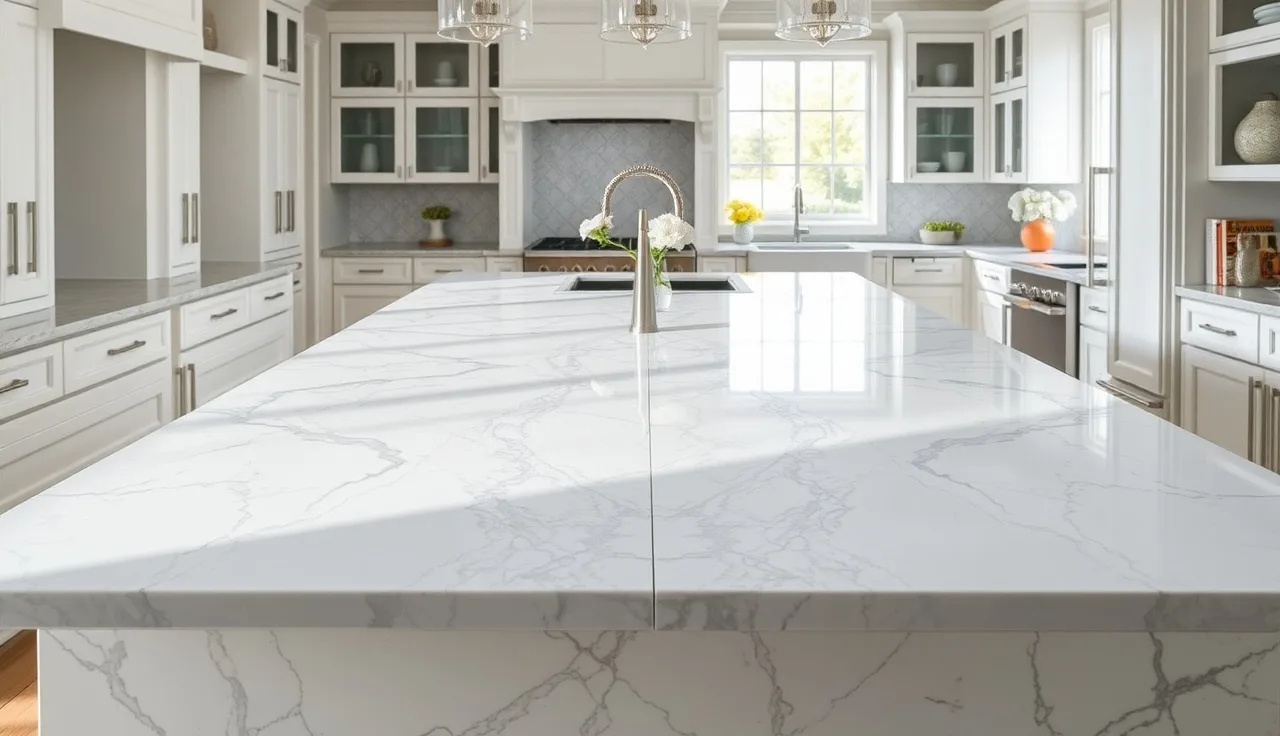
- A bookmatch layout takes two consecutive slabs cut from the same block and flips one over so the veining mirrors itself, like the pages of an open book.
- The result is a dramatic, symmetrical pattern across a seam.
- It costs more because fabricators must buy and cut matched pairs, but on high-movement marbles and quartzites it produces a look you cannot fake with a single slab.
What does bookmatch mean in stone fabrication?
Bookmatching is a layout technique where two slabs that came from consecutive cuts of the same stone block sit side by side, with one slab flipped along the seam axis so its veining becomes a mirror image of the other. Picture the two pages of an open book: whatever pattern appears on the left page reflects on the right. The term comes straight from woodworking and veneer work, where the same trick has been used for centuries on figured walnut, burl, and matched rosewood panels.
In stone, the effect works because quarrying produces sequential slabs that share nearly identical internal mineral structures. When you cut a block, slab one and slab two are essentially the same slice of Earth taken from millimeters apart. Flip one and the veins, color clouds, and fossil lines echo each other across the joint.
The mirror isn't perfect. Stone isn't paper. Variations in thickness, polishing pressure, and mineral density mean the match is always approximate. On some stones, like heavily veined Calacatta marble or Verde Alpi, the match is so close it looks almost digital. On a quieter granite with subtle, random speckling, you'd never notice the difference anyway, so bookmatching there is largely pointless.
Fabricators and designers reach for bookmatch layouts most often on marble countertops and dramatic quartzites, where movement is the whole reason someone picked the stone in the first place.
How does the bookmatching process actually work in a fabrication shop?
It starts at the slab yard, not at the template stage. A fabricator or designer has to find a matched pair before any cutting happens. Most quarries and distributors bundle consecutive slabs together and mark them with a common lot number, but the bundles sometimes get split during shipping. Checking that two slabs are truly sequential is step one: lay them side by side face up, flip one, and hold them at the intended seam to see whether the veins align.
Once the pair is confirmed, the layout plan governs everything. The fabricator marks which face of each slab faces up and which edge becomes the seam edge. Then both slabs get cut along exactly parallel lines so the edges mate tightly. Even a two-degree angular difference in the saw cuts will throw the mirror off at the countertop surface. On a CNC bridge saw this is straightforward. On an older manually guided saw it takes real care.
The seam itself gets treated like any stone seam: ground flat, joined with color-matched epoxy or polyester adhesive, and polished flush. The difference from a plain seam is that the fabricator has to position the two pieces precisely so the vein lines on one slab pick up where the vein lines on the other leave off. That alignment step can add an hour or more of setup time per seam.
Shops that track slab inventory and layout digitally, using software that logs slab lot numbers and cut diagrams, have a real edge. Knowing which slabs remain from a matched pair before a customer walks in is worth more than most shops realize.
After the countertops are cut and seamed, the mirror shows up at the finished joint. A four-centimeter mitered waterfall edge done in bookmatch, where the vein runs from the horizontal top down the vertical side and the mirrored slab continues it on the other side, is one of the most striking things a shop can produce.
Which stone types benefit most from a bookmatch layout?
Not every stone is worth bookmatching. The technique pays off on stones with strong, linear movement: heavy veining, bold color clouds, or directional fossil patterns. Here is a practical breakdown:
| Stone Type | Bookmatch Impact | Worth the Premium? |
|---|---|---|
| Calacatta marble | Very high: dramatic gold/gray veins mirror sharply | Yes, nearly always |
| Statuario marble | Very high: bright white with bold dark veins | Yes |
| Book-matched quartzite (e.g., Fantasy Brown, Taj Mahal) | High: flowing movement looks intentional | Usually yes |
| Verde Alpi / green marbles | High: strong linear veins | Yes for focal surfaces |
| Leathered granite with movement | Moderate | Situational |
| White/gray granite (low movement) | Low: mirror effect nearly invisible | Rarely worth it |
| Engineered quartz | Not applicable: pattern is manufactured, not natural | No |
| Soapstone | Low: color is fairly uniform | No |
The stones where bookmatching transforms a countertop are exactly the ones where natural movement is dramatic enough to be worth choreographing. A Calacatta Borghini slab already costs $150 to $250 per square foot or more at retail [1]. Bookmatching it costs you one extra slab and some fabrication time, but the result carries architectural weight no single slab can match.
Granite with salt-and-pepper speckle? Nobody will ever know whether you bookmatched it or not. Save the money.
What are the different types of bookmatch layouts?
The basic open-book mirror is the most common, but fabricators use a few variations depending on the project geometry and the stone's movement direction.
Standard bookmatch (two-slab). Two consecutive slabs meet at one seam, one flipped. The veining mirrors across that single joint. This is what most people mean when they say bookmatch.
Four-way match. Four consecutive slabs get arranged in a two-by-two grid: the top two mirror left-right, the bottom two mirror left-right, and then the bottom pair mirrors top-to-bottom against the top pair. The result is a radially symmetric pattern. You see it most often on large floor medallions and feature walls, rarely on countertops because kitchen geometry doesn't usually offer four equal quadrants. When it does, it's spectacular.
Waterfall bookmatch. The countertop top surface and the vertical waterfall panel get cut from the matched pair, with the seam at the miter. The vein appears to flow continuously from horizontal to vertical. This counts as a bookmatch even though the seam is a 45-degree miter rather than a butt joint. It demands tight grain alignment and is a real fabrication test.
Full-height backsplash bookmatch. Some designers run a bookmatched pair across the countertop and up a slab backsplash behind it so the mirror continues vertically. It requires planning the cut layout before either piece is cut.
For kitchen countertops, the standard two-slab bookmatch is far and away the most common. The four-way match shows up mostly on very large islands with statement stone.
How much does a bookmatched countertop cost compared to a standard layout?
Bookmatching adds cost in three places: material, fabrication labor, and potential waste.
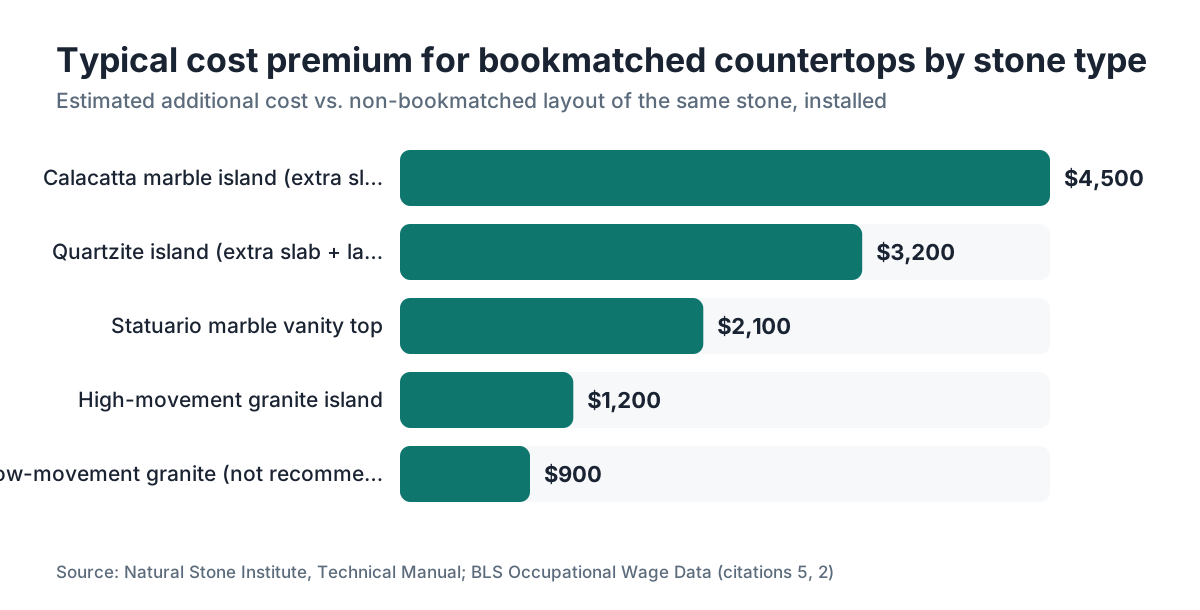
Material cost: you need two matched slabs instead of possibly squeezing a project out of one or mixing non-matched slabs. Matched pairs from a distributor sometimes sell as a bundle at a modest premium (5 to 15 percent over two individual slabs), but more often the cost hit is simply that you have to buy both slabs even if your square footage might otherwise have fit on one. On a premium stone at $120 to $200 per slab square foot, that can mean $1,000 to $3,000 in extra material [1][2].
Fabrication labor: the seam alignment work adds roughly 1 to 3 hours of skilled labor per seam. At shop rates of $75 to $150 per hour [2], that's $75 to $450 in additional labor per seam, depending on the stone's pattern and how many passes it takes to line the veins up.
Waste: because the two slabs must be cut along exactly matching lines to produce clean mirrored edges, remnants are larger and less useful for other jobs. A shop doing precise layout optimization (the kind countertop nesting software handles automatically) can trim this down, but some extra waste is structurally unavoidable.
All in, a bookmatched island in high-movement marble typically adds $1,500 to $5,000 to the total project cost compared to a non-bookmatched layout in the same stone. On a $15,000 to $25,000 high-end kitchen countertop project, that's a real but not prohibitive premium for the effect you get.
For budget stones or solid-color engineered products, the question never comes up. Cambria countertops, for example, have a manufactured pattern that repeats. There's no slab-to-slab veining to mirror.
What are the pros and cons of a bookmatch countertop layout?
Pros:
The visual impact on high-movement stone is genuinely hard to get any other way. A well-executed bookmatch reads as intentional design rather than accidental beauty. Designers and architects who work with natural stone tend to specify it on focal surfaces for exactly that reason.
It uses the stone's natural character as the design element, which means the look can't be copied in laminate countertops or formica countertops or any manufactured product. Rarity has real value in renovation projects where standing out matters.
The technique works on walls, floors, and waterfall edges as well as countertops, so a homeowner can carry the same design language through multiple surfaces if they planned early enough to buy sufficient matched slabs.
Cons:
Cost is the obvious one. You're paying for material you may not need and for extra fabrication time.
The seam is always there. Bookmatching makes the seam look intentional and designed, but it doesn't erase it. On a very tight budget, or on a countertop where a joint-free surface is the priority, a single slab with no seam beats a bookmatched pair every time.
Not every distributor can supply matched pairs, and availability depends on what came out of a particular block. You can't bookmatch slabs that weren't quarried in sequence. That limits design flexibility, especially mid-project if a slab gets damaged and needs replacement.
Fabrication skill matters enormously. A poorly aligned bookmatch looks worse than no bookmatch at all, because the misaligned mirror pulls the eye straight to the mistake. Make sure your fabricator has done this before and can show real examples of their work.
Maintenance is the same as for any natural stone counter. The seam, once epoxied and polished, is not a weak point if it's done right. See how to clean stone countertops for the standard care routine that applies.
How do you know if a slab pair is truly matched and consecutive?
This is the part homeowners almost never think about and fabricators sometimes skip under time pressure. A genuine matched pair has to come from sequential saw passes through the same block. Distributors and importers usually mark this with a gang saw sequence number or a shared bundle tag, but those records aren't always complete by the time slabs reach a regional yard.
The field test: stand two slabs vertically side by side with the faces toward you, then flip one so its polished face now faces away. Align the edges you intend to seam and step back. The veining should form a rough mirror image. It won't be perfect, but the major vein paths should clearly reflect. If the veins run in completely different directions or the color clouds don't echo, the slabs are not from the same sequential cut, no matter what the lot number says.
For expensive stones, ask your fabricator or stone yard to lay the two slabs flat on the warehouse floor with one flipped before you commit to buying. Most reputable yards will do it. If a yard refuses, that's information.
Slab thickness should also match. Two-centimeter and three-centimeter slabs from different production runs won't pair well even if the veining happens to look similar.
Once you've confirmed the match, photograph the slabs as laid out, mark the seam edges with chalk or tape, and make sure that notation travels with the slabs to the fabrication shop. The layout information has to move from the yard to the shop without ambiguity.
Can you bookmatch engineered quartz or only natural stone?
You can't bookmatch engineered quartz in any meaningful sense. Engineered quartz (brands like Cambria, Silestone, or Caesarstone) is made by mixing crushed quartz with resins and pigments, then pressing it into slabs under high pressure. The pattern gets applied during manufacturing and repeats across slabs from the same run, but the repetition isn't positional the way natural stone slabs from a sequential block cut are.
Two quartz slabs with the same product name look alike, but flipping one won't produce a true mirror because there's no underlying geology to reflect. The veining in engineered quartz is placed during manufacturing to look natural, but it lacks the continuous mineral structure that makes bookmatching work in real stone.
Some engineered quartz makers have experimented with matched-slab products, trying to create a designed mirror effect at the factory. That's not true bookmatching, and it's only available in specific product lines.
For the real thing, you need natural stone: marble, quartzite, granite, travertine, onyx, or similar. The technique is one of the strongest arguments for choosing natural stone over engineered alternatives when a dramatic result matters.
Where in a kitchen or home do bookmatched countertops work best?
The best candidate is any large, uninterrupted surface where the seam can sit at the visual center and the mirror pattern has room to spread. A kitchen island is the classic application: the seam runs down the middle of the island, the vein patterns radiate outward symmetrically, and anyone walking into the kitchen sees it immediately.
Waterfall islands are a close second. The seam sits at the miter where the top meets the vertical drop, and the bookmatch makes the transition look continuous rather than jointed. This one requires the fabricator to plan the cut geometry carefully so the vein angle at the miter creates the intended flow.
Bathroom vanity tops work well when the top is wide enough (roughly 48 inches or more) that the seam doesn't land in an awkward spot near a sink. On a narrow 30-inch vanity, the seam and the mirror effect are both too compressed to read as designed.
Feature walls, fireplace surrounds, and shower walls are strong applications. The visual field is larger, there's no cutout to interrupt the pattern, and the stone is seen from across a room, which is exactly where the mirror effect reads best.
For countertop installation planning, the key question is: where will someone stand when they first see this surface? The bookmatched seam should sit at the center of that sight line, or the design logic is lost.
What should you ask your fabricator before approving a bookmatch layout?
Have them show you the two slabs laid out as they'll be installed before cutting starts. This is non-negotiable for a bookmatch project. You're buying this specific look, and the only way to approve it is to see it.
Ask how they'll handle the seam alignment during fabrication. Specifically: will they use a CNC bridge saw or a manual saw for the seam edges? CNC cuts are more repeatable. Will they dry-fit the pieces before epoxy? Dry-fitting is standard practice for any seam, but especially important here.
Ask about their experience with the specific stone you've chosen. A fabricator who has done a dozen Calacatta bookmatch islands knows where the alignment traps are. One who has only done solid-surface work is going to learn on your project.
Ask to see photos of past bookmatch work, ideally in a similar stone. Every fabricator should have a portfolio of seam work.
Ask what happens if a slab is damaged during fabrication. For a matched pair, a damaged slab may mean sourcing a new pair from scratch, which could be months away or impossible if the block is exhausted. Understanding that risk upfront lets you decide whether to order a third backup slab, which some designers do on very expensive stone.
Shops using digital quoting and nesting tools can show you a scaled cut layout before any material gets touched. SlabWise, for example, lets fabricators map the slab layout digitally so homeowners see exactly how the matched pieces will be cut and how much material is left over. Ask whether your shop works this way.
Is a bookmatch layout worth the extra cost for your project?
Honestly, it depends on the stone and the surface.
If you're putting in a polished Calacatta marble island in a kitchen that will be a focal point of the home, and you have matched slabs available, the bookmatch premium is almost certainly worth it. The difference between a bookmatched Calacatta island and a non-bookmatched one is visible from across the room. Interior photographers actively hunt for bookmatched stone for editorial shoots. Real estate agents in high-end markets say it photographs well and reads as a quality signal to buyers.
If you're doing a standard kitchen renovation on a mid-range granite, don't bother. The stone's character doesn't reward the technique and you won't see a return on the extra cost.
The honest middle ground: if you're already buying a high-movement stone because you love the drama of it, the incremental cost of bookmatching is often the best few thousand dollars in the project. The stone is already expensive. The fabrication is already happening. The matched pair, if available, is a modest step up from where you already are. That math usually works.
If you're debating between a lower-movement stone and a higher-movement matched pair, that's a harder call. A granite countertops project in a beautiful consistent granite at $60 per square foot installed is often a smarter choice than a bookmatched marble at $250 per square foot if the marble's maintenance demands and cost don't fit the household.
The best outcomes come from choosing the stone you genuinely love, then asking your fabricator early whether matched slabs are available. Don't tack bookmatching on as an afterthought once the slabs are already in the shop.
Frequently asked questions
What is the difference between a bookmatch and a regular stone countertop seam?
A regular countertop seam joins two pieces of stone with no intentional pattern alignment; the veins on each side are whatever they happen to be. A bookmatch seam deliberately mirrors the veining across the joint by using two slabs from the same block and flipping one. The seam is the same type of joint in both cases, but the bookmatch makes it a design element rather than a necessary interruption.
Does bookmatching a countertop weaken the seam?
No. Seam strength depends on how it's epoxied and whether the substrate supports both pieces evenly, not on whether the pieces are bookmatched. A properly executed bookmatch seam is as strong as any other stone seam. The alignment process does require more careful dry-fitting before adhesive goes down, but that extra care tends to produce a tighter joint, not a weaker one.
Can any fabricator do a bookmatch, or do I need a specialist?
Most experienced fabricators can execute a bookmatch, but skill varies a lot. The technique needs precise parallel saw cuts, careful seam alignment, and experience reading stone grain. Ask for photos of past bookmatch work before hiring. A fabricator who has never done one is not who you want learning on a $10,000 slab. This is a case where a few extra calls to verify experience are worth the time.
How do I find matched slab pairs at a stone yard?
Ask the yard if they sell slabs in gang-sawn bundles with sequence numbers. Most larger distributors track consecutive cuts from the same block. Tell them you need a matched pair for bookmatching and they'll know what you mean. Some yards will pull two slabs and let you flip one on the warehouse floor to check the match before you buy. If a yard doesn't do that, find one that does for a premium-stone purchase.
Does a bookmatch layout cost more at every price point of stone?
The extra cost applies at every price point, but the relative impact differs. On a $50-per-square-foot stone, buying an extra matched slab and paying for alignment labor might add 20 to 30 percent to the total. On a $200-per-square-foot stone, the percentage bump from labor is smaller even though the absolute dollar amount is larger. The technique makes the most economic sense when the stone's visual quality already justifies a premium.
Can you bookmatch quartzite countertops?
Yes, and quartzite is one of the best candidates. Stones like Taj Mahal, Fantasy Brown, and Calacatta Macaubas have dramatic linear veining that mirrors beautifully. The process is identical to marble: confirm consecutive slabs from the same block, flip one, align the seam edges, and cut. Quartzite is harder than marble, which can add slightly more cutting time, but the match quality is typically excellent on high-movement material.
Is bookmatching possible for bathroom vanity countertops?
Yes, though the surface needs to be wide enough to let the mirror pattern breathe. A vanity 48 inches or wider works well; the seam can land at center and the vein pattern has room to spread on each side. On a narrow 30-inch single-sink vanity, the seam and the mirror are both compressed and the design logic is harder to see. Bathroom applications work best on double vanities and master bath surfaces.
What stones are most commonly bookmatched for countertops?
Calacatta marble, Statuario marble, Carrara with strong veining, Taj Mahal quartzite, Fantasy Brown quartzite, and Verde Alpi marble are the most common choices. Onyx gets bookmatched frequently for bar tops and bathroom surfaces where backlit effects amplify the mirror. These are all stones with bold, directional movement that produces a clear and dramatic reflection across the seam.
Does bookmatching affect how I need to care for or clean the countertop?
No. The care routine for a bookmatched countertop is exactly the same as for any other countertop in the same stone. The seam, once properly epoxied and cured, is not a special cleaning concern. Marble and quartzite need sealing and gentle pH-neutral cleaners regardless of layout. Follow the standard guidance for whichever stone you choose; the bookmatch layout changes nothing about the maintenance.
What happens if one slab in a matched pair gets damaged during installation?
This is the real risk. If a slab from a matched pair breaks on site, finding a replacement that matches is often impossible unless you ordered a backup slab from the same block. The original block may be exhausted. On very expensive stone, some designers order a third slab from the same bundle as insurance. Talk to your fabricator about this risk before installation day, especially if the slabs are being transported a long distance.
How visible is the seam in a bookmatched countertop?
The seam itself, as a physical joint, is no more or less visible than any other well-executed stone seam. A tight, color-matched epoxy joint on polished marble is nearly invisible from standing height. What the bookmatch does is make the seam location obvious as a design axis, because the veining mirrors across it. So a bookmatched seam is both less visually disruptive (it looks intentional) and more prominent (the eye naturally finds the mirror axis).
Can a four-way bookmatch work on a kitchen island?
It can, but it needs an island with a roughly square or rectangular footprint and no interrupting sink or cooktop cutout that would break the symmetry. Four consecutive slabs from the same block are needed, which is harder to source than two. The result is radially symmetric and more dramatic than a standard two-slab bookmatch. For most kitchens, the geometry and sourcing constraints make it impractical, but on a large open island it's genuinely striking.
Do fabricators charge a design fee for planning a bookmatch layout?
Some do, some don't. Shops that offer detailed pre-fabrication layout planning, including digital cut diagrams, sometimes include a design or layout fee of $150 to $500 depending on project complexity. More often the cost is folded into the overall fabrication quote. Ask explicitly whether the seam alignment work is included in the quoted price or billed separately, especially if your project has multiple bookmatched seams or a waterfall edge.
Sources
- U.S. Geological Survey, Minerals Yearbook: Stone, Crushed and Dimension: Natural stone slab pricing and market data for dimension stone including marble and granite in the United States
- U.S. Bureau of Labor Statistics, Occupational Employment and Wage Statistics: Terrazzo Workers and Finishers, Stone Cutters and Carvers: Wage data for stone fabrication trades, supporting fabrication labor rate ranges of $75 to $150 per hour in the United States
- USGS, Mineral Resources Program: Marble and Dimension Stone: Quarrying and production sequence data for dimension stone, including how sequential slab cuts share mineral structure
- Natural Stone Institute, Technical Manual for Stone Countertop Fabrication: Industry standards for seam placement, adhesive selection, and bookmatching technique in natural stone countertop fabrication
- Natural Stone Institute, Dimension Stone Design Manual: Definitions and specifications for matched-slab layout techniques including bookmatch and four-way match in stone design
- Marble Institute of America (now Natural Stone Institute), Marble: Characteristics, Selection, and Use: Technical guidance on marble slab sequencing and gang-saw production that enables consecutive matched pairs for bookmatching
- U.S. Department of Energy, Lawrence Berkeley National Laboratory: Building Technologies Program, Residential Kitchen and Bath Remodel Data: Residential kitchen countertop project cost ranges referenced in context of premium stone installation costs
- U.S. Census Bureau, American Housing Survey: Kitchen and Bath Remodeling: Survey data on kitchen renovation expenditures supporting cost context for high-end countertop projects in the $15,000 to $25,000 range
- USGS, Open-File Report: Quarrying Methods and Slab Production for Dimension Stone: Technical description of gang-saw quarrying process that produces sequentially matched stone slabs from a single block
Last updated 2026-07-11