TL;DR
- Thermal shock happens when a sudden, steep temperature change makes one part of a stone expand faster than the part next to it.
- The stress that builds up can crack the slab.
- Marble and granite are more vulnerable than engineered quartz.
- No countertop is completely immune.
- A trivet costs almost nothing and prevents the problem entirely.
What exactly is thermal shock?
Thermal shock is what happens when one part of a material gets hot or cold much faster than the part right next to it. That part expands or contracts while its neighbor stays put. The stress at the boundary can beat the material's tensile strength. Then something gives. In stone, that means a crack.
The physics are simple. Every solid has a coefficient of thermal expansion (CTE), a number that says how much it grows per degree of temperature rise. When a hot pan hits a cold countertop, the surface under the pan tries to expand while the rest of the slab hasn't moved. The line between those two zones takes the strain. Push it far enough and the stone fails at its weakest point, which is usually an existing microcrack, a vein, or a thin section near a cutout.
Thermal shock is not the same as slow heat damage. A countertop baking in afternoon sun for years gets uniformly warm and expands uniformly. That rarely hurts anything. The danger is the sudden delta: a 500-degree cast-iron skillet dropped straight off the burner onto a 70-degree slab.
How does thermal shock affect stone countertops specifically?
A countertop sits on a cabinet, so its underside stays near room temperature while the top takes the hit. That gradient through the thickness of the slab is where the trouble starts. A typical kitchen granite slab is 3 cm (about 1.2 inches) thick. A cast-iron pan off a high burner runs 400 to 600 degrees Fahrenheit [1]. The surface under it jumps in seconds. The bottom of the slab hasn't budged. You get tensile stress on the cooler side and compressive stress on the hotter side.
Granite has a CTE of roughly 4 to 8 parts per million per degree Celsius depending on its mineralogy [2]. Marble runs slightly lower, around 3 to 7 ppm per degree C [2]. Quartzite sits in a similar band. None of those are high numbers next to metals, which is why stone tiles and stone cookware have been around forever. But stone is brittle. It has almost no give. It can't flex to relieve stress the way steel or copper can. So when the stress arrives, stone either holds or it breaks.
The visible result is usually a hairline crack running out from the heat source, or a pop that sounds like a small gunshot with a crack appearing near a sink or cooktop cutout. Those cutout corners are stress concentrators before any heat touches them. Add thermal shock and they fail first.
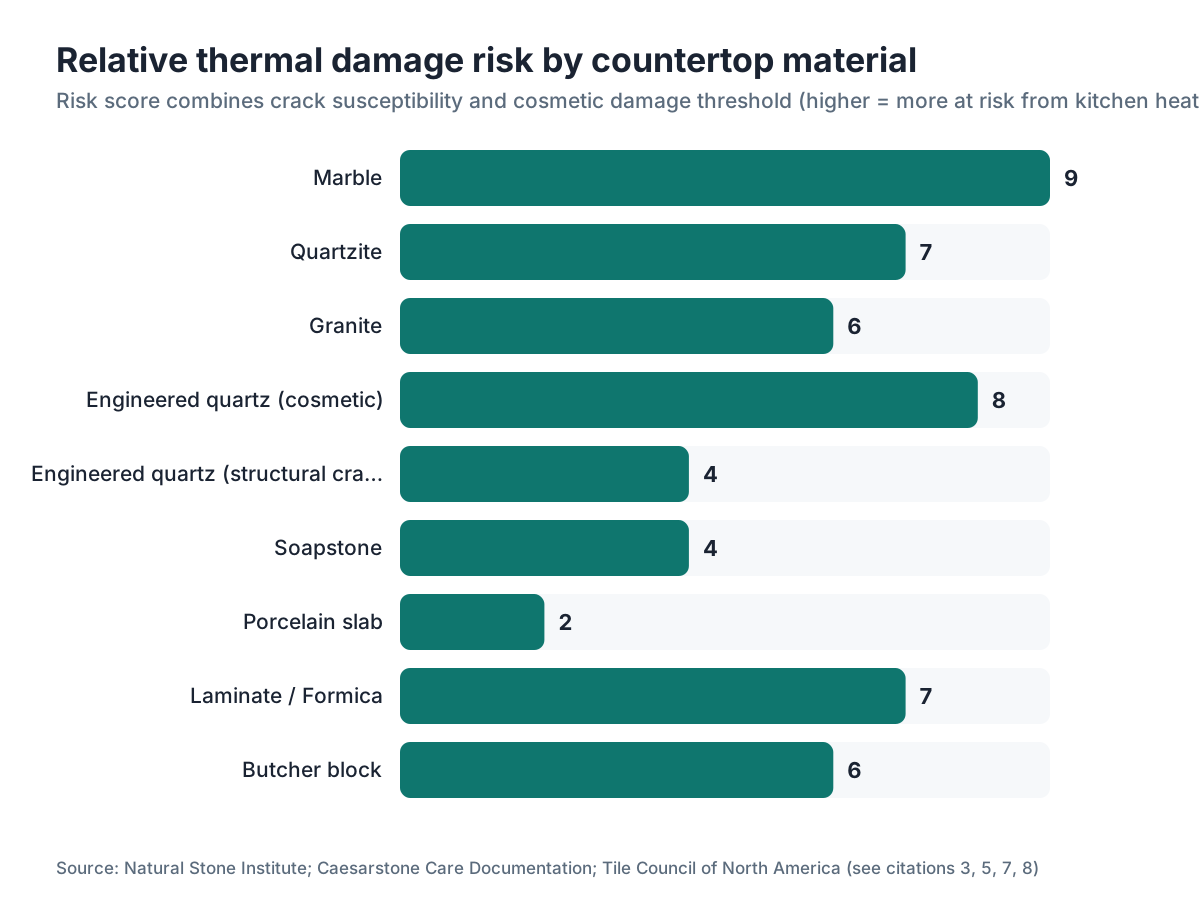
Quartz countertops (engineered stone, like Caesarstone or Cambria) use a resin binder, typically around 6 to 10 percent by weight [3]. That resin has a much higher CTE than the quartz aggregate. Above roughly 150 degrees Celsius (about 300 degrees Fahrenheit), sustained heat can soften the resin, discolor it, or pull it away from the aggregate, leaving a cloudy burn mark that never comes out [3]. So the crack risk from one quick heat exposure is lower for engineered quartz than for natural stone, but the cosmetic damage risk is higher.
Which countertop materials are most vulnerable to thermal shock?
Materials don't respond to thermal shock the same way. The table below sums up the risk level, the main failure mode, and a rough damage threshold for common countertop materials.
| Material | Thermal shock crack risk | Main failure mode | Rough damage threshold |
|---|---|---|---|
| Marble | High | Hairline cracks, spalling | Sudden delta >150°F |
| Quartzite | Medium-High | Cracks along veins | Sudden delta >150°F |
| Granite | Medium | Cracks at cutouts, veins | Sudden delta >200°F |
| Soapstone | Medium-Low | Cracks (but very rare) | Tolerates moderate heat well |
| Engineered quartz | Low (crack), High (burn) | Resin discoloration, delamination | Sustained >300°F |
| Concrete | Medium | Cracks, surface spalling | Varies by mix |
| Porcelain tile | Low-Medium | Grout cracking, tile fracture | Depends on thickness |
| Butcher block | N/A | Scorching, charring | Direct heat scorches at ~212°F |
| Laminate | N/A | Bubbling, delamination | ~150°F sustained |
Marble carries the highest risk among natural stones. Calcite, its main mineral, has strongly anisotropic thermal expansion: it grows at different rates in different crystallographic directions [4]. That mismatch at the grain boundaries is why marble microcracks more readily than granite, which is built from minerals whose expansion rates match up better.
Soapstone is the interesting exception. People have used it for wood stove surrounds and lab countertops for more than a century because it takes heat well [5]. Its main mineral, talc, has low thermal conductivity, so it heats slowly and the gradient through the slab stays gentle. Soapstone is not magic, though. A big enough, fast enough temperature change can still crack it.
Granite countertops land in the middle. Granite is tougher than marble, but the mix of quartz, feldspar, and mica means different grains expand at different rates. Existing microcracks or natural fissures (common in plenty of granite slabs) can spread under thermal stress. The risk climbs sharply near cutouts.
What temperatures actually cause damage?
There's no single magic number, because the outcome hangs on three things: the temperature delta (not the absolute temperature), how fast the change hits, and the condition of the stone. A slowly warmed granite can handle a higher temperature than the same slab slammed with a sudden load.
Here are the reference points that matter. A cast-iron pan on a high gas burner reaches 400 to 700 degrees Fahrenheit in a few minutes [1]. A glass baking dish out of a 450-degree oven is, obviously, around 450 degrees. The bottom of a slow cooker on "low" runs 175 to 200 degrees Fahrenheit, which is a much smaller delta and rarely causes trouble.
Engineered quartz makers publish their own limits. Caesarstone's care documentation says surfaces should not be exposed to temperatures above 150 degrees Celsius (302 degrees Fahrenheit) and warns against placing hot pots directly on the surface [3]. Cambria's care guide says the same [11]. Those limits are for sustained exposure. A brief touch of a hot pan bottom is less likely to crack the surface, but it can still haze the resin.
For natural stone, ASTM C880 gives fabricators a flexural strength baseline [6], but there's no equivalent ASTM test that maps thermal shock straight to countertop failure in a real kitchen. The caution around natural stone and heat comes from fabricator experience and materials science, not a controlled kitchen test protocol. Nobody has published a study that says "at X degrees, granite countertops fail Y percent of the time." So you'll see ranges and educated estimates in this space, and anyone quoting a hard threshold is guessing.
Does sealing a stone countertop protect it from thermal shock?
No. Sealing handles porosity and stains, nothing more. A penetrating sealer soaks into the stone's pore structure and blocks liquids from passing through [7]. It does nothing about the mechanical stress from a rapid temperature change. A sealed marble slab cracks from thermal shock exactly as fast as an unsealed one.
This mix-up is common. Fabricators talk a lot about sealing, for good reason, and homeowners hear "protected" and assume it means protected from everything. Sealers keep olive oil and red wine from staining the stone. They have zero effect on thermal shock.
People also ask about heat-resistant surface coatings. High-temperature stone coatings exist for industrial and exterior work, but nothing sold for residential countertops meaningfully raises the thermal shock threshold. The protection strategy for stone is behavioral, full stop: use trivets and hot pads.
Can a cracked stone countertop be repaired after thermal shock?
Sometimes. It depends on the crack type, its location, and how far it ran.
Hairline surface cracks can often be filled with a color-matched epoxy or polyester adhesive. Fabricators use two-part epoxies that bond well to stone and take a tint to blend with the veining. Done well, the repair nearly disappears from standing height. Get close and you can usually still see it.
A crack that runs all the way through the slab, especially near a sink cutout or cooktop opening, is a structural failure. That slab comes out and gets replaced. There's no reliable way to structurally restore a through-crack in a kitchen counter that will survive daily use. Some shops try a rodded repair (epoxying steel rods across the crack from underneath), but that's a stopgap, and most fabricators won't warranty it.
Crack repair by a stone restoration pro runs roughly $200 to $500 for a simple surface crack, based on typical regional pricing from stone restoration contractors. Full slab replacement costs far more. Going back to the original fabricator is usually cleanest, because they may still have leftover slab material and they know how the counter was installed. Countertop installation details (overhangs, support spans, cutout geometry) all shape how a repair holds up.
For marble countertops, fixing a crack is more urgent. The crack collects acids and staining agents that make it uglier over time.
How do I protect my countertops from thermal shock?
The fix is boring, which is probably why people skip it. Trivets and silicone mats. That's the whole strategy.
A trivet puts an air gap between the hot vessel and the stone. The pan radiates heat into the air instead of dumping it straight into the slab. Even a cheap $8 silicone trivet drops the temperature at the stone surface hard. You don't need cork, you don't need thicker granite, you don't need to switch materials. You need a trivet.
A few things worth knowing:
Instant Pots and other electric pressure cookers get surprisingly hot on the bottom during the saute function, often above 300 degrees Fahrenheit. Put them on a trivet.
Crockpots on "high" can reach bottom temperatures that are risky for engineered quartz. Use a silicone mat.
Glass baking dishes from the oven are big, heavy, and loaded with thermal energy. Set them on a trivet or a folded kitchen towel every time.
Don't put a cold stone under a very hot pot either. A slab in a kitchen that dropped to 55 degrees overnight has a bigger delta waiting. Same risk, opposite direction.
For fabricators coaching customers: have this talk at templating or at delivery. A short, honest walkthrough of what the material can and can't take sets real expectations and cuts callbacks. Some shops hand over a printed care card with every job. Good habit.
For the full care picture on specific materials, the guides on how to clean stone countertops and how to clean soapstone countertops cover daily maintenance alongside the heat side of things.
Is engineered quartz safer than natural stone for heat resistance?
Depends what you mean by "safer." Engineered quartz is less likely to develop a structural crack from a single thermal shock event than most natural stones. It's more likely to show permanent cosmetic damage from heat. The resin holding the quartz aggregate can discolor, cloud, or blister at temperatures granite would shrug off.
Caesarstone, one of the bigger quartz brands, states in its published care documentation that "a sudden change in temperature may cause the surface to crack," and it flatly recommends trivets [3]. So the maker of the product sold as low-maintenance is telling you to use a trivet.
Porcelain slab countertops (a newer category, not the same thing as ceramic tile) hold heat far better. Fired above 1200 degrees Celsius during manufacturing [8], thin porcelain slabs generally handle direct contact with hot cookware better than any stone or quartz. They aren't immune to thermal shock cracking, but the threshold is higher.
Laminate countertops and Formica countertops have a plastic surface that bubbles and delaminates under sustained heat above about 150 degrees Fahrenheit. They don't crack from thermal shock. They melt, which is arguably worse to look at and can't be repaired. Corian countertops and other solid-surface materials take more heat than laminate but still call for trivets, and light scorching can often be sanded out.
Does the thickness of the stone slab affect thermal shock risk?
Yes, but the relationship is not "thicker is always safer."
A thicker slab has more thermal mass, so heat takes longer to reach the underside. That slows the gradient and lowers the peak stress for a given heat exposure. A 3 cm slab handles heat somewhat better than a 2 cm slab for that reason.
But thickness also changes the bending stresses from the counter's own weight and normal use loads. And in most kitchen scenarios the thermal shock stress runs in-plane, across the surface, not through the thickness. So going from 2 cm to 3 cm helps at the margins without changing your risk profile much. The trivet is still the answer.
Edge details matter more than people expect. Waterfall edges, mitered corners, and elaborate ogee profiles all create thin, unsupported sections that crack more easily under thermal shock. Thin sections gain and lose heat faster and have less material to spread the stress. Simple eased or beveled edges forgive more.
What's the difference between thermal shock damage and a natural fissure?
A natural fissure is a separation inside the stone that formed during geological processes, long before anyone quarried it. Fabricators and suppliers call these "features" rather than defects because they're inherent to the material and don't hurt structural integrity in a properly supported counter [9].
Thermal shock damage looks different. A thermal shock crack usually radiates out from a heat contact point, or shows up suddenly near a cutout right after a heat event. The fracture surface is fresh and bright. A natural fissure has been there since the stone formed, so its inner surfaces are often oxidized, stained, or filled with minerals.
Homeowners sometimes mistake an old fissure for a new thermal shock crack, especially if they never looked closely at the slab during installation. The reliable way to tell them apart is to document the slab at install (phone photos are fine) and compare against any new crack. Fabricators using slabwise.com's quoting and layout tools can attach slab photos to a job record, which settles exactly these arguments later.
If you're not sure, a stone restoration pro can read the crack surface and usually tell you whether it's fresh (thermal shock) or old (natural fissure or existing defect).
Does homeowner's insurance cover thermal shock damage to countertops?
Generally, no. Standard homeowner's policies cover sudden and accidental damage from defined perils: fire, water from a burst pipe, theft, and the like. Cracking a countertop with a hot pan counts as owner-caused damage or wear and tear, and both are typically excluded [10].
Some home warranty plans cover countertop mechanical failures, but the language varies wildly and heat damage is often written out as "misuse." Read the actual policy before you assume anything.
A few premium homeowner's policies (and some add-on riders) do cover accidental breakage of fixed items, countertops included. If you carry that coverage, photograph the damage right away and call your insurer before any repair work starts. Beginning repairs before you file usually voids the claim.
Fabricators sometimes offer workmanship warranties, but those cover installation defects, not heat damage after the fact. If a counter cracked because of a flaw in the stone or a fabrication error (an undercut corner, an inadequate support span), that's a separate conversation and a legitimate warranty claim.
Frequently asked questions
Can you put a hot pan directly on granite?
Granite handles moderate heat, but you shouldn't do it. A very hot pan (400+ degrees Fahrenheit) set suddenly on a room-temperature slab creates the temperature delta that causes thermal shock cracking. The risk is worse near cutouts and natural fissures. Using a trivet costs you nothing and kills the risk outright. Most granite fabricators tell you not to place hot pans directly on the stone.
Will a hot coffee mug crack a quartz countertop?
A mug of hot coffee sits around 160 to 180 degrees Fahrenheit, below the threshold where quartz resin discolors (around 300 degrees Fahrenheit). One mug won't cause visible damage. Repeated hot mugs in the same spot over months may slowly haze the surface. The real threats are slow cookers, Instant Pots, and baking pans, not your morning coffee.
Is marble worse than granite for thermal shock?
Yes, marble is more vulnerable. Calcite, marble's main mineral, expands at different rates in different crystal directions, which builds internal stress at grain boundaries when the temperature changes. Granite's interlocked mineral structure spreads that stress more evenly. Neither should have hot pans placed directly on it. The difference is degree of risk, not a clean safe-versus-unsafe line.
Can thermal shock crack a countertop instantly?
Yes. The crack can appear within seconds of a very hot object landing on a cold slab. The sound is often a pop or a sharp snap. The crack usually radiates from the contact point outward, often stopping at a nearby edge or cutout. Sometimes it spreads slowly over minutes as the temperature equalizes. Either way, the damage starts the instant the crack does.
Does a thick trivet or silicone mat actually protect stone countertops from heat?
Yes, and well. A trivet or silicone mat breaks the direct conduction path from the hot vessel to the stone. Even a thin silicone mat a few millimeters thick keeps the stone surface temperature well below the thermal shock threshold under normal kitchen use. It's the most effective and cheapest protection there is. Trivets are not optional if you want to avoid the risk.
What is the thermal shock resistance of engineered quartz?
Engineered quartz (Caesarstone, Cambria, Silestone) resists cracking from thermal shock better than natural stone, because the polymer resin has some flexibility. But that resin discolors and can delaminate from the aggregate at sustained temperatures above about 150 degrees Celsius (302 degrees Fahrenheit). Caesarstone's own documentation says to avoid direct heat and use trivets. Lower structural risk, real cosmetic risk.
How can I tell if my countertop cracked from thermal shock or was already cracked?
A thermal shock crack has fresh, bright fracture surfaces and usually radiates from a heat contact point or appears near a cutout. A pre-existing natural fissure has oxidized, often mineralized surfaces and has been there since fabrication. Photos taken at install are the best reference. If you didn't take any, a stone restoration pro can examine the crack under magnification and usually identify a fresh fracture versus an old fissure.
Are porcelain countertops resistant to thermal shock?
Porcelain slab countertops resist thermal shock better than natural stone or engineered quartz. Porcelain is fired above 1200 degrees Celsius during manufacturing, which makes it dense and stable. It generally handles hot pans better than stone. It's not completely immune to thermal shock cracking, but the damage threshold is much higher. Porcelain is the strongest argument for that material in a cook-heavy kitchen.
Does quartzite hold up better than marble to heat?
Quartzite is tougher than marble and holds up somewhat better to thermal shock. It's a metamorphic rock built mostly from quartz grains, which are harder and more thermally stable than the calcite in marble. But quartzite slabs often carry veining and natural fissures that concentrate stress. It still needs trivets. The edge over marble is real but not big enough to make casual heat exposure safe.
Can you repair a countertop cracked by thermal shock?
Surface hairline cracks can be filled with color-matched epoxy by a stone restoration pro, with results that nearly vanish at normal viewing distance. That repair runs $200 to $500. A crack that runs fully through the slab, especially near a sink or cooktop cutout, is a structural failure that needs full slab replacement. There's no reliable structural repair for a through-crack in a kitchen counter that lasts under daily use.
Does sealing a stone countertop protect it from thermal shock?
No. Penetrating sealers work on porosity and stain resistance. They soak into the pore structure and block liquids. They do nothing about the mechanical stress from a rapid temperature change. A sealed slab cracks from thermal shock exactly as fast as an unsealed one. Sealing and trivet use address completely different risks, and neither replaces the other.
Which countertop material is most resistant to thermal shock?
Fired porcelain slab is the most heat-resistant residential countertop surface. Among natural stones, soapstone and granite take heat better than marble or quartzite. Engineered quartz resists thermal shock cracking reasonably well but shows permanent cosmetic damage (resin discoloration) at lower temperatures than stone fractures. Butcher block and laminate are the most vulnerable to heat, though they scorch or bubble rather than crack.
Does the size of the hot object matter for thermal shock risk?
Yes. A large Dutch oven fresh from the oven covers more surface area and carries more total thermal energy than a small saucepan. More area means more of the slab surface goes hot at once, and the boundary zone where hot meets cold gets larger and longer. Bigger, heavier, hotter objects mean greater risk. A larger trivet that fully supports the vessel bottom protects better than a small one.
Sources
- USDA Food Safety and Inspection Service, Safe Food Handling: Cast-iron cookware surface temperatures of 400 to 700 degrees Fahrenheit reached during typical stovetop use
- USGS, Mineralogy and Physical Properties of Common Rocks: Granite coefficient of thermal expansion 4 to 8 ppm per degree Celsius; marble 3 to 7 ppm per degree Celsius depending on mineralogy
- Caesarstone, Care and Maintenance Documentation: Caesarstone states surfaces should not be exposed to temperatures above 150 degrees Celsius and warns against placing hot pots directly on the surface; states 'a sudden change in temperature may cause the surface to crack'
- Geological Society of America, Thermal Properties of Calcite: Calcite has anisotropic thermal expansion, expanding at different rates in different crystallographic directions, creating intergranular stress in marble under temperature change
- Natural Stone Institute, Soapstone Material Properties: Soapstone has been used for laboratory countertops and stove surrounds because of its relatively low thermal conductivity and heat tolerance
- ASTM International, ASTM C880 Standard Test Method for Flexural Strength of Dimension Stone: ASTM C880 provides fabricators with baseline flexural strength data for dimension stone, used as a reference for mechanical properties in countertop applications
- Natural Stone Institute, Sealer and Stone Care Technical Bulletin: Penetrating sealers work by blocking pore structure to resist liquid infiltration; they do not alter mechanical or thermal properties of the stone
- Tile Council of North America, Porcelain Tile Technical Specifications: Porcelain tile and slab products are fired at temperatures exceeding 1200 degrees Celsius, producing a dense, low-porosity material with high thermal stability
- Natural Stone Institute, Understanding Natural Stone Fissures and Pits: Natural fissures in granite and quartzite are inherent geological features that do not affect structural integrity in properly supported countertop applications
- Insurance Information Institute, Homeowners Insurance Coverage Basics: Standard homeowners insurance policies exclude owner-caused damage and wear and tear; heat damage to countertops from placing hot objects on them is typically not a covered peril
- Cambria, Care and Use Guidelines: Cambria's published care guide recommends against direct heat contact and advises use of trivets to protect the engineered quartz surface
Last updated 2026-07-11