TL;DR
- White haze on polished granite after installation almost always comes from one of five sources: hard-water mineral deposits, alkaline cleaner residue, sealer applied over moisture, efflorescence pushed up from the substrate, or micro-scratching from abrasive pads.
- Most cases clear with the right acidic or neutral cleaner.
- Sealer haze and efflorescence usually need a professional.
Why does polished granite get a white haze in the first place?
Polished granite leaves the shop with a factory mirror finish, usually 80 to 100 gloss units on a 60-degree gloss meter [10]. That finish is purely mechanical. It gets ground and buffed into the crystal structure, so anything that disrupts the surface or leaves a film on top of it scatters light and produces a dull, whitish cast.
Here is the trap most homeowners fall into. Haze looks the same whether the cause is mineral scale, soap film, or a failed sealer. The appearance is nearly identical. The fix depends entirely on the cause, and the wrong treatment makes things worse. Scrub alkaline scale with an alkaline cleaner and nothing happens. Apply more sealer over a sealer-haze problem and you double the film.
Five causes account for nearly every white-haze complaint on granite countertops: (1) hard-water calcium and magnesium deposits, (2) alkaline soap or cleaner residue, (3) sealer applied over damp stone, (4) efflorescence from the mortar or substrate below, and (5) micro-scratches from abrasive cloths or steel wool. Each leaves a slightly different pattern and answers to different chemistry.
Is the haze from hard water mineral deposits?
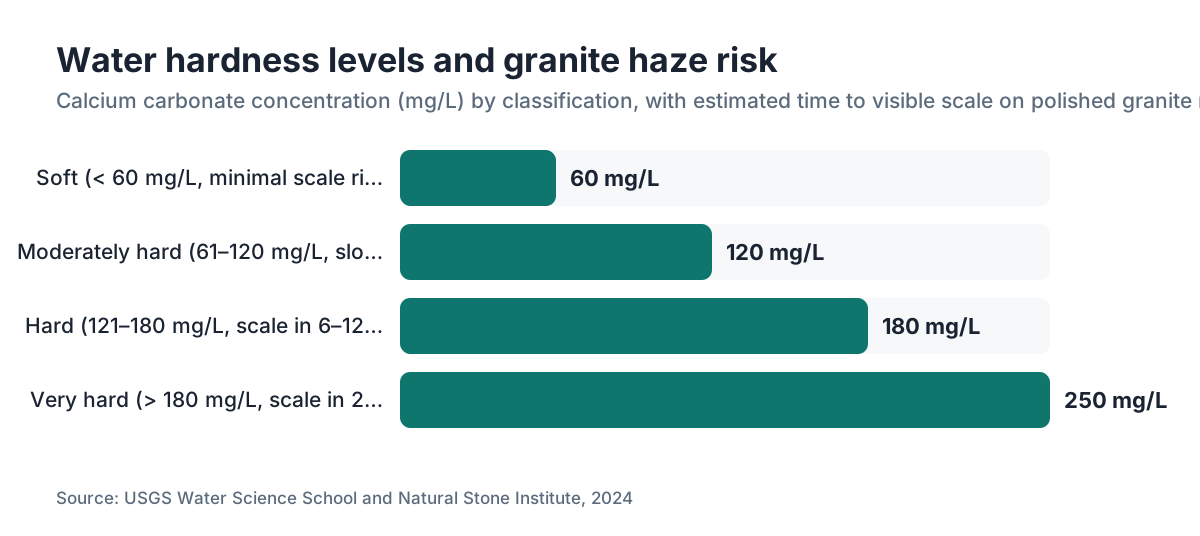
This is the most common cause by a wide margin. Hard water carries dissolved calcium carbonate and magnesium compounds. When that water evaporates off granite, the minerals stay behind as a white, powdery, or milky film [1]. Where water hardness runs above 120 milligrams per liter (7 grains per gallon), visible scale can show up after just a few weeks of normal kitchen use [8].
The U.S. Geological Survey estimates that roughly 85 percent of American homes receive hard water, with the hardest supplies in the Southwest, Midwest, and Florida [1]. Live in one of those regions and see haze near the sink, around the faucet base, or wherever water pools and dries? Hard water is almost certainly the culprit.
Hard-water haze feels slightly rough under a fingernail. It usually comes off with a purpose-made stone-safe descaler or a diluted white vinegar solution (1 part vinegar to 4 parts water, applied briefly and rinsed right away). One caution: vinegar sits around pH 2.5, and long contact with calcium-rich granite can etch the polish. Wet the area, let it dwell 30 to 60 seconds, then rinse well and dry. If the haze is gone, you had mineral scale. If a dull spot stays after the scale lifts, the acid may have already etched the polish, and that is a separate problem that needs re-polishing.
Prevention is simple. Dry the countertop after every wet use near the sink, install a water softener if hardness clears 180 mg/L [8], and pick a penetrating sealer rated for hard-water conditions.
Can soap and alkaline cleaners cause haze on granite?
Yes, and this is probably the second most common cause. Most household sprays, dish soaps, and floor cleaners run a pH between 9 and 12 to cut grease [2]. On glass or tile, that alkalinity rinses clean. On polished stone, especially over an existing sealer, the surfactants in those cleaners leave a residue that builds up layer by layer into a visible haze.
Cleaner-residue haze spreads even and uniform across the whole counter rather than pooling near the sink, because people wipe the whole surface. Breathe on it and it smears a little, the way a dirty drinking glass does, because the film is still partly greasy.
The fix is a pH-neutral stone cleaner (pH 6 to 8) on a clean microfiber cloth. One pass often lifts weeks of buildup. The Natural Stone Institute warns that cleaners with bleach, ammonia, and citrus acids can dull polished finishes, and recommends staying inside a pH of 5 to 10 on finished stone [2].
If neutral cleaner alone does not clear it, a commercial stone soap-scum remover made for granite breaks the residue without attacking the polish. Do not reach for cream abrasive cleaners thinking the mild grit will buff it out. Those scratch the polish and turn a cleaning problem into a fabrication problem.
For a fuller look at cleaning methods across stone types, how to clean stone countertops covers safe product chemistry in detail.
What does sealer haze look like and why does it happen?
Sealer haze is one of the trickier causes because it shows up hours or days after installation, not weeks later. It reads as a milky, sometimes streaky film that ignores normal cleaning and can feel slightly tacky in spots.
Two scenarios cause it. First, the sealer went on stone that was not fully dry. Granite holds microscopic porosity, and if moisture is present when an impregnating sealer goes down, the sealer bonds to water molecules instead of soaking into the stone. You get a trapped, cloudy film [3]. This is common right after installation, when the water used during final polishing has not fully evaporated, or when outdoor humidity is high.
Second, excess sealer that nobody wiped off inside the product's working window dries on the surface instead of inside the stone. Impregnating sealers work by penetrating below the surface. The portion sitting on top has nowhere to go, so it hazes as it cures.
The Natural Stone Institute (formerly the Marble Institute of America) advises applying sealer to dry stone in sections and buffing off any excess before the product turns tacky, usually within 3 to 5 minutes depending on brand [3].
Fixing sealer haze almost always takes a sealer stripper made for natural stone. Generic solvents can discolor granite or leave their own residue. After stripping, let the stone dry fully (24 to 48 hours in normal indoor conditions), then re-seal correctly. If stripping does not bring back full gloss, the surface may need professional re-polishing with diamond abrasives.
High-volume shops can head off sealer callbacks by logging exactly when sealer went on relative to wet fabrication steps. Software that tracks job timelines, like SlabWise, helps a shop document cure times and catch technician errors before the countertop ships.
What is efflorescence and how does it reach the granite surface?
Efflorescence is soluble salt migrating from a concrete or mortar substrate up through porous stone to the surface, where the water evaporates and leaves the salt behind as a white, powdery deposit [4]. It shows up more often on tile floors and exterior stone, but it happens on granite counters set over a mortar bed or in an outdoor kitchen where the substrate stays damp.
Indoors, the likely scenario is a laminated or built-up edge where the stone sits close to thinset or concrete backer board, or an outdoor counter exposed to rain and freeze-thaw cycles. Efflorescence haze shows most at edges, seams, or near the backsplash where stone meets mortar. It often comes back weeks after you clean it, because the source (the wet substrate) keeps pushing salt upward.
The Portland Cement Association frames efflorescence as a moisture problem first: salt migration stops when moisture migration stops [4]. Cleaning the visible deposit with a diluted acid wash removes what you can see, but the real fix is sealing the substrate or improving drainage so water cannot saturate the mortar bed.
On outdoor granite, a breathable penetrating sealer on both the stone and the exposed mortar edges sharply cuts recurrence. If indoor efflorescence keeps returning, look for a plumbing leak or a condensation source. That has to be fixed before any cosmetic treatment holds.
Can micro-scratches cause a white haze rather than actual staining?
Yes, and this is the cause that mimics a surface deposit while actually being physical damage. Polished granite reflects light because the crystal faces were ground flat and smooth to a very fine grit (typically 1800 to 3000 grit equivalent). Touch that surface repeatedly with anything abrasive and those flat faces get scratched into tiny pits that scatter light instead of bouncing it back cleanly. The result reads as a white haze, not a distinct scratch.
Usual suspects: green or blue scrub pads (even the non-scratch ones that are fine for cookware), powdery abrasive cleaners like Comet or Ajax, paper towels (whose wood fibers are coarser than the polish), and ceramic or stoneware dishes dragged across the surface.
Micro-scratch haze shows up first where people clean most, usually the center of the counter and near the sink. Unlike mineral haze, it does not budge when you apply cleaner or water. Wet the surface and it briefly looks more reflective (water fills the scratches optically), but the haze returns the moment it dries.
Diagnosis is quick. Wet the hazy area with plain water. If the haze vanishes when wet and returns fully when dry, you are looking at micro-scratches, not a deposit.
The only real fix is re-polishing. A trained stone restoration tech runs a sequence of diamond abrasive pads to re-flatten the surface and rebuild the mirror finish. Consumer diamond kits exist, but on a large kitchen counter, getting an even result without an orbital polisher and proper grit progression is genuinely hard. For one small hazy patch (say, the area in front of the sink), a skilled DIYer can get acceptable results with a 5-step diamond pad kit. For a whole countertop, hire a pro.
How do you figure out which cause you're dealing with?
Run this diagnostic before you buy a single product.
Step 1. Wet the hazy area with plain water and watch for 30 seconds. If the haze disappears while wet and returns dry, micro-scratches are the cause. Stop here and call a stone restoration pro.
Step 2. If wetting does nothing, spray a little pH-neutral stone cleaner and wipe with a clean microfiber cloth. If the haze clears, it was cleaner or soap residue.
Step 3. If neutral cleaner fails, try a little diluted white vinegar (1:4 ratio) on an inconspicuous spot for 30 seconds, then rinse. If the haze breaks up, it was mineral scale. Extend to the full surface carefully.
Step 4. If none of that works and the haze appeared shortly after installation or after sealing, suspect sealer residue or sealer-over-moisture. Move to a stone-safe sealer stripper.
Step 5. If the haze concentrates at edges, seams, or backsplash contact points, and especially if it returns after cleaning, suspect efflorescence from the substrate.
| Haze type | Location pattern | Wet test | Responds to |
|---|---|---|---|
| Hard-water scale | Near sink, faucet | Still visible | Diluted acid descaler |
| Cleaner residue | Even across surface | Still visible | pH-neutral cleaner |
| Sealer haze | Even or streaky | Still visible | Sealer stripper |
| Efflorescence | Edges, seams | Still visible | Acid wash + substrate sealing |
| Micro-scratches | High-use zones | Disappears | Re-polishing only |
What cleaners and products actually remove each type of haze?
The stone-care market is large and lightly regulated, so plenty of products claim to fix everything. Here is what actually works, sorted by cause.
Hard-water mineral scale: a purpose-made stone descaler (look for labels rating it safe on marble and granite, usually buffered to pH 4 to 5) is the safest choice. Products with sulfamic or phosphoric acid at low concentration are effective and gentler than hydrochloric-acid products. Brief contact with diluted white vinegar (pH 2.5) also works but demands careful rinsing. Never use straight vinegar or bathroom lime-and-rust removers that contain hydrochloric acid. Those etch polished granite for good [5].
Cleaner and soap residue: any stone-specific cleaner with a neutral pH. MB Stone Care, Stonetech by DuPont, and Weiman Stone are widely available examples. A clean microfiber cloth matters as much as the cleaner. Skip paper towels.
Sealer haze: stone-safe sealer strippers or solvent-based removers labeled for impregnating sealers. Acetone in small amounts dissolves many solvent-based sealers, but it also lifts sealers you want to keep, so use it only if you plan to re-seal afterward.
Efflorescence: diluted muriatic acid (1 part acid to 10 parts water) is a traditional trade remedy for exterior stone [4], but on a polished kitchen counter the etching risk is high. A safer route is a commercial efflorescence remover formulated for polished stone, sold by stone restoration suppliers. Always neutralize with baking soda and water, then rinse well.
Micro-scratches: no cleaner helps. Diamond polishing pads starting at 400 grit and stepping through 800, 1500, 3000, and a final polishing compound are the correct path [6].
The guide on how to clean stone countertops breaks down safe chemistry for everyday maintenance in more detail.
Does applying more sealer fix white haze or make it worse?
Applying more sealer over existing haze almost always makes it worse, and it is an extremely common mistake. Homeowners see dull granite, assume the sealer wore off, and put down a fresh coat. If the haze is mineral scale, they seal the scale into the surface. If it is old sealer residue, they add another layer of film. The surface gets duller with each pass.
Granite sealing is not a cosmetic treatment. It is a penetrating one. A quality impregnating sealer soaks below the surface and fills the micro-pores that would otherwise drink up oils and stains. You cannot see a correctly applied sealer at all. The stone looks identical before and after. If sealing changes the look (shinier, cloudier, or more colored), either the product is a topical coating (generally a bad choice for kitchen granite) or something went wrong in the application [3].
The standard test for whether granite needs re-sealing: drop a few drops of water on the surface and wait 15 to 20 minutes. If the water beads and wipes off clean, the sealer is still working. If it soaks in and darkens the stone, re-seal. Most interior kitchen granite in low-humidity homes needs re-sealing every 1 to 3 years [3]. Outdoor granite or granite near a heavily used sink may need it annually.
Fabricators getting sealer-haze callbacks should audit their application procedure. Tracking dwell time, ambient humidity at application, and whether the stone was confirmed dry before sealing catches most causes.
When should you call a stone restoration professional?
Most mineral scale and cleaner-residue haze is genuinely DIY-fixable. The cases that warrant a pro: confirmed micro-scratches covering more than a square foot, sealer haze that shrugs off stripping, any situation where DIY attempts left the surface looking worse, and efflorescence that keeps returning (which signals a moisture problem a pro can help diagnose).
Stone restoration pros run industrial diamond tooling on orbital machines that hold consistent pressure and grit progression. Expect roughly $200 to $600 for a full countertop re-polish on a standard kitchen in 2024, depending on square footage and damage severity [7]. Spot re-polishing a 1-square-foot problem area runs $100 to $150 as a minimum service call in most markets.
Before you hire, ask specifically whether they have worked on polished granite (more than honed), and ask them to explain the grit sequence they plan to use. A tech who cannot explain diamond pad grits has probably not done much stone restoration.
For comparable stone-care context, the cleaning approach for quartzite (which has polish chemistry similar to granite) lives in how to clean quartzite countertops.
How can you prevent white haze from coming back?
Prevention is genuinely easy once you know the causes. A few specific habits kill most of the risk.
Dry the countertop after every wet use near the sink. A hanging microfiber towel next to the faucet is the single best prevention tool for hard-water haze. It costs almost nothing and works.
Switch to a pH-neutral stone cleaner for all daily wiping. Most grocery-store sprays are too alkaline for regular use on polished granite. Buy one bottle of pH-neutral stone cleaner and keep it by the sink. Per-use cost is negligible.
Avoid abrasive pads entirely. Even soft scrub pads sold for kitchens can scratch a polished surface over hundreds of passes. Microfiber cloths only.
On new installations, confirm with your fabricator that the stone was dry before sealing and that the correct sealer dwell and wipe-off protocol was followed. Ask for the sealer brand and product name so you can re-apply the same type later.
On outdoor installs or counters on a mortar bed, apply a penetrating sealer to the substrate edges as well as the stone face, and make sure drainage is good enough that water does not pool under the slab.
Want a material that asks for less maintenance? marble countertops and kitchen countertops compare the maintenance tradeoffs of popular options.
Fabricators who want to cut post-installation complaint rates can lean on SlabWise job tracking to document sealer type, application date, and field notes, so there is a clear record if a haze complaint lands weeks later.
Frequently asked questions
Why did white haze appear on my granite countertop right after installation?
Haze appearing within days of installation usually points to two causes: sealer applied over stone that was not fully dry, or excess sealer that was not buffed off in time. Both leave a milky, sometimes streaky film that ignores normal cleaning. A stone-safe sealer stripper is the first step. If stripping restores the gloss, re-seal correctly on a confirmed dry surface.
Can vinegar remove white haze from granite safely?
Diluted vinegar (1 part to 4 parts water) can dissolve hard-water mineral scale in 30 to 60 seconds on granite, but it sits around pH 2.5 and can etch the polished surface if left too long or used often. Rinse right away and thoroughly. For regular cleaning, a purpose-made stone descaler buffered to pH 4 or 5 is safer than straight vinegar.
What is the water-drop test and how does it help diagnose granite haze?
Put a few drops of plain water on the hazy area. If the haze disappears completely while the stone is wet and returns fully when it dries, the cause is micro-scratches, not a deposit. No cleaner will fix that; the surface needs re-polishing. If the haze stays visible even when wet, you are looking at a surface deposit: mineral scale, cleaner residue, sealer film, or efflorescence.
Does polished granite haze differ from honed granite haze?
Yes. Polished granite has a mirror finish (80 to 100 gloss units) that shows any surface disruption as visible haze. Honed granite has a matte surface by design, so the contrast is lower and deposits hide until they are severe. Both surfaces get mineral scale and cleaner residue, but micro-scratch haze is almost exclusively a polished-stone complaint, where the gloss baseline is high enough to make light-scattering obvious.
Is white haze on granite the same as etching?
Not exactly. Haze from deposits (scale, cleaner, sealer) sits on top of the surface and can be cleaned off. Etching is actual surface dissolution from acid contact, and it leaves a dull spot that cannot be cleaned away because the stone itself has changed. The two can overlap: acid cleaners used to remove scale can etch the polish if left too long, leaving a dull patch even after the deposit is gone.
Can hard water cause permanent damage to polished granite?
Mineral scale from hard water is not intrinsically damaging if removed promptly. The risk is when scale gets scrubbed off with abrasive pads (causing micro-scratches) or dissolved with strong acid (causing etching). Either response can permanently dull the polish. Caught early and treated with a buffered descaler and microfiber cloth, hard-water haze causes no lasting damage.
Why does my granite look hazy only near the sink?
Localization near the sink strongly points to hard-water mineral scale. Water evaporates where it splashes, drops its dissolved minerals, and builds up over days and weeks. The same area dries out repeatedly, concentrating the mineral film. It can also mean soap or dish-soap residue if you wash dishes in that basin. Both respond to a pH-neutral cleaner first, then a stone-safe descaler if the cleaner alone falls short.
What causes white haze on outdoor granite countertops specifically?
Outdoor granite adds two causes uncommon indoors: efflorescence from the mortar substrate (especially after rain), and UV-degraded sealer. Salt from efflorescence migrates upward when the slab gets wet repeatedly. UV exposure degrades some solvent-based sealers over 1 to 2 years, leaving a chalky residue. Outdoor granite needs more frequent re-sealing than indoor granite, typically annually, and substrate drainage is critical to prevent efflorescence.
Can a fabricator be responsible for white haze after countertop installation?
Yes, in specific circumstances. If haze appears within 48 to 72 hours of installation, the most likely fabricator-related causes are: sealer applied too wet, excess sealer not buffed in time, or surface not fully dried after wet fabrication before the slab was sealed and delivered. A fabricator who documents their sealing procedure and uses a consistent protocol has strong evidence in their favor if a callback comes in.
How long does it take white haze to form from hard water?
In areas with water hardness above 180 mg/L (roughly 10 grains per gallon), visible scale can build up in as little as 2 to 4 weeks with daily kitchen use near a sink. In moderately hard water (120 to 180 mg/L), it typically takes 6 to 12 weeks to become noticeable. In soft water below 60 mg/L, mineral haze is rarely a problem without an unusually high-use sink.
Does re-polishing granite after white haze restore it completely?
Yes, for micro-scratch and etching haze. Professional re-polishing with a proper diamond grit sequence (typically 400, 800, 1500, 3000 grit, then compound) re-flattens the crystal faces and restores the original mirror finish. The process removes a very small amount of material (microns), so it can be done multiple times over a countertop's life without measurable thickness loss. Deposit-based haze does not need re-polishing; cleaning is enough.
What type of cleaner should I use every day to prevent granite haze?
A pH-neutral stone cleaner in the pH 6 to 8 range, applied with a microfiber cloth. The Natural Stone Institute specifically warns against cleaners with bleach, ammonia, or citrus acids for regular use on polished stone. Many grocery-store kitchen sprays fall outside the safe pH range. One bottle of a dedicated stone cleaner (brands like MB Stone Care, Stonetech, or Weiman Stone) used consistently prevents most cleaner-residue haze entirely.
Will applying a new sealer fix or hide white haze on granite?
No. Applying sealer over existing haze almost always makes it worse. A properly applied impregnating sealer is invisible on the surface; it works inside the stone's pores. If you can see a film after sealing, either the application was wrong or the stone was not clean and dry. Diagnose and remove the haze first, confirm the surface is clean and dry, then seal if the water-bead test shows the stone needs it.
Sources
- U.S. Geological Survey, Water Science School, Hardness of Water: Approximately 85 percent of American homes receive hard water, with hardest supplies in the Southwest, Midwest, and Florida.
- Natural Stone Institute, Care and Maintenance Guidelines: Cleaners with bleach, ammonia, and citrus acids can dull polished stone finishes; cleaners should have a pH between 5 and 10.
- Natural Stone Institute, Sealing Natural Stone Technical Bulletin: Sealers should be applied to dry stone and any excess buffed off before the product becomes tacky; an impregnating sealer is invisible on the surface when correctly applied.
- Portland Cement Association, Efflorescence: Causes and Cures: Efflorescence is primarily a moisture-management problem; salt migration stops when moisture migration stops. Diluted muriatic acid is a traditional trade remedy.
- University of Florida IFAS Extension, EDIS, Cleaning Natural Stone Surfaces: Hydrochloric-acid-based cleaners can etch polished granite and marble irreversibly and should be avoided on finished stone surfaces.
- Natural Stone Institute, Stone Restoration and Maintenance Manual: Re-polishing polished granite requires a progressive diamond pad sequence from 400 through 3000 grit followed by a polishing compound.
- Angi, Stone Countertop Polishing Cost Guide 2024: Professional countertop re-polishing in the United States cost roughly $200 to $600 for a standard kitchen in 2024 depending on square footage and damage severity.
- USGS, Water Resources Mission Area: Water hardness above 120 mg/L (7 grains per gallon) is classified as hard; above 180 mg/L is very hard.
- EPA, Ground Water and Drinking Water: Hardness minerals (calcium and magnesium) are not regulated contaminants but are widely measured in municipal water quality reports.
- Natural Stone Institute, Glossary of Stone Industry Terms: Polished granite finish is measured in gloss units; a mirror-finish polished granite typically reads 80 to 100 gloss units at 60 degrees.
Last updated 2026-07-09