TL;DR
- Quartz countertop edges chip during transport because engineered stone is brittle under impact and has almost no flex.
- The main causes are unsupported overhangs, slab-on-slab contact, sudden braking, missing corner protection, and thin edge profiles.
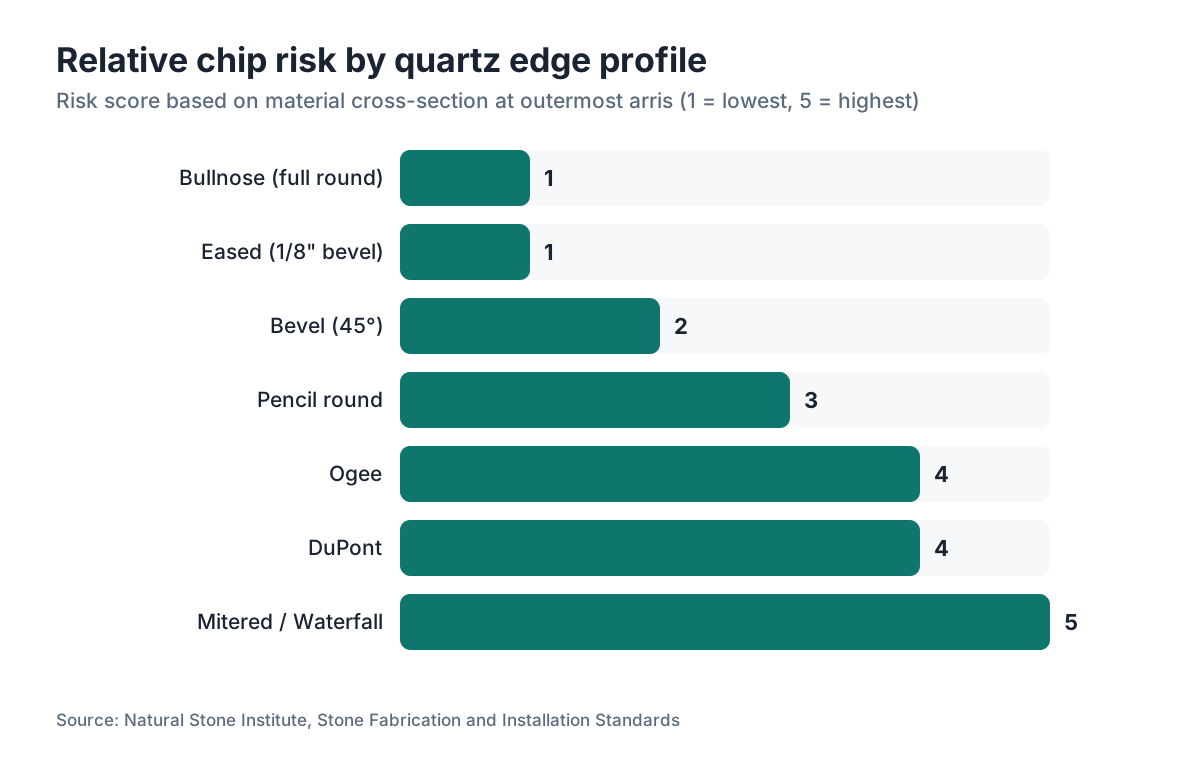
- Chips show up most on mitered, eased, or pencil-round edges because those leave the least material at the outermost point.
Why does quartz chip so easily compared to other countertop materials?
Quartz countertops are engineered stone: roughly 90-94% ground quartz particles bound with polymer resins, pigments, and sometimes glass or mirror chips [9]. That composition gives quartz its hardness (typically 7 on the Mohs scale), its consistent color, and its stain resistance. It also makes quartz genuinely brittle in a way that laminate, solid surface, and even some softer natural stones are not.
Brittle means the material absorbs energy by cracking instead of flexing. When a quartz slab sits on a truck bed and the truck hits a pothole, the slab flexes for a fraction of a second. If that flex passes the material's tensile strength at any point, a crack or chip runs from the weakest location outward. The weakest location is almost always an edge, because edges have the least cross-sectional mass to spread stress.
Compare that to laminate countertops or Corian countertops. Those materials bend under impact rather than fracturing. Natural stones like granite can chip too, but granite's interlocking crystal structure gives it slightly better impact resistance than the polymer-bound quartz composite. Marble edges chip badly, which is why marble fabricators apply the same protection described here. Quartz, though, is the material most likely to chip during transport, because the manufacturing process aligns the aggregate particles in ways that create preferential fracture planes near surfaces.
What are the main mechanical causes of edge chipping in transit?
Five failure modes account for most transit chips.
Unsupported overhangs flex and snap. A standard quartz slab is 1.25 inches (3 cm) thick and can weigh 18-25 pounds per square foot [2]. When that slab rides on an A-frame transport rack with only two or three support points, the ends overhang. Every bump transfers a bending moment to those unsupported spans. The edge at the tip of the overhang moves the most and takes the highest stress. Long peninsulas and island pieces, which may span 8-10 feet, are the worst offenders because the overhang-to-support ratio is worst.
Slab-on-slab or slab-on-metal contact. Load multiple pieces without padding between them and they knock against each other in transit. Even soft contact at 5 mph relative motion can chip a polished edge. The top arris (the sharp corner where the face meets the polished top surface) is the first point of contact in any slab-to-slab collision.
Sudden braking. A piece riding horizontally in a van or pickup shifts forward under braking. If it slides into a wall or toolbox, the edge takes the full kinetic energy of the load. A 60-pound countertop piece decelerating from 30 mph to zero in one second generates roughly 800 newtons of force at the contact point.
Missing or compressed corner protection. Fabricators use foam corner guards, cardboard sleeves, or rubber edge protectors to cushion the arrises. When that protection is absent, slides off, or gets compressed flat by stacking weight, the edge is bare against whatever it touches.
Thin or pointed edge profiles. A mitered edge, an ogee, or a 1/8-inch pencil round leaves very little quartz at the outermost line. Those profiles chip at lower impact energies than a full 3 cm eased edge, which has a larger cross-section to absorb force. Waterfall edges, often mitered at 45 degrees to wrap down a cabinet side, are among the most fragile pieces to move.
Does the type of edge profile affect how likely chipping is?
Yes, a lot. The geometry of the edge profile controls how much material sits at the outermost point and how stress concentrates there.
| Edge Profile | Relative Chip Risk | Why |
|---|---|---|
| Eased (1/8" bevel) | Low | Flat bevel removes the sharp arris, distributes impact |
| Bevel (45°) | Low-Medium | Similar to eased but longer bevel face |
| Bullnose (full round) | Low-Medium | No arris at all, impact rolls off |
| Pencil round (small radius) | Medium | Thin rounded tip, vulnerable on 2 cm slabs |
| Ogee | Medium-High | Undercut geometry creates thin section at cove |
| Dupont / DuPont | Medium-High | Undercut similar to ogee |
| Waterfall / Mitered | High | 45° miter leaves a knife-edge arris |
| Laminated mitered (double) | High | Two knife-edges plus a glue joint |
Fabricators who track callbacks generally see mitered pieces return for re-fabrication at two to four times the rate of bullnose or eased pieces, though nobody publishes industry-wide data on this. The closest published comparison comes from stone industry training materials, which consistently rate mitered and ogee profiles as "high fragility" for transport [3].
Profile matters less than how the piece is padded. A well-protected miter can survive 500 miles. A bare bullnose can chip against the cargo door on a five-minute drive. But if you're picking an edge and transport damage is a real worry, a bullnose or eased profile genuinely is more forgiving.
How do A-frame racks and transport vehicles affect chip risk?
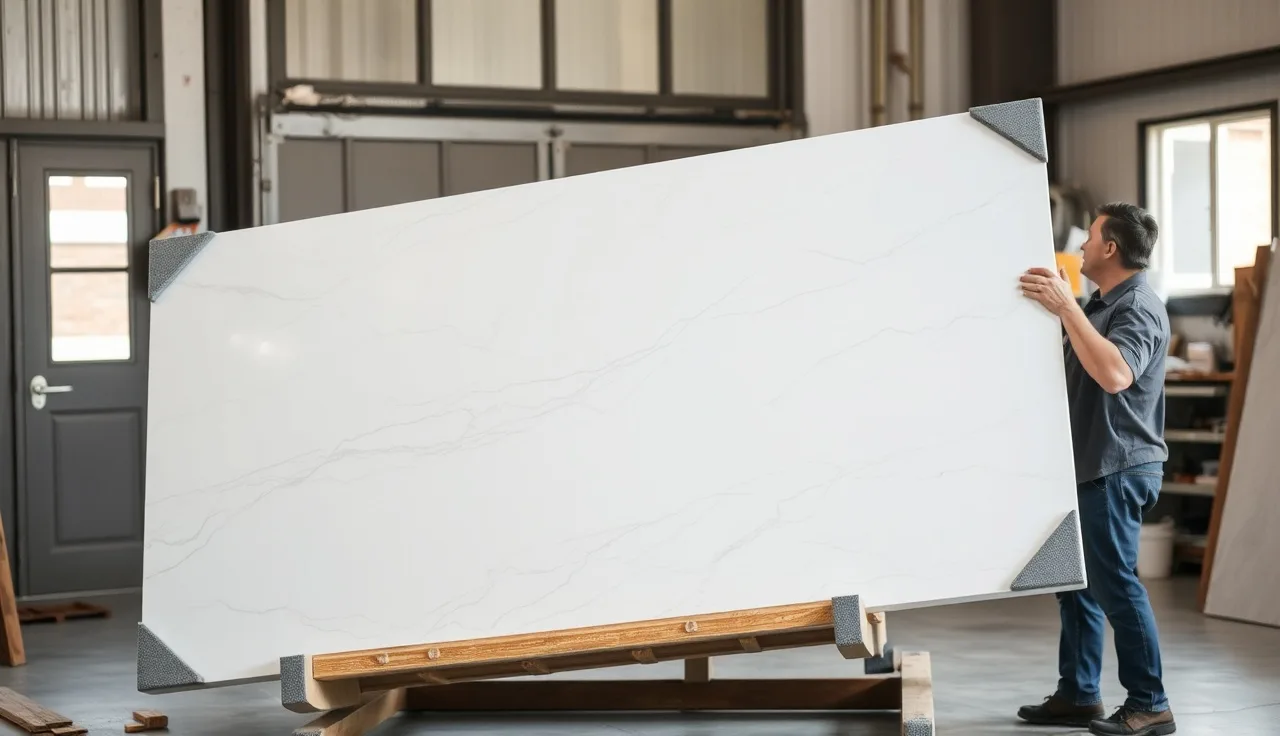
Most professional countertop fabricators use A-frame transport racks, which stand the slabs on edge at a slight lean rather than laying them flat. Standing stone on edge is safer for long-distance transport because it puts the slab in compression along its face rather than in bending across its length. A stone under compression is much stronger than a stone under tension. This is the same principle that makes stone arches and columns work: stone tolerates compression well and tension poorly [4].
A-frames cut chipping risk two ways. First, the slab's own weight pushes straight down through the edge resting on the padded base of the rack, not across a span. Second, braking and acceleration forces push the slab face-to-face against the rack padding rather than edge-to-surface against a van wall.
Flat transport (laying slabs horizontal in a pickup bed or enclosed trailer) is the higher-risk approach. Fabricators use it for short runs and small pieces, and it works fine with proper padding and blocking, but the bending moment problem is real. A 96-inch island piece laid flat in a pickup bed has about 24 inches of unsupported overhang on each end if the truck bed is only 48 inches wide. Those ends bounce over every expansion joint.
Vehicle type matters too. A truck with leaf-spring rear suspension passes road shock more sharply than an air-ride van or a dedicated stone hauler with air suspension. Some larger shops run dedicated air-ride vehicles for exactly this reason: fewer transit chip callbacks.
What role does padding and wrapping play in preventing edge chips?
Padding is the single most controllable variable in transit chip prevention. The goal is simple. Kill any direct hard-surface-to-hard-surface contact at the edges.
Foam corner guards are the standard fix for piece edges. They slip over the arris and stay put by gravity or light tape. The foam needs to be dense enough to resist compression under load: open-cell packing foam squashes almost to nothing, while closed-cell polyethylene foam holds its cushion. A corner guard that has flattened out protects nothing.
Kraft paper or cardboard between stacked pieces protects faces and cuts edge-on-edge contact when pieces are standing in an A-frame. Some shops wrap entire pieces in stretch wrap, which bundles the corner guards in place and stops them from sliding off on bumpy roads.
Rubber edge protectors (sometimes called U-channel edge trim) beat foam for impact resistance on the base edge of a slab standing in a rack, because that base edge takes the most vibration energy. A 1/4-inch rubber U-channel absorbs a lot more impulse force than an equivalent foam pad.
The one place shops routinely underprotect is the top arris of a piece standing in an A-frame. That top arris sits exposed, and if the piece shifts in a curve or hard brake, it can contact the slab next to it. Keeping pieces slightly apart in the rack (a foam block between them at the top) solves it.
Does the thickness of the quartz slab change how likely it is to chip?
Thinner slabs chip more easily, and the difference is real. The two standard thicknesses in North America are 2 cm (about 3/4 inch) and 3 cm (about 1-1/4 inch). Residential countertops are almost universally 3 cm now, but 2 cm material still shows up in some commercial jobs and on certain shower walls or furniture tops.
A 2 cm slab has roughly 44% less cross-sectional area at the edge than a 3 cm slab. Less material means less resistance to bending and lower impact energy needed to start a chip. Fabricators usually laminate 2 cm quartz edges with a strip of matching material to bring the visible edge up to 3 cm apparent thickness. That laminate strip adds some mass at the edge but introduces a glue joint that can also start a fracture if the adhesive bond is imperfect.
Some ultra-compact surfaces (Dekton, Neolith) come as thin as 8 mm (about 5/16 inch) for wall cladding. Those panels are extraordinarily fragile in transport and need specialized crating that most stone fabricators handle differently from countertop slabs.
Who is responsible when quartz edges arrive chipped?
This is where job-site politics get messy, and the answer turns on who controlled the slab when the damage happened.
If the fabricator picked up raw slabs from a distributor's yard and chipping showed up after fabrication but before delivery, the fabricator owns the damage. If chipping showed up on finished pieces during the fabricator's delivery to the home, the fabricator is again responsible.
If the slab was delivered by a distributor to the fabricator's shop and arrived chipped, the distributor or carrier is responsible. Proving it means a written note on the delivery receipt at the time of delivery, not a phone call the next day. Take photos before the driver leaves. That part is not optional.
For homeowners: inspect every piece at delivery, before the installers move anything inside. Chips found after installation are harder to pin down. Fabricators will argue the piece was fine when it left the shop. Homeowners argue the piece arrived damaged. Without time-stamped photos taken before pieces entered the building, neither side has strong proof.
Contractor agreements and purchase orders often carry language about acceptance of goods. Read that section. Some contracts say signature on delivery counts as acceptance of condition. Others give 24 or 48 hours for hidden damage claims. The Uniform Commercial Code, which governs goods sales in every U.S. state, requires buyers to inspect goods within a reasonable time and to notify the seller of nonconformity [5]. What counts as "reasonable" depends on the circumstances, but courts have generally found that countertop chips visible on delivery need same-day notice.
For fabricators tracking this across jobs, countertop installation documentation practices matter. A shop that photographs every finished piece before loading and again on arrival at the job site can settle disputes fast.
Can chipped quartz edges be repaired, or does the piece need to be remade?
Small chips can often be repaired well. Large chips, broken corners, or cracks that run into the field of the slab usually mean a remake.
The repair method for small quartz edge chips is color-matched epoxy or polyester filler. The fabricator or an experienced countertop repair technician mixes pigmented filler to match the base color and pattern, fills the void, lets it cure, then hand-polishes to blend the surface. On solid-color quartz (whites, blacks, grays), these repairs are nearly invisible from 18 inches away. On heavily veined or patterned quartz, the fill is visible under close inspection because no pigment mix fully copies the veining.
The Marble Institute of America (now part of the Natural Stone Institute) recommends that chips deeper than 3 mm or wider than 6 mm be evaluated for structural integrity before filling, because a chip that large may point to a subsurface crack that filling alone won't fix [6].
For homeowners negotiating with a fabricator over transit damage: a repair that's visible at arm's length is not the same as a new piece. Ask for a written repair warranty. If the fabricator's installer can repair it on-site and the result is invisible in normal lighting, that's often a fair outcome for small chips. If the chip is on a prominent eased edge facing the kitchen aisle, push for a remake.
Cost of repair versus remake: a professional epoxy repair typically runs $75-$200 depending on the number of chips and travel time. A remade and reinstalled countertop piece can run $400-$1,500 or more depending on size and complexity [7].
What steps should fabricators take to prevent transit chips?
Prevention comes down to three things: how pieces are prepped before loading, how they're loaded and secured, and how the vehicle handles the road.
Before loading, every mitered, ogee, or pointed profile gets foam corner protection on every exposed arris. Pencil-round and eased pieces still benefit from corner guards (more on corners than long edges). Check pieces for existing micro-cracks from fabrication, especially around cutouts and sink openings, because those cracks grow under transport vibration.
Loading on an A-frame: pieces stand at roughly 15-20 degrees from vertical, not more. Too close to vertical and a sharp brake tips them. Too far from vertical and the bending moment climbs. Heavy pieces go in the middle of the rack, lighter accent pieces at the ends. Pad between every piece at the top arris zone.
For flat transport: block every overhang with support within 12 inches of each end. Strap every piece down but protect the strap contact points with foam or cardboard so the strap itself doesn't chip the polished face edge.
Driving: slower over railroad crossings and speed bumps is not a joke. A 2-inch speed bump at 25 mph transmits roughly four to six times more shock than the same bump at 5 mph, based on basic kinematic math. Fabricators who track callback rates informally often blame a meaningful chunk of chips on railroad crossings. Train the drivers.
For shops running multiple deliveries a day, tracking which jobs come back with damage complaints and which don't is genuinely useful data. Fabrication shop software like SlabWise can log job-level notes on transit damage claims, which makes it possible to spot patterns (specific drivers, routes, vehicle types, or edge profiles) that wouldn't show up any other way.
The Natural Stone Institute's installation and fabrication standards offer guidance on safe handling for stone slabs that applies directly to engineered quartz [6].
Does quartz brand or product line affect chip susceptibility?
All major engineered quartz brands (Cambria, Caesarstone, Silestone, Viatera, MSI Q Premium, and others) use broadly similar manufacturing: the Bretonstone process, developed by Breton S.p.A. in Italy, licenses to most major producers and involves vibro-compaction of the aggregate-resin mix under vacuum before curing [8]. The resulting material properties land in a similar range across brands.
That said, resin content varies. Higher resin content tends to give slightly more flexibility and impact resistance. Lower resin content produces a harder, more purely quartz-like material that can be a touch more brittle. Some brands also vary aggregate particle size, and finer particles can create a more uniform (and potentially more crack-resistant) matrix.
Cambria countertops, for example, are made entirely in the U.S. and use a higher-thickness standard (their slabs come only in 1-1/4 inch / 3 cm). Thicker slabs are inherently less prone to transit flex damage.
The honest answer is that brand differences in transit chip risk are small next to the handling differences. A well-packed Caesarstone miter survives where a poorly packed Cambria miter chips. Picking a brand to reduce transit chip risk is not a real strategy. Picking the right edge profile and insisting on proper packaging is.
For comparison, granite countertops and marble countertops face the same transit chipping issues. Granite is slightly more impact-resistant thanks to its interlocking crystal structure. Marble is softer and scratches easily, and its cleavage planes can make it prone to different cracking patterns under flex.
What should homeowners inspect when countertops are delivered?
Do this inspection before the installers move pieces from the truck into the house. Once a piece crosses the threshold, blaming anyone for damage gets harder.
Look at every edge, not only the visible fronts. Run a clean cloth slowly along each arris and feel for chips, because small chips are easier to feel than see, especially on white quartz. Use a flashlight at a low angle (raking light) across each edge face. Chips throw shadow lines that flatly-lit eyes miss.
Check corners first. Corner chips are the most common transit damage because corners have the least surrounding material and take impact from two directions at once.
Check around any pre-cut openings (sink cutouts, cooktop openings). The material around those openings has less cross-section and is vulnerable in both fabrication and transport.
If you find damage, photograph it immediately with a ruler or coin for scale and let your phone time-stamp the photos in the metadata. Tell the lead installer in writing (a text message is fine) before they start installation. Do not let damaged pieces go in, because once they're set in adhesive and the cabinets are under them, you've quietly accepted the condition.
Small chips the fabricator's repair technician can fix on-site to your satisfaction are a fair resolution for genuinely minor damage. A chip that's visible at normal standing distance or on a prominent edge facing the room is a different matter.
Frequently asked questions
Can a chip on a quartz countertop edge be fixed without replacing the whole slab?
Yes, for small chips. A technician mixes color-matched epoxy filler, fills the void, and polishes it flush. On solid-color quartz the result is often invisible at arm's length. On heavily veined patterns, some mismatch is usually visible under close inspection. Chips deeper than about 3 mm or wider than 6 mm should be evaluated for subsurface cracking before filling, since filling alone won't address a crack that runs into the slab body.
How do I know if the chip happened during transport or during fabrication?
Fresh chips have bright, unoxidized fracture surfaces that look slightly glossy inside the break. Old chips or fabrication-stage damage sometimes collect dust or show slight discoloration at the fracture. Photographing slabs in the shop before loading and again on arrival gives you documentary evidence. Without photos, blaming a chip on a specific stage of the process is mostly about who holds the stronger position in the negotiation.
Which edge profiles are least likely to chip during transport?
Bullnose and eased (beveled) edges are the most chip-resistant because they remove the sharp arris and leave more material at the outermost edge point. Pencil-round edges on 3 cm slabs are also fairly durable. Mitered, ogee, DuPont, and waterfall profiles are most vulnerable because they leave a thin or undercut section at the edge tip. If transport damage is a real concern, especially for a long run, a bullnose or eased profile is the practical choice.
Does quartz chip more easily than granite during transport?
Quartz and granite are similar in chip risk, but quartz's polymer-bound composite structure creates preferential fracture planes near surfaces that pure granite doesn't have. Granite's interlocking crystal structure gives it slightly better random-direction impact resistance. In practice, the edge profile and how well pieces are padded matter far more than material type. Both materials need the same protection: foam corner guards, separation between pieces, and A-frame transport for long slabs.
What is the best way to transport a quartz countertop in a pickup truck?
Stand the piece on its long edge in the truck bed if it fits, leaning against the cab with foam padding at every contact point. If it must lie flat, support within 12 inches of each end to minimize overhang, pad all edges and corners with closed-cell foam, and strap it down with strap protectors at the strap-to-edge contact points. Drive slowly over all bumps. A 96-inch piece with 24 inches of unsupported overhang is already a chip risk before the truck starts.
Is the fabricator or the homeowner responsible for chips found at installation?
The fabricator is responsible for damage that happened during their transport to the job site. The homeowner's job is to inspect every piece at delivery, before installation begins, and document any damage with time-stamped photos. The Uniform Commercial Code requires buyers to notify sellers of nonconformity within a reasonable time. Chips found after pieces are already set in adhesive are much harder to attribute and typically harder to get fixed at no charge.
Why do quartz countertop edges chip more than the flat surface?
The flat field of a slab has the full thickness of material on both sides to spread impact energy. An edge has material on only one side, so all impact force concentrates at the arris (the outermost line). The cross-section at an edge is also the zone that takes the highest tensile stress under bending, and stone is much weaker in tension than compression. Those two factors combine to make edges the lowest-energy fracture starting point in any brittle stone product.
Can vibration alone (without impact) chip quartz edges in transit?
Sustained vibration is unlikely to chip a quartz edge on its own, but it can grow existing micro-cracks that eventually cause a chip at a point of impact. Fabrication processes (CNC cutting, edge profiling with diamond tooling) sometimes leave small subsurface cracks around cutouts and at edge corners. Transport vibration can extend those cracks until a minor bump completes the chip. This is why pieces with complex cutouts carry higher chip risk than simple rectangular pieces.
How thick should foam padding be to protect quartz edges during transport?
Closed-cell polyethylene foam at least 1/2 inch (12 mm) thick is the standard minimum for corner guards on polished edges. Thinner foam or open-cell packing foam compresses under slab weight and gives minimal cushion. For the base edge of a slab standing in an A-frame, a rubber U-channel (1/4 inch wall thickness) protects better than foam because it resists compression under the slab's full weight. More padding is better; the constraint is usually that overpadded pieces won't fit tightly in the rack.
Do longer countertop pieces chip more in transit than shorter ones?
Yes. Longer pieces have a higher overhang-to-support ratio when laid flat and more total flex potential under road vibration. An 8-foot island section is meaningfully harder to transport without chipping than a 3-foot perimeter section. Fabricators handling long pieces should always prefer A-frame standing transport, add support points, and consider whether a seam in the design would cut piece length and transit risk without changing the look much.
Will a warranty cover chips found at the time of installation?
Manufacturer warranties on quartz (Cambria, Caesarstone, Silestone, etc.) typically cover defects in material and manufacturing, not damage from mishandling or transport. A chip from a transit impact is a handling issue, not a manufacturing defect, and the manufacturer will deny it. Your recourse is with the fabricator or carrier who controlled the piece when the damage happened. Some fabricators include a transit damage guarantee in their purchase contracts; ask to see that language before signing.
Can sink cutouts weaken a quartz slab and make it more likely to crack during transport?
Yes. Sink cutouts remove material from the interior of the slab and create stress concentration points at the corners of the opening. Fabricators handle this with radius corners on the cutout (sharp 90-degree corners create severe stress risers) and sometimes with fiberglass mesh reinforcement on the underside. During transport, a finished slab with a sink cutout should be supported at least at two points under the field zones, not only at the ends, to keep the cutout corners out of peak bending stress over every road bump.
What is the difference between a chip and a crack in a quartz countertop?
A chip is a piece of material broken out from a surface or edge, leaving a void. A crack is a fracture line that may have no material removed but runs into the body of the slab. Chips are almost always edge phenomena and usually repairable with filler. Cracks are more serious: a crack that runs across the field of the slab may point to structural failure, and the slab should be remade. Cracks that start at cutout corners and run toward the edge are common transport failures and are almost always remake situations.
Sources
- Marble Institute of America / Natural Stone Institute, Dimension Stone Design Manual: Standard quartz slab thickness is 1.25 inches (3 cm) and engineered stone weighs approximately 18-25 pounds per square foot
- Natural Stone Institute, Stone Fabrication and Installation Standards: Mitered and ogee profiles are classified as high-fragility edge profiles for transport and handling purposes
- National Concrete Masonry Association, Stone and Masonry Structural Principles: Stone and masonry materials tolerate compressive loads far better than tensile loads; standing slabs on edge puts them in compression rather than bending tension
- Cornell Law School Legal Information Institute, UCC Article 2 - Sales (2-607): UCC 2-607 states that a buyer who has accepted goods must notify the seller of any breach within a reasonable time after discovery or be barred from any remedy
- Natural Stone Institute, Marble and Stone Fabrication Industry Standards: Chips deeper than 3 mm or wider than 6 mm should be evaluated for subsurface cracking before filling
- Angi, Countertop Repair Cost Guide: Professional countertop chip repair costs typically range from $75-$200; countertop replacement or remakes range from $400-$1,500 or more depending on size
- Breton S.p.A., Bretonstone Technology Overview: The Bretonstone process uses vibro-compaction of the aggregate-resin mix under vacuum before curing and licenses to most major engineered quartz producers
- Occupational Safety and Health Administration (OSHA), Crystalline Silica page: OSHA recognizes engineered quartz countertop fabrication as a high-silica-exposure occupation, confirming the high quartz particle content of the material
- National Institute of Standards and Technology (NIST): Quartz (silicon dioxide) has a Mohs hardness of 7 and is characterized as a brittle material with low tensile strength relative to compressive strength
- Caesarstone, Product Technical Data Sheet: Caesarstone engineered quartz products come in standard 2 cm and 3 cm thicknesses for countertop applications
- Cambria, Product Specifications and Warranty Documentation: Cambria manufactures all quartz surfaces in the U.S. and offers products only in 1-1/4 inch (3 cm) standard countertop thickness
Last updated 2026-07-11