TL;DR
- Vermont Danby marble comes out of a single underground quarry in Danby, Vermont.
- It has a bright white background, soft gray veining, and a lower absorption rate than most marbles.
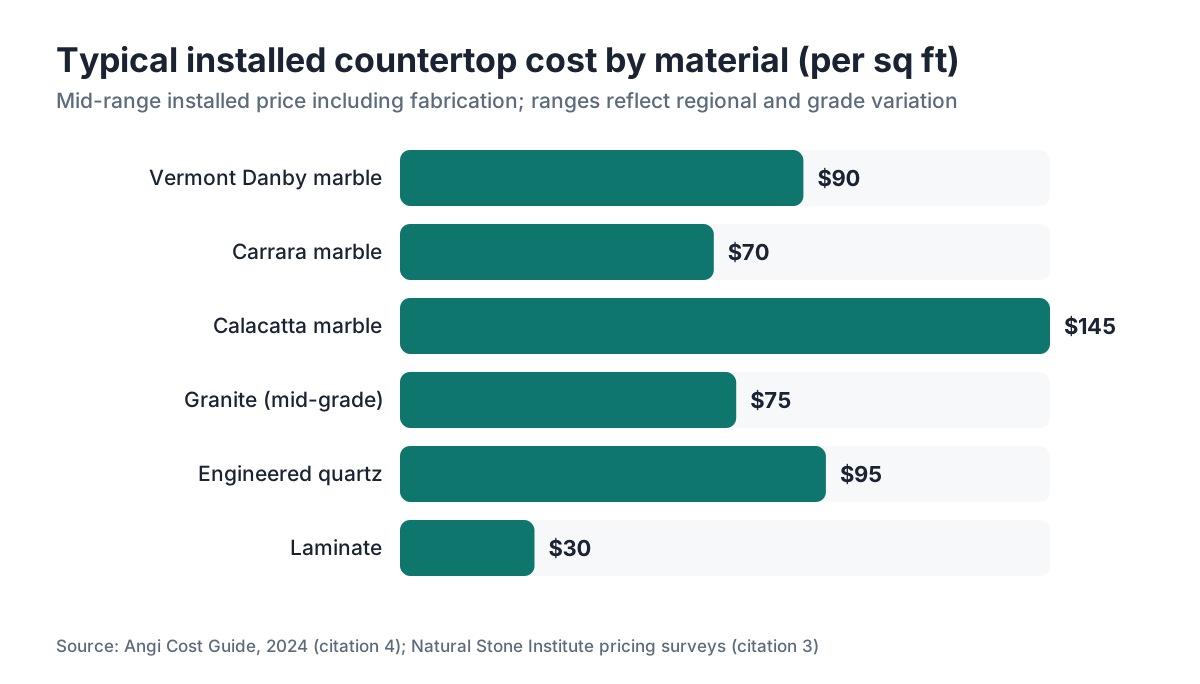
- Installed countertops run $60 to $120 per square foot.
- It etches and stains like all calcite-based stone, but the dolomite chemistry makes it a bit more forgiving than Carrara if you seal it and wipe acidic spills fast.
What is Vermont Danby marble and where does it come from?
Vermont Danby marble comes from a single quarry near the town of Danby in Rutland County, Vermont. The Vermont Marble Company opened that quarry in the late 1800s, and the deposit has been worked more or less continuously since. Today the quarry is operated by Vermont Quarries, which markets the stone under the Danby name. [1]
The stone is a dolomitic marble, meaning it contains a higher proportion of dolomite (calcium magnesium carbonate) alongside the calcite found in typical marble. That chemistry matters: dolomitic marble generally has slightly lower water absorption and a bit more resistance to surface etching than pure calcite marble, though it is not immune to either. [2]
Danby's signature look is a bright, cool white background with soft gray-to-charcoal veining that tends to run in a fairly consistent direction. Some slabs carry a subtle silver or pale gold tone depending on where in the deposit they were cut. The aesthetic sits somewhere between the snowy white of Thassos Greek marble and the more dramatic gray movement of Calacatta Italian marble.
The quarry runs underground, not as an open pit. That shields the stone from freeze-thaw cycles during extraction, which operators say reduces internal micro-cracking. Whether that translates to measurable performance differences in finished countertops is debated, but fabricators who have worked both outdoor-quarried and underground stone note that Danby tends to cut very cleanly. [1]
How does Vermont Danby marble compare to Carrara and Calacatta?
Homeowners cross-shop three white marbles most often: Carrara, Calacatta, and Danby. They look similar in photos. They behave differently on a countertop.
| Property | Vermont Danby | Carrara | Calacatta |
|---|---|---|---|
| Background color | Bright cool white | White to light gray | White, often warmer |
| Veining | Soft gray, subtle | Fine gray, consistent | Bold gray or gold, dramatic |
| Water absorption (approx.) | 0.08 to 0.12% | 0.15 to 0.25% | 0.10 to 0.20% |
| Primary mineral | Dolomitic marble | Calcite marble | Calcite marble |
| Origin | Danby, Vermont | Carrara, Italy | Carrara, Italy |
| Typical slab price (raw) | $18, $40/sq ft | $10, $25/sq ft | $40, $120/sq ft |
| Typical installed price | $60, $120/sq ft | $50, $90/sq ft | $90, $200+/sq ft |
Carrara is the cheapest and most widely available Italian marble, with finer, more uniform veining. It has a higher absorption rate than Danby, so it stains more easily. Calacatta is the most dramatic and the most expensive, with bold veining that can look incredible on a kitchen island, but its calcite content makes it just as vulnerable to etching as any other marble. [3]
Danby sits in the middle on price and at the low end on absorption. That is why some fabricators call it a more practical white marble for real kitchen use. "More practical" is relative, though. All three will etch if you leave lemon juice, vinegar, or wine on the surface. The dolomite chemistry in Danby slows the reaction. It does not stop it.
For a broader look at how marble fits the countertop landscape, see the marble countertops guide. If you are deciding between marble and a completely different material, granite countertops gives you a useful side-by-side.
What does Vermont Danby marble cost for countertops?
Installed Danby marble countertops typically run $60 to $120 per square foot for a standard kitchen, based on fabricator pricing across the Northeast and Mid-Atlantic. That range covers material, fabrication, and basic installation. It does not include tear-out of existing counters, plumbing disconnects, or edge upgrades beyond a standard eased or bevel profile. [4]
Raw slab pricing from distributors generally falls between $18 and $40 per square foot for Danby, depending on slab size, thickness (2 cm vs. 3 cm), and grade. Thicker 3 cm material costs more but does not need a substrate, which offsets some of the difference in the finished job. Most residential installers prefer 3 cm for kitchens.
Fabrication adds $25 to $50 per square foot on top of material, and installation another $10 to $20 per square foot for straightforward jobs. Cutouts for sinks and cooktops add $100 to $200 each. Complex edge profiles like ogee or waterfall add $15 to $30 per linear foot.
Geography moves the number hard. In Manhattan or Boston, the high end can push past $150/sq ft for premium material with a full bullnose edge and an undermount sink. In rural Vermont or the Southeast, you may find Danby installed closer to $55 to $65/sq ft if a local fabricator has supplier relationships. Always get at least three quotes.
For fabricators quoting marble, accurate material and waste math makes a real difference on thin-margin natural stone work. Tools like SlabWise handle slab nesting and quote generation so you don't leave money on the table or over-order material.
Compare this against kitchen countertops for a full range of material costs if you are still deciding.
Does Vermont Danby marble hold up in a kitchen?
Honest answer: marble in a kitchen means you change your habits, and Danby is no exception. It is not a low-maintenance material.
The two main failure modes for marble countertops are etching and staining. Etching is a chemical reaction where acid dissolves the surface of the calcium carbonate minerals, leaving a dull spot or ring that reads different in sheen from the polished surface around it. Staining is a physical process where a pigmented liquid soaks into the pore structure. Danby's lower absorption rate makes it somewhat less prone to deep staining than Carrara, but etching is still very much a concern. [2]
Common kitchen acids that etch marble: lemon juice, lime juice, vinegar, wine, tomato sauce, coffee, and even sparkling water. The reaction is fast, sometimes visible within seconds on a polished surface. A honed or matte finish hides etch marks far better than a polished one because the surface is already uniformly matte. Many designers spec honed Danby in working kitchens for exactly this reason.
Sealing slows staining but does nothing for etching. Seal Danby with a penetrating impregnating sealer rated for marble every 6 to 12 months depending on use. [5] A simple test: drop a few drops of water on the surface. If they soak in within a few minutes rather than beading up, it is time to reseal.
With those caveats, plenty of homeowners live happily with Danby marble in their kitchens for decades. The patina that develops, including faint etch marks and the slight dulling of high-traffic areas, is exactly what gives old European kitchen marble its character. If that is not your aesthetic, marble is probably not your material. If it is, Danby is one of the better choices.
What finish options are available for Danby marble countertops?
You have four realistic finishes for Danby marble countertops: polished, honed, leathered (or brushed), and sand-blasted. Each changes both the look and the maintenance.
Polished is the mirror finish most people picture when they think of marble. It shows the full depth of the white and gray, and the veining pops. The tradeoff: every etch mark is visible because the acid attack creates a dull spot against the shine. Polished Danby is stunning on install day and demands the most attention in a working kitchen.
Honed is a flat matte surface, made by stopping the grinding process before the final polish stage. Etch marks are far less obvious because the surface is already matte. Fingerprints and water marks show more readily, but they wipe off. Most kitchen designers who spec marble in actual cooking kitchens use honed. It also shows off Danby's cool white tone without the mirror glare.
Leathered (also called brushed or antiqued) means running the surface with diamond brushes to create a slightly textured finish. It hides etching and fingerprints well, and it adds a tactile quality some homeowners love. It is less common for marble than for quartzite or granite, but it works on Danby. Ask your fabricator if they have the tooling. Not all shops do.
Sand-blasted or flamed finishes exist but are uncommon for countertops. They show up more on exterior or commercial work.
For daily care regardless of finish, see the how to clean stone countertops guide. The maintenance rules for marble overlap with those for other calcareous stones.
How do you maintain and seal Vermont Danby marble countertops?
Daily maintenance is simple: wipe spills immediately, and use a pH-neutral stone cleaner or just warm water and a soft cloth. Never use vinegar, bleach, ammonia-based cleaners, or anything labeled as a bathroom tile cleaner. Most commercial kitchen cleaners are too acidic for marble. [5]
Sealing is the main protection against staining. Use an impregnating (penetrating) sealer made for marble or calcite-based stone. These are not topical coatings. They soak into the surface and partially fill the pore structure to slow liquid absorption. Products like Miracle Sealants 511 Impregnator and Tenax Hydrex are widely used in the trade, though that is not an exhaustive list and regional suppliers carry equivalent products.
How often to reseal depends on how hard the surface gets used. The water bead test is the practical standard: if water stops beading and starts soaking in within 3 to 4 minutes, reseal. In an active kitchen that might be every 6 months. In a lightly used bathroom, once a year or less. [5]
For light etching on a polished surface, marble polishing powder (a fine-grit aluminum oxide compound marketed as marble polish) can restore some sheen. For honed surfaces the process is similar, but stop before you create a shine. Severe etching or deep staining usually needs professional honing or re-polishing by a stone restoration contractor.
Keep cutting boards on the counter. Marble is softer than granite (Mohs hardness around 3 to 4 for marble vs. 6 to 7 for granite) and will scratch under direct knife contact. [6] The scratches are usually minor and blend into the patina, but they are easy to avoid.
Is Vermont Danby marble good for bathrooms and other applications?
Bathrooms are where Danby marble performs best for most homeowners. Low acid exposure relative to a kitchen means etching is almost never an issue. Toothpaste is mildly abrasive but not strongly acidic. Soap scum is alkaline, which won't etch but can leave residue. The main risk in a bathroom is staining from hair products, dyes, and oils.
Danby is also a natural pick for bathroom floors, tub surrounds, and shower walls, though slabs in wet areas need proper substrate prep and grout or caulk joints instead of tight butt joints to allow for movement. For shower floors, spec a honed or brushed finish for slip resistance. Polished marble on a shower floor is a fall hazard.
Beyond kitchens and baths, Danby shows up in fireplace surrounds, foyer floors, and furniture like islands and vanities. Its consistent light color works well in formal spaces. It has a long history in monumental and memorial work, which is how the Vermont quarries built their reputation in the first place.
If marble feels like too much maintenance, cambria countertops is a popular engineered alternative that mimics the Danby look without the etching risk. Corian countertops is another lower-maintenance path if the aesthetic is flexible.
What should you know about buying and selecting Danby marble slabs?
Danby marble comes in standard slab sizes, typically around 55 to 65 inches wide by 100 to 130 inches long, though individual slabs vary. View slabs in person before purchase if you possibly can. Photos do not capture the range of variation within a single lot. Veining in Danby runs relatively consistent, but some slabs carry more movement than others, and background color can shift slightly from batch to batch.
Request book-matched pairs if your project has a large island or a wall application where matching veining direction matters. Book matching means two adjacent slabs are opened like a book to create a mirrored vein pattern. Not all distributors stock book-matched Danby pairs, so ask early.
Verify the thickness. True 3 cm material (about 1.25 inches) is standard for countertops and does not need a plywood substrate. Some imported material labeled "3 cm" actually comes in at 2.6 to 2.8 cm, which affects the install. Your fabricator should be checking this.
Ask your distributor whether the slab has been reinforced. Danby is a strong marble, but large-format slabs, especially those with prominent veining channels, are sometimes stabilized on the back with fiberglass mesh or epoxy during finishing. That is standard practice and not a quality defect. It just means you are getting a fully processed slab.
If you are comparing distributors across regions, the ASTM C503 standard covers classification and testing for marble used in construction, including absorption and modulus of rupture requirements. [7] Asking your supplier whether their Danby stock meets C503 is a fair quality check.
For fabricators running production quotes, accurate slab yield affects profit on every Danby job. SlabWise has a quoting and nesting tool built around real slab dimensions, which saves time when you are pricing multiple marble jobs in a day.
How does Danby marble perform on sustainability and sourcing?
Vermont Danby marble has a domestic sourcing story that imported marble cannot match. The quarry is in Vermont, which cuts shipping distance for buyers in the Northeast and drops the transportation carbon footprint compared to stone shipped from Italy, Brazil, or Turkey. [10]
Stone quarrying still has environmental costs: land disturbance, water use in cutting and polishing, and energy for processing. Vermont's Act 250 land use statute requires environmental review for large developments and quarrying operations in the state, which puts some regulatory oversight on extraction practices. [8]
The domestic-origin angle matters to buyers who want American-made materials, and Vermont Quarries and its distributors lean on it in their marketing. Whether it matters to you is a personal call, but it is an honest differentiator.
Longevity is the clearest sustainability argument for natural stone of any kind. A well-maintained marble countertop can last the life of the building, unlike laminate countertops or formica countertops, which typically need replacement every 10 to 20 years. The longer the useful life, the lower the lifecycle material impact.
What are the most common problems with Vermont Danby marble countertops?
The complaints fabricators and homeowners report most often fall into four buckets.
First, unexpected etching. Most homeowners are not warned clearly enough at purchase that marble etches from acids. The first time someone leaves a lemon half face-down on a polished Danby counter and walks away, the dull ring they find is a rude surprise. This is not a defect in the stone. It is a property of calcite minerals. Clear pre-sale communication from dealers and fabricators heads off most of the anger.
Second, edge chipping. Marble is more brittle than granite at edges and corners. A chip from a heavy pot dropped near a sharp 90-degree edge is not unusual. Spec a slightly softened edge profile, like an eased or bevel edge, instead of a full square edge on kitchen work. It cuts the chip risk with no aesthetic cost.
Third, structural cracking near cutouts. Sink and cooktop cutouts remove a big chunk of the slab in high-stress areas. Some fabricators add fiberglass reinforcement on the underside near cutouts. That is good practice for marble, more so than for granite. Ask your fabricator if they do it.
Fourth, inconsistent sealing advice. Some homeowners are told to reseal annually, others never get told at all. The stone industry does not have one universal standard, and individual sealers make different longevity claims. The water bead test above is the only practical guide that matters. Do it every 6 months and you will not go wrong. [5]
For stone types that are harder and less prone to these issues, the how to clean quartzite countertops guide covers quartzite, which is often sold alongside marble and is significantly harder and more stain-resistant.
How do fabricators work with Vermont Danby marble in the shop?
Danby is a pleasure to fabricate by marble standards. It is consistent in hardness, cuts cleanly with standard marble blades, and polishes to a bright finish without the color variation you get from Italian marbles that carry heavy resin fills out of the quarry.
Standard wet saw work with a diamond blade runs well at typical marble cutting speeds. Bridge saws are preferred for long straight cuts to keep the blade from drifting, which would throw off vein alignment on book-matched pieces.
For CNC work, watch the tool paths around the sink cutout. Marble does not have the tensile strength of granite [6], and aggressive plunge cuts near the narrow bridge sections on an undermount sink cutout can crack the stone. Most experienced shops run those sections with multiple shallow passes instead of full-depth cuts in one shot.
Edge profiling on polished Danby needs the full sequence of diamond pads from coarse to fine to hit the mirror finish that matches the face. Skipping grits to save time on marble shows in the finished edge in a way it does not always show on darker stone. Slower is faster here.
Waste math matters more on marble than on granite. Danby slabs tend to be smaller than large granite slabs, and the book-match constraint (when it applies) limits your layout options. Running accurate yield estimates at quoting time prevents the jobs where you order one slab and discover mid-fabrication you need a second.
Frequently asked questions
Is Vermont Danby marble the same as Thassos marble?
No. Thassos is a Greek marble quarried from the island of Thassos, and it is one of the purest white marbles available, with almost no veining. Danby has soft gray veining and a slightly warmer white background in most slabs. Both are calcite-based and etch from acids, but they look distinctly different in person. Thassos is also typically more expensive and less available through domestic distributors.
Can you use Vermont Danby marble in an outdoor kitchen?
It is not ideal. Marble has relatively low resistance to freeze-thaw cycling compared to granite or quartzite, and outdoor exposure speeds up etching from rain, which is mildly acidic. The underground extraction reduces some internal micro-cracking, but the finished stone still carries the same mineral vulnerabilities as any other marble outdoors. For outdoor countertops in cold climates, granite or quartzite is the better choice.
What edge profiles work best with Danby marble?
Eased, bevel, and ogee edges are all common on Danby. For kitchens, eased or bevel edges cut chip risk at corners compared to a full square edge. Ogee and waterfall edges look dramatic but take more fabrication time and cost more. The key functional point: avoid very sharp 90-degree square edges on marble kitchen counters, because the brittle edge is vulnerable to chipping from dropped cookware.
How thick should Vermont Danby marble countertops be?
3 cm (about 1.25 inches) is the standard for countertops and is what most fabricators recommend for kitchens. It does not need a plywood substrate, which simplifies installation. 2 cm material is available and costs less per square foot for the raw slab, but it needs a substrate and the total system cost often ends up similar. For bathroom vanities with light use, 2 cm is sometimes run with a laminated-edge detail to appear thicker.
Does Vermont Danby marble turn yellow over time?
Danby's dolomitic composition makes it fairly stable against yellowing. Some marbles yellow from oxidation of iron minerals or from residue buildup in the pores. Danby's low absorption rate reduces residue accumulation. That said, solvent-based sealers can leave a yellow tint, and oil-based products (like cooking oil or certain furniture polishes) can cause yellowing in the pore structure. Stick to impregnating stone sealers and pH-neutral cleaners.
How do you remove etch marks from polished Danby marble?
Light etch marks on polished Danby can be buffed out with marble polishing powder, a fine aluminum oxide compound. Apply a small amount with a soft cloth, work it in with a circular motion, and buff away. Deeper etching needs professional honing and re-polishing by a stone restoration contractor. Prevention is far easier: use trivets, coasters, and cutting boards, and wipe acidic spills right away.
Is Vermont Danby marble safe for food contact?
Yes, natural marble has no toxic compounds that would migrate into food. The concern with marble in food prep areas is the reverse: food acids etching the stone and organic liquids staining it. From a food safety standpoint, marble is inert. The FDA regulates food contact surfaces in commercial settings, and natural stone is an accepted material when properly sealed and maintained.
What is the resale value impact of Danby marble countertops?
Stone countertops generally add to perceived home value, and natural marble carries more cachet with buyers than engineered stone in luxury markets. No solid national dataset isolates Danby specifically. The National Association of Realtors' remodeling reports cover kitchen remodels broadly but do not break out countertop materials. [9] The cleaner the marble is at time of sale, the better the perception. Heavy etching or staining can work against you.
Can you repair a cracked Danby marble countertop?
Small cracks and chips can be repaired with color-matched epoxy or polyester adhesive, which fabricators use routinely. On a white marble like Danby, color matching is straightforward. Structural cracks that run fully through the slab near a cutout are more serious and may require the section to be replaced. A reputable fabricator or stone restoration contractor can assess whether a given crack is cosmetic or structural.
How does Danby marble compare to engineered quartz that mimics it?
Engineered quartz products that mimic Danby's look (sold under names like Silestone Arctic White or Caesarstone Statuario Nuvo) are harder, non-porous, and do not etch from acids. They cost roughly $70 to $120 installed, overlapping with Danby's range. The tradeoff is that quartz can discolor from prolonged UV exposure near sunny windows, and it lacks the natural variation and depth of real stone. Many designers consider the real thing irreplaceable for certain looks.
Where can you buy Vermont Danby marble slabs?
Vermont Quarries distributes through regional stone distributors across the Northeast, Mid-Atlantic, and select national distributors. Major slab warehouses in metro areas often stock Danby or can order it. Lead times vary: if a distributor has Danby in the yard, fabrication can begin within days. If it needs to be ordered, expect 2 to 6 weeks. Your fabricator usually has distributor relationships and can source material, or you can visit a slab yard directly.
Is honed or polished Danby marble better for a kitchen?
Honed is the practical choice for an active kitchen. Etch marks are far less visible on a matte surface because it is already uniformly dull. Polished Danby is stunning but demands more vigilance: every acid contact leaves a visible dull spot against the shine. For bathrooms or lightly used surfaces, polished is a reasonable choice. For a main cooking kitchen used daily, honed is what most stone professionals recommend.
Does Vermont Danby marble need to be sealed before use?
Yes. Even if the fabricator applied a sealer during polishing, apply a fresh coat of penetrating impregnating sealer before the countertop goes into service. Fabrication sealers are often just a step in polishing and may not be the full protective application meant for long-term use. Apply sealer per the manufacturer's instructions, allow proper cure time (typically 24 hours), then run the water bead test before heavy use.
Sources
- Vermont Quarries, About the Quarry: Vermont Danby marble is quarried underground near Danby, Vermont, and has been worked since the late 1800s; the underground extraction reduces freeze-thaw micro-cracking.
- Natural Stone Institute, Marble Technical and Dimensional Stone Guidance: Dolomitic marble generally has lower water absorption and slightly higher etch resistance than pure calcite marble, but all marble etches from acidic contact.
- Natural Stone Institute, Marble Technical Guide: Carrara marble absorption rates average 0.15 to 0.25%; Calacatta and Danby fall lower; all are calcite-based and etch from acidic contact.
- Angi, Marble Countertop Cost Guide: Installed marble countertops nationwide typically cost $50, $200 per square foot depending on material grade, edge profile, and region.
- Natural Stone Institute, Care and Maintenance of Stone Surfaces: Penetrating impregnating sealers should be reapplied when the water bead test fails (water absorbs within 3 to 4 minutes); frequency varies by use but typically every 6 to 12 months for kitchen marble.
- USGS National Minerals Information Center, Dimension Stone Statistics and Information: Marble rates approximately 3 to 4 on the Mohs hardness scale versus granite at 6 to 7; marble has lower tensile strength and is more prone to edge chipping and cracking near cutouts.
- ASTM International, ASTM C503 Standard Specification for Marble Dimension Stone: ASTM C503 sets classification and minimum performance requirements for marble dimension stone including absorption, modulus of rupture, and compressive strength.
- Vermont Agency of Natural Resources, Act 250 Land Use and Development Control Law: Vermont's Act 250 requires environmental review and permits for large-scale land use including quarrying operations, providing regulatory oversight on extraction in Vermont.
- National Association of Realtors, Remodeling Impact Report: Kitchen remodels including countertop upgrades rank among the top projects for perceived value among buyers; no material-specific breakdown for Danby is available.
- USGS National Minerals Information Center, Dimension Stone Minerals Yearbook: Vermont is among the leading U.S. states for marble and granite production; domestic dimension stone quarrying reduces transportation compared to imported stone.
Last updated 2026-07-09