TL;DR
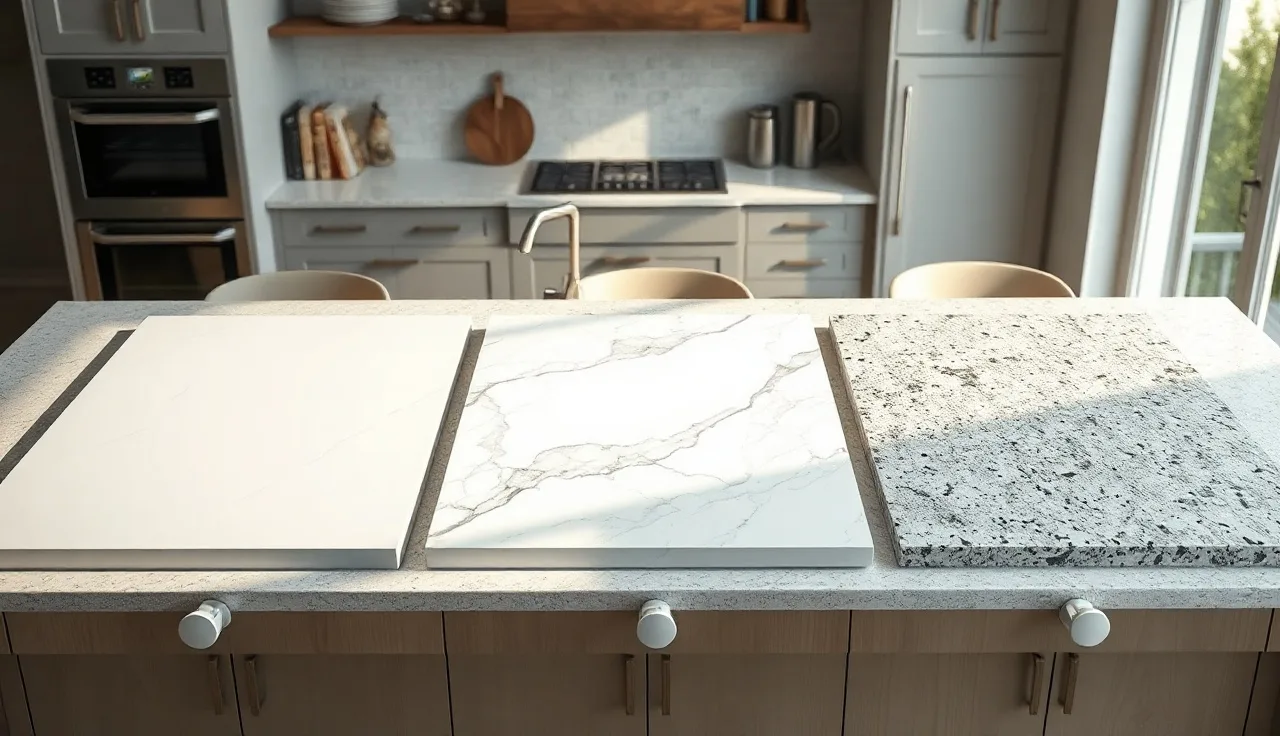
- Quartz countertops split into five visual types: solid/concrete look, marble-look, granite-look, bold/exotic patterns, and recycled-content quartz.
- All are engineered stone, roughly 90 to 94% ground quartz bound with polymer resin.
- Installed prices run $50 to $150 per square foot.
- The differences between types are almost entirely visual.
- Durability and maintenance stay nearly identical across the whole category.
What exactly is quartz countertop material, and how is it made?
Quartz countertops are engineered stone. They are not quarried as a single slab the way granite or marble is. Manufacturers grind natural quartz crystals into aggregate, mix that aggregate with polymer resins (usually polyester or epoxy), add pigments, then compress the mix under vacuum and vibration to squeeze out air voids. Out comes a dense, non-porous, uniform slab.[1]
The standard recipe is roughly 90 to 94% ground quartz by weight. Resins and pigments make up the other 6 to 10%.[2] That ratio has held steady since Breton S.p.A. invented the Bretonstone process in Italy in the 1960s and later licensed it to manufacturers including Cosentino (Silestone), Caesarstone, and Cambria.[1]
Because the pattern is built in a factory instead of formed by geology, producers can make quartz look like almost anything. A pale Carrara marble. A dense black granite. A flat concrete gray. Or something that exists nowhere in nature. That's the real story behind the different "types" of quartz. The engineering underneath is the same. The types are visual categories, not structural ones.
Here's a point that trips up a lot of homeowners: quartz countertops are not quartzite. Quartzite is a natural metamorphic stone that has to be sealed and can etch. Engineered quartz needs no sealing and shrugs off etching. If a fabricator uses those two words like they mean the same thing, stop and ask which product is actually in the quote.
What are the main types of quartz countertops by appearance?
Most manufacturers sort their quartz lines into visual families, and the countertop trade follows suit. Five categories cover almost everything you'll see in a showroom.
1. Solid and near-solid colors These are the plainest slabs: one color, little to no veining or particle movement. Crisp white, warm cream, pure black, matte concrete gray. They photograph beautifully in modern kitchens and hide seams better than busy slabs, because there's no pattern to line up. Caesarstone's Pebbled Beach and Silestone's Blanco Zeus are common picks.
2. Concrete and aggregate looks This sits between plain and patterned. The slab carries visible aggregate flecks suspended in a background color, close to terrazzo or raw concrete. Flecks usually run 1 to 3 mm and scatter randomly. Nuvolato-style designs (Italian for "cloudy") land here too. They suit industrial, Scandinavian, and transitional kitchens.
3. Marble-look quartz This is the fastest-growing category on the market. The slabs copy Calacatta, Carrara, Statuario, and other white or gray Italian marbles, veins and all, in gold, gray, or charcoal. Brands like Cambria have poured money into it, with designs like Brittanicca and Skara Brae that are genuinely hard to pick out from natural stone in a kitchen photo. The veining is printed or layered during manufacturing, so it repeats at slab intervals. On a big island, a sharp eye can catch the repeat.
4. Granite-look quartz These copy the speckled, granular face of natural granite, using larger aggregate particles in contrasting colors. Against granite countertops, granite-look quartz prices more predictably (real granite swings wildly on exotic slabs) and skips the sealing. If you want the granite look without the maintenance gamble, this is a real middle road.
5. Bold, exotic, and tonal patterns The premium tier. Dramatic black-and-gold, deep blue waterfall looks, burgundy and forest-green slabs no natural stone quite matches. These are pure factory aesthetics, and they run a 20 to 40% premium over entry-level slabs within the same brand.[3] Most people use them as focal-point islands rather than covering a whole kitchen.
How do quartz countertop prices compare across types and brands?
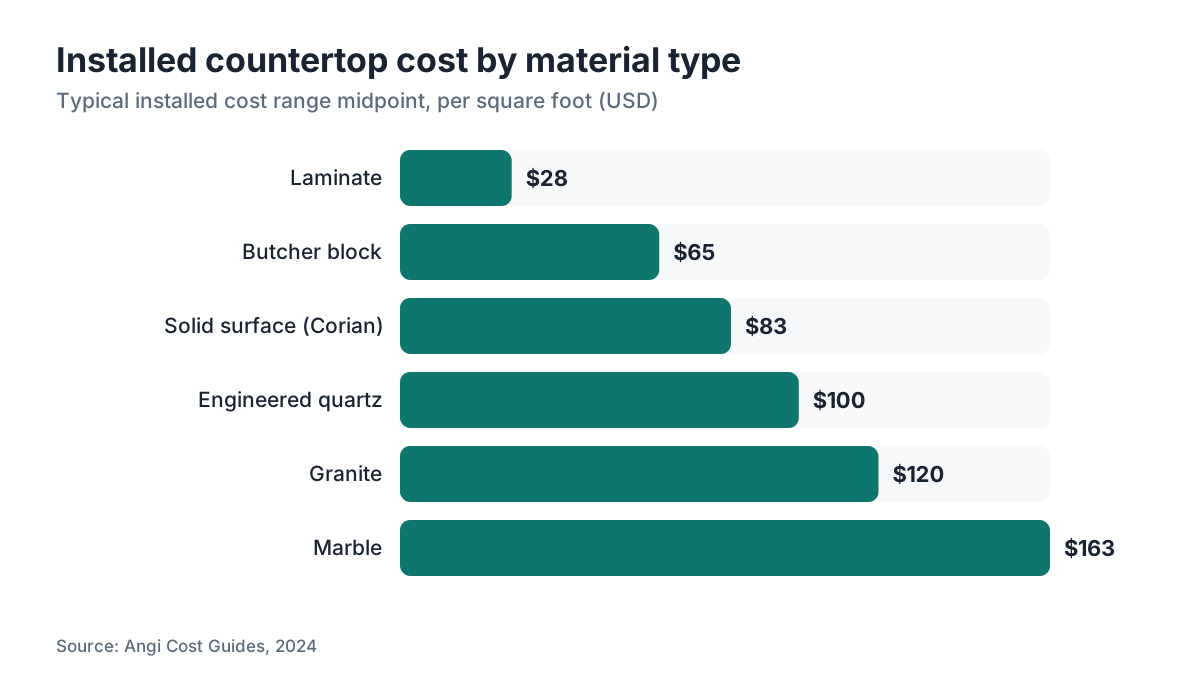
Installed quartz countertops in the United States generally run $50 to $150 per square foot, covering material, fabrication, and basic installation.[3] That range is wide because it stretches from entry-level residential lines at big-box stores up to premium designer series at stone yards.
Here's how the tiers actually break down:
| Tier | Typical installed cost (per sq ft) | Examples |
|---|---|---|
| Entry (solid colors, basic aggregate) | $50 to $75 | MSI Q Quartz, Silestone entry lines |
| Mid (marble-look, granite-look) | $75 to $110 | Caesarstone, Cambria standard series |
| Premium (exotic, bold patterns, thick slabs) | $110 to $150+ | Cambria designer, Compac haute |
The visual type you pick doesn't set the price as directly as the brand tier does. A solid-color Cambria slab costs more than a marble-look slab from an off-brand maker. What really moves the number: brand, thickness (2 cm versus 3 cm), slab series, and how complex your edge profiles and cutouts are.
Fabricators, take note. On large jobs with multiple slab types, nesting layout drives your material waste. How tightly you yield each slab against the template lands straight on your margin. Tools like SlabWise run that optimization for you, which matters when a client picks a heavily veined marble-look slab that needs careful pattern matching.
For context, laminate countertops install for $15 to $40 per square foot, and marble countertops run $75 to $250 installed depending on origin and rarity.[4]
Does the type of quartz affect durability or performance?
Mostly no. The engineering is identical across visual types from any one manufacturer. Engineered quartz sits at roughly Mohs hardness 7, above most kitchen acids and metals but below diamond and some hard ceramics.[5] Buy a solid white slab or a bold blue exotic and you get the same scratch and heat behavior.
A few real differences do exist.
Dark and solid-color slabs show scratches and fingerprints more plainly than aggregate or veined designs. A hairline scratch on matte black quartz jumps out. The same scratch on speckled granite-look quartz vanishes into the pattern.
High-gloss (polished) finishes show water spots and smudges more than honed or leathered ones. Honed quartz got popular partly for that reason. The finish doesn't touch hardness or stain resistance, but it changes how much daily wiping you'll actually do.
Very dark pigments can fade under UV near windows over the years. Most manufacturers name this in their warranty language. Lighter colors and veined designs don't show UV effects as readily.
One misconception worth killing: quartz is heat resistant, not heat proof. A pan straight off a burner can crack or discolor the resin binder no matter the color or pattern. Use a trivet. That rule holds for every type.
Which quartz type is easiest to maintain?
All engineered quartz is non-porous, so you never seal it.[2] Coffee, wine, and oil sit on the surface instead of soaking in. Routine cleaning is warm water and mild dish soap. That's the whole job.
For deep cleaning, most makers push non-abrasive cleaners and warn against high-concentration bleach, which can break down the resin binder. NSF International's food-equipment materials standard treats surface porosity as a sanitation factor, and non-porous surfaces generally support less bacterial growth than porous ones, which is part of why quartz sells well to sanitation-minded buyers.[6]
Maintenance differences by type are cosmetic, not chemical. Solid white shows stains and dried water more than veined designs. Gloss finishes need more frequent wiping than honed. If you hate cleaning, a mid-toned aggregate or veined design in a honed finish is the honest low-maintenance pick.
Comparing quartz to natural stone? See how to clean stone countertops and how to clean quartzite countertops for exactly what the sealing and maintenance gap looks like day to day.
How do quartz countertop types compare to other countertop materials?
Quartz sits in the middle-to-upper tier of the countertop market. Here's a straight comparison with the common alternatives:
| Material | Needs sealing | Heat resistance | Scratch resistance | Installed cost range |
|---|---|---|---|---|
| Engineered quartz | No | Moderate | High (~Mohs 7) | $50 to $150/sq ft |
| Granite | Yes (1 to 2x/yr) | High | High | $40 to $200/sq ft |
| Marble | Yes (frequently) | Moderate | Low (etches) | $75 to $250/sq ft |
| Laminate | No | Low | Low | $15 to $40/sq ft |
| Butcher block | Yes (oil regularly) | Moderate | Low | $30 to $100/sq ft |
| Solid surface (Corian) | No | Low | Moderate | $45 to $120/sq ft |
Quartz beats marble countertops and granite countertops on maintenance. It loses to both on heat resistance, and it loses to granite on entry-level price. Butcher block countertops and laminate countertops cost less but need more maintenance or earlier replacement. Corian countertops are the closest fight: also non-porous, also manufactured, but softer and easier to repair.
For every option side by side, the kitchen countertops guide lays them all out.
What thickness options exist for quartz countertops?
Quartz slabs come in two standard thicknesses: 2 centimeters (about 3/4 inch) and 3 centimeters (about 1-1/4 inch). A 1.2 cm option exists but almost never shows up in residential work.
3 cm is the residential standard across most U.S. markets now. It's heavier and more rigid, and it doesn't need a plywood substrate to span typical cabinet runs, which cuts a step out of installation. Most fabricators would rather work in 3 cm because it gives cleaner edge profiles and a little more room for error on cuts.
2 cm slabs cost a bit less per square foot but usually need a substrate, which adds labor and can eat up much of the material savings. Some designers run 2 cm with a laminated edge to fake the chunky look of 3 cm without the full weight.
Thickness moves installed cost, not visual type. You can get a marble-look slab in 2 cm or 3 cm. The choice comes down to your cabinetry, your budget, and what your fabricator recommends for your layout.
What are the most popular quartz countertop brands and how do their lines differ?
A handful of brands run the North American market.
Caesarstone (Israeli company, manufactured in Israel and the U.S.) is one of the oldest engineered-stone brands going, founded in 1987.[7] The range runs from entry-level solids up through the Metropolitan and Supernatural series, which push into high-movement marble and concrete looks. The 5000 Midday white and 4600 DC Concrete sell year after year.
Cambria is the only major quartz brand made entirely in the U.S., producing slabs in Le Sueur, Minnesota.[8] It sells through authorized dealers rather than big-box stores, which keeps prices higher but guarantees trained fabricators. Its designer series (Brittanicca Warm, Skara Brae, Ella) sit at the top of the marble-look category. Our full Cambria countertops guide has the details.
Silestone by Cosentino (Spanish) was among the first to add antibacterial silver-ion technology to quartz, though the practical value of that in a kitchen is debatable given that non-porous quartz already resists bacteria.[9] Its N-Boost finish, launched in the 2010s, adds stain resistance to the resin layer.
MSI Q Quartz is the value pick, stocked at Home Depot and Lowe's. Quality is solid for the money. The variety is narrower than the premium brands, but for a rental or a budget kitchen, it's a rational call.
Compac and Vicostone fill out the mid-tier. Both are manufactured in Asia and sold through stone distributors. Vicostone in particular has raised its quality noticeably over the last decade and prices its marble-look slabs well.
Brand choice matters more than you'd think. Warranty coverage, whether a distributor can match a slab for a repair years out, and how familiar your fabricator is with the slab's cutting behavior all shift by brand. A slab you can't rematch in three years when a client calls with a chip is a liability.
Are there quartz countertops made with recycled content?
Yes. Several makers build quartz slabs with recycled glass, mirror fragments, or reclaimed stone in the aggregate. IceStone, based in Brooklyn, builds slabs mostly from recycled glass and Portland cement, which technically makes it a glass-cement composite rather than polymer-bound quartz, but it sells alongside quartz.[10] Vetrazzo uses 85% recycled glass in a cement binder.
Within conventional polymer-bound quartz, Cosentino's Silestone has released lines that cut water and energy use in manufacturing as part of its sustainability reporting, though the slab composition itself stays conventional quartz aggregate.
If environmental credentials drive your choice, check two things: the recycled-content percentage (some "eco" lines carry very little actual recycled material) and where the quartz is mined and processed. Quartz crystal for engineered stone comes largely from Brazil, India, and Turkey, and the footprint of long-distance shipping can cancel out recycled-content gains.[11]
Greenguard (now Greenguard Gold) is the most reliable third-party marker for low chemical emissions from quartz slabs. Caesarstone, Cambria, and Silestone all carry Greenguard Gold certification.[12]
How do I choose which type of quartz countertop is right for my kitchen?
Start with your cabinet color and flooring, not the quartz. The quartz has to live with those for 15 to 20 years. White shaker cabinets over light oak floors are neutral enough to take almost any slab. Dark navy cabinets ask for more careful contrast.
A few practical filters.
Staging a home to sell? Solid white or light gray quartz photographs best and appeals to the widest buyer pool. Don't blow budget on premium exotic patterns for a flip.
Cook heavily and want the least visible upkeep? Pick a mid-toned veined or aggregate design in a honed finish. It hides crumbs, water marks, and light scratches between cleanings.
Want the kitchen to be a showpiece? Put a bold pattern on the island and keep the perimeter counters in a simpler solid or aggregate. Full exotic-pattern coverage across a busy kitchen reads as chaos.
For fabricators, the calculus is different: steer clients toward slabs your distributors actually stock as full slabs, not display samples that take three weeks to source. A gorgeous marble-look slab that delays a job by two weeks creates problems a solid or standard-aggregate slab never would. Learn what your local distributors hold in-stock versus what needs a special order.
Getting quotes from several fabricators? The countertop installation guide breaks down what a typical installed quote includes and what to watch for in the fine print.
What does a quartz countertop warranty actually cover?
Most major brands offer limited lifetime warranties to the original purchaser. Cambria, Caesarstone, and Silestone all carry one.[7][8][9] "Limited lifetime" means manufacturing defects, not damage from misuse.
What warranties normally exclude: heat damage from direct contact, impact chips, cuts from knives used straight on the surface, and damage from bad installation. That last one matters. If a fabricator skips adequate substrate support or sets the slab without proper adhesive at the joints, a warranty claim can get denied on the grounds of improper installation.
Caesarstone's warranty covers, in its own words, "defects in material and workmanship under normal use and service conditions," and it specifically carves out damage from "thermal shock, impact, or physical abuse."[7]
Secondhand buyers get nothing. Every warranty I've seen is non-transferable. If you're buying a home with quartz countertops and the slab has a visible crack or chip, treat it as out of warranty and price the repair into your offer.
Frequently asked questions
What is the difference between quartz and quartzite countertops?
Quartz countertops are engineered: ground quartz crystals mixed with resin, non-porous, never sealed. Quartzite is a natural metamorphic stone quarried from the earth, porous, sealed 1 to 2 times a year, and it can etch from acid. They look alike but behave very differently. If a showroom is fuzzy on the distinction, ask for the material's absorption rate test results.
Does quartz stain easily?
No. Quartz is non-porous, so liquids sit on top instead of soaking in. Coffee, wine, and oil wipe off with soap and water. The resin binder can be damaged by long exposure to very strong chemicals like paint stripper or concentrated bleach, and those can leave permanent discoloration. Normal kitchen use carries almost no staining risk compared to marble or unsealed granite.
Can you put hot pans directly on quartz countertops?
No. The polymer resin binder in quartz can crack, discolor, or delaminate under sudden or sustained high heat. A pan pulled straight from a 500°F oven can leave visible damage. Every major manufacturer warns against direct heat contact. Use a trivet or hot pad. This holds for all types and brands of engineered quartz.
How long do quartz countertops last?
With normal use and proper care, engineered quartz countertops last 20 to 25 years or more. The non-porous surface resists the bacteria and mineral buildup that wear down other materials. The practical limit is usually looks: people remodel kitchens before the quartz wears out. Most major brands offer limited lifetime warranties against manufacturing defects for the original purchaser.
Is marble-look quartz actually as good as real marble?
For kitchen function, marble-look quartz beats real marble. It doesn't etch from lemon juice or vinegar, needs no sealing, and is harder. Where real marble wins: it's genuinely unique (no two slabs match), it has real veining depth and translucency that close inspection reveals, and for some buyers the natural material matters on its own. Marble-look quartz repeats its pattern. Real marble never does.
What is the cheapest type of quartz countertop?
Solid-color or simple aggregate quartz from mid-tier brands like MSI Q Quartz or entry Silestone lines, bought at a big-box store, is the least expensive option. Installed cost can drop to $50 to $60 per square foot for a straightforward rectangular layout. The visual simplicity actually helps here: no pattern matching means less material waste and faster fabrication.
Do all quartz countertops look the same? How do I tell brands apart?
No. Brand differences are real but subtle to untrained eyes. Cambria slabs tend toward higher-movement patterns and a more saturated palette. Caesarstone leans clean and minimal. Silestone offers more mid-toned, European-influenced options. Best way to compare: visit a stone yard carrying multiple brands and look at full slabs, not 4-inch samples. Small samples don't show how a vein reads across a 10-foot island.
Can quartz countertops be repaired if they chip or crack?
Yes, within limits. Small edge chips can be filled with color-matched epoxy by a fabricator. The repair is usually visible up close but functional. Cracks through the full thickness are harder to hide; a seam filler and polishing can minimize but rarely erase the crack line. Catastrophic cracks usually mean slab replacement. That's why overhang support and proper installation matter so much.
What quartz countertop finish options are available?
The three main finishes are polished (high gloss), honed (flat matte), and leathered or suede (slight texture). Polished is the default and gives the most stain resistance and easiest cleaning. Honed looks more natural and shows fewer fingerprints but can pick up light staining a touch easier. Leathered is a texture brushed into the surface and hides imperfections well. Not every slab and brand comes in all three.
Is thicker quartz (3 cm) worth the extra cost over 2 cm?
For most residential kitchens, yes. 3 cm quartz doesn't need a plywood underlayment on standard 24-inch cabinet spans, which simplifies installation and dodges the slight height-variation risk of building up a substrate. The material cost difference is roughly $5 to $15 per square foot. In most markets the labor savings offset the material premium, and edge profiles look cleaner on 3 cm.
Which quartz brands are made in the United States?
Cambria is the only major quartz brand that manufactures entirely in the U.S., at its facility in Le Sueur, Minnesota. Caesarstone has a U.S. plant in Richmond Hill, Georgia, though some of its slabs are still imported from Israel. Most other brands, including Vicostone and Compac, manufacture in Asia or Europe and import to North American distributors.
How do I know if my quartz countertop quote is fair?
Get at least three quotes and confirm they all specify the same brand, series, thickness, edge profile, and square footage. A $30/sq ft gap between quotes usually means different material tiers or edge profiles, more than markup. Ask each fabricator for the slab name and series so you can compare exactly. Installation complexity (islands, curved edges, multiple cutouts) adds cost that varies by shop.
Do dark quartz countertops fade over time?
UV exposure can fade dark pigments in engineered quartz over years, especially near south-facing windows without UV-filtering glass. Most manufacturers name this risk in their warranty exclusions. If you want a very dark slab near a sunny window, ask your fabricator or distributor whether that specific product has known UV stability issues. Light colors and mid-toned veined designs are far less susceptible.
Can quartz be used outdoors?
Generally no. Most manufacturers void warranties for outdoor installations. UV exposure degrades the resin binder, temperature cycling can drive expansion and cracking, and prolonged moisture at the underside causes problems. A few brands offer outdoor-rated quartz composites, but those are niche. For outdoor kitchens, porcelain slabs or sealed granite hold up better.
Sources
- Breton S.p.A., Bretonstone system technical overview: Breton invented the engineered stone (Bretonstone) manufacturing process and licenses it to quartz countertop manufacturers worldwide
- U.S. Geological Survey, National Minerals Information Center: Engineered quartz slabs contain approximately 90 to 94% ground quartz by weight, with remainder being polymer resins and pigments
- HomeAdvisor / Angi, Quartz Countertop Cost Guide: Installed quartz countertop costs in the U.S. range from approximately $50, $150 per square foot including material, fabrication, and installation
- HomeAdvisor / Angi, Marble Countertop Cost Guide: Marble countertops install for $75, $250 per square foot depending on origin and rarity; laminate countertops install for $15, $40 per square foot
- National Park Service, Mohs Hardness Scale reference: The Mohs hardness scale ranks minerals 1 to 10; quartz sits at 7, above common kitchen acids and metals but below diamond and some hard ceramics
- NSF International, NSF/ANSI 51 Food Equipment Materials standard: Non-porous surfaces generally support less bacterial growth than porous surfaces, relevant to kitchen countertop material selection
- Caesarstone, Limited Lifetime Warranty documentation: Caesarstone offers a limited lifetime warranty covering defects in material and workmanship under normal use, excluding thermal shock, impact, and physical abuse; company founded 1987
- Cambria, About Cambria page: Cambria is fully American-made, manufacturing quartz slabs at its Le Sueur, Minnesota facility, and sells exclusively through authorized dealers
- Cosentino / Silestone, Product and Warranty Information: Silestone offers a 25-year transferable warranty on residential installations and incorporates antibacterial technology using silver ion treatment in select product lines
- IceStone, Product Specifications and Sustainability Data: IceStone manufactures countertop slabs from recycled glass and Portland cement, with recycled content comprising the majority of material by volume
- U.S. Geological Survey, National Minerals Information Center: Quartz crystal for engineered stone is primarily mined in Brazil, India, and Turkey before processing and shipping to slab manufacturers globally
- UL Solutions, Greenguard Certification Program: Caesarstone, Cambria, and Silestone hold Greenguard Gold certification for low chemical emissions from their quartz slab products
Last updated 2026-07-09