TL;DR
- Marble countertops split along three choices that drive everything: quarry region (Carrara, Calacatta, Statuario, Crema Marfil, Nero Marquina, and others), finish (polished, honed, or leathered), and thickness (2cm vs 3cm).
- Installed prices run roughly $40 to $200 per square foot.
- Each type has a distinct look, hardness, and maintenance reality you should understand before you buy.
What are the main types of marble countertops?
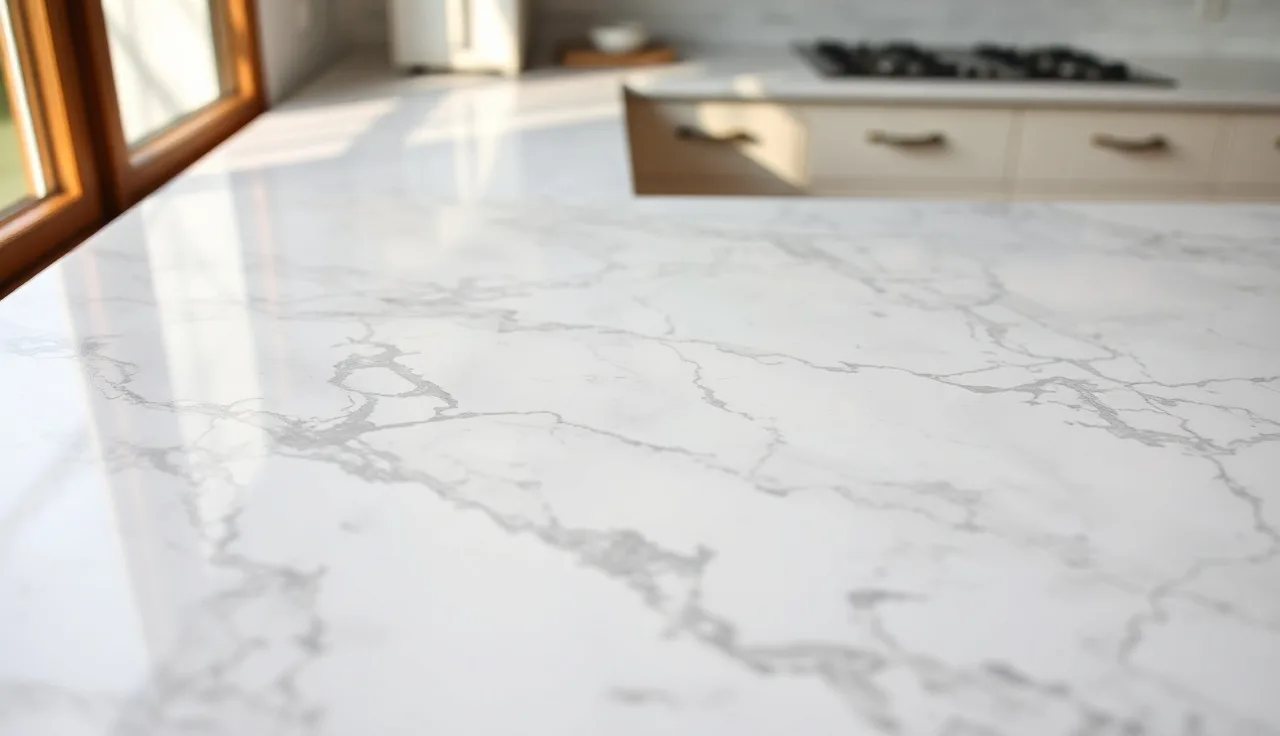
Marble is metamorphic limestone. Heat and pressure recrystallize the calcium carbonate into interlocking calcite crystals, and trace minerals draw the veining everyone recognizes. The quarry region sets almost everything else: color, vein character, density, and price.
Most of the marble homeowners and shops actually deal with falls into four groups. White Italian marbles (Carrara, Calacatta, Statuario). Colored European marbles (Crema Marfil, Portoro, Rosso Levanto). Black and dark marbles (Nero Marquina, Nero Portoro). And exotic or rare stones (Breccia Capraia, Paonazzo, Royal Botticino). Each group behaves differently on a countertop and carries a very different price.
Showroom confusion comes from loose naming. A slab labeled "Calacatta" at one distributor can look nothing like the next dealer's "Calacatta Gold." The Natural Stone Institute treats marble trade names as unstandardized, so the only reliable way to judge a slab is to see the whole thing in person or get a full-slab photo. A small sample chip lies [1].
For how marble fits the full countertop picture, see the marble countertops overview, or compare it against the whole kitchen countertops field.
What is the difference between Carrara, Calacatta, and Statuario marble?
These three come up in every countertop conversation, and they really are different stones. This is more than marketing tiers.
Carrara is the workhorse. It comes from the Carrara region of Tuscany, quarried there continuously since Roman times [2]. The background is soft white or light grey, and the veining runs fine, feathery, and grey. It is the most common Italian white marble in U.S. shops, which keeps it accessible: roughly $40 to $100 per square foot installed, depending on grade and your market.
Calacatta comes from the same mountain range but from deeper, more limited quarries. The background is whiter and brighter, and the veining is bolder, often carrying gold or warm brown running through thick dramatic lines. Smaller quarries and more variable slabs push the price up: typically $100 to $200 per square foot installed [3]. Calacatta Gold has a warm golden vein. Calacatta Borghini gets prized for its tight, crisp white ground with sparse bold grey veins. Calacatta Michelangelo leans toward heavy, chaotic veining.
Statuario sits at the top. It comes from Carrara too, but from a narrow band of quarries that produce an extremely bright white background with elegant, widely spaced dark grey veins. Michelangelo carved his sculptures from Statuario [2]. Supply is genuinely limited, and slabs over 7 feet tall are rare. Expect $150 to $250 per square foot installed, more for premium bookmatched pieces.
The practical difference plays out on a kitchen island. Carrara looks classic and slightly rustic. Calacatta looks contemporary and editorial. Statuario looks sculptural and formal. All three are equally porous, and all three need sealing.
What are the most popular colored and exotic marble types?
White Italian marble gets the press. The wider palette comes from quarries across Spain, Turkey, Greece, Brazil, and beyond, and some of it is spectacular.
Crema Marfil comes from Alicante, Spain. It is a cream-beige stone with subtle veining and tight, consistent patterning. It stays popular for traditional kitchens and bathrooms because it pairs easily with warm wood and beige cabinetry. Fabricators like it because it stays consistent slab to slab. Installed cost typically runs $50 to $120 per square foot [3].
Nero Marquina is a near-black marble from the Basque region of Spain, with sharp white veining that reads as a bold graphic. It looks sophisticated in modern and transitional kitchens, especially on islands next to white perimeter counters. It shows water spots and dust more than pale stone, which surprises some owners.
Portoro (sometimes Portoro Gold or Portoro Extra) is a black Italian marble with dramatic gold and yellow veining, quarried on the island of Palmaria near La Spezia. Supply is tight and the price reflects it: $150 to $300 per square foot is realistic for premium material.
Rosso Levanto is a deep red marble with white veining, quarried in Liguria, Italy. It rarely covers a full countertop but shows up on accent islands and bar tops. Very dramatic. Also very polarizing.
Emperador is a Spanish brown marble that runs from light tan with cream veining to deep chocolate with white and gold veins. Dark Emperador is one of the most requested brown stones in fabrication shops.
Breccia stones earn their own mention. Breccia marble forms from angular rock fragments cemented together, so it reads as a fractured mosaic rather than flowing veins. Breccia Capraia, Breccia Oniciata, and Breccia Imperiale each carry a chaotic, geological look that suits certain bold kitchens.
How does marble finish type (polished, honed, leathered) change how it looks and performs?
The quarry sets the color. The finish sets how the stone feels, how it takes wear, and how forgiving it is day to day.
Polished marble has a reflective, glassy surface built by progressively finer abrasives and a final buff. It pulls out the full depth of color and the sharpest vein contrast. It also shows etching almost instantly, the dull marks acid leaves behind from lemon juice, vinegar, coffee, or wine, because the etch breaks the polish and creates visible contrast. Polished white marble in a busy kitchen shows etch marks within weeks. Some owners read this as patina. Others find it maddening.
Honed marble has a matte or satin surface. The stone is ground smooth but never buffed to a gloss. It still etches, because etching is a chemical reaction with the calcite, not a coating problem. But etch marks barely register on a honed surface, since the stone already reads matte. This is why most fabricators steer kitchen clients toward honed. It hides fingerprints and smudges too. The tradeoff: it needs sealing just as often as polished, and some stains soak into the open pores a bit faster.
Leathered marble runs through diamond-tipped brushes that open the surface texture into a slightly rough, tactile finish. It hides smudges and water spots better than polished or honed. The downside is cleaning between the texture ridges takes more effort, and not every fabricator offers it.
For anyone cooking real food in a real kitchen, honed is the honest pick. Polished belongs in low-traffic spots: a powder room vanity, a butler's pantry, a fireplace surround.
See how to clean stone countertops for maintenance that applies no matter the finish.
What does marble cost per square foot, by type?
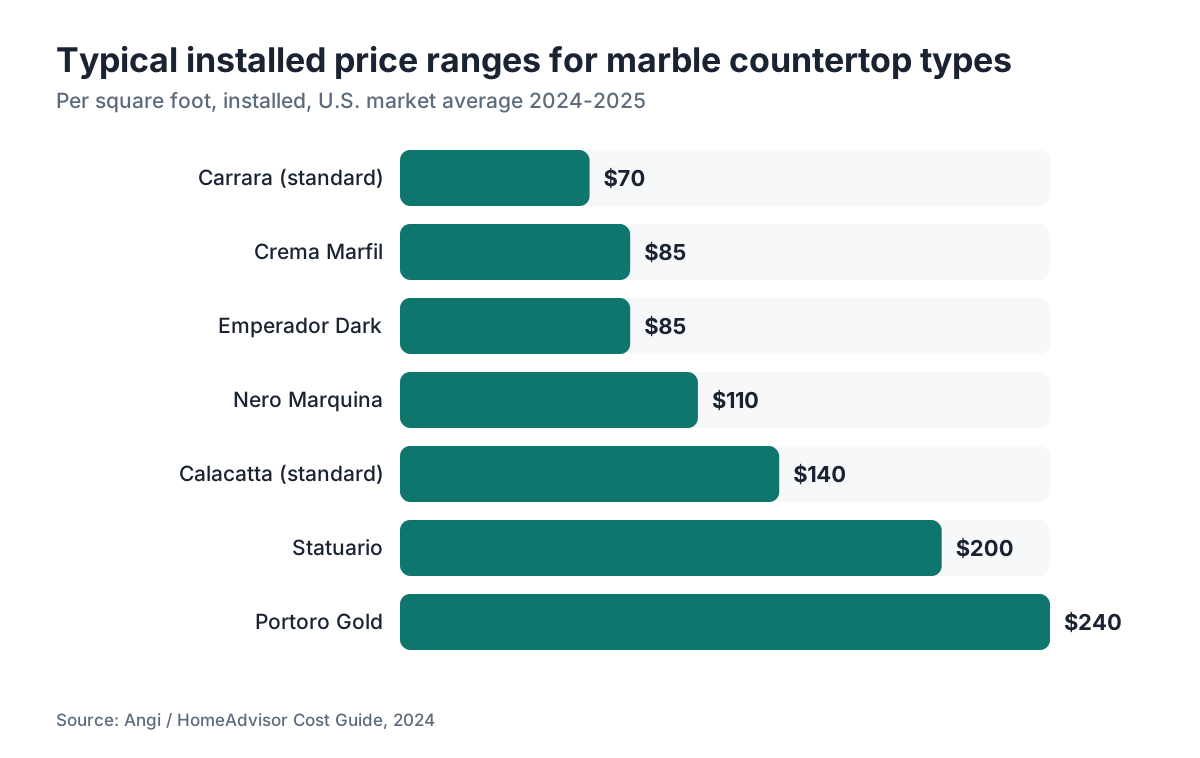
Price swings with region, distributor markup, and slab grade. The ranges below reflect typical installed costs in U.S. markets across 2024 to 2025 [3][4].
| Marble Type | Material Only ($/sq ft) | Installed ($/sq ft) |
|---|---|---|
| Carrara (standard grade) | $15 to $40 | $40 to $100 |
| Crema Marfil | $20 to $50 | $50 to $120 |
| Calacatta (standard) | $50 to $100 | $100 to $180 |
| Statuario | $80 to $150 | $150 to $250+ |
| Nero Marquina | $30 to $70 | $70 to $150 |
| Portoro / Portoro Gold | $100 to $200 | $180 to $300+ |
| Calacatta Borghini / Michelangelo | $100 to $200 | $200 to $350+ |
| Emperador Dark | $20 to $50 | $50 to $120 |
These are ranges, not quotes. A fabricator in a high-cost metro charges more for labor than a shop in a mid-size market. Remnant slabs (pieces left over from earlier jobs) can cut material cost 30 to 60 percent on smaller projects like bathroom vanities.
The installed price covers material, cutting, edge profiling, and installation. It usually leaves out sink cutouts (typically $100 to $200 extra), seams (priced per seam or per project), and delivery. Ask every fabricator to break out those line items so you can compare bids fairly.
Shops that want cleaner job costing and tighter estimates on marble use tools like SlabWise to run slab nesting and quotes before they buy material. Accurate layouts matter a lot on expensive stone, where a bad nest can waste hundreds of dollars per slab.
Is marble actually durable enough for kitchen countertops?
Marble scores 3 to 4 on the Mohs hardness scale, against granite at 6 to 7 and quartzite at 7 [5]. So marble scratches from everyday sharp objects and etches from any mildly acidic liquid. It is porous too, so a spill that sits (red wine, oil, coffee) can stain.
The honest answer: marble is not as durable as granite or quartzite for kitchen use. "Durable enough" depends entirely on how you cook and how you feel about a little imperfection.
Pastry kitchens use marble on purpose, because the stone stays cool and keeps butter from melting during lamination. But those kitchens deep-clean constantly and nobody panics over a mark on a work surface.
If you use cutting boards every time, wipe spills fast, and accept that marble earns character over the years, it works fine. If you want a pristine surface with zero maintenance worry, look at quartzite (harder, similar look), granite countertops, or a good engineered stone like Cambria countertops.
The USDA's Food Safety and Inspection Service tells home cooks to keep surfaces clean but never bans porous stone in a home kitchen [6]. The porosity concern is real. It is also manageable with proper sealing and normal hygiene.
How often does marble need to be sealed, and does the type matter?
All true marble needs sealing, because it is porous calcite. How often depends on how hard you use the surface and which stone you have.
Tighter, denser marbles like Statuario and some Calacattas soak up less than open-grained Carrara, but none of them are waterproof. A water test tells you when to reseal. Put a tablespoon of water on the surface. If it beads, the sealer still works. If it darkens the stone and soaks in within a few minutes, reseal.
Annual sealing is a reasonable starting point for most kitchen counters. Heavily used surfaces may want it every six months. A bathroom vanity used twice a day might go two years between treatments.
Use impregnating (penetrating) sealers on marble. They soak into the pores instead of forming a film, so they never peel or haze. Skip topcoat wax sealers, which cloud over time. The Natural Stone Institute recommends testing any sealer in a hidden spot first, because some older products can slightly shift the color of certain stones [1].
Etching is a separate problem from sealing, and this trips up a lot of homeowners. A sealer does not stop etch marks. Etching is a chemical reaction where acid dissolves calcium carbonate right at the surface. The only fix is polishing the etch out (on polished stone) or accepting it (on honed stone, where it is mostly invisible). A freshly sealed marble is not acid-proof.
What thickness should you choose for marble countertops?
Standard marble comes in two thicknesses: 2 centimeter (about 3/4 inch) and 3 centimeter (about 1-1/4 inch). A 1.2cm option exists but stays uncommon and usually rides on a plywood substrate.
3cm is the U.S. standard for most kitchen counters. It needs no plywood sub-base, it resists cracking better during fabrication and installation, and it looks substantial on the edge. Most shops prefer 3cm because there is less risk of breakage during transport and templating.
2cm costs less in raw material but often needs a laminated edge or substrate, which claws back some of the savings. It shows up more in Europe and on furniture-grade or thin-profile work like floating shelves and decorative panels.
For marble specifically, 3cm earns its extra cost. Marble is softer than granite and cracks along veins during handling more readily. The added mass of 3cm buys a real safety margin. Long spans (islands over 8 feet) may still need corbels or steel support regardless of thickness, because marble lacks granite's tensile strength.
See countertop installation for how thickness shapes the install process.
What edge profiles work best with marble?
Edge profiles change the visual weight of a counter and also affect durability at its weakest point: the edge.
Eased and straight edges rule contemporary kitchens. They are simple, they match modern cabinetry, and they cost the least to fabricate. The 90-degree corner on a full eased edge is the most chip-prone spot on any stone countertop, marble included.
Beveled edges (a small 45-degree cut at the top corner) knock off that vulnerable corner and look clean on marble. Pencil, ogee, and bullnose profiles read more traditional. Waterfall edges, where the slab drops vertically down the cabinet side to the floor, are a modern statement that works especially well with bold-veined Calacattas.
For white marble, many designers pick a simple straight or beveled edge and let the stone carry the room. For darker stones like Portoro or Nero Marquina, a polished bullnose or dupont profile opens up a dramatic reveal of the stone's depth.
Mitered edges join two pieces of stone at a 45-degree angle to fake a very thick slab. They are popular on islands, commonly run in 2cm or 3cm to produce a 4cm or 6cm apparent thickness. This burns through much more stone. On expensive material like Calacatta or Statuario, a mitered waterfall island can turn into a very large line item fast.
How does marble compare to quartzite and engineered quartz for countertops?
This is where most homeowners land after falling for marble's look and worrying about its upkeep.
Quartzite is a natural stone that looks a lot like marble, especially white quartzites like Super White, Sea Pearl, or White Macaubas. It is harder (Mohs 7), less porous in most cases, and more resistant to etching because it holds far less calcite. But not everything sold as quartzite actually is quartzite. Some slabs are marble, some are dolomitic marble, some are a mix. The reliable tests are a pH acid test or a professional petrographic test. See how to clean quartzite countertops for identifying and caring for the real thing.
Engineered quartz (brands like Cambria, Silestone, or Caesarstone) is made from roughly 90 to 94 percent ground quartz bound with polymer resin [7]. It does not etch, needs no sealing, and beats marble on hardness. Many engineered slabs now copy Calacatta and Carrara looks convincingly. The tradeoffs: it is not natural stone (some people care a lot, others not at all), and heat damages it more easily than natural stone because the resin binder softens.
The honest comparison for a busy family kitchen: engineered quartz or quartzite is easier to live with than marble. But if you truly love marble's specific look, nothing else copies the translucence and depth of real calcite crystal. Plenty of people take on the maintenance because the substitutes leave them cold. That is a legitimate call.
For other non-stone routes, laminate countertops and Corian countertops sit at very different price and performance points.
What should you ask a fabricator before buying marble?
The questions you ask at the slab yard and in the shop save you regret later. Ask all of them.
Ask to see the full slab, not the sample. Marble varies wildly within a single slab. A pretty chip with tight veining might come off a slab riddled with a big open vein network or color clouds the chip never showed. Buying for a large kitchen? Ask to see at least two or three slabs from the same lot so you understand the range.
Ask about vein direction and layout. A good fabricator walks you through how the slab lands across your counter. On dramatic veined stone, the direction the veins run changes the whole look. Bookmatching (mirroring two slabs) creates a symmetrical butterfly effect that hits hard on islands, but it means buying more material.
Ask what the finished edge looks like on this specific stone. Some marbles have a creamy interior (the body color revealed at the cut edge) that reads as either beautiful or startling depending on the stone.
Ask about seam placement before you lock a layout. Seams in marble show more than in engineered stone, because natural variation makes a perfect match impossible. A skilled fabricator shows you where seams fall relative to your sink, cooktop, and sightlines.
Ask how the shop handles delivery and installation of marble specifically. Because marble is softer and cracks along veins, it needs careful transport. A shop that runs marble often has different handling protocols than one that mostly cuts granite.
Shops that quote marble accurately from the start, with real material costs and yield built into the estimate, hand you a more reliable final number. Slab nesting software lets fabricators do that without guessing, which protects both sides of the deal.
What are the best marble types for bathroom vanities versus kitchen islands?
The use case genuinely changes which stone makes sense. Match the marble to the abuse it will take.
Bathroom vanities live an easy life next to kitchen counters. The main threats are toothpaste (mildly abrasive, not strongly acidic), cleaning products (check the pH before you use anything), and standing water around the sink cutout. Because the surface sees light duty, polished finishes hold up far better in a bathroom than a kitchen. This is where Statuario and Calacatta Borghini earn their keep, because you get their full beauty without daily etch risk.
Kitchen islands take the most punishment. Food acid, cutting, hot pots set down carelessly, constant contact with hands and utensils. For an island, honed Carrara or honed Calacatta is the pragmatic pick: beautiful, livable, and when it wears in over years it looks intentional rather than damaged. Thick 3cm slabs with rounded or beveled edges cut chip risk at the vulnerable corners.
Bar tops and prep surfaces deserve a separate think. If your island doubles as a bar where wine, citrus, and mixers land nightly, either pick a stone you honestly do not mind etching, or run quartzite, engineered quartz, or a butcher block countertops section at the prep zone and save the marble for the display run.
Fireplace surrounds and decorative work are where marble shines with no compromise. No food, no acid, controlled traffic. Statuario or Portoro on a fireplace surround looks extraordinary and looks the same in 30 years.
Frequently asked questions
What is the most popular type of marble for kitchen countertops?
Carrara is the most common marble in U.S. kitchen countertops. Its softer white-grey background and fine veining suit both traditional and contemporary kitchens, and its relative abundance keeps prices below Calacatta or Statuario. Calacatta is the next most requested, driven largely by its dramatic veining, which photographs well and has become a design standard in high-end kitchen renovations.
How do I know if a slab labeled quartzite is actually quartzite and not marble?
The simplest field test is a pH acid test: put a small drop of muriatic acid or even white vinegar on an inconspicuous spot. Marble (calcite) fizzes immediately. True quartzite does not react. Many slabs sold as quartzite in showrooms are actually soft quartzite, dolomitic marble, or even true marble. If it fizzes, treat it as marble for maintenance no matter what the label says.
Can marble countertops be repaired if they chip or crack?
Small edge chips can be filled with color-matched epoxy or polyester filler by an experienced stone restoration contractor. The repair usually shows up close but not in normal use. Cracks along natural veins are more serious and sometimes need epoxy injected from below for reinforcement. Large breaks usually mean slab replacement. Prevention matters: avoid point-loading heavy items on unsupported overhangs.
Does sealing marble prevent etching?
No. Sealing protects against liquid absorption and staining, but it does nothing for etching. Etching is a chemical reaction between acid and the calcium carbonate in the stone itself. It happens below and through any sealer layer. The only way to reduce visible etch marks is to choose a honed finish, which already reads matte so the disruption hides better, and to wipe acid spills immediately instead of letting them sit.
What is honed marble and is it better than polished for kitchens?
Honed marble has a smooth matte or satin finish rather than a high gloss. For kitchen counters, honed is usually the better choice because etch marks (from citrus, vinegar, wine, and similar acids) are far less visible on a matte surface than on a polished one. The stone is identical underneath; only the surface texture changes. Honed does not seal better than polished and still needs the same maintenance routine.
What is the difference between Calacatta Gold and regular Calacatta marble?
Calacatta Gold refers to a variation with warm golden-yellow veining on a bright white background. Standard Calacatta typically shows grey veining. Both come from the same mountain region in Tuscany but from different quarry layers. Calacatta Gold often carries a premium because the warm veining is particularly sought-after for transitional and warm-toned kitchens. The name is not standardized, so verify the actual slab rather than trusting the label.
How thick should marble countertops be?
3 centimeter (about 1-1/4 inch) is the standard and preferred thickness for kitchen marble in the U.S. It needs no plywood substrate, it handles fabrication and transport better than 2cm, and it resists cracking along natural veins more reliably. The 2cm option costs less in raw material but usually needs a laminated edge or substrate, and it carries more breakage risk with a soft stone like marble.
Is white Carrara marble always cheaper than Calacatta?
Generally yes. Carrara quarries are more prolific and the stone is widely available, which keeps material costs lower. Calacatta comes from more limited quarry sections and varies more slab to slab, which drives the price up. That said, high-grade Carrara with exceptional pattern and few defects can approach lower-tier Calacatta pricing. The grade within each category matters as much as the category itself.
Can marble countertops be used outdoors?
Marble is a poor choice for outdoor counters in climates that freeze. Water penetrates the porous stone, and freeze-thaw cycles cause spalling and cracking. In warm, dry climates marble does better outdoors but still weathers and etches from rain (which is mildly acidic) over time. Honed or textured finishes show weathering less dramatically than polished. For outdoor kitchens, granite or porcelain are more durable picks.
How much does it cost to install marble countertops in a typical kitchen?
A typical U.S. kitchen with 50 to 60 square feet of counter costs roughly $2,000 to $10,000 installed for marble, depending on the stone. Carrara in a mid-size market might run $40 to $100 per square foot installed, landing a 55-square-foot kitchen at $2,200 to $5,500. Calacatta or Statuario for the same kitchen could run $8,000 to $14,000 or more. Edge profiles, sink cutouts, and seam complexity all add to the base.
What household cleaners are safe to use on marble countertops?
pH-neutral dish soap diluted in warm water is safe for regular cleaning. Avoid vinegar, lemon juice, bleach, hydrogen peroxide, and anything marketed as a grout cleaner or bathroom acid cleaner. Even mild acids etch marble permanently at the surface. Several stone-specific brands (StoneTech, Miracle Sealants) make pH-neutral formulas for calcite-based stone. When in doubt, plain warm water and a soft cloth is the safest default.
Does the vein direction matter when installing marble?
Yes, and it is worth settling with your fabricator before the template is cut. Running veins horizontally across a long counter usually looks natural and elegant. Running them diagonally or vertically can feel intentional and dramatic or awkward depending on the stone. Bookmatched applications force the fabricator to plan slab layout in advance. You cannot change vein direction after cutting, so review a layout drawing or digital template before work begins.
What is the best marble type for a bathroom vanity?
Bathroom vanities are an ideal spot for premium marble because acid exposure is far lower than a kitchen. Statuario and Calacatta Borghini are popular because their bright white backgrounds and sculptural veining look their best in a polished finish, which holds up well in a bathroom. Smaller vanity tops also keep the material cost manageable: a 25 by 50 inch top uses only about 9 square feet of stone.
Sources
- Natural Stone Institute (formerly Marble Institute of America) - Natural Stone Specifications and Standards: Trade names for marble are not standardized; the Natural Stone Institute recommends evaluating full slabs rather than small samples, and recommends testing any sealer in an inconspicuous area before full application.
- Encyclopaedia Britannica - Carrara marble: Carrara has been quarried in Tuscany continuously since Roman times; Michelangelo's sculptures were carved from Statuario marble from the same mountain range.
- Angi (formerly HomeAdvisor) - Marble Countertop Cost Guide: Installed marble countertop prices range from approximately $40 to $200 per square foot depending on stone type and market, with Carrara at the lower end and premium Calacatta and Statuario at the upper end.
- RSMeans Building Construction Cost Data (annual): Stone countertop installation labor and material costs by region; used to validate installed price ranges for natural stone countertops in U.S. markets.
- National Park Service - Mohs Hardness Scale: Marble (calcite) rates 3 to 4 on the Mohs hardness scale, while quartz-based stones rate around 7, making marble notably softer than granite and quartzite.
- USDA Food Safety and Inspection Service - Kitchen Cleaning and Sanitizing Guidance: USDA FSIS guidance on keeping kitchen surfaces clean does not specifically prohibit porous natural stone for home kitchen use.
- Natural Stone Institute - Engineered Stone vs Natural Stone comparison: Engineered quartz countertops are manufactured from approximately 90 to 94 percent ground quartz bound with polymer resin and do not require sealing.
- National Kitchen and Bath Association - Design and Cost Trends: Natural stone remains among the most specified countertop materials in kitchen and bath design projects tracked by NKBA surveys.
- Occupational Safety and Health Administration - Crystalline Silica in Construction: OSHA regulates crystalline silica exposure in stone fabrication shops; marble contains calcite rather than quartz but fabrication still generates respirable dust that requires controls.
Last updated 2026-07-09