
TL;DR
- Stone fabrication is the process of cutting, edging, and finishing raw stone slabs into countertops and other surfaces.
- Done well, the work lasts decades.
- Done poorly, it fails at the seams or the sink cutout within a few years.
- This guide covers how fabrication actually works, what quality looks like, what it costs, and what homeowners and shop owners should demand from the process.
What is stone fabrication and what does the process actually involve?
Stone fabrication is the full chain of steps that turns a raw slab into an installed countertop. It starts the moment someone picks a slab at the yard and ends when the last seam is polished and the sink is set. Between those two points, a skilled shop does templating, layout (called nesting), cutting, edge profiling, cutouts for sinks and cooktops, surface finishing, and installation.
Templating used to mean a physical cardboard or luan template built on-site. Most shops now use a laser or structured-light digital templater, which captures the exact geometry of the cabinets in a few minutes and feeds it straight into CNC software [1]. That shift cut template errors way down. But the technology is only as good as the person running it.
Once the template is in, the fabricator lays out each piece on the slab. This is called nesting, and it's where real money is either saved or wasted. Good nesting keeps the vein running in a natural direction across a kitchen and minimizes leftover drops. Bad nesting produces seams in the worst places and burns through expensive stone.
Cutting happens on a waterjet or a bridge saw. A waterjet uses a high-pressure stream of water mixed with garnet abrasive to cut almost any stone without heat or mechanical stress, which matters for brittle materials like quartzite [2]. Bridge saws use diamond-tipped blades and are the standard tool in most shops. CNC routers then profile the edges and cut the openings for sinks and cooktops.
Finishing gives the stone its final look. A polished edge runs through a progressive sequence of diamond pads, typically from 50-grit all the way to 3000-grit or higher, with water cooling the whole time. A honed finish stops earlier in the sequence. The last step before installation is usually a penetrating sealer on porous stones like marble and granite.
What materials does a stone fabrication shop work with?
The word "stone" covers many different materials, and they don't all behave the same way on the saw or in someone's kitchen.
Granite is the workhorse of the industry. It's hard, relatively consistent, and well understood by fabricators. Most shops cut and finish granite without drama. See the full breakdown in our granite countertops guide.
Marble is softer (roughly 3-4 on the Mohs scale, compared to granite's 6-7) and etches easily from acids [3]. Fabrication isn't harder per se, but the material demands more care during handling because thin slabs of marble can crack under their own weight if they aren't supported well. A marble kitchen is worth understanding fully before you commit; the marble countertops article covers the real maintenance trade-offs.
Quartzite is a metamorphic rock that trips up a lot of buyers because it's often sold under the same name as engineered quartz (which it is not). Natural quartzite is harder than granite and far more abrasion-resistant, but some varieties have fissures that need extra seaming care. If you already own quartzite, read the how to clean quartzite countertops guide before you do anything that could damage the surface.
Engineered quartz, products like Cambria, is manufactured from roughly 90-94% crushed quartz bound in polymer resin [4]. It doesn't need sealing, but it can't take sustained direct heat the way granite can. The Cambria countertops page covers what makes that brand different.
Soapstone is dense and nonporous but soft (1-2 on the Mohs scale). It scratches, though the scratches sand out. It's an interesting fabrication job because it wants different blade speeds than granite. If you already have soapstone installed, check how to clean soapstone countertops before reaching for any cleaner.
Shops also fabricate other natural stones like quarried slate, limestone, and onyx. Each has its quirks. Onyx is translucent and often backlit, which means the fabricator has to be careful about seam placement and filler color.
For comparison, non-stone alternatives like laminate countertops, Formica countertops, and Corian countertops are fabricated by entirely different processes and generally don't need the heavy tooling a stone shop uses.
How much does stone fabrication cost per square foot?
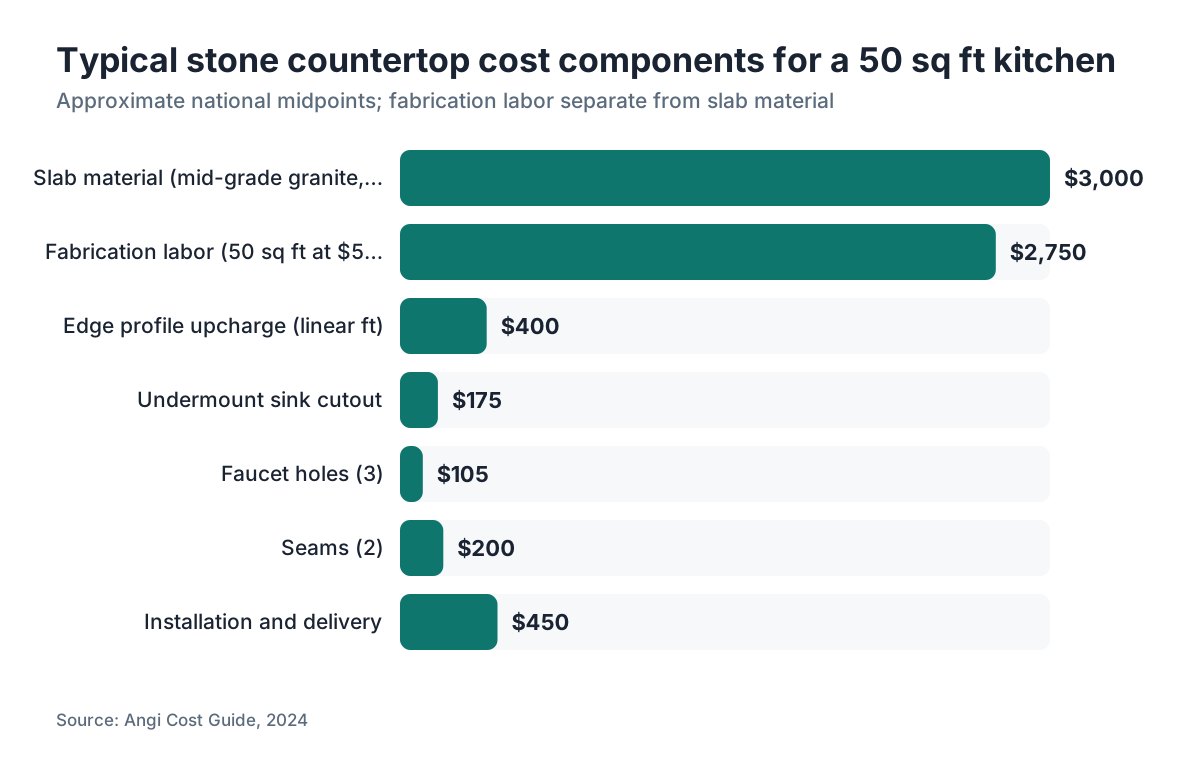
Fabrication cost is almost always quoted separately from slab cost, though some shops bundle them. Nationally, fabrication labor and machine time run roughly $35 to $80 per square foot for standard granite or quartz, before the slab material itself [5]. That range is wide because it covers everything from a basic eased edge on a simple layout to a mitered waterfall edge on a kitchen with six inside corners.
Here's what actually moves the price:
Edge profile. A simple eased or bevel edge is on the low end. A full bullnose costs more because it removes material on both faces. A mitered edge (where two pieces meet at 45 degrees for a thick-slab look) is the most labor-intensive and can add $15 to $30 per linear foot over a standard profile.
Cutouts. Each sink cutout runs $100 to $250 depending on shape. Undermount sinks require a polished reveal on the underside of the stone. Cooktop cutouts are similar. Faucet holes are $20 to $50 each.
Seams. Seams take time, epoxy matched to the stone's color, and careful grinding and polishing. Each seam adds $50 to $150 to the job depending on the shop.
Material. Slab cost is entirely separate and swings a lot. Builder-grade granite might be $20 per square foot wholesale; rare Brazilian quartzite can be $200 or more per square foot [5].
Installation is sometimes quoted separately too; see countertop installation for what that adds and what it involves.
A typical kitchen with roughly 50 square feet of countertop, standard granite, a straight run with one undermount sink, and an eased edge might total $2,500 to $4,500 installed in most markets. A kitchen with premium stone, waterfall edges, and complex geometry can easily reach $10,000 or more.
What separates quality stone fabrication from work that fails?
The differences show up in specific, observable ways. You can check most of them yourself before you sign anything.
Seam quality. A good seam is nearly invisible on a uniform stone and color-matched on a patterned one. The two pieces should be level within a fraction of a millimeter. The epoxy should be the right color. Most of all, the seam should sit where it's structurally sound and visually minimal, not wherever is easiest for the fabricator. Bad seams are visible, feel rough, and eventually collect debris and bacteria.
Edge consistency. Run your hand along the edge profile. It should feel the same from one end to the other. Hand-polished edge sections often show variation that CNC work doesn't, but either method can be done well or badly.
Undermount sink reveals. The polished reveal (the exposed underside of the stone around the sink cutout) should be even all the way around and should carry the same finish level as the top surface.
Overhang support. The Marble Institute of America (now part of the Natural Stone Institute) has long recommended that unsupported granite overhangs not exceed 12 inches without corbel or bracket support, and that 3/4-inch (2 cm) slabs are more vulnerable than 1.25-inch (3 cm) slabs [6]. Shops that skip this guidance save themselves five minutes and might cost you a cracked counter.
Sealer application. Porous stones need sealer before installation. A shop that skips this step or does it wrong leaves the surface unprotected. The Natural Stone Institute publishes care and installation guidance that spells this out [6].
For a general reference on keeping stone clean and protected after install, the how to clean stone countertops guide covers what products work and which ones etch or strip sealers.
How does digital templating change fabrication quality and speed?
Digital templating is the single biggest process change in stone fabrication over the past 15 years. Instead of bending cardboard to the shape of your cabinets and hoping it transfers accurately back at the shop, a technician uses a device like a Proliner (made by Prodim) or a structured-light scanner to capture precise point-cloud data of the space [1]. That data goes straight into nesting and CNC software.
The effect on quality is real. Gaps between stone and wall that used to run 1/4 inch or more now routinely come in under 1/8 inch. That means less caulk, better appearance, and fewer callbacks. For shops, fewer remakes means the job is more profitable.
Speed improves too. A physical template for a medium kitchen takes 45 to 60 minutes to build on-site, and then the template has to physically travel back to the shop before anyone can start layout. A digital template takes 15 to 20 minutes and can be emailed to the shop before the technician is back in the truck.
Some high-volume shops have wired the template data directly into quoting software so pricing and nesting happen almost at the same time. This is exactly the workflow tools like SlabWise are built around: connecting the template geometry to the quote so fabricators can see yield, cost, and margin in real time before they commit to a price.
Still, digital templating doesn't erase human judgment. Someone has to decide where seams go, which part of the slab faces which direction, and whether a cabinet run is level enough to proceed. Technology assists. It doesn't replace experience.
What should homeowners look for in a stone fabrication shop?
You're hiring someone to work with a material that costs hundreds or thousands of dollars and will sit in your kitchen for decades. The stakes are high enough to spend time evaluating the shop.
Go see the shop in person. A shop that won't let you visit is a shop that doesn't want you to see how it works. What you're after isn't gleam, it's organization. Organized shops make fewer mistakes. Stone dust, water, and noise are all normal; chaos and offcuts stacked in random piles are warning signs.
Ask to see seam samples. Any competent shop has demo pieces showing what their seam work looks like. If they can't produce one, that tells you something.
Check for certifications. The Natural Stone Institute runs the Accredited Natural Stone Fabricator program, which puts a shop through an inspection against defined quality standards [6]. It's not everywhere, so don't cross off shops that aren't certified, but certification is a real positive signal.
Ask specifically about overhang support, the sealer they use and when it goes on, and where seams will fall in your kitchen. Good fabricators have immediate, specific answers. Vague answers or obvious annoyance at being asked are red flags.
Check lead times honestly. Most quality stone shops in mid-size markets run 2 to 4 weeks from template to install. If a shop promises installation in 3 days, either they're very slow right now (possible) or they're cutting corners somewhere (also possible).
Get the quote itemized. Slab cost, fabrication labor, edge profile, cutouts, seams, delivery, and installation should each be a line item. A shop that hands you one lump number makes it impossible to compare their price to anyone else's.
How does nesting affect material yield and cost?
Nesting is the process of laying out the cut pieces of a kitchen on the digital picture of the slab before any stone is touched. It sounds simple. It's actually where a lot of money is won or lost, for both the fabricator and the homeowner.
Most residential slabs sell in full or half slabs. A full slab is typically around 55 to 65 square feet for granite, though exotic stones can run larger or smaller [5]. If your kitchen needs 52 square feet, you probably need a full slab. How the pieces nest on that slab decides how much drop (leftover stone) you produce.
A few things that affect nesting efficiency:
Vein matching. For a book-matched look, or even for a consistent vein direction across a peninsula, pieces can't just go anywhere. They have to hold a specific orientation. That constraint cuts nesting flexibility and often raises material waste.
Islands and peninsulas. Wide pieces are harder to nest efficiently. An island top that's 48 inches wide on a slab that's 55 inches wide leaves very little room for other pieces on that slab.
Number of pieces. More pieces means more seams and also more room to maneuver in nesting. Fewer, larger pieces look cleaner but are harder to fit efficiently.
A skilled fabricator using software-assisted nesting can typically hit 85-95% yield on a straightforward kitchen layout [7]. Complex layouts with lots of curves, book-matching requirements, or wide islands might drop to 70% or lower. That wasted stone either lands on the homeowner through a higher slab cost or gets eaten by the shop, depending on how the job was quoted.
For fabricators, nesting is one of the highest-leverage activities in the shop because every point of yield improvement goes straight to margin.
What are standard edge profiles and how do they affect the final look?
Edge profile is one of those choices that seems minor until you're looking at it every day. It changes the visual weight of the counter, the feel under your hand, and the price of the job.
Here's a plain-language breakdown of the most common profiles:
Eased edge. The square edge with the top corners slightly softened. It's the simplest, cleanest, cheapest option. Works in modern and contemporary kitchens without looking like a choice you made to save money.
Bevel edge. A 45-degree chamfer on the top corner. A little more visual interest than eased, still inexpensive.
Bullnose. Fully rounded top (and sometimes both top and bottom, called a full bullnose). Soft, traditional look. Removes more material than eased, so it costs more. Has mostly fallen out of fashion in contemporary design.
Ogee. An S-curve profile, very traditional, tied to older kitchen styles. Labor-intensive and polarizing; it looks dated to some buyers.
Mitered or waterfall edge. Not really an edge profile so much as a construction technique: two pieces of stone meet at a 45-degree angle to create the illusion of a much thicker slab, or to wrap the stone down the side of a cabinet run to the floor. Very modern look, much more expensive because it needs very precise cuts and extra stone.
Laminated edge. A strip of stone is glued to the underside of the countertop front edge to fake a thicker appearance without buying a full thick slab. Cheaper than a waterfall, gets you some of the same visual weight.
Most fabricators offer the first three or four profiles at no upcharge or a small one, and move to higher pricing for ogee, mitered, and waterfall. Ask specifically; pricing varies a lot by shop.
How long does stone countertop fabrication take from template to install?
The honest answer is 10 to 20 business days for most shops under normal conditions, but that range has a lot of variance.
Here's where the time actually goes:
Templating takes a few hours on-site. Digital template processing is fast, often done the same day. Nesting and layout is a few hours of shop time. The actual cutting and edge work on a typical kitchen takes 4 to 8 hours of machine and labor time. Seam work and finishing adds a few more hours. Then there's cure time for any epoxy, quality checking, and scheduling the installation crew.
The bottleneck in most shops isn't machine time. It's scheduling. A busy fabrication shop might have 20 or 30 jobs in process at once. Your job is in queue with all of them. If a machine goes down, if a slab arrives damaged, or if two jobs ahead of yours both need callbacks, your timeline moves.
Some delays are in the homeowner's control: getting final cabinet measurements to the shop before the cabinets are actually level and shimmed in, picking a slab that isn't in stock at the local yard, or changing the edge profile after the job has been templated.
Some aren't: shop backlog, stone supply chain issues (imported granite and quartzite slabs sometimes face shipping delays), and equipment maintenance.
If a contractor tells you stone countertops can be done in 3 days, be skeptical. That timeline is possible if the shop has zero backlog and all material is in hand, but it's not typical. Build two to three weeks into your kitchen renovation timeline for countertops as the realistic buffer.
What do fabrication shops look for when evaluating slab quality at the yard?
Not all slabs are equal, and a good fabricator knows how to read a slab before committing to it. Homeowners who understand this can take part in slab selection intelligently instead of just picking by color.
Fissures vs. cracks. Natural fissures are part of the stone's formation and generally don't affect structural integrity. Actual cracks go all the way through and are a real problem. Run a fingernail across the surface; if it catches, you may have a crack rather than a fissure [3]. A fabricator can sometimes work around a crack with seam placement, but it's a risk.
Mesh backing. Many exotic stones come from the yard with fiberglass mesh epoxied to the back to hold fragile sections together. This isn't bad in itself, but it tells you the slab is fragile and needs careful handling. It also affects how the edges look if the mesh shows on a raw cut edge, which the fabricator has to plan for.
Thickness consistency. Slabs from some quarries vary a lot in thickness from one end to the other. That creates leveling problems during installation. A fabricator should measure at several points.
Resin fills. Most natural stone slabs get filled with clear or tinted resin before they leave the finishing facility. This is normal and accepted in the industry. But poorly matched resin fills, or fills over large voids, can be a problem structurally and visually. Look at the slab under good lighting at an angle.
Color and vein consistency. Slabs are cut from a block, and adjacent slabs from the same block look similar but not identical. If you need two slabs for a large kitchen, try to get them from the same block (they'll share lot numbers at the yard).
For kitchen countertops projects specifically, seeing slabs in person at the yard, rather than approving a photo, is almost always worth the trip.
How do fabricators price a job and what's in a fair quote?
A complete, honest stone fabrication quote should have these line items:
| Line item | What it covers | Typical range |
|---|---|---|
| Slab material | Cost of the raw stone, per square foot | $20-$200+/sq ft |
| Fabrication labor | Cutting, edging, finishing | $35-$80/sq ft |
| Edge profile | Upcharge above standard eased | $0-$30+/lin ft |
| Sink cutout | Each undermount or drop-in cutout | $100-$250 |
| Faucet holes | Per hole | $20-$50 |
| Cooktop cutout | Per cutout | $100-$200 |
| Seams | Per seam, labor only | $50-$150 |
| Delivery | Varies by distance | $0-$200 |
| Installation | Setting, shimming, silicone | $200-$600 |
These ranges are national approximations; urban markets on the coasts run 20-40% higher than rural markets [5].
A quote that bundles everything into one number isn't necessarily dishonest, but it makes comparison shopping nearly impossible. Push for itemization. If a shop refuses, that tells you something about how they handle the rest of the relationship.
Also watch for what isn't in the quote: haul-away of old countertops, plumber disconnect and reconnect for the sink, and any countertop support modifications. These are often handled by other trades and can add $150 to $500 to a project.
Fabricators who use modern quoting software can turn around a detailed written quote much faster than shops still working off spreadsheets or paper. For fabricators trying to tighten up their quoting process, shop management platforms like SlabWise handle nesting, material costing, and quote generation in one place, which matters when you're trying to price a job accurately in 20 minutes instead of two hours.
What are the most common fabrication mistakes and how do you spot them before installation?
Some fabrication mistakes show up immediately. Others don't become obvious for months. Here's what to look for.
Wrong seam placement. Seams should not run through the center of a sink cutout, over a dishwasher (a high-vibration area), or across the middle of a highly visible flat run of counter. If the fabricator's proposed seam placement bothers you, say so before cutting starts. After, it's too late.
Uneven reveal on undermount sinks. This is one of the most common complaints. The reveal should be consistent all the way around the sink opening. If it's wider on one side, the layout was off.
Color-mismatched epoxy. The epoxy used in seams, sink reveals, and any filled voids should match the stone closely. Shops that only stock a few generic colors produce visible seams that didn't need to be visible.
Edge profile inconsistency. Check the full run of edge. On a long counter, the profile depth can drift slightly. This is more common on hand-finished sections than on CNC work.
Countertop not level. The countertop should be shimmed to level, more than set on whatever surface the cabinets present. Unlevel countertops create drainage problems at the sink and look bad.
Inadequate caulking at backsplash. The joint between countertop and tile or wall should be filled with flexible silicone, not grout. Grout cracks as the house moves. This isn't strictly a fabrication error, but it happens during installation and the fabricator is often on the hook for it.
No sealer on porous stone. Ask to see the sealer product used and when it was applied. On marble and granite, sealer should go on before installation, typically at the shop or right before install [6]. Stone that wasn't sealed shows staining faster and needs more maintenance.
Frequently asked questions
What does a stone fabrication shop actually do?
A stone fabrication shop takes raw stone slabs and turns them into finished countertops. The process covers measuring (templating), layout and nesting on the slab, cutting on a bridge saw or waterjet, edge profiling on a CNC machine, cutouts for sinks and cooktops, surface finishing, and installation. Most shops handle all of this in-house, though some outsource installation to a separate crew.
How much does stone fabrication cost per square foot in 2025?
Fabrication labor, separate from the slab material cost, typically runs $35 to $80 per square foot nationally. Simple layouts with standard edges sit at the low end; complex jobs with mitered edges, multiple cutouts, and book-matched stone hit the high end. Add $20 to $200 or more per square foot for the slab itself, depending on the material. Urban coastal markets run 20-40% higher than rural areas.
What is the difference between natural stone and engineered quartz fabrication?
Natural stone (granite, marble, quartzite, soapstone) comes from quarries and has variable mineral structure, fissures, and porosity that require sealing. Engineered quartz is manufactured from crushed quartz and resin, very consistent, needs no sealing, but can't tolerate sustained heat. The cutting and edging equipment is similar, but blade speeds, tooling wear rates, and edge finishing techniques differ between the two material types.
How long does stone fabrication take from start to installation?
Most shops complete a residential kitchen in 10 to 20 business days from template to installation under normal conditions. The bottleneck is usually shop scheduling, not machine time. Cutting and finishing a typical kitchen takes 4 to 8 hours of actual shop time. Allow 2 to 3 weeks in your renovation timeline to be safe, more if you're working with a premium shop that has a long backlog.
What is digital templating and is it better than traditional cardboard templates?
Digital templating uses a laser or structured-light device to capture the exact geometry of your cabinet run as a point-cloud file. That file goes straight into CNC cutting software. It's faster than cardboard (15-20 minutes vs 45-60 minutes on-site), more accurate (gaps routinely under 1/8 inch vs 1/4 inch or more), and reduces callbacks from fit errors. Nearly all quality shops have made the switch in the last decade.
What is nesting in stone fabrication?
Nesting is the process of digitally arranging the cut pieces of a countertop job on the stone slab before any cutting begins. The goal is to maximize material yield (minimize waste) while respecting vein direction and keeping seams out of bad spots. Good nesting saves material cost. On a typical kitchen, a skilled fabricator can achieve 85-95% yield on straightforward layouts using software-assisted nesting.
What edge profiles are most popular for stone countertops?
Eased edges (square with softened corners) dominate contemporary kitchens and cost the least. Bevel adds a chamfer at a small upcharge. Bullnose is fully rounded and traditional. Mitered and waterfall edges are the most expensive, requiring 45-degree cuts and much more material. Ogee profiles are highly traditional and mostly out of fashion. Profile choice affects both the price and resale perception of the kitchen.
Does stone need to be sealed before or after installation?
Porous natural stones like marble and granite should be sealed before installation, ideally at the shop. Sealing at this stage is easier because the stone can be reached from all sides. Most fabricators apply one coat; some homeowners add a second coat after installation. Engineered quartz does not need sealing. Quartzite varies: some varieties are very porous, others are quite dense.
How do I know if a stone fabrication seam is good quality?
A quality seam should be nearly invisible on uniform stone and color-matched on patterned stone. Run your finger across it: it should feel level, with no lip between the two pieces. The epoxy filler should match the stone color closely, not stand out as a contrasting line. The seam should not sit over high-vibration areas like dishwashers or run through the center of sink cutouts.
What certifications should a stone fabrication shop have?
The Natural Stone Institute runs the Accredited Natural Stone Fabricator program, which puts a shop through an on-site inspection against defined quality and process standards. It's meaningful but not universal; many excellent shops don't have it, and some certified shops still produce mediocre work. Treat it as a positive signal, not the only signal. Seeing the shop in person and reviewing their seam samples matters more.
What is the difference between a waterjet and a bridge saw for cutting stone?
A bridge saw uses a rotating diamond blade and is the standard in most stone shops. It's fast, reliable, and excellent for straight cuts. A waterjet uses high-pressure water mixed with garnet abrasive to cut stone without heat or blade contact, making it better for brittle materials, curved cuts, and detailed shapes. Many shops have both; waterjets cost more to run but give you more flexibility.
How much overhang can a stone countertop have without support?
The Natural Stone Institute recommends that unsupported overhangs on 3/4-inch (2 cm) stone not exceed 6 inches, and on 1.25-inch (3 cm) stone not exceed 12 inches. Beyond those limits, corbels or brackets are needed. Thinner slabs crack more easily under unsupported weight. Bar-height overhangs for seating almost always need brackets regardless of slab thickness.
Can a homeowner visit the fabrication shop to approve work before installation?
Yes, and with expensive stone you should ask for this. Most reputable shops welcome a pre-installation check, where you can see the seam placement, verify the edge profile, check the sink cutout reveal, and confirm the stone piece orientation before anything gets loaded on the truck. Not all shops offer this proactively; ask when you place the order. It's much cheaper to fix a problem at the shop than after installation.
What questions should I ask a stone fabrication shop before hiring them?
Ask to see recent seam samples. Ask where seams will fall in your specific kitchen and why. Ask what sealer they use and when it's applied. Ask about overhang support requirements for your layout. Ask for an itemized quote. Ask whether they do digital templating. Ask their current lead time. Good fabricators answer these questions specifically and quickly; vague or defensive answers are a warning sign.
Sources
- OSHA, Waterjet Cutting Safety and Operations: Waterjet cutting uses high-pressure water mixed with abrasive garnet to cut materials without heat or mechanical stress, relevant to brittle stone materials.
- Natural Stone Institute, Technical Manual for Natural Stone: Marble rates roughly 3-4 on the Mohs hardness scale and is susceptible to etching from acidic substances; granite rates 6-7 and is significantly harder.
- Cambria Company, Product Composition FAQ: Engineered quartz countertops like Cambria are manufactured from approximately 90-94% natural quartz bound in polymer resin and require no sealing.
- HomeAdvisor (Angi), Countertop Installation Cost Guide 2024: National fabrication labor costs run approximately $35-$80 per square foot; slab costs range from $20 for builder granite to $200 or more for exotic quartzite; full slabs average 55-65 square feet.
- Natural Stone Institute, Accredited Fabricator Program and Installation Standards: The Natural Stone Institute recommends unsupported granite overhangs not exceed 12 inches for 3 cm slabs and publishes guidelines on sealer application and shop certification through the Accredited Natural Stone Fabricator program.
- Slipstream Software, Stone Fabrication Nesting Yield Analysis: Software-assisted nesting on straightforward residential kitchen layouts typically achieves 85-95% material yield; complex layouts with wide pieces or vein-matching requirements can drop to 70% or lower.
- U.S. Bureau of Labor Statistics, Construction and Extraction Occupations Wages 2023: Labor cost data for tile and stone finishers supports the fabrication labor cost ranges cited in this article.
- U.S. Geological Survey, Mineral Commodity Summaries: Stone, Dimension 2024: USGS tracks domestic dimension stone production, quarry output, and import volumes relevant to slab pricing and supply chain conditions.
- EPA, Silica Dust Exposure and OSHA Permissible Exposure Limits for Stone Fabrication: Stone cutting and finishing generates silica dust; OSHA PEL for respirable crystalline silica is 50 micrograms per cubic meter as an 8-hour TWA, directly relevant to stone fabrication shop safety requirements.
- OSHA, Silica in the Workplace: Countertop Manufacturing: OSHA has identified engineered stone countertop fabrication as a high-risk silica dust exposure environment, publishing specific guidance for fabrication shops.
Last updated 2026-07-11