TL;DR
- Stone tech fabrication covers the machines, software, and processes a modern countertop shop uses to turn raw slabs into finished countertops.
- Key steps are digital templating, CNC sawing, waterjet or CNC router shaping, edge polishing, and installation.
- Lead times run 5 to 14 days for most residential jobs.
- Material costs range from about $40 to $200 per square foot installed, depending on stone choice and edge complexity.
What is stone tech fabrication and why does it matter to buyers?
Stone tech fabrication is the full production chain a shop uses to convert a raw stone slab into an installed countertop. It starts the moment a templater walks into your kitchen and ends when the installers level the last section and silicone the seams.
The word "tech" isn't marketing. Over the past two decades, the countertop industry moved from hand-guided saws and angle grinders to laser digital templating, CNC bridge saws, waterjet cutters, and robotic edge polishing lines. That shift changed lead times, tolerances, and labor costs, and those changes land in your quote whether you notice them or not.
For homeowners, understanding the process means you know what questions to ask, why the shop needs exact cabinet measurements before cutting, and why a $35-per-square-foot quote probably skips steps that a $95 quote includes. For fabricators, it means knowing which machines pay off and which ones sit idle collecting dust.
A well-equipped residential stone fab shop in 2025 runs at least one CNC bridge saw, a waterjet or CNC router for cutouts and radius work, an automated or semi-automated edge polisher, and digital templating devices. Shops without CNC gear still exist. Their tolerances and throughput rarely keep up on volume residential work.
What machines does a modern stone fabrication shop actually use?
The core equipment list has stayed fairly consistent since roughly 2010, but the machines got much better at their jobs. Here is what you find in a well-run shop.
CNC bridge saw. This is the workhorse. A bridge saw carries a diamond blade on a moving gantry and cuts slabs to dimension. Older manual bridge saws needed an operator guiding every cut. Modern CNC versions take a DXF file from the templating software, run the cut automatically, and can miter edges in the same pass on machines with tilting heads. Entry-level CNC bridge saws run roughly $80,000 to $150,000 new. High-end Italian or Spanish machines (Comandulli, Intermac, Park Industries) can reach $400,000 or more [1].
Waterjet cutter. Waterjets use a high-pressure stream of water mixed with abrasive garnet to cut stone without a blade. They handle tight inside radii, sink cutouts, and decorative inlays that a blade cannot. A 5-axis waterjet adds bevel cuts and compound angles. Waterjet systems start around $100,000 and scale up from there [2].
CNC router / machining center. Some shops prefer a CNC router for sink cutouts and shaping over a waterjet, especially on engineered stone where the cut edge doesn't show as much. Routers are faster on straight cuts and cheaper to run per part than waterjets. Waterjets win on radiused cuts in hard stone.
Automated edge polisher. Edge finishing used to be all hand work with an angle grinder and a series of diamond pads. Automated edge polishers (conveyor-style or CNC spindle machines) handle standard profiles like eased, bevel, bullnose, and ogee at consistent quality across a full run. Hand work still finishes complex profiles and cleans up machine marks.
Digital templating device. Laser templating tools (LT-55, Proliner, or similar) map a job site in minutes and produce a digital file the shop imports straight into fabrication software. That file drives the CNC saw and catches cabinet irregularities before the slab is cut. Templating hardware runs $15,000 to $60,000 depending on brand and features [3].
Overhead crane and vacuum lifters. A full slab of granite or quartzite can weigh 700 to 1,100 pounds. Every shop that handles full slabs needs overhead lifting equipment and vacuum pad systems to move stone safely. This is unglamorous. The injury and breakage rate in shops without proper lifting gear is high enough to change your mind about skipping it.
For kitchen countertops specifically, the combination of CNC sawing and waterjet cutouts is the most common production path in 2025.
How does digital templating work and why does it beat manual measuring?
Digital templating uses a laser device or a structured-light scanner to capture the exact geometry of your cabinet tops, walls, and existing features, then exports a file the shop cuts from. It beats manual measuring because it holds tolerances to about 1 mm and removes the transcription errors that pile up when a human copies a cardboard template onto stone.
Manual templating means a tech builds a physical template on-site from luan (thin plywood strips) or cardboard, carries it back to the shop, and traces it onto the slab. It works. But it introduces human error at every transfer step, and the template is a one-time-use physical object.
The digital device stores measurements accurate to about 1 mm or better, and the tech exports a DXF or proprietary file on-site [3]. Back at the shop, that file loads directly into the nesting or CAD software.
The practical difference is easy to picture. A manual template might put the sink cutout 3/8 inch off center once you account for template flex and copy error. A digital template holds that cutout to within 1 to 2 mm across the whole job. On a large island with a farmhouse sink, that accuracy keeps the installer from shimming or re-cutting on-site.
Digital templating also speeds the schedule. The templater can leave the job site and the shop has a cuttable file within hours, sometimes the same afternoon. Manual templates require a shop visit to trace and digitize, which adds a day or two.
The downside is equipment cost and the training time to run the device well. A junior templater with a laser device can still produce a bad file by missing a wall angle or forgetting to account for a 1/4-inch tile lip. The technology reduces error. It doesn't replace a careful operator.
What does a stone fabrication shop charge, and what drives the price?
Fabrication pricing runs two main ways: price per square foot (most common for residential) or price per piece (more common for commercial or very complex jobs). The per-square-foot number covers stone material, cutting, edge work, and installation. It usually leaves out the sink, faucet, and demolition of your old tops.
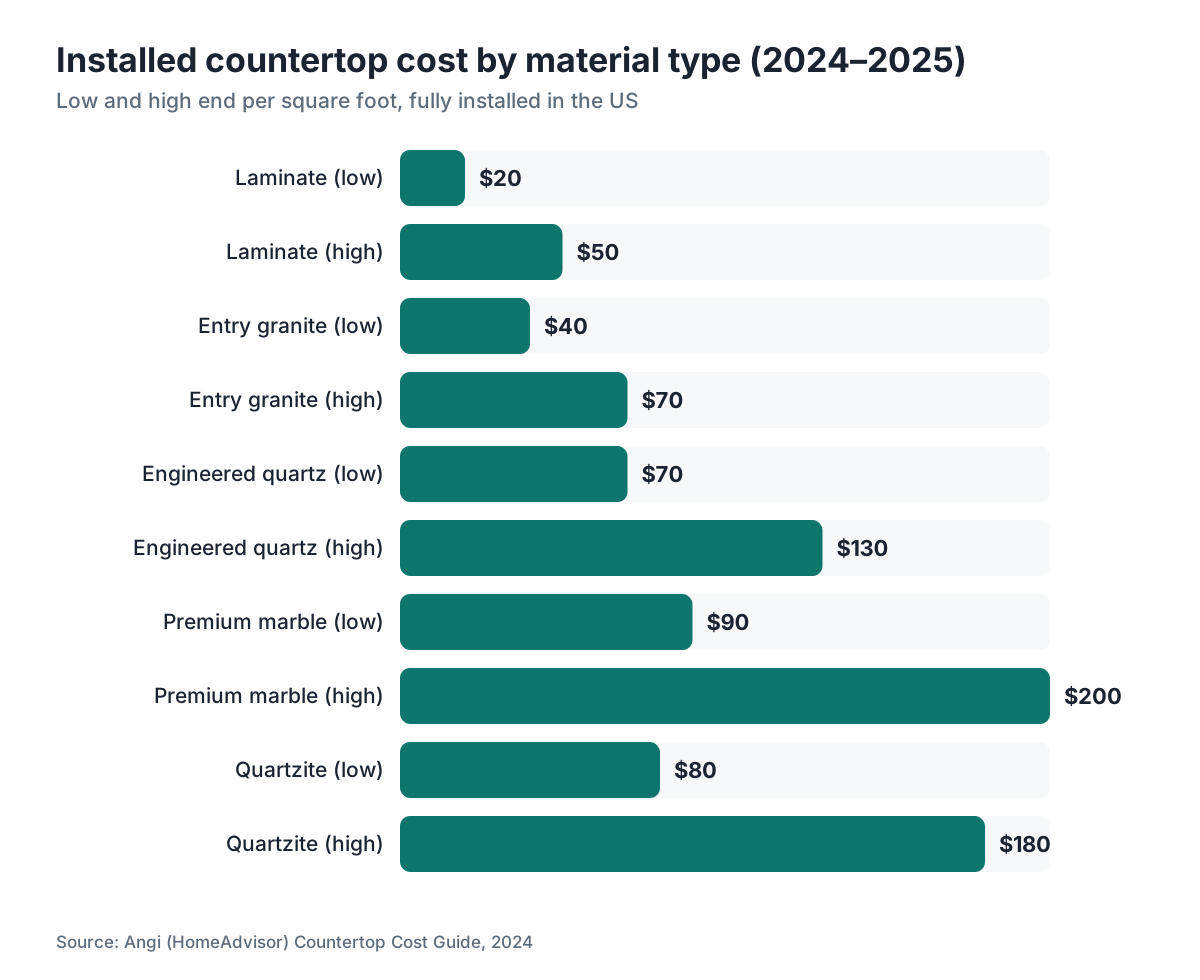
Here is a realistic cost range by material type, installed, in the United States as of 2024 to 2025 [4]:
| Material | Low end ($/sq ft installed) | High end ($/sq ft installed) |
|---|---|---|
| Laminate (shop-fabricated) | $20 | $50 |
| Entry granite | $40 | $70 |
| Mid-grade granite | $65 | $110 |
| Engineered quartz | $70 | $130 |
| Premium marble | $90 | $200 |
| Quartzite | $80 | $180 |
| Soapstone | $70 | $150 |
Several things move the price besides material. Edge profile complexity matters a lot. An eased edge might cost $10 to $18 per linear foot while a double ogee or mitered waterfall edge can run $40 to $80 per linear foot or more, depending on the shop [4]. Sink cutouts typically add $100 to $200 each. Cooktop cutouts and faucet holes add similar amounts.
Shop location sets overhead, and overhead shows up in quotes. A fabrication shop in a high-rent metro (think northern New Jersey, suburban Chicago, or coastal California) will generally quote $15 to $25 per square foot higher than a comparable shop in a lower-cost region, assuming similar machine quality and stone source.
The Trenton, NJ area shows this geography well. Shops in Mercer County and Burlington County serve both the Philadelphia and New York markets, which creates competitive pricing pressure but also means they pay northeastern labor and real estate costs. Stone tech fabrication in Trenton and the surrounding corridor tends to price in the mid-to-upper range for granite and quartz, reflecting both the demand and the input costs [11].
For granite countertops specifically, the material cost spread is wide enough that two shops quoting "granite" can land $40 per square foot apart simply because one is quoting a Level 1 imported granite and the other a Level 4 Brazilian exotic.
Want to skip the phone tag and get a real number fast? Fabrication software like SlabWise generates instant quotes from your measurements and material choice, so you see the full breakdown before you ever call a shop.
What is the typical timeline from template to install?
Most residential countertop jobs run 5 to 14 calendar days from template to install. The clock starts after you sign a contract and your cabinets are in place and level. Three stages fill that window: template, fabrication, and installation.
Digital templating usually takes 30 to 90 minutes on-site for a standard kitchen. The shop then needs time to program the cuts, nest the pieces onto the slab to cut waste, run the CNC saw, do edge work, and quality-check the finished pieces.
A well-run shop with full CNC equipment can fabricate a standard kitchen (30 to 60 square feet) in one to two production days once the file is programmed. But shops run several jobs at once, and scheduling decides when your job hits the floor. Most residential shops quote 5 to 14 calendar days from template to install [5].
Delays happen for a few reasons. Stone that has to be special-ordered from a distributor adds transit time, sometimes 1 to 3 weeks if it comes from overseas. Complex jobs with mitered edges, waterfall sides, or tight radius work take longer in fabrication. And install crew scheduling in a busy market can push a job out even when fabrication is done.
A shop with a backlog (which is most busy shops in spring and summer) may quote 2 to 3 weeks as a realistic number. Ask the shop what their current lead time is at the moment you sign, not what the marketing page says.
How does CNC nesting software affect slab yield and job cost?
Nesting is how the shop arranges the cut pieces from a job (or several jobs) onto a slab to leave the least leftover stone. Better nesting means less waste, which lowers material cost per job or improves the shop's margin. Every slab has a fixed area and the shop pays for all of it, used or not.
Manual nesting on paper or a basic CAD layout leaves 20 to 35 percent of a slab as waste on typical residential jobs, depending on how irregular the pieces are [6]. Automated nesting software takes the templated DXF files and computes the optimal layout algorithmically, which usually trims remnant waste to 15 to 25 percent on the same work. On an $800 slab, that difference is $80 to $160 in recovered material.
Nesting also sets seam placement. Good nesting software lets the shop see where seams will fall before cutting, so the fabricator can drop a seam somewhere less visible (under the sink front, at an inside corner) instead of straight across the center of an island.
For fabricators chasing quote accuracy, nesting ties directly into pricing. Quote before you nest and you may under- or over-price the stone. Shops that nest before quoting, or use software that folds the two steps together, give more accurate quotes and lose money on material far less often.
SlabWise is built around exactly this workflow: the quote and the nest share the same measurements, so the number you hand a customer matches what you actually cut.
What edge profiles can a stone shop produce and which ones cost more?
The edge profile is the shape machined onto the front face of the countertop. It changes both the look and the price. Shops make profiles on an automated polisher (for standard shapes), a CNC machining center, or by hand.
Common profiles and their relative cost:
Eased edge (straight with a slight soften): The default. Lowest cost. Automated polisher handles it fast.
Bevel: One angled face. Similar cost to eased, slightly more polishing time.
Bullnose (full or half): Rounded top. Very common. Automated lines run it well.
Ogee: An S-curve. Needs a shaped wheel or CNC spindle. Costs more than bullnose, typically $5 to $15 per linear foot more depending on the shop.
Double ogee: Two S-curves stacked. Hand finishing usually blends the transitions. Premium pricing.
Mitered edge (for waterfall islands): The top surface and a vertical panel get cut at 45 degrees and bonded, faking the look of a thick slab. Labor heavy, needs precise CNC cuts, and adds real cost. A waterfall island can add $600 to $2,000 to a project [4].
For marble countertops, edge choice also affects maintenance: a more detailed profile has more surface area to soak up staining liquids along the edge grain, which matters on a porous stone.
For cambria countertops and other engineered quartz products, edge profiles cover the same range, but the non-porous surface means maintenance worries stay minimal no matter how complex the profile.
How does stone fabrication differ for granite vs. quartz vs. quartzite?
The fabrication process is broadly similar across materials, but each stone has properties that change how a shop handles it.
Granite is hard and brittle. Cutting needs sharp diamond tooling. Granite's crystalline structure means thin spans (overhangs or bridging sections) can crack along crystal boundaries without proper support. Most fabricators recommend no more than 10 to 12 inches of unsupported overhang on granite without added corbel or bracket support [7]. Granite takes an excellent polish and keeps it.
Engineered quartz (Cambria, Silestone, Caesarstone) is consistent all the way through the slab, which makes CNC programming predictable. No natural grain or vein to plan around. The resin binder means the shop runs slightly different blade speeds than with natural stone. Quartz is denser and heavier per square foot than most granites.
Quartzite gets confused with quartz because of the name, but it is a natural metamorphic rock, not an engineered product. It is one of the hardest natural stones a shop will cut, so it wears blades and tooling faster. Some quartzite varieties carry heavy natural veining that fabricators must orient carefully to match across seams. For care requirements, see the how to clean quartzite countertops guide.
Marble is softer than granite or quartzite and cuts more easily, but it scratches and etches from acids. The fabrication process is similar. Shops take more care polishing marble because it shows swirl marks easily, and edge finishing takes more hand time for a clean result.
Soapstone is very soft next to other natural stones, with a Mohs hardness around 1 to 2 compared to granite at 6 to 7 [8]. It cuts fast but nicks easily during handling. Most soapstone fabricators reach for routers rather than waterjet on this material. For maintenance guidance, see how to clean soapstone countertops.
For general stone care after installation, how to clean stone countertops covers the shared principles across material types.
What should homeowners look for when choosing a stone fabrication shop?
Equipment matters, but it isn't everything. A shop with a $300,000 CNC bridge saw and undertrained operators will turn out worse work than a careful manual shop. Here is what to actually check.
Visit the shop. A clean, organized shop floor is a signal. Slab storage should be A-frame racks, not slabs leaning against walls. If the finished piece area looks dusty and cluttered, that is how your countertops get treated before delivery.
Ask about their templating process. Digital templating is standard in most metro markets now. If a shop still uses only paper or cardboard templates, ask whether their tolerances have caused fit problems. Not a disqualifier, but worth knowing.
Ask for references on jobs of similar complexity. A shop that does mostly commercial flat-cut work may not have strong experience on residential kitchens with complex islands, farm sinks, or radius corners.
Get a written quote with line items. Edge profile cost, sink cutout cost, delivery and install fee, and sealing should all sit on their own lines. Vague per-square-foot quotes that say "everything included" tend to hide surprises at invoice time.
Check their seam policy. Ask where seams will fall and how they set them. Seam color-matching with epoxy tinted to the stone is standard practice. Ask to see a recent seam in a finished sample or showroom piece.
Ask about remnants. If your job leaves a usable remnant from the slab you bought, some shops return it or credit it toward future work. Others keep every remnant. This is negotiable and worth raising upfront.
For homeowners weighing alternatives alongside stone, laminate countertops, formica countertops, and corian countertops all involve different fabrication processes and different shops. A dedicated stone fab shop usually won't fabricate laminate or Corian, and vice versa.
What are common fabrication defects and how do shops catch them?
No production process is perfect, and stone fabrication has its failure modes. Knowing them helps you inspect your installation with a sharper eye.
Seam gaps. A gap wider than 1/16 inch at a seam usually means the two pieces weren't cut to the same angle, or the epoxy went on before the edges were perfectly aligned. Acceptable seam visibility is a matter of shop quality standards. Some shops get nearly invisible seams on consistent stone.
Chipping at cutouts. Sink and cooktop cutouts are stress points. A dull blade or a too-aggressive feed rate can chip the underside of the cutout. Most chips are on the underside and hidden by the sink rim, but a top-surface chip is a defect that warrants a recut.
Edge profile inconsistency. On long runs, an automated polisher can lose pressure at the start or end of a pass, leaving the profile slightly off at the ends. A careful quality check before the piece leaves the shop catches it.
Slab breakage during transport. Thin sections (a peninsula overhang cut as a separate piece) can crack in transit if the truck isn't padded properly. Any shop doing long overhangs or thin accent pieces should transport them flat, not vertical.
Quality-focused shops dry-fit all pieces before finishing, catching fit problems before the stone is polished. Ask your shop if they do this.
For the installation itself, see countertop installation for what happens the day the crew arrives.
How is stone fabrication evolving, and what comes next?
The dominant trend is tighter integration between the job site, the office, and the shop floor. Ten years ago, a template might take two days to become a shop drawing. Today, a digital template converts to CNC-ready files in under an hour at a well-run shop.
Robotics is moving into edge polishing. Robotic polishing arms (BACA Systems, for one, has systems starting around $200,000 to $400,000) handle profiles that used to need hand work, at more consistent quality and lower per-piece labor cost [9]. These systems make sense for shops running high volume. They are hard to justify for a shop doing fewer than 20 kitchens a month.
Artificial intelligence is starting to show up in nesting and quoting. Some fabrication software now uses machine learning to sharpen nesting efficiency over time, learning the shop's typical job mix and remnant inventory. The gains are real but modest: a 2 to 5 percent yield improvement on top of already-optimized algorithmic nesting [6].
Material supply chains are changing too. Large-format slabs (bigger than 120 x 60 inches, sometimes called "jumbo" or "maxi" slabs) are becoming more common, especially from Brazilian and Indian suppliers. Big slabs cut seams on large islands but demand equipment with more travel and heavier-duty lifting, which not every shop has.
On the materials side, sintered stone (Dekton, Neolith) keeps taking market share. Sintered panels are extremely hard and need diamond tooling matched specifically to the material. Shops that fabricate sintered stone keep dedicated blade and router bit inventories separate from their natural stone tooling [10].
The fundamentals of cutting, shaping, and polishing stone are not going to change. What changes is how much of that work runs automated versus hand-guided, and how tightly the digital workflow ties every step together, from a customer's first measurement to the final install.
Frequently asked questions
How long does stone countertop fabrication take from start to finish?
Most residential jobs take 5 to 14 calendar days from digital templating to installation. The templating appointment itself takes 30 to 90 minutes on site. Fabrication for a standard kitchen runs 1 to 2 production days, but shop scheduling and slab availability determine when your job actually gets cut. Special-order stone can add 1 to 3 weeks.
What is the difference between a waterjet and a CNC saw in stone fabrication?
A CNC bridge saw uses a rotating diamond blade to make straight and angled cuts. A waterjet uses a high-pressure water and abrasive stream to cut any shape, including tight inside curves and complex inlays. Most shops use both: the bridge saw for primary dimensioning and the waterjet for sink cutouts, radius corners, and detailed shapes a blade cannot handle cleanly.
Does stone tech fabrication in Trenton NJ cost more than the national average?
The Trenton and central New Jersey corridor sits in a higher-cost labor and real estate market than much of the country. Shops in Mercer and Burlington Counties serving both Philadelphia and New York area customers typically quote at the upper end of mid-range pricing, roughly $65 to $130 per square foot installed for granite and quartz. You can find lower quotes, but verify what is included.
What questions should I ask a stone fabrication shop before signing a contract?
Ask how they template (digital or manual), where seams will fall, what the edge profile cost is per linear foot, whether the install and delivery fee is included, and what their policy is on remnant pieces. Also ask for their current lead time at signing rather than their advertised lead time. Get all of this in writing with line-item pricing.
Can a stone fabrication shop cut any shape, or are there limits?
A shop with a waterjet or 5-axis CNC can cut virtually any 2D shape, including tight curves, letters, and decorative cutouts. The practical limits are minimum thickness (very thin sections can crack), minimum inside radius (most shops hold to at least 3/4 inch inside radius on hard stone), and the time cost, which gets passed along to you on complex shapes.
What does a stone fabrication shop do with leftover slab material?
Remnants become inventory that the shop can sell separately, usually at a discount, for small projects like bathroom vanities, laundry rooms, or outdoor bars. Some shops credit a portion of the remnant value back to the customer. Others keep all remnants as part of their standard contract. Ask before you sign if you have a follow-on project in mind.
How thick are standard stone countertop slabs and how does thickness affect fabrication?
Standard residential countertops use 3 cm (about 1.25 inch) slabs for most natural stone and engineered quartz. Some shops offer 2 cm slabs for lighter applications like vertical surfaces or thin profiles. Thicker slabs (4 to 6 cm, sometimes called laminated edges) are built by bonding two 2 cm pieces face to face at the edge, not from a single thick slab. Thickness affects blade depth settings and support requirements.
Is sintered stone harder to fabricate than granite?
Yes. Sintered stone like Dekton or Neolith is among the hardest materials a shop will cut, roughly equivalent to or harder than the hardest quartzite. It wears diamond tooling faster and requires specific blade and router bit formulations designed for ultra-compact surfaces. Shops that fabricate sintered stone regularly keep a separate tooling inventory from their natural stone blades.
What is the standard seam gap for stone countertops?
Industry practice puts the acceptable seam gap at 1/16 inch or less, filled with color-matched epoxy. Tighter is better: many high-end shops aim for nearly invisible seams on consistent stone. Seams on heavily veined marble or exotic stone will always be more visible because the vein pattern cannot continue perfectly across the joint. Ask to see samples of their seam work before committing.
Do I need to seal stone countertops after fabrication?
Most natural stone (granite, marble, quartzite, soapstone) benefits from sealing before use. Some shops apply a factory seal before delivery; others leave it to the homeowner. Engineered quartz does not need sealing because the resin binder makes it non-porous. Sintered stone also does not need sealing. Ask your shop what they apply and when you should re-seal, typically every 1 to 3 years for porous natural stone.
How do I know if a stone fabrication quote is accurate and complete?
A complete quote lists square footage, price per square foot by material level, edge profile type and linear footage, number of cutouts with individual pricing, delivery and installation fee, any demolition or haul-away charges, and tax. A single-line quote with a total number is incomplete. If something is not listed, ask specifically whether it is included, and get the answer in writing before you sign.
Can stone fabrication shops handle outdoor countertop projects?
Yes, but material choice matters for outdoor use. Granite and soapstone hold up well outdoors. Marble is susceptible to acid rain etching and UV fading over time in direct sun. Engineered quartz manufacturers generally void warranties on outdoor installations because UV exposure degrades the resin binder. Sintered stone is among the best outdoor options because it is UV-stable and nearly impervious to freeze-thaw cycles.
What is a waterfall edge and how much does it cost to fabricate?
A waterfall edge runs the countertop material vertically down the side of a cabinet or island, creating a continuous stone panel from the top surface to the floor. The top and side pieces are mitered at 45 degrees and bonded. Fabrication is labor intensive: precise CNC cuts, careful vein matching on natural stone, and more epoxy work. Expect to add $600 to $2,000 or more over a standard countertop price, depending on panel height and material.
Sources
- Park Industries, CNC Bridge Saw product pages: CNC bridge saw pricing ranges from roughly $80,000 for entry-level to $400,000+ for high-end multi-axis machines
- Flow International Corporation, waterjet cutting systems overview: Industrial waterjet systems for stone start around $100,000 and scale upward based on table size and axis count
- Prodim USA, Proliner digital templating device specifications: Digital templating devices achieve measurement accuracy to approximately 1 mm and export DXF files for CNC use
- HomeAdvisor (Angi), Countertop Installation Cost Guide 2024: Installed countertop costs range from $20/sq ft for laminate to $200+/sq ft for premium natural stone; waterfall edges add $600 to $2,000
- Marble Institute of America (now Natural Stone Institute), Residential Fabrication Best Practices: Standard residential countertop lead times run 5 to 14 calendar days from digital template to installation
- Natural Stone Institute, Slab Yield and Waste Management Technical Bulletin: Manual nesting leaves 20 to 35 percent of a slab as waste; automated nesting software reduces this to 15 to 25 percent on typical residential work
- Natural Stone Institute, Installation Guidelines for Stone Countertops: Most fabricators recommend no more than 10 to 12 inches of unsupported granite overhang without corbel or bracket support
- U.S. Geological Survey, Mineral Resources Program, Soapstone: Soapstone has a Mohs hardness of approximately 1 to 2, compared to granite at 6 to 7
- BACA Systems, robotic stone fabrication equipment overview: Robotic polishing and fabrication systems for stone shops are priced in the $200,000 to $400,000 range
- Cosentino Group, Dekton technical fabrication guide: Sintered stone (Dekton) requires dedicated diamond tooling separate from standard natural stone blades due to extreme hardness
- U.S. Bureau of Labor Statistics, Occupational Employment and Wage Statistics, Tile and Stone Setters: Labor cost data for stone installation trades, used to contextualize regional pricing differences
- U.S. Geological Survey, Mineral Commodity Summaries, Stone (crushed and dimension): Dimension stone production and import statistics that underpin material cost ranges cited for granite and marble
Last updated 2026-07-09