TL;DR
- St.
- Louis has a dense market of stone fabricators, from large production shops to small custom outfits.
- Granite and quartz countertops typically run $55 to $130 per square foot installed in the metro area.
- Get at least three quotes, understand slab yield, and check lead times before you commit.
- Those three moves separate a smooth project from a frustrating one.
What does a stone fabricator actually do?
A stone fabricator is not a supplier and not a general contractor. They sit in between. They buy raw slabs from a stone distributor or broker, cut those slabs to the dimensions your kitchen or bath requires, shape the edges, cut sink and cooktop openings, and install the finished pieces. That full chain, from raw stone to finished countertop bolted to your cabinets, is what separates a fabricator from a tile shop or a big-box installer.
Most fabricators in St. Louis either own their own CNC bridge saw and waterjet equipment or contract out the heavy cutting to a shared production facility. The distinction matters to you as a homeowner. Shops that own their equipment tend to hold tighter tolerances and turn jobs around faster, while shops that outsource cuts sometimes tack on a production lag of four to ten days [1].
Fabrication also includes templating, which is the step where a tech comes to your home, measures your exact cabinet layout, accounts for any walls that are out of square, and produces either a physical template or a digital file. Good templating is where bad surprises get caught early. Rushed or skipped templating is where they happen at installation.
How many stone fabricators are in the St. Louis area?
The St. Louis metro spans Missouri and Illinois counties including St. Louis City, St. Louis County, St. Charles County, and Madison and St. Clair counties on the Illinois side. It supports somewhere between 30 and 60 active stone fabrication businesses, depending on how you count shops that also do tile or solid surface [2]. That range is wide because the industry has no formal licensing registry in Missouri. Anyone can open a fabrication shop.
The market roughly breaks into three tiers. Large production shops, some doing 50 or more kitchens a week, often supply builder-grade projects and big-box retailers like Home Depot and Lowe's. Mid-size independent shops handle custom residential and commercial work, usually with lead times of one to three weeks. Small custom shops, sometimes one or two people with a single saw, focus on specialty stones, unusual edge profiles, and clients who want someone who will actually answer the phone.
For most homeowners doing a standard kitchen remodel, mid-size independent shops tend to hit the best balance of price, lead time, and attention. Large shops can be cheaper, but they can also make you feel like a ticket number. Small shops are sometimes outstanding and sometimes one illness away from blowing your schedule.
What do countertops cost from St. Louis fabricators?
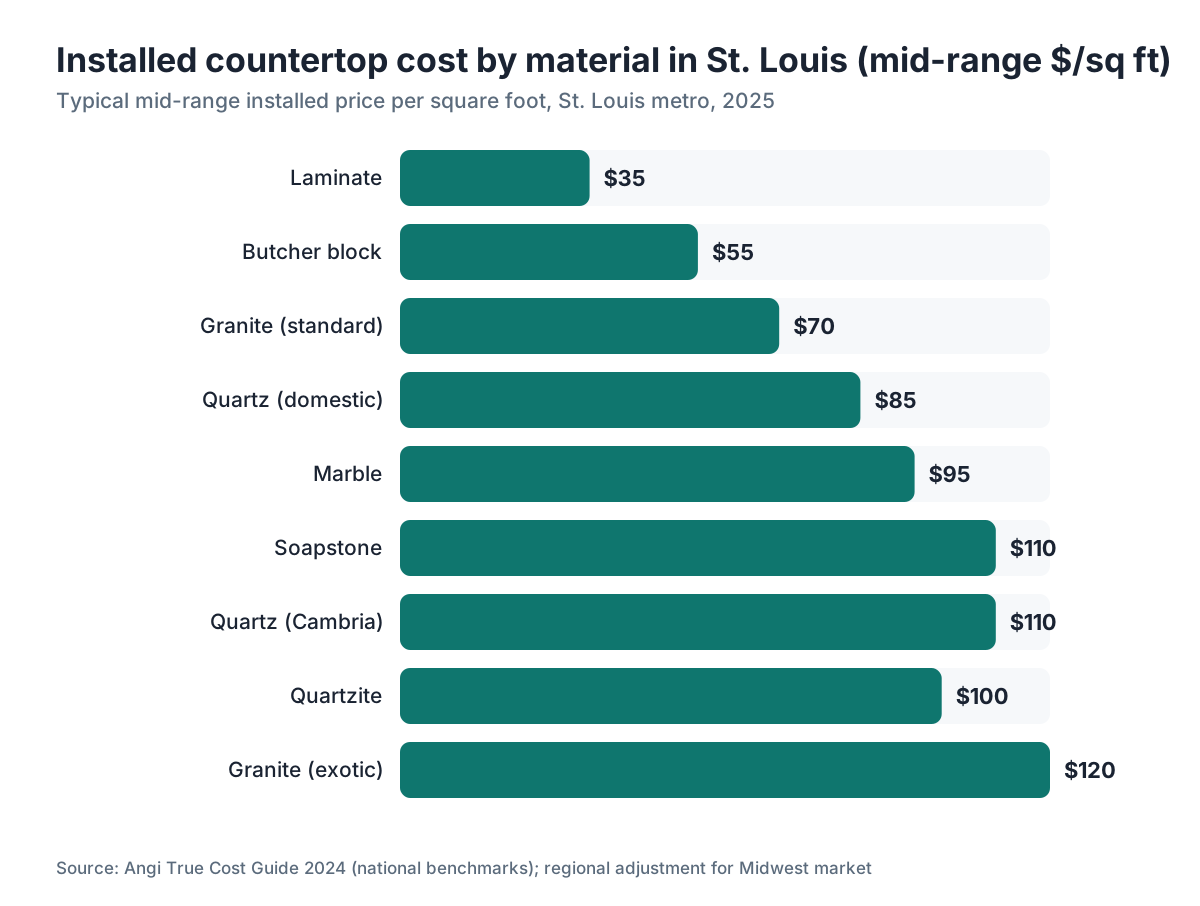
Prices in the St. Louis market as of 2025 generally fall in these ranges for common materials, fully installed (fabrication, edge profile, and basic installation included, minus any unusual structural work):
| Material | Low end ($/sq ft) | Typical mid-range ($/sq ft) | High end ($/sq ft) |
|---|---|---|---|
| Granite (standard colors) | $50 | $70 | $110 |
| Granite (exotic slabs) | $80 | $120 | $180+ |
| Quartz (domestic brands) | $60 | $85 | $120 |
| Quartz (premium, e.g. Cambria) | $90 | $110 | $150 |
| Quartzite (natural) | $75 | $100 | $160+ |
| Marble (entry level) | $65 | $95 | $140 |
| Soapstone | $80 | $110 | $145 |
| Laminate (fabricated) | $20 | $35 | $55 |
| Butcher block | $30 | $55 | $90 |
These numbers reflect what actual Midwest fabricators are quoting, not national averages, which tend to skew toward coastal markets [3]. Missouri has no sales tax exemption for residential construction materials, so expect sales tax on top of the quoted figures [10].
A standard kitchen of roughly 45 square feet of countertop, which is close to the national average kitchen size, runs about $2,500 to $5,500 for granite or quartz from a mid-tier St. Louis shop. That number climbs fast if you add a waterfall edge, a complex island with mitered corners, or exotic stone.
For granite countertops, the raw slab grade matters more than almost anything else in pricing. Level 1 or builder-grade granite is often stock material from large distributors. Level 3 and above usually means you're selecting a specific slab at a stone yard. The jump from Level 1 to Level 3 can easily add $30 per square foot.
How do St. Louis stone fabricators price their quotes?
Most fabricators price by square footage of finished countertop, but that sentence hides a lot of variation in how the square footage gets calculated. Some shops measure to the finished edge of the stone, some include the overhang, some charge for cutouts separately, and some bundle cutouts into a flat per-piece fee. A sink cutout in St. Louis typically runs $75 to $200 depending on complexity. A cooktop cutout is similar [4].
Edge profiles are another variable. An eased or straight edge is usually included. An ogee, dupont, or waterfall edge adds $10 to $30 per linear foot or more, and complex mitered edges on thick stock (like a 6-centimeter mitered waterfall) can add several hundred dollars to a job.
Fabrication shops also set a minimum square footage, often 15 to 20 square feet, because the setup cost of cutting one small piece of stone is nearly the same as cutting a full kitchen. Small bathroom vanity projects sometimes cost more per square foot than a kitchen for this reason.
Delivery and installation is usually bundled into quotes in the St. Louis market, though a few shops charge it separately. Always ask. A shop that quotes $65 per square foot installed looks different from one that quotes $65 per square foot plus a $350 installation fee once you do the math on a small job.
For fabricators running their own shops, software like SlabWise handles quote generation and slab nesting so jobs get priced accurately from the start rather than reconciled at the end. That's the single biggest source of margin loss in production shops.
What questions should you ask before hiring a St. Louis stone fabricator?
The questions that actually separate good shops from risky ones are not about price. They're operational.
Ask where they source their slabs. Shops that bring you to a stone yard to hand-pick your slab give you more control over color and veining than shops that pull from warehouse inventory. This matters most for granite, quartzite, and marble, where two slabs with the same name can look nothing alike.
Ask who does the templating and who does the installation. Some shops use in-house crews for both. Others subcontract installation to third parties. If they subcontract installation, ask how long that crew has worked with them. High installer turnover is a warning sign.
Ask for the full lead time, from signed contract to installed countertop. In St. Louis, a reasonable timeline is 7 to 14 days for most jobs. Anything under 5 days is either a small bathroom or a shop with unusually low volume. Anything over 21 days should come with a specific explanation.
Ask how they handle problems. Chips during transport, a template measurement that was slightly off, a slab with a hidden flaw that only appears after cutting. Every shop will tell you they handle problems well. Ask them to describe a specific situation where something went wrong and what they did. The answer tells you a lot.
Finally, ask whether the quote is all-inclusive. Get the scope in writing: square footage, edge profile, number of cutouts, sink type if applicable, tear-out of old countertop if needed, and haul-away. A verbal quote missing any of those items can become a surprise invoice line.
Is Missouri stone fabricator work licensed or regulated?
Missouri does not require a specific state license for countertop fabrication. General contractors in Missouri do need a license in some jurisdictions, and several municipalities in the St. Louis metro including St. Louis City and St. Louis County have their own contractor registration requirements, but countertop installation is typically classified as a trade specialty that falls outside general contractor licensing thresholds for smaller projects [5].
What does matter is liability insurance and workers' compensation coverage. A fabricator or their crew working in your home without proper insurance leaves you exposed if someone is injured on the job. Ask for a certificate of insurance before signing anything, and verify it covers both general liability and workers' comp. Missouri law requires employers with five or more employees (or any employees in the construction industry) to carry workers' compensation [6].
There is no state-run quality registry for fabricators in Missouri, which means Yelp, Google reviews, and word-of-mouth from local contractors and designers carry more weight here than they would in states with licensing boards. The National Kitchen and Bath Association (NKBA) and the Natural Stone Institute both offer certifications that reputable shops sometimes pursue, but neither is required [7][11].
What stone materials are most popular with St. Louis homeowners?
Granite held the top spot in the Midwest for most of the 2000s and still has strong demand in St. Louis, particularly in the $70,000 to $150,000 kitchen remodel bracket. It's familiar, durable, and served by plenty of distributors. The St. Louis area has several large stone distribution warehouses, including operations in the Earth City and Maryland Heights industrial corridors, which means local fabricators have solid slab access without long freight times.
Engineered quartz has gained ground steadily. Brands like Cambria (Minnesota-made), Silestone, and Caesarstone all have distribution in the St. Louis market. Cambria countertops in particular show up often in higher-end St. Louis County and St. Charles County renovations because Cambria's lifetime warranty and domestic manufacturing appeal to buyers in that price bracket [12].
Quartzite, a natural metamorphic stone often confused with quartzite-branded quartz, has become more common in the St. Louis custom market. It's genuinely hard, takes a beautiful polish, and has a natural look engineered stone can't quite match. The tradeoff is cost and the need for periodic sealing. If you're considering it, read up on how to clean quartzite countertops before committing.
Marble shows up mostly in bathrooms and baking stations in St. Louis homes. Most fabricators will caution you about marble in high-traffic kitchens because it etches from acids, and Missouri kitchens cook real food. Marble countertops work well if you know what you're signing up for.
Laminate and solid surface are not dead. Plenty of St. Louis fabricators handle laminate countertops for rental properties, budget renovations, and clients who want a clean look without the stone price. Butcher block is a niche but real category, mostly for kitchen islands and bakers. See butcher block countertops for material specifics.
How do you compare quotes from different St. Louis fabricators?
Get at least three quotes, and make sure they are quoting the same scope. This sounds obvious and is routinely ignored. A quote for granite at $72 per square foot means nothing without knowing whether it includes the edge profile you want, how many cutouts are included, and whether tear-out of your existing countertop is part of the price.
Build a simple comparison sheet with these line items: material and grade, square footage (confirm they measured the same way), edge profile, number of sink and cooktop cutouts, tear-out if needed, installation, and tax. Then compare line by line. A shop that looks $400 cheaper may be excluding tear-out or charging extra for your ogee edge.
Also look at the slab source. A quote for "Level 2 granite" from Distributor A and the same Level 2 label from Distributor B may be meaningfully different stones. The only way to know is to go look at the actual slab.
Turnaround time is part of the comparison too. If your kitchen is partially demolished and you need countertops in 10 days, a shop with a 3-week backlog is not actually a competitor regardless of price.
For kitchen countertops specifically, installation day itself is worth thinking about. A shop that sends two experienced installers with proper lifting equipment is different from one that sends one person with a pickup truck. Ask how many people will be on your job and whether they carry their own support equipment.
What's the typical timeline for a countertop project in St. Louis?
Here is how the timeline typically breaks down for a mid-size residential project with a St. Louis fabricator:
Consultation and quote: 1 to 3 days, often same-day for phone quotes, longer if you want to visit the stone yard.
Slab selection and contract signing: 1 to 5 days depending on how quickly you decide and whether the slab needs to be ordered in versus pulled from stock.
Templating: Usually scheduled 1 to 3 days after contract signing. The tech visits your home, measures, and either cuts a physical template or produces a digital file. This step cannot happen until your cabinets are installed and fully leveled, which is a frequent delay point in renovation projects.
Fabrication: 3 to 7 business days at most mid-size shops. High-volume shops may be faster. Custom shops doing hand-finishing may be longer.
Installation: Typically scheduled 1 to 3 days after fabrication is complete.
Total realistic timeline from contract to installed countertops: 10 to 21 days. If a shop promises you countertops in 4 days on a full kitchen, ask specifically how they plan to do it. Sometimes they can. Sometimes that promise becomes a problem.
The most common delay homeowners cause themselves is having cabinets that aren't fully set and level when the template appointment arrives. Fabricators charge rebooking fees (typically $75 to $150 in the St. Louis market) if they show up and can't template because the space isn't ready.
What should you expect on installation day?
Installation for a standard kitchen takes 2 to 5 hours for most jobs. A complex kitchen with multiple cutouts, a waterfall island, or awkward access points can run all day.
The crew will typically carry slabs in, dry-fit them, make any minor field adjustments with an angle grinder, set them in adhesive or silicone, and install the drop-in or undermount sink if that's part of the scope. Plumbing reconnection is almost never included in a fabricator's scope. Your plumber does that after the countertop is down.
Expect some dust and noise. Stone grinding is loud and produces fine silica dust, which is a genuine health hazard. Reputable shops wet-grind or use vacuum-shrouded tools to control dust [8]. If a crew shows up and starts dry-grinding without controls, that's worth noting both for your own health and because it likely means they're not up on current OSHA silica exposure rules, which took effect in 2017 [8].
Once the stone is set, a full cure of the adhesive or silicone takes 24 hours, and most fabricators ask you not to put heavy loads on the stone or submerse the sink area during that time. Sealing, if needed, can usually happen the same day on a fully dry stone or the next day.
For ongoing care after installation, how to clean stone countertops covers the basics for most natural stone surfaces without the common mistakes that cause damage.
How do fabricator shops in St. Louis differ from big-box installers?
Home Depot and Lowe's both offer countertop installation in the St. Louis market, and they subcontract the actual fabrication to local or regional shops. That's worth knowing, because the stone work itself may come from a local fabricator regardless of where you bought it.
The differences that matter are control and accountability. When you hire a local fabricator directly, you're talking to the person (or one step removed from the person) who will actually make and install your countertops. When you go through a big-box retailer, you're dealing with a customer service layer that may have limited ability to solve problems in the field.
Price comparison is harder than it looks. Big-box retailers sometimes run promotions that make their all-in price competitive with or cheaper than independents, particularly for entry-level granite or quartz. But those promotions often come with restricted slab selection and longer lead times, because the retailer's supply chain is less flexible than a local shop's.
For standard projects with common materials, either channel can work fine. For anything custom, anything with complex geometry, or anything where your slab choice really matters, a local independent fabricator gives you more control and more direct communication. See countertop installation for a broader look at the installation process itself.
What are the signs of a good versus a risky St. Louis fabricator?
Good signs: they invite you to see the shop (or at minimum can describe their equipment specifically), they offer to bring you to the slab yard, their template tech calls ahead and shows up on time, they give you a written quote with all line items, they can name their installation crew and confirm they are employees rather than day labor, and their reviews mention specific employees by name (which suggests repeat customer relationships).
Risky signs: quote given verbally only with no itemization, inability to give a clear lead time, no certificate of insurance on request, pressure to sign and pay a deposit the same day before seeing the stone, and any shop that tells you templating is not necessary for a standard kitchen (it always is).
Also worth checking: the Natural Stone Institute's Accreditation program, which evaluates fabricators on business practices, safety, and quality. Accredited shops in the Midwest are not numerous, but the credential is real [7]. NKBA certification is another credential to note for shops that do a lot of kitchen work [11].
For fabricator shop owners and operators looking to tighten up their own quoting and nesting workflow, SlabWise is worth a look specifically because slab yield tracking and quote accuracy are the two operational areas where small shops most commonly leave money on the table.
Frequently asked questions
How much does a typical kitchen countertop cost from a St. Louis fabricator?
A standard kitchen of about 45 square feet runs roughly $2,500 to $5,500 installed for granite or quartz from a mid-tier St. Louis shop. Exotic stones or complex designs push that higher. The spread comes from material grade, edge profile, and whether tear-out of your old countertop is included. Always confirm what's in the quote before comparing prices.
Do stone fabricators in Missouri need a license?
Missouri has no state license specifically for stone fabrication or countertop installation. Some St. Louis metro municipalities have general contractor registration requirements, but countertop work typically falls outside those thresholds for small projects. What matters more is proof of general liability insurance and workers' compensation coverage, which you should request in writing before any work begins.
How long does it take to get countertops from a St. Louis fabricator?
Most mid-size St. Louis shops can template, fabricate, and install within 10 to 21 days from contract signing. Templating can't happen until cabinets are fully installed and level, which is the most common homeowner-caused delay. Large production shops can sometimes move faster. Small custom shops may run longer on complex jobs.
What's the difference between a stone fabricator and a stone supplier?
A stone supplier sells raw slabs. A fabricator buys those slabs, cuts them to your specific dimensions, shapes the edges, cuts sink and cooktop openings, and installs the finished pieces. Most fabricators don't quarry or import stone themselves. They source from regional distributors, several of which sit in the Earth City and Maryland Heights areas of the St. Louis metro.
Can I bring my own slab to a St. Louis fabricator?
Yes, many local fabricators will accept customer-supplied material, often called a CSM job. Expect a higher per-square-foot fabrication charge because the shop earns no markup on material. You also assume more risk if the slab cracks during fabrication, since the shop's warranty typically covers only fabrication defects, not the raw material. Ask about their CSM policy specifically before purchasing a slab independently.
What stone is best for St. Louis kitchens?
Granite and quartz are the most practical choices for high-traffic St. Louis kitchens. Both handle heat, cuts, and daily use well. Quartz has no sealing requirement. Granite needs sealing once every year or two. Marble etches from acids and scratches more easily, making it better suited for bathrooms or low-use spots. Quartzite is a strong option if you want natural stone with better hardness than marble.
How do St. Louis fabricators calculate square footage for quotes?
Most fabricators measure the finished surface area including overhangs but not cutouts, though practices vary. Some charge for cutouts separately at $75 to $200 each. Edge profiles are usually priced per linear foot on top of the square footage rate. Always ask how the shop measures and whether the quote includes cutouts, edge profiles, and installation before comparing to another shop's number.
What is silica dust and why should I ask about it?
Silica is a mineral in natural stone and engineered quartz. Dry cutting or grinding stone generates fine silica dust that causes silicosis, a serious and permanent lung disease. OSHA's Table 1 silica rule, effective 2017, requires fabricators to use wet cutting, vacuum shrouds, or respiratory protection during stone work. Ask any crew working in your home how they control silica dust. It's a health and compliance issue.
Is engineered quartz or natural granite better value in St. Louis?
At comparable grades, pricing is close. Entry-level granite often undercuts entry-level quartz. Mid-grade quartz and mid-grade granite trade places depending on the specific stone and distributor. The real value difference is maintenance: quartz needs no sealing, granite does. Granite offers more visual uniqueness since each slab is one of a kind. Quartz offers more color consistency for designs where matching is critical.
Do fabricators in St. Louis handle outdoor kitchen countertops?
Some do, but not all. Granite, quartzite, and certain porcelain slabs work for outdoor applications in the St. Louis climate, which sees real freeze-thaw cycles. Engineered quartz is not recommended outdoors because UV exposure and temperature swings degrade the resin binder over time. If you want outdoor stone countertops, ask specifically whether the shop has experience with exterior installs and what materials they recommend for the Midwest climate.
What's a realistic deposit to pay a St. Louis fabricator?
Most local fabricators ask for 50% down at contract signing, with the remainder due at installation. Some shops ask for 100% upfront, which is more common at large production shops. Paying 100% before templating puts all the risk on you if the shop has delays or disputes. A 50% deposit is standard and reasonable. Anything higher should come with a clear refund policy in writing.
Can I get countertops installed without a contractor?
Yes. Fabricators in St. Louis sell and install directly to homeowners without requiring a general contractor as an intermediary. You'll still need a licensed plumber to reconnect supply lines and drain after the countertop goes in, since most fabricators explicitly exclude plumbing from their scope. Electricians are needed if your cooktop or disposal requires any electrical work timed to the countertop installation.
What's the best way to find reputable stone fabricators in St. Louis?
Word of mouth from local kitchen designers, cabinet shops, and contractors is the most reliable signal, because those professionals see the actual quality of finished work. Google reviews filtered for recency (last 12 months) are useful. The Natural Stone Institute's fabricator locator and the NKBA member directory both list credentialed shops. Visiting the shop in person before signing is worth the 30 minutes. A clean, organized shop with good equipment is a real signal.
Sources
- Natural Stone Institute, Fabrication Standard: Stone fabrication equipment ownership versus subcontracting affects production turnaround and tolerances
- U.S. Census Bureau, County Business Patterns, NAICS 327991 (Cut Stone and Stone Product Manufacturing): Number of stone fabrication establishments in the St. Louis metro area
- HomeAdvisor (Angi), True Cost Guide: Countertop Installation Costs: National average countertop installation costs by material type
- Remodeling Magazine, Cost vs. Value Report 2024: Midwestern kitchen remodel cost benchmarks including countertop scope
- Missouri Department of Labor and Industrial Relations, Workers Compensation: Missouri workers' compensation coverage requirement for employers with five or more employees, or any employees in construction
- Natural Stone Institute, Accreditation Program: NSI accreditation evaluates fabricators on business practices, safety, and quality standards
- OSHA, Crystalline Silica Standard: OSHA's respirable crystalline silica standard, effective 2017, requires wet cutting, vacuum shrouds, or respiratory protection during stone fabrication and grinding
- Missouri Department of Revenue, Sales and Use Tax: Missouri does not exempt residential construction materials from state sales tax
- National Kitchen and Bath Association (NKBA): NKBA certification exists for kitchen and bath professionals including fabricators; it is voluntary, not required
- Cambria, Product Warranty Information: Cambria offers a lifetime warranty on its engineered quartz products
Last updated 2026-07-09