TL;DR
- New York has hundreds of stone fabricators, from one-person shops in the outer boroughs to large plants upstate and on Long Island.
- Installed countertops run $60 to $200 per square foot depending on material and complexity, with NYC and Long Island at the top of that range.
- This guide covers vetting shops, real fabrication costs, and what to watch for.
How does the New York stone fabrication market actually work?
New York is not one market. It's four or five overlapping ones.
The five boroughs pull from a dense cluster of fabricators in Queens, Brooklyn, and the Bronx, plus a second ring of larger shops on Long Island in Nassau and Suffolk counties. Upstate, smaller regional operations in Albany, Syracuse, Buffalo, and the Hudson Valley serve local contractors and homeowners without metro overhead. Material flows differently too. Metro shops often buy slabs straight from international importers at ports in New Jersey and Brooklyn. Upstate shops mostly buy through regional distributors.
The tradeoff is simple. A shop in Maspeth, Queens has probably handled more exotic Italian marble and Brazilian quartzite than a shop in Binghamton. But the Binghamton shop might turn your job in two weeks instead of six and charge $30 less per square foot in labor. Neither is automatically better. It depends on what you need.
For homeowners in the five boroughs, the real contest runs between a handful of mid-size shops doing mostly kitchen and bath remodels and a longer tail of small fabricators who might be excellent or might be broke. Vetting matters more here than in markets where the same five shops have run for thirty years and word travels fast.
What does stone fabrication cost in New York?
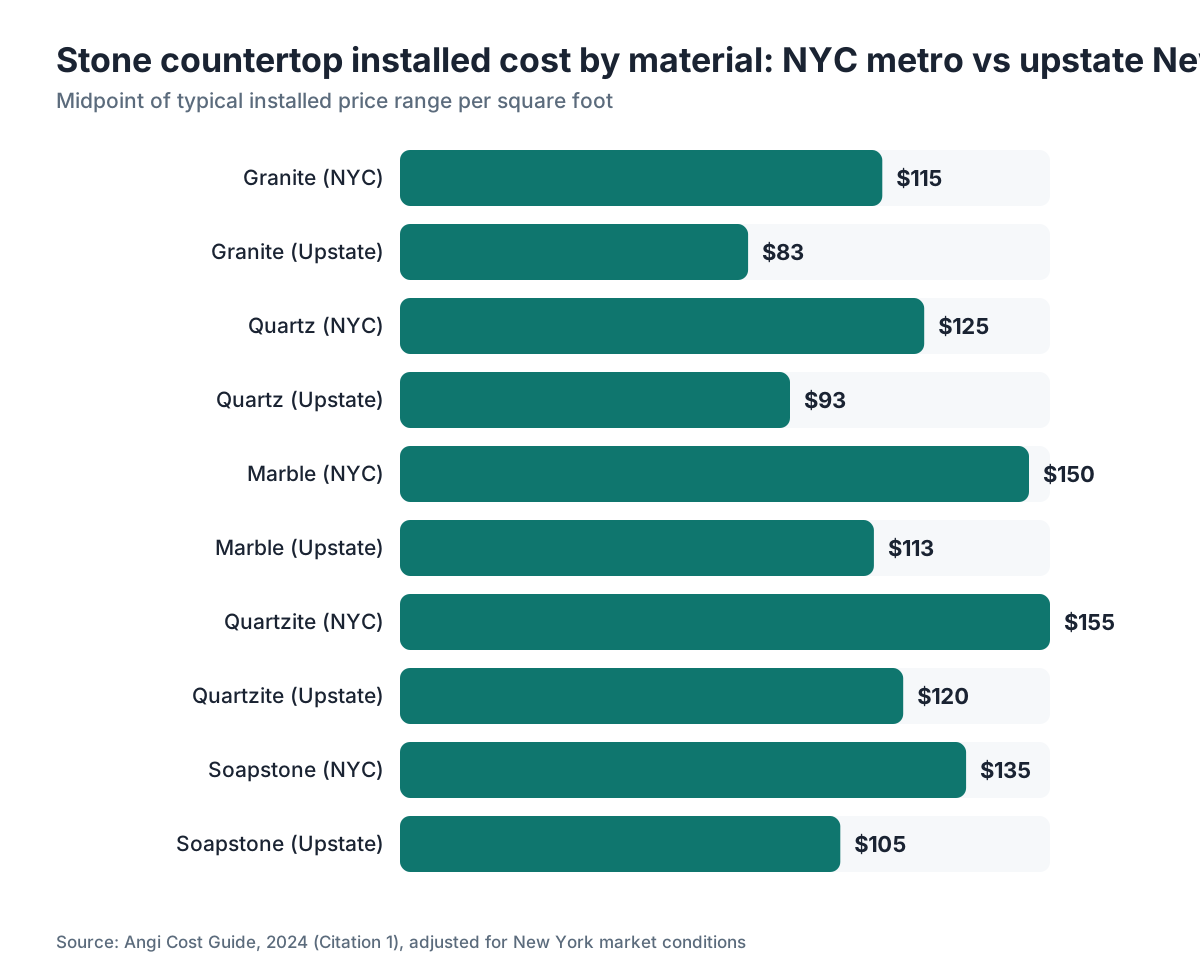
Installed countertops in New York run above the national median, driven by labor, real estate, and logistics. Expect $80 to $160 per square foot for granite or quartz in the metro, and $55 to $120 upstate. Here is a rough breakdown by material for a standard kitchen with around 40 square feet of counter [1][2]:
| Material | NYC/Long Island installed (per sq ft) | Upstate NY installed (per sq ft) |
|---|---|---|
| Granite | $80, $150 | $55, $110 |
| Quartz (engineered) | $90, $160 | $65, $120 |
| Marble | $100, $200+ | $75, $150 |
| Quartzite | $110, $200+ | $80, $160 |
| Soapstone | $90, $180 | $70, $140 |
Those ranges are wide because they have to be. A 40-square-foot galley kitchen with a straight run and an undermount sink is not the same job as a 40-square-foot island with waterfall edges, mitered corners, and a farmhouse sink cutout. Edge profiles alone swing a quote by $20 to $40 per linear foot depending on whether you want an eased edge or a full ogee. Apron-front sink cutouts typically add $150 to $300.
The biggest price driver most homeowners miss is material grade within a category. "Granite" on a box-store pricing page means Level 1 commodity material. The Brazilian Blue Bahia you fell for on Instagram is Level 5 or 6 and costs three times as much before fabrication even starts. Ask to see the slab, more than a sample tile, and confirm the price per square foot applies to the actual slab you're picking.
Deposits at New York shops typically run 50% down, with the balance due at installation. Get it in writing. Under New York City rules, the Department of Consumer and Worker Protection requires home improvement contractors to provide a written contract for jobs over $500 [3]. Fabricators doing residential work in the city fall under that rule.
What credentials and licenses should a New York stone fabricator have?
New York City is one of the few places in the country with a mandatory home improvement contractor license, run by the Department of Consumer and Worker Protection. Any contractor doing home improvement work in the five boroughs for pay must hold a Home Improvement Contractor (HIC) license [3]. A stone fabricator installing a kitchen counter is doing home improvement work. Ask for the license number and verify it on the DCWP license lookup before you sign anything.
Outside the five boroughs, requirements vary by county and town. Westchester, Nassau, and Suffolk counties each run their own contractor licensing ordinances. Many upstate towns have no specific contractor license beyond a general business registration, though building permits may apply to certain structural work.
Licensing aside, any fabricator working at your home should carry general liability insurance and workers' compensation insurance. Ask for a certificate of insurance naming your property address. A credible shop sends it without drama. One that hesitates or says "we don't usually do that" is telling you something.
For the shops themselves, the Natural Stone Institute runs the Accredited Natural Stone Fabricator program, which audits equipment, quality control, and worker safety [4]. It's not universal, and plenty of excellent shops skip it. When a shop has it, that's a real signal.
How do I find and vet a stone fabricator in New York?
A referral from a general contractor or kitchen designer you already trust is the most reliable starting point. These trades work with fabricators on dozens of jobs and know who shows up on time, cuts accurately, and handles a cracked slab without a fight. A GC who won't hand over a fabricator name is a GC who doesn't trust their own referrals.
Beyond referrals, the Natural Stone Institute keeps a member directory with fabricators by state [4]. Not every good shop is listed, but the ones that are have at least joined the professional community.
When you call a shop, ask these before you visit:
- Do you fabricate in-house or outsource cutting to a third-party shop? (Some "fabricators" are really installers who subcontract the actual stonework.)
- What is your current lead time from template to install?
- What CNC equipment do you run, and how old is it?
- Can I visit and see work in progress?
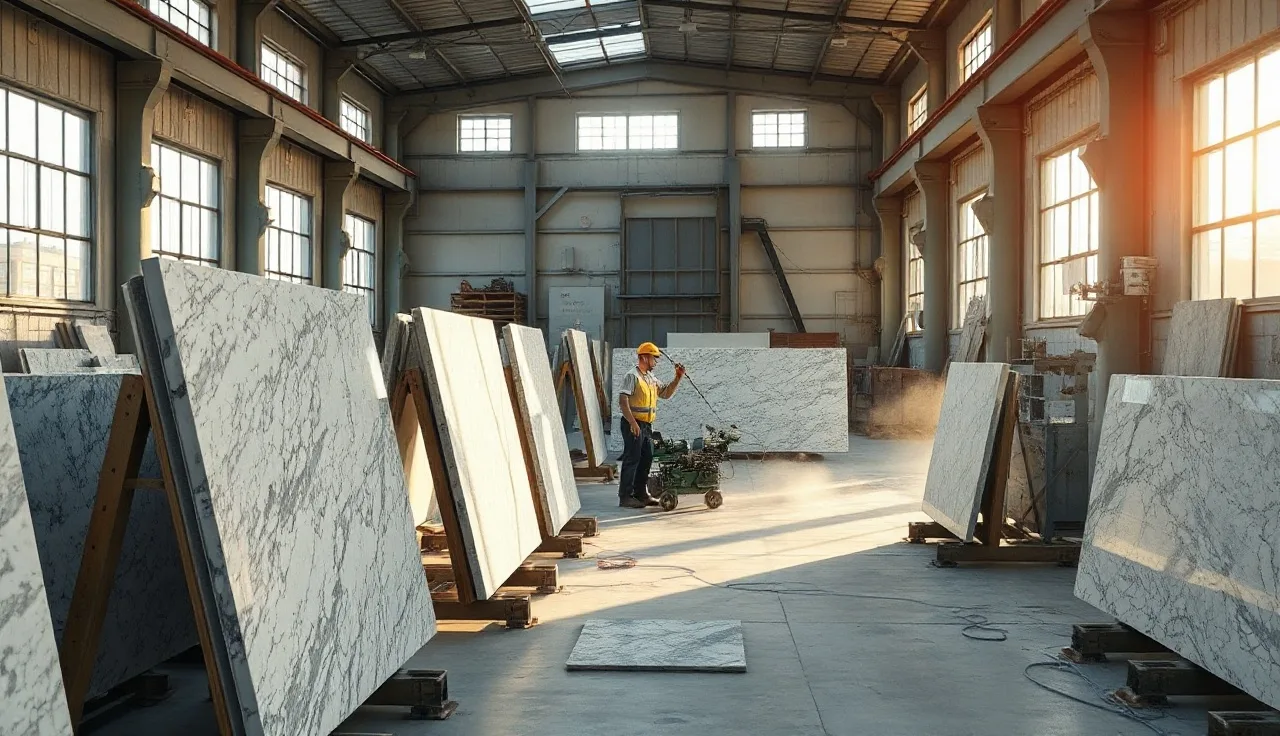
The shop visit matters. A fabricator who won't let you see the floor is hiding something, usually chaos or a shop too small for the work they've promised. You want slabs stored vertically on proper A-frames, water filtration on the wet saws, and a workflow that isn't drowning. You don't need a spotless showroom. You need a functioning operation.
Google and Yelp reviews are fine, but read them critically. A fabricator with 4.2 stars and 200 reviews over five years tells you more than one with 4.9 stars and 11 reviews. Watch how the shop answers negative reviews. A professional response to a complaint says more about how disputes get handled than any five-star rave.
For fabricators running at scale who want to tighten quoting and material yield, tools like SlabWise help shop owners calculate waste, automate quotes, and track job costs, which trickles down to better pricing accuracy for customers.
What is the typical timeline from template to installed countertops in New York?
Plan on three to six weeks for a standard kitchen in the NYC metro, and two to four weeks upstate. Both stretch longer during the spring remodel season (March through June) and the fall push (September through November).
Here is how the timeline breaks down:
Template day: A templator comes to your home after cabinets are installed and leveled (or at rough-in for an overlay on existing counters). Digital templating with a laser takes 45 to 90 minutes for a typical kitchen. Old-school luan template boards take longer. Either way, the template starts your countdown.
Slab selection and confirmation: If you haven't chosen your slab, you do it now. Some shops let you pick earlier, but templating first tells you exactly how many square feet you need so you can book the right slabs. Allow one to three days.
Fabrication: Once the slab is confirmed and the template data is in, cutting and finishing takes two to four days of actual shop time. The queue behind other jobs is what stretches it to one to three weeks.
Installation: A crew of two to three can install a typical kitchen in four to eight hours. Scheduling is the variable. Metro shops book install crews two to three weeks out during busy periods.
If a shop promises a faster timeline than this, ask how. Sometimes they have genuine capacity. Sometimes they're telling you what you want to hear, and you find out the hard way when install day slips.
How does New York's stone market compare to other major cities like New Orleans?
New York and New Orleans sit at opposite ends of several spectrums, which makes the comparison useful. One has scale and specialization. The other has a smaller ecosystem where shops do more kinds of work to stay busy.
New York's metro holds roughly 20 million people, so fabricators can specialize and still fill the calendar [7]. New Orleans, with a metro around 1.3 million, has a smaller fabricator base where many shops mix commercial, residential, and restoration [7]. The Gulf Coast also runs more of its imports through the port of New Orleans, which can mean good slab selection at competitive prices for buyers who know where to look.
Granite and quartz installation in New Orleans typically runs $50 to $120 per square foot installed, well below New York metro averages, mostly because labor and real estate cost less [1]. The material cost for the same slab is often similar or slightly higher in New Orleans, since a thinner-volume distributor tends to carry a fatter margin.
Lead times in New Orleans run faster for standard residential work, often two to three weeks from template to install, because the queue is shorter. For rare or highly specified stone, though, a New York shop with direct importer relationships may have better access and quicker sourcing.
Regulation is where New York stands alone. The NYC licensing and permitting requirements have no equivalent in New Orleans, which operates under Louisiana's state contractor licensing system rather than a city-specific regime.
What materials are most popular with New York fabricators right now?
Engineered quartz has led residential countertop work in New York for a decade and still covers the majority of kitchen jobs at most shops. Cambria, Silestone, and Caesarstone all have strong distribution here. See the full breakdown of Cambria countertops if you're weighing that route.
Natural marble countertops run disproportionately popular in New York compared to national averages, especially in Manhattan and Brooklyn brownstones where the look fits the architecture. Calacatta and Statuario from Italy stay in strong demand despite the price spikes that followed supply chain disruptions in 2021 and 2022.
Granite countertops hold steady, particularly in outer-borough and suburban markets where value per dollar carries more weight. The Brazilian and Indian granite selections at New York distributors run deep.
Quartzite, which is not quartz, has grown fast in the high-end segment. It's a natural stone with marble-like looks and better hardness. If you go that way, read up on how to clean quartzite countertops before committing, because maintenance surprises a lot of buyers.
Soapstone is a niche but real part of the market, mostly for renovations in older homes where buyers want a period look. How to clean soapstone countertops is worth understanding first, since the oiling routine catches some people off guard.
On the budget end, laminate countertops and Formica countertops are more alive than many showroom salespeople admit, especially for rentals and secondary spaces. Several New York fabricators do laminate alongside stone.
What should I expect during countertop installation day in New York?
For a standard New York kitchen, plan on a crew of two to three people and a work window of four to eight hours. In a high-rise, which covers a large share of NYC installs, add logistics: elevator reservations, building COI requirements, and parking for a delivery truck in a neighborhood that may not have any.
Most NYC building management offices require a certificate of insurance from the contractor before work begins. Your fabricator should provide it automatically. If they seem unfamiliar with the requirement, that's a bad sign for an NYC shop.
The crew carries sections of stone in through the main entrance. Sections get cut to fit through doors and hallways, then seamed together during installation. In a large open kitchen on the ground floor of a house, seaming matters less. In a fifth-floor walk-up, expect more seams because the slab sections have to be manageable by hand.
After installation, there's usually a 24 to 48 hour cure time before the sink and appliances go back in if epoxy adhesive was used for the undermount. Some crews use mechanical fastening that turns around faster. Ask in advance which method your fabricator uses.
For the full picture start to finish, the countertop installation guide covers it in detail.
What are common complaints about stone fabricators and how do I avoid them?
The New York State Attorney General's office and the NYC DCWP both take steady complaints about home improvement contractors every year, and fabricators are not immune [3][5]. The recurring problems fall into a few buckets.
Slab substitution. You pick a beautiful slab at the warehouse, but the material that shows up on install day comes from a different, lower-quality lot. The fix: mark your selected slab with a paint pen or tape carrying your job number at the warehouse, and get the slab ID confirmed in your written contract.
Deposit disputes. A homeowner pays a large deposit, the fabricator hits financial trouble or loses the slab, and clawing the money back turns into a fight. Paying by credit card gives you chargeback rights if the contractor never delivers. Paying by check does not. On a $5,000 job, the card processing fee a fabricator passes on is cheap insurance.
Edge quality and seam placement. Seams put in the wrong spot for aesthetics, or edges left with visible grinding marks, are fabrication quality problems that are hard to fix after installation. Ask to see photos of finished seams on past work. Ask where the seams will land and get it noted.
Cracked stone during install. Stone cracks during installation more often than the industry advertises. The real question is whether the fabricator owns the mistake or argues it was a pre-existing flaw. A shop with proper insurance and a professional attitude replaces the piece. Get the warranty terms in writing before you start [9].
How should fabricators in New York think about running their business more efficiently?
The New York market is competitive enough that margin compression is real, especially for shops working in the $80 to $120 per square foot range where homeowners are price-sensitive but still want natural stone. The shops that last are the ones managing material yield, job costing, and scheduling with real numbers instead of gut feel. New York state labor costs for construction trades run above the national average, which squeezes margin harder here than almost anywhere [8].
Material waste is the quiet killer in fabrication profit. A job quoted at 15% waste that actually runs 25% because of slab defects or complex cuts can turn a profitable job into a break-even one. Shops using digital templating and nesting software to plan cuts before touching the slab consistently run lower waste, which improves margin on every job.
Quoting accuracy matters more in a high-cost market than almost anywhere. A shop in a cheaper market can absorb a small quoting error. In New York, where labor, overhead, and material are all elevated, a quote that's off by 10% is a real problem. Fabrication quoting software like SlabWise is built for exactly this: it helps shops produce accurate per-job quotes that account for material, labor, and edge work without leaning on spreadsheets that break or estimators who leave.
Lead time management is the other lever. Shops with a reputation for reliable timelines pull more GC referrals, because contractors can't afford to have jobs held up waiting on countertops. Posting your current lead time on your website, honest and visible, is something almost no New York shop does. It's an easy way to stand out.
What do I need to know about stone selection and kitchen countertops in New York specifically?
New York buyers, especially in the metro, skew toward higher-end materials and dramatic veining more than the national average. Part of that is income distribution. Part of it is a design culture soaked in media and showrooms. The result: New York fabricators handle a lot of book-matched marble, waterfall islands, and exotic quartzite that shops in other markets rarely touch.
That concentration of expertise helps buyers who want unusual materials. If you want Taj Mahal quartzite with a book-matched island, a well-established Queens or Long Island fabricator who does this regularly beats a generalist shop in a smaller market.
The flip side of that demand is that some New York showrooms lean hard on upselling. The jump from a Level 2 granite to a Level 4 marble can double your total project cost. Know your budget ceiling before you walk into a slab warehouse, because the selection is deep enough to pull you well past it if you aren't anchored.
For surfaces outside the kitchen, like bathrooms and laundry rooms, how to clean stone countertops is worth reading before you finalize material, especially for surfaces that see a lot of water and cleaning products.
Frequently asked questions
How much does a stone fabricator charge for a typical kitchen in New York City?
In NYC and Long Island, expect $80 to $160 per square foot installed for quartz or granite, and $100 to $200 or more for marble or quartzite. A 40-square-foot kitchen with a standard undermount sink cutout and an eased edge commonly runs $3,500 to $7,000 total. Unusual edge profiles, complex cutouts, and premium material grades push the number higher.
Do stone fabricators in New York City need a license?
Yes. Any contractor doing home improvement work in the five boroughs for pay must hold a Home Improvement Contractor license from the NYC Department of Consumer and Worker Protection. Verify the license number on the DCWP website before signing a contract. Outside NYC, requirements vary by county; check with Nassau, Suffolk, or Westchester county offices for their specific rules.
How long does it take to get countertops installed in New York?
In the NYC metro, three to six weeks from template to installation is realistic for a standard kitchen during normal periods. That stretches to six to eight weeks during peak spring and fall remodel seasons. Upstate shops often run two to four weeks. The queue at the specific shop you hire matters more than any market average, so ask for a current lead time before committing.
What is the difference between a stone fabricator and a countertop installer?
A fabricator cuts, edges, and finishes raw stone slabs into countertop pieces sized for your specific kitchen. An installer places and secures them. Many companies do both, but some installers subcontract the cutting to a separate fabrication shop. Knowing whether your shop fabricates in-house or outsources matters for quality control and accountability if something goes wrong.
What questions should I ask a New York stone fabricator before hiring?
Ask whether they fabricate in-house, what their current lead time is, what CNC equipment they run, whether you can visit the shop, and whether they carry general liability and workers' comp insurance. In NYC, ask for their Home Improvement Contractor license number. For the contract, confirm slab selection details, seam placement, edge profiles, and warranty terms are all written down.
Can I visit the stone fabrication shop before I hire them?
Yes, and you should. A reputable shop welcomes visits and shows you the cutting floor, how slabs are stored, and work in progress. A shop that won't allow a visit doesn't want you to see something. Look for slabs stored vertically on A-frames, wet saws with filtration, and a workflow that doesn't look overwhelmed. You don't need a showroom; you need a functioning shop.
What happens if the stone cracks during installation?
If the crack comes from fabrication error or mishandling, a professional shop replaces the piece at their cost. If the fabricator claims a pre-existing flaw in the stone, expect a disagreement. Your best protection is a written warranty clause that spells out what the shop is responsible for and for how long. Paying by credit card also preserves chargeback rights if the contractor fails to perform.
Is it cheaper to buy stone countertops upstate New York than in NYC?
Generally yes. Installed granite or quartz in Albany, Buffalo, or the Hudson Valley typically runs $55 to $120 per square foot compared to $80 to $160 in NYC and Long Island. Labor and overhead cost less upstate. Material for the same slab can be similar or slightly higher upstate if local distributors serve a thinner volume and pass on higher margins.
How do I make sure I get the specific slab I selected?
Mark your selected slab with your name, job number, and selection date using paint stick or tape before leaving the warehouse, and photograph it with the markings visible. Get the slab's lot number and dimension confirmed in your written contract. Some shops let you come back and verify the slab is still tagged before fabrication begins. This one step prevents most slab substitution disputes.
Do New York City apartment buildings have special requirements for countertop installation?
Many do. Co-ops and condos commonly require a certificate of insurance from the contractor before allowing work, and sometimes a move-in/move-out deposit. Some buildings require elevator reservations and restrict work to weekday business hours. Your fabricator should know this in the NYC market. If they seem unfamiliar with building COI requirements, that's a warning sign for a metro-area shop.
What stone materials are popular with New York fabricators for high-end kitchens?
Calacatta and Statuario marble from Italy, Taj Mahal and Sea Pearl quartzite from Brazil, and book-matched slabs for waterfall islands are all common at high-end New York shops. Engineered quartz from Cambria, Silestone, and Caesarstone dominates the mid-market. Soapstone shows up regularly in renovation work on pre-war buildings where buyers want a historically consistent look.
Are there accreditation programs for stone fabricators I should know about?
The Natural Stone Institute runs the Accredited Natural Stone Fabricator program, which audits shops on equipment, quality control, and worker safety. It's not universal, but membership is a real signal of professional engagement. NSI also publishes installation and care standards fabricators can reference. You can search for accredited shops by location on the NSI website.
How do fabricators calculate the price of my countertop job?
Most shops price by square footage for the slab and fabrication labor, then add line items for edge profiles, sink cutouts, cooktop cutouts, seams, and special work like mitered edges or ogee profiles. Material grade heavily affects the slab price. Some shops bundle everything into a per-square-foot installed price; others itemize. Ask for an itemized quote so you can compare shops on the same basis.
Sources
- HomeAdvisor / Angi, Countertop Installation Cost Guide: National and regional ranges for installed countertop costs by material, used to contextualize New York and New Orleans pricing
- U.S. Bureau of Labor Statistics, Consumer Expenditure Survey: New York metro area household expenditure data indicating above-average spending on home improvement relative to national median
- NYC Department of Consumer and Worker Protection: NYC requires a Home Improvement Contractor license and a written contract for home improvement jobs over $500
- Natural Stone Institute, Accredited Natural Stone Fabricator Program: NSI administers accreditation for fabricators and maintains a member and accredited-shop directory searchable by state
- New York State Office of the Attorney General, Consumer Frauds: NYS AG office receives ongoing complaints about home improvement contractors including deposit disputes and failure to perform
- U.S. Geological Survey, National Minerals Information Center: USGS tracks U.S. dimension stone production, consumption, and import volumes; used to contextualize stone supply chain to New York
- U.S. Census Bureau, American Community Survey: NYC metro area population approximately 20 million, New Orleans metro approximately 1.3 million; used for market size comparison
- New York State Department of Labor: New York state labor cost data for construction and stone-related trades, supporting above-national-average fabrication pricing
- Natural Stone Institute, Care and Maintenance Guidelines: Industry standards for stone installation, seaming, and warranty practices referenced in quality and complaint sections
Last updated 2026-07-09