TL;DR
- Bay Area stone fabricators cut, edge, and install countertops from granite, quartz, marble, and quartzite.
- Installed prices in the region run about $65 to $200 per square foot depending on material and edge profile.
- Hire on fabrication skill, not showroom looks.
- This guide covers what fabricators do, what drives cost, and how to compare shops without getting played.
What does a stone fabricator actually do?
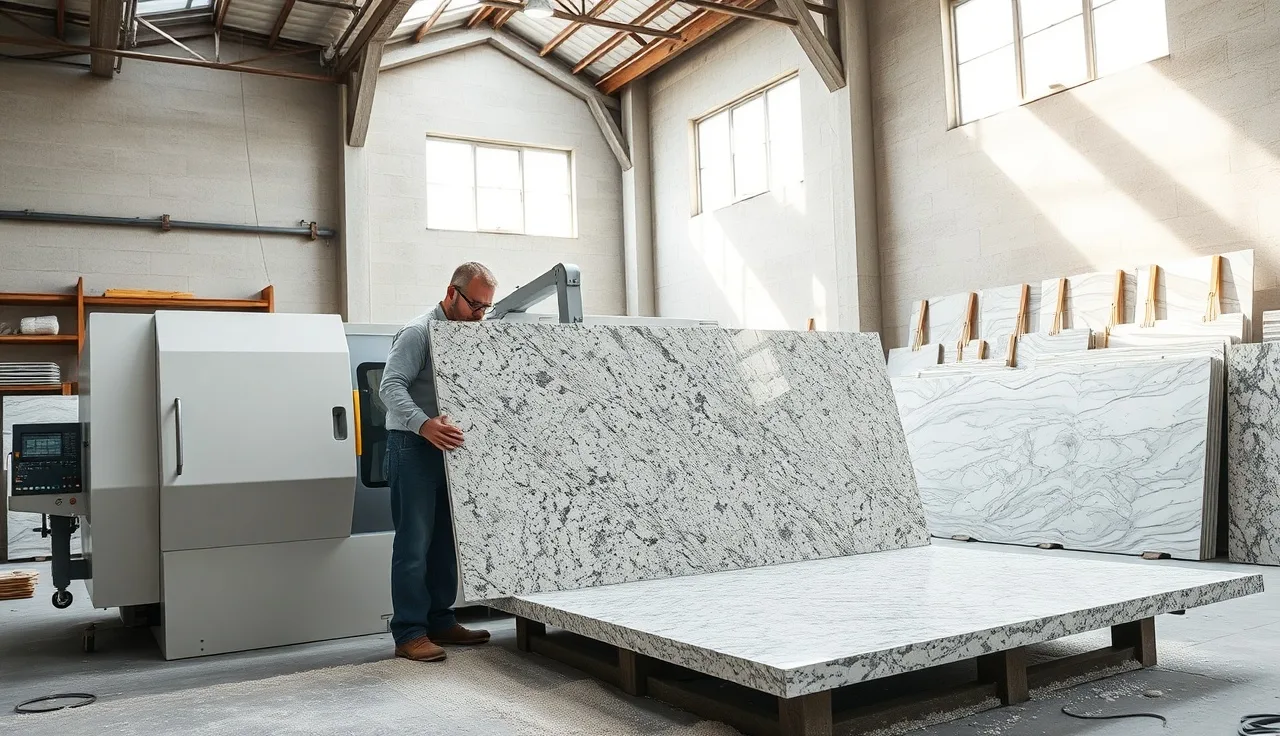
A stone fabricator takes raw slabs and turns them into finished countertops. That means templating your kitchen, cutting stone to those exact measurements, edging the exposed faces, cutting sink and cooktop openings, and installing the finished pieces. A fabricator is not a tile contractor, not a general contractor, and not a stone importer, though plenty of shops dabble in all of it.
The chain matters because quality can slip at every step. Templating sets the whole job. A shop using digital templating (a laser or structured-light device) captures your counters to within about 1 mm. Shops still running cardboard or wood stick templates are not automatically bad, but ask how they handle discrepancies on install day. There will be some.
Cutting happens on CNC bridge saws or waterjet tables. Edge profiles get cut and polished on CNC edge machines or by hand. Hand polishing isn't worse, just slower and pricier on complex profiles. Sink cutouts and seams are where shop quality shows the most. A good seam is hard to find with your eyes six inches away. A bad one is visible from the doorway.
Installation is the last step and the one where finished stone gets wrecked most often. Ask every shop how they support large spans and what they do if a piece cracks on install. The answer tells you whether they've done this a hundred times or a dozen.
How much do stone countertops cost in the Bay Area?
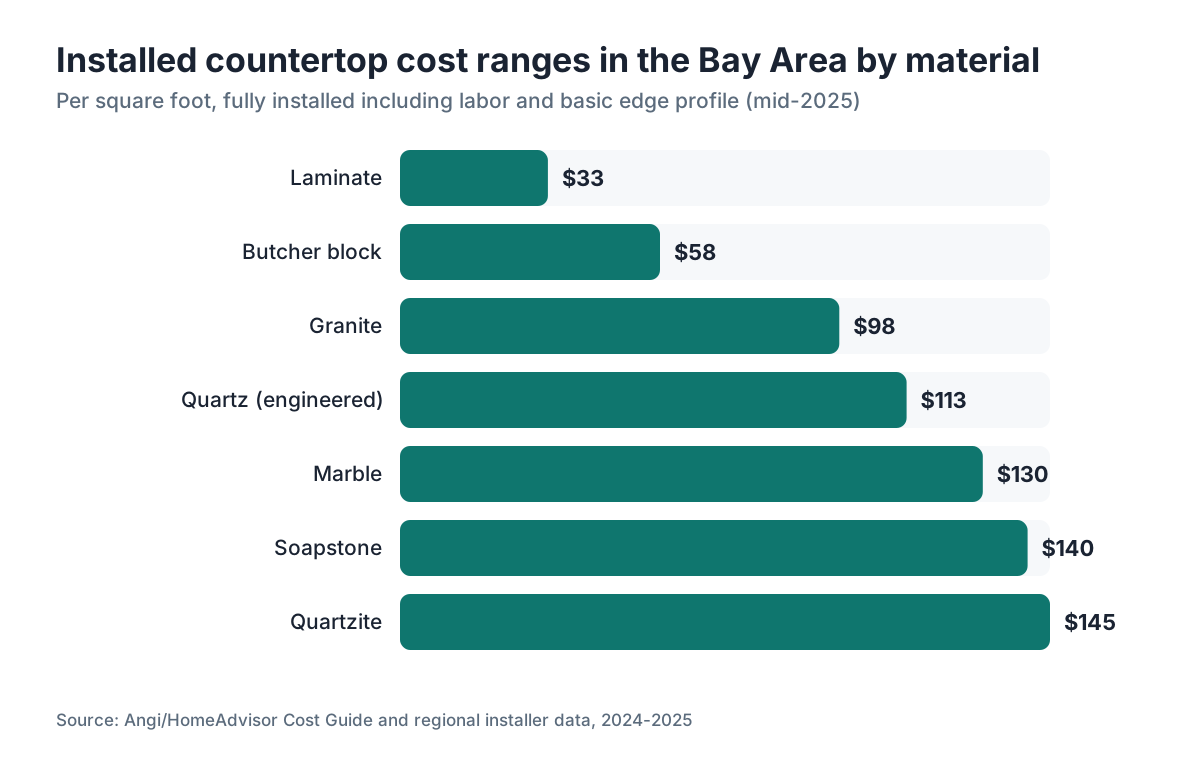
Installed countertops in the Bay Area run roughly $65 to $200 per square foot, with the exact number driven by material, edge profile, and slab rarity. The region is one of the priciest labor markets in the country, and that shows up on every quote. Here's a realistic snapshot as of mid-2025.
| Material | Installed cost per sq ft (Bay Area) | Notes |
|---|---|---|
| Laminate | $20 to $45 | Fabricated locally or prefab; some shops don't do it |
| Butcher block | $35 to $80 | Depends on species; different skill set |
| Granite | $65 to $130 | Wide range; rare colors hit $200+ |
| Quartz (engineered) | $75 to $150 | Silestone, Cambria, MSI, etc. |
| Marble | $85 to $175 | Carrara is lower end; bookmatch marble is much higher |
| Quartzite | $90 to $200+ | Often misidentified; verify with acid test |
| Soapstone | $100 to $180 | Niche; fewer Bay Area shops cut it regularly |
Those ranges come from published regional data and installer surveys, not one shop's price sheet. [1][2] The spread inside each material is real. A 3 cm quartzite slab in a rare color, cut to a waterfall edge with a farmhouse sink cutout, is a different animal than standard 3 cm quartz with an eased edge and a round undermount sink.
Labor eats a bigger share of Bay Area countertop cost than almost anywhere else in the country. California's statewide minimum wage hit $16.50 per hour in January 2025, [3] and Bay Area cities go higher: San Francisco's minimum is $18.67 per hour as of July 2025. [4] Putting two skilled installers on a job for four hours costs a shop a lot more here than in Phoenix. That's not a complaint, just something to hold in your head when you compare a local quote to a national average you found online.
Square footage almost never tells the whole story. Edge length, seam count, cutouts, and material thickness all move the final number. A kitchen that measures 45 square feet on paper can quote at 55 once overhangs and waste get counted right.
Want material comparisons beyond stone? See kitchen countertops for the full picture. Laminate countertops and formica countertops sit at the low end. Natural stone and engineered quartz like Cambria countertops sit at the top.
How do Bay Area stone fabricators build their quotes?
Every real fabricator quotes by square footage, but what goes into that number varies. A full countertop quote includes raw slab cost, cutting and fabrication labor, edge profile (straight edges cost less than ogee or waterfall), sink cutouts (usually $150 to $350 each for undermount), cooktop cutouts, seaming, delivery, and installation labor. Some shops roll it into one per-square-foot figure. Others itemize. Neither is dishonest, but itemized quotes let you compare shops on the same terms.
Slab price is the single biggest variable. Bay Area distributors carry thousands of slabs, and the gap between budget granite and a bookmatch exotic quartzite can run $15 to $80 per square foot before a single cut. If a shop quotes you without a specific slab picked out, that's a rough estimate, not a real number.
Waste factor is the thing most homeowners never think to ask about. Slabs are rectangular. Kitchens are not. Most fabricators plan for 15% to 20% waste on a standard kitchen, and an L-shape or galley layout with lots of short runs can push it higher. Many shops charge you for the full slab even if they only use part of it. That's legal and common, and it covers remnants they may never sell. Ask how they handle remnants, and ask whether you can buy the leftover for a bathroom vanity while you're at it.
Shops running nesting software can sometimes cut waste. Nesting lets a fabricator lay out every piece on a virtual slab before cutting, which trims offcuts and can lower material cost on certain layouts. Tools like SlabWise do this. Ask a shop whether they nest, especially on expensive stone.
Tax gets left off early quotes constantly. California's statewide sales tax is 7.25%, and Bay Area counties stack on top. In San Francisco County and Santa Clara County, the combined rate is 8.625% as of 2025. [5] On a $6,000 job, that's over $500. Make sure every quote you're comparing includes it.
What questions should you ask a Bay Area stone fabricator before hiring?
Start here: do you fabricate in-house, or do you outsource the cutting? Showrooms are not fabrication shops. Some Bay Area stone businesses have gorgeous showrooms and send the actual cutting to a third-party shop. That's not automatically a problem, but it tangles your warranty if something goes wrong, so ask up front.
Ask to see their shop. A real fabricator won't flinch. You want to see a CNC saw or bridge saw, an edge polishing machine, and evidence they're cutting stone this week. A warehouse full of slabs and no cutting equipment means you're talking to a distributor, not a fabricator.
Ask for references from the last six months, not a curated list from 2019. Then actually call them. Ask about the seams specifically: could you see them? Ask whether the crew cleaned up and whether the job passed inspection if permits were required.
Ask about lead time. Bay Area shops running at capacity are often booking four to eight weeks out. Anyone promising installation in five days is either lying or has no work, and both should worry you.
Ask what happens if a slab cracks on install. It happens. Stone is heavy, Bay Area houses have tight passages, and pieces crack in transit or squeezing through a doorway. A shop with a clear answer (we re-cut from remaining slab stock, or we source a new slab and eat the cost) has dealt with this before. Vague answers are a red flag.
Get the full scope in writing before any money changes hands. California Business and Professions Code Section 7159 requires written contracts for home improvement work over $500, including a description of the work, materials, start date, and completion date. [6] A fabricator who resists a written contract is ignoring state law.
How do you find reputable stone fabricators in the Bay Area?
Start with referrals and reviews, then verify the license. The Bay Area has dozens of fabricators, from one-person operations to shops running multiple CNC lines. The density gives you real options. It also means some shops have quietly changed business names after a run of bad reviews.
The Natural Stone Institute (formerly the Marble Institute of America) keeps a member directory. [7] Membership requires fabricators to meet professionalism and ethics standards, though membership alone guarantees nothing. The National Kitchen and Bath Association (NKBA) [8] is another directory, aimed at shops with staff certified in kitchen design and installation.
Google reviews are the most practical starting point. Look for volume (50-plus reviews beats three glowing five-stars) and read the one and two-star reviews first. Patterns matter. Repeated mentions of bad seams, delays, or broken pieces mean more than one angry customer having a bad week.
Contractor referrals are underrated. Ask your GC, your kitchen designer, or your tile guy who they've watched do good work on real job sites. People in the trade see finished results across dozens of kitchens and know which shops show up on time and install clean.
Distributors like MS International (MSI), Arizona Tile, and Floor & Decor carry slabs, and some run fabrication or refer you to fabricators they work with regularly. [9] Those aren't unbiased endorsements, but a distributor has a real stake in sending you to a shop that won't wreck slabs on the cutting table.
The Contractors State License Board (CSLB) lets you verify any contractor holds a valid California license. [10] For stone installation, look for a C-54 (ceramic and mosaic tile) or B (general building) license. Not every countertop fabricator carries the right class, and California law requires licensure for home improvement contracts over $500.
What materials do Bay Area stone fabricators work with?
Most full-service Bay Area shops cut every major stone type. Not all of them are equally good at all of it, and some have real specializations.
Granite countertops are the most commonly fabricated stone in most shops. It's hard, forgiving, and the tooling is standard. Any shop with a bridge saw and an edge machine can do decent granite.
Marble countertops are softer and prone to scratching and etching, so the edge polishing and seam work needs more care. Some shops do marble beautifully. Others treat it like granite and hand you back visible tooling marks. Ask to see example marble jobs before you commit.
Quartzite causes the most confusion in the Bay Area market right now. Plenty of slabs sold as quartzite are actually marble or a softer stone that etches and stains like marble. Real quartzite won't react to a drop of muriatic acid. Marble and soft imposters fizz right away. If a fabricator can't tell you whether your stone is true quartzite, that's a problem. The guide on how to clean quartzite countertops covers what you're signing up for with the real thing.
Engineered quartz brands like Caesarstone, Silestone, and Cambria run on the same equipment as natural stone. Some fabricators prefer quartz because the material is consistent and calibrated, which speeds production. See Cambria countertops for a closer look at that line.
Soapstone is niche, and fewer Bay Area shops cut it regularly. The stone is soft and wants different tooling speeds. If you want soapstone, ask whether the shop has done multiple jobs in it, more than one. The how to clean soapstone countertops guide covers what living with it looks like.
Some Bay Area fabricators also handle butcher block countertops, but wood is a separate skill from stone. A shop that offers both isn't automatically great at both. Ask for examples of each.
Chasing a lower-cost surface? Most stone fabricators won't touch laminate countertops or Corian countertops. Those need a different kind of shop.
What do Bay Area countertop installation logistics look like?
Bay Area houses throw installation problems at you that barely exist in the rest of the country. Narrow Victorian hallways, steep hillside driveways, condos with freight elevator rules, and multi-floor townhomes all limit how a slab gets from a van to your kitchen.
A full island in 3 cm granite can weigh 400 to 600 pounds. Two installers hauling that up a narrow staircase in a San Francisco flat is genuinely dangerous and slow. Ask whether the shop has done your building type before. A shop that lives in new-construction tract homes in San Jose may not have the logistics for a third-floor Oakland condo.
Permits are sometimes required for countertop replacement in California, depending on scope. A countertop-only swap usually doesn't trigger a permit. Move plumbing, electrical, or structural elements as part of a remodel, and permits are almost certain, with the countertop work sequenced around them. Your GC or designer should manage this. If you're acting as your own GC, the California Department of Consumer Affairs has owner-builder permit guidance. [11]
Homes built before 1978 may have lead paint where countertop brackets or soffits are coming out. Cal/OSHA has specific rules for renovation work that disturbs lead paint. [12] A stone fabricator isn't usually responsible for that. You are, and it's worth knowing before you tear out old counters.
For a full walkthrough of install day, the countertop installation guide covers the sequence: what to prep, how to protect your cabinets, and what to watch for.
What are the biggest red flags when hiring a stone fabricator in the Bay Area?
The lowball bid is the one that burns people. Bay Area labor and overhead are high. If a shop quotes 30% below everyone else, something is getting cut: stone quality, material thickness, or installer experience. Great deals exist, but a suspiciously low bid earns extra scrutiny, not less.
No written contract is an instant disqualifier. California law requires written contracts for home improvement work over $500. [6] A shop that says they don't need paperwork is either green or dodging accountability on purpose.
Unlicensed work is a serious problem in California's stone trade. A 2021 CSLB enforcement sweep found unlicensed contractors operating across multiple Bay Area counties. [10] Paying an unlicensed contractor voids some of your consumer protections under California law, and if a worker gets hurt at your home, you could carry liability exposure.
Vague slab sourcing is a softer flag but a real one. Some shops sell stone they call "premium quartzite" that's actually dolomitic marble, a softer stone that etches easily and needs far more babysitting. Ask for the exact trade name and country of origin. A shop that can't tell you isn't sourcing carefully.
Big deposits up front are the last one. California law caps deposits on home improvement contracts at 10% of the contract price or $1,000, whichever is less, for licensed contractors. [6] Any shop demanding 50% to 100% before work starts is breaking that law and is a credit risk on top of it.
How do fabricators and shops use technology to improve accuracy and efficiency?
Bay Area shops adopted technology faster than most U.S. markets, mostly because labor costs here make efficiency tools pay for themselves. CNC bridge saws, digital templating, and automated edge machines are common at mid-to-large shops. Smaller operations often still run manual templating and conventional saws, which isn't inherently worse but leans hard on the skill of the individual cutter.
Digital templating with a device like the LT-2D3D or Prodim Proliner captures a kitchen to within about a millimeter and exports straight to CNC cutting files. That cuts template-to-install time and shrinks the odds of a miscut. Shops using it should be able to show you the template file if you ask.
Nesting software, which lays out pieces on a slab to minimize waste, is increasingly common at shops handling expensive material. SlabWise is one tool fabricators use for this, running quoting and layout in the same workflow. For you, the practical payoff is that a shop nesting an expensive quartzite or exotic marble job may beat a shop that cuts by eye on material cost.
Some Bay Area fabricators now offer 3D rendering previews that show your selected slab in your actual kitchen layout, including where the veining lands across seams. That's not a gimmick. Vein alignment at seams is one of the biggest aesthetic variables in a stone job, and seeing it in advance kills a lot of surprises.
The most practical benefit for homeowners is faster, more accurate quotes. A shop with good quoting software turns around a detailed, itemized quote in 24 to 48 hours. A shop that takes two weeks probably has process problems or is running you through a manual system that's also prone to errors.
How long does the full process take, from selection to install?
The full countertop process in the Bay Area runs four to ten weeks from first contact to installed counters, depending on material availability, shop backlog, and how fast you make decisions.
Here's a realistic timeline.
Week 1 to 2: Visit distributors or showrooms and pick a slab. This takes as long as you let it. Some people choose in an afternoon. Others look for three weeks. Most fabricators won't start until you've picked a slab and paid a deposit.
Week 2 to 3: Template appointment. Digital templating usually takes one to two hours for a full kitchen. Shops schedule templates after cabinets are installed and leveled.
Week 3 to 6: Fabrication. Most Bay Area shops run two to four weeks of backlog in busy seasons (spring and fall). If your material is in stock, the cutting itself takes two to four days. Waiting on a slab shipped from a distributor's warehouse adds a week or two.
Week 4 to 8: Installation day. Installing a full kitchen runs four to eight hours for most homes. Counters usually aren't sealed on install day. Most shops come back to seal after 24 to 48 hours or walk you through DIY sealing.
For context, a 2022 survey of U.S. countertop fabricators put the national median fabrication-to-install lead time at 12 to 14 business days after template, with Bay Area and other high-cost metros running slightly longer on backlog. [1] That lines up with what Bay Area shops quote when you ask directly.
Need counters faster? Some shops keep cut-to-size remnants for small kitchens or islands and can turn those around in a week or less. That's no help for a full remodel, but it works for a powder room vanity or a small rental kitchen.
Are there specific licensing and insurance requirements for stone fabricators in California?
Yes. California requires contractors doing home improvement work to be licensed by the Contractors State License Board (CSLB). [10] The relevant classes for countertop work are generally C-54 (Ceramic and Mosaic Tile) or B (General Building Contractor). Some shops hold a D-12 (Synthetic Products) class for engineered stone, though the industry still argues over which class quartz belongs in.
Verifying a license is free and takes two minutes at the CSLB website. Enter the contractor's name or license number and confirm the license is active, the bond is current, and there are no disciplinary actions on file. A single old misdemeanor or code violation shouldn't automatically knock a shop out. A pattern of disciplinary actions should.
Insurance means general liability (typically $1 million per occurrence for a residential contractor) plus workers' compensation for any employees. Ask for certificates of insurance before you sign. If a stone installer gets hurt at your home and the shop carries no workers' comp, you could face liability exposure as the homeowner.
California's Contractor State License Law also requires licensed contractors to carry a surety bond, set at $25,000 as of 2023. [10] The bond isn't insurance, but it gives you some financial recourse if the contractor abandons a job or fails to perform.
The California Department of Consumer Affairs, which oversees the CSLB, has published guidance noting that a contractor who is not properly licensed cannot use the courts to collect payment for work on a project that required a license. [11] That cuts both ways for fabricators: unlicensed shops have limited legal recourse if you refuse to pay for bad work.
Frequently asked questions
How much does it cost to install granite countertops in the Bay Area?
Installed granite in the Bay Area runs roughly $65 to $130 per square foot for most colors and edge profiles. Rare or bookmatched slabs can push past $200 per square foot installed. The wide range reflects slab cost differences more than labor variation. Get quotes with a specific slab selected, or the number is just a guess.
What is the difference between a stone fabricator and a stone supplier?
A supplier (or distributor) imports and warehouses slabs but does not cut or install them. A fabricator buys from the supplier, cuts the stone to your dimensions, edges it, and installs it. Some distributors run in-house fabrication arms. Others refer you to third-party fabricators. Knowing which you're dealing with matters for warranty and accountability if something goes wrong.
Do I need a permit for countertop replacement in California?
A straight countertop swap, same footprint, no plumbing or electrical changes, generally does not require a building permit in most Bay Area jurisdictions. If your remodel touches plumbing, electrical, or structural elements, permits are almost certainly required. Check with your local building department before assuming you're in the clear. Rules vary by city and county.
How do I verify a stone fabricator is licensed in California?
Go to the CSLB license check tool at cslb.ca.gov and enter the contractor's name or license number. Confirm the license is active, the expiration date is current, and there are no pending disciplinary actions. It takes about two minutes. Never skip this step on a job over $500; California law requires licensure at that threshold.
How long does it take to get countertops installed after templating in the Bay Area?
Most Bay Area shops run two to four weeks from template appointment to installation, depending on their backlog and whether your slab is in stock. Busy seasons (spring and fall) push lead times toward the longer end. If a shop quotes you five to seven days for a custom job, ask how they're managing their current workload before assuming that's realistic.
What is the maximum deposit a stone fabricator can require in California?
Under California Business and Professions Code Section 7159, licensed contractors can require a deposit of no more than 10% of the contract price or $1,000, whichever is less, on home improvement contracts. Any contractor demanding 50% or more upfront is not following California law, which is a serious red flag regardless of how good their portfolio looks.
Can a stone fabricator work with engineered quartz and natural stone?
Yes. The same CNC bridge saws and edge machines that cut granite and marble also cut engineered quartz brands like Caesarstone, Silestone, and Cambria. Most full-service Bay Area fabricators work with both. Some shops prefer engineered quartz because the material is dimensionally consistent. The skill requirement is roughly the same; the tooling is identical.
What edge profiles are available, and how much do they add to the cost?
A standard eased or straight edge is usually included in the base price. Beveled, pencil, and bullnose edges add about $10 to $20 per linear foot. Ogee and waterfall edges cost significantly more, sometimes $30 to $60 per linear foot, because they need multiple polishing passes. A typical kitchen has 25 to 40 linear feet of edge, so profile choice moves the total quote a real amount.
Is quartzite different from quartz countertops?
Completely different. Quartzite is a natural metamorphic rock, mined from the earth, and one of the hardest countertop materials available. Engineered quartz (sold as Silestone, Caesarstone, etc.) is a manufactured product made from ground quartz bound with polymer resin. The naming confusion is everywhere. Many Bay Area suppliers mislabel dolomitic marble as quartzite, which causes problems because the care requirements are entirely different.
What should I do to prepare my kitchen before the countertop installers arrive?
Clear everything off the cabinets and clear the path from your front door to the kitchen. Disconnect the plumbing under the sink, or confirm the fabricator does this and who reconnects it. Protect floors with cardboard or moving blankets along the route. Make sure the cabinet boxes are fully installed and level. Installers cannot level uneven cabinets; that should happen before template day, not install day.
How do I clean and maintain stone countertops after installation?
For most natural stone, mild dish soap and warm water handle everyday cleaning. Avoid acidic cleaners (vinegar, citrus-based sprays) on marble and limestone, which etch easily. Seal granite and marble once a year with a penetrating sealer. Engineered quartz needs no sealing. For specific stone types, see the guides on how to clean quartzite countertops and how to clean soapstone countertops on SlabWise.
Do Bay Area stone fabricators offer remnant slabs at a discount?
Many do. Remnants are leftover pieces from larger jobs, and fabricators would rather sell them than store or toss them. A remnant can cover a powder room vanity, a laundry surround, or a small island. Prices vary widely, sometimes as low as $200 to $400 for a piece big enough for a bathroom vanity. Ask any fabricator you visit whether they keep a remnant yard.
What is digital templating, and is it worth paying extra for?
Digital templating uses a laser or structured-light device to capture your kitchen layout to within about 1 mm. The data feeds directly into CNC cutting software, which cuts down on human measurement error. Most full-service Bay Area shops now include digital templating at no extra charge. If a shop charges a separate fee (sometimes $150 to $300), ask whether it gets credited against the job total.
Can I buy a slab directly and supply it to a fabricator?
Yes, some fabricators accept customer-supplied material (CSM), though not all do. The catch is that the fabricator's warranty usually won't cover material defects if they didn't source the slab. If a slab cracks during cutting and you supplied it, the replacement cost is yours. Some homeowners do this to reach distributor pricing. Just understand the risk allocation before you agree.
Sources
- Freedonia Group, "Countertops" market report (referenced in trade coverage by Kitchen & Bath Business): National median fabrication-to-install lead time after template was 12 to 14 business days; regional cost ranges for installed countertops
- HomeAdvisor (Angi), Countertop Installation Cost Guide: Installed countertop cost ranges by material including granite, quartz, marble, and quartzite
- California Department of Industrial Relations, Minimum Wage: California statewide minimum wage reached $16.50 per hour in January 2025
- City and County of San Francisco, Office of Labor Standards Enforcement, Minimum Wage: San Francisco minimum wage is $18.67 per hour as of July 2025
- California Department of Tax and Fee Administration, Sales and Use Tax Rates: California statewide sales tax is 7.25%; combined rate in San Francisco and Santa Clara counties is 8.625% as of 2025
- California Business and Professions Code Section 7159, Home Improvement Contracts: California law requires written contracts for home improvement work over $500 and limits deposits to 10% or $1,000 (whichever is less) for licensed contractors
- Natural Stone Institute, Member Directory: NSI (formerly Marble Institute of America) maintains a directory of member fabricators who meet professional and ethics standards
- National Kitchen and Bath Association, Professional Directory: NKBA maintains a directory of certified kitchen and bath professionals including fabricators and installers
- MS International (MSI), Stone Fabrication and Distribution: MSI operates slab distribution and some fabrication services and can refer customers to regional fabricators
- California Contractors State License Board (CSLB), License Verification and Enforcement: CSLB requires licensure for home improvement work over $500; surety bond is $25,000 as of 2023; 2021 enforcement sweeps found unlicensed contractors in Bay Area counties
- California Department of Consumer Affairs, Contractor Guidance: An unlicensed contractor cannot take legal action to collect payment for work performed on a project that required a license; owner-builder permit rules apply to homeowners acting as their own GC
- California Division of Occupational Safety and Health (Cal/OSHA), Lead in Construction: Cal/OSHA requires specific precautions for renovation work in homes built before 1978 that may disturb lead paint
Last updated 2026-07-09