TL;DR
- Stone fabrication turns raw slabs into finished countertops through six steps: templating, cutting, shaping edges, CNC machining, finishing, and installation.
- The process takes 5 to 14 days at most shops.
- Quality depends on blade choice, water cooling, and template precision.
- Expect to pay $40 to $100 per square foot for fabrication labor alone, separate from the material cost.
What is stone fabrication and what does it actually involve?
Stone fabrication is the process of turning a raw stone slab into a finished, installed countertop. It sounds simple until you watch it happen. A full slab of granite or quartzite can weigh 700 to 900 pounds [1], is rarely perfectly flat, and has to be cut to millimeter tolerances so it drops into a kitchen without gaps or rocking. Getting that right takes more than a wet saw and ambition.
Most shops follow roughly the same sequence: template the space, cut the slab to rough shape, machine the edges and cutouts, finish the surface, and install. The steps look linear on paper. In practice they loop back. A bad template means a recut. A rushed finish means callbacks. The whole chain fails at its weakest link, which is usually whoever is moving fastest.
The materials shops work with have grown a lot. Twenty years ago a residential shop mostly cut granite and marble. Today they might run granite countertops, marble countertops, quartzite, porcelain panels, engineered quartz like Cambria countertops, and sometimes ultra-compact surfaces like Dekton. Each material behaves differently under a blade, which is why technique matters as much as equipment.
How does the templating step work, and why does it matter so much?
Templating is the measurement phase, and it decides whether every downstream problem happens or gets prevented. A fabricator comes to your home before any cutting starts, measures the exact geometry of your cabinets, locates every sink cutout, cooktop, faucet hole, and backsplash return, then produces a template the shop uses to cut the stone.
Traditional shops use strips of thin luan (a lightweight plywood) glued into the shape of the counter. A good luan template is accurate to about 1/16 of an inch. Most mid-size and large shops have moved to digital templating systems like Proliner or Laser Products Industries scanners. These capture the space in three dimensions and export a DXF file that goes straight to the CNC machine, skipping the physical template entirely [2]. Digital templating usually gets within 1mm and sometimes tighter.
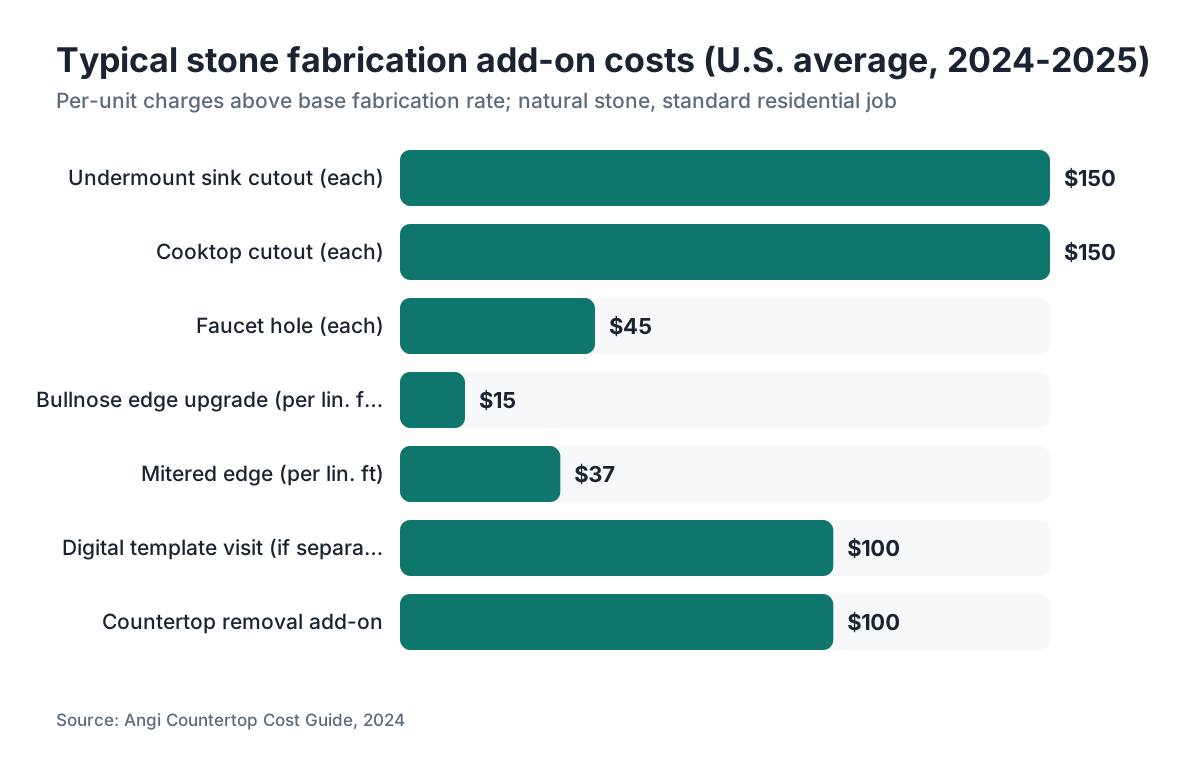
Stone cannot be stretched. That single fact is why templating drives quality. Measure short and you are cutting a new piece. Measure long and you are trimming on-site with a grinder, which leaves a rougher edge. Neither one is free. Most fabricators charge $50 to $150 for the template visit as a line item, though many fold it into the total quote.
For complex layouts, an L-shape or U-shape kitchen with multiple seam placements, the templater also decides where seams fall. Seam placement is partly structural (stone bridges need support) and partly aesthetic (a seam through the middle of a cooktop opening is a problem). The Natural Stone Institute's fabrication standards recommend that seam placement be documented in writing and approved by the homeowner before cutting begins [3].
What cutting equipment and saw types do fabrication shops use?
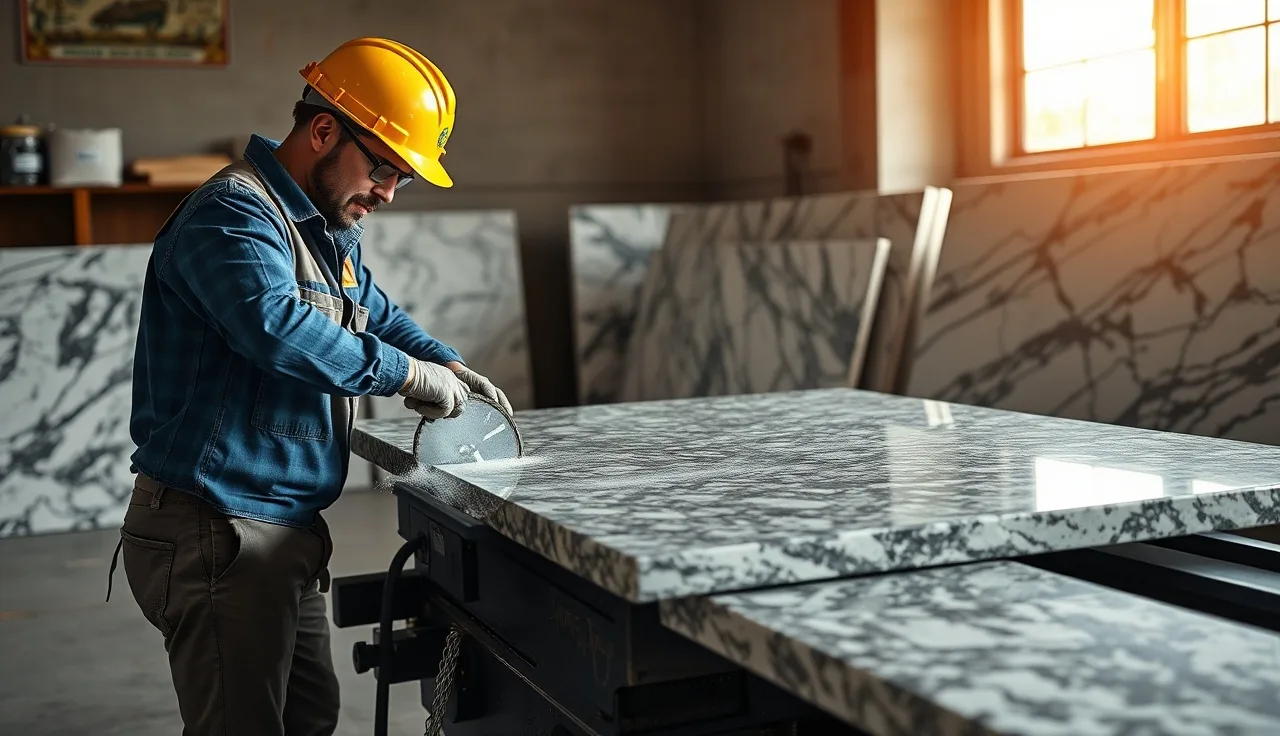
The main cutting tool in any stone shop is a bridge saw. It holds a diamond blade on a horizontal arm that travels on rails over the slab, which sits on a fixed table. Water floods the blade nonstop to cool the diamond segments and hold down silica dust. Entry-level bridge saws are manual or semi-automatic, and a skilled operator steers the blade path by hand. CNC bridge saws accept a programmed cut file and run automatically, which is faster and more repeatable but still needs a human loading and unloading slabs.
Diamond blade diameter for countertop work is typically 14 or 16 inches [4]. The diamonds are not solid. They sit embedded in metal segments around the rim. As the blade cuts, the metal wears away slightly and exposes fresh diamond. Blade hardness is matched to material hardness. Cut granite with a blade bonded too hard and the diamonds glaze over and stop cutting clean. Cut soft marble with a soft bond and the blade wears out too fast. Blade selection is a real craft skill. A fabricator who buys one blade for everything is cutting corners.
For curved cuts, miters, or specialty shapes, shops use handheld angle grinders with diamond blades or routers with diamond-tipped bits. These are not precise, but they are flexible. A good fabricator keeps handheld grinder work off anything the homeowner will see.
Silica exposure during cutting is a serious occupational hazard. OSHA's permissible exposure limit for respirable crystalline silica is 50 micrograms per cubic meter of air as an 8-hour time-weighted average [5]. The federal standard, 29 CFR 1910.1053, requires engineering controls (wet cutting, local exhaust ventilation) for stone fabrication, which is why water-cooled cutting is more than good practice. It is the law in commercial shops.
| Saw Type | Cut Accuracy | Best For | Typical Cost (equipment) |
|---|---|---|---|
| Manual bridge saw | ±2-3mm | Straight cuts, learning shops | $8,000-$25,000 |
| CNC bridge saw | ±0.5mm | High volume, complex layouts | $80,000-$250,000 |
| Waterjet cutter | ±0.1mm | Mosaics, tight radius, exotic shapes | $150,000-$500,000 |
| Handheld angle grinder | ±3-6mm | Site adjustments, one-off curves | $50-$400 |
What is CNC machining and when do shops use it for countertops?
CNC stands for computer numerical control. A CNC machine reads a digital file and moves a tool along programmed paths with no human steering. In stone fabrication, CNC does two main jobs: routing edge profiles and cutting interior shapes like sink openings or cooktop cutouts.
A CNC router for stone spins diamond-tipped bits at high speed with water cooling. It can run a bullnose profile, an ogee, a beveled edge, or a custom carved shape to the same dimensions across every linear inch. That consistency matters most on long runs, where a hand-profiled edge shows slight variation in height or curve radius at the seams. On a 12-foot island, that variation catches light and looks sloppy.
Shops with CNC equipment can also cut a sink opening with radius corners, meaning the corners of the undermount opening are round rather than square. A square interior corner concentrates stress and cracks easily. Most quality shops specify a minimum 3/8-inch radius on interior corners for exactly this reason [3].
Not every job needs CNC. A simple straight-edged countertop with a flat polish can be done entirely on a manual bridge saw with hand polishing. CNC time adds cost, typically $10 to $25 per linear foot for edges and $50 to $150 per cutout depending on complexity [6]. If you are comparing quotes, a CNC shop is not automatically better. It is more consistent at scale and on complex profiles.
How do edge profiles work, and which ones are structurally better?
An edge profile is the shape machined onto the exposed edge of a countertop. It is partly decoration and partly function. Some profiles protect the edge better. Others are purely looks.
The eased edge is the most common. It is a flat face with a slightly softened top corner, maybe 1/8 inch. It is clean, cheap to machine, and hides chips well because it has no thin lips to break. The bullnose is the most popular upgrade, rounding the top corner into a half-circle. It feels soft to the touch and forgives at seams. The ogee is the fancy S-curve profile that was everywhere in the 1990s and early 2000s. It looks ornate, but the thin top lip chips on granite if someone sets a cast-iron pan down hard.
Mitered edges, where two pieces of stone join at 45 degrees to fake a thick slab, keep gaining popularity because they let a 3/4-inch stone look 1-1/2 or 2 inches thick. They need precise CNC cutting to close the joint tight. A miter done by hand usually shows a gap. Done on a calibrated CNC, the seam can be nearly invisible before epoxy fill.
The worst edges for durability are any profile with a thin, unsupported ledge. An ogee with a full top lip, a double Roman, or a waterfall mitered edge with a very thin bottom face are all weak at the overhang. A 2cm stone (roughly 3/4 inch) is thinner than 3cm (roughly 1-1/4 inch) and takes edge damage more easily regardless of profile. Most fabricators push hard for 3cm stone on any edge profile with a projecting element [3].
What surface finishes are available and how are they applied?
The surface finish changes how stone looks, how it feels, and how much maintenance it needs. Polished is the default. A polished surface has run through a sequence of progressively finer abrasive grits, from coarse diamond pads in the 50 to 100 range up through 400, 800, 1500, and sometimes 3000, until the surface reflects light like glass. This happens with a variable-speed wet polisher and diamond pads. Figure 20 to 40 minutes per slab section for a skilled operator [6].
Honed finish stops short of full polish, usually ending around 400 grit. The surface is smooth but matte, with no shine. Honed shows fingerprints and water spots more than polished on darker stones. On marble, many designers prefer honed because it looks softer and reads like the carved stone in old architecture.
Leathered or brushed finish gets applied with flexible diamond brushes that raise the stone's crystalline texture slightly. Quartzite and granite both leather well. The finish hides fingerprints better than polished and has a tactile feel people either love or hate. It cannot go on engineered quartz, which has no natural crystal structure to raise.
Flamed and sandblasted finishes show up on outdoor or commercial jobs more than residential counters. A flamed finish exposes aggregate by thermal shock, giving a rough anti-slip surface. Nobody is putting flamed granite in a kitchen.
For homeowners, the maintenance question is real. A polished surface seals more easily and shows etching more dramatically, especially on marble and limestone. A honed surface forgives acid etch marks because there is no reflective surface to disrupt, but it soaks up stains faster if unsealed. Our guide on how to clean stone countertops covers the specifics.
How do fabricators handle seams, and what makes a seam look good?
A seam is where two pieces of stone meet. On countertops longer than the slab, or on L-shapes and U-shapes where corners join, seams are unavoidable. The goal is to make them invisible or close to it.
Good seam work starts before cutting. The fabricator matches slab sections so the veining or grain runs continuously across the joint. This is seam matching or book matching. On solid-color granite it barely matters. On a heavily veined white marble or a flowing quartzite, it is the whole game.
The joint gets filled with two-part epoxy color-matched to the stone. Most shops run a product system like Akemi or Tenax, blending pigments until the fill matches the stone's background. The epoxy goes on with the two sections clamped tight, sometimes with suction cup seam setters so the surfaces sit coplanar (flush). After cure, the epoxy is hand-polished flush with the surface.
A good seam is tight (under 1/16 inch), flat (surfaces level with each other within 1/32 inch), and matched in color [11]. A bad seam shows from across the room. Most residential countertop callbacks are about seams. The Natural Stone Institute's fabrication guidelines state that seam placement should be agreed on in writing before cutting, and that homeowners should understand seams will be visible on close inspection no matter the quality [3].
For quartzite specifically, seam care runs the whole life of the surface. The article on how to clean quartzite countertops covers what to avoid around seam lines.
What does stone fabrication cost, and what drives the price?
Fabrication cost is almost always quoted per square foot, and it covers labor and shop overhead but not the stone itself. Material is priced separately. Fabrication rates at most U.S. shops in 2024 and 2025 run $40 to $100 per square foot for standard work, with complex jobs (multiple cutouts, difficult edge profiles, book-matched seams) going higher [6]. The range is wide because regional labor costs, shop automation, and stone type all move the number.
Here is what typically adds cost:
- Edge profile upgrades. An eased edge is usually included. Bullnose adds $10 to $20 per linear foot. A mitered edge can add $25 to $50 per linear foot.
- Cutouts. Each sink cutout runs $100 to $200. Cooktop cutouts are similar. Faucet holes are $30 to $60 each.
- Stone type. Porcelain and ultra-compact surfaces are harder on tooling and need slower cutting, so some shops add a surcharge of 10 to 20 percent.
- Seam complexity. A simple straight seam costs less than a diagonal or book-matched seam with vein alignment.
- Stone thickness. Working with 2cm stone means extra lamination (gluing a strip to build up the edge), which adds labor.
Here is a number to hold onto. A typical 50-square-foot kitchen with one undermount sink, an eased edge, and two seams runs $2,500 to $4,000 in fabrication labor in most U.S. markets. Add material on top, which swings enormously from $30 per square foot for basic granite to $200 and up for rare quartzite.
Shops that run automated nesting software pull better yield from each slab, which cuts waste and holds material overhead down. Tools like SlabWise handle nesting and quoting digitally, so fabricators can price jobs faster and more accurately without leaving money on the table. For homeowners, asking a shop how they build quotes tells you a lot about how organized the operation is.
To understand what installation adds on top of fabrication, the countertop installation guide breaks that cost down separately.
How does stone fabrication differ by material type?
The techniques are the same in principle, but execution changes by material, sometimes a lot.
Granite is the workhorse. It is hard, abrasive on tooling, and cuts clean with a standard diamond blade. It polishes to a high gloss. Granite's interlocking crystal structure resists chipping at edges when the blade speed and feed rate are right. Most fabricators are most comfortable with granite because it forgives more than the alternatives.
Marble is softer (3 to 4 on the Mohs scale versus 6 to 7 for granite) [7] and cuts faster, but it fractures under stress if the slab gets handled roughly or the cutting table supports it unevenly. Marble seams need more careful epoxy color matching because the stone is often white or cream with dark veins that cannot hide. Etching from acidic foods is a consumer complaint, not a fabrication issue, but shops should disclose it.
Engineered quartz (Silestone, Caesarstone, Cambria, and others) has a polymer binder that makes it slightly flexible compared to natural stone. It cuts and edges much like granite, but the polymer can melt at the cut edge if the blade runs hot or dry. Steady water flow is the whole trick.
Porcelain panels (large-format porcelain, sometimes called sintered stone) are the hardest material most residential shops touch. They are thin (6mm or 12mm typically) and brittle. A 12mm porcelain slab snaps from a point impact granite would shrug off. Fabricating porcelain takes diamond blades rated for it, slower feed rates, and full-surface support when moving. Many shops either refuse porcelain or charge a steep premium.
Soapstone is the softest common countertop material, around Mohs 1 to 2 [7]. It cuts with almost no tool wear. The catch is that it scratches easily in the shop and has to be protected all through fabrication. Read the how to clean soapstone countertops guide to understand what the surface is like after installation.
Laminate, butcher block, and Corian are not stone but share some shop space. Laminate countertops and butcher block countertops use woodworking tools entirely. Corian countertops are solid-surface acrylic that routes and sands but needs different seaming chemistry.
What quality checks should a fabrication shop perform before delivery?
A good shop inspects pieces before they leave the building, not after they are installed. The checklist is short. It just needs someone willing to slow down.
Dimensional check: every piece gets measured against the template or DXF file. Length and width should match within 1/16 inch. If digital templating was used, the tolerance should be tighter.
Flatness: countertop sections should not rock when placed on a flat reference surface. Warp comes from cutting a slab that was not fully supported, or from grinding one face harder than the other during polishing.
Edge profile consistency: run a profile gauge along the edge and check for variation. A bullnose that is full-round in one section and slightly flat in another will catch light differently once installed.
Seam fit: dry-fit the pieces together before packing. Check flush level, gap width, and the color match of the epoxy fill.
Surface inspection: in raking light, look for scratches, pitting (small voids in the stone), tooling marks, or uneven polish. Natural pitting in granite or quartzite is a stone characteristic, not a flaw. Grinding scratches from a too-coarse abrasive left in before final polishing are a shop problem.
Sink and cooktop cutout corners: confirm radius corners are present and consistent. Check that cutout dimensions match the sink specs the homeowner provided. A cutout 1/4 inch too small means a site grind. Too large and the sink clips have nothing to grab.
Documentation: the shop should hand over a work order showing the template date, cut date, stone origin (slab number, quarry if known), seam placements, and any homeowner sign-offs. This matters for warranty claims and for kitchen countertops projects that eventually get sold with the home.
How is silica dust managed in stone fabrication shops?
This is not a side topic. Silica exposure in stone fabrication causes silicosis, an irreversible and sometimes fatal lung disease. The occupational risk in countertop fabrication is well documented, especially for engineered quartz, which can contain up to 93 percent crystalline silica compared to 20 to 45 percent in natural granite [5].
OSHA's final rule on respirable crystalline silica (29 CFR 1910.1053 for general industry) took effect in 2018. It requires fabrication shops to keep a written exposure control plan, use engineering controls as the primary way to cut exposure, and run medical surveillance for workers exposed above the action level of 25 micrograms per cubic meter [5]. The standard states that employers must limit exposure to a PEL of "50 µg/m3, calculated as an 8-hour TWA."
In practice, compliant shops wet-cut all slab work (the water suppresses dust at the source), add local exhaust ventilation at grinding and polishing stations, enclose or downdraft dry processes, and use respirators as a supplemental control. NIOSH-approved respirators for silica are N95 at minimum, with P100 preferred for grinding [8].
California has enforced this harder than most states. Cal/OSHA's silica standards mirror federal OSHA but come with more active inspection in the Bay Area and Southern California, where fabrication shops cluster. Several enforcement actions have produced six-figure penalties for shops running dry cutting without controls [10].
As a homeowner you would not usually see any of this. But you can ask a shop whether they wet-cut and run local exhaust ventilation. A shop that does not know what you are asking probably has no written exposure control plan, which is a compliance problem. It also tells you how they run everything else.
What should homeowners look for when choosing a fabrication shop?
The equipment list matters less than the people running it. A shop with a CNC machine and a rushed, undertrained crew turns out worse work than a careful manual shop. Still, some things are worth checking.
Ask to see the shop, not the showroom. A clean shop with organized slab storage, visible water systems on the saws, and clear workflow layout tells you plenty. Slabs stored vertically on A-frames without padding arrive at your house with edge chips. Slabs laid on unpadded rollers pick up surface scratches.
Ask for references from jobs with material like yours. Granite references say nothing about how a shop handles a difficult quartzite or a thin porcelain panel.
Ask about the warranty. Most residential shops offer 1 year on workmanship. Some offer less. Find out exactly what is covered: seams reopening, edge chipping, dimensional errors. And what is not: natural pitting, consumer damage, stone characteristics disclosed before purchase.
Get seam placement documented before cutting starts. This is the single most common source of post-installation disputes. Where the seam falls relative to a cooktop or prep area affects daily use more than it affects looks.
For engineered quartz, ask whether the shop is certified by the manufacturer. Cambria, Caesarstone, Silestone, and others run fabricator certification programs that require training on their specific material [9]. Installing engineered quartz wrong (bad support, wrong adhesive) can void the manufacturer's warranty.
On price: the cheapest quote is usually cheap for a reason. Material substitution (a lower slab grade than quoted), thinner stone than specified, skipped edge treatments, or rushed templating are the usual ways a shop hits a low number. Get itemized quotes, not a lump total, so you can compare line by line.
Frequently asked questions
How long does stone fabrication take from template to installation?
Most residential countertop projects take 5 to 14 business days from the template date to installation. Simple jobs in a busy, well-equipped shop can finish in 3 to 5 days. Complex projects with multiple seams, unusual materials like porcelain, or high shop volume can push to 3 weeks. Ask your fabricator for a specific commitment and get it in writing, because your kitchen timeline with contractors depends on it.
What is the difference between 2cm and 3cm stone thickness?
2cm (roughly 3/4 inch) stone is thinner, lighter, and cheaper per square foot. Most fabricators laminate a strip of matching stone to the front edge to make it look thicker. 3cm (roughly 1-1/4 inch) is heavier but needs no lamination and is stronger, especially at overhangs and around cutouts. Most shops and most manufacturers recommend 3cm over 2cm for residential countertops.
Can fabricators fix chips or cracks in natural stone?
Yes, within limits. Small chips (under 1/4 inch) can be filled with color-matched epoxy and re-polished, often invisibly. Larger edge chips may need a replacement section. Cracks that run through the full thickness are structural and usually cannot be repaired to the point of being unnoticeable. Prevention matters more: edge profile choice, cabinet support, and avoiding point impacts cut the risk a lot.
What is waterjet cutting and when does a fabricator need it?
Waterjet cutting uses a high-pressure stream of water mixed with abrasive garnet to cut stone without a blade. It is highly precise (within 0.1mm), makes no heat, and cuts any shape including tight curves, decorative cutouts, and mosaics. Most residential countertop work does not need it. It earns its keep on medallions, custom sink cutouts with very small radii, or pattern matching in exotic stone where a saw blade would fracture the material.
Why do some countertop slabs need to be supported with a mesh or rod?
Some materials, particularly marble and exotic quartzite with long veins running across a weak axis, get reinforced on the back face with fiberglass mesh or epoxy-set rods before or during fabrication. This is back rodding or back netting. It does not change the look but sharply cuts the chance of the slab cracking during transport or installation. Shops that skip this on structurally marginal slabs are gambling at the homeowner's expense.
Is there a way to see seam placement before the stone is cut?
Yes. With digital templating, the shop can show you a layout drawing before cutting, with seam lines marked. Some shops use visualization software that overlays the cut pattern on a photo of the actual slab. If your shop only does paper templates, ask them to sketch the seam placement on the template and confirm it with you before the cut date. This is standard practice, and any reputable shop should accommodate it.
What is backsplash fabrication and is it done the same way as countertops?
Backsplashes are cut from the same slab material using the same bridge saw and finishing equipment. The main difference is size: backsplash pieces are often thin strips (4 to 6 inches tall, sometimes full slab height for a dramatic effect). Outlets and switches need precise rectangular cutouts, usually done on a CNC router. Matching the polish level and finish of the countertop exactly means running the backsplash pieces through the same polishing sequence.
What causes countertop stone to crack after installation?
Post-installation cracks come from a few sources. Thermal shock (a frozen pan straight on stone, or direct heat from a pot) can crack even thick granite. Weak cabinet support, especially at overhangs past 10 to 12 inches, creates flexural stress. Cutout corners with no radius concentrate stress and crack under point loading. Settlement cracks happen when cabinets shift. And some slabs carry natural fissures a fabricator should have flagged. Fabrication error and homeowner misuse are both real causes.
How do fabricators match stone veining across seams?
The fabricator picks two adjacent sections from the same slab and orients them so the veining runs across the joint as naturally as possible. On highly directional stones, this sometimes means sacrificing yield to get the pattern right. For book-matched seams, one piece is flipped like turning a page in a book, creating a mirrored vein pattern. Book matching needs a very tight, precise seam to look right and shows up most on dramatic slabs where the effect justifies the cost.
Do fabricators handle countertop removal, or is that separate?
Many shops offer removal of existing countertops as an add-on, usually $50 to $150 for a standard kitchen. Some do not do it at all and expect the homeowner or general contractor to handle it before the template date. In older homes, tile or laminate countertops on plywood decking add complexity. Confirm this scope in writing before scheduling, because a missing countertop removal on installation day delays everything.
What is the role of epoxy in stone fabrication?
Epoxy is the primary adhesive and filler in countertop fabrication. It bonds seam joints, fills chips and voids in the stone surface, laminates strips to build up 2cm edges, and anchors undermount sinks. Two-part epoxy systems made for stone (Akemi, Tenax, and Integra are common brands) cure very hard and get color-matched to the stone. Water-clear epoxy handles transparent repairs on dark stones. The quality of epoxy work is one of the most visible signs of a shop's overall skill.
Can fabricators work with stone outdoors, and does it change the technique?
Outdoor countertops, usually for outdoor kitchens and bars, use the same cutting and finishing equipment. The material choice changes: granite and quartzite hold up well outside, while marble weathers and etches from rain. Some finishes do better outdoors than others. A polished surface shows water spots and weathering more, and a leathered or honed finish forgives it. Seams outdoors should be sealed with a UV-stable epoxy, since standard epoxy yellows under prolonged sun.
What questions should I ask a fabricator before signing a contract?
Ask: What templating method do you use, digital or manual? Who runs the template, and is that the same person who reviews the cut file? Where will the seams fall, and can you show me on a drawing? What edge profiles are in the base price? What is your warranty and what does it exclude? Do you wet-cut throughout? What is the lead time from template to installation, in writing? These questions sort organized shops from disorganized ones fast.
Sources
- Natural Stone Institute (formerly Marble Institute of America), Dimension Stone Design Manual: Full granite slabs commonly weigh 700-900 pounds depending on size and thickness.
- Laser Products Industries, digital templating systems overview: Digital templating scanners capture a space in three dimensions and export a DXF file directly to CNC equipment, reaching accuracy within roughly 1mm.
- Natural Stone Institute, Fabrication and Installation Standards: The Natural Stone Institute recommends seam placement be documented in writing before cutting, a minimum 3/8-inch radius on interior corners, and 3cm thickness for profiles with projecting elements.
- OSHA, Crystalline Silica page (stone fabrication guidance): Diamond blades of 14-16 inches are standard for bridge saws in countertop fabrication; water cooling is required for dust suppression.
- U.S. OSHA, 29 CFR 1910.1053 Occupational Exposure to Respirable Crystalline Silica: OSHA's PEL for respirable crystalline silica is 50 micrograms per cubic meter (8-hour TWA); engineered quartz can contain up to 93% crystalline silica; the action level is 25 micrograms per cubic meter.
- Angi (formerly HomeAdvisor), Granite Countertop Cost Guide: Stone fabrication labor typically runs $40-$100 per square foot; CNC edge profiling adds $10-$25 per linear foot; sink cutouts add $100-$200 per opening.
- National Park Service, Mohs Hardness Scale reference: On the Mohs hardness scale, marble rates roughly 3-4, granite 6-7, and soapstone (talc-rich) 1-2.
- NIOSH (CDC), Silica in stone fabrication and respirator guidance: NIOSH recommends P100 respirators as preferred over N95 for grinding operations in stone fabrication shops.
- Cambria, Fabricator Certification Program: Cambria and other engineered quartz manufacturers operate fabricator certification programs requiring training on their specific materials; improper fabrication can void manufacturer warranty.
- California Division of Occupational Safety and Health (Cal/OSHA): Cal/OSHA has run active inspection programs in California fabrication shops, producing significant penalties for shops without compliant dust controls.
- Natural Stone Institute, Countertop Fabrication Tolerances: Industry fabrication standards specify seam flatness within 1/32 inch and seam gap under 1/16 inch for acceptable residential work.
Last updated 2026-07-09