TL;DR
- Four forces are reshaping stone fabrication in 2025: tighter OSHA silica dust enforcement, softening engineered-quartz demand as silicosis lawsuits pile up, a decade-long skilled-labor shortage, and tariff-driven price swings on imported slabs.
- Shops that fix their dust controls, widen their slab mix, and quote faster are pulling ahead.
- Ones that don't are getting squeezed on both cost and liability.
What is the biggest news in stone fabrication right now?
Silica dust is the loudest story in the trade. Not because it's new. OSHA's respirable crystalline silica rule for construction has been on the books since 2017. What changed is enforcement pressure inside fabrication shops, which has ramped up sharply since 2023. The rule sets a permissible exposure limit (PEL) of 50 micrograms per cubic meter of air as an eight-hour time-weighted average, down from the old 250 µg/m³ limit [1]. That's a fivefold cut. Plenty of wet-saw and dry-polishing setups still can't hit it reliably without engineered controls.
Lawsuits are the second half of the story. A wave of silicosis injury litigation, centered on workers who fabricated engineered quartz containing 90-plus percent silica by weight, has already remade the Australian market. Australia banned engineered stone for benchtop fabrication in July 2024 [2]. The U.S. hasn't followed with a ban, but the litigation has landed here. Multiple class actions and individual claims are moving through state courts, and at least one major engineered-stone brand has faced settlements tied to fabricator health claims. Shops are watching all of it.
Behind those two headlines sits a third. The quartz countertop market that carried shop revenue through the 2010s is cooling. Design taste has been rotating back toward natural stone for two to three years now, especially quartzite, dolomite, and bookmatched marble. Demand for granite countertops and marble countertops has picked up as a result. Fabricators who built their whole operation around quartz are retooling both their skills and their marketing.
How is the OSHA silica rule affecting fabrication shops in 2025?
The rule hits shops through 29 CFR 1910.1053 (general industry) and 29 CFR 1926.1153 (construction, which covers field installation) [1]. For shops, it requires monitoring triggered at the 25 µg/m³ action level, a 50 µg/m³ PEL, a written exposure control plan, a designated competent person, and medical surveillance for anyone exposed above the action level for 30 or more days a year.
Here's the practical problem. Dry-cutting and dry-grinding engineered quartz blows past the PEL by a factor of ten or more with no controls at all. Table 1 in the construction standard lists specified engineering and work-practice controls that give you a presumption of compliance for certain tasks, but you have to actually run them, more than know they exist. Wet cutting with integrated water delivery, enclosed blade guards, and local exhaust ventilation are the main tools. Respirators alone don't count when engineering controls can feasibly reach the PEL [1].
Inspections are up. OSHA's National Emphasis Program on Respirable Crystalline Silica tells compliance officers to target stonecutting and stone products establishments, among other high-risk sectors [3]. Willful violations can hit $156,259 each under 2024 inflation-adjusted penalties. Serious violations run up to $15,625 each. Those numbers can end a mid-sized shop.
The gap inspectors find most often isn't missing water delivery. It's thin exposure-monitoring records and no written exposure control plan. Shops tend to have the hardware and not the paperwork. Both are required, and the paperwork is what gets cited.
What is the silicosis and engineered quartz lawsuit situation in the U.S.?
Silicosis is a fibrotic lung disease from inhaling fine crystalline silica particles. There's no cure. Progressive massive fibrosis, the worst form, is fatal [4]. Engineered quartz products, sold under brands like Cambria, Caesarstone, and Silestone, run roughly 90 to 93 percent silica by weight. Cut, ground, or polished dry, they throw off respirable silica at levels that can produce accelerated silicosis in a few years of exposure, versus the decades typical for miners or sandblasters.
Australia's July 2024 ban followed a Safe Work Australia determination that occupational exposure couldn't be controlled adequately. The Safe Work Australia report described the silicosis rates among engineered-stone fabricators in stark public-health terms and recommended prohibition [2].
In the U.S., as of mid-2025, lawsuits are active in California, Texas, Florida, and New York state courts. Plaintiffs are mostly former fabrication workers, often immigrants who worked in small shops, diagnosed with accelerated silicosis before age 45. Defendants include both manufacturers and distributors. There's no federal ban, and OSHA hasn't proposed an engineered-stone-specific rule, but several legal scholars point to the Australian precedent as a template U.S. regulators could copy.
For fabricators, this is real liability. Workers' comp usually caps employer liability for occupational disease, but weak dust controls can crack the door to third-party tort claims. Talking to a labor attorney and documenting your silica program isn't optional anymore. For homeowners worried about the finished product: once a slab is installed and sealed, Cambria countertops and other engineered surfaces carry essentially no silica risk in normal use. The hazard lives in the fabrication shop, not the kitchen.
How are tariffs affecting stone slab prices in 2025?
Slab pricing has gotten genuinely hard to predict. The Section 301 tariffs on Chinese goods, in effect since 2018 and expanded in 2024, cover many engineered quartz products and some natural stone. The 2024 USTR review pushed tariffs on Chinese quartz to 150 percent [5]. That's not a typo. It has effectively ended most Chinese quartz imports into the U.S.
Natural stone is messier. Brazilian, Indian, and Italian imports fall under different schedules and, as of mid-2025, mostly haven't seen the same jump. But the broad reciprocal-tariff proposals floating around early 2025 spooked importers and distributors, who passed that uncertainty down to fabricators as price volatility. A slab that landed at $18 per square foot in January might get quoted at $22 to $26 by the time it hits a regional yard in June, with real doubt about what the next container costs.
Here's what fabricators are actually doing. Quote materials at current replacement cost, not what you paid. Some shops moved to open-book pricing on large jobs, showing the client the slab ticket plus a fixed fabrication fee. Others added a material escalation clause to contracts that won't settle for more than 60 days. Both are honest. Both hold up.
Homeowners, listen for this. A fabricator who says "the slab price may move before we order" is being straight with you, not setting up a bait-and-switch. Ask them to lock the price for 30 days in writing. Most can do that on material already sitting in their yard.
What does the stone countertop market actually look like in terms of size and growth?
The U.S. countertop market is big. The Census Bureau's Annual Survey of Manufactures tracks activity under NAICS 327991 (Cut Stone and Stone Product Manufacturing) [11], and the broader kitchen and bath renovation spend shows up through the Joint Center for Housing Studies at Harvard [12] and National Kitchen and Bath Association (NKBA) surveys.
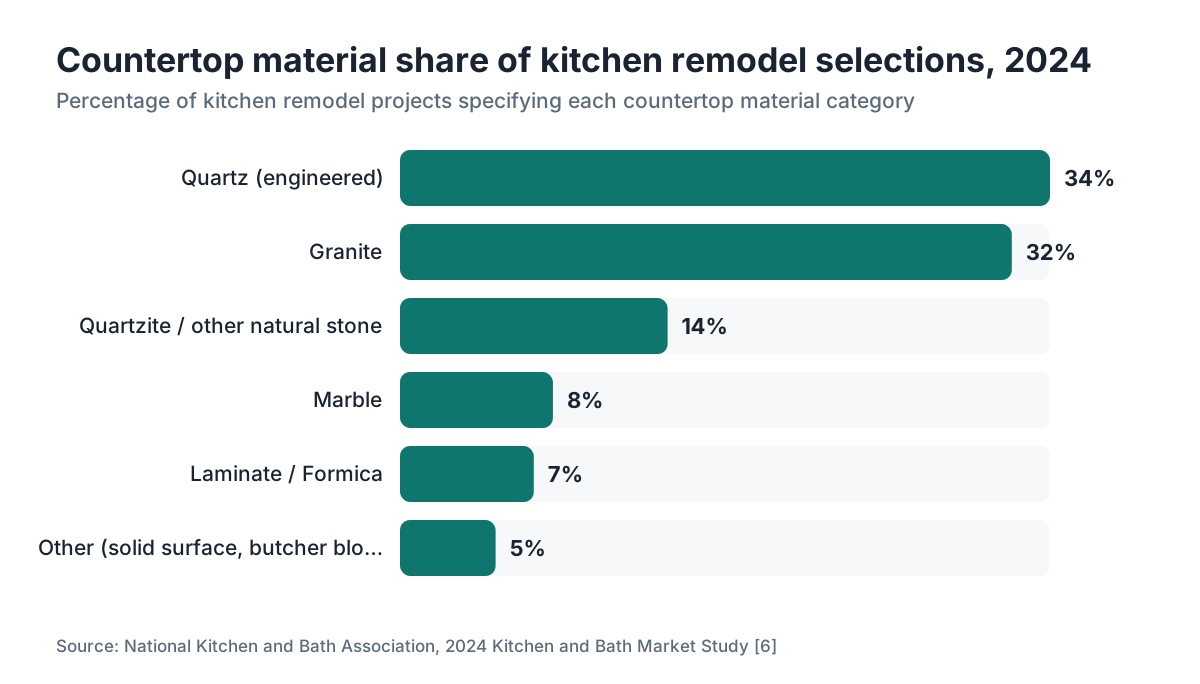
Granite and quartz together account for roughly 66 percent of countertop material selections in kitchen remodels, per the NKBA's 2024 Kitchen and Bath Market Study [6]. That combined share has held fairly steady, but the mix inside it is moving. Quartz has slipped from its 2019-2020 peak while quartzite and dolomite have roughly doubled their share of the natural-stone categories since 2020. Laminate, tracked on its own, keeps holding a steady budget slot. For context on those, see laminate countertops.
Revenue per job is up, driven by material inflation and the shift toward labor-heavy natural stones with complicated edge profiles. NKBA data suggests average kitchen countertop project spend rose from roughly $3,600 in 2020 to over $5,500 by 2023 [6]. That number swings hard by region and material.
The workforce is the constraint. The Bureau of Labor Statistics Occupational Employment and Wage Statistics program files stone cutters and sawyers under SOC 51-9195. As of the May 2023 survey, the median annual wage for that occupation was $41,280, with the 75th percentile at $52,390 [7]. Those wages have trailed inflation and competing trades, which feeds a hiring problem that won't quit.
Is there a skilled labor shortage in stone fabrication, and how bad is it?
Yes. It's bad, and it's been building for a decade.
Stone fabrication takes two to four years to learn: reading templates, running CNC equipment, hand-finishing edges, managing water systems, seaming stone tight, and installing without cracking a slab. Those skills don't port over cleanly from other trades. And shops have historically paid less than comparable construction work, so the fight for experienced hands is brutal.
The Associated General Contractors of America's 2024 workforce survey found that 93 percent of construction and specialty contractors reported trouble filling hourly craft positions [8]. Stone fabrication sits right next to that world and shares the same broken pipeline. Vocational programs that teach fabrication specifically are rare. The Natural Stone Institute (formerly the Marble Institute of America) runs training programs, but the graduate count is a small slice of what the industry needs [9].
You see it in lead times. A custom stone countertop that took three to four weeks from template to install in 2019 now commonly runs five to eight weeks at many shops. The machines aren't slower. Scheduling around available skilled labor is harder. Shops are pushing CNC automation harder to cut the number of skilled hands per job. Digital templating, CNC waterjet cutting, and automated polishing lines are investments more shops are making precisely because hiring is so hard.
This is also where quoting software earns its keep. Save an hour a day on manual estimating, say through platforms like SlabWise that automate slab nesting and pricing, and you give your best estimator more capacity without a new hire. When labor is this tight, that hour has a real dollar value.
What technology trends are changing how fabrication shops operate?
CNC waterjet and CNC bridge saw adoption has been the dominant tech story of the past decade. The 2023-2025 stretch added two newer threads: digital templating systems and AI-assisted quoting.
Digital templating, using laser measuring devices like the Prodim Proliner or LT-2D3D systems, went from specialty tool to near-standard gear at shops doing more than 50 jobs a month. The device captures precise measurements, spits out a digital DXF file, and feeds it straight to the CNC. The error rate from manual template transfer drops hard. The real payoff is more than accuracy. It's speed, and the ability to hand template-to-cut work to a remote technician or run jobs overnight.
AI-assisted quoting and automated nesting are the next wave. Nesting is the job of figuring out how to cut multiple pieces from a slab with the least waste, and it's traditionally been manual or done with basic CAD. Optimized nesting can cut slab consumption by 8 to 15 percent on typical jobs. At $15 to $25 per square foot in material, that's real money, not rounding error. Software that handles it automatically is genuinely useful.
Remote collaboration with homeowners has evolved too. Virtual slab selection, where a fabricator shares high-resolution slab photos with tagged yard locations and the homeowner approves remotely, has trimmed in-person yard visits and shortened the sales cycle. Shops that use it report fewer "I changed my mind after seeing it in person" reversals, which is a genuine scheduling headache when capacity is tight.
If you want to understand what a properly run project involves, the full countertop installation sequence from template to final set is worth reading before you sign anything.
What natural stone trends are gaining ground with designers and homeowners?
Quartzite is the biggest story in natural stone right now. It gives designers what they want: the visual movement of marble with far better acid resistance and hardness. Quartzite sits around 7 on the Mohs scale versus 3 to 4 for marble, so it shrugs off kitchen acid splashes that would etch a marble top. It's harder to fabricate, which is part of why it costs more, but demand has outrun supply in the premium slab market for three years straight.
Bookmatching has moved from high-end hospitality projects into ordinary residential jobs. A bookmatched install uses two consecutive slabs cut from the same block, opened like a book so the veining mirrors across a seam. The effect stops people in the doorway. The cost premium is real. You're buying two slabs for what might otherwise be a one-slab job, and the labor to align that seam precisely is significant. But when a homeowner is putting $8,000 to $15,000 into a kitchen countertop, bookmatching is often the detail that makes the room.
Soapstone and dolomite are getting renewed attention too. The care questions come up fast, so see how to clean quartzite countertops and how to clean soapstone countertops for the practical stuff. How to clean stone countertops covers the broad principles.
On the engineered side, ultra-compact sintered surfaces (Dekton, Lapitec, Neolith) are drawing fabricator interest as a lower-silica alternative to quartz with different regulatory implications. They need diamond tooling and slow feed rates, but several fabricators describe them as a product they can sell with a clear conscience while the quartz litigation plays out.
How are sustainability and environmental concerns affecting the fabrication industry?
Sustainability pressure hits fabrication from a few directions at once.
Water use is a live operational concern. A wet-saw CNC bridge saw in active production can pull 50 to 200 gallons of water an hour. Most shops recirculate through settling tanks, but the leftover solids, a slurry of stone dust and silica, need proper disposal. Dump silica slurry the wrong way and you create environmental liability, and some municipalities have tightened discharge permits for fabrication operations. Shops that treat and document their slurry disposal are ahead of a regulatory wave that's still building.
Remnant disposal is the sister problem. A typical job leaves 20 to 40 percent of a slab as cutoffs. Big pieces sell as remnants for smaller projects. Small ones usually hit the dumpster. There's a small but growing market for remnant stone in landscape, flooring, and mosaic work, and a few regional recyclers now take fabrication remnants for aggregate or resale, though coverage is patchy outside major metros.
Carbon footprint on imported stone is a real number that some commercial and LEED-certified residential projects now want documented. Stone quarried in Italy and shipped to the U.S. carries a different footprint than domestic material. Domestic granite sources exist in Vermont, Georgia, and elsewhere. The Barre, Vermont granite district has supplied U.S. fabricators for over a century. For homeowners weighing the material choice, the kitchen countertops overview covers the full landscape, footprint included.
What should homeowners know about how industry changes affect their countertop project?
Lead times are longer than they were five years ago. If a fabricator says six to eight weeks, believe them. Chasing the fastest-quoting shop instead of the most competent one is a false economy. Stone that's templated wrong, seamed poorly, or set without proper substrate support will show problems inside a year.
Material prices swing. Get a quote that names the exact slab (by lot and bundle number if possible) and locks that price for 30 days. Understand that if your job is scheduled six weeks out and the material hasn't been pulled from the yard yet, you may face an adjustment.
Ask your fabricator straight about silica dust controls. A shop that wet-cuts, runs local exhaust ventilation, and keeps a written exposure control plan is one that takes worker health seriously. That kind of discipline usually tracks with careful, accurate fabrication overall. The question isn't rude. It's a quality signal.
If you're considering materials that simplify care or cut cost, butcher block countertops and Corian countertops are useful benchmarks. Neither involves silica dust in fabrication, and both have stable, mature supply chains.
Get at least three quotes. Not because the lowest one wins, but because the spread tells you plenty. If one quote comes in 40 percent under the others, something's off. The shop cut corners on material grade, skipped the cost of silica controls, or bought slab lots that carry quality risk. The quotes that cluster together are your real market rate.
What industry associations and publications cover stone fabrication news?
The Natural Stone Institute (NSI) is the main trade association for U.S. stone fabrication. Formed from the merger of the Marble Institute of America and the Building Stone Institute, NSI publishes technical bulletins, runs the Accredited Natural Stone Professional (ANSP) certification, and advocates on regulatory issues including OSHA silica enforcement. Its site posts member alerts when rules change [9].
The Tile Council of North America (TCNA) and the Ceramic Tile Distributors Association cover adjacent markets and occasionally cross into fabrication on installation standards.
StoneCon is the industry's main annual conference. It pulls together fabricators, tooling suppliers, and software vendors, and it's a decent read on where the industry is actually spending money.
For trade press, Stone World magazine has covered the business for decades with a mix of project features and news. The Natural Stone Institute's technical bulletins and OSHA's small-entity compliance guides are free public resources worth bookmarking.
On the regulatory side, three federal sources touch most shops day to day: OSHA's silica pages, the Mine Safety and Health Administration (MSHA) for quarry operations, and EPA industrial stormwater permit guidance for slurry disposal [1][3][10]. Shops in California also answer to Cal/OSHA, which often runs stricter than the federal standard, and the California Division of Occupational Safety and Health has been an aggressive enforcer in the stone fabrication sector.
Frequently asked questions
Is engineered quartz banned in the U.S. like it is in Australia?
No. Australia banned engineered stone for benchtop fabrication in July 2024 after Safe Work Australia flagged silicosis among fabricators as a public health emergency. The U.S. has no such ban as of mid-2025. OSHA's silica rule governs exposure limits, and litigation is ongoing, but American fabricators can still legally work with engineered quartz if they meet the 50 µg/m³ permissible exposure limit using proper engineering controls.
What is the OSHA silica permissible exposure limit for stone fabrication workers?
OSHA sets the PEL at 50 micrograms of respirable crystalline silica per cubic meter of air, measured as an eight-hour time-weighted average, under 29 CFR 1910.1053 for general industry shops and 29 CFR 1926.1153 for construction work. The action level that triggers monitoring and medical surveillance is 25 µg/m³. Dry cutting engineered quartz can top 500 µg/m³ without controls.
How much do tariffs add to stone countertop prices in 2025?
Chinese engineered quartz now faces a 150 percent tariff following the 2024 USTR Section 301 review, which effectively removed it from the U.S. import market. Natural stone from Brazil, India, and Italy falls under different, generally lower schedules. The retail effect varies by material and region, but fabricators report 10 to 25 percent material cost increases on many imported slabs compared with 2022 baseline prices.
Why are countertop fabrication lead times so long right now?
Skilled labor is the main bottleneck. Fabrication takes two to four years to learn, and the trade has struggled to attract workers at wages that trail comparable construction trades. Most shops run at or near capacity. Template-to-install timelines that ran three to four weeks in 2019 now commonly run five to eight weeks at busy shops. Waiting on a specific slab lot can add more delay.
What natural stone is most popular right now in 2025?
Quartzite has been the fastest-growing natural stone category for two to three years. Its mix of marble-like looks and better acid resistance than true marble drives strong designer and homeowner demand. Bookmatched marble and dolomite are gaining share at the premium end. Granite still holds the largest overall volume by a wide margin.
How do fabrication shops handle stone slab remnants and waste?
Large remnants (pieces above roughly two square feet) usually sell at a discount for small projects, backsplashes, or secondary surfaces. Smaller cutoffs often hit the dumpster, though a growing number of regional recyclers accept fabrication remnants for landscape or aggregate use. Slurry water from wet cutting must be settled and disposed of under local discharge permits. Improper slurry disposal can trigger environmental violations.
Is CNC technology standard in stone fabrication shops now?
CNC bridge saws are standard equipment at most shops doing significant volume. CNC waterjet cutting, which allows complex curved cuts without blade stress, is common at mid-to-large shops. Digital laser templating is approaching standard at shops doing 50-plus jobs a month. Smaller shops doing fewer than 20 jobs monthly may still rely on manual templating and conventional wet saws, though digital adoption is spreading even there.
What wages do stone fabrication workers earn?
The Bureau of Labor Statistics May 2023 Occupational Employment and Wage Statistics survey put the median annual wage for stone cutters and sawyers (SOC 51-9195) at $41,280, with the 75th percentile at $52,390. Experienced CNC operators and lead fabricators at high-volume shops can earn above that, but the median has trailed inflation and competing trade wages, feeding directly into the labor shortage.
What should I ask a fabricator before hiring them for a stone countertop?
Ask how they control silica dust, whether they wet-cut or run local exhaust ventilation, what their current lead time is, and whether they can lock your slab price once it's pulled from the yard. Ask to see seams on completed jobs. Confirm they'll pull a permit for install if your municipality requires one. Get the quote in writing with the specific slab lot number. Three competing quotes give you a meaningful price range.
How does the silicosis lawsuit wave affect homeowners buying stone countertops?
Homeowners face no risk from silica in installed, sealed countertops. The hazard is in the fabrication process, not the finished surface. The litigation may affect fabricator insurance costs, product availability if brands exit the market, and long-term engineered-quartz pricing. Choosing a shop with solid dust controls is also choosing one likely to stay in business long enough to honor a warranty claim.
What is sintered stone and is it replacing quartz in fabrication shops?
Sintered stone (Dekton, Lapitec, Neolith, and similar brands) is made by applying extreme heat and pressure to a mineral mix, producing a dense, non-porous surface. It has lower silica content by weight than engineered quartz and generally better heat and UV resistance. It needs specialized tooling and slow cutting speeds. Some fabricators actively push it as a quartz alternative while silica litigation concerns stay high, though it costs more and takes longer to process.
Are domestic (U.S.-quarried) stone slabs a viable alternative to imported stone?
Yes, for some material categories. Vermont and Georgia are established granite-producing states, and Vermont quarries have operated for over a century. Domestic material dodges tariff exposure and carries a lower shipping carbon footprint. The trade-off is limited variety next to global import options. Most domestic stone still moves through the same distributor yard system as imported stone, so sourcing it works the same way for fabricators.
What software are fabrication shops using to improve efficiency?
Digital templating software (interfacing with Prodim, LT-2D3D, and similar devices) and CNC-compatible file formats are table stakes at most mid-size shops. Quoting and job-management software, including cloud tools that handle slab nesting and automated pricing, are an active investment area. The point is cutting the skilled-estimator time per job, which matters when labor is short. Some shops also run customer-facing portals for slab approval and change-order sign-off.
Where can I find the OSHA rules that apply to my fabrication shop?
Start at OSHA's crystalline silica standards page, which links both 29 CFR 1910.1053 (general industry) and 29 CFR 1926.1153 (construction). It hosts the small-entity compliance guides, sample written exposure control plans, and the Table 1 task list. For quarry-side operations look at MSHA, and for slurry discharge check EPA industrial stormwater permit guidance and your state or municipal permit office.
Sources
- OSHA, Respirable Crystalline Silica Standards for Construction and General Industry: OSHA's silica PEL is 50 µg/m³ as an 8-hour TWA under 29 CFR 1910.1053 and 29 CFR 1926.1153
- OSHA, National Emphasis Program on Respirable Crystalline Silica: OSHA's silica National Emphasis Program directs compliance officers to target stonecutting and stone products establishments
- CDC/NIOSH, Silica page: Silicosis is a fibrotic, incurable lung disease; progressive massive fibrosis is its most severe and fatal form
- Office of the United States Trade Representative, Section 301 Investigations: The 2024 USTR Section 301 review raised tariffs on Chinese quartz products to 150 percent
- National Kitchen and Bath Association, 2024 Kitchen and Bath Market Study: Granite and quartz together account for roughly 66 percent of countertop material selections in kitchen remodels per the 2024 NKBA study; average kitchen countertop spend rose from about $3,600 in 2020 to over $5,500 by 2023
- U.S. Bureau of Labor Statistics, Occupational Employment and Wage Statistics: Median annual wages for stone cutters and sawyers (SOC 51-9195) were $41,280, with 75th percentile at $52,390, per May 2023 BLS OEWS data
- Associated General Contractors of America, 2024 Workforce Survey: 93 percent of construction and specialty contractors reported difficulty filling hourly craft positions in the 2024 AGC workforce survey
- Natural Stone Institute, Accreditation and Training Programs: NSI runs the ANSP certification and publishes technical bulletins on regulatory and fabrication standards
- U.S. Environmental Protection Agency, Industrial Stormwater Program: EPA industrial stormwater permitting under NPDES governs discharge from fabrication operations including slurry handling
- U.S. Census Bureau, Annual Survey of Manufactures: NAICS 327991 (Cut Stone and Stone Product Manufacturing) captures U.S. fabrication industry activity in Census economic surveys
- Joint Center for Housing Studies at Harvard University: Harvard JCHS tracks kitchen and bath renovation spending trends used as context for countertop market growth
Last updated 2026-07-09