TL;DR
- Stone countertop fabrication turns raw slabs into finished, installed countertops through templating, digital layout, CNC or waterjet cutting, edge profiling, polishing, and installation.
- A typical kitchen takes 1 to 3 weeks.
- Material and fabrication combined run $40 to $200 per square foot installed, depending on stone type, complexity, and where you live.
What is stone countertop fabrication, exactly?
Fabrication is everything between a raw slab sitting in a yard and a finished countertop sitting in your kitchen. It covers templating, digital layout, cutting, edge profiling, cutouts for sinks and cooktops, surface finishing, seam work, and installation. Most homeowners think they're buying a countertop. They're really buying a fabrication service that happens to include the stone.
The stone itself, granite, marble, quartzite, soapstone, quartz composite, can be bought as a raw slab from a distributor. The fabricator then processes it to your exact dimensions. Some shops own their slabs. Others let you buy the slab yourself and bring it in. Either way, the fabrication labor is the thing you're really hiring.
Quality varies enormously. Two shops can cut from the same slab and produce countertops that look and perform completely differently, because the difference lives in the tolerance of the cuts, the edge work, the care during installation, and the accuracy of the template. A bad template means seams that gap, edges that don't line up with cabinets, and cutouts that bind on an undermount sink.
For homeowners shopping kitchen countertops, understanding fabrication helps you ask better questions and catch problems before they're permanent. For fabricators, the process defines your cost structure, your throughput, and your reputation.
What are the main steps in the fabrication process?
A full fabrication job has six recognizable phases. They overlap in practice, but each one has to succeed for the final result to work.
1. Templating. A templater visits the job site and captures the exact geometry of the cabinet layout. Old-school shops still use luan (thin plywood strips) to build a physical template. Most modern shops use a laser templating device like a Proliner or an LT-2D3D. These tools capture points in 3D space and send a digital file straight to the shop's CNC software. Laser templating is faster, more accurate, and kills transcription errors. The site visit takes 30 minutes to 2 hours depending on kitchen complexity [1].
2. Digital layout (nesting). Back at the shop, the template file gets laid over a digital scan of the actual slab. The goal is to place the pieces to minimize waste, match veining across seams, and steer around natural flaws in the stone. This is where a lot of money gets saved or lost. Poor layout wastes expensive material. Good layout also lets you show the customer exactly where the veins will fall before any cuts happen.
3. Cutting. Most shops run a CNC bridge saw, a waterjet, or both. The bridge saw is faster for straight cuts and miters. The waterjet is the right tool when you need curves, radius edges, tight internal cutouts, or decorative inlays, because the abrasive water stream can change direction mid-cut without putting mechanical stress on the stone [2]. Plenty of shops use the bridge saw for the main cuts and switch to the waterjet or a hand router for the detail work.
4. Edge profiling. This is where the raw slab edge gets shaped into an eased, beveled, bullnose, ogee, or any other profile. CNC edge polishers automate this step and hold consistent results across long runs. Hand-profiling still exists in artisan shops and for unusual custom work.
5. Polishing and finishing. The surface and edges get taken to the specified finish: honed, polished, leathered, or brushed. A polished finish on granite or quartzite runs through progressive grits, often ending at 3000 or higher. Some stones, like soapstone, get left at a lower grit and oiled on site.
6. Installation. The pieces travel in an A-frame rack in a padded van and get set on the cabinets with construction adhesive and, where needed, support brackets. Seams get color-matched epoxy. Undermount sinks get clipped from below. The install for a typical kitchen runs 2 to 6 hours with a two-person crew.
Each step adds labor cost. Each step is also a place where a shop's skill, or lack of it, shows up in the final product.
How much does stone countertop fabrication cost?
Costs vary so much by region, material, and shop that any single number lies to you. Here's the real picture.
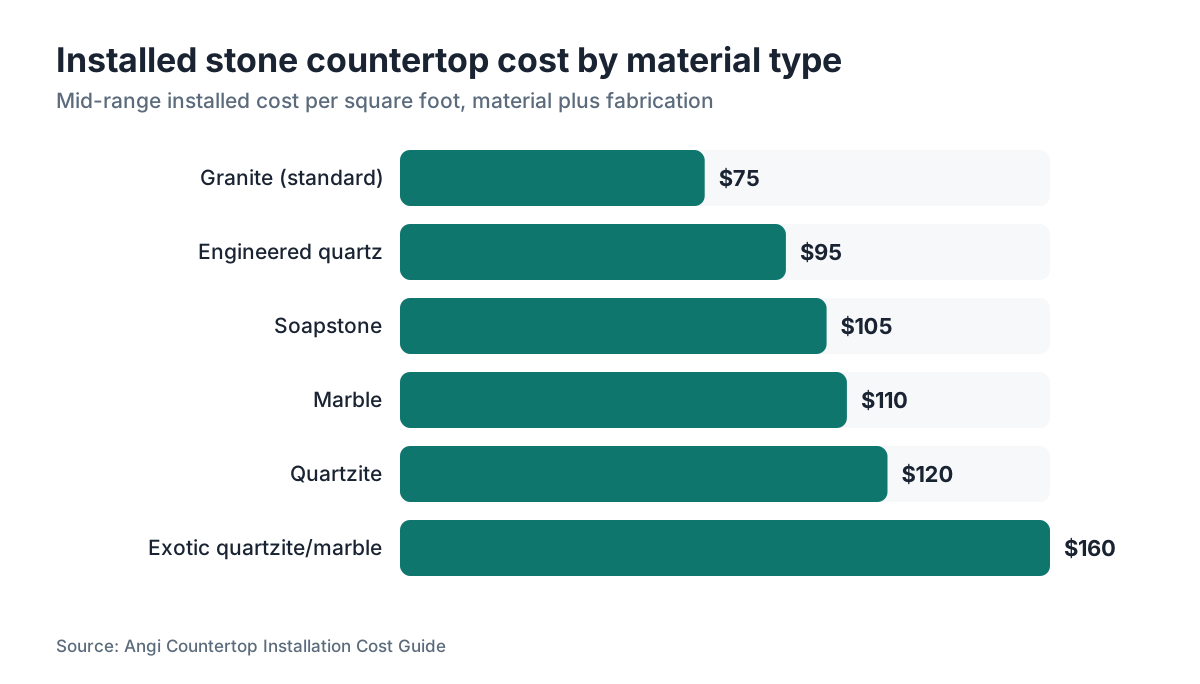
For material plus fabrication combined, installed, the rough ranges are:
| Stone Type | Low ($/sq ft installed) | Mid ($/sq ft installed) | High ($/sq ft installed) |
|---|---|---|---|
| Granite (standard) | $40 | $75 | $125 |
| Marble | $60 | $110 | $200+ |
| Quartzite | $65 | $120 | $200+ |
| Engineered quartz | $55 | $95 | $150 |
| Soapstone | $70 | $105 | $160 |
| Quartzite (exotic) | $100 | $160 | $250+ |
These ranges come from national retail cost guides and fabricator pricing [3]. Labor alone, separate from material, usually runs $25 to $50 per square foot, though in high-cost markets like San Francisco or New York it can push $60 to $80.
Extras add up fast. Waterjet cutouts, full-height backsplashes, mitered edges, and radius corners each carry a line-item charge. A single undermount sink cutout might add $100 to $200. A mitered waterfall edge can add $400 to $800 or more to a small island. Seams charge by the linear foot, often $20 to $40 per foot in visible spots.
Fabrication-only pricing (you source your own slab) usually runs $30 to $55 per square foot for standard work at a mid-tier shop. That's the number fabricators quote against their real cost, which includes machine time, labor, waste, and overhead.
For granite countertops specifically, the slab cost often runs 40 to 60% of the total job. A cheaper fabricator who wastes material on a $180 slab can cost you more than a better shop charging a higher labor rate.
What equipment do fabrication shops actually use?
A fully equipped shop has a lot of iron on the floor. The core machines are the bridge saw, the CNC edge polisher, and increasingly, the CNC waterjet. Here's what each one does.
A CNC bridge saw is the workhorse. It makes straight cuts, diagonal cuts, and miters on slabs up to 130 inches or more. The saw head rides a gantry over the slab. Good bridge saws hold tolerances to about plus or minus 0.5mm on a long cut [4]. Brands like Park Industries, Breton, and GMM dominate the market. A new mid-range CNC bridge saw runs $80,000 to $200,000.
A CNC waterjet cuts with a high-pressure stream of water mixed with garnet abrasive. Pressures run 60,000 PSI and up. The advantage that matters: the cutting tool exerts almost no mechanical force on the material, so you can cut curves, tight radii, and complex shapes without cracking the slab [2]. Waterjet is also the safe bet for delicate materials like ultra-thin quartzite or heavily veined marble, where a saw blade might follow a vein and split the piece. The downside is speed. Waterjet cuts are slower and the abrasive is a consumable cost.
A CNC edge polisher (also called a CNC router or edge machine) takes the cut slab and machines the profile automatically. It runs the piece past shaped diamond tooling heads in sequence. A 25-foot run of bullnose gets done in minutes that would take an hour by hand.
Many shops also own a Proliner or similar digital templating device. It isn't a cutting machine. It's a measurement device. But it defines everything downstream. A Proliner from Prodim runs $15,000 to $25,000 new [1].
Layout efficiency matters as much as the machines. SlabWise is built for exactly this: digital layout over slab photos, accurate square-footage quotes, and job costing in one workflow. If you run a shop, it's worth seeing how that changes your waste percentage before you commit to hand-nesting every job.
Small shops and one-person operations sometimes skip the CNC bridge saw entirely and run a hand-guided wet saw with a guide fence, then finish edges with angle grinders and hand polishers. The quality ceiling is lower. The capital cost is a fraction.
How long does fabrication take from template to installation?
A typical residential kitchen takes 1 to 3 weeks from templating to installation. Here's where the time goes.
Templating happens after the cabinets are set and leveled. Scheduling that site visit can add 3 to 7 days of calendar time. The template itself takes an hour or two on site.
Once the template is in, digital layout and CNC programming take a few hours for a simple job, half a day or more for a complex one with multiple pieces, matched veining, and custom features.
Cutting and edge work on a standard kitchen, say 45 to 55 square feet, take 4 to 8 hours of machine time. A busy shop runs multiple jobs a day, so your job goes into the queue. Most shops are booking 7 to 14 days out during busy seasons (spring and early summer are the peak).
Installation is usually a half-day job for two people on a standard kitchen.
If you picked a natural stone that needs sealing, the fabricator typically seals at the shop after polishing, then the installer may add a final coat on site. Some stones, like quartzite, do better with an impregnating sealer applied 24 to 48 hours before installation.
Rush jobs exist. Some shops template and install in 5 to 7 days for a premium. If a job slips because cabinets ran late or the distributor backordered your slab, that 2-week lead time stretches to 6 weeks fast.
Commercial and multi-family projects take longer. A 20-unit condo building with identical kitchens might take 6 to 10 weeks for a mid-size shop, because slab procurement at that volume often means waiting on container shipments from Brazil or Italy [5].
What stone materials can be fabricated, and do they need different approaches?
Every natural and engineered stone used for countertops goes through the same basic sequence, but the material properties change how you handle each step.
Granite is the most forgiving to fabricate. It's hard, fairly consistent, and holds an edge well. The high silica content means dust control matters (OSHA has specific standards for respirable crystalline silica, which we cover below), but the material itself doesn't surprise fabricators much [6].
Marble is softer and chips more easily at cut edges. It also wants to follow its own veining under a saw blade. Experienced fabricators cut marble slower and watch for stress fractures, especially in exotic marbles with heavy veining. Marble takes a high polish beautifully and scratches in service. Read more about the tradeoffs at marble countertops.
Quartzite is harder than granite and eats tooling faster. Cutting speeds come down and blade life shortens. Waterjet earns its keep on quartzite because it sidesteps the blade-wear problem on tight cuts. After installation, follow the care guidance at how to clean quartzite countertops to protect the finish.
Engineered quartz (brands like Cambria, Silestone, Caesarstone) is consistent in thickness and composition, which makes it predictable to cut and polish. The binders can gum up tooling differently than natural stone, and the material doesn't tolerate heat well, which matters for cooktop cutouts. See Cambria countertops for brand-specific notes.
Soapstone is soft and cuts quickly, but it chips at thin edges and needs careful handling. How to clean soapstone countertops covers the post-install care most fabricators recommend.
Porcelain and sintered stone (like Dekton or Neolith) are the trickiest. They're extremely hard and brittle, so blade selection matters enormously, cut speeds have to be right, and the pieces can shatter if they aren't supported properly during handling. Waterjet shines here.
Thickness matters too. Standard slabs come in 2cm (about 3/4 inch) or 3cm (about 1-1/4 inch). 3cm has taken over as the residential standard in North America because it's strong enough to overhang cabinets without extra support and skips the plywood substrate. 2cm material still shows up on vertical surfaces and some backsplashes.
What health and safety rules apply to stone fabrication shops?
This is not optional reading. OSHA's silica standard for construction and general industry is one of the biggest regulatory changes to hit stone fabrication in the past decade, and non-compliance carries real penalties.
Respirable crystalline silica (RCS) is the hazard. Quartz-containing stone, granite especially, throws off fine silica particles when it's cut, ground, or polished dry. Silicosis is the lung disease that follows chronic exposure. OSHA's final rule on occupational exposure to respirable crystalline silica, published in March 2016, set the permissible exposure limit at 50 micrograms per cubic meter of air as an 8-hour time-weighted average. The rule states the PEL directly: employers must ensure no employee is exposed above "50 micrograms per cubic meter of air (50 µg/m3) as an 8-hour time-weighted average" [6]. That's half the prior standard.
For fabricators, the rule means wet cutting or wet grinding on most operations, integrated water suppression on saws and edge polishers as standard equipment, and engineering controls plus respiratory protection anytime you run a dry grinder or dry hand tool on stone. The standard also requires medical surveillance for workers exposed above the action level (25 µg/m³) for 30 or more days a year.
Engineered quartz, some imported brands in particular, carries unusually high crystalline silica content, sometimes over 90%. Australia banned the manufacture, supply, and installation of engineered stone in 2024 over silicosis cases [7]. The U.S. hasn't gone that far, but OSHA has issued enforcement guidance calling out engineered stone as a high-risk material.
California runs its own Cal/OSHA standard, at least as strict as federal OSHA, and it's been enforced hard in stone shops around Los Angeles [8].
A compliant shop has a written exposure control plan, air monitoring records, wet-cutting equipment on every machine, N95 or better respirators on hand, and documented training. Shops that skip this aren't only a regulatory risk. They're a liability risk and a threat to their own workers' lungs.
How do fabricators price jobs and avoid losing money?
Pricing stone fabrication is harder than it looks. The material cost moves, the waste percentage swings with layout, and labor time is genuinely hard to predict on complex jobs.
Most shops price per square foot for the standard scope, then add line items for anything outside it: cutouts, seams, waterfall edges, corbels, edge upgrades, radius corners, delivery to hard sites. The base square footage covers material, basic edge profiling, one or two standard cutouts, and installation.
Waste is a real cost most homeowners don't see. A typical residential kitchen job wastes 15 to 25% of the slab to cutouts, offcuts, and layout constraints. Slabs come in fixed sizes, often 55 to 60 square feet for a standard slab and 110 to 130 square feet for a jumbo. If your job needs 48 square feet of countertop, you still buy the 60-square-foot slab.
For fabricators, the math has to account for:
- Slab cost (including the waste portion)
- CNC machine time (often priced per hour of run time, roughly $80 to $150/hr)
- Labor (templating, programming, handling, installation)
- Shop overhead (building, equipment depreciation, insurance, silica compliance)
- Sealer, adhesive, sink clips, and hardware
A well-run shop targets a gross margin of 45 to 55% on fabrication work. That sounds high until you count the overhead of maintaining CNC equipment, paying skilled templaters and installers, carrying liability insurance, and meeting OSHA requirements.
Digital quoting tools that automate slab layout help here. When a templater sees the slab scan and the cut plan on the same screen, waste drops and quote accuracy climbs. Shops quoting by hand from paper templates often undercharge complex jobs by 10 to 20% because they underestimate the time involved.
For a closer look at the install end, countertop installation covers what happens once the fabricated pieces reach the job site.
What should homeowners look for when choosing a fabricator?
A few things separate competent shops from the ones that generate angry reviews.
First, ask to see the templating setup. A shop that still uses luan templates exclusively is behind the curve on accuracy. That's not a dealbreaker if they have deep experience and good installers, but laser templating cuts human error at a step where errors are expensive.
Second, ask to see the shop floor. A shop with a CNC bridge saw, an edge polisher, and wet-cutting on every operation is running a real fabrication business. A shop where someone is dry-cutting with a hand grinder in a dusty back room is a safety problem and probably a quality problem.
Third, ask about the seam plan before any cutting starts. Seams belong in low-visibility spots when possible, across a sink front rather than down the middle of a run, and they should be disclosed in the quote. Some fabricators slip in extra seams to cut material waste and never tell the customer.
Fourth, check that the quote names the material thickness. 3cm is the current standard for countertops. A quote based on 2cm looks cheaper but may need a plywood substrate and will feel thinner at the edge.
Fifth, ask how they handle a problem. Any fabricator in business more than a few years has cracked a slab or cut a piece wrong. The ones you want to hire tell you what happened and how they fixed it. The ones you don't will deflect.
For comparison, laminate countertops and Formica countertops go through a completely different process with no CNC stone work, which is why the labor cost drops so much. They're genuinely good choices for some kitchens, and knowing the fabrication cost difference helps you make that call with clear eyes.
SlabWise's instant quote tool gives homeowners a real-time price range for their kitchen, so you have a number to compare when a fabricator's quote lands.
What's the difference between a waterjet and a CNC bridge saw for stone?
Both machines cut stone. The choice is about the type of cut, not about one being generally better.
A CNC bridge saw uses a diamond blade spinning at high speed. It makes precise straight cuts and angled cuts (miters) efficiently. Long straight runs, like the main pieces of a kitchen counter, are fast and accurate on a bridge saw. The limit is geometry: the blade is round and can't cut an inside radius. It also puts some mechanical force into the stone, which can crack along natural fissures if you're careless.
A CNC waterjet uses a high-pressure water and garnet stream, often 87,000 PSI or more, to erode the material. The stream puts essentially no mechanical force on the slab, so it cuts curves, circles, custom shapes, and complex sink openings without stressing the stone [2]. It's also the right call for sintered stone and ultra-thin engineered stone where blade vibration would chip the edge.
The tradeoffs:
| Feature | CNC Bridge Saw | CNC Waterjet |
|---|---|---|
| Straight cuts | Fast, excellent | Slower |
| Curved cuts | Not possible | Excellent |
| Internal cutouts (round) | Needs additional tool | Yes, directly |
| Delicate/thin material | Risky | Better |
| Operating cost | Lower (blade wear) | Higher (garnet abrasive) |
| Capital cost | $80k, $200k | $100k, $300k |
| Silica dust generation | Wet cutting required | Very low |
Many shops own both. The bridge saw handles volume cutting and the waterjet handles detail. If a shop has only a bridge saw, that's fine for 90% of residential jobs. If you have a complex curved island or an elaborate decorative inlay, find a shop with waterjet capability.
Garnet abrasive, the cutting medium in waterjet, is a consumable. Crystalline silica content varies by garnet source, so shops should confirm their supplier's silica content, since some imported abrasives run higher than domestic garnet [9].
How do fabrication shops handle slab layout to minimize waste?
Slab layout, called nesting in manufacturing, is the process of arranging all the cut pieces across the slab to minimize offcuts. It sounds like a puzzle. It is one.
A standard kitchen might have 6 to 10 individual pieces: left counter, right counter, island top, window sill, backsplash pieces. Each piece has a specific dimension and, on veined stone, a specific grain direction. The fabricator has to fit them all on the available slab (or slabs) with minimal waste, keep veins matched across seams, and keep the stone's flaws outside the finished pieces.
Manual nesting, done on paper or in a basic CAD program, works but it's slow, and the optimizer is human attention, which is inconsistent. A shop running 20 jobs a week can't have a senior employee spending an hour per job on layout.
Digital nesting software overlays template shapes on a calibrated photo of the actual slab. It suggests arrangements, flags when a piece crosses a flaw or hits a rough edge, and calculates exact square footage used versus total slab area. That turns the waste number from a guess into a measurement.
For a fabricator buying slabs at $8 to $15 per square foot (typical for mid-grade granite) [3], saving even 5 square feet of material per job across 100 jobs a year is $4,000 to $7,500 in material savings. On exotic stone at $30 to $50 per square foot, the math gets much louder.
For homeowners, the practical takeaway: if your job has any complex veining requirement (like a waterfall island where the grain has to wrap the corner), ask the fabricator to show you the digital layout before cutting. A good shop does this as standard. It's your proof that the veins will land where you expect them.
What happens after fabrication is done? Installation and aftercare.
Fabrication ends when the pieces are finished in the shop and loaded into the truck. Installation is technically a separate step, though most fabrication shops do their own install or subcontract to a trusted crew.
On installation day, the crew brings the pieces in carefully, usually on A-frame racks or padded carts. Natural stone is heavy: 3cm granite weighs roughly 18 to 20 pounds per square foot [10]. A standard 50-square-foot kitchen carries 900 to 1,000 pounds of stone. Moving that through a door frame without chipping corners takes experience.
The pieces go down on a bead of construction adhesive (most shops use neutral-cure silicone or a dedicated stone adhesive) run across the cabinet tops. Seams get color-matched epoxy, mixed on site. A seam tool (a specialized clamp) pulls the pieces tight while the epoxy sets. The finished seam should be nearly invisible on a dark or busy stone and visible but clean on a light uniform stone.
Undermount sink installation happens at the same time. The sink rim gets silicone, the sink goes up from below, and stainless clips tighten against the underside of the stone. The installer checks that the sink flange sits flush with or slightly below the countertop surface.
After installation, the standard move for most natural stone is a penetrating sealer. Granite, quartzite, and marble all benefit, though how often you reapply depends on the stone's porosity and the sealer used [11]. A quick water-bead test tells you when: if water soaks in instead of beading, the sealer has worn. For ongoing care, how to clean stone countertops covers what's safe and what isn't on natural stone.
Frequently asked questions
How long does stone countertop fabrication take from start to finish?
For a typical residential kitchen, plan on 1 to 3 weeks from the templating visit to installation day. The template visit usually happens 3 to 7 days after cabinets are set. CNC cutting and edge work take 4 to 8 hours of machine time, but most shops are 7 to 14 days out in their queue. Rush service is available at most shops for a premium, sometimes compressing the schedule to 5 to 7 days.
What is the average cost of stone countertop fabrication per square foot?
Fabrication labor alone, not counting material, usually runs $25 to $55 per square foot at a mid-tier shop in most U.S. markets. Material plus fabrication combined, installed, ranges from about $40 per square foot for standard granite to $200 or more per square foot for exotic quartzite or marble. High-cost metros like New York and San Francisco push those numbers 20 to 40% higher.
What is the difference between a CNC bridge saw and a waterjet for cutting stone?
A CNC bridge saw uses a diamond blade and is fast and accurate for straight and mitered cuts. A CNC waterjet uses a pressurized water and garnet stream at up to 87,000 PSI, which lets it cut curves, circles, and complex shapes with minimal mechanical stress on the stone. Most well-equipped shops use both: the bridge saw for main cuts and the waterjet for detail work.
Do I need to seal my stone countertop after fabrication?
Most natural stone countertops benefit from a penetrating impregnating sealer applied after installation. Granite, quartzite, and marble are all porous to varying degrees. The fabricator may seal at the shop before delivery. A simple water test tells you whether the sealer still works: pour a tablespoon of water on the stone and wait 10 minutes. If it soaks in, it's time to reapply.
What is digital templating and why does it matter?
Digital templating uses a laser measuring device (like a Prodim Proliner) to capture the exact geometry of a kitchen's cabinet layout in 3D. The resulting file goes straight to the shop's CNC software, cutting out manual transcription errors. It's faster than luan (physical) templates and produces tighter-fitting pieces. It also lets the shop do digital slab layout before any stone is cut.
What is respirable crystalline silica, and why does it matter for stone fabrication shops?
Respirable crystalline silica (RCS) is a fine particle released when quartz-containing stone is cut, ground, or polished dry. Chronic exposure causes silicosis, an incurable lung disease. OSHA's 2016 standard set the permissible exposure limit at 50 micrograms per cubic meter of air (8-hour average). Stone shops must use wet-cutting methods and keep written exposure control plans. Engineered quartz is especially high-risk, with some products over 90% crystalline silica.
How much stone slab do I need for a kitchen, accounting for waste?
Calculate your countertop square footage from the cabinet layout, then add 15 to 25% for waste from cutouts, layout constraints, and slab shape. Standard slabs run 55 to 65 square feet; jumbo slabs run 110 to 130 square feet. If your countertop needs a matched vein across a seam or a specific grain direction, waste can run higher. Your fabricator's digital layout can show you the exact material needed before you commit.
What edge profiles are available in stone countertop fabrication?
Common edge profiles include eased (a slight top bevel), beveled, half-bullnose, full bullnose, ogee, dupont, waterfall, and laminated (two pieces stacked for a thick-looking edge). CNC edge polishers produce most profiles automatically. Unusual custom profiles are possible but add labor cost. The edge profile affects both looks and durability: sharp square edges chip more easily than eased or bullnose edges.
Can a fabrication shop match the vein pattern across seams in marble or quartzite?
Yes, this is called book-matching or vein-matching, depending on the method. Book-matching opens two adjacent slab faces like a book so the veins mirror each other. Vein-matching aligns the veining so it flows continuously across a seam. Both need a shop that does digital layout over actual slab photos and a fabricator experienced with veined stone. Not every shop offers this, and it adds cost and complexity.
Is 2cm or 3cm stone better for countertops?
3cm (about 1-1/4 inch) is the current residential standard in North America. It's strong enough to cantilever over cabinets without a plywood substrate, looks substantial at the edge, and simplifies installation. 2cm stone costs less per square foot but usually needs a plywood base, which adds labor and can complicate undermount sink installation. For most homeowners remodeling a kitchen today, 3cm is the right choice.
What questions should I ask before hiring a stone fabrication shop?
Ask: Do you use digital or laser templating? What CNC equipment do you run? How do you handle wet cutting and silica dust control? Where will the seams be and why? Is the quote based on 2cm or 3cm material? What's included in the base price versus line-item extras? How do you handle a mistake like a cracked slab or a wrong cut? A shop that answers clearly and confidently is worth hiring.
How do stone fabrication costs compare to laminate or solid surface countertops?
Laminate countertops installed usually run $15 to $40 per square foot. Solid surface materials like Corian run $45 to $100 per square foot. Natural stone starts around $40 per square foot for basic granite and climbs from there. The fabrication labor for stone is higher because it needs expensive CNC equipment, skilled installers, and dust control compliance. For budget-sensitive projects, laminate is a legitimately good option with far lower fabrication costs.
What is slab nesting or digital layout, and how does it reduce waste?
Nesting is the process of arranging all cut pieces across the available slab area to minimize wasted material. Digital nesting software overlays template shapes on a calibrated photo of the actual slab, lets the programmer optimize the arrangement, and calculates exact material usage. Compared to manual layout, digital nesting typically cuts material waste by 5 to 15%. On expensive exotic stone, that saving can be several hundred dollars per job.
Do fabricators handle all stone types, or do some shops specialize?
Most full-service shops handle granite, marble, quartzite, and engineered quartz. Porcelain and sintered stone (Dekton, Neolith) need specific blade selection and slower cut speeds, so not every shop takes those jobs. Some smaller shops work natural stone only and refer engineered quartz jobs out. Ask specifically whether a shop has experience with your material before signing a contract, especially for porcelain or ultra-thin formats.
Sources
- Flow International Corporation, waterjet cutting technology overview: Abrasive waterjet cutting operates at up to 87,000 PSI and exerts minimal mechanical force on the workpiece, enabling curves and complex shapes in brittle materials like stone.
- Angi (formerly HomeAdvisor), Countertop Installation Cost Guide: Installed stone countertop costs range from about $40 per square foot for standard granite to $200+ per square foot for exotic natural stone; mid-grade granite slabs run roughly $8 to $15 per square foot.
- Park Industries, CNC bridge saw product specifications: CNC bridge saws hold cutting tolerances of approximately plus or minus 0.5mm on long straight cuts.
- U.S. Geological Survey, National Minerals Information Center, Dimension Stone: A large share of dimension stone slab used in U.S. fabrication is imported, primarily from Brazil and Italy, creating lead times tied to container shipping.
- U.S. Occupational Safety and Health Administration, Occupational Exposure to Respirable Crystalline Silica Final Rule (29 CFR 1910.1053 and 1926.1153): OSHA's 2016 final rule set the permissible exposure limit for respirable crystalline silica at 50 micrograms per cubic meter of air as an 8-hour time-weighted average, half the prior standard.
- California Department of Industrial Relations, Division of Occupational Safety and Health (Cal/OSHA): Cal/OSHA enforces silica exposure standards at least as strict as federal OSHA, with enforcement actions documented in California stone fabrication shops.
- U.S. Geological Survey, National Minerals Information Center, Garnet (Industrial): Garnet is the primary abrasive used in waterjet cutting; crystalline silica content varies by source and should be confirmed by fabricators for dust exposure compliance.
- Natural Stone Institute (formerly Marble Institute of America), Dimensional Stone Design Manual: 3cm natural granite countertop weighs approximately 18 to 20 pounds per square foot, requiring careful handling and two-person installation crews.
- Natural Stone Institute, Care and Cleaning of Natural Stone: Penetrating impregnating sealers are recommended for most natural stone countertops; the water-bead test is a standard field method for assessing when reapplication is needed.
Last updated 2026-07-09